Computing finite semigroups
J. East, A. Egri-Nagy, J. D. Mitchell, and Y. P´
eresse
October 8, 2015
Abstract
Using a variant of Schreier’s Theorem, and the theory of Green’s relations, we show how to reduce the computation of an arbitrary subsemigroup of a finite regular semigroup to that of certain associated subgroups. Examples of semigroups to which these results apply include many important classes: transformation semigroups, partial permutation semigroups and inverse semigroups, partition monoids, matrix semigroups, and subsemigroups of finite regular Rees matrix and 0-matrix semigroups over groups. For any subsemigroup of such a semigroup, it is possible to, among other things, efficiently compute its size and Green’s relations, test membership, factorize elements over the generators, find the semigroup generated by the given subsemigroup and any collection of additional elements, calculate the partial order of theD-classes, test regularity, and determine the idempotents. This is achieved by representing the given subsemigroup without exhaustively enumerating its elements. It is also possible to compute the Green’s classes of an element of such a subsemigroup without determining the global structure of the semigroup.
Contents
1 Introduction 2
2 Mathematical prerequisites 4
3 From transformation semigroups to arbitrary regular semigroups 6
3.1 Equivalent actions on Green’s classes . . . 6
3.2 Faithful representations of stabilisers . . . 8
3.3 A decomposition for Green’s classes . . . 8
3.4 Membership testing . . . 11
3.5 Classes within classes . . . 13
4 Specific classes of semigroups 14 4.1 Transformation semigroups . . . 15
4.2 Partial permutation semigroups and inverse semigroups . . . 16
4.3 Matrix semigroups . . . 16
4.4 Subsemigroups of a Rees 0-matrix semigroup . . . 17
4.5 Partition monoids . . . 19
5 Algorithms 21 5.1 Assumptions . . . 22
5.2 Computational prerequisites . . . 23
5.3 Components of the action . . . 24
5.4 Individual Green’s classes . . . 26
5.5 The global structure of a semigroup . . . 29
5.6 Optimizations for regular and inverse semigroups . . . 34
6 Examples 36
Acknowledgements 42
List of Algorithms
1 Compute a component of an action . . . 25
2 Trace a Schreier tree . . . 25
3 Compute Schreier generators for a stabiliser . . . 25
4 Compute Schreier generators forSx. . . 26
5 Elements of an R-class . . . 27
6 R-classes in aD-class . . . 28
7 Test membership in anR-class . . . 28
8 Test membership in aD-class . . . 28
9 Regularity of anR-class . . . 29
10 Idempotents in an R-class . . . 30
11 Enumerate theR-classes of a semigroup . . . 31
12 Test membership in a semigroup . . . 32
13 Factorise an element over the generators . . . 33
14 The partial order of theD-classes of a semigroup . . . 34
15 The closure of a semigroup and some elements . . . 35
List of Figures
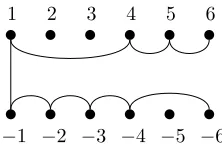
1 Graphical representations of the partitionsx, y∈P6. . . 202 A graphical representation of the productxy∈P6. . . 20
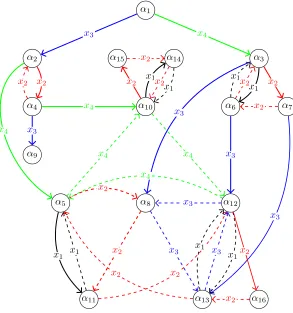
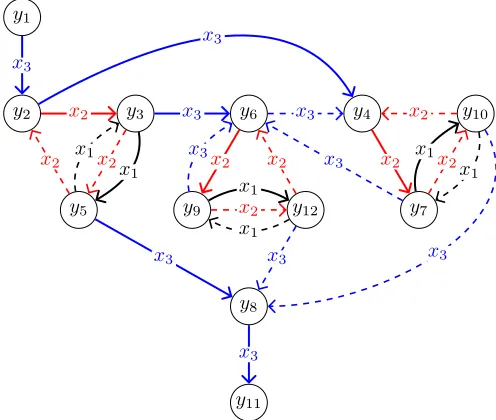
3 The orbit graph of (S)λwith loops and (all but one of the) edges to α9 omitted, and the Schreier tree indicated by solid edges. . . 37
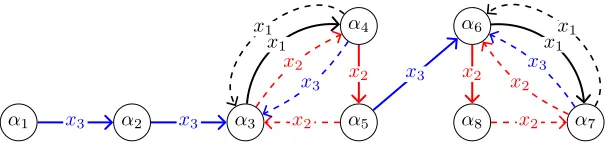
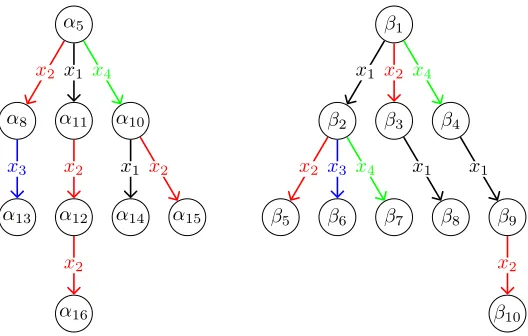
4 The orbit graph of (T)λwith loops omitted, and the Schreier tree indicated by solid edges. 38 5 Schreier trees for the strongly connected component of (x1x3x4)λin (S)λ, and for (x1x3x4)ρ in (S)ρ. . . 39
6 The orbit graph of (T)ρandRwith loops omitted, and the Schreier tree indicated by solid edges. . . 40
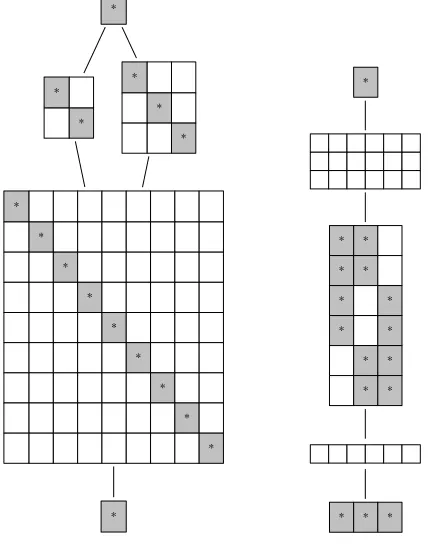
7 The partial order of the D-classes ofS (left) andT (right), group H-classes indicated by shaded boxes. . . 43
1
Introduction
A semigroup is a set with an associative binary operation. There are many articles in the literature concerned with the idea of investigating semigroups using a computer; early examples are [5,6,12,18,33]. There are also several examples of software packages specifically for computing with semigroups, such as AUTOMATE [7], Monoid [22], SgpWin [27], Semigroupe [34], and more general computational algebra systems, such asMagma[4],GAP[15], andSage[42], with some functionality relating to semigroups; see also [8].
Semigroups are commonly represented either by presentations (abstract generators and defining rela-tions) or by a generating set consisting of a specific type of element, such as transformations, matrices, or binary relations. In this paper, we are solely concerned with semigroups defined by generators.
Computing with semigroups defined by generators or with finitely presented semigroups ishard; it is shown in [3] that testing membership in a finite commutative transformation semigroup is NP-complete, and it is well-known that determining any ‘sensible’ property of a finitely presented semigroup is undecid-able by the famous results of Post [35] and Markov [26]. However, in spite of the fact that the general case is hard, it is still possible to compute with semigroups efficiently in many particular instances. Perhaps more importantly, it is possible to perform calculations using a computer that it would be impossible (several times over) to do by hand.
atransformation semigroup. For example, if each of the 99= 387420489 transformations on a 9-element
set is stored as a tuple of 9 integers from 1 to 9 andα is the number of bits required to store such an integer, then
99+1·α= 3486784401·αbits
are required to store these transformations. InGAP, for example, such an integer requires 16-bits, and so approximately 6 gigabytes of memory would be required in this case. Therefore if we want to exhaustively enumerate a semigroup, then we must be happy to do so with relatively small semigroups. Exhaustive algorithms have the advantage that they are relatively straightforward to apply; if the multiplication of a class of semigroups can be defined to a computer, then these algorithms can be applied. For example, inSemigroupe[34] it is possible to compute with semigroups of transformations, partial transformations, and several types of matrix semigroups including boolean matrices.
Non-exhaustive algorithms are described in [19,20,23,24], and the latter were implemented in the Monoidpackage [22] forGAP3 and its later incarnations inGAP4. In examples where it is not possible to store the elements, these methods can be used to determine structural information about a semigroup, such as its size and Green’s relations (see Section 2 for the relevant definitions). In many examples, the non-exhaustive algorithms have better performance than their exhaustive analogues. However, on the down side, the non-exhaustive algorithms described in [20,23,24] only apply to transformation semigroups. The methods in [19] are analogues of the methods in [20] in the context of semigroups of binary relations; but an implementation does not appear to be readily available.
To one degree or another, the articles [3,19,20,23,24] use variants of Schreier’s Theorem [45, The-orem 2.57] and the theory of Green’s relations to reduce the computation of the semigroup to that of its Sch¨utzenberger groups. It is then possible to use the well-developed and efficient algorithms from Computational Group Theory [39,41,45], stemming from the Schreier-Sims Algorithm, to compute with these subgroups. In this paper, we go one step further by giving a computational paradigm for arbitrary subsemigroups of finite regular semigroups. Semigroups to which the paradigm can be efficiently applied include many of the most important classes: transformation semigroups, partial permutation semigroups and inverse semigroups, partition monoids, matrix semigroups, and subsemigroups of finite regular Rees matrix and 0-matrix semigroups. We generalise and improve the central notions in [20,23,24] from trans-formation semigroups to arbitrary subsemigroups of an arbitrary finite regular semigroup. For such a subsemigroup, it is possible to efficiently compute its size and Green’s classes, test membership, factorize elements over the generators, find the semigroup generated by the given subsemigroup and any collection of additional elements, calculate the partial order of the D-classes, test regularity, and determine the idempotents. This is achieved by representing the given subsemigroup without exhaustively enumerating its elements. In particular, our methods can be used to determine properties of semigroups, where it is not possible to store every element of that semigroup. It is also possible to compute the Green’s classes of an element of such a subsemigroup without determining the global structure of the semigroup.
Although not described here, it is also possible to use the data structures provided to find the group of units (if it exists), minimal ideal, find a small generating set, and test if a semigroup satisfies various properties such as being simple, completely regular, Clifford and so on. The algorithms described in this paper are implemented in their full generality in theGAP[15] package Semigroups[28], which is open source software.
The analogue of Cayley’s Theorem for semigroups states that every finite semigroup is isomorphic to a transformation semigroup. Consequently, it could be argued that it is sufficient to have computational tools available for transformation semigroups only. An analogous argument could be made for arbitrary groups with respect to permutation groups, but developments in computational group theory suggest otherwise. For example, the Matrix Group Recognition Project has produced efficient algorithms for computing with groups of matrices over finite fields; [1] and [21]. Similarly, for some classes of semigroups, such as sub-semigroups of the partition monoid or a Rees matrix semigroup, the only known faithful transformation representations are those that act on the elements of the semigroup itself. Hence, it is necessary in such examples to exhaustively compute the elements of the semigroup before a transformation representation is available. At this point any transformation representation, and the non-exhaustive methods that could be applied to it, are redundant. Therefore, to compute with such semigroups without exhaustively enumer-ating them, it is necessary to have non-exhaustive algorithms that apply directly to the given semigroups and, in particular, do not require a transformation representation. It is such algorithms that we present in this paper.
representa-tion. Even in these cases, it is sometimes preferable to compute in the native matrix representation: in particular, where there are methods for matrix groups that are more efficient than computing a permuta-tion representapermuta-tion.
The algorithms in this paper only apply to subsemigroups of a regular semigroup. However, it would be possible to modify several of these algorithms, including the main one (Algorithm11), so that they apply to subsemigroupsS of a non-regular semigroupU. In particular, if it were possible to determine whether a given element was regular or not inU, then we could use the data structure forR-classes described in Section 5 for the regular elements, and perform an exhaustive enumeration of R-classes of non-regular elements inU. Or alternatively, it might be possible to use a combination of the approaches described in this paper and those in [19,20]. Such an approach would be possible with, say, semigroups of binary relations. It is possible to check that a binary relation is regular as an element of the semigroup of all binary relations in polynomial time; see [10,37]. However, we did not yet follow this approach either in the paper or in theSemigroupspackage since it is relatively easy to find a transformation representation of a semigroup of binary relations.
This paper is organised as follows. In Section2, we recall some well-known mathematical notions, and establish some notation that is required in subsequent sections. In Section3, we provide the mathematical basis that proves the validity of the algorithms presented in Sections 5. In Section 4, we show that transformation semigroups, partial permutation semigroups and inverse semigroups, partition monoids, semigroups of matrices over a finite field, and subsemigroups of finite regular Rees matrix or 0-matrix semigroups satisfy the conditions from Section3 and, hence, belong to the class of semigroups with which we can compute efficiently. Detailed algorithms are presented as pseudocode in Section5, including some remarks about how the main algorithms presented can be simplified in the case of regular and inverse semigroups. In Section6we give several detailed examples.
2
Mathematical prerequisites
A semigroupS isregular if for everyx∈S there exists x0 ∈S such thatxx0x=x. A semigroupS is a monoid if it has an identity element, i.e. an elemente∈S such thates=se=s for alls∈S. IfS is a semigroup, we writeS1 for the monoid obtained by adjoining an identity 1
S to S if necessary.
For any set Ω, the set ΩΩ of transformations of Ω is a semigroup under composition of functions,
known as the full transformation monoid on Ω. The identity element of ΩΩ is the identity function on
Ω, which will be denoted idΩ. We denote the full transformation monoid on the finite set{1, . . . , n} by
Tn. Throughout this article, we will write functions to the right of their arguments and compose functions
from left to right.
IfX is a subset of a semigroupS, then the least subsemigroup ofS containingX is denoted byhXi; this is also referred to as thesubsemigroup generated by X. We denote the cardinality of a setX by|X|. LetS be a semigroup and letx, y∈S be arbitrary. We say thatxandy areL-related if the principal left ideals generated byxandy inS are equal; in other words,S1x=S1y. We writexLy to denote that
xandy areL-related. In Section 3, we often want to distinguish between the cases when elements are
L-related in a semigroupU or in a subsemigroupSofU. We writexLSyorxLUy to differentiate these cases.
Green’s R-relation is defined dually to Green’s L-relation; Green’s H-relation is the meet, in the lattice of equivalence relations onS, of L and R; and D is the join. We will refer to the equivalence classes asK-classes where K is any of R,L, H, or D, and the K-class ofx∈S will be denoted by
Kx, orKxS if it is necessary to explicitly refer to the semigroup where the relation is defined. We denote
the set ofK-classes of a semigroupS byS/K.
In a finite semigroup,xDy if and only if the (2-sided) principal ideals generated byxandy are equal. Containment of principal ideals induces a partial order on theD-classes ofS, sometimes denoted≤D; that is,Dx≤D Dy if and only ifS1xS1⊆S1yS1.
Proposition 2.1 (cf. Proposition A.1.16 in [36]). Let U be a semigroup and let S be a subsemigroup of
U. Suppose that xandy are regular elements ofS. Then xKUy if and only if xKSy, where K is any
ofR,L orH.
Note that the previous result does not necessarily hold forK =D.
LetS be a semigroup and let Ω be a set. A function Ψ : Ω×S1−→Ω is a right action ofS on Ω if
• (α,1)Ψ =α.
For the sake of brevity, we will write α·s instead of (α, s)Ψ, and we will say thatS acts on Ω on the right. Left actions are defined analogously, and we write s·α in this case, and sayS acts on Ω on the left. The kernel of a function f : X −→ Y, where X and Y are any sets, is the equivalence relation {(x, y)∈ X×X : (x)f = (y)f}. A right action of a semigroup S on a set Ω induces a homomorphism fromS to the full transformation monoid on Ω defined by mappings∈S to the transformation defined by
α7→(α, s)Ψ for all α∈Ω.
An action is called faithful if the induced homomorphism is injective. The kernel of a right action of a semigroupS on a set Ω is just the kernel of the induced homomorphism, i.e. the equivalence relation {(s, t)∈S×S:α·s=α·t (∀α∈Ω)}. The kernel of a left action is defined analogously.
If S acts on the sets Ω and Ω0 on the right, then we say that λ : Ω −→ Ω0 is a homomorphism of right actions if (α·s)λ= (α)λ·sfor all α∈Ω and s∈S1. Homomorphisms of left actions are defined
analogously. An isomorphism of (left or right) actions is a bijective homomorphism of (left or right) actions.
If Ω is a set, then we denote the set of subsets of Ω byP(Ω). If S is a semigroup acting on the right on Ω, then the action ofS on Ω induces a natural action ofS onP(Ω), which we write as:
Σ·s={α·s:α∈Σ} for each Σ⊆Ω. (2.2)
We will denote the function from Σ to Σ·sdefined by α7→ α·s by s|Σ. We define the stabiliser of Σ
underS to be
StabS(Σ) ={s∈S1: Σ·s= Σ}.
The quotient of the stabiliser by the kernel of its action on Σ, i.e. the congruence
{(s, t) :s, t∈StabS(Σ), s|Σ=t|Σ},
is isomorphic to
SΣ={s|Σ:s∈StabS(Σ)}
which in the case that Σ is finite, is a subgroup of the symmetric group Sym(Σ) on Σ. The stabiliserSΣ
can also be seen as a subgroup of Sym(Ω) by extending the action of its elements so that they fix Ω\Σ pointwise. It is immediate thats|Σ·t|Σ= (st)|Σ for alls, t∈StabS(Σ).
IfS acts on Ω, thestrongly connected component (usually abbreviated to s.c.c.) of an elementα∈Ω is the set of all β ∈Ω such that β =α·sand α=β·t for somes, t∈ S1. We write α∼β ifαand β
belong to the same s.c.c. and the action is clear from the context. IfS is not a group andα∈Ω, then
α·S1={α·s:s∈S1},
is a disjoint union of strongly connected components of the action ofS. Note thatα·S1 might consist of more than one strongly connected component. IfS is a group, thenα·S1has only one strongly connected component, which is usually called theorbit ofαunder S.
Proposition 2.3. LetS=hXibe a semigroup that acts on a finite setΩon the right and letΣ1, . . . ,Σn⊆
Ωbe the elements of a strongly connected component of the action ofS onP(Ω). Then the following hold:
(a) if Σ1·ui = Σi for some ui ∈S1, then there exists ui ∈S1 such thatΣi·ui = Σ1, (uiui)|Σ1 = idΣ1,
and(uiui)|Σi= idΣi;
(b) SΣi andSΣj are conjugate subgroups of Sym(Ω)for all i, j∈ {1, . . . , n};
(c) if u1=u1= 1S and ui, ui∈S are as in part (a) fori >1, then SΣ1 is generated by
{(uixuj)|Σ1 : 1≤i, j≤n, x∈X, Σi·x= Σj}.
Proof. Let θ : S −→ ΩΩ be the homomorphism induced by the action of S on Ω. Then (S)θ is a
We will refer to the generators ofSΣ1 in Proposition2.3(c) asSchreier generators of SΣ1, due to the
similarity of this proposition and Schreier’s Theorem [45, Theorem 2.57]. If S is a semigroup acting on a set Ω, if Σ,Γ⊆Ω are such that Σ∼Γ and ifu∈S is any element such that Σ·u= Γ, then we writeuto denote an element ofS with the properties in Proposition2.3(a).
The analogous definitions can be made, and an analogous version of Proposition 2.3 holds for left actions. In the next section there are several propositions involving left and right actions in the same statement, and so we define the following notation for left actions. IfS is a semigroup acting on the left on a set Ω and Σ⊆Ω, then the induced left action ofSonP(Ω) is defined analogously to (2.2); the function
α7→s·αis denoted byΣ|s; and we define
ΣS={Σ|s:s·Σ = Σ}
and in the case that Ω is finite,ΣS≤Sym(Ω).
3
From transformation semigroups to arbitrary regular
semi-groups
In this section, we will generalise the results of [23] from transformation semigroups to subsemigroups of an arbitrary finite regular semigroup.
Generally speaking, the central notion is that for a fixed semigroup U with a determined structure, we can use the properties ofU to produce algorithms to compute any subsemigroupS ofU specified by a generating set. For example,U can be the full transformation monoid or the symmetric inverse monoid on a finite set. Roughly speaking, the subsemigroupS can be decomposed into itsR-classes, and anR-class can be decomposed into the stabiliserSL (under right multiplication onP(U)) of anL-classLin U and
the s.c.c. ofL under the action of S on the L-classes of U. DecomposingS in this way will permit us to efficiently compute many aspects of the structure ofS without enumerating its elements exhaustively. For instance, using this decomposition, we can test membership inS, compute the size, Green’s structure, idempotents, elements, and maximal subgroups ofS.
Throughout the remainder of this section we suppose thatU is an arbitrary finite semigroup, andSis a subsemigroup ofU.
3.1
Equivalent actions on Green’s classes
We require the following actions of S: the action onP(U) induced by multiplying elements ofU on the right bys∈S1, i.e.:
As={as:a∈A} (3.1)
wheres∈S1 andA⊆U; and the action ofS onU/L defined by
Lx·s=Lxs (3.2)
for allx∈U ands∈S1. The latter defines an action sinceL is a right congruence.
In general, the actions defined in (3.1) and (3.2) are not equal when restricted toU/L. For example, it can be the case thatLxs(Lxsand, in particular,Lxs6∈U/L. However, the actions do coincide in one
case, as described in the next lemma, which is particularly important here.
Lemma 3.3. Let x, y∈U be arbitrary. ThenLx, Ly∈U/L belong to the same s.c.c. of the action ofS
defined by (3.2)if and only ifLxandLy belong to the same s.c.c. of the action ofS defined by (3.1).
Proof. The converse implication is trivial. If Lx, Ly ∈ U/L belong to the same strongly connected
component under the action (3.2), then, there exists s ∈ S1 such that Lxs = Ly. Hence, by Green’s
Lemma [17, Lemma 2.2.1], the function from Lx to Lxs = Ly defined by z 7→ zs for all z ∈ Lx is a
bijection and soLx·s=Lxs={ys:y∈Lx}.
In general, it is impractical to compute directly with the actions defined in (3.1) and (3.2). However, we can replace these actions by equivalent actions in the following sense.
Definition 3.4. We say that a right action ofS on a set Ω isequivalent (viaλ)to the action of S onU
by right multiplication if there exists a homomorphismλ:U −→Ω of these actions where the kernel ofλ
isLU, i.e. ker(λ) ={(u, v)∈U×U : (u)λ= (v)λ}=LU.
The following lemma justifies the use of the word “equivalent” in the previous definition.
Lemma 3.5. Suppose thatS has a right action on a setΩthat is equivalent viaλ:U −→Ωto the action ofS onU by right multiplication. Then the following hold:
(a) if x, y∈U, then: (x)λ∼(y)λif and only if Lx∼Ly under the action ofS on U/L defined in (3.2);
(b) if Ω is the s.c.c. of an LU-class under the action of S on P(U) by right multiplication, then λ
induces an isomorphism from the natural action of StabS(Ω) on Ω to the action of StabS(Ω) on
{(x)λ:LU x ∈Ω}.
Proof. (a)This follows immediately from the definition of a homomorphism of actions, and the assumption that the kernel ofλisLU.
(b)LetX={(x)λ:LU
x ∈Ω}and letθ: Ω−→X be defined by (LUx)θ= (x)λ. Since the kernel ofλis
LU, it follows that θ is well-defined, and a bijection. IfLU
x ∈Ω ands∈StabS(Ω), then, by Lemma3.3,
it follows that
(LUxs)θ= (LUx ·s)θ= (LUxs)θ= (xs)λ,
and sinceλis a homomorphism of actions:
(xs)λ= (x)λ·s= (LUx)θ·s.
Thusθ is a isomorphism of the actions of StabS(Ω) on Ω andX, as required.
It follows from Lemma3.5that any statement about either of the actions ofSdefined in (3.1) or (3.2) within a strongly connected component ofLU-classes can be replaced with an equivalent statement about
the action ofS within a strongly connected component of the action ofS on Ω.
Throughout this section we suppose thatShas a right action on some set Ω equivalent, viaλ:U −→Ω, to the action ofS onU by right multiplication. As anaide-m´emoire, we will write (U)λor (S)λinstead of Ω. We also writeρto denote the analogue ofλfor left actions. More precisely, we suppose thatS has a left action on a set (U)ρ, the kernel of this action isRU, and there is a homomorphismρ:U −→(U)ρ
of the actions ofSonU by left multiplication and ofS on (U)ρ. In Section4, we will show how to obtain
λfrom Definition3.4, and its analogue ρ, for several well-known classes of semigroups, such that we can compute with the action ofS on (S)λand (S)ρefficiently.
Recall that we writeα∼β to denote thatαandβ belong to the same strongly connected component of an action. We will make repeated use of the following lemma later in this section.
Lemma 3.6. Let x∈S ands, t∈S1 be arbitrary. Then:
(a) (x)λ∼(xs)λif and only if xRSxs;
(b) (x)ρ∼(tx)ρif and only ifxLStx;
(c) (x)λ∼(xs)λand(x)ρ∼(tx)ρtogether imply thatxDStxs.
Proof. We only prove parts (a) and (c), since the proof of part (b) is dual to that of (a).
(a). (⇒) Suppose that (x)λ∼(xs)λ. Then LU
xs and LUx belong to the same s.c.c. of the action ofS
onU/L by right multiplication. Hence, by Proposition2.3(a), there exists∈S1 such thatLU
xs·s=LUx
and (ss)|LU
x = idLUx. Hence, in particular,xss=xand soxsR
Sx.
(⇐) SupposexRSxs. Then there existst∈S1 such thatxst=x. It follows that (x)λ·s= (xs)λand
(xs)λ·t= (x)λ. Hence (x)λ∼(xs)λ.
(c). Suppose that (x)λ∼(xs)λ and (x)ρ∼(tx)ρ. Then, by parts (a) and (b), xRSxs andxLStx.
3.2
Faithful representations of stabilisers
LetU be an arbitrary finite semigroup, and letS be any subsemigroup ofU.
In the same way that it is impractical to compute with the action of S on the L-classes ofU, it is equally impractical to compute directly with the natural action of the stabiliser of an L-class inS on thatL-class. For example, the L-classL of any transformation x∈T10 with 5 points in its image has
5,103,000 elements but, in this case,UL has a faithful permutation representation on only 5 points.
With the preceding comments in mind, throughout this section we will make statements about arbitrary faithful representations ofUL,L∈U/L, rather than about the natural action ofUL (orSL) onL. More
specifically, ifx∈U andζ is any faithful representation ofULU
x, then we define
µx: StabU(LUx)−→(ULU
x)ζ by (u)µx= (u|LUx)ζ for allu∈U. (3.7)
It is clear that µx is a homomorphism. Since S is a subsemigroup of U, it follows that StabS(LUx) is a
subsemigroup StabU(LUx) andSLU
x is a subgroup ofULUx. Henceµx: StabU(L
U
x)−→(ULU
x)ζ restricted to StabS(LUx) is a homomorphism from StabS(LUx) to (SLU
x)ζ.
It is possible that, sinceζ depends of theL-class ofxin U, we should useζLU
x to denote the faithful representation given above. However, to simplify our notation we will not do this. Note that, with this definition, (s, t)∈ker(µx) if and only if s|LU
x =t|LUx. To simplify our notation, we will write Sx and Ux to denote (StabS(LUx))µx = (SLU
x)ζ and (StabU(L
U
x))µx = (ULU
x)ζ, respectively. Analogously, for every
x∈U we suppose that we have a homomorphismνx from StabU(RUx) into a group where the image ofνx
is isomorphic toRU
xU. We writexS andxU for (StabS(R
U
x))νxand (StabU(RxU))νx, respectively.
In the case that S is a transformation, partial permutation, matrix, or partition semigroup, or a subsemigroup of a Rees 0-matrix semigroup, we will show in Section4how to obtain faithful representations of the stabilisers ofL- andR-classes as permutation or matrix groups. It is then possible to use algorithms from Computational Group Theory to compute with these groups.
We will make repeated use of the following straightforward lemma.
Lemma 3.8. Let x∈U and s, t∈StabU(LUx)be arbitrary. Then the following are equivalent:
(a) (s)µx= (t)µx;
(b) ys=yt for ally∈LU x;
(c) there existsy∈LU
x such thatys=yt.
Proof. (a) ⇒(b) If (s)µx= (t)µx, then (s|LU
x)ζ= (t|LUx)ζ and sos|LUx =t|LUx. It follows thatys=yt for ally∈LU
x.
(b)⇒(c) is trivial.
(c) ⇒(a) Suppose thaty∈LUx is such thatys=yt. Ifz∈LUx is arbitrary, then there exists u∈U1
such thatz=uy. Hencezs=uys=uyt=ztand sos|LU
x =t|LUx. It follows, by the definition ofµx, that (s, t)∈ker(µx) and so (s)µx= (t)µx.
The analogue of Lemma3.8also holds for StabU(RxU) andνx; the details are omitted.
3.3
A decomposition for Green’s classes
In this section, we show how to decompose anR- orL-class of our subsemigroupS as briefly discussed above. Recall that we supposed thatS has a right action on some set equivalent via λ:U −→(U)λto the action ofS onU by right multiplication (Definition3.4).
Proposition 3.9(cf. Theorems 3.3 and 4.3 in [23]). If x∈S is arbitrary, then:
(a) {(y)λ:yRSx} is a strongly connected component of the right action ofS on (S)λ;
(b) {(y)ρ:yLSx} is a strongly connected component of the left action ofS on (S)ρ.
Proof. We only prove the first statement, as the proof of the second is dual. Suppose y ∈S and x6=y. ThenyRSxif and only if there existss∈S such thatxs=y andxsRSx. By Lemma 3.6(a), xsRSxif
Corollary 3.10. Let x, y, s, t∈S. Then the following hold:
(a) if xRSy andxsLUy, thenxsRSy;
(b) if xLSy andtxRUy, then txLSy.
Proof. Again, we only prove part (a). Since xsLUy, it follows that (xs)λ= (y)λ and, since xRSy, by
Proposition3.9, (x)λ∼(y)λ=λ(xs). HencexsRSxby Lemma3.6, and, sincexRSy by assumption, the
proof is complete.
Proposition 3.11(cf. Theorems 3.7 and 4.6 in [23]). Suppose that x∈S and there exists x0 ∈U where
xx0x=x(i.e.xis regular inU). Then the following hold:
(a) LUx ∩RSx ={y∈RSx : (y)λ= (x)λ}is a group under the multiplication∗ defined bys∗t=sx0t for all s, t∈LU
x ∩RSx and its identity isx;
(b) φ:Sx−→LUx ∩RSx defined by((s)µx)φ=xs, for alls∈StabS(LUx), is an isomorphism;
(c) φ−1:LU
x ∩RSx −→Sx is defined by(s)φ−1= (x0s)µx for alls∈LUx ∩RSx.
Proof. We begin by showing that xis an identity under the multiplication∗ ofLU
x ∩RSx. Sincex0x∈LUx
andxx0 ∈RU
x are idempotents, it follows thatx0xis a right identity forLUx andxx0 is a left identity for RS
x ⊆RUx. So, ifs∈LUx ∩RSx is arbitrary, then
x∗s=xx0s=s=sx0x=s∗x,
as required.
We will prove that part (b) holds, which implies part (a).
φis well-defined. Ifs∈StabS(LUx), thenxsLUx. Hence, by Corollary3.10(a),xsRSxand so ((s)µx)φ= xs∈LU
x ∩RSx. Ift∈StabS(LUx) is such that (t)µx= (s)µx, then, by Lemma3.8,xt=xs. φis surjective. Lets∈LU
x ∩RSx be arbitrary. Thenxx0s=x∗s=ssincexis the identity ofLUx ∩RSx.
It follows that
LUx ·x0s=LUs =LUx
and so x0s ∈ StabU(LUx). Since xRSs, there exists u ∈ S1 such that xu = s = xx0s. It follows that u∈StabS(LUx) and, by Lemma3.8, (u)µx= (x0s)µx. Thus ((u)µx)φ=xu=sandφis surjective.
φis a homomorphism. Lets, t∈StabS(LUx). Then, sincexs∈LUx andx0xis a right identity forLUx,
((s)µx)φ∗((t)µx)φ=xs∗xt=xsx0xt=xst= ((st)µx)φ= ((s)µx·(t)µx)φ,
as required.
φ is injective. Let θ : LUx ∩RSx −→ Sx be defined by (y)θ = (x0y)µx for all y ∈ LUx ∩R S
x. We will
show that φθ is the identity mapping on Sx, which implies that φ is injective, that (y)θ ∈ Sx for all y ∈LUx ∩RSx (since φis surjective), and also proves part (c) of the proposition. If s∈StabS(LUx), then
((s)µx)φθ = (xs)θ = (x0xs)µx. But xx0xs = xs and so (x0xs)µx = (s)µx by Lemma 3.8. Therefore,
((s)µx)φθ= (s)µx, as required.
We state the analogue of Proposition3.11for the action of S onU/R by left multiplication.
Proposition 3.12. Suppose thatx∈S and there existsx0∈U wherexx0x=x. Then the following hold:
(a) LSx∩RUx ={y ∈LSx : (y)ρ= (x)ρ} is a group under the multiplication∗ defined bys∗t=sx0t for all s, t∈LSx∩RUx and its identity isx;
(b) φ:xS−→LSx∩RUx defined by((s)νx)φ=sx, for alls∈StabS(RUx), is an isomorphism;
(c) φ−1:LS
x∩RUx −→xS is defined by(s)φ−1= (sx0)νx for alls∈LSx∩RUx.
We can also characterise anH-class in a subsemigroup of a semigroup in terms of the stabilisers of its
L- and R-class. Note that in the special case thatS =U, it follows immediately from Proposition3.11
Proposition 3.13(cf. Theorem 5.1 in [23]). Suppose thatx∈S and there existsx0 ∈U wherexx0x=x. Then the following hold:
(a) Ψ :xS−→Ux defined by((s)νx)Ψ = (x0sx)µx,s∈StabS(RUx), is an embedding;
(b) HxS is a group under the multiplications∗t=sx0t, with identityx, and it is isomorphic toSx∩(xS)Ψ;
(c) HS
x under∗ is isomorphic to the Sch¨utzenberger group ofHxS.
Proof. (a). Let φ : xS −→ LxS ∩RUx be the isomorphism defined in Proposition 3.12(b), and let θ : LU
x ∩RUx −→Ux be the isomorphism defined in Proposition 3.11(c) (applied toU as a subsemigroup of
itself). Then, sinceLS
x∩RUx ⊆LUx∩RUx,φθ:xS −→Uxis a embedding (being the composition of injective
homomorphisms). By definition, ((s)νx)φθ= (x0sx)µx= ((s)νx)Ψ, for alls∈StabS(RUx).
(b). Note thatHS
x =LSx∩RSx = (LUx∩RSx)∩(RUx∩LSx). From Proposition3.11(c),φ
−1
1 :RSx∩LUx −→ Sx≤Ux defined by
(s)φ−11= (x0s)µx
is an isomorphism (whereRS
x ∩LUx has multiplication∗defined in Proposition 3.11(a) ass∗t=sx0t for
alls, t∈RS
x∩LUx). Similarly, by Proposition3.12(c), φ−
1 2 :R
U
x ∩LSx −→xS defined by
(s)φ−21= (sx0)νx
is an isomorphism. Hence ifs∈HS
x, then, by Proposition3.11(a),
(s)φ−21Ψ = (x0sx0x)µx= (x0s)µx= (s)φ−11
and soφ−11, restricted toHS
x, is an injective homomorphism fromHxS under∗into Sx∩(xS)Ψ.
Ifg∈Sx∩(xS)Ψ, then there existsa∈StabS(RUx) such that (x0ax)µx=g. SinceaxRUxandxx0is a
left identity inRxU, it follows thatxx0ax=ax and soax=xx0ax= ((x0ax)µx)φ1∈RSx∩L U
x ⊆R
S x where φ1 is given in Proposition3.11(b). Similarly, (a)νx∈ xS implies thatax = ((a)νx)φ2∈ RUx ∩LSx ⊆LSx.
Thereforeax∈HxS and (ax)φ−
1
1 = (x0ax)µx=g, and soφ−11is surjective and thus an isomorphism from
HS
x toSx∩(xS)Ψ, as required.
(c). TheSch¨utzenberger group ofH =HxS is defined to be the quotient of StabS(H) by the kernel of
its action onH (by right multiplication on the elements ofH). In our notation the Sch¨utzenberger group ofH is denotedSH, however in the literature it is usually denoted by ΓR(H). It is well-known that ΓR(H)
acts transitively and freely on H, see for example [36, Section A.3.1]. It follows that φ: ΓR(H)−→ H
defined by
(s|H)φ=xs
is a bijection. Ifs|H, t|H ∈ΓR(H), thenxs∈H and soxsx0x=xs∗x=xs, sincexis the identity ofH
by Proposition3.11(a). Thus
(s|H·t|H)φ=xst=xsx0xt= (s|H)φ∗(t|H)φ
andφis an isomorphism, as required.
The statement of Proposition 3.13can be simplified somewhat in the case that the element x∈S is regular inS and not only inU.
Corollary 3.14. Suppose that x∈ S and there exists x0 ∈S where xx0x=x. Then the following three groups are isomorphic: HS
x under the multiplications∗t=sx0t,Sx, andxS. Furthermore,Ψ :xS −→Sx
defined by((s)νx)Ψ = (x0sx)µx is an isomorphism.
Proof. Since xis regular inS, it follows thatHS
x =LSx∩RSx =LUx ∩RSx and, similarly,HxS =RUx ∩LSx.
So, the first part of the statement follows by Propositions3.11(b) and3.12(b).
By Propositions3.12(b) and3.11(c), respectively, there exist isomorphismsφ: xS −→LSx∩RUx and θ:LU
x ∩RSx −→Sx. Therefore sinceHxS =LUx ∩RSx =RxU∩LSx, it follows that Ψ =φθ:xS−→Sx is an
isomorphism.
We collect some corollaries of what we have proved so far.
(a) If xRSy, then S LU
x and SLUy are conjugate subgroups of Sym(U). In particular, Sx and Sy are iso-morphic;
(b) |RS
x| equals the size of the group Sx multiplied by the size of the s.c.c. of (x)λunder the action of S
on (S)λ;
(c) If (x)λ∼(y)λ, then|RS
x|=|RSy|;
(d) If xRSy andu∈S1 is such that (x)λ·u= (y)λ, then the function fromLUx ∩RxS toLUy ∩RSx defined
by s7→suis a bijection.
Proof. (a). Since xRSy, it follows by Proposition 3.9(a) that LUx and LUy are in the same s.c.c. of the
action ofS on theL-classes ofU. Thus, by Proposition2.3(b), it follows thatSLU
x andSLUy are conjugate subgroups of the symmetric group onU, and so, in particular, are isomorphic.
(b). The setRSx is partitioned by the setsRSx∩LUy =RSy∩LUy for ally∈RxS. By Proposition3.11(b), |RSy∩LUy|=|Sy|and by part (a),|Sy|=|Sx|for ally∈RSx. Thus|RSx|equals the number of distinct values
ofλwhen applied to elements ofRS
x multiplied by|Sx|. Proposition3.9(a) says that{(y)λ:y∈RSx}is a
s.c.c. of the right action ofS on (S)λ.
(c). This follows immediately from parts (a) and (b).
(d). Lets∈LU
x ∩RSx be arbitrary. Then sRSxRSyandsuLUxuLUy, and so, by Corollary3.10(a), suRSy, i.e. su∈LU
y∩RSx. By Proposition2.3(a), there existsu∈S1such thatsuu=sfor alls∈LUx∩RSx.
Therefores7→suandt7→tuare mutually inverse bijections fromLU
x ∩RSx to LUy ∩RSx and back.
For the sake of completeness, we state the analgoue of Corollary3.15forL-classes.
Corollary 3.16. If x, y∈S are regular elements of U, then the following hold:
(a) If xLSy, then RU
xS and RUyS are conjugate subgroups of Sym(U). In particular, xS and yS are isomorphic;
(b) |LS
x| equals the size of the group xS multiplied by the size of the s.c.c. of(x)ρunder the action ofS
on (S)ρ;
(c) If (x)ρ∼(y)ρ, then|LSx|=|LSy|;
(d) If xLSy andu∈S1 is such thatu·(x)ρ= (y)ρ, then the function fromRU
x ∩LSx toRUy ∩LSx defined
by s7→usis a bijection.
3.4
Membership testing
Let U be a semigroup and let S be a subsemigroup of U. The next proposition shows that testing membership in anR-class ofSis equivalent to testing membership in a stabiliser of anL-class ofU. Since the latter is a group, this reduces the problem of membership testing inR-classes to that of membership testing in a group, so we can then take advantage of efficient algorithms from computational group theory; such as the Schreier-Sims algorithm [45, Section 4.4].
Proposition 3.17. Suppose that x∈S and there is x0 ∈ U with xx0x=x. If y ∈U is arbitrary, then
yRSx if and only if yRUx, (y)λ ∼ (x)λ, and (x0yv)µ
x ∈ Sx where v ∈ S1 is any element such that
(y)λ·v= (x)λ.
Proof. (⇒) Since RS
x ⊆ RUx, yRUx and from Proposition 3.9(a), (y)λ∼ (x)λ. Suppose that v ∈ S1 is
such that (y)λ·v = (x)λ. Then, by Corollary 3.15(d), yv ∈ LU
x ∩RSx and so, by Proposition 3.11(c),
(x0yv)µx∈Sx.
(⇐) Sincey ∈RU
x and xx0 is a left identity in its RU-class, it follows that xx0y =y. Suppose that v ∈ S1 is any element such that (y)λ·v = (x)λ (such an element exists by assumption). Then, by
assumption, (x0yv)µx∈Sx and so by Proposition 3.11(b), yv =x·x0yv∈LUx ∩RxS. But (y)λ∼(yv)λ,
and so, by Lemma3.6(a), yRSyv, and soxRSyvRSy, as required.
Corollary 3.18. Let x∈S be such that there isx0∈U with xx0x=x, and let y∈U be such that there existu∈S1andv∈U1 with(x)λ·u= (y)λandxuv=x. ThenyRSxif and only ifyRUx,(y)λ∼(x)λ,
and(x0yv)µx∈Sx.
Proof. (⇒) ThatyRUxand (y)λ∼(x)λfollows from Proposition3.17. Supposeu∈S andv∈U are such
that (x)λ·u= (y)λandxuv =x. By Proposition 2.3(a) there existsu∈S1 such thatxuu=x=xuv. It follows that zu = zv for all z ∈ LxuS , and, in particular, yu = yv. Hence, by Proposition 3.17, (x0yv)µx= (x0yu)µx∈Sx.
(⇐) It suffices by Proposition3.17 to show that there exists w ∈S1 such that (y)λ·w = (x)λand (x0yw)µx ∈ Sx. Since (x)λ ∼ (y)λ and (x)λ·u = (y)λ, by Proposition 2.3(a) and Lemma 3.8, there
existsu∈S1 such that xuu=x=xuv. Hence, as above,yu =yv and so (x0yu)µ
x= (x0yv)µx∈Sx, as
required.
We state an analogue of Proposition3.17forL-classes, with a slight difference.
Proposition 3.19. Suppose that x ∈ S and there is x0 ∈ U with xx0x = x. If y ∈ U is arbitrary, then yLSx if and only if yLUx, (y)ρ ∼ (x)ρ, and (x0vy)µ
x ∈ (xS)Ψ where v ∈ S1 is any element
such that v·(y)ρ = (x)ρ and Ψ : xS −→ Ux defined by ((s)νx)Ψ = (x0sx)µx is the embedding from
Proposition3.13(a).
Proof. The direct analogue of Proposition 3.17 states that yLSx if and only if yLUx, (y)ρ ∼ (x)ρ, and (vyx0)νx ∈ xS. The last part is equivalent to ((vyx0)νx)Ψ = (x0vyx0x)µx = (x0vy)µx ∈ (xS)Ψ, as
required.
Propositions 3.17 and3.19 allow us to express the elements of anRS- andLS-class in a particular form, which will be of use in the algorithms later in the paper.
Corollary 3.20. Suppose that x∈S and there isx0∈U with xx0x=x. Then
(a) if U is any subset ofS1 such that {(xu)λ:u∈ U }={(y)λ: (y)λ∼(x)λ}, then
RSx ={xsu:s∈StabS(LUx), u∈ U };
(b) if V is any subset of S1 such that {(vx)ρ:v∈ V}={(y)ρ: (y)ρ∼(x)ρ}, then
LSx ={vtx:t∈StabS(RUx), v∈ V}.
Proof. We only prove part (a), since the proof of part (b) is dual.
Let s ∈ StabS(LUx) and let u ∈ U be arbitrary. Since (xsu)λ = (xu)λ ∼ (x)λ, it follows, by
Lemma3.6(a), thatxsuRSx.
IfyRSx, then, by Proposition 3.9, (y)λ∼(x)λ, and so there exists u∈ U such that (x)λ·u= (y)λ. Sincexx0is a left identity forRU
x,xx0y=y. By Proposition2.3(a), there isu∈S1such that (y)λ·u= (x)λ
andyuu=y. Hence, by Proposition3.17,x0yu∈Stab
S(LUx) andy=x·x0yu·u.
We will prove the analogue of Proposition3.17forD-classes, for which we require following proposition.
Proposition 3.21 (cf. Theorem 6.2 in [22]). If x∈S is such that there isx0 ∈U with xx0x=x, then
DS
x∩HxU ={sxt:s∈StabS(RUx), t∈StabS(LUx)}.
Proof. Lets∈StabS(RUx) andt∈StabS(LxU) be arbitrary. It follows that (xt)λ= (x)λand (sx)ρ= (x)ρ,
and so, by Lemma3.6,xtRSx,sxLSx, andxDSsxt. AlsoxtRSximplies thatsxtRSsxRUxandsxLSx
impliessxtLSxtLUx, and sosxt∈HxU, as required.
For the other inclusion, lety ∈DSx∩HxU be arbitrary. ThenxDSy and so there is s∈S1 such that sxLSxandsxRSy. Hences·RUx =RUsx =RUy =RUx and sos∈StabS(RxU). SincesxRSy, there exists t ∈ S1 such that sxt = y and so LU
x ·t = LUsx·t = LUy = LUx, which implies that t ∈ StabS(LUx), as
required.
Proposition 3.22. Suppose that x∈S and there is x0 ∈ U with xx0x=x. If y ∈U is arbitrary, then
yDSx if and only if (y)λ ∼ (x)λ, (y)ρ ∼ (x)ρ, and for any u, v ∈ S1 such that (y)λ·u = (x)λ and
v·(y)ρ= (x)ρ there existst∈StabS(LUx)such that
(x0vyu)µx·((t)µx)−1∈(xS)Ψ,
Proof. (⇒) Let y∈DS
x. Then there exists w∈S such thatyRSwLSx. By Proposition3.9(a) and (b),
respectively, it follows that (y)λ∼(w)λ= (x)λ, and (x)ρ∼(w)ρ= (y)ρ.
Suppose that u, v ∈ S1 are any elements such that (y)λ·u = (x)λ and v·(y)ρ = (x)ρ. Then, by
Lemma 3.6, vyLSy and yuRSy, and so vyuLSyuLUxand vyuRSvyRUx. Thus vyuHUx and, since yRSyuLSvyu, it follows thatvyuDSx.
By Proposition 3.21, there exist s ∈ StabS(RUx) and t ∈ StabS(LUx) such that vyu = sxt. Since s ∈ StabS(RUx), it follows that ((s)νx)Ψ = (x0sx)µx ∈ (xS)Ψ (by Proposition 3.13(a)). In particular, x0sx∈StabU(LxU) and so (x0vyu)µx= (x0sxt)µx= (x0sx)µx·(t)µx and so
(x0vyu)µx·((t)µx)−1= (x0sx)µx∈(xS)Ψ,
as required.
(⇐) Suppose thatu, v∈S1are any elements such that (y)λ·u= (x)λandv·(y)ρ= (x)ρ. Since (y)λ∼
(x)λ= (yu)λand (y)ρ∼(x)ρ= (vy)ρ, it follows from Lemma3.6(c), thatyDSvyu. By assumption, there
exists∈StabS(RUx),t∈StabS(LUx) such that
(x0vyu)µx= ((s)νx)Ψ·(t)µx= (x0sxt)µx.
In particular, by Lemma3.8, xx0vyu=xx0sxt. Sincexx0 is a left identity for RUx =RUvy, we deduce that xx0vy=vy. Also, by Proposition3.21,sxt∈DS
x∩HxU implies thatRUsxt=RUx and soxx0sxt=sxt. Thus yDSvyu=xx0vyu=xx0sxt=sxtDSx.
3.5
Classes within classes
The next two propositions allow us to determine theRS-,LS- and HS-classes within a given DS-class in terms of the groupsSx,xS, and the action ofS on (S)λand (S)ρ.
If G is a group and H is a subgroup of G, then a left transversal of H in G is a set of left coset representatives ofH in G. Right transversals are defined analogously.
Proposition 3.23. Suppose that x∈S and there isx0∈U with xx0x=xand that:
(a) Cis a minimal subset ofStabU(LUx)such that{(c)µx:c∈ C}is a left transversal ofSx∩(xS)Ψin(xS)Ψ
whereΨ :xS−→Ux, defined by ((s)νx)Ψ = (x0sx)µx, is the embedding from Proposition3.13(a);
(b) {u1, . . . , um}is a minimal subset ofS1 such that{ui·(x)ρ: 1≤i≤m}equals the s.c.c. of(x)ρunder
the left action of S on(S)ρ.
Then{uixc:c∈ C, 1≤i≤m} is a minimal set ofHS-class representatives ofLSx, and hence a minimal
set ofRS-class representatives forDS x.
Proof. We start by proving that for all c∈ C, there existsc∗ ∈StabS(RUx) such thatc∗x=xcand that xcLSx. Suppose that c ∈ C is arbitrary. Then (c)µx ∈ (xS)Ψ and so there exists c∗ ∈ StabS(RxU)
such that ((c∗)νx)Ψ = (x0c∗x)µx = (c)µx. Hence, by Lemma 3.8, xx0c∗x= xc. Sincec∗ ∈ StabS(RUx),
Proposition 3.12(b) implies that c∗xRUx and c∗xLSx, and so c∗x = xx0c∗x = xc. It follows that
xc=c∗xLSx.
By the assumption in part (b) and by Lemma3.6(b),uixLSxfor alli, and souixcLSxcLSxfor all i. Hence it suffices to show that{uixc:c∈ C, 1≤i≤m}is a minimal set ofRS-class representatives for DS
x. In other words, ifyDSx, then we must show thatyRSuixcfor some i∈ {1, . . . , m}and c∈ C, and
that (uixc, ujxd)6∈RS ifi6=j or c6=d.
We start by showing that for everyy∈DS
x∩HxU there isc∈ Csuch thatyRSxc. By Proposition3.21,
there exists∈StabS(RUx), t∈StabS(LUx) such thaty=sxt. It follows thatsxRUxandxtLUx, and so,
by Corollary3.10,sxLSxandxtRSx. Thussx∈LS
x∩RUx, and so, from Proposition3.12(c), (sxx0)νx∈xS
and ((sxx0)νx)Ψ = (x0sxx0x)µx = (x0sx)µx ∈ (xS)Ψ. If c ∈ C is such that (c)µx is the representative
of the left coset ofSx∩(xS)Ψ containing (x0sx)µx, then (x0sxg)µx= (x0sx)µx·(g)µx = (c)µx for some g∈StabS(LUx) such that (g)µx∈Sx∩(xS)Ψ. Thus, by Lemma3.8,xx0sxg=xc. Butsx∈RUx implies
that xx0sx=sx and so sxg =xc. Since xgLUx, it follows from Corollary 3.10(a) that xgRSxand so
sxgRSsx. ButxtRSxand soy=sxtRSsxRSsxg=xc.
Again by Proposition3.22, (x)λ∼(y)λ and so there existsv ∈S1 such that (y)λ·v = (x)λ. It follows
thatyDSu
iyv by Lemma3.6(c). From Lemma 3.6(a), since (y)λ∼(x)λ= (yv)λ, it follows that yRSyv
and so (yv)ρ = (y)ρ. Thus (uiyv)ρ = ui ·(yv)ρ = ui ·(y)ρ = (x)ρ and so uiyvRUx. Dually, from
Lemma3.6(b), uiyvLUxand souiyv ∈DxS∩HxU. Hence there existsc∈ C such that uiyvRSxc and so yRSyv=u
iuiyvRSuixc, as required.
Suppose there existi, j∈ {1,2, . . . , m}andc, d∈ C such that uixcRSujxd. Then, sincexcRUxRUxd
(from the first paragraph), it follows that (xc)ρ= (x)ρ= (xd)ρ. Thus
ui·(x)ρ=ui·(xc)ρ= (uixc)ρ= (ujxd)ρ=uj·(xd)ρ=uj·(x)ρ
and, by the minimality of {u1, . . . , um}, it follows that ui = uj and i = j. By the analogue of
Propo-sition 2.3(a), there exists ui such that uiuixc = xc and uiuixd = xd. Hence since uixcRSujxd and
RS is a left congruence, it follows thatxcRSxd. If xc= xd, then, by Lemma 3.8, (c)µ
x = (d)µx, and
by the minimality of C, c = d. Suppose that xc 6= xd. Then there exists y ∈ S such that xcy = xd. We showed above that xcLSxLSxd, and so xLSxd = xcyLSxy, and, in particular, y ∈ Stab
S(LUx).
From Lemma 3.8applied to xcy =xd, we deduce that (c)µx(y)µx = (cy)µx = (d)µx. This implies that
((c)µx)−1(d)µx = (y)µx ∈ Sx. Therefore (c)µx and (d)µx are representatives of the same left coset of Sx∩(xS)Ψ in (xS)Ψ, and again by the minimality ofC,c=d.
Next, we give an analogue of Proposition3.23forLS- andHS-class representatives.
Proposition 3.24. Suppose that x∈S and there isx0∈U with xx0x=xand that:
(a) C is a minimal subset of StabS(LUx)such that {(c)µx:c∈ C}is a right transversal ofSx∩(xS)Ψ in Sx whereΨ :xS−→Ux, defined by ((s)νx)Ψ = (x0sx)µx, is the embedding from Proposition3.13(a);
(b) {v1, . . . , vm} is a minimal subset ofS1such that{(x)ρ·vi: 1≤i≤m} equals the s.c.c. of(x)λunder
the right action of S on(S)λ.
Then{xcvi:c∈ C, 1≤i≤m}is a minimal set ofHS-class representatives ofRSx, and hence a minimal
set ofLS-class representatives forDS x.
Proof. It follows from part (b) and Lemma 3.6(a) that xcviRSxcRSx, and so it suffices to show that
{xcvi :c∈ C, 1≤i≤m}is a set of LS-class representatives forDSx. The proof is somewhat similar to
that of Proposition3.23, and so we will omit some details. Ify ∈DS
x ∩HxU, then we will show that there is c∈ C such thatyLSxc. By Proposition 3.21, there
exist s ∈ StabS(RUx) and t ∈ StabS(LUx) such that y = sxt. As in the proof of Proposition 3.23, it
follows thatsxLSx andxtRSx. Thusxt∈LU
x ∩RxS and so (x0xt)µx ∈Sx. If c∈ C is such that (c)µx
is the representative of the right coset containing (x0xt)µx, then there existsg ∈ StabS(RUx) such that
(x0gx)µx∈Sx∩(xS)Ψ and (x0gxt)µx= (x0gxx0xt)µx= (c)µx. Hence, by Lemma3.8,xx0gxt=xc. But xtRSxandg∈StabS(RUx) and so (gxt)ρ=g·(xt)ρ=g·(x)ρ= (x)ρ, which implies thatgxtR
Ux. Since
xx0is a left identity forRUx,xx0gxt=gxt, and sogxt=xc. SincegxRUx, from Corollary3.10(b),gxLSx
and soxc=gxtLSxt. Thereforey=sxtLSxtLSxc, as required.
The proof that an arbitraryy ∈DSx is LS-related toxcvi for some i and that (xcvi, xdvj)6∈LS if i 6=j or c 6=d, is directly analogous to the final part of the proof of Proposition 3.23, and so we omit it.
4
Specific classes of semigroups
In this section, we show how the results in Section3 can be efficiently applied to transformation, partial permutation, matrix, and partition semigroups; and also to subsemigroups of finite regular Rees 0-matrix semigroups. More precisely, suppose thatUis any of the full transformation monoid, the symmetric inverse monoid, the general linear monoid over any finite field, the partition monoid, or a finite regular Rees 0-matrix semigroup (the definitions of these semigroups can be found below) and thatSis any subsemigroup ofU. Then, as described at the start of Section 3, we will show that there exist homomorphismsλandρ
of the actions ofS onU by right and left multiplication whose kernels areLU andRU, respectively, and
where it is comparatively easy to compute with the actions ofSon (S)λand (S)ρ. For such subsemigroups
4.1
Transformation semigroups
Letn ∈ N and write n= {1, . . . , n}. As already stated, a transformation of nis a function from nto itself, and thefull transformation monoid of degree n, denoted Tn, is the monoid of all transformations
onnunder composition. We refer to subsemigroups ofTn astransformation semigroups of degree n. It is
well-known that the full transformation monoid is regular; see [17, Exercise 2.6.15]. Hence, it is possible to apply the results from Section3to any transformation semigroupS.
Letf ∈Tn be arbitrary. Then theimage off is defined to be
im(f) ={(i)f :i∈n} ⊆n
and thekernel off is defined by
ker(f) ={(i, j) : (i)f = (j)f} ⊆n×n.
The kernel of a transformation is an equivalence relation, and every equivalence relation onnis the kernel of some transformation onn. We will denote byK the set of all equivalence relations onn. The kernel classesof a transformation f ∈Tn, are just the equivalence classes of the equivalence relation ker(f).
The following well-known result characterises the Green’s relations on the full transformation monoid.
Proposition 4.1(Exercise 2.6.16 in [17].). Let n∈Nand letf, g∈Tn. Then the following hold:
(a) fLTng if and only if im(f) = im(g);
(b) fRTng if and only ifker(f) = ker(g);
(c) fDTng if and only if |im(f)|=|im(g)|.
Proposition 4.2. LetS be an arbitrary transformation semigroup of degreen∈N. Then:
(a) λ : Tn −→ P(n) defined by (x)λ = im(x) is a homomorphism of the actions of S on Tn by right
multiplication, and the natural action onP(n)andker(λ) =LTn;
(b) if Lis any L-class of Tn, then SL acts faithfully onim(x) for eachx∈L;
(c) ρ:Tn −→ K defined by(x)ρ= ker(x) is a homomorphism of the actions ofS onTn by left
multipli-cation, and the left action of S on K defined by
x·K= ker(xy) where y∈Tn, ker(y) =K
andker(ρ) =RU;
(d) ifRis anyR-class ofTn, thenRSacts faithfully on the set of kernel classes ofker(x)for eachx∈R.
Proof. We will only prove parts (a) and (b); the proofs of parts (c) and (d) are analogous.
(a). It follows from Proposition 4.1 that ker(λ) = LTn. If x ∈ T
n and s ∈ S are arbitrary, then
(xs)λ= im(xs) = im(x)·s= (x)λ·sand so λis a homomorphism of the actions in part (a).
(b). Letx ∈L and let ζ : SL −→ Sim(x) be defined by (s|L)ζ = s|im(x) where the action of s|im(x) on
im(x) (on the right) is defined by: i·(s|im(x)) = (i)s, for all i∈ im(x). Let s∈ StabS(L) be arbitrary.
Then xs∈ L and so im(xs) = im(x), and, in particular, s acts on im(x). Thus ζ is well-defined. It is routine to verify thatζ is a homomorphism. From the definition of ζ, s, t∈ S have the same action on im(x) if and only ifxs=xt. But, by Lemma3.8,xs=xtif and only ifs|L=t|Land the action of SL on
4.2
Partial permutation semigroups and inverse semigroups
A partial permutation on n = {1, . . . , n} is an injective function from a subset of n to another subset of equal cardinality. Thesymmetric inverse monoid of degreen, denoted In, is the monoid of all partial
permutations on nunder composition (as binary relations). We refer to subsemigroups of In as partial
permutation semigroups of degreen. A semigroupU is calledinverseif for everyx∈Uthere exists a unique
y∈U such thatxyx=xandyxy=y. Every inverse semigroup is isomorphic to an inverse subsemigroup of a symmetric inverse monoid by the Vagner-Preston Theorem; see [17, Theorem 5.1.7]. Since every inverse semigroup is regular, we may apply the results from Section3 to arbitrary subsemigroups of the symmetric inverse monoid. We will give an analogue of Proposition4.2for subsemigroups of any symmetric inverse monoid over a finite set, for which we require a description of the Green’s relations inIn.
Letf ∈In be arbitrary. Then thedomain off is defined to be
dom(f) ={i∈n: (i)f is defined} ⊆n
and theimage off is
im(f) ={(i)f :i∈dom(f)} ⊆n.
Theinverse off is the unique partial permutationf−1with the property thatf f−1f =f andf−1f f−1=
f−1; note thatf−1coincides with the usual inverse mapping im(f)−→dom(f).
Proposition 4.3 (Exercise 5.11.2 in [17].). Let n∈N and let f, g∈In be arbitrary. Then the following
hold:
(a) fLIng if and only if im(f) = im(g);
(b) fRIng if and only if dom(f) = dom(g);
(c) fDIng if and only if |im(f)|=|im(g)|.
Proposition 4.4. LetS be an arbitrary partial permutation semigroup of degreen∈N. Then:
(a) λ : In −→ P(n) defined by (x)λ = im(x) is a homomorphism of the actions of S on In by right
multiplication, and the right action onP(n) defined by
A·x={(a)x:a∈A∩dom(x)} forA∈ P(n)andx∈In
andker(λ) =LIn;
(b) if Lis any L-class of In, then(In)L acts faithfully on the right ofim(x) for eachx∈L;
(c) ρ : In −→ P(n) defined by (x)ρ = dom(x) is a homomorphism of the actions of S on In by left
multiplication, and the left action onP(n)defined by
x·A={(a)x−1:a∈A∩im(x)} forA∈ P(n)andx∈In;
andker(ρ) =RIn;
(d) if Ris any R-class of In, thenRS acts faithfully on the left ofdom(x)for eachx∈R.
Proof. The proof of this proposition is very similar to that of Proposition4.2and is omitted.
4.3
Matrix semigroups
LetR be a finite field, letn∈N, and letMn(R) denote the monoid ofn×nmatrices with entries inR
(under the usual matrix multiplication). The monoid Mn(R) is called ageneral linear monoid. In this
paper, amatrix semigroupis a subsemigroup of some general linear monoid. It is well-known thatMn(R)
is a regular semigroup [32, Lemma 2.1].
Ifα∈Mn(R) is arbitrary, then denote byr(α) therow spaceofα(i.e. the subspace of then-dimensional
vector space over R spanned by the rows of α). We denote the dimension of r(α) by dim(r(α)). The notion of acolumn spaceand its dimension are defined dually. We denote the column space ofα∈Mn(R)
Proposition 4.5(Lemma 2.1 in [32]). LetRbe a finite field, letn∈N, and letα, β∈Mn(R)be arbitrary.
Then the following hold:
(a) αLMn(R)β if and only if r(α) =r(β);
(b) αRMn(R)β if and only ifc(α) =c(β);
(c) αDMn(R)β if and only if dim(r(α)) = dim(r(β)).
Proposition 4.6. Let Rbe a finite field, letn∈N, and let S be an arbitrary subsemigroup of the general linear monoidMn(R). Then the following hold:
(a) if Ω denotes the collection of subspaces of Rn as row vectors, then λ : M
n(R) −→ Ω defined by
(α)λ=r(α)is a homomorphism of the actions ofS on Mn(R)by right multiplication, and the action
on Ωby right multiplication, andker(λ) =LMn(R);
(b) if Lis any L-class of Mn(R), thenSL acts faithfully onr(α)for eachα∈L;
(c) if Ω denotes the collection of subspaces of Rn as column vectors, thenρ : M
n(R) −→ Ω defined by
(α)ρ=c(α) is a homomorphism of the actions ofS on Mn(R)by left multiplication, and the action
on Ωby left multiplication, andker(ρ) =RMn(R);
(d) if Ris any R-class of Mn(R), thenRS acts faithfully onc(α)for eachα∈R.
Proof. We will only prove (a) and (b); the proofs of parts (c) and (d) follow by analogous arguments. We will writeLα to mean theL-class of α∈Mn(R) in Mn(R) throughout this proof.
(a). It follows from Proposition 4.5(a) that (α)λ= (β)λif and only ifαLMn(R)β, and so ker(λ) =
LMn(R). We also have
(αβ)λ=r(αβ) =r(α)·β= (α)λ·β
for allα∈Mn(R) andβ∈S, and soλis a homomorphism of actions.
(b). LetLbe anyL-class inMn(R), letα∈Land letβ, γ∈StabS(L). Then αβ∈L and soβ acts
onr(α) by right multiplication. By Lemma 3.8, it follows thatβ andγ have equal action on r(α) if and only ifαβ=αγ if and only ifα|L=β|L.
4.4
Subsemigroups of a Rees 0-matrix semigroup
In this section, we describe how the results from Section 3 can be applied to subsemigroups of a Rees 0-matrix semigroup. We start by recalling the relevant definitions.
LetT be a semigroup, let 0 be an element not inT, let I andJ be sets, and let P = (pj,i)j∈J,i∈I be
a|J| × |I|matrix with entries from T∪ {0}. Then theRees 0-matrix semigroup M0[T;I, J;P] is the set
(I×T ×J)∪ {0}with multiplication defined by
0x=x0 = 0 for allx∈ M0[T;I, J;P] and (i, g, j)(k, h, l) =
(
(i, gpj,kh, l) ifpj,k6= 0
0 ifpj,k= 0.
A semigroupU with a zero element 0 is 0-simple ifU and{0}are its only ideals.
Theorem 4.7(Theorem 3.2.3 in [17] or Theorem A.4.15 in [36]). A finite semigroupU is0-simple if and only if it is isomorphic to a Rees 0-matrix semigroupM0[G;I, J;P], whereGis a group, andP is regular,
in the sense that every row and every column contains at least one non-zero entry.
Green’s relations of a regular Rees 0-matrix semigroup are described in the following proposition.
Proposition 4.8. Let U =M0[G;I, J;P] be a finite Rees0-matrix semigroup whereGis a group and P
is regular. Then the following hold for allx, y∈U:
(a) xLUy if and only ifx, y∈I×G× {j} for somej∈J or x=y= 0.
Obviously, we do not require any theory beyond that given above to compute with Rees 0-matrix semigroups, since their size, elements, and in the case that they are regular, their Green’s structure and maximal subgroups too, are part of their definition. However, it might be that we would like to compute with a proper subsemigroup of a Rees 0-matrix semigroup. Several computational problems for arbitrary finite semigroups can be reduced, in part, to problems for associated Rees 0-matrix semigroups (the prin-cipal factors of certainD-classes). For example, this is the case for finding the automorphism group [2], minimal (idempotent) generating sets [9,16], or the maximal subsemigroups of a finite semigroup. In the latter example, we may wish to determine the structure of the maximal subsemigroups, which are not necessarily Rees 0-matrix semigroups themselves. In the absence of a method to find a convenient repre-sentation of a subsemigroup of a Rees 0-matrix semigroup, as, for example, a transformation semigroup, we would have to compute directly with the subsemigroup.
Proposition 4.9. Let S be an arbitrary subsemigroup of a finite regular Rees 0-matrix semigroupU = M0[G;I, J;P] over a permutation groupGacting faithfully onnfor somen∈
N. Then:
(a) λ:U −→J∪ {0}defined by(i, g, j)λ=j and(0)λ= 0 is a homomorphism of the actions ofS on U
by right multiplication, and the right action of S on J∪ {0} defined by
0·(i, g, j) = 0·0 = 0 =k·0 and k·(i, g, j) =
(
j if pk,i 6= 0
0 if pk,i = 0
for allk∈J, andker(λ) =LU;
(b) if Lis any non-zeroL-class of U, then the action ofSL on ndefined by
m·(i, g, j)|L= (m)pj,ig for all m∈n
is faithful;
(c) ρ:U −→I∪ {0} defined by(i, g, j)ρ=iand (0)ρ= 0 is a homomorphism of the actions ofS on U
by left multiplication, and the left action of S onI∪ {0}defined by
(i, g, j)·0 = 0·0 = 0 = 0·k and (i, g, j)·k=
(
i ifpj,k6= 0
0 ifpj,k= 0
for allk∈I, andker(ρ) =RU;
(d) if Ris any non-zeroR-class of U, then the action ofRS onndefined by
R|(i, g, j)·m= (m)g−1p−j,i1 for all m∈n
is faithful.
Proof. We only prove parts (a) and (b); parts (c) and (d) follow by analogous arguments.
(a). It follows by Proposition4.8(a) that (x)λ= (y)λif and only ifxLUy, for eachx, y∈U, and so the kernel ofλisLU. We will show thatλis a homomorphism of actions.
Let x ∈ U and s ∈ S be arbitrary. We must show that (xs)λ = (x)λ·s. If x= 0 or s = 0, then (xs)λ= (0)λ= 0 = (x)λ·s. Suppose that x= (i, g, j)∈U \ {0} and s= (k, h, l)∈S\ {0}. Ifpj,k= 0,
thenxs= 0 and so
(xs)λ= (0)λ= 0 =j·(k, h, l) = (x)λ·s.
Ifpj,k6= 0, then
(xs)λ=l=j·(k, h, l) = (x)λ·s.
(b). Letx= (i, g, j)∈U\ {0} and let L=LUx ={(i0, g0, j) :i0 ∈I, g0 ∈G}. If (k, h, l)∈StabS(L) is
arbitrary, then, sinceL·(k, h, l) =L, it follows that pj,k 6= 0 and l=j. It follows that we may define a