Digital
Pathways
in Community
Museums
by Catherine Anne Cassidy, Adeola Fabola,
Alan Miller, Karin Weil, Simón Urbina,
C
atherine Anne Cassidy
holds
an B.A. in Anthropology from
the University of Central Florida,
a MLitt (dist.)in Museum and Gallery
Studies at the University of St Andrews
and is currently a Ph.D. candidate in
the school of Computer Science. She has
led the virtual museum design work in
the EU-LAC MUSEUMS project, and
developed workflows for community‑led
digitisation efforts in Scotland, Europe
and Latin America, creating Virtual Tours,
3D Artefacts and Virtual Museums.
A
deola Fabola
has a B.A. in IT
from Bells University, a Masters
in Management and IT as well
as a Ph.D. in Computer Science at
the University of St Andrews. He has
experience working with communities
and immersive technologies and has
developed exhibitions for the Timespan
Museum and Perth Museum and Art
Gallery in Scotland. He has also worked
with museums in the Caribbean.
His Ph.D. thesis focuses on the design
of a Virtual Museum Infrastructure,
which supports communities and
museums co‑creation.
A
lan Miller
is a lecturer in Digital
Heritage in the School of Computer
Science at the University of
St Andrews. He holds a B.A. in Politics
from the University of York, MSc in
Software Systems and a Ph.D. in
Computer Networking from the University
of Glasgow. His research focuses on
the use of emergent 3D and immersive
technologies to support experiential
learning with a strong focus
on communities and heritage.
K
arin Weil
holds an MBA in
Anthropology from the Austral
University of Chile (UACh) and
is the Director of the Museological
Directorate of UACh. She is an authority
in cultural heritage management and
cultural policy development. She is the
general coordinator for the network
of museums and cultural centres of the
Los Rios region. She serves as Principal
Investigator of the Chilean team
in the EU-LAC MUSEUMS project.
S
imón Urbina
is an archaeologist.
He holds a Master’s degree in History
and a Ph.D. in the History of Chile,
both from the University of Chile, and
oversees the Archaeology Laboratory
of the Museological Department of
the UACh. Simón Urbina is the Vice
President of the Society of Chilean
Archaeology and President of the
Heritage Educators Regional Network.
M
ario Antas
has a Master’s degree
in Art History and a Ph.D. in
Museology. He coordinates
the Department of Projects and
Communication of the National Museum
of Archaeology in Lisbon, Portugal,
He is also coordinator of the Portuguese
team in the Eurovision’s Museums
Exhibiting Europe (EMEE) co‑financed
project, and a member of EU-LAC
and the ICOM Portugal board.
A
lissandra Cummins
holds a B.A.
(hons) in Art History from the
University of East Anglia and
a Master’s Degree in Museum Studies
from Leicester University. She was
President of the International Council
of Museums (2004‑2010) and
Chairperson of the UNESCO Executive
Board (2011‑2013) She is Director of
the Barbados Museum and Historical
Society, and a lecturer in Museum
and Heritage Studies at the University
of the West Indies, serving as its
Principal Investigator for the EU‑LAC
Museums Project.
3D model of ceramic pottery from the Túcume archaeological site in Lambayeque region, Peru. © EU-LAC MUSEUMS
© 2019 The Authors
D
igital technologies enable worldwide outreach; they can build relationships between communities and their museums, stimulate participation in the creation of digital heritage and enhance a visit to the museum (Cassidy et al. 2017). Through the Museums and Community: Concepts, Experiences, and Sustainability in Europe, Latin American and the Caribbean (EU-LAC MUSEUMS)—a consortium of eight institutions investigating the social, technological and cultural relations between Europe, Latin America and the Caribbean through community museology—a series of community work-shops were organised, and the outputs, experiences and scholarship of communities and community museums were evaluated in over 20 museums accross three conti-nents, funded by EU Horizons 2020. More than 300 participants digitised 3d arte-facts, captured and produced spherical virtual tours and drafted Wikis to accompany the digital resources. A virtual museum infrastructure was built as a repository for the digital resources that displayed the material geographically, as well as the different connections between the participant communities and museums.The project team investigated methodologies, simplified workflows and employed emergent technologies, which would best assist community museums globally. The goal was to enable the creation of quality digital content using commodity hardware readily available to hosting museums and workshop participants to demonstrate its capacity to preserve, promote and strengthen community ties with their tangible and intangible heritage.
In what follows, an overview of the project work is provided, including the state of play with technology, workshop structure and analysis. The workshops themselves are discussed, including relevant case studies. The virtual museum technology used during the project to collate and present project resources digitally is outlined for po-tential expanded use. Evaluation on the challenges and opportunities learnt through the workshops and research is presented, as well as the potential benefits emergent 3d and spherical technologies have for museums and their communities.
Context
A
s stated in the 2015 UNESCORecommendation Concerning the Protection and Promotion of Museums and Collections, Their Diversity and their Role in Society: ‘Museums and col-lections constitute primary means by which tangible and intangible testimo-nies of nature and human cultures are safeguarded’ as ‘the protection and pro-motion of cultural and natural diversity are major challenges of the twenty-first century’ (UNESCO 2015).
A
s well as protecting and promoting heritage, museums need to be areas for cultural transmission where the re-sponsibility is given back to the commu-nity to protect and care for their cultural and natural heritage. Museums can as-sist in job creation through conservation projects, the establishment of new mu-seums and heritage organisations, which in turn supports economic development. (Bowitz and Ibenholt 2009; Timothy and Nyaupane 2009).M
useums can only play this societal role if they function as accessible mediums to knowledge transmission, as stated by Cameron, rather than custodial ‘temples’, where visitors analyse their re-ality with those ‘accepted and approved in society’ (Cameron 1971). As a forum, the museum serves as a platform forvisitors to contribute, discuss, share, and actively engage with heritage, while still acting as its custodian. If the two ideas worked together within an institution, the museum should inspire trust and credence in the community, and enables members to use it as a venue to contrib-ute, express their views, and tackle issues that are pertinent to society. The greater the emphasis on the view of the muse-um as a formuse-um, the greater the emphasis on visitor participation and in turn the greater the identification, specifically, as a community museum (UNESCO 2016, III.11).
I
n the broadest sense, a communi-ty museum is a communi-type of museum con-cerned with the heritage of a group, ethnic group, geographical area or a se-lection of people and/or places which identify or are affiliated with a common theme. A community museum acts as a tool for communities to build collective self-knowledge, for community engage-ment and for collective interpretation of the community’s history and their pres-ent reality (Lersch and Camarena 2010). The community works to define proj-ect goals with the museum, which align with community interests in order to represent their heritage (Simon 2010). Often, institutional staff are members of the represented community, whichplaces community museums in a unique situation to disseminate their own cul-ture, while emphasising their communi-ties’ voice without internal ethnocentric pressures.
H
owever, community museums face challenges, such as shortages of operating funds, resources and infra-structure (Lindqvist 2012). Frequently, the lack of formal infrastructure inhib-its proper curation and conservation of heritage content, and the shortage of funds and resources (which may include skilled staff) inhibits the development of interactive exhibits for public engage-ment (Chittenden 2011; Ssenyonga 2016).F
urthermore, there is a pressing need to preserve heritage content in museums, precipitated by the pros-pect of loss and degradation of con-tent through climate change and natu-ral disasters (Huijbregts 2012; Lankester and Brimblecombe 2012; Phillips 2015; Osipova et al. 2016). Given the signifi-cant variation in the nature of commu-nity museums, there is a fluctuation in the level of resources available to or-ganisations that identify as community museums. Thus, the extent of resources available to community museums is im-portant to understand.Digital heritage and community museums
T
he proliferation of mobile, web and social media technologies at the dawn of the new millennium ushered the world into a new era in which par-ticipation, collaboration and engage-ment can be achieved on a global scale (Simon 2010). Moore’s law states that the number of transistors in a single silicon chip is expected to double every year (Moore 1998). The continual change in the capabilities of digital devices is re-flected in the emergence of new appli-cations and the dissemination of digital literacies. This in turn could disrupt re-lations between communities and muse-ums, if, as Simon identifies, technology used for collaboration and participation is used in diverging ways.A
s the concept of a ‘museum expe-rience’ shifted the focus from the collection itself to the connection a visi-tor has to the collection, the use of nov-el technology has exponentially added depth to experiences, providing a more meaningful connection (Sabiescu, Calviand Vermeeren 2018). Simultaneously, the growing trend of ‘open-sourced’ in-formation has audiences expecting ac-cess to knowledge in real time. To ap-peal to growing demands, real time data access and personalised museum experi-ences, museums who utilise appropriate technologies are mediums to both the transmission of information and settings for meaningful visitor experiences.
A
concept that has arisen from thesedemands, as well as other influenc-es, is digital heritage. Digital heritage embodies the use of technology for the representation and interpretation of tan-gible and intantan-gible cultural and natu-ral heritage. Intangible heritage lends it-self to representation using multimedia such as audio and video recordings or in written form using electronic text. Two Dimensional (2d) images and videos can be used to capture both immovable and movable heritage of a cultural or natu-ral kind. Advances in computer graphics facilitate the depiction of remote scenes
using game engines and spherical im-agery and the representation of objects using Three-Dimensional (3d) imagery (Kennedy et al. 2013).
T
hese trends allude to virtual aspects of museums, either conceived as vir-tual museums or as mixed reality exhib-its combining the virtual and the real (Cassidy 2018; Miller et al. 2015). The key to harnessing the disruptive pow-er of technology in ordpow-er to strengthen and enrich relations between communi-ty and museum is to connect museum with the digital technologies and litera-cies their communities use and are de-veloping. Combined with improved processing power, graphics and com-munication capabilities of mobile tech-nologies, the development of affordable, yet interactive systems for the curation, conservation and dissemination of heri-tage is attainable.Methodology
O
ur research focuses on the use of affordable, immersive (mobile and web-based) systems for local and global heritage engagement. The methodology was adopted for this work, which includ-ed preliminary research into digitising techniques, software development that was trialled, and post processing tech-niques tested to produce superior digi-tal content. Workshops were conducted and adapted throughout the months of delivery.A brief presentation
M
useums and communities were se-lected for workshops from the host country by EU-LAC project partners based on the project’s focus and desire to conserve and promote heritage. – Technology guides were created forthe project, tested and shared with partners, involving museums prior to the workshops.
– The digitisation team conducted pre-workshop visits to coordinate the execution of the workshops, facilitating local participation and selection artefacts, identify places and participant priorities to implement technological tools.
Workshop schedule
– The workshops began with an exchange of experiences and a presentation and demonstration of technologies.
– In the afternoon, participants chose activities that entailed the creation of digital outputs to be used by the host museum. This provided active learning through hands-on experience with 3d digitisation, virtual tour creation, working with metadata, drafting Wikis, participating in intangible heritage and developing interpretation. – At the end of the workshops, formal
or informal evaluation was conducted by host museums. Follow up to the workshops included post-processing of the media created during the visit, communicating with participants and a reflection on the taught processes.
P
rior to the workshops, preliminary projects were carried out by the St Andrews team. The aim was to test the design of teaching and subsequent-ly evaluate informal learning of 3d and spherical technologies in community museums. This motivated the develop-ment of a virtual museum framework, which enabled workshop participantsto work with emergent technologies and support the production and dissemina-tion of digital outputs during and after the workshops.
I
n addition to being practice-based, with evaluations in real-world scenar-ios, the methodology has been iterative, proof that findings from initial work-shop cycles influenced the design and implementation of the virtual museum framework. The latter assists curation, conservation and dissemination of con-tent and was then used to facilitate sub-sequent workshops. Their aim was to define a framework to evaluate its po-tential to meet the needs of community museums.Virtual Museum Framework (VMF)
T
he Virtual Museum Frameworkpro-vides support for the creation, ar-chive, interpretation and dissemination of digital cultural heritage. It simpli-fies the creation of virtual museums for community museums.
I
nitially, workshop activities indicated the creation of single virtual museum to showcase the 3d and spherical me-dia digitisation. However, it was imper-ative for each museum and community to have ownership of their content. The concept therefore evolved into a VMF, which would enable each museum to create, archive and disseminate media. A number of requirements determined the design priorities for the VMF: the management of digital collections, con-tinued creation of digitised artefacts and the degrees of technical skills in commu-nity museums.S
ome of the outputs expected from the VMF were the ability to digital-ly represent vulnerable heritage, and de-velop participation in communities and the possibility to instill empathy through sharing. This could be done by creating a simple system that could cater to nu-merous institutions. As a consequence, the VMF had to fulfil the following requirements:1. The digital preservation of the state of natural and cultural heritage. 2. Provision of engaging immersive exhibits, which are accessible both locally and globally.
3. Supporting community participation in the creation and curation of digital heritage.
Structure
T
he VMF is the digital pathway for all media produced by a given work-shop and by the museum and commu-nity thereafter. It provides clear and streamlined processes that allow for the continued hosting, examination and transmission of new content.Archive process
S
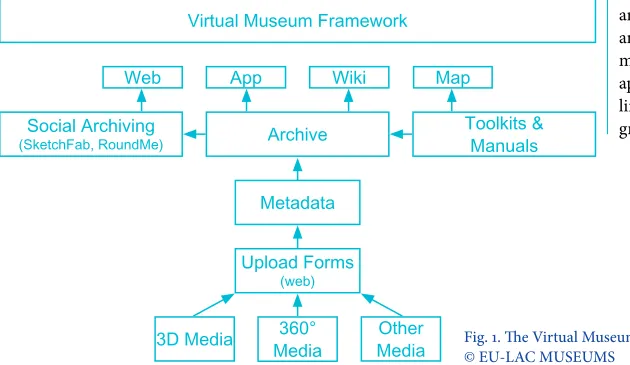
ingle media—such as 3d models, ob-ject images to be processed, 360 de-gree images, video, audio—is compiled in the archive form, where the metadata associated with the media can be trans-ferred into the archiving system. The archival information is incorporated into the Europeana Data Model (which builds upon the Dublin Core schema as it is familiar to heritage professionals and improves interoperability with other cataloguing and asset management sys-tems).1 The data supplied using the ar-chive form is stored in a back-end Digital Asset Management System implemented through Omeka, and is categorised by entity type. An entry for a single media upload can be retrieved after creation and edited to modify information.2Digital artefacts
O
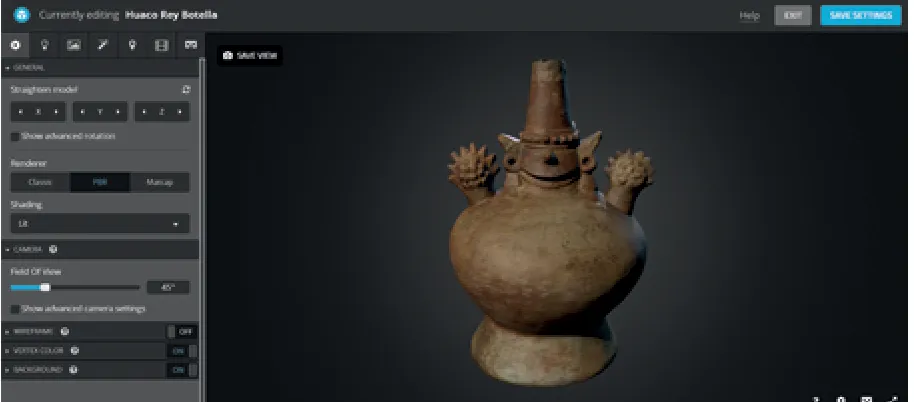
nce data has been uploaded to the web-based archiving system, the individual content is processed af-ter a fidelity check by the project team. Unprocessed photos of digitised objects are sent through a queue system, which was specifically created for the project, given the volume of 3d objects generat-ed. It uses open source software to create a 3d file, and automatically uploads into a SketchFab collection. As a social ar-chiving site, SketchFab tracks a user’s fol-lowers, views and comments and allows for in-player description and media. TheSketchFab player, much like a YouTube player, can be embedded in websites eas-ily and shared on other social platforms. 3d objects are viewable in full screen mode or through a virtual reality head-set with the platform’s mobile app.
Virtual tours
3
60 degree photospheres either stand alone as a single image or are compiled into virtual tours, centred around a location, museum or theme. Photospheres require similar approvals and processes as 3d models and are auto-matically uploaded into RoundMe as an online tour under a museum’s collection. As a social archiving site, RoundMe also tracks followers, views and comments and the player is easily embedded into websites. Photospheres and virtual tours are viewable full screen or through a vir-tual reality headset using the platform’s mobile app.Wiki
A
Wiki (MediaWiki) facilitates collab-orative work and the online revision of a topic. It also allows for varied in-sights by museum staff and community members, in addition to enabling more online discoverability on a known digi-tal encyclopaedia platform, which pro-motes the collections globally. An entry is generated for each media type upload-ed to the archive and is placupload-ed within the hierarchical arrangement of media and museums, which was created for the project. A museum’s Wiki links to the project’s Wiki and connects to the mu-seum’s established Wiki page, if the in-stitution has one built.Toolkits
[image:5.539.35.350.582.765.2]I
n order to aid preparation for the work-shops and provide instruction after-wards, toolkits researched and designed for community use by the project team are available on the website for self-guid-ance through every aspect of the virtual museum site. The relevant software and app guides are also available through links that will take a user to the pro-gramme’s home page (Fig. 1).Fig. 1. The Virtual Museum Framework workflow. © EU-LAC MUSEUMS
Virtual Museum Framework
Web
Social Archiving
(SketchFab, RoundMe) Archive
Metadata
Upload Forms
(web)
3D Media Media360° MediaOther
Toolkits & Manuals
Workshops
T
he 3d workshops involved museum staff, young professionals, communi-ty members associated with the museum as well as others outside the communi-ty. The aim was to explore how certain technologies can be used to understand the inheritance, transmission and diffu-sion of heritage, through digital repre-sentation. This point of departure would enable the establishing or strengthening of relations between the museum and its community and was also an opportuni-ty for the digital team to digitise objects, places and intangible heritage of the communities that belong to the consor-tium partners. In turn, this increased the project’s resource database.T
he digitising methods taught focused primarily on the use of Structure from Motion (SFM), (or photogram-metry) for the digitisation of artefacts. Instant spherical photography was used to capture locations for virtual tours. We chose to focus on these technologies due to the high fidelity of the results and ac-cessible equipment can be used. In previ-ous research, both methods were found teachable with satisfactory results.Digitising methods and tools
P
hotogrammetry requires manual settings on a camera to digitally rec-reate the structure of an entity (artefact, building) from hundreds of overlapping photographs. Those are captured from various perspectives (Westoby et al. 2012). A more rigorous photogramme-try setup may require a mid- to high-end camera, lights and a soft box for an improved control over the environment. The processing requires images to be matched in order to identify common points. The aim is to create sparse and dense point clouds, generate and trim meshes, which are then exported as 3d models (Fig. 2).S
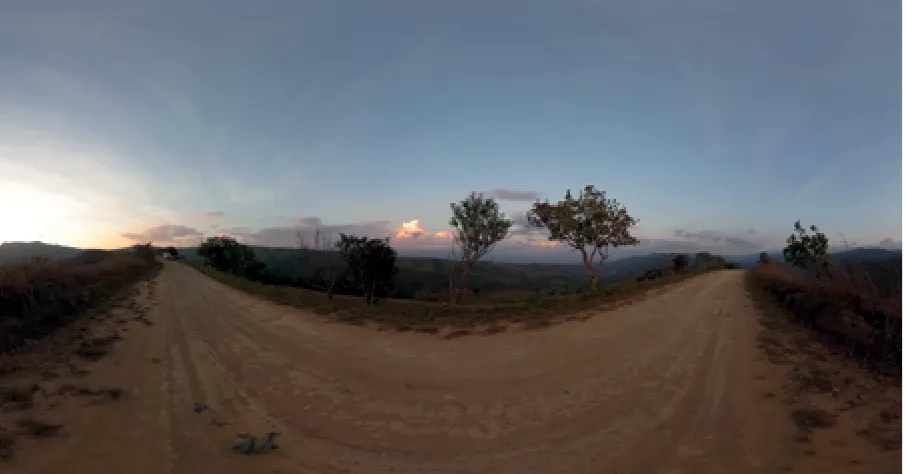
pherical images (360 degree images or photospheres) can be used to make virtual tours that immerse users in remote landscapes and city scapes, or to provide visual representations of the past, which constitute tangible cultur-al and naturcultur-al heritage. The last decade has seen an increase in the availability of cameras meant for capturing spher-ical images, such as the Ricoh Theta, GoPro Fusion and Samsung Gear 360. Smartphones are also equipped with cameras, and numerous spherical im-age-capturing applications can be found on app stores (Fig. 3). [image:6.539.52.506.34.329.2]E
stablished social archiving sites (SketchFab for 3d objects, RoundMe for virtual tours) were used to digitally present media produced from the work-shops on the Web. These websites have integrated sharing systems and online communities that make categorising and searching for content reliable and relatively discoverable. For this project, the VMF was created to collate and al-low for upload of media that had been generated from the workshops onto the Web. The structure of the VMF provided a straightforward means for communi-ties to continue managing their collec-tions, as well as access other collections produced by the workshops (Fig. 4).Fig. 2. Photogrammetry in Malalhue, Chile. © EU-LAC MUSEUMS
Workshop format and content
T
he project partners in Europe, LatinAmerica and the Caribbean iden-tified museums to participate in the workshops according to two criteria: a long-standing relationship, or their remoteness or insularity. Workshops were held in Scotland, Portugal, Spain, Barbados, Trinidad, Jamaica, Costa Rica, Peru and Chile. Where possible, an in-tergenerational element was included, so that community elders were involved in the selection and dissemination of ‘com-munity icons’ to the younger generation, thereby passing down community mem-ory and contributing to community re-silience in an age of globalisation (Fig. 5).
P
articipants came from diverse back-grounds, including museum profes-sionals, photographers, students, com-munity volunteers, school children, and academics. In total, over 300 peo-ple participated in the workshops. 3d manuals produced for the project were sent beforehand for museums and par-ticipants to familiarise themselves with the content to be presented. The work-shops equipped participants with digi-tisation skills, enabling them to under-stand the potentialities and limitations of the methods.As regards photogrammetry, the workshop looked at six stages of a successful digital artefact creation project:
1. Artefact selection, which depends on selecting objects with suitable characteristics, such as: minimal shine, appropriate features on surfaces and lack of occlusion.
2. Equipment selection, which requires a high-fidelity digitalisation studio to obtain professional results with a limited budget.
3. Doing the Shoot: how to install the equipment and set the camera in manual mode, in order to take photographs for optimal results. 4. Creating the Model: several options to create digital objects from photos were discussed. All pathways were introduced, and at least one methodology was fully explained. Participants were provided with an overview of the technologies, alongside hands-on experience. 5. Archiving: an infrastructure was provided that enabled source materials and their models to be archived. Metadata was described and obtained to be archived with the digital object. 6. Curation: our approach to curation stresses the separation of technology and content, enabling domain experts and volunteers to lead in artefact curation.
P
hotosphere training was also pro-vided, enabling participants to learn how to use mobile phones, tablets and cameras to create spherical photographs. In regard to virtual tours, the workshop included the following subjects: 1. Site selection: the choice of an appropriate location is critical, as framing does not take place in spherical photography.2. Equipment and software, three modes of creation of photospheres and their respective software were presented, using mobile phones, cameras and DSLR cameras.
3. Executing a shoot: the selection of scenes is critical to a successful shoot. This includes location, light conditions and time of day. HDR techniques may be necessary to successfully shoot some scenes; bright windows pose a hazard for indoor shoots.
4. Processing and stitching: the steps towards the use of open source software was introduced, as well as the insertion of appropriate XDif data.
5. Archiving spherical media: a proper archiving of photospheres and source materials provides future proofing and allows for optimisation in appropriate use cases. 6. Sharing spherical media:
[image:7.539.37.490.35.272.2]opportunities for a widespread dissemination of photospheres through Google Map’s Street View, virtual tours in Roundme and creating bespoke web and mobile applications.
Case Study: Seixal Ecomuseum, Portugal
W
orkshops took place at the Ecomuseu Municipal do Seixal (EMS) in Seixal, Portugal. The EMS integrates five museums and three ex-tended sites, along with three tradition-al recreationtradition-al crafts. The heritage of the ecomuseum consists of immovable cultural heritage, floating heritage and movable property, including archaeo-logical, technical and industrial, artistic and ethnographic collections and docu-mentary funds, mostly originating from the Seixal county.S
ites include archaeological collec-tions of Roman pottery at Quinta do Rouxinol, industrial collections at the Mundet cork factory and maritime and ethnographic collections of the Tagus estuary traditional shipyards. The EMS also preserves intangible heritage by preserving and transmitting techniques related to typography, grinding, ship-building, sailing in the Tagus estuaryand the production of mechanical steam power for black gunpowder production at the Vale de Milhaços Powder Factory (Virtual Museum-Portugal, EU-LAC MUSEUMS 2018).
T
he workshop drew in academics, professional photographers, and re-search students. Given the variety of the subject matter, participants may not have been knowledgeable in all aspects. The project’s digital team adapted to the skill set present and prioritised hands-on and group learning around a phase of the VMF. Participants could choose to attend the workshop dedicated to photogrammetry, or virtual tours, col-lections management and metadata. All participants could switch groups as de-sired. Since they were quite skilled in the chosen fields, the level of training was heightened, much to the participants satisfaction as most returned for the workshop held the next day in Lisbon.A model of an object studied the previ-ous day was 3d printed and presented by an EMS workshop attendee.
[image:8.539.51.508.36.237.2]T
he Portuguese team continued to carry out the digitisation of the EMS sites after the workshop. Archaeologists working with the EMS have manifested great interest in 3d capture, having seen its merit for their research. Digitisation would elevate sites to a higher status of protection as they are central tenets of the country’s heritage. This status would ensure their future conservation and guardianship. Additional interest in digital technologies, such as aerial pho-tography and survey, for research, pro-motion and conservation have been in-vestigated and deployed at the sites. The project’s digital team has been liaising for advanced processing guidance, aerial capture and digital management (Fig. 6).Fig. 4. An example of a scanned 3d model: here, a ‘huaco’. © EU-LAC MUSEUMS
[image:8.539.52.504.257.456.2]Case Study: The Barbados Museum & Historical Society, Barbados
T
he first Caribbean workshop was held at the Barbados Museum and Historical Society (BMHS) in Bridgetown, Barbados. The BHMS is a non-profit organisation established in 1933 and its origins are as a communi-ty museum, which it still identifies as today. The museum’s directive is to col-lect, document and conserve evidence of Barbados’s cultural, historical and envi-ronmental heritage, and to interpret for all sectors of society. In addition to sev-en permansev-ent galleries, the museum tegrates co-creation and community in-terest into its exhibition programming. The museum’s building is part of the pro-tected UNESCO World Heritage site of Historic Bridgetown and Garrison.M
ore than 20 participants took part in the workshop, including muse-um staff, students from the University of the West Indies and a youth group from a local church. Project activities differed from most workshops, in that they were completed in four days at the BMHS, allowing for the project team to work intensely with museum staff as well as participants. The museum identified their interest in using digital technology in other social domains after the work-shops, to put back into the service of the community. This included a focus ontraining museum staff in photogramme-try skills and processing 3d models after the end of the workshop.
A
s evidence of their training, the BMHS held a free two-week sum-mer intensive for photogrammetry for local youth aged between 17 and 25 in July 2018. Three participants complet-ed the intensive programme, which was overseen and taught by a member of staff who had participated in the proj-ect’s initial 3d workshop. Participants were taught through a combination of tutorials, hands-on sessions and created six 3d models from the museum’s collec-tion. The intensive programme conclud-ed with their virtual exhibition presen-tations, which are publicly displayed on Sketchfab. Over the two weeks, partici-pants gained capacity in:– Interpreting exhibition spaces – Developing virtual exhibitions – Object handling
– Accessing library archives and museum databases – Research historical narratives – Using photography equipment – Working with 3d software
[image:9.539.36.492.35.341.2]T
hey also expressed eagerness to ap-ply their newly learned skills in their own fields, which included history, ge-ology and animation. Multiple academic and social groups planned visits to the museum during the time of the inten-sive, which gave participants a chance to present the skills they had just learned to others.Fig. 6. Mercury figure scanned in Seixal, Portugal. © EU-LAC MUSEUMS
Case Study: Malalhue, Chile
T
he project’s final workshop was held at the Museo Despierta Hermano in Malalhue, in the municipality of Lanco, Valdivia in Chile. The Network of Museums of the Los Ríos Region was es-tablished in 2012 and is convened by the museum unit of the Austral University of Chile (UACh) (Weil 2015). The network currently includes twenty three institu-tions: museums, libraries, cultural cen-tres and interpretation cencen-tres, which all depend on community organisations, municipalities, universities or state de-partments (Weil et al. 2018). Despite different trajectories and geographi-cal locations, the network defines three common objectives:1. To facilitate associativity and professional collaboration among its members;
2. To build and sustain dissemination and permanent communication supports;
3. To implement various strategies for the registration, documentation and legal protection of heritage collections that are housed in the network’s museum, in accordance with current legislation in Chile (Urbina et al. 2017).
T
he Museo Despierta Hermano was selected as a venue due to its unique cultural heritage, remote location and indigenous community. Workshop par-ticipants came from a wide range of backgrounds, including museum vol-unteers, community members and lo-cal municipal officials, and just as vast of knowledge in digital literacies. The hands-on aspects of the workshop were dedicated to 3d artefact creation and vir-tual tour building. However traditional customs were performed by communi-ty members for the documentation of intangible heritage. Students and aca-demics from the UACh who attended the workshop held at the university days prior, assisted and instructed parts of the workshop, while overseen by project team members. [image:10.539.53.505.34.342.2]T
he network of community museums brought together by the UACh have continued to incorporate digital tech-nologies for the conservation of unique cultural heritage and the promotion of the local communities with continued practice facilitated by the university. Municipal members that attended the workshop were instrumental in the ac-knowledgment that digital technologies have a place in community museums and will help ensure survival of culture, traditions and history (Fig. 7).Fig. 7. Decorative pipe scanned in Malalhue, Chile. © EU-LAC MUSEUMS
The network of community museums brought together
by the Austral University of Chile have continued
to incorporate digital technologies for the conservation
of unique cultural heritage and the promotion
Workshops results and analysis
C
entral in the dissemination of skills was the hands-on approach carried out to facilitate the workshops and was made possible by holding full-day work-shops. The relevance of the objects, loca-tions and stories to the local community strengthened the engagement of partici-pants and promoted active participation as well as developed their collective un-derstanding of local heritage.T
he digital outputs from the work-shops were impressive in terms of numbers: over 150 digital artefacts were successfully digitised and over thirty virtual tours created by both attendees and the project’s digital team. Metadata proved to be an important activity, which many participants unanimous-ly agreed to be just as important at the digital files themselves. The use of social archiving sites was straightforward since they have similar designs to those which attendees were already familiar.A
n issue with social archiving sites, especially in remote locations, was poor interactivity and slow upload times. Where web connectivity was suc-cessful, museums utilised outputs in websites, on social media and within the Wiki system. The Wiki provided a clean and simple framework where it was evi-dent how to embed different media types and combine them with a textual narra-tive. In several workshops, they acted as an effective forum for intergenerationaland cross-profession communication on heritage, inviting all members of the community to complete an item’s story. During the workshops we learnt or confirmed:
– 3d digitisation worked well and produced high quality models from affordable and compact equipment. It was challenging to provide enough software training within the available time frame of the workshop. However, the instruction was thorough enough to provide attendees with informative decisions regarding how to proceed with a digitisation project.
– Virtual tours provided instantaneous creation that allowed participants to work with content immediately after shooting. Within the social archive site’s framework, 360 degree photos were easy to combine with flat media and text.
– Community digital infrastructure was an invaluable resource, as it included smart phones and digital literacies to be used in all workshops. The ability to incorporate the VMF into the workshop format was important to provide coherence by assembling media, connecting workshop outputs with museums and shaping the structure based on feedback from the previous workshop.
B
ecause museums were the backdrop of the workshop, participants were able to connect with existing community networks, as well as provide the project’s digital team with contacts and testers for future work. The workshops revealed an eagerness to engage with emergent tech-nologies for the preservation and com-munication of heritage. This presents the following opportunities:1. The widespread dissemination of inaccessible heritage through its digitisation and communication. 2. Allowing the community to have a voice through the co-creation of digital outputs, virtual exhibitions and promotion of their own heritage. 3. Establishing a workflow through a VMF that enables community museums to create and manage digital content, as well as a structure to teach other the integral aspects to digital media collections.
4. Strengthening the connection between communities and their museums through the use of existing digital literacies and digital infrastructures, as well as developing them for the future.
[image:11.539.35.490.36.285.2]5. Increasing intergenerational and cross-demographic communication, through parallel and integrated engagement with technology and heritage.
Design for the development of a Virtual Museum Infrastructure (VMI)
S
ince the 2003 ICH Convention re-jects the term ‘preservation’ in fear of suspending heritage at a point of history and recognises that heritage is ever evolving (UNESCO 2003), the VMF, proves to be an appropriate me-dium for digital cultural heritage as it can also adapt to technological advance-ments and changes in museum practices. During the workshops, the project team became certain that the dissemination of digital literacies, the availability of commodity devices and the existence of social archive platforms would enable a large-scale production of the creation, archiving and dissemination of 3d arte-facts and virtual tours. The project work-shops helped to accelerate a process that was already underway.W
e propose a Virtual Museum Infrastructure that enables entire networks of museums to create virtu-al museum content for their individu-al museums and connect them. The in-frastructure extends the idea of a VMF, and enables the creation of networks of virtual museums and allow museums to join such networks. The design build on the VMF with two significant enhance-ments: local nodes that connect to the VMI and extend it into the physical mu-seums, and support for interactive so-cial mapping.3 We have made significant progress in designing a VMI and have created a prototype that can be accessed.U
pon registering with the VMI, an organisation can access the frame-work required to develop its own VMF. It can upload media into an archive and associate it with metadata. The facilities for media galleries, social archive con-nectivity, Wiki and supporting toolkits all become available. The VMI also pro-vides support for spatial representation through interactive maps that support layers. [image:12.539.50.504.38.287.2]M
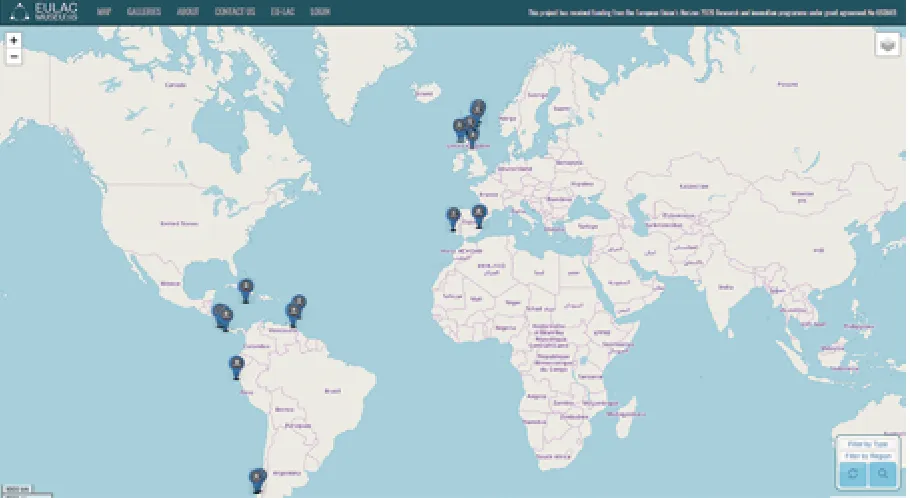
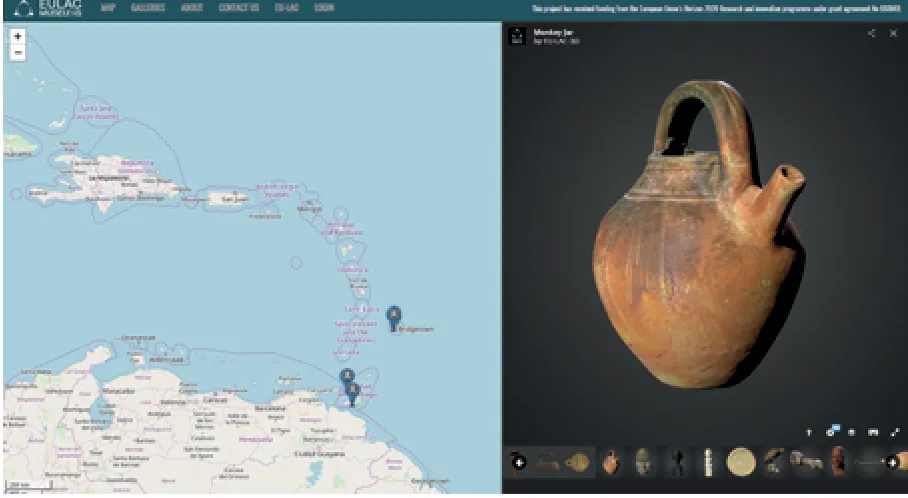
useums that participated in the workshops are currently represent-ed on a map (Fig. 8). By clicking on a point on the map, a pop-up appears, which contains links to media created during the workshop and to other re-lated media, such as the museum’s web page. The map is global and adjustable: representations can be modified and lay-ers of data can be switched on and off. The upload system enables objects to be associated with layers, while the meta-data contains location information that enables the media to be associated with a layer and then plotted on the map (Fig. 9).Fig. 9. An interactive map of the Virtual Museum Infrastructure. © EU-LAC MUSEUMS
I
n this article, we outlined activities and outputs from a series of global
workshops, as well as the development of a Virtual Museum Infrastructure
(VMI). In each of the workshops, community members learned how
to create digital 3d artefacts and spherical virtual tours. This work
was supported by the creation of a VMI, which showcases the content
created in the workshops and supports the creation of future content.
Workshop success was measured formally and informally.
Overall, the reception was positive. High levels of engagement occurred
throughout the process, with an encouraging amount of post-workshop
exploration and creation. In every country, enthusiasm and motivation
to engage with emergent technologies were obvious. When the workshops
came to a close the ability for technology to enhance the community
museum as well as promote and connect them globally was clear.
We trialled and proposed an active VMF and a prototype VMI which,
in addition to presentation, provides support for all stages of the media life cycle.
The VMF is structured to support content re-use, so that the same content can be
deployed easily on the Web, social archive sites, social media and mobile contexts.
The VMI enables individual museums to develop their own virtual museums
and make them globally accessible, facilitating connections and comparisons.
Combining the integration of the Web, mobile and immersive technologies
in a VMI achieves the goal to provide engaging experiences to users; for example
by virtual reality headsets to provide immersive virtual tours of remote
locations and allowing the inspection of 3d artefacts. By combining a Digital
Asset Management System back-end with a management front-end, heritage
practitioners can create and update content, whilst a presentation front-end
provides instant feedback. This allows heritage practitioners and community
members alike to continuously manage and use their virtual museums.
Our experience strongly suggests a VMI and digital workshop structure
for museums and their communities is an approach that is both feasible
and mutually beneficial.
Notes
1 A small selection of terminology used to describe digital resources, the Dublin Core Metadata Element Set is endorsed in the following standards documents: IETF RFC 5013, ISO Standard 15836-1:2017, NISO Standard Z39.85.
2Omeka is an open source web publishing platform for the display of library, museum, and scholarly collections and exhibitions.
References
ӹBowitz, E. and Ibenholt, K. 2009. ‘Economic Impacts of Cultural Heritage – Research and Perspectives,’ Journal of Cultural Heritage, Vol. 10, No. 1, pp. 1-8.
ӹCameron, D. 1971. ‘The Museum, a Temple or the Forum,’ Curator, Vol. 14, No. 1, pp. 11-24.
ӹCassidy, C., Miller, A., et al. 2017. ‘A Digital Museum Infrastructure for Preserving Community Collections from Climate Change,’ in Immersive Learning Research Network, Third Conference, iLRN 2017, Coimbra, Portugal, June 26-29, 2017: Workshop, Long and Short Papers, and Poster Proceedings. Edited by D. Beck, C. Allison, L. Morgado, et al. Graz: Verlag der Technischen Universität, pp. 170-177.
ӹCassidy, C., Fabola, A., Rhodes, E. and Miller, A. (2018). ‘The Making and Evaluation of Picts and Pixels: Mixed Exhibiting in the Real and the Unreal,’ Communications in Computer and Information Science, pp. 97-112.
ӹChittenden, D. 2011. ‘Commentary: Roles, Opportunities, and Challenges - Science Museums Engaging the Public in Emerging Science and Technology,’
Journal of Nanoparticle Research, Vol. 13, No. 4, pp. 1549-1556.
ӹEU-LAC Museums. 2018. [Online].
Ecomuseu Municipal do Seixal.
Available at: https://eulacmuseums. net/index.php/portugal-2/details/5/3 [Accessed 1 June 2018].
ӹEU-LAC Museums. 2018. [Online].
Charles Town Maroons Cultural Center and Museum. Available at: https:// eulacmuseums.net/index.php/jamaica-2/ details/5/56 [Accessed 1 June 2018].
ӹHuijbregts, Z., Kramer, R. P., Martens, M. H. J., et al. 2012. ‘A Proposed Method to Assess the Damage Risk of Future Climate Change to Museum Objects in Historic Buildings,’ Building and Environment, Vol. 55, pp. 43-56.
ӹICOM. 2007. [Online]. International Council of Museums Statutes. Available at: http://archives.icom.museum/statutes. html#2 [Accessed 1 June 2018].
ӹKennedy, S., Fawcett, R., Miller, A., Dow, L., Sweetman, R., Field, A., Campbell, A., Oliver, I., McCaffery, J. and Allison, C. 2013. ‘Exploring Canons and Cathedrals with Open Virtual Worlds: The Recreation of St Andrews Cathedral, St Andrews day, 1318’, Digital Heritage International Congress (DigitalHeritage). IEEE Vol. 2, pp. 273-280.
ӹLankester, P. and Brimblecombe, P. 2012. ‘The Impact of Future Climate on Historic Interiors,’ Science of the Total Environment,
Vol. 417-418, pp. 248-254.
ӹLindqvist, K. 2012. ‘Museum Finances: Challenges Beyond Economic Crises,’
Museum Management and Curatorship, Vol. 27, No. 1, pp. 1-15.
ӹMack, C. 2011. ‘Fifty Years of Moore’s Law,’ IEEE Transactions on Semiconductor Manufacturing, Vol. 24, No. 2, pp. 202-207.
ӹMarkham, A., Osipova, E., Lafrenz, S. and Caldas, A. 2016. World Heritage and Tourism in a Changing Climate / UNESCO,United Nations Environment Programme and Union of Concerned Scientists.[ebook]. Nairobi, Kenya: UNEP and Paris: UNESCO. Available at: https://whc.unesco.org/document/139944 [Accessed 12 June 2018].
ӹMiller, A., Vermehren, A., Fabola, A., McCaffery, J. 2015. ‘The Virtual Museums of Caen: A Case Study on Modes of Representation of Digital Historical Content,’ Digital Heritage Congress 2015. IEEE. Available at: https:// ieeexplore.ieee.org/document/7419571 [Accessed 25 November 2018].
ӹMoore, G. 1998. ‘Cramming More Components onto Integrated Circuits,’ in Proceedings of the IEEE, Vol. 86, No. 1, pp. 82-85.
ӹNoble, J. 1970. ‘Museum Manifesto’,
Museum News, Vol. 48, No. 8, pp. 16-20.
ӹPhillips, H. 2015. ‘The Capacity to Adapt to Climate Change at Heritage Sites: The Development of a Conceptual Framework,’ Environmental Science and Policy, Vol. 47, pp. 118-125.
ӹSimon, N. 2010. The Participatory Museum. Santa Cruz, California: Museum 2.0.
ӹSsenyonga, F. 2016. ‘The Emerging Role of Community Museums in Uganda: The Need for Capacity Building Among Managers,’ Museum International, Vol. 68, No. 1-2, pp. 125-129.
ӹTeresa Morales, L. and Ocampo Cuauhtémoc, C. (2010). The Community Museum: A Space for the Exercise of Communal Power, in: Cadernos de Sociomuseologia No. 38 Special edition, 22nd ICOM General Conference, pp.135-152.
ӹTimothy, D. J. and Nyaupane, G. P. 2009.
Cultural Heritage and Tourism in the Developing World: A Regional Perspective.
London: Routledge. (Contemporary Geographies of Leisure, Tourism and Mobility).
ӹUNESCO. 1972. [Online]. Convention Concerning the Protection of the World Cultural and Natural Heritage. Paris: UNESCO. Available at: https://whc. unesco.org/archive/convention-en.pdf [Accessed June 2018].
ӹUNESCO. 2003 [Online]. Convention for the Safeguarding of the Intangible Cultural Heritage. Available at: http://unesdoc. unesco.org/images//0013/001325/132540e. pdf [Acessed 24 Nov. 2018].
ӹUNESCO. 2015. [Online].
Recommendation Concerning the Protection and Promotion of Museums and Collections, their Diversity and Their Role in Society. Available at: http://unesdoc.unesco. org/images/0024/002463/246331m.pdf [Accessed 22 Nov. 2018].
ӹUNESCO. 2016. [Online]. Shenzhen Declaration on Museums and Collections. Paris: UNESCO. Available at: http:// www.unesco.org/new/fileadmin/ MULTIMEDIA/HQ/CLT/pdf/Shenzhen_ Declaration-en.pdf [Accessed June 2018].
ӹUNESCO. 2017. [Online]. Tangible Cultural Heritage. Paris: UNESCO. Available at: http://www.unesco.org/new/ en/cairo/culture/tangible-cultural-heritage [Accessed 1 June 2018].
ӹUrbina, S., Weil, K., Godoy Gallardo, M. and Adán, L. 2017. [Online]. ‘Social and Legal Protection of Ceramic Collections as a Key Aspect of Sustainable Heritage Management in Collaborations Between University Museums and Communities in a South American region (Chile),’ in 17th Annual UMAC Conference ‘Global Issues in University Museums and Collections: Objects, Ideas, Ideologies, People’, hosted by the University of Helsinki and the University of Jyväskylä, September 5-8, 2017. Available at: DOI: 10.13140/ RG.2.2.31486.89926 [Accessed 12 June 2018].
ӹVermeeren, A., Calvi, L. and Sabiescu, A. (eds). 2018. Museum Experience Design: Crowds, Ecosystems and Novel Technologies. Heidelberg: Springer International Publishing (Springer Series on Cultural Computing).
ӹWeil, K. 2015. ‘La Dirección museológica de la Universidad Austral de Chile,’
Revista Museos, No. 34, pp. 68-75.
ӹWeil, K., Godoy M. and Urbina, S. 2018. ‘Construyendo sentido a partir del trabajo asociativo desde los museos universitarios,’ in Temas globales en museos y colecciones universitarias: Diagnóstico y gestión de los museos universitarios. VIII Encuentro de museos universitarios del Mercosur y V Encuentro de museos universitarios de Latinoamérica y del Caribe y I Encuentro de museos universitarios de Perú, Lima, 23-24 de octubre de 2017. Edited by L. Repetto Málaga. Lima: ICOM-Perú, pp. 72-79.
ӹWestoby, M. J., Brasington, J., Glasser, N. F., Hambrey, M. J. and Reynolds, J. M. 2012. ‘Structure-from-Motion’ Photogrammetry: A Low-Cost, Effective Tool for Geoscience Applications,’
Geomorphology, Vol. 179, pp. 300-314.