sciences
Article
Size Characterisation Method and Detection
Enhancement of Plasmonic Nanoparticles in
a Pump–Probe System
Rafael Fuentes-Domínguez1,* ID, Richard J. Smith1, Fernando Pérez-Cota1, Leonel Marques1, Ovidio Peña-Rodríguez2 ID and Matt Clark1 ID
1 Optics and Photonics Group, University of Nottingham, University Park, Nottingham NG7 2RD, UK;
[email protected] (R.J.S.); [email protected] (F.P.-C.); [email protected] (L.M.); [email protected] (M.C.)
2 Instituto de Fusión Nuclear, Universidad Politécnica de Madrid, C/ José Gutiérrez Abascal 2,
E-28006 Madrid, Spain; [email protected]
* Correspondence: [email protected]; Tel.: +44-(0)115-951-5605
Received: 5 July 2017 ; Accepted: 7 August 2017 ; Published: 10 August 2017
Abstract:The optical resonance of metal nanoparticles can be used to enhance the generation and detection of their main vibrational mode. In this work, we show that this method allows the accurate characterisation of the particle’s size because the vibrational frequency of plasmonic nanoparticles only depends on their mechanical properties. Moreover, by a careful selection of the particle size and/or probe laser wavelength, the detected signal can be increased by a large factor (∼9 for the particles used in this work) under the same illumination conditions. Finally, we show experimentally that particles of different sizes inside the point spread function can be observed due to the differences in their vibrational states, which could provide a feasible route to super-resolution.
Keywords:plasmonics; metal nanostructures; pulsed lasers
1. Introduction
The physical and optical properties of nanoparticles have been heavily studied in the last few decades. This interest stems from their specific behaviour that depends on the particle size and shape and is very different from that of the bulk material. The optical scattering properties of nanoparticles have been well-known since the development of Mie theory [1] and, more recently, the stability of numerical solutions has allowed reliable calculations on spherical structures [2,3]. Additionally, the mechanical properties have been investigated, firstly by Raman scattering [4–6] and later by means of pump–probe techniques [7–13].
Nanoparticles can work as sources of ultrasounds when a short optical pulse (pump laser) is used to thermally excite them producing GHz acoustic waves [14,15]. The vibrational response of a nanoparticle can be detected in the time domain by measuring the changes in the scattered light. To access the very high frequency range of the vibrations of these small particles, the scattering is detected using pulsed lasers in a pump–probe configuration [16,17]. Both the generation and detection processes can be enhanced by matching the pump and probe wavelengths with the optical resonances of these nanoparticles. This approach may open a new method for cell imaging, where the acoustic transducers are placed inside the sample [18]. This configuration allows the generation of spherical acoustic waves probing the sample in all directions, unlike the currently used thin-film opto-acoustic transducers [19–21], which only produces waves orthogonal to the surface. Moreover, nanoparticles generate higher ultrasonic spatial frequencies, which could increase the lateral resolution.
However, the attenuation of acoustic waves in the GHz range is large, so it is crucial to maximise signal levels by optimising the generated wave amplitude and detection sensitivity without increasing the power density of the lasers. This improves the signal-to-noise ratio, decreases the time of the data acquisition and avoids damaging biological samples.
One popular method of detecting a signal is to choose a probe wavelength near the plasmon edge around 530 nm where the scattering is sensitive to the change in the dielectric function caused by the free electrons’ contribution [22,23]. However, the signal received from the backscattered light in this regime is poor due to the low level of backscatter which results in a low signal-to-noise ratio and the need to increase the acquisition time (Section2.3).
By choosing the probe laser away from the plasmon edge in the red or near infrared (>700 nm) region, another modulation mechanism may be accessed. Here, the scattering cross-section is a strong function of wavelength and size and by choosing a particle size/wavelength combination, where the change in scattering cross-section vs. particle size is high, it is possible to enhance the optical detection of the particles’ vibrational modes.
In this work, we describe the theoretical basis of the generation and detection, the optical and mechanical modelling of the nanoparticles, the sample fabrication, the experimental results and the optimisation of the optical detection. A scan of a sample containing particles with different sizes shows the existence of multiple frequencies inside the point spread function, which could allow identification of single particles with ultra-high resolution.
2. Design
A schematic representation of the pump–probe experiment is shown in Figure1a. The optical design of the nanoparticles is such that they strongly absorb at one wavelength of light (λpump,
Figure1b), making them efficient thermoelastic generators of elastic waves and have a strongly modulated scattering cross-section at a second wavelength (λprobe) when the device vibrates (Figure1c).
Consequently, elastic waves are generated when the particle is illuminated with a short (ps) pulse of light atλpump and illumination with a second pulse of light atλprobedetects the changes in the
reflected/transmitted light intensity produced by the (instantaneous) change in size (caused by mechanical vibration). Section2.1contains a detailed optical model that provides the means to choose the most suitable material and size of the particle to match the surrounding media and probe laser wavelength,λprobe.
Pump
Probe
a
300 500 700 900
Wavelength (nm) 0
0.01 0.02 0.03
ab
s
(µ
m
2)
b
100 200 300 400 500 Diameter (nm)
0 0.2 0.4 0.6
b
(µ
m
2)
0 5 10 15 20
|d
b
/d
r|
10
3(µ
m
2/n
m
)
[image:2.595.84.516.527.648.2]c
In our experiment, the pump laser wavelength was dictated by the tuning range of the lasers and the need to operate without damage or significant absorption in the surrounding media. A wavelength of 415 nm was chosen because it is strongly absorbed by all the different sizes of gold nanoparticles used but not by the surrounding media (air and water), and this region is away from the plasmon edge so it is not affected by small changes in the particle size, ensuring that the generation efficiency is the same for all of the particle sizes used in this paper.
The probe laser wavelength was chosen in the near infrared (NIR) region (700–850 nm) because of the low absorption (Figure1b) and high sensitivity for 150–200 nm particle sizes (Figure2). This region shows high signal-to-noise ratio for backscattered light unlike the plasmon edge where the DC is nearly 0 (Figure2a–d).
50 100 150 200 250 300
Diameter (nm) 0 20 40 60 80 100 120 140 Frequency (GHz) Silica Ag Au
700 750 800 850 900
Wavelength (nm) 0 0.06 0.12 |d b / d r| / b (1 / n m ) 150nm 200nm 250nm
e
f
0 50 100 150 200 250 300
Diameter (nm) 400 500 600 700 800 900 Wavelength (nm) 0 0.1 0.2 b (µ m 2)
0 50 100 150 200 250 300
Diameter (nm) 400 500 600 700 800 900 Wavelength (nm) 0 2 4 |d b / d r| 1 0 3(µ m 2/ n m )
0 50 100 150 200 250 300
Diameter (nm) 400 500 600 700 800 900 Wavelength (nm) 0 0.1 0.2 |d b /d r| / b (1 /n m )
0 50 100 150 200 250 300
[image:3.595.82.514.237.454.2]Diameter (nm) 400 500 600 700 800 900 Wavelength (nm) 0 5 10 15 |d b / d r| / b 1 0 3(µ m / n m )
a
b
c
d
Figure 2.(a) theoretical backscattering cross-section [24] as a function of particle diameter and probe laser wavelength using Equation (2) for a gold nanoparticle in water; (b) optical sensitivity defined as the change in scattered light over 1 nm change in the radius of the particle; (c) modulation depth (optical sensitivity divided by the backscattering cross-section); (d) the optical sensitivity with respect to the signal-to-noise ratio (SNR) assuming optical shot noise; (e) theoretical change in modulation depth per nm for a 150, 200 and 250 nm gold nanoparticles in air (lines) and water (dots), calculated by the Mie model; (f) theoretical breathing mode frequency for a nanoparticle of silica, silver (Ag) and gold (Au) in air (lines) and water (dots), calculated by the mechanical model.
2.1. Optical Design and Modelling
The optical response of metal nanoparticles can be modelled by the calculation of the scattering, radar backscattering, extinction and absorption cross-sections obtained from a Mie model (Equations (1)–(4)) [3,24]:
σsca = 2πr
2
x2 ∞
∑
n=1
(2n+1)(|an|2+|bn|2) (1)
σback =
πr2
x2 ∞
∑
n=1
(2n+1)(−1)n(an−bn)
2 (2)
σext= 2πr
2
x2 ∞
∑
n=1
σabs =σext−σabs (4)
The particle is characterized by the size parameterx=2πnmr/λand the relative refractive index
m=n/nm, whereλis the wavelength of the incident wave in vacuum,ris the particle radius andnm
andnare the refractive index of the medium and the particle, respectively. The expressions foranand
bnare shown below:
an =
[Hna(mx)/m+n/x]ψn(x)−ψn−1(x)
[Ha
n(mx) +n/x]ζn(x)−ζn−1(x) (5)
bn =
[mHnb(mx) +n/x]ψn(x)−ψn−1(x)
[mHb
n(mx) +n/x]ζn(x)−ζn−1(x) (6)
whereψandζare the Riccati–Bessel functions defined, for instance, in Kai and Massoli et al. [25] and
the determinantsHnaandHnb, defined in Peña et al. [3]
2.2. Principles of Optical Generation
The principle of excitation is based on the well-known phenomenon of thermal excitation. The light absorbed by the particle results in rapid heating and a subsequent stress that excites vibrations in the particle. In general, the particle heating is not uniform but our particles are small compared with the optical wavelength and the contribution to the thermalisation of the hot electrons that are initially excited means that it is reasonable to assume uniform heating. In the case of larger particles, these assumptions might not be valid.
To maximise the efficiency of generation, the particle needs to be a strong absorber of the pump light, which can be achieved by using an appropriate pump wavelength, particle material and, to a lesser extent, particle size. Figure1b shows the absorption cross-section for a 150 nm gold nanoparticle as a function of wavelength. In this case, the absorption around 530 nm is strongly determined by the main plasmon resonance and largely independent of the size and the optical properties of the external media. In our set-up, the pump wavelength was fixed at 415 nm, which provided good absorption for all particle sizes and was not strongly absorbed by the surrounding media.
2.3. Principles of Optical Detection
The scattering cross-section can be (with the right combination of materials, size and wavelength) a sensitive function of particle size. Thus, when the particle vibrates, there will be a change in the scattering cross-section and the intensity of the scattered light will be modulated by the vibration, which constitutes the principle of detection in our work. Other factors, like the change in temperature of the particle/surrounding media/substrate, the photo-elastic effect and the very short-lived electronic contribution from the hot electrons, can affect the particle scattering, but we have neglected them. The temperature change results in a slowly varying thermal background in our signals, which is removed by signal processing, and the photo-elastic effect is thought to only provide a small contribution to the signal received (as this effect in gold is small [26,27]) and the short-lived electronic effects are tied up in a “co-incidence peak”, which is removed alongside the thermal decay. In this paper, we define the optical sensitivity as the change in scattered light over a 1 nm change in the radius of the particle. This shows the change in reflected/transmitted light during the vibration of the particle.
modulation depth, defined as the optical sensitivity divided by the radar backscattering cross-section, which shows a region with high response for a nanoparticle smaller than 100 nm. This region is very high as the DC is nearly 0. Therefore, although this appears to be the best place to operate, the extremely low light return means that the signal-to-noise ratio (SNR) will be poor. Figure2d shows the sensitivity with respect to SNR and here a particle with size∼150 nm is optimal.
Figure2e shows the modulation depth for the three sizes of gold nanoparticles measured in this paper (150, 200 and 250 nm) as a function of the probe laser wavelength (the range of our setup) in air (lines) and water (dots) surrounding media. The chosen media for the study of the optical response of plasmonic nanoparticles is water where the optical response follows different tendencies for the three sizes in the available probe wavelength range. It is clear from there that the size of the particle, the probe laser wavelength and the surrounding media have a significant impact on the optical response. For example, the optical response of a 250 nm gold nanoparticle will increase a factor of∼6 when the probe wavelength is tuned from 850 to 700 nm.
2.4. Mechanical Design and Modelling
The vibration frequency is a function of the material properties, the particle size and, to a lesser extent, the surrounding media. We have assumed that only the main breathing mode of vibration is excited. This is justified because the particle is small and uniformly heated on a time scale that is short compared with the period of vibration. Moreover, we do not expect to detect the presence of higher order modes of vibration, and they would be heavily damped compared with the breathing mode.
The acoustic properties of a nanosphere can be described in terms of vibrations of a homogeneous elastic body embedded in an infinite homogeneous medium [12,13,28]. This macroscopic model is valid for particles with diameter larger than a few nanometers where continuum mechanics and bulk elastic constants can be used [29,30]. The complex radial frequency modes, ˜ωn(R) =ξnν(Ls)/R,
depend onνL(s), the longitudinal sound velocity of the sphere;R, the radius of the sphere; andξn,
the eigenvalues, given by Equation (7) [31]:
ξncot(ξn) =1−
ξn2(1+iξn/α)/η
ξ2n−4α2γ2(1−1/η β2)(1+iξn/α) (7)
where the parameters are defined by:
α=νL(m)/νL(s); β=ν(Tm)/ν(Ts)
γ=ν(Tm)/ν(Lm); η=ρ(m)/ρ(s) (8)
whereρ(m)(s)andνL(m,T)(s)are the density and the longitudinal (L) or transverse (T) sound velocity of
the medium (m) and sphere (s).
Voisin et al. have assumed a weak coupling between the sphere and the medium (Im(ξn)Re(ξn))
and weak damping [28]. Therefore, the radial mode frequencies,ωn, can be related to the real part ofξn
(Re(ξn)≈(n+1)π) and the damping of the sphere modes,γn, is proportional to the imaginary part of
ξn(Im(ξn)≈ηα). Hence, the main breathing mode frequency (n=0) of a nanosphere and the damping
between it and the medium are expressed in Equations (9) and (10), respectively:
fn=Re(ξn)
νL(s)
2πR ≈(n+1) ν(Ls)
2R (9)
γn=Im(ξn)
ν(Ls)
R ≈
ρ(m) ρ(s)
νL(m)
Figure2f shows the theoretical main breathing mode frequency in air (lines) and water (dots) as a function of size for a nanoparticle made of silica, silver and gold. It can be seen there that, for all the materials, the frequency generated is inversely proportional to the particle size. It can be seen also that a faster material (in terms of the longitudinal speed of sound), like silica, generates higher frequencies than a slower material like silver or gold. Furthermore, the breathing mode frequency for a gold particle will be slightly damped in a water surrounding media (<1 GHz).
3. Sample Preparation
An electrostatic layer-by-layer self-assembly process was used [32] to bond the gold nanoparticles to the substrate, allowing to measure the same sample in an air and water surrounding media. A clean glass substrate was washed and dried with nitrogen. A thin gold film,∼30 nm, was coated on half of the substrate (this is used to set the correct overlapping of pump and probe beams). On the other half, a 2 mg/mL poly (allylamine hydrochloride) (PAH) (Mw 58,000) solution was prepared in water and coated onto the glass substrate for 20 min. The sample was re-washed with water and dried with nitrogen. The gold nanoparticles solution (diluted in water 1/500,v:v) was drop-coated and allowed to set overnight. The prepared sample was placed into a sealed gasket cell and filled with deionized water. All chemicals and the gold nanoparticles used in this sample preparation were purchased from Sigma-Aldrich. The nanoparticles were used as received with no surface modification or washing step involved. The polydispersity index (PDI) was less than 20% for the gold nanoparticles (values provided by the manufacturers).
4. Experimental Setup
The experiment is based on a dual laser asynchronous optical sampling (ASOPs) system [16,17]. It controls two femtosecond pulsed lasers (∼100 fs pulse width) with a repetition rate of 80 MHz and allows the delay between the pulses to be set and swept from 0 to 12.5 ns every 100µs (10 kHz). The wavelength of the probe laser is tunable from 700 to 850 nm. The sample is scanned by moving electromechanical stages with a minimum step motion of 100 nm. Typically, 30,000 averages per point are taken during scanning, which takes around 9 s to acquire. The system uses a maximum of 2 mW average power in the probe and 1 mW in the pump measured at the sample corresponding to pulse energies of 25 and 10 pJ and peak powers of 250 and 100 W, respectively. The response of the transducer is detected by monitoring the low frequency (<30 MHz) intensity variation of the probe light on a photo-detector, which is captured and averaged on a digital oscilloscope (DSO). With this arrangement, a signal detected at delay of T on the DSO corresponds to a real delay between the laser pulses of T/8000 and a frequency measured on the DSO of fscopecorresponds to a real frequency of 8000fscope.
5. Results
5.1. Optical Response
The optical response of plasmonic nanoparticles was studied by the backscattered signal from the center of gold nanoparticles, by comparing the modulation of the backscattering cross-section when the probe wavelength is changed. This was performed by measuring 150, 200 and 250 nm gold nanoparticles immersed in water because their optical response shows different behaviours unlike air surrounding media (Figure2e). The range of the probe wavelength is from 720 to 800 nm, which is sufficient to cover the region of special interest, the drop in the optical response at∼750 nm wavelength for a 200 nm gold particle.
of a gold nanoparticle surrounded by water for a fixed probe laser wavelength following the same scan procedure several times. The optical response of the three sizes, shown in Figure3, matches the theoretical modulation depth (optical sensitivity over the radar backscattering cross-section) given by Mie theory. The optical response of a 150 nm particle increases a factor of∼1.3 when the probe wavelength is tuned from 720 to 800 nm (Figure3a,d). On the other hand, the same tunable range produces a decrease in a factor of∼3 in the optical response of a 250 nm particle (Figure3c,f). Finally, the maximum enhancement in our experimental data, a factor of∼9, is given by a 200 nm particle when the probe wavelength is tuned from 745 to 770 nm (Figure3b,e).
720 740 760 780 800
Wavelength (nm) 0 0.5 1 a.u. 0 0.05 0.1 (1/nm) Experimental data Mie model
0 10 20 30 40 50
GHz 0 1 2 a.u. 720nm 800nm
0 0.2 0.4
ns a.u. 720nm 800nm
x3
c
f
720 740 760 780 800
Wavelength (nm) 0 1 2 a.u. 0 0.01 (1/nm) Experimental data Mie model
0 10 20 30 40 50
GHz 0 1 2 a.u. 745nm 800nm
0 0.2 0.4
ns a.u. 745nm 800nm
x9
b
e
0 10 20 30 40 50
GHz 0 1 2 a.u. 720nm 800nm
0 0.2 0.4
ns
a.u.
720nm
800nm
720 740 760 780 800
Wavelength (nm) 0 1 2 a.u. 0 0.04 0.08 (1/nm) Experimental data Mie model x1.3
a
d
0 0.2 0.4
ns
a.u.
720nm
800nm
0 10 20 30 40 50
GHz 0 1 2 a.u. 745nm 770nm
0 0.2 0.4
[image:7.595.88.514.209.632.2]ns a.u. 745nm 770nm
x9
e
This enhanced response provides a way to improve the detection of the different main vibrational modes by choosing the right probe wavelength based on Mie theory without increasing the laser power. Moreover, it might be possible to suppress the signal from certain particles by careful choice of the wavelength. The discrepancies between the experimental data and the theory might be related to the extra reflections produced by the cover-slip or the effect of the electrostatic layer-by-layer self-assembly process, which bonds the particle to the substrate.
5.2. Mechanical Response
In this section, the mechanical response of plasmonic nanoparticles was investigated detecting the forward scattering as this setup is simpler, less susceptible to alignment errors, and it gives higher to signal-to-noise ratio with fewer averages because the optical throughput is higher. As the time to acquire an image is much longer than the previous section where the same points were compared, air surrounding media is used to avoid any defects such as the formation of air bubbles inside the gasket cell.
The mechanical response of plasmonic nanoparticles was investigated using three different sizes of gold nanoparticles: 150, 200 and 250 nm (samples S1–S3, respectively). Their theoretical breathing mode frequencies are 21.6, 16.2 and 12.9 GHz, respectively. However, this will vary depending on the actual size of the particle, allowing size characterisation.
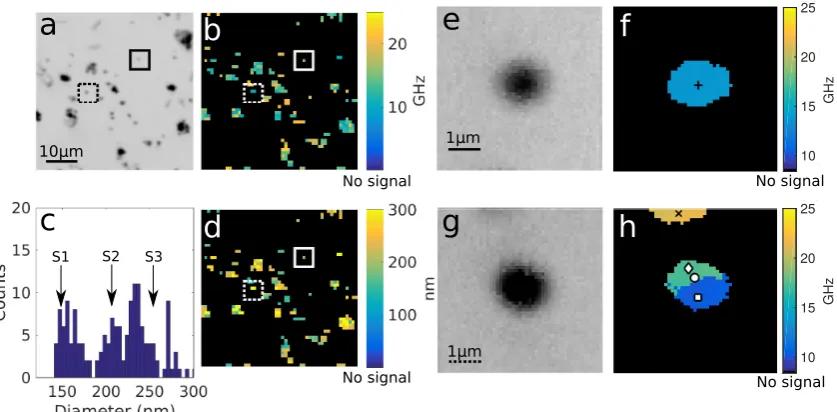
Figure 4 shows the experimental data taken from a sample containing a mixture of gold nanoparticles of different sizes. The sample is scanned over an area of 50 ×50µm2with a step size of 1µm (the same size as the spot of the pump laser). In this case, the probe laser wavelength is 780 nm where their optical response shows similar behaviour. The optical picture of the scanned sample shows several nanoparticles with different apparent sizes (Figure4a). After signal processing, the breathing mode frequency for each particle is obtained, as shown in Figure4b. Each frequency can be related to the actual size of the particle (Equation (9)), giving a study of the population of sizes (Figure4c) or an ultrasonic picture in nm (Figure4d).
Our experimental setup allows us to scan specific area with finer step size, marked as the solid and dashed square areas in Figure4. These scanned areas are 5×5µm2with 100 nm step size. Both optical
a
b
d
c
No signal
No signal 10m
S1 S2 S3
h
h
10 15 20 25
GHz
g
1m
No signal
h
10 15 20 25
GHz
e
1m
f
[image:9.595.92.511.89.295.2]No signal
Figure 4.Sample containing a mixture of gold nanospheres of different sizes, imaged over an area of 50×50µm2and two 5×5µm2finer scans measuring transmitted light. (a) optical picture of the big scanned area; (b) ultrasonic picture showing the frequency measured; (c) histogram with the size distribution of particles where the arrows show the expected size of nanoparticles (150, 200 and 250 nm diameter); (d) ultrasonic picture showing the size of the nanospheres using the mechanical model (Section2.4) to convert the breathing mode into size in nm; (e,f) are the optical and acoustic pictures, respectively, of the solid square area (5×5µm2); (g,h) are the optical and acoustic pictures, respectively, of the dashed square area (5×5µm2).
5.3. Particle Resolution
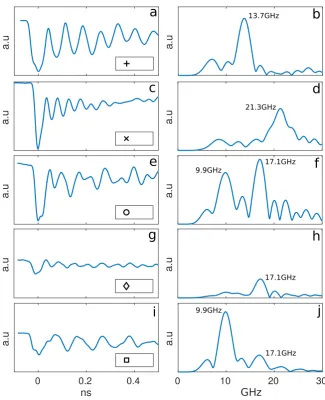
Example experimental traces from the two finer scans (100 nm step size) from Section5.2(marked points) are shown in Figure5. A single frequency component is presented when there is a single nanoparticle. There are no low frequency components (2–7 GHz), which would be expected if a few particles were in contact (considered as dumbbells) [34]. Figure5b,d show 13.7 GHz and 21.3 GHz component given by∼250 nm and∼150 nm single gold nanoparticles, respectively.
On the other hand, if several particles are present in the same point spread function, the signals show various frequency components, due to the different sizes of the nanoparticles. Two frequency components are shown in Figure5f: 9.9 GHz and 17.1 GHz, respectively, from the center of the middle blob in Figure4h. This indicates that there are two nanoparticles with different sizes: either in contact (dumbbell) or separated. We suppose that they are separated because the low frequency component might match a∼300 nm size particle. This is confirmed when one of the frequency components decays moving towards the edges of the blob; therefore, two independent particles with∼300 nm and
GHz
a.u. a.u
a.u. a.u
a.u. a.u
0 0.2 0.4
ns
a.u.
0 10 20 30
GHz
a.u
a.u. a.u
a
b
c
d
e
ns
a.u
a.u
a.u
a.u
a.u
a
13.7GHzb
21.3GHz
c
d
e
f
g
h
i
j
17.1GHz 9.9GHz
17.1GHz
9.9GHz
17.1GHz
[image:10.595.135.461.87.488.2]GHz
Figure 5. Experimental traces and their frequency spectrums, showing the main breathing mode frequencies. (a,b) example traces for the particle in Figure4f; (c,d) example traces of the top particle for Figure4h; (e–j) example traces for the middle particle in three different locations for Figure4h.
6. Conclusions
Acknowledgments: This work was supported by the Engineering and Physical Sciences Research Council (Grant No. EP/K021877/1) (EPSRC).
Author Contributions:Rafael Fuentes-Domínguez, Richard J. Smith and Matt Clark conceived and designed the experiments; Rafael Fuentes-Domínguez performed the experiments and wrote the paper; Leonel Marques made the samples; Fernando Pérez-Cota and Ovidio Peña-Rodríguez participated in the paper’s revision and made many suggestions. All authors read and approved the final manuscript.
Conflicts of Interest:The authors declare no conflict of interest.
References
1. Mie, G. Contributions on the optics of turbid media, particularly of colloidal metal solutions. Ann. Phys
1908, 25, 377–445.
2. Yang, W. Improved recursive algorithm for light scattering by a multilayered sphere. Appl. Opt. 2003,
42, 1710–1720.
3. Peña, O.; Pal, U. Scattering of electromagnetic radiation by a multilayered sphere. Comput. Phys. Commun.
2009,180, 2348–2354.
4. Fujii, M.; Nagareda, T.; Hayashi, S.; Yamamoto, K. Low-frequency Raman scattering from small silver particles embedded in SiO2thin films. Phys. Rev. B1991,44, 6243.
5. Portales, H.; Saviot, L.; Duval, E.; Fujii, M.; Hayashi, S.; Del Fatti, N.; Vallée, F. Resonant Raman scattering by breathing modes of metal nanoparticles. J. Chem. Phys.2001,115, 3444–3447.
6. Tcherniega, N.; Zemskov, K.; Savranskii, V.; Kudryavtseva, A.; Olenin, A.Y.; Lisichkin, G. Experimental observation of stimulated low-frequency Raman scattering in water suspensions of silver and gold nanoparticles.Opt. Lett.2013,38, 824–826.
7. Hodak, J.H.; Martini, I.; Hartland, G.V. Observation of acoustic quantum beats in nanometer sized Au particles.J. Chem. Phys.1998,108, 9210–9213.
8. Hodak, J.H.; Henglein, A.; Hartland, G.V. Size dependent properties of Au particles: Coherent excitation and dephasing of acoustic vibrational modes. J. Chem. Phys.1999,111, 8613–8621.
9. Van Dijk, M.A.; Lippitz, M.; Orrit, M. Detection of acoustic oscillations of single gold nanospheres by time-resolved interferometry.Phys. Rev. Lett.2005,95, 267406.
10. Hartland, G.V. Coherent excitation of vibrational modes in metallic nanoparticles.Annu. Rev. Phys. Chem.
2006,57, 403–430.
11. Guillet, Y.; Rossignol, C.; Audoin, B.; Calbris, G.; Ravaine, S. Optoacoustic response of a single submicronic gold particle revealed by the picosecond ultrasonics technique. Appl. Phys. Lett.2009,95, 61909.
12. Crut, A.; Maioli, P.; Del Fatti, N.; Vallée, F. Acoustic vibrations of metal nano-objects: Time-domain investigations.Phys. Rep.2015,549, 1–43.
13. Crut, A.; Maioli, P.; Del Fatti, N.; Vallée, F. Time-domain investigation of the acoustic vibrations of metal nanoparticles: Size and encapsulation effects.Ultrasonics2015,56, 98–108.
14. Perner, M.; Gresillon, S.; März, J.; Von Plessen, G.; Feldmann, J.; Porstendorfer, J.; Berg, K.J.; Berg, G. Observation of hot-electron pressure in the vibration dynamics of metal nanoparticles. Phys. Rev. Lett.2000,
85, 792.
15. Voisin, C.; Del Fatti, N.; Christofilos, D.; Vallée, F. Ultrafast electron dynamics and optical nonlinearities in metal nanoparticles. J. Phys. Chem. B2001,105, 2264–2280.
16. Elzinga, P.A.; Lytle, F.E.; Jian, Y.; King, G.B.; Laurendeau, N.M. Pump/probe spectroscopy by asynchronous optical sampling.Appl. Spectrosc.1987,41, 2–4.
17. Bartels, A.; Cerna, R.; Kistner, C.; Thoma, A.; Hudert, F.; Janke, C.; Dekorsy, T. Ultrafast time-domain spectroscopy based on high-speed asynchronous optical sampling. Rev. Sci. Instrum.2007,78, 35107. 18. Aylott, J.W. Optical nanosensors-an enabling technology for intracellular measurements. Analyst2003,
128, 309–312.
19. Smith, R.J.; Cota, F.P.; Marques, L.; Chen, X.; Arca, A.; Webb, K.; Aylott, J.; Somekh, M.G.; Clark, M. Optically excited nanoscale ultrasonic transducers. J. Acoust. Soc. Am.2015,137, 219–227.
21. Pérez-Cota, F.; Smith, R.J.; Moradi, E.; Marques, L.; Webb, K.F.; Clark, M. High resolution 3D imaging of living cells with sub-optical wavelength phonons. Sci. Rep.2016,6, 39326.
22. Lerme, J.; Pellarin, M.; Cottancin, E.; Gaudry, M.; Broyer, M.; Del Fatti, N.; Vallee, F.; Voisin, C. Influence of lattice contraction on the optical properties and the electron dynamics in silver clusters. Eur. Phys. J. D-At. Mol. Opt. Plasma Phys.2001,17, 213–220.
23. Coronado, E.A.; Schatz, G.C. Surface plasmon broadening for arbitrary shape nanoparticles: A geometrical probability approach. J. Chem. Phys.2003,119, 3926–3934.
24. Bohren, C.F.; Huffman, D.R.Absorption and Scattering of Light by Small Particles; John Wiley & Sons: Hoboken, NJ, USA, 2008.
25. Kai, L.; Massoli, P. Scattering of electromagnetic-plane waves by radially inhomogeneous spheres: A finely stratified sphere model.Appl. Opt.1994,33, 501–511.
26. Garfinkel, M.; Tiemann, J.; Engeler, W. Piezoreflectivity of the noble metals. Phys. Rev.1966,148, 695. 27. Wright, O.B. Ultrafast nonequilibrium stress generation in gold and silver. Phys. Rev. B1994,49, 9985. 28. Voisin, C.; Christofilos, D.; Del Fatti, N.; Vallée, F. Environment effect on the acoustic vibration of metal
nanoparticles.Phys. B Condens. Matter2002,316, 89–94.
29. Juvé, V.; Crut, A.; Maioli, P.; Pellarin, M.; Broyer, M.; Del Fatti, N.; Vallée, F. Probing elasticity at the nanoscale: Terahertz acoustic vibration of small metal nanoparticles.Nano Lett.2010,10, 1853–1858.
30. Sauceda, H.E.; Mongin, D.; Maioli, P.; Crut, A.; Pellarin, M.; Fatti, N.D.; Vallée, F.; Garzón, I.L. Vibrational properties of metal nanoparticles: Atomistic simulation and comparison with time-resolved investigation.
J. Phys. Chem. C2012,116, 25147–25156.
31. Dubrovskiy, V.; Morochnik, V. Natural vibrations of a spherical inhomogeneity in an elastic medium.
Izv. Earth Phys.1981,17, 494–504.
32. Ai, H.; Jones, S.A.; Lvov, Y.M. Biomedical applications of electrostatic layer-by-layer nano-assembly of polymers, enzymes, and nanoparticles.Cell Biochem. Biophys.2003,39, 23–43.
33. Mongin, D.; Juvé, V.; Maioli, P.; Crut, A.; Del Fatti, N.; Vallée, F.; Sànchez-Iglesias, A.; Pastoriza-Santos, I.; Liz-Marzán, L.M. Acoustic vibrations of metal-dielectric core-shell nanoparticles. Nano Lett. 2011,
11, 3016–3021.
34. Tchebotareva, A.L.; Van Dijk, M.A.; Ruijgrok, P.V.; Fokkema, V.; Hesselberth, M.H.; Lippitz, M.; Orrit, M. Acoustic and optical modes of single dumbbells of gold nanoparticles.ChemPhysChem2009,10, 111–114. 35. Yu, K.; Sader, J.E.; Zijlstra, P.; Hong, M.; Xu, Q.H.; Orrit, M. Probing silver deposition on single gold nanorods
by their acoustic vibrations.Nano Lett.2014,14, 915–922.
c
![Figure 1. (a) schematic representation of the experiment, showing the spherical nanoparticle, the pumpand probe laser beams and the vibrations; (b) the absorption cross-section for a 150 nm gold nanoparticlecomputed [3] with the fixed pump wavelength (λpump](https://thumb-us.123doks.com/thumbv2/123dok_us/8569550.368078/2.595.84.516.527.648/schematic-representation-experiment-nanoparticle-vibrations-absorption-nanoparticlecomputed-wavelength.webp)
![Figure 2. ((optical sensitivity divided by the backscattering cross-section); (a) theoretical backscattering cross-section [24] as a function of particle diameter and probelaser wavelength using Equation (2) for a gold nanoparticle in water; (b) optical sensitivity definedas the change in scattered light over 1 nm change in the radius of the particle; (c) modulation depthd) the optical sensitivity with respectto the signal-to-noise ratio (SNR) assuming optical shot noise; (e) theoretical change in modulationdepth per nm for a 150, 200 and 250 nm gold nanoparticles in air (lines) and water (dots), calculated bythe Mie model; (f) theoretical breathing mode frequency for a nanoparticle of silica, silver (Ag) andgold (Au) in air (lines) and water (dots), calculated by the mechanical model.](https://thumb-us.123doks.com/thumbv2/123dok_us/8569550.368078/3.595.82.514.237.454/sensitivity-backscattering-backscattering-nanoparticle-modulationdepth-nanoparticles-theoretical-nanoparticle.webp)