Maintaining Regularity and Generalization in Data using MDL and GA: Case of
Grammatical Inference
Hari Mohan Pandey
a, *, Ankit Chaudhary
b, Deepti Mehrotra
c, Graham Kendall
d,
a Department of Computer Science & Engineering, Amity University Uttar Pradesh,Sector 125, Noida, IndiabDepartment of Computer Science, Truman State University, USA
cAmity School of Engineering & Technology, Amity University, Sector 125, Noida, India
dThe University of Nottigham Malaysia CampusJalan Borga, 43500 Semenyih, Selangor Darul Ehsan, Malaysia
1.Introduction
The problem with the inductive and statistical inference systems is to maintain regularity in the data. In other words “How to take decision for selecting an appropriate model that should present the competing explanation of the data using limited observations?” Figure 1 shows an envision where a sender who want to transmit some data to the receiver and, therefore interested in selecting the best model which can maximally compress the observed data and delivered to the receiver using as few bits as possible.
Sender Receiver
Best model selection, maximally compress a digital representation
of observed data
Fig. 1. An envision shows the rationale of using the MDL principle. The sender wants to transmit some data to the receiver.
Formally, the selection of the best model is the process to decide among the model classes based on the data. The Principle of Parsimony (Occam’s razor) is the soul of the model selection, states that “given a choice of theories, the simplest is preferable”
[4] [5]. The purpose to implement the Parsimony Principle is to find out a model, which can best fit to the data. Rissanen extracted the essence of the Occam’s theory and presented the
Principle of Minimum Description Length states that “choose the model that gives the shortest description of data” [4] [12].
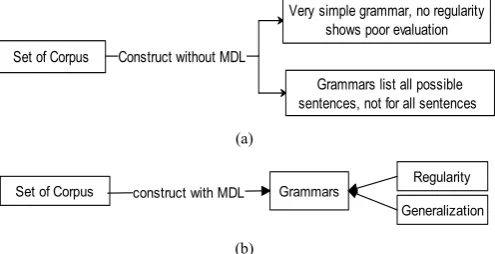
The domain of inquiry in this paper is the GI problem. A grammar can be constructed without using the MDL principle, but does not reflect any regularity in the data (Figure 2 (a)). In addition, it is difficult to know when to generalize and specialize the training data. In such situation, the constructed grammar is considered as a very simple grammar, because it simply provides the validity of any combination of words, therefore the grammar does not show any regularity, hence the high amount of
A R T I C L E I N F O A B S T R A C T
Article history:
Received
Received in revised form Accepted
Available online
In this paper, a genetic algorithm with minimum description length (GAWMDL) is proposed for the grammatical inference. The primary challenge of identifying a language of infinite cardinality from a finite set of examples should know when to generalize and specialize the training data. The minimum description length principle has been incorporated addresses this issue, is discussed in this paper. Previously, the e-GRIDS learning model was proposed, have enjoyed the merits of the minimum description length principle, but is limited to positive examples only. On the other hand, the proposed GAWMDL combines with the traditional genetic algorithm has a powerful global exploration capability that can exploit an optimum offspring’s, is an effective approach to handle a problem has a large search space as to the grammatical inference problem. The computational capability, the genetic algorithm poses is not questionable, but still it suffers with a critical issue known as premature convergence mainly arises due to lack of population diversity. The proposed GAWMDL incorporates the bit mask oriented data structure that performs the reproduction operations, creating the mask and then a Boolean based procedure has been applied to create an offspring’s in a generative manner. The Boolean based procedure uses the Boolean operators are capable of introducing the diversity in the population, hence alleviate the premature convergence. The proposed GAWMDL is effectively applied in the context free as well as regular languages of varying complexities. The computational experiments show that the GAWMDL finds an optimal or close-to-optimal grammar with the best fitness value. Two fold performance analyses have been performed. First, the GAWMDL has been evaluated against the elite mating pool genetic algorithm was proposed to introduce the diversity and addresses the premature convergence. Then, the presented GAWMDL has been tested against the improved tabular representation algorithm was mainly proposed for the grammatical inference. In addition, the authors evaluate the performance of the GAWMDL against the genetic algorithm not using the minimum description length principle. Statistical test has been conducted indicates the superiority of the proposed algorithm over the other algorithms. Overall, the proposed GAWMDL algorithm is developed that greatly improves the performance in three main aspects: maintains regularity of the data, alleviate premature convergence, and is capable in grammatical inference from both positive and negative corpora.
Keywords:
Bit-masking oriented data structure Context free grammar
Genetic Algorithm Grammar induction Learning algorithm
information is needed to specify them. At the opposite, one can construct grammars that can list all possible sentences/corpus, but is not suitable for all sentences (Figure 2 (a)). Although, this type of grammar shows some sort of regularity, but fail to present any generalization, since it contains the information about each observed corpus, therefore it always shows the poor performance and assumed to be very complex.
On the other hand, the construction of a grammar using the MDL principle shows regularities in the data and also makes generalizations beyond the observed corpus (Figure 2 (b)). Therefore, the MDL principle behaves as a middle level and fills the gaps presented in Figure 2 (a). The Bayes theorem can be used to derive the MDL principle, but the working of the MDL principle is not similar to the Bayes theorem since the MDL principle uses code length rather probabilities [4] [12] [54]. The MDL principle was used widely in the GI problem [5] [13] [14] [15] [16] [17] [55].
Set of Corpus
Very simple grammar, no regularity shows poor evaluation
Grammars list all possible sentences, not for all sentences Construct without MDL
Construct without MDL
(a)
Set of Corpus construct with MDLconstruct with MDL Grammars
Regularity
Generalization
[image:2.595.41.289.251.378.2](b)
Fig. 2.The MDL principle as a middle level for the grammatical construction.
Several approaches have been attempted for the GI (see section 2). This paper presents a modified GA based approach that utilizes the MDL principle for generating an appropriate number of corpuses (positive and negative) to present the language feature. The GA is a search and an optimization algorithm based on the natural selection and genetics. The GA is one of the most popular algorithms in the categories of the EA. The basic principles of the GA’s were initially developed by Holland [1] and further carried by De Jong [17] and Goldberg [2]. Goldberg and Michalewicz have presented a detailed overview of the GA in various fields [2] [11]. The GA works with a population of solutions represented by some encoding mechanism. During the implementation of a GA every solution or individual is assigned a fitness value, which is the measure of the quality of the solution. The fitness of an individual is directly related to an objective function of the optimization problem. Then, using the reproduction (crossover and mutation) operators an individual population can be modified to a new one. In GAs, the searching for an optimum is iteratively guided by the fitness of the current generation. Whenever, a researcher applies a GA for an optimization problem, it runs thousands of individual, each represents a solution. The obtained solutions are evaluated and recombined to get an offspring. It has been proven in [1] [2] [11] [55] [56] that the previous generations details are only implicitly and partially preserved in the current generation. Hence, the regeneration is hard to manage because of numerous reasons [30] [73]. The GAs has gained popularity due to its applicability in a wide range of problems, including multimodal function optimization, machine learning, pattern recognition, image processing, natural language processing, and grammar induction [8] [23].
The domain of inquiry in this paper is the GI problem. The grammar induction is applied to construct a grammar poses many theoretical problems, as “learning of CFGs is much harder than learning DFA” [57]. As an implication of the work presented in [19], the learning algorithms have been developed that exploit
knowledge of negative sample, structural information, or restrict grammars to some subclasses such as linear grammars, k-bounded grammars, structurally reversible languages and terminal distinguishable CFLs [57]. The previous research [58] [59] [60] conducted shows that few classes of CFLs are polynomial time identifiable in the limit from the positive samples only. Another issue in the GI is the immense search space in which an exhaustive approach is not feasible [61].
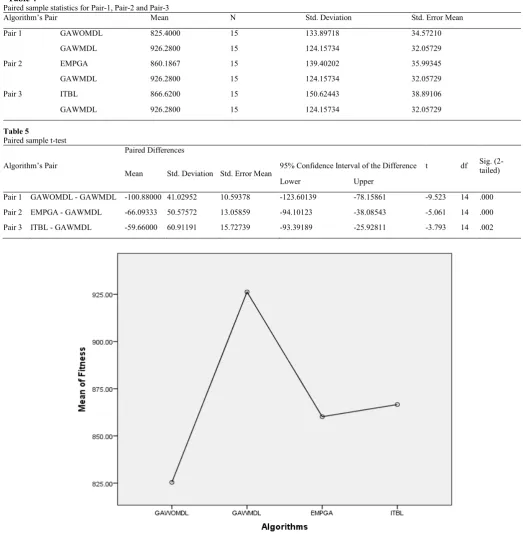
Therefore, a different and more efficient approach to explore the search space is needed, which identify the regularity in the data and simplify the representation (handles the huge number of grammar rules). The GI approach implemented in this paper applies a modified GA with the MDL (GAWMDL) principle that combines with the BMODS to apply reproduction operators. It uses the BBP for breeding in the next generation. The key benefit of implementing the BBP is it introduces the diversity in the population that helps to alleviate the premature convergence (a situation when the diversity of the population decreases, leading to an unwanted convergence and produces a solution which is far from the best solution). The MDL principle is incorporated supports two different operations, namely merge and constructs. These two operations, reduce the burden of handling a large number of grammar rules. In addition, the MDL principle allows the system not to overestimate and it generates samples that are sufficient enough to acquire the basic properties of the language. These features help the proposed GA to converge in a time effective manner. The computational experiments have been conducted on a set of corpus (positive and negative) of RLs and CFLs. The robust experimental environment is developed to perform the experiments. The results have been collected and tested against three algorithms are: GAWOMDL, EMPGA [18] and ITBL [51] [52] [53]. The primary objective of comparing the proposed GA with the EMPGA and ITBL is both of these algorithms were proposed for the CFG induction using the GA. There exist evidences are available proving that the EMPGA handles the situation of the premature convergence successfully [18]. The computational results demonstrate that the proposed GA has outperformed the other algorithms (GAWOMDL, EMPGA and ITBL). The authors have conducted the statistical test to determine the performance significance of the proposed GAWMDL. The paired t-test has been conducted creating three pairs: GAWOMDL-GAWMDL, EMPGA-GAWMDL and ITBL-GAWMDL. The results of the paired t-test concludes that the proposed GAWMDL is statistically significant than the other algorithms.
The rest of the paper is organized as follows: Section 2 presents the background and related work in the GI with pros and cons of the existing approaches. The authors discuss the role of the MDL principle and its connection with the statistical modeling in Section 3. The proposed GAWMDL for the GI has been discussed in a detailed and comprehensive manner in Section 4. A flow chart of the proposed GAWMDL is presented to demonstrate the overall procedure of the GI and the use of the MDL (role of merging and construct) principle. An example is discussed represents the suitability of the MDL principle in the GI and how the GA helps in optimizing the solution. The experimental details, parameters tuning, observations, results, discussion and statistical test’s results are given in Section 5 followed by the concluding remarks for the paper in Section 6. Lastly but not the least the important literatures on the GI, MDL principle and on the model selection are presented in the reference section.
2.Background and related work in grammar induction
to its wide fields of application to solve practical problems in a variety of fields, including compilation and translation, human machine interaction, graphic languages, design of programming language, data mining, computational biology, natural language processing, software engineering and machine learning etc.
The first learning model was proposed by Gold [19]. Gold addressed the question “Is the information sufficient to determine which of the possible languages is the unknown language?” [19]. It was shown that an inference algorithm can identify an unknown language in the limit from the complete information in a finite number of steps. The key issue with the Gold’s approach is that there is no sufficient information present with inference algorithm about the identification of the correct grammar because it is always possible that the next sample may invalidate the previous hypothesis. Angluin [44] has proposed “tell tales” (a unique string makes the difference between languages) to avoid the drawback of the Gold’s model. Although, Gold [19] laid the foundation of the GI, Bunke and Sanfeliu [27] have presented the first usable GI algorithm in syntactic pattern recognition community with the aim to classify and analyze the patterns, classify the biological sequence, and for character recognition, etc. The main drawback of this algorithm was it only deals with positive data, unable to deal with noisy data, does not fit exactly into a finite state machine and therefore good formal language theories were lost.
Stevenson and Cordy [28] [29] explains theorists and empiricists are the two main groups contributing in the field of GI. Language classes and learning models were considered by the theorists group to set up the boundaries of what is learnable and how efficiently it can be learned. On the other hand, the empiricists group dealt with a practical problem by solving it; finally they have made significant contributions in the GI.
The teacher and query is another learning model, where a teacher, also referred as an oracle knows the target languages and is capable to answer a particular type of questions/queries from the inference algorithm. Six types of queries were described by Angluin [45], two of which are membership and equivalence queries, have a significant impact on learning. In case of the membership queries, the inference algorithm presents either “yes” or “no” as an answer to the oracle, whereas an oracle receives “yes” if the hypothesis is true and “no” otherwise by the inference algorithm. Valiant [46] has presented the PAC learning model, which takes the advantages of both the identification of the limit and the
teachers and queries learning models. The PAC learning model is different from the other two former learning models because of two reasons: first, it does not guarantee exact identification with certainty; second, compromise between accuracy and certainty. The problem with the PAC model is that the inference algorithm must learn in polynomial time under all distributions, but it is believed to be too strict in reality. These problems occur because many apparently simple classes are either known to be NP-hard or at least not known to be polynomial learnable for all the distributions [29]. To mitigate this issue, Li et al. [47] has proposed an inference algorithm that considers the simple distribution only.
Apart from the above popular learning models, many researchers have explained the suitability of the NN for the GI. The NN has shown the ability to maintain a temporal internal state like a short term memory [29]. In case of the NN, a set of inputs and their corresponding outputs (Yes: string is in the target language, No: otherwise) and a defined function needs to learn, which describes those input-output pairs [20]. Alex, et al [40] has conducted experiments for the handwriting recognition using the NN and it was explained
that the NN has the capability to predict subsequent elements from an input sequence of elements. Cleeremans et al. [39] has implemented a special case of a recurrent network presented by Elman [41] known a simple RNN to approximate a DFA. Delgado and Pegalajar [42] have presented a multi-objective GA to analyze the optimal size of a RNN to learn from the positive and negative examples. The merits of the SOM have been used to determine the automation, after the completion of the training process. Although, the NN has widely been used for the GI, as it is found good at simulating an unknown function, but found less effective because there is no way to reconstruct the function from the connections in a trained network [29].
A detailed survey of various GI algorithms is presented in [6] [29] [30] [38] [39] [43] [44]. The inductive inference is the process of making generalization from the input (string). Wyard [3] has presented the impact of the different grammatical representation and the experimental result shows that the EA uses standard CFG in BNF has outperformed the others. Thanaruk and Okumaru [20] have classified the grammar induction methods into three major categories, namely; supervised, semi-supervised and unsupervised on the basis of the type of required data. Javed et al. [21] presented a GP based approach to learning the CFG. The work presented in [2] was an extension of the work conducted in [3] applying the grammar specific heuristic operator. In addition, a better construction of the initial population was suggested. Choubey and Kharat [22] have presented a sequential structuring approach that performs coding and decoding of the binary coded chromosomes into terminal and non-terminals and vice-versa. A CFG induction library was presented using the GA, contains various Java classes to perform the GI [8] [23]. Hrncic and Marjan [61] [62] have implemented a MA for the GI that assists the domain experts and software language engineers to develop the DSLs by automatically producing a grammar. Hrncic et al. [63] has proposed an unsupervised incremental learning algorithm using a MA for the DSLs. The authors [74] have proposed a GI approach known as MAGIc (based on the MA), was proposed to extract grammars from DSL examples.
Sakakibara and Kondo [51] have proposed a GA for learning the CFG from a finite sample of positive and negative examples. The authors [51] have used a table similar to the parse table that reduces the partitioning problem of non-terminal and then the GA has been applied to solve the partitioning problem. Jaworski and Unold [52] have brought some improvement, which mainly involve: initial population block size manipulation, block deletes specialized operator and modified fitness function and experimentally proved that the TBLA is not vulnerable to block size and population size, and the ITBL is capable to find the solutions faster. Bhalse and Gupta [53] have applied the ITBL for the GI.
3.Minimum description length principle
The theory of induction [64] [65] says that under the right circumstances learning is “finding a shorter description of the observed data”. The MDL principle suggests choosing the model, which provides the shortest description of data [4]. It works on coding rather on probability. Hence, the focus is about casting a statistical model as a means of generating code, and resulting code lengths. The MDL principle has connections with more traditional frameworks given for the statistical estimation. In classical terms, we are intended to estimate the parameter
θ
of a given model.{
f x
(
n| ) :
θ θ
k}
Equation (1) is based on observations
x
n=
( ... )
x
1x
n . The aim is to chooseθ
ˆ
to maximizef x
θ(
n)
overθ
∈ Θ
. According to the maximum likelihood principleθ
ˆ
’s asymptotic efficiency in the form of repeated sampling under some regularity and handled by Cramer-Rao information lower bound theory in the finite sample case. From a coding point of view, both sender and receiver know which memberf
θof the parametric familyΜ
generated a data stringx
nis simply−
log
2f x
θ(
n)
, since on average code based onf
θ, achieve entropy lower bound. Thenoticeable thing is minimizing
−
log
2f x
θ(
n)
is the same as maximizing, therefore the MDL principle coincides with the maximum likelihood principle in parametric estimation problems. The MDL principle enjoys all the desirable features of the maximum likelihood principle. In case of modeling, one has to transmitθ
, as receiver did not know its value in advance. Adding in this case, we get a code length of the data stringn
x
using equation (2).log
(
n)
( )
MDL
= −
f x
θ+
L
θ
(2)
Now, if the term
L
( )
θ
is constant, then the MDL principle needs a model, which minimizes−
log
f x
θ(
n)
among all the densities in the family. The maximum likelihood principle breaks down when one is forced to choose among nested classes of parametric models. This occurs most noticeably in variable selection for the linear regression.4. Grammatical inference using GA and the MDL principle
The input for the algorithm is a set of
corpus
C
1L=
{ ,
c c
1 2,... ..,
c
ic
L}
.L
is the total length of the corpus,c
iindicates thei
thstring of the corpus set, for eachi
,1
≤ ≤
i
L
. The proposed GA tries to infer a grammar rule. A partial grammar G is defined that contains a set of CFG rules for the training data. G can be described in a somewhat nonstandard way as a set of classes. For every classg
, exactlyone corresponding non-terminal
g
'is present, which is the set of grammar rules with this non-terminal on the left hand side of the production rules. Two basic operations have been performed. First, merge or merge for shorting the production rules. Second, the construction operation, which construct for shorting the production rules. If two production rules are merged, then they have been removed from the G and replaced by a new production rule. The new production rule would be obtained by taking the union of the existing grammar rules. For example, suppose' ' ' ' '
1
{
1 2 4/
3}
g
=
g
→
g g
g
andg
8'=
{
g
5'→
g
7'}
are twoproduction rules belongs to G. Now, if
g
1'andg
8'are merged, itproduces a new production rule
' ' ' ' ' ' '
1 8 2 4 3 7
{
} {
/
/
}
new new
g
=
g
∪
g
=
g
→
g g
g
g
and wewould remove
g
1'andg
8' from G. Re-indexing is done at thisstage to incorporate
g
new. Merging of production rules is found effective and yields better result by decreasing the number of classes. On the other hand, ifg
landg
k are two classes, then a new classg
newis created, which contains just one productionrule
g
new=
{
g
new'→
g g
l' k'}
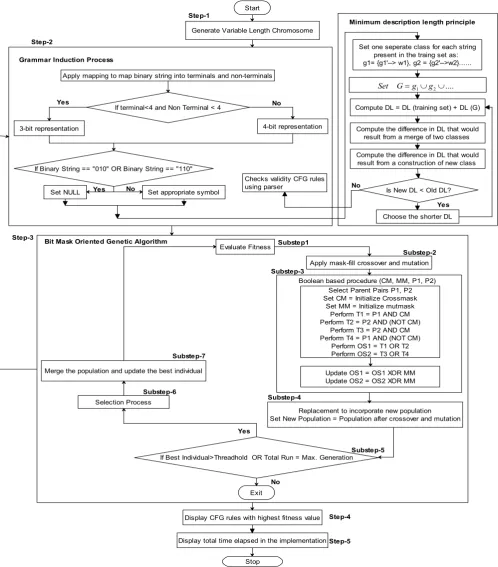
. The working of MDL principle isused for the GI shows these two operations are represented in a separate block in Figure 3.
In order to define a DL for each
c
i∈
C
1L, a system generated code is employed, which uses a unique representation for each training data. Dense code is set, i.e., a sequence of code words which defines a training data [65]. The reason of doing this is that we are interested in representing G in the form of code, but the information theory explains that to arrive at an ideal code (shortest description of training data), one need to keep track of the frequencies of occurrence of the training data in classes belongs inG
[81]. The two operations (merge and construct) are useful reduces the DL.4.1. Genetic algorithm adapted
Pandey et al. [8] has presented a GA for the CFG induction uses the simple 1-point and 2-point crossover and a bit inversion mutation operator to introduce the diversity during the execution of the GA. The authors [7] [23] have proposed a Java based library for the GI uses the GA. The algorithm implemented in [7] [8] [23] works successfully for the relatively simple and deterministic CFG induction, but has been found incapable for the complex corpus. In addition, these approaches were not focused towards handling premature convergence in the GA.
In this paper, we have implemented an algorithm GAWMDL for the CFG induction. The proposed GAWMDL is different from the other approaches as it uses the BMODS to perform the reproduction operations [10]. The breeding process is also very different than the former approaches as the proposed GAWMDL incorporates the BBP uses the Boolean based operators (substep-3 in Figure (substep-3), which not only generates the new offspring’s, but also alleviates the risk of premature convergence [30] by introducing the diversity in the population. The proposed GAWMDL algorithm uses the merit of the MDL principle, is employed maintains the regularity and generalization in the training data according the DL (Figure 3).
The e-GRIDS learning model have been proposed, also uses the MDL principle for the generalization and specialization of the training data [50]. The working of the e-GRIDS model is based on the simplicity uses the beam search, which start constructing the initial grammar for each input sentence and then apply the e-GRIDS learning operators, includes MergeNT, CreateNT and
Create OptionalNT. The workings of these operators are discussed in [50]. The key drawback of the e-GRIDS learning model are: it is not fit for the negative examples, the beam search has been used in the learning process uses three operators as discussed above, but implementing these operators and collecting the temporary results makes it ineffective. On the other hand, the proposed GAWMDL algorithm is more powerful as it is capable to deal with both positive and negative training data. The MDL principle increases the effectiveness of the proposed algorithm as it supports in generalization and specialization of the training data. The training set and test set are required for the learning has been generated by the length L (or DL) (L = 0, 1, 2, ……) such that it covers all the possible valid strings of the length L until the sufficient number of the valid strings of corpus that has been generated. The invalid strings generated during this process are considered as the negative strings.
Start
Generate Variable Length Chromosome
Apply mapping to map binary string into terminals and non-terminals
If terminal<4 and Non Terminal < 4
3-bit representation 4-bit representation
If Binary String == "010" OR Binary String == "110"
Set NULL Grammar Induction Process
Evaluate Fitness
If Best Individual>Threadhold OR Total Run = Max. Generation
Apply mask-fill crossover and mutation
Select Parent Pairs P1, P2 Set CM = Initialize Crossmask
Set MM = Initialize mutmask Perform T1 = P1 AND CM Perform T2 = P2 AND (NOT CM)
Perform T3 = P2 AND CM Perform T4 = P1 AND (NOT CM)
Perform OS1 = T1 OR T2 Perform OS2 = T3 OR T4
Update OS1 = OS1 XOR MM Update OS2 = OS2 XOR MM Boolean based procedure (CM, MM, P1, P2)
Replacement to incorporate new population Set New Population = Population after crossover and mutation Selection Process
Merge the population and update the best individual
Exit Bit Mask Oriented Genetic Algorithm
Display CFG rules with highest fitness value
Display total time elapsed in the implementation
Stop Step-1
Step-2
Step-3
Substep1
Substep-2
Substep-3
Substep-4
Substep-5 Substep-6
Substep-7
Step-4
Step-5 No
Yes
Yes
Yes
No Set appropriate symbol
No
Set one seperate class for each string present in the traing set as: g1= {g1'--> w1}, g2 = {g2'-->w2}...
1 2 ....
Set G=g ∪g ∪
Compute DL = DL (training set) + DL (G)
Compute the difference in DL that would result from a merge of two classes
Compute the difference in DL that would result from a construction of new class
Is New DL < Old DL?
Choose the shorter DL Checks validity CFG rules
using parser
Yes No
Minimum description length principle
[image:5.595.49.548.50.618.2]CM: crossmask, MM: mutmask, T1, T2, T3, T4: Temporary variables, OS1, OS2: offspring, DL: Description length, G: Partial grammar set, g: Grammar class, P1, P2: Parents
Fig. 3. Grammatical inference using GA and MDL principle
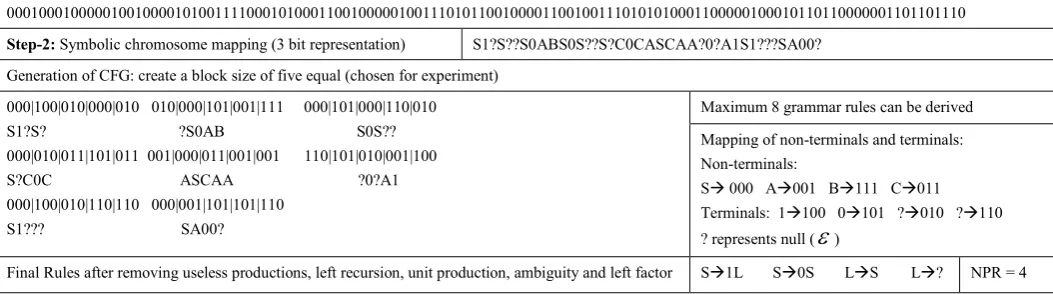
During the mapping process, if the string “010” or “110” is encountered, set null (
ε
). After the completion of the mapping process, the process of the construction of the CFG starts with the start symbol ‘S’ mapped at “000”. The symbolic representation contains the block size of five equal to the PRL (PRL = 5). The symbolic grammar is traced from ‘S’ to terminal to remove useless productions and the remaining production rules are tested for removal of left recursion, unit production, ambiguity and left factor. During the grammar rule generation, the MDL principle is used in generating the code for the grammar and to perform operations: merging and construct to reduce the complexity (see section 4).Mapping process for palindrome over (0 + 1)*
Step-1: Binary Chromosome of size 120 (initial random population)
000100010000010010000101001111000101000110010000010011101011001000011001001110101010001100000100010110110000001101101110
Step-2: Symbolic chromosome mapping (3 bit representation) S1?S??S0ABS0S??S?C0CASCAA?0?A1S1???SA00?
[image:6.595.35.562.83.230.2]Generation of CFG: create a block size of five equal (chosen for experiment)
000|100|010|000|010 010|000|101|001|111 000|101|000|110|010
S1?S? ?S0AB S0S?? 000|010|011|101|011 001|000|011|001|001 110|101|010|001|100 S?C0C ASCAA ?0?A1 000|100|010|110|110 000|001|101|101|110
S1??? SA00?
Maximum 8 grammar rules can be derived
Mapping of non-terminals and terminals: Non-terminals:
S 000 A001 B111 C011
Terminals: 1100 0101 ?010 ?110
? represents null (
ε
)Final Rules after removing useless productions, left recursion, unit production, ambiguity and left factor S1L S0S LS L? NPR = 4
Fig. 4. Demonstration of step-2 of the algorithm (coding and decoding mechanism adapted)
*(( ) ( )) (2* )
Fitness=
∑
K APS RNS+ − ANS RPS+ + K NPR− (3)S.T.
ANS + RNS ≤ Number of positive samples in corpus data
ANS + RPS ≤ Number of negative samples in corpus data
NPR: maximum number of allowable grammar rules
K: constant
Computing Fitness: suppose the CS is equal to 120 is taken, which derives a maximum 8 grammar rules (Figure 4). In the present scenario, 25 each positive and negative sample string are found sufficient to generate the best possible production rules. In an ideal situation, we have assumed that the system is not rejecting any positive strings and not accepting any negative sample strings, then the value of ANS = RPS = 0. In the example that have been presented in Figure 4, the value of NPR = 4 is considered. K is a constant (K = 10), taken, so that the grammar has less production rules with high fitness value can be created.
Putting these values in equation (3), we get 516 ((10*(25 + 25) - (0 + 0)) + (2 * 10 - 4)), which is the fitness value in the first generation. At this stage, evolutionary operation (crossover, mutation and selection) takes place finds an optimal solution in a generative manner. The important thing to note here is, K = 10 is considered to conduct the experiment and any increase in K, would lead to high value of fitness by that factor. But as per the CS (CS = 120), only 8 grammar rules can be extracted. Further, substitution/break for the removal of left recursion and other pre-processing leads to at most of additional 4-5 rules approximately. Therefore, K = 10 (i.e. 2K = 20) is considered that differentiate between various grammar based on the number of rules. As discussed, an increase in K will produce high fitness value, but it will be just for the sake of increasing the fitness value and not for representing the difference between various grammars. Hence, K = 10 is sufficient in this process to determine the optimum production rules. If the CS is increased to produce more grammar rule, a higher value of K might be taken, but there is no need of doing this because by setting K =10, the same task can be done satisfactorily.
Step-3 shows the main functions of the proposed GAWMDL. It utilizes the BMODS [10] to improve the capability of the crossover and mutation operations, replaces various algorithms and codifies specialized rules of mating, supports a formal separation between searching for a proper bit composition and an effective achievement of the offspring’s. The previous research signifies that the binary code based GA can be grouped into an explicit and implicit binary formulation [11]. On the other hand, in bit masking scheme, there is no need to use an explicit data structure, since only high level operations, working on an integer values are mapped into a discrete representation domain are executed. Iuspa [10] has presented a detailed description about
the construction of the BMODS. Two integer arrays known as CM and MM are used to perform the crossover and mutation operations.
For the creation of the BMODS an integer genome array has been formed, where a set of integer values are linked with the design variables. The binary image has been used to represent the masks and is used to generate the CM and MM. The following convention has been made to represent a binary image for the CM: high value, i.e. one or true for the current image bit is a pointer to the first parent while low value i.e. zero or false is a pointer to the second parent. Similarly, for the MM an integer sequence has been used that indicates its binary image using the following convention: “if the pointed bit of the target string has to be inverted (i.e. high value) or not (i.e. low value)”. In order to create a generic child individual a vector function
1 2
( ,
,
,
)
f P P CM MM
has been used takes four arguments:1
P
,P
2,CM
andMM
.The implementation of the BMODS for any real life problem is a two-step process: first apply crossover and mutation mask-fill operation and then apply mask application on the selected parent strings. Three crossovers (cut crossover, bit-by-bit and local cut) and a mutation (mutation mask-fill: similar to an inverted mutation has been applied based on a specific mutation rate) operations are applied as suggested in [10].
At substep-2 and 3, the mask-fill reproduction operators are applied and then the BBP. The key challenge in applying a GA is how to handle the premature convergence – a situation when the diversity of the population decreases leads the GA’s search to a local optimum convergence. The BBP is found capable of introducing the diversity in the population in a generative manner that helps in avoiding the premature convergence.
The process of generating a new offspring’s takes place at substep-3. A couple of parent strings have been selected using an appropriate selection method. The authors have applied the roulette wheel selection technique for the GAWMDL. Two complementary child vectors, as to crossover operation are generated applying equation (4).
1 1
( ,
1 2,
,
)
OS
=
f P P CM MM
2 2
( ,
1 2,
,
)
OS
=
f P P CM MM
(4)
Fig. 5. Demonstration of a new offspring generation after applying genetic reproduction of the GAWMDL
Positive
"10","1010","101010","10101010", "1010101010","101010101010",
... Negative
"1","0","11","00","01","101", "100","1011",...
S->M M->? M->11M S->10B B->SS B->0 S->C0C S->A0 C->ASA A->0
S->CI S->1CSM M->S0SM M->? I->SM I->M C->010A A->1 S->M M->A1M M->? A->?
S->M 00S->A0SSM M->BSM M->? B->1S A->1S0
...
S->? S->10
S->C 0 A M M->? M->1 C M C->AA1 C->0S A->10 S->M M->CM M->? C->1S0S
...
S->10M M->SM M->? (1013) NPR= 3 S->M M->CM M->? C->1S0S (1012) NPR= 4 S->1C0M M->SM M->? C->? (1012) NPR= 4 S->10M M->SL M->? L->SM L->M (1011) NPR= 5
S->C M->CM M->? C->10M (1012) NPR= 4 S->? S->10S (1014) NPR= 2
Complex Grammar at Initial Stage of Evolution Sample Space (Training Data) L1: (10)*
CFG Rules Good fit to the data with fitness CFG Rules Good fit to the data with fitness
Simple but non-Constraint CFG
Rules at intermediate stage Good CFG Rules with best
fitness value at final stage
1 2
3 4
Fig.6. Demonstration of MDL principle (for L1 = (10)*) which says that “more we are able to compress the data implies that we learned more” (NPR: Number of production rules)
The arguments CM and MM are used to find the suitable crossover scheme (cut crossover, bit-by-bit and local cut) and mutation rule (mutation mask-fill). For the sake of simplicity equation (4) can be converted into a new form to show both crossover and mutation operations separately. Equation (5) represents the crossover vector and a binary image that allows
1
P
orP
2 to a child bit transfer according to the correlated CM value.1
(
1)
(
2(
))
OS
=
P ANDCM OR P AND NOTCM
2
(
2)
(
1(
))
OS
=
P ANDCM OR P AND NOTCM
(5)
Equation (6) expresses the mutation operation has been derived from the equation (4), under the situation that a single MM vector of both child strings is set.
j i
OS
=
OS XORMM
(6)The step-by-step mechanism of generating a new offspring is depicted at Substep-3 (Figure 3), whilst Figure 5 demonstrates the process of offspring creation using an example.
The interesting thing to note at this stage is as the CM and MM vectors have been considered as an argument to the function (f1 and f2), a new individual has no strict correlation with the
specific type of the crossover scheme or parent pairs as happen in case of an explicit binary formulation. In some specific case, if the evolutionary process is needed for some couples for an identical crossover such as bit-by-bit crossover with a constant seed, then only that operation is performed and fill the mask properly, then apply equation (5) multiple times, changing the selected parent pairs only.
An individual population is updated with its fitness value (substep-4) and then merges them. This process has been repeated until the termination condition (maximum number of generations or threshold (threshold indicates the highest rank solution’s fitness)) is reached. This stopping criterion is common for each language input. Finally, display the best production rules and the processing time.
4.2.The MDL principle in the GI: an example
An example of L1 = (10)* is presented demonstrates the applicability of the MDL principle in maintaining the regularity of the data (Figure 6).
1) First ellipse indicates the sample space of the positive and negative training data for L1 = (10)*.
2) Initially, we get very complex CFG rules with a very less fitness value which can be refined by applying the proposed GA’s reproduction operator in each generation, where the MDL principle helps in compressing the grammar rules and
P 1 1 0 0 1 0 0 0 0 1 0 1 1 1 0 1 1 1 1 0 0 0 1 1 0 0 0 0 0 0 0 0 0 P 2 1 1 0 1 0 1 1 0 1 1 0 1 1 0 0 1 0 1 0 1 0 1 1 1 0 1 0 1 0 0 1 1
C M 1 1 1 1 1 1 1 1 1 1 1 1 1 1 1 1 1 1 1 1 1 1 1 1 0 0 0 0 0 0 0 0 T 1 = P 1 A N D C M
T 1 1 0 0 1 0 0 0 0 1 0 1 1 1 0 1 1 1 1 0 0 0 1 1 0 0 0 0 0 0 0 0 0 T 2 = P 2 A N D ( N O T C M )
T 2 1 0 0 1 0 0 0 0 1 0 1 1 1 0 1 1 1 1 0 0 0 1 1 0 0 0 0 0 0 0 0 0 OF F S P R I N G1 = T 1 O R T 2
O S 1 1 0 0 1 0 0 0 0 1 0 1 1 1 0 1 1 1 1 0 0 0 1 1 0 0 0 0 0 0 0 0 0
M M 0 0 0 0 0 1 0 0 0 0 0 0 0 0 0 0 0 0 0 1 0 0 1 0 0 0 0 0 0 0 0 0 OF F S P R I N G A F T E R M U T A T I O N = O F F S P R I N G1 X O R M M
O S 1 1 0 0 1 0 1 0 0 1 0 1 1 1 0 1 1 1 1 0 1 0 1 0 0 0 1 0 0 1 1 1 1 O S 2 1 1 0 1 0 0 1 0 1 1 0 1 1 0 0 1 0 1 0 0 0 1 0 1 0 0 0 0 0 0 0 0
8
to generate positive and negative string set required during the execution.
3) After a few generations, simple grammar, but non-constraint CFG rules have been received.
4) But, when the proposed GAWMDL search reaches to the threshold/termination condition, it produces grammar’s rule and maximum fitness value. Such grammars are assumed as a well CFG rules with best fitness value.
5) In the fourth ellipse six CFG rules are provided: first CFG rules have NPR = 3, fitness value =1013. In second, third and fifth CFG, NPR = 4, fitness value = 1012 but the noticeable thing is the rules generated are different from the same language. At fourth CFG, NPR = 5, fitness value = 1011. In case of sixth CFG, NPR = 2, fitness value = 1014, indicates that the MDL principle has compressed the data more in the case of sixth CFG rules with a maximum fitness value and therefore the system has learned more.
In the present scenario, for selecting the corpus, strings of terminals are generated for the length ‘L’ for the given language. Initially, L = 0 is chosen, which gradually increases up to the required length to represent the language features. Here, a corpus of twenty five each positive and negative string is found to be sufficient to represent the selected languages L1 - L13 for the CFG induction.
5.Simulation model
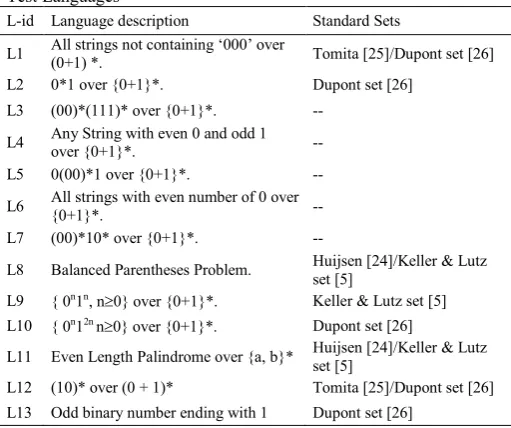
[image:8.595.35.291.411.625.2]The computational experiments have been conducted on a set of RLs and CFLs (L1 through L13) as listed in Table 1. The Java programming on Net Beans IDE 7.0.1, Intel CoreTM 2processor (2.8 GHz) with 2 GB RAM have been used.
Table 1 Test Languages
L-id Language description Standard Sets
L1 All strings not containing ‘000’ over
(0+1) *. Tomita [25]/Dupont set [26]
L2 0*1 over {0+1}*. Dupont set [26]
L3 (00)*(111)* over {0+1}*. --
L4 Any String with even 0 and odd 1
over {0+1}*. --
L5 0(00)*1 over {0+1}*. --
L6 All strings with even number of 0 over {0+1}*. --
L7 (00)*10* over {0+1}*. --
L8 Balanced Parentheses Problem. Huijsen [24]/Keller & Lutz set [5]
L9 { 0n1n, n≥0} over {0+1}*. Keller & Lutz set [5] L10 { 0n12n n≥0} over {0+1}*. Dupont set [26]
L11 Even Length Palindrome over {a, b}* Huijsen [24]/Keller & Lutz set [5]
L12 (10)* over (0 + 1)* Tomita [25]/Dupont set [26] L13 Odd binary number ending with 1 Dupont set [26]
5.1.Parameter Tuning
An extensive control parameter tuning is performed. The orthogonal array with Taguchi SNR [66] [67] [68] [69] is applied in the tuning process that helps in the well balanced experiment design. The Taguchi SNR is a log function of the desired output serves as an objective function for the optimization helps in data analysis and prediction of an optimum result. Equation (7) has been used to evaluate the SNR.
2
1
10 log
u
N u i
u i
y
SNR
N
=
= −
∑
(7)Where, i = experiment number, u = trial number, Ni = number of trials for the experiment, and yu= number generations taken in each trial to reach to the solution.
The GA’s performance is largely depends PS, CS, CR and MR. During the tuning process four control factors with three levels PS = [120, 180, 360], CS = [120, 240, 280], CR = [0.3, 0.7, 0.9], and MR = [0.2, 0.5, 0.8] have been used, where following setting gave the best results PS: CS: CR: MR = [120:120: 0.9: 0.8]. The maximum number of generations = 500 is taken for the experimentations.
5.2.Performance Comparison
The authors have compared the performance of the proposed GAWMDL with the GAWOMDL, ITBL and EMPGA. The ITBL and EMPGA have been considered for the comparison purpose as both the algorithms were applied to the CFG induction. The EMPGA was mainly proposed to alleviate the premature convergence [18]. As the authors have made the claim that the proposed GAWMDL is capable of handling the premature convergence (as the mask-fill reproduction operators and the BBP introduces diversity in the offspring’s) leads to compare the performance of the proposed GAWMDL against an algorithm (in our case EMPGA) that introduces diversity in the offspring. The same computational environment has been set up for each algorithm.
5.3.Results and Discussion
The experimental results show that the GAWMDL is capable in the CFG induction. The MDL principle is found effective in identifying the correct sample string from the corpus with a minimum DL (Figure 6). The GA is a stochastic search technique; therefore results are collected at an average of ten runs. The resultant grammar rule is validated against the best known available grammar rules are represented via the standard representation
<
V
, , ,
∑
P S
>
. Table 2 represents the grammar rules received, fitness value and NPRs.In order to evaluate the performance of the proposed GAWMDL, a comparative analysis has been conducted as depicted in Table 3. The results have been reported shows that the performance has vastly improved in the case of the GAWMDL. Table 3 shows generation range, threshold value, mean and standard deviation for each language L1 through L13. As discussed, the results are collected at an average of the first successful ten runs. The number of generations has been taken over ten runs varies, therefore generation range is given. The phenomenon involved with generation range can be understood with the help of an example: the generation range for L1 in case of “GAWO MDL” is 21 ± 10 indicates that generations taken over ten runs varies between 11 (21-10) and 31 (21 +10), similarly for others. The mean and standard deviation for the GAWMDL concludes that the convergence rate is faster than other algorithms. Also, the convergence rate of the ITBL and EMPGA is considerably good, whilst the convergence rate of the GAWOMDL is worst.
L1 L2
L3 L4
L5 L6
L7 L8
10
L11 L12
[image:10.595.76.538.48.356.2]L13
[image:10.595.42.557.399.542.2]Fig 7. Fitness Vs. generation charts w.r.t. proposed approches for each algorithm implemented
Table 2
Resultant grammar rules with fitness value and number of production rules
L-id Fitness Grammar
<
V
, , ,
∑
P S
>
NPRL1 1011 <{S,C,M}, {0, 1}, {SCCM, M?, M1SM, C?, C0}, S> 5
L2 1014 <{S}, {0, 1}, {S1, S 0S}, S> 2
L3 1013 <{S}, {0, 1}, {S?, S11S1, S00S}, S> 3
L4 1011 <{S, M}, {0, 1}, {S1M, S0SM, MSSM, M?, M0M}, S> 5
L5 1013 <{S, C}, {0, 1}, {SC, S00S, C01}, S> 3
L6 1012 <{S, C}, {0, 1}, {SC, S1S, S 0S, C0}, S> 4
L7 1012 <{S, M}, {0, 1{, {S1M, S00SM, M?, M0M 4
L8 1014 <{S}, {(, )}, {S?, S (S)S}, S> 2
L9 1014 <{S}, {0, 1}, {S?, S0S1}, S> 2
L10 1012 <{S, A}, {0, 1}, {SA11, S 1, S011, A0S}, S> 4
L11 1013 <{S}, {a, b}, {SbSb, SaSa, S?}, S> 3
L12 1014 <{S}, {0, 1}, {S?, S10S}, S> 2
L13 1012 <{S, M}, {0, 1}, {S1M, S0SM, MSM, M?}, S> 4
NPR: number of production rules
Table 3
Comparative analysis of GA with and without MDL
L-id GAWOMDL GAWMDL ITBL EMPGA
Th GR µ σ Th GR µ σ Th GR µ σ Th GR µ σ
L1 30 21±10 22.6 5.7 27 15±11 15.4 4.5 28 18±8 20.7 4.3 31 24±9 24.8 6.2
L2 16 9±7 8.3 3.85 12 6±4 5.3 4.3 19 10±7 6.2 3.4 18 13±5 11.6 4.89
L3 21 26±16 26.3 8.95 17 24±15 23.2 6.78 18 28±15 27.5 8.24 25 30±12 30.4 9.5
L4 33 21±11 18.7 6.3 30 19±10 16.6 5.8 29 19±12 16.4 5.8 37 26±14 21.8 7.41
L5 44 12±9 10.45 5.46 39 9±7 8.53 4.8 47 13±11 10.9 5.62 51 15±8 11.9 12.02
L6 18 14±9 14.9 4.8 13 12±7 12.83 3.4 13 12±9 12.5 3.9 23 18±8 17.5 5.86
L7 19 18±13 21.3 8.91 16 15±8 18.8 6.24 16 19±8 22.8 7.3 26 21±7 20.2 10.61
L8 16 8±7 8.2 3.64 9 6±4 6.7 3.2 18 7±5 6.6 3.2 19 13±10 9.7 5.9
L9 15 7±4 3.6 1.24 11 5±3 3.46 1.03 14 8±5 5.6 2.3 21 10± 6 5.3 3.54
L10 22 33±24 21.63 14.83 17 30±22 19.8 12.6 26 37±25 20.2 15.9 27 38±26 27.4 16.2
L11 16 30±19 32.4 10.08 12 29±15 29.23 8.6 19 27±21 30.3 27.8 22 42±21 35.4 18.3
L12 10 7±4 4.8 1.235 8 5±3 3.8 1.12 7 9±5 3.2 2.7 16 11±8 4.8 3.5
L13 24 14±8 12.3 5.3 12 12±6 10.9 4.6 21 13±9 11.2 6.7 31 18±9 13.5 7.6
[image:10.595.48.551.575.763.2]Table 4
Paired sample statistics for Pair-1, Pair-2 and Pair-3
Algorithm’s Pair Mean N Std. Deviation Std. Error Mean
Pair 1 GAWOMDL 825.4000 15 133.89718 34.57210
GAWMDL 926.2800 15 124.15734 32.05729
Pair 2 EMPGA 860.1867 15 139.40202 35.99345
GAWMDL 926.2800 15 124.15734 32.05729
Pair 3 ITBL 866.6200 15 150.62443 38.89106
[image:11.595.35.559.57.592.2]GAWMDL 926.2800 15 124.15734 32.05729
Table 5
Paired sample t-test
Algorithm’s Pair
Paired Differences
t df Sig.
(2-tailed) Mean Std. Deviation Std. Error Mean
95% Confidence Interval of the Difference
Lower Upper
Pair 1 GAWOMDL - GAWMDL -100.88000 41.02952 10.59378 -123.60139 -78.15861 -9.523 14 .000
Pair 2 EMPGA - GAWMDL -66.09333 50.57572 13.05859 -94.10123 -38.08543 -5.061 14 .000
Pair 3 ITBL - GAWMDL -59.66000 60.91191 15.72739 -93.39189 -25.92811 -3.793 14 .002
Fig. 8. Profile Plot for estimated marginal means of fitness for each approach
5.4.Statistical Tests
A statistical test has been conducted to evaluate the performance significance of the proposed GAWMDL with the GAWOMDL, ITBL and EMPGA. The paired t-test is conducted on the collected sample considering the hypothesis: “there is no significant difference in the mean of samples at the 5% level of confidence” i.e.
0
:
1 2 3 4H
µ
=
µ
=
µ
=
µ
:
A
H
µ
1≠
µ
2≠
µ
3≠
µ
4A paired t-test is applied to compare the two sample means. Three pairs: pair-1 (GAWOMDL-GAWMDL), pair-2 (EMPGA-GAWMDL) and pair-3 (ITBL-(EMPGA-GAWMDL) have been formed to
conduct the paired t-test. Table 4 represents the paired sample statistics for Pair-1, 2 and 3 respectively. Total 15 (N = 15) samples have been drawn from each algorithm. The average fitness value for the proposed GAWMDL is 926.2800 higher than the others 825.4000, 860.1867 and 866.6200 have been received respectively for the GAWOMDL, EMPGA and ITBL. The main result of the paired t-test is presented in Table 5.
12
EMPGA and ITBL). Figure 8 shows the mean fitness value for each algorithm. The X-axis and Y-axis are represented respectively the algorithms and estimated marginal mean fitness value. From Figure 8, it can also be seen that the proposed GAWMDL has shown the highest average fitness value as compared to the other algorithms.
6.Conclusions
In this paper, we have developed a GAWMDL for the CFG induction uses the BMODS to perform the crossover and mutation operations creating CM and MM. The BBP has been used to create an offspring in the next generation. The proposed GA uses the MDL principle to generate a corpus of positive and negative strings up to an appropriate length. A more robust experimental environment has been designed using an orthogonal array and the Taguchi SNR method.
The authors have used 3-levels and four factors during the robust experimental design process. The computational experiments have been performed in various languages of varying complexities (Table 1). The results reported have demonstrated the capability of the proposed algorithm for the GI. Also, it is important to note that the Boolean based operators introduce the diversity in the population in a generative manner that helps the proposed GAWMDL to alleviate the premature convergence. The performance of the proposed GAWMDL has been evaluated against three algorithms: GAWOMDL, EMPGA and ITBL. The EMPGA has been considered in the comparison, mainly because it was proposed to alleviate the premature convergence within the GA and has been applied for the GI. On the other hand, the ITBL focusses on the CFG induction. The comparative results have demonstrated the superiority of the proposed GAWMDL over the other algorithms (GAWOMDL, EMPGA and ITBL). The statistical test (paired t-test) has been conducted. The pairs (pair-1, 2, and 3) have been formed to conduct the tests conclude that the proposed GAWMDL is statistically significantly different than the other methods. One thing more to note at this stage is: the performance of the EMPGA and ITBL is almost similar, whilst the GAWOMDL has shown the worst performance. Overall, a GA based GI system has been proposed using the MDL principles for the generalization and specialization of the training data.
7.References
1. Holland, John H. Adaptation in natural and artificial systems: an introductory analysis with applications to biology, control, and artificial intelligence. MIT press, 1992.
2. Goldberg, David E. "Genetic algorithms in search, optimization, and machine learning." (1989).
3. P. Wyard, Representational issues for context-free grammar induction using 431 genetic algorithm, in: in Proceedings of the 2nd International Colloquium on 432 Grammatical Inference and Applications, Lecture Notes in Artificial Intelli-433 gence, vol. 862, 1994, pp. 222–235 434 4. Hansen, Mark H., and Bin Yu. "Model selection and the principle of
minimum description length." Journal of the American Statistical Association 96.454 (2001): 746-774.
5. Keller, Bill, and Rudi Lutz. "Evolving stochastic context-free grammars from examples using a minimum description length principle." 1997 Workshop on Automata Induction Grammatical Inference and Language Acquisition. 1997.
6. Sakakibara, Yasubumi. "Recent advances of grammatical inference."Theoretical Computer Science 185.1 (1997): 15-45. 7. Choubey, Nitin Surajkishor, Hari Mohan Pandey, and M. U. Kharat.
"Developing Genetic Algorithm Library Using Java for CFG Induction." International Journal of Advancements in Technology 2.1 (2011): 117-128.
8. Pandey, Hari Mohan, Anurag Dixit, and Deepti Mehrotra. "Genetic algorithms: concepts, issues and a case study of grammar induction." Proceedings of the CUBE International Information Technology Conference. ACM, 2012.
9. Sivaraj, R., and T. Ravichandran. "A REVIEW OF SELECTION METHODS IN GENETIC ALGORITHM." International Journal of Engineering Science & Technology 3.5 (2011).
10. Iuspa, Luigi, and Francesco Scaramuzzino. "A bit-masking oriented data structure for evolutionary operator’s implementation in genetic algorithms." Soft Computing 5.1 (2001): 58-68.
11. Michalewicz, Zbigniew. Genetic algorithms+ data structures= evolution programs. Springer, 1996.
12. Rissanen, Jorma. "Modeling by shortest data description." Automatica 14.5 (1978): 465-471.
13. Hlynsson, Höskuldur. "Transfer learning using the minimum description length principle with a decision tree application." (2007).
14. Jonyer, Istvan, Lawrence B. Holder, and Diane J. Cook. "MDL-based context-free graph grammar induction and applications." International Journal on Artificial Intelligence Tools 13.01 (2004): 65-79.
15. Saers, Markus, Karteek Addanki, and Dekai Wu. "Iterative rule segmentation under minimum description length for unsupervised transduction grammar induction." Statistical Language and Speech Processing. Springer Berlin Heidelberg, 2013. 224-235.
16. Lee, Kyuhwa, Tae-Kyun Kim, and Yiannis Demiris. "Learning action symbols for hierarchical grammar induction." Pattern Recognition (ICPR), 2012 21st International Conference on. IEEE, 2012.
17. De Jong, Kenneth Alan. "Analysis of the behavior of a class of genetic adaptive systems." (1975).
18. Choubey, Nitin, and Madan Kharat. "Approaches for Handling Premature Convergence in CFG Induction Using GA." Soft Computing in Industrial Applications (2011): 55-66.
19. Gold, E. Mark. "Language identification in the limit." Information and control10.5 (1967): 447-474.
20. Theeramunkongy, Thanaruk, and Manabu Okumuray. "Grammar acquisition and statistical parsing by exploiting Local Contextual Information." Journal of Natural Language Processing Vol 2.3 (1995). 21. Javed, Faizan, et al. "Context-free grammar induction using genetic
programming." Proceedings of the 42nd annual Southeast regional conference. ACM, 2004.
22. Choubey, N. S., and M. U. Kharat. "Sequential structuring element for CFG induction using genetic algorithm." International Journal of Futuristic Computer Application 1 (2010).
23. Pandey, Hari Mohan. "Context free grammar induction library using Genetic Algorithms." Computer and Communication Technology (ICCCT), 2010 International Conference on. IEEE, 2010.
24. Huijsen, Willem-Olaf. "Genetic grammatical inference." CLIN IV: Papers from the Fourth CLIN Meeting. 1993.
25. Tomita, Masaru. "Dynamic construction of finite-state automata from examples using hill-climbing." Proceedings of the fourth annual cognitive science conference. 1982.
26. Dupont, Pierre. "Regular grammatical inference from positive and negative samples by genetic search: the GIG method." Grammatical Inference and Applications. Springer Berlin Heidelberg, 1994. 236-245. 27. Bunke, Horst, and Alberto Sanfeliu, eds. Syntactic and structural
pattern recognition: theory and applications. Vol. 7. World Scientific, 1990.
28. Stevenson, Andrew, and James R. Cordy. "Grammatical inference in software engineering: An overview of the state of the art." Software Language Engineering. Springer Berlin Heidelberg, 2013. 204-223. 29. Stevenson, Andrew, and James R. Cordy. "A Survey of Grammatical
Inference in Software Engineering." Science of Computer Programming (2014).
30. Pandey, Hari Mohan, Ankit Choudhary, and Deepti Mehrotra. "A Comparative Review of Approaches to Prevent Premature Convergence in GA." Applied Soft Computing (2014).
31. Pullum, Geoffrey K. "Learnability, hyperlearning, and the poverty of the stimulus." Proceedings of the Annual Meeting of the Berkeley Linguistics Society. Vol. 22. No. 1. 2012.
32. Angluin, Dana, and Carl H. Smith. "Inductive inference: Theory and methods."ACM Computing Surveys (CSUR) 15.3 (1983): 237-269. 33. Fu, King Sun. Syntactic pattern recognition and applications. Vol. 4.
Englewood Cliffs: Prentice-Hall, 1982.
34. Harrison, Michael A. Introduction to formal language theory. Addison-Wesley Longman Publishing Co., Inc., 1978.
35. Lang, Kevin J. "Random DFA's can be approximately learned from sparse uniform examples." Proceedings of the fifth annual workshop on Computational learning theory. ACM, 1992.
36. Oliveira, Arlindo L., ed. Grammatical Inference: Algorithms and Applications: 5th International Colloquium, ICGI 2000, Lisbon, Portugal, September 11-13, 2000 Proceedings. No. 1891. Springer, 2000.