Using Domain Knowledge about Medications to Correct Recognition Errors
in Medical Report Creation
Stephanie Schreitter Alexandra Klein Johannes Matiasek
Austrian Research Institute for Artificial Intelligence (OFAI)
Freyung 6/6 1010 Vienna, Austria
Harald Trost
Section for Artificial Intelligence Center for Med. Statistics, Informatics,
and Intelligent Systems Medical University of Vienna
Freyung 6/2 1010 Vienna, Austria
Abstract
We present an approach to analysing auto-matic speech recognition (ASR) hypotheses for dictated medical reports based on back-ground knowledge. Our application area is prescriptions of medications, which are a fre-quent source of misrecognitions: In a sam-ple report corpus, we found that about 40% of the active substances or trade names and dosages were recognized incorrectly. In about 25% of these errors, the correct string of words was contained in the word graph. We have built a knowledge base of medications based on information contained in the Unified Med-ical Language System (UMLS), consisting of trade names, active substances, strengths and dosages. From this, we generate a va-riety of linguistic realizations for prescrip-tions. Whenever an inconsistency in a pre-scription is encountered on the best path of the word graph, the system searches for alter-native paths which contain valid linguistic re-alizations of prescriptions consistent with the knowledge base. If such a path exists, a new concept edge with a better score is added to the word graph, resulting in a higher plausi-bility for this reading. The concept edge can be used for rescoring the word graph to obtain a new best path. A preliminary evaluation led to encouraging results: in nearly half of the cases where the word graph contained the cor-rect variant, the corcor-rection was successful.
1 Introduction
Automatic speech recognition (ASR) is widely used in the domain of medical reporting. Users appreciate
the fact that the records can be accessed immediately after their creation and that speech recognition pro-vides a hands-free input mode, which is important as physicians often simultaneously handle documents such as notes and X-rays (Alapetite et al., 2009). A drawback of using ASR is the fact that speech-recognition errors have to be corrected manually by medical experts before the resulting texts can be used for electronic patient records, quality control and billing purposes. This manual post-processing is time-consuming, which slows down hospital work-flows.
A number of recognition errors could be avoided by incorporating explicit domain knowledge. We consider prescriptions of medications a good start-ing point as they are common and frequent in the various medical fields. Furthermore, they contain trade names and dosages, i.e. proper names and dig-its, which are frequently misrecognized by ASR in all domains.
For our approach, we have extracted and adapted information about medications from the Unified Medical Language System (UMLS) (Lindberg et al., 1993). This data contains information about trade names, active substances, strengths and dosages and can easily be modified, e.g. when new medications are released.
of word graphs for the reports, we realized that in about 30% of these errors, the correct string of words was contained in the word graph, but not ranked as the best path.
In the following sections, we will first give an overview of previous approaches to detecting speech-recognition errors and semantic rescoring of word-graph hypotheses. Then, we will describe how we have adapted information about medications from the UMLS to enhance the word graph with concept nodes representing domain-specific infor-mation. Finally, we will illustrate the potential for improving the speech-recognition result by means of an evaluation of word graphs for medical reports which were processed by our system.
2 Extraction of Medication Information, Error Handling and Semantic Rescoring
(Gold et al., 2008) gives an overview on extract-ing structured medication information from clinical narratives. Extracted medication information may serve as a base for quality control, pharmaceutical research and the automatic creation of Electronic Health Records (EHR) from clinical narratives. The
i2b2 Shared Task 2009 focussed on medication
ex-traction, e.g. (Patrick and Li, 2009; Halgrim et al., 2010). These approaches work on written narrative texts from clinical settings, which may have been typed by physicians, transcribed by medical tran-scriptionists or recognized by ASR and corrected by medical transcriptionists.
In contrast, our approach takes as input word graphs produced by an ASR system from dictated texts and aims at minimizing the post-processing re-quired by human experts.
Speech-recognition systems turn acoustic input into word graphs, which are directed acyclic graphs representing the recognized spoken forms and their confidence scores (Oerder and Ney, 1993). In most speech-recognition systems, meaning is implicitly represented in the language model (LM), indicat-ing the plausibility of sequences of words in terms of n-grams. It has often been stated that the intro-duction of an explicit representation of the utterance meaning will improve recognition results. Naturally, this works best in limited domains: the larger an application domain, the more difficult it is to build
an optimal knowledge representation for all possi-ble user utterances. Limited domains seem to be more rewarding with regard to coverage and perfor-mance. Consequently, combining speech recogni-tion and speech understanding has so far mostly re-sulted in applications in the field of dialogue systems where knowledge about the domain is represented in terms of the underlying database, e.g. (Seneff and Polifroni, 2000).
Several approaches have investigated the poten-tial of improving the mapping between the user ut-terance and the underlying database by constructing a representation of the utterance meaning. Mean-ing analysis is either a separate post-processMean-ing step or an integral part of the recognition process. In some approaches, the recognition result is analyzed with regards to content to support the dialogue man-ager in dealing with inconsistencies (Macherey et al., 2003). As far as dictated input is concerned, which is not controlled by a dialogue manager, (Voll, 2006) developed a post-ASR error-detection mech-anism for radiology reports. The hybrid approach uses statistical as well as rule-based methods. The knowledge source UMLS is employed for measur-ing the semantic distance between concepts and for assessing the coherence of the recognition result.
In other approaches, the analysis of meaning is integrated into the recognition process. Se-mantic confidence measurement annotates recogni-tion hypotheses with addirecogni-tional informarecogni-tion about their assumed plausibility based on semantic scores (Zhang and Rudnicky, 2001; Sarikaya et al., 2003). (Gurevych and Porzel, 2003; Gurevych et al., 2003) present a rescoring approach where the hypothe-ses in the word graph are reordered according to semantic information. Usually, conceptual parsers are employed which construct a parse tree of con-cepts representing the input text for mapping be-tween the recognition result and the underlying rep-resentation. Semantic language modeling (Wanget al., 2004; Buehler et al., 2005) enhances the lan-guage model to incorporate sequences of concepts which are considered coherent and typical for a spe-cific context. In these approaches, the representa-tions of the underlying knowledge are created spe-cially for the applications or are derived from a text corpus.
for integrating available knowledge sources into the analysis of the word graph during the recognition process. We have decided not to integrate the com-ponent directly into the ASR system but to introduce a separate post-processing step for the recognition of information about medications with the word graphs as interface. This makes it easier to update the med-ication knowledge base, e.g. if new medmed-ications are released. Furthermore, it is not necessary to retrain the ASR system language model for each new ver-sion of the medication knowledge base.
3 Knowledge Base and Text Corpus
For our approach, we prepared a knowledge base concerning medications and dosages, and we used a corpus of medical reports, dictated by physicians in hospitals. The ASR result and a manual transcrip-tion is available for each report. For a subset of the corpus, word graphs could be obtained. By aligning the recognition result with the manual transcriptions, error regions can be extracted.
3.1 Knowledge Base
As it is our aim to find correct dosages of med-ications in the word graph, we built a domain-specific knowledge base which contains medica-tions and strengths as they occur in prescripmedica-tions. In our sample of medical reports, about 1/3 of the medications occurred as active ingredients while the rest were trade names. Therefore, both had to be covered in our knowledge base which is based on RxNorm (Liu et al., 2005). RxNorm is a standard-ized nomenclature for clinical drugs and drug de-livery devices and part of UMLS, ensuring a broad coverage of trade names and active ingredients. Of several available versions of RxNorm, the semantic branded drug form is the most suitable one for our purposes as it contains pharmaceutical ingredients, strengths, and trade names. For example, the trade name SynthroidR is listed as follows:
Thyroxine 0.025 MG Oral Tablet [SynthroidR]
Thyroxine is the active ingredient with the dosage
value 0.025 and the dosage unit milligrams. The dosage unit form is oral tablet.
We used a RxNorm version with 1,508 active sub-stances and 7,688 trade names (11,263 trade names counting the different dosages). The active ingre-dients in RxNorm are associated with Anatomical Therapeutic Chemical (ATC) Codes.
3.2 Sample Corpus
The corpus is a random sample of 924 clinical re-ports which were dictated by physicians from var-ious specialties and hospitals. The dications were processed by an ASR system and transcribed by hu-man experts. Word graphs marked with the best path (indicating the highest acoustic and language-model scores) represent the recognition result. Tradenames are part of the recognition lexicon, but they are fre-quently misrecognized.
Of the 9196 medications (i.e. trade names and active substances) in RxNorm, only 330 (3.6%) ap-peared in the sample corpus.
We searched the corpus for recognition errors concerning trade names, active ingredients and their dosages by comparing the manual transcriptions to the best paths in the word graphs, and a list of the mismatches (i.e. recognition errors) and their fre-quencies was compiled. It turned out that 39.3% of all trade names and active ingredients were recog-nized incorrectly. The average ASR word-error rate of the reports was 38.1%. Aproximately 1-2% of the trade names were not covered by RxNorm.
4 Approach
Our approach consists of a generation mechanism which anticipates possible spoken forms for the content of the knowledge base. The word graphs are searched for trade names or active substances and, subsequently, matching dosages. New concept edges are inserted if valid prescriptions are found in the word graph.
4.1 Detecting Medications in the Word Graph
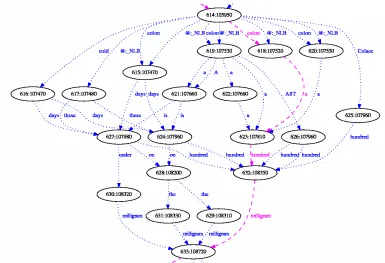
Figure 1: Sample word graph fragment
In case a match, i.e. a trade name or an active sub-stance, is found, all edges succeeding the medica-tion edge are searched for dosage values and dosage units. So far, we only examine the context to the right-hand side; in the data, we did not encounter any medications where the dosage occurred before the trade name or active substance. The following kinds of fillers between the trade name or active sub-stance and the dosage are allowed: ’to’ and ’of’ as well as non-utterances such as hesitation, noise and silence; in the corpus, we did not encounter any other fillers.
4.2 Generation of Spoken Forms and Mapping
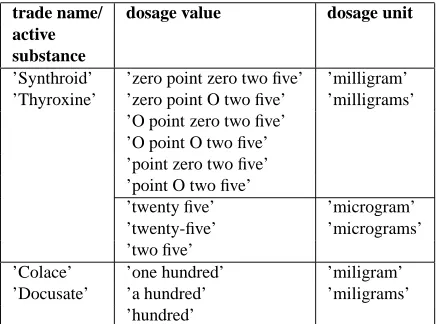
The medication found in the word graph is looked up in RxNorm, and all possible spoken forms of valid dosage values and dosage units for this medication are generated. Spoken forms for the medication names consist of the trade names and the active sub-stances. Variation in the pronunciation of the trade names or active substances is handled by the ASR recognition lexicon. For generating spoken forms of the dosage values, finite-state tools were used. For dosage units, we wrote a small grammar. Looking
at two examples, the medication SynthroidR and
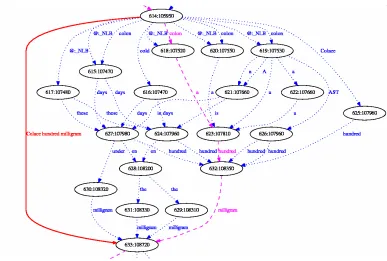
ColaceR (the latter appears in the word graphs in Figure 2 and Figure 1), the spoken forms shown in Table 1 are generated. Each box contains the al-ternative spoken variants. SynthroidR contains the active substance Thyroxine and ColaceR contains the active substance Docusate; users may either re-fer to the trade name or the active substance, so both possibilities are generated for each medication and dosage. RxNorm does not contain the dosage unit ’mcg’ (micrograms), which occurred in the reports. Therefore, microgram dosage values were converted to milligrams. Since both ’miligram(s)’ and ’mi-crogram(s)’ may occur for SynthroidR, dosage val-ues for both dosage units are generated. Although strictly, ’twenty five’ and ’twenty-five’ are identical spoken forms, both versions may appear in the word graph and thus are provided by our system.
Sometimes, a medication may contain several ac-tive substances, e.g. HyzaarR, a medication against high blood pressure:
trade name/ dosage value dosage unit active
substance
’Synthroid’ ’zero point zero two five’ ’milligram’ ’Thyroxine’ ’zero point O two five’ ’milligrams’
’O point zero two five’ ’O point O two five’ ’point zero two five’ ’point O two five’
’twenty five’ ’microgram’ ’twenty-five’ ’micrograms’ ’two five’
’Colace’ ’one hundred’ ’miligram’ ’Docusate’ ’a hundred’ ’miligrams’
[image:5.612.76.295.67.229.2]’hundred’
Table 1: Generated spoken forms found in the word graph
In these cases, the generation of possible spoken forms also includes different permutations of sub-stances, as well as a spoken forms containing the dosage unit either only at the end or after each value if the dosage unit is identical.
4.3 Inserting Concept Edges
The sequences of words which constitute the word graph are compared to the spoken forms generated for the RxNorm knowledge base. The active sub-stances or trade names serve as a starting point: in case a trade name is found in the word graph, the spoken forms for dosages of all active substances are generated in all permutations. If an active substance is found in the word graph, only the spoken forms for the substance dosage are searched in the word graph.
A new concept edge is inserted into the word graph for each path matching one of the generated spoken forms of the medications data base. The in-serted concept edges span from the first matching node to the last matching node on the path. Fig-ure 2 shows the word graph from FigFig-ure 1 with an in-serted concept edge (in bold). For each inin-serted con-cept edge, new concon-cept-edge attributes are assigned containing the IDs of the original edges as children, their added scores plus an additional concept score and the sequence of words. Since no large-scale ex-periments have yet been carried out, so far the con-cept score which is added to the individual scores of the children is an arbitrary number which improves the score of the medication subpath in constrast to
paths which do not contain valid medication infor-mation. If several competing medication paths are found, a concept edge is inserted for each path, and the concept edges can be ranked according to their acoustic and language-model scores.
5 Evaluation
In the first step, we examined a report sample in or-der to determine if there are cases where a valid pre-scription is recognised although the physician did not mention a prescription. We did not encounter this phenomenon in our report corpus.
We then applied our method to a sample of 924 word graphs. In this sample,
• 481 valid dosages could be found, although
• only 325 of these were on the best path.
With our approach, for the 156 prescriptions (32%) which were not on the best path, alternatives could be reconstructed from the word graph. Based on the inserted concept edges, the best path can be rescored.
In order to measure recall, i.e. how many of all existing prescriptions in the reports can be detected with our knowledge base, we manually checked a sample of 132 reports (containing manual tran-scriptions and ASR results). In this sample, 85 er-rors concerning medications and/or prescriptions oc-curred. For 19 of the 85 errors, the correct result was contained in the word graph. For 8 errors, it could be reconstructed. So about 9% of the errors concern-ing medications can be corrected in our sample. For the cases where the prescription could not be recon-structed although it was contained in the word graph, an analysis of the errors is shown in Table 2.
Since new medications are constantly being re-leased, and trade names change frequently, mis-matches may be due to the fact that our version of RxNorm was from a more recent point in time than the report corpus. We assume that under real-world conditions, both RxNorm and the medications pre-scribed by physicians reflect the current situation.
Some problems concerning medication names and dosage units were caused by missing spoken forms containing abbreviations, e.g. of dosage units (mg vs. mg/ml) or names (Lantus vs. Lantus
Figure 2: Sample word graph fragment with inserted concept node (left)
Table 2: Error types found in manual evaluation
type of error # example
Word Graph RxNorm
differences in medication names 3 Cardizem CD 120 mg Cardizem 120 mg
between the knowledge base and the word graph
differences in dosage values 4 Tapazole 60 mg Tapazole 10 mg
between the knowledge base and the word graph
differences in dosage units 4 Epogen 20000 units Epogen 20000 ml
between the knowledge base and the word graph
There are also cases where two medications appear in the word graph, and both had the valid prescrip-tion strength, therefore the system was not able to determine the correct medication.
6 Conclusion
In this paper, we present an attempt to reduce the number of speech-recognition errors concern-ing prescriptions of medications based on a domain-specific knowledge base. Our approach uses word graphs as input and creates new versions of the word graph with inserted concept edges if more plausi-ble prescriptions are found. The concept edges can
be used for rescoring the best path. An evaluation showed that 32% of prescriptions found in the word graphs were not on the best path but could be re-constructed. The manual evaluation of 132 reports shows that our method covers 42% of the prescrip-tions which are actually spoken during the dictation.
[image:6.612.95.519.387.498.2]as-sessed from a broader medical point of view, e.g. in case two subsequent prescriptions are encountered in the word graph which are incompatible due to drug interactions. As a next step, the system can be extended to compare the prescriptions with the patient record, e.g. if a patient has medication al-lergies. So far, our simple solution integrating only available, constantly updated knowledge about med-ications has already turned out to be a good starting point for rescoring word graphs based on domain knowledge.
Acknowledgments
The work presented here has been carried out in the context of the Austrian KNet competence net-work COAST. We gratefully acknowledge funding by the Austrian Federal Ministry of Economics and Labour, and ZIT Zentrum fuer Innovation und Tech-nologie, Vienna. The Austrian Research Institute for Artificial Intelligence is supported by the Aus-trian Federal Ministry for Transport, Innovation, and Technology and by the Austrian Federal Ministry for Science and Research. The authors would like to thank the anonymous reviewers for their helpful comments.
References
A. Alapetite, A., H.B. Andersen, H.B. and M. Hertzumb. Acceptance of speech recognition by physicians: A survey of expectations, experiences, and social in-fluence. International Journal of Human-Computer
Studies 67(1) (2009) 36–49
D. B¨uhler, W. Minker and A. Elciyanti. Us-ing language modelling to integrate speech recognition with a flat semantic analysis. In:
6th SIGdial Workshop on Discourse and Di-alogue, Lisbon, Portugal (September 2005) http://www.sigdial.org/workshops/workshop6/proceed-ings/pdf/86-paper.pdf.
S. Gold, N. Elhadad, X. Zhu, J.J. Cimino, G. Hripcsak. Extracting Structured Medication Event Information from Discharge Summaries. In: Proceedings of the
AMIA 2008 Symposium.
I. Gurevych and R. Porzel. Using knowledge-based scores for identifying best speech recognition hy-pothesis. In: Proceedings of ISCA Tutorial and Research Workshop on Error Handling in Spoken Dialogue Systems, Chateau-d’Oex-Vaud,
Switzer-land (2003) 77–81
http://proffs.tk.informatik.tu- darmstadt.de/TK/abstracts.php3?lang=en&bibtex=1&-paperID=431.
R. Porzel, I. Gurevych and C. M¨uller. Ontology-based
contextual coherence scoring. Technical report,
Euro-pean Media Laboratory, Heidelberg, Germany (2003) http://citeseer.ist.psu.edu/649012.html.
S.R. Halgrim, F. Xia, I. Solti, E. Cadag and O. Uzuner. Statistical Extraction of Medication Information from Clinical Records. In: Proc. of AMIA Summit on
Trans-lational Bioinformatics, San Francisco, CA, March
10-12, 2010.
D.A. Lindberg, B.L. Humphreys and A.T. McCray. The unified medical language system. Methods of In-formation in Medicine 32(4) (August 1993) 281–291
http://www.nlm.nih.gov/research/umls/.
S. Liu, W. Ma, R. Moore, V. Ganesan and S. Nelson. Rxnorm: Prescription for electronic drug information exchange. IT Professional 7(5) (September/October 2005) 17–23
K. Macherey, O. Bender and H. Ney. Multi-level er-ror handling for tree based dialogue course man-agement. In: Proceedings of ISCA Tutorial and
Research Workshop on Error Handling in Spo-ken Dialogue Systems, Chateau-d’Oex-Vaud,
Switzer-land (2003) 123–128, http://www-i6.informatik.rwth-aachen.de/˜bender/papers/isca tutorial 2003.pdf. M. Oerder and H. Ney. Word graphs: An efficient
inter-face between continuous speech recognition and lan-guage understanding. In: Proc. IEEE ICASSP’93. Vol-ume 2. 119–122.
J. Patrick and M. Li. A Cascade Approach to Extracting Medication Events. In: Proc. Australasian Language
Technology Workshop (ALTA) 2009.
R. Sarikaya, Y. Gao and M. Picheny. Word level confi-dence measurement using semantic features. In: Proc.
of IEEE ICASSP2003. Volume 1. (April 2003) 604–
607.
S. Seneff and J. Polifroni. Dialogue Management in the MERCURY Flight Reservation System. In:
Satel-lite Dialogue Workshop, ANLP-NAACL, Seattle (April
2000).
K.D. Voll. A Methodology of Error Detection: Improving Speech Recognition in Radiology.
PhD thesis, Simon Fraser University (2006) http://ir.lib.sfu.ca/handle/1892/2734.
K. Wang, Y.Y. Wang and A. Acero. Use and acquisition of semantic language model. In: HLT-NAACL. (2004) http://www.aclweb.org/anthology-new/N/N04/N04-3011.pdf.
R. Zhang and A.I. Rudnicky. Word level confi-dence annotation using combinations of fea-tures. In: Proceedings of Eurospeech. (2001)