Improving Verb Phrase Extraction from Historical Text
by use of Verb Valency Frames
Eva Pettersson and Joakim Nivre Department of Linguistics and Philology
Uppsala University
Abstract
In this paper we explore the idea of using verb valency information to improve verb phrase extraction from historical text. As a case study, we perform experiments on Early Modern Swedish data, but the ap-proach could easily be transferred to other languages and/or time periods as well. We show that by using verb valency infor-mation in a post-processing step to the verb phrase extraction system, it is pos-sible to remove improbable complements extracted by the parser and insert probable complements not extracted by the parser, leading to an increase in both precision and recall for the extracted complements.
1 Introduction
Information extraction from historical text is a challenging field of research that is of interest not only to language technology researchers but also to historians and other researchers within the hu-manities, where information extraction is still to a large extent performed more or less manually due to a lack of NLP tools adapted to historical text and insufficient amounts of annotated data for training such tools.
In the Gender and Work project (GaW), his-torians are building a database with information on what men and women did for a living in the Early Modern Swedish society, i.e. approximately 1550–1800 ( ˚Agren et al., 2011). This information is currently extracted by researchers manually go-ing through large volumes of text from this time period, searching for relevant text passages de-scribing working activities. In this process, it has been noticed that working activities often are de-scribed in the form of verb phrases, such ashugga
ved(”chop wood”),s¨alja fisk(”sell fish”) ortj¨ana som piga(”serve as a maid”). Based on this ob-servation, Pettersson et al. (2012) developed a method for automatically extracting verb phrases from historical documents by use of spelling nor-malisation succeeded by tagging and parsing. Us-ing this approach, it is possible to correctly iden-tify a large proportion of the verbs in Early Mod-ern Swedish text. Due to issues such as differences in word order and significantly longer sentences than in present-day Swedish texts (combined with sentence segmentation problems due to inconsis-tent use of punctuation), it is however still hard for the parser to extract the correct complements as-sociated with each verb.
In this work we propose a method for improving verb phrase extraction results by providing verb valency information to the extraction process. We describe the effect of removing improbable com-plements from the extracted verb phrases, as well as adding probable complements based on verb valency frames combined with words and phrases occurring in close context to the head verb.
2 Related Work
Syntactic analysis of historical text is a tricky task, due to differences in vocabulary, spelling, word or-der, and grammar. S´anchez-Marco (2011) trained a tagger for Old Spanish, based on a 20 million to-ken corpus of texts from the 12th to the 16th cen-tury, by expanding the dictionary and modifying tokenisation and affixation rules. An accuracy of 94.5% was reported for finding the right part-of-speech, and an accuracy of 89.9% for finding the complete morphological tag.
for adapting the Pro3Gres dependency parser to analyse historical English text. In this approach, spelling normalisation is a key factor, transform-ing the historical spelltransform-ing to a modern spelltransform-ing by use of the VARD2 tool (Baron and Rayson, 2008) before parsing. In addition to spelling normali-sation, a set of handwritten grammar rules were added to capture unseen interpretations of specific words, for relaxing word order constraints, and for ignoring commas in a sentence. Schneider con-cluded that spelling normalisation had a large im-pact on parsing accuracy, whereas the grammar adaptations where easy to implement but lead to small improvements only.
Pettersson et al. (2013) also presented an ap-proach to automatic annotation of historical text based on spelling normalisation. In this approach, the historical spelling is translated to a modern spelling employing character-based statistical ma-chine translation (SMT) techniques, before tag-ging and parsing is performed by use of standard natural language processing tools developed for present-day language. The method was evaluated on the basis of verb phrase extraction results from Early Modern Swedish text, where the amount of correctly identified verb complements (including partial matches) increased from 32.9% for the text in its original spelling to 46.2% for the text in its automatically modernised spelling. Earlier work by the same authors showed that using contempo-rary valency dictionaries to remove extracted com-plements not adhering to the valency frame of a specific verb had a positive effect on verb phrase extraction precision (Pettersson et al., 2012).
In the context of valency-based parsing of mod-ern language, Jakub´ıˇcek and Kov´aˇr (2013) intro-duced a verb valency-based method for improving Czech parsing. Their experiments were based on the Synt parser, which is a head-driven chart parser with a hand-crafted meta-grammar for Czech, pro-ducing a list of ranked phrase-structure trees as output. They used two different dictionaries with valency information to rerank the suggested parses in accordance with the valency frames suggested for the verb in the dictionaries. Evaluation was performed on the Brno Phrasal Treebank using the leaf-ancestor assessment metric, and an im-provement from 86.4% to 87.7% was reported for the highest-ranked tree when comparing the Synt parser in its original setting to the inclusion of va-lency frames for reranking of the output parses.
For modern Swedish, Øvrelid and Nivre (2007) experimented on ways to improve parsing accu-racy for core grammatical functions including for example object, subject predicative, and preposi-tional argument. They found that by providing the parser with linguistically motivated features such as animacy, definiteness, pronoun type and case, a 50% error reduction could be achieved for the syntactic functions targeted in the study.
3 Approach
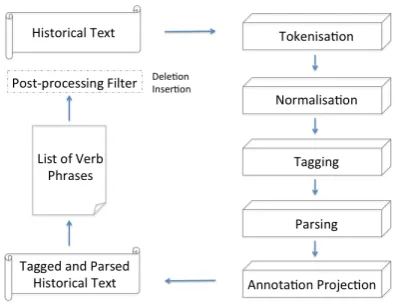
Figure 1: Method overview.
modify the complements suggested by the parser.
3.1 Deletion of Improbable Complements
As discussed in Section 1, certain characteristics of historical text make it difficult for the parser to correctly extract the complements of a verb. Therefore, we add valency information in a post-processing step, filtering away extracted comple-ments that do not conform to the valency frame of the verb. A similar idea was presented in Petters-son et al. (2012), where filtering was based on va-lency frames given in two contemporary dictionar-ies, i.e. Lexin1and Parole2. However, some word forms in historical text are not frequent enough in contemporary language to occur in modern dictio-naries. Examples from the GaW training corpus areabsentera(old word for ”be absent”),umg¨alla
(old word for ”suffer for”), and ¨arna(old word for ”intend to”). Moreover, the meaning of verbs tend to change over time, and it is not obvious that verb valency frames for present-day Swedish also holds for historical Swedish. An example from the GaW corpus is the verbsl˚a(”hit”) which in both Lexin and Parole is listed as a monotransitive verb (”to hit someone”). In the GaW corpus however, it is repeatedly used as a ditransitive verb, as inSedhan hadhe Erich OluffSon slaghit Pelle Pederssonn tre bl˚anader(”Then Erich OluffSon had hit Pelle Ped-erssonn three bruises”). A comparison between the valency frames present in the GaW corpus and the frames present in the Lexin dictionary shows that only 16% of the verb forms that are present in both the old and the modern resource (108 out of 675 verb forms) have equal valency frames. In our
1
http://spraakbanken.gu.se/lexin/valens lexikon.html
2http://spraakbanken.gu.se/swe/resurs/parole
approach to deletion of improbable complements, we therefore base the valency frames not only on the contemporary valency dictionaries, but also on the verbal complements occurring in the training part of the GaW corpus.
Deletion experiments are performed for all complement types extracted from the parser ex-cept for subjects, since a verb is typically expected to have a subject. We present deletion experiments for the following five settings:
1. Lexin
For each extracted complement, if the head verb is present in the Lexin valency dictio-nary and the valency frame in Lexin does not allow for a complement of the type in-dicated by the parse label, the complement is removed from the extracted verb phrase.
2. Parole
For each extracted complement, if the head verb is present in the Parole valency dictio-nary and the valency frame in Parole does not allow for a complement of the type in-dicated by the parse label, the complement is removed from the extracted verb phrase.
3. GaW Corpus
For each extracted complement, if the head verb is present in the training part of the GaW corpus, and none of the occurrences in the corpus contain a complement of the type in-dicated by the parse label, the complement is removed from the extracted verb phrase.
4. All combined
men-tioned above, and none of these resources al-low for a complement of the type indicated by the parse label, the complement is removed from the extracted verb phrase. Likewise, if the head verb is present in only two of these three resources, and none of these two re-sources allow for a complement of the type indicated by the parse label, the complement is removed from the extracted verb phrase. Finally, if the head verb is present in one resource exclusively, and this resource does not allow for a complement of the type indi-cated by the parse label, the complement is removed from the extracted verb phrase.
5. All one-by-one
For each extracted complement, if the head verb is present in the best-performing re-source, i.e. the resource yielding the high-est complement extraction f-score in the first three experiments, and the valency frame in this resource does not allow for a comple-ment of the type indicated by the parse la-bel, the complement is removed from the ex-tracted verb phrase. Otherwise, if the head verb is present in the second best-performing resource, and the valency frame in this re-source does not allow for a complement of the type indicated by the parse label, the com-plement is removed from the extracted verb phrase. Only if the head verb is not present in any of the two best-performing resources, the third resource is consulted.
3.2 Insertion of Probable Complements
Apart from filtering away unlikely complements extracted by the parser, we also aim at inserting probable complements not found by the parser, by searching the parsed sentence for words and phrases that match the valency frame of the head verb, but which have not been extracted by the parser. Since the word order is more varying in Early Modern Swedish than in present-day Swedish, all complements are searched for both to the left and to the right of the head verb.
In the insertion experiments, we focus on phrasal verbs in the broader sense, including par-ticles, reflexives, and prepositional complements. We believe that these complement types are rel-atively easy to recognise in a sentence. Further-more, if for example a reflexive pronoun is found close to the head verb in the sentence, and the
va-lency frame suggests a reflexive pronoun, then the probability that this reflexive belongs to the verb is rather high. The same argument holds for prepo-sitional phrases containing the expected preposi-tion to form a preposipreposi-tional complement, and for prepositions or adverbials identical to a particle expected by the valency frame of the head verb. For direct and indirect objects on the other hand, even if we find a noun phrase close to the verb, it would still be hard to determine whether this noun phrase actually corresponds to a direct or in-direct object, since noun phrases may occur with many different functions in a clause, and the word order is not fixed, particularly not for historical text. Therefore we would run a high risk of ex-tracting for example the subject noun phrase in-stead of the direct or indirect object noun phrase, especially for languages like Swedish, where sub-ject/object distinctions are not manifested mor-phologically other than for pronouns. Further-more, direct objects are not always expressed in the form of noun phrases, but are quite often ex-pressed as for instance clauses, as in the following example from the GaW corpus: fordra at Barnet skal d¨opas hemma(”demand that the Child should be christened at home”). Similarly, subject pred-icatives may also be expressed in varying ways and infinitive complements are often ambiguous to other functions. Thus, these categories are ex-cluded from the insertion experiments.
In accordance with the arguments given above, the following three experiments are performed for insertion of probable complements:
1. Insertion of prepositional complement
If the valency frame of the head verb (in any of the three valency resources) allows for a prepositional complement, and a preposi-tional phrase containing the expected prepo-sition is found either to the left or to the right of the head verb, this prepositional phrase is added to the extracted verb phrase with a prepositional complement label.
2. Insertion of particle
3. Insertion of reflexive
If the valency frame of the head verb allows for a reflexive pronoun, and the word form
sig (”oneself”), or the alternative historical spellingsigh, is found either to the left or to the right of the head verb, this word form is added to the extracted verb phrase with a re-flexive label.
4 Data
Verb valency frames are extracted from three sources: the contemporary Lexin valency dictio-nary, the contemporary Parole valency dictiodictio-nary, and the training and development parts of the GaW corpus of Early Modern Swedish court records and church documents. Evaluation is performed on the evaluation part of the GaW corpus. All the verbs in the GaW corpus have been manually an-notated as such, and all complements adhering to the verbs have been annotated with labels denot-ing subject (for passive verbs only), direct object, indirect object, prepositional complement, infini-tive complement, subject predicainfini-tive, verb parti-cle, and reflexive pronoun. Furthermore, the train-ing and development parts of the corpus have been annotated with information on the manually mod-ernised spelling for each original word form oc-curring in the text.
Both in the Lexin dictionary and in the Parole dictionary, verb valency frames are connected to the present tense form of the verb only, without in-formation on other inflectional forms of the verb. In the verb phrase extraction process however, we need to connect whatever inflectional form of the verb that is used in the sentence to the correct va-lency frame. For broader coverage of the vava-lency dictionaries, the present tense forms were there-fore expanded to other inflectional forms based on the Saldo dictionary and the SUC corpus. The Saldo dictionary is a dictionary of present-day Swedish word forms, with morphological and in-flectional information (Borin et al., 2008). By comparing the present tense verb form in Lexin or Parole to the Saldo dictionary, it is thus possible to extract a lemma corresponding to the verb form, and from that lemma all the inflectional forms ad-hering to that lemma. For verb forms not found in the Saldo dictionary, the SUC corpus was con-sulted. Since this corpus has been manually an-notated with lemma information, all inflectional forms of the same lemma occurring in the corpus
may thus be extracted. For Lexin and Parole verb forms not found in neither Saldo nor SUC, only the present tense form of the verb is stored with its corresponding valency frame.
For the GaW corpus, we have a similar problem in that only those verb forms that occur in the cor-pus will be assigned a valency frame, and if sev-eral forms of the same verb occur in the corpus, these will be assigned valency frames separate from each other. To deal with this, we use the same method of comparison to Saldo and SUC for re-trieving the full set of word forms associated with a verb form, assigning the same valency frame to all verb forms belonging to the same lemma. In this process, we use the manually normalised form of each verb for comparison towards Saldo and SUC, to avoid mismatches due to spelling varia-tion in the historical corpus.
It could be argued that instead of generating all fullforms for a verb, it would be more efficient to perform lemmatisation prior to comparison. This would however potentially impose more ambigu-ity to the valency frames, since word forms in the SUC corpus are associated with their base form rather than the actual lemma. This means that present tense forms such as ¨ar (”is”) and varar
(”lasts”) are both associated with the same base formvara(”to be/to last”), even though their in-flectional paradigms and valency frames differ sig-nificantly. For properly lemmatised sources, these word forms would instead have been associated with different lemmas, e.g.vara1andvara2.
Table 1 shows the number of verb forms found in Saldo and SUC respectively, during the process of expanding the valency frames to more inflec-tional forms. The GaW corpus has been divided into training (train), development (dev) and test sets, where the training part is the same data set as was used for training and tuning in Pettersson et al. (2013), and the development set is the same data set as was used for evaluation in the same pa-per. In total, the training and development parts contain 600 sentences each, whereas the test set contains 300 sentences. Since the test set will only be used for evaluation, no expansion to inflectional forms is needed for this particular data set.
Verbs Saldo SUC Not found
Lexin 3,281 3,181 33 67
Parole 4,304 4,263 26 15
GaW Train 1,329 1,168 14 147
GaW Dev 1,410 1,245 15 150
[image:6.595.84.284.62.130.2]GaW Test 987 n/a n/a n/a
Table 1: Verb forms found in Saldo and SUC dur-ing the process of expanddur-ing the valency frames to more inflectional forms.
repeated testing. In the final evaluation, the train-ing and development sets are merged to a com-bined valency resource, and evaluation scores are given for the test part of the corpus.
verb forms expanded forms
Lexin 3,281 42,545
Parole 4,304 32,640
GaW Train 1,329 10,032
GaW Dev 1,410 10,394
[image:6.595.88.276.263.332.2]GaW Test 987 n/a
Table 2: Number of verb forms in the language resources, before and after word form expansion.
5 Evaluation
Evaluation is performed in terms of precision, re-call and f-score based on the extracted comple-ments, where the baseline case is the original verb phrase extraction system without any of the above specified amendments. We define true positives as correctly extracted complements. Likewise, false positives are complements extracted by the system that are not present in the gold standard, whereas false negatives are complements that are present in the gold standard but not extracted by the system. Since we are specifically aiming at extracting the correct complements, intransitive verbs that were also identified as intransitive by the extraction sys-tem will not contribute to the set of true posi-tives. Intransitive verbs for which the system has extracted complements will however contribute to the set of false positives, whereas verbs identified as intransitive by the system though complements are present in the gold standard will add to the set of false negatives.
We also make a distinction between labelled and unlabelled precision and recall, where labelled precision and recall requires that the correct label for the complement has been assigned, i.e. direct object, prepositional complement etc, whereas un-labelled precision and recall only concerns the
ex-tracted word sequences, regardless of what label the parser has assigned to the complement.
Since the overall aim of the verb phrase extrac-tion process is to present to historians text pas-sages that may be of interest, partial matches are also regarded as true positives, as these would still point the user to the right text passage. True pos-itives thus include the following cases, with au-thentic examples from the GaW corpus:
• Exact match
Gold complement:2 klimpar sm¨or
Extracted complement:2 klimpar sm¨or
”2 lumps of butter”
• Substring type A
Gold complement:de penningar ochmedel Extracted complement:medel
”(the money and)resources”
• Substring type B
Gold complement:detta
Extracted complement:dettaefter honom
”this(after him)”
• Overlap
Gold complement:f¨orswagatock f¨ortrygt
Extracted complement:noghf¨orswagat ”(probably)weakened(and oppressed)”
6 Model Selection
In the model selection phase, we try different strategies for deletion and insertion of comple-ments, using the training part of the corpus as a basis for valency frames, and the development part of the corpus for testing.
6.1 Deletion of Improbable Complements
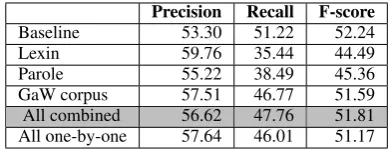
For deletion of improbable complements, we first need to decide which of the five settings listed in Section 3.1 that should be chosen. We therefore ran experiments where deletion is performed for all complement types (except subject), evaluating the results for each setting separately. The results for unlabelled complement extraction are summa-rized in Table 3.
Precision Recall F-score
Baseline 53.30 51.22 52.24
Lexin 59.76 35.44 44.49
Parole 55.22 38.49 45.36
GaW corpus 57.51 46.77 51.59
All combined 56.62 47.76 51.81
All one-by-one 57.64 46.01 51.17
Table 3: Unlabelled results for deletion of improb-able complements with different settings.
[image:6.595.319.515.626.702.2]pre-cision as compared to the original system. How-ever, recall varies to a great extent. For the largest resource, i.e. the Lexin dictionary, precision is the highest, but recall is very low. This indicates that a great amount of verb forms are found in the Lexin dictionary, but with valency frames that do not cor-respond to the way the verbs are used in historical texts, meaning that complements are erroneously deleted. This confirms our initial hypothesis that due to language change, contemporary dictionar-ies are not sufficient for guiding a parser with valency information. Further arguments for this hypothesis is the fact that even though the GaW training corpus is by far the smallest valency re-source, using only this resource for defining verb valency frames results in a substantially higher f-score value than using Lexin or Parole. In fact, the f-score results for using the GaW corpus only are almost as high as for using all resources combined. Since all methods improve precision as com-pared to the baseline, we choose the combined method for further experiments, since this method has the highest recall and also the highest f-score. In the next round of experiments, we want to find out which complement types should be can-didates for deletion. The hypothesis is that some complement types may be more thoroughly cov-ered in the valency resources than others. If so, deletion of complements may only be a success-ful method for some complement types, whereas others should be left unmodified in the deletion process. To test this hypothesis, we tried dele-tion for each complement type separately, keeping only those that improve f-score as compared to the baseline system. These experiments were run with the combined setting, in accordance with the argu-ments given above. The results are presented in Table 4, where it can be noticed that only deletion of direct objects and subject predicatives are suc-cessful in improving the f-score value as compared to the baseline. Keeping these two categories as candidates for deletion, a precision of 54.96% is achieved, with a recall of 50.25%, as compared to the baseline precision of 53.30 and recall of 51.22.
6.2 Insertion of Probable Complements
As described in Section 3.2, the insertion ex-periments are targeted at particles, reflexives, and prepositional objects. Whenever the valency frame of the head verb in the extracted phrase al-lows for a complement of the specified type, the
Precision Recall F-score
Baseline 53.30 51.22 52.24
A) direct object 54.29 50.62 52.39 B) indirect object 53.37 50.92 52.12
C) prep compl 56.06 47.51 51.43
D) inf compl 53.34 51.02 52.15
E) subj predicative 53.93 50.84 52.34
F) particle 53.45 50.84 52.11
G) reflexive 53.19 50.50 51.81
[image:7.595.312.521.61.167.2]A + E 54.96 50.25 52.50
Table 4: Unlabelled results for deletion of improb-able complements for the setting ”all combined”, varying the complements included for deletion.
parsed sentence is searched for words and phrases matching the complement at hand. In the insertion experiments, we tried the following enhancements of the original insertion strategy:
1. Inclusion of stopwords, for which no comple-ments are to be added. The set of stopwords were empirically defined as word forms be-longing to any of the lemmasvara(”be”),bli
(”become”),ha(”have”) andfinnas(”exist”).
2. Prohibiting punctuation to occur between the head verb and the candidate complement.
3. Inclusion of a distance threshold, defining how many tokens that may come in between the head verb and the candidate complement. We tried a number of different thresholds, out of which a threshold of 5 tokens turned out to yield the best results.
The insertion results are presented in Table 5, showing that without any restrictions in the inser-tion process, recall can be increased from 51.22% to 53.63%. This is however at the expense of a substantial drop in precision from 53.30% to 37.47% as compared to the baseline system. Re-strictions in the form of A) stopwords for which no complements are inserted, B) prohibition of punctuation between the head verb and the candi-date complement, and C) defining a threshold for how many tokens are allowed to occur between the head verb and the candidate complement, all had a positive effect on precision and f-score. Thus, in the best setting, i.e. where all three restrictions are implemented, a precision of 52.57% is achieved, with a recall of 52.45%.
Precision Recall F-score
Baseline 53.30 51.22 52.24
Original 37.47 53.63 44.12
A) Stopwords 45.69 53.41 49.25
B) Punctuation 47.81 53.04 50.29
C) Threshold 51.42 52.54 51.97
[image:8.595.86.282.62.135.2]A + B + C 52.57 52.45 52.51
Table 5: Unlabelled results for insertion of proba-ble complements.
three complement types are included for insertion.
Precision Recall F-score
Baseline 53.30 51.22 52.24
A) prep compl 52.70 51.86 52.28
B) particle 53.23 51.28 52.24
C) reflexive 53.20 51.75 52.46
A + C 52.60 52.39 52.49
[image:8.595.86.279.217.292.2]A + B + C 52.57 52.45 52.51
Table 6: Unlabelled results for insertion of prob-able complements, varying the complements in-cluded for insertion.
[image:8.595.86.280.516.647.2]7 Results
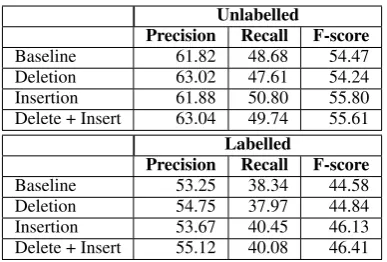
Table 7 presents the complement extraction results on the test corpus, with the training and develop-ment part of the GaW corpus merged into a single historical valency resource. Results are presented for the baseline system (without additional dele-tion or inserdele-tion), for the best deledele-tion setting as argued in Section 6.1, for the best insertion setting as argued in Section 6.2, and for both deletion and insertion combined.
Unlabelled
Precision Recall F-score
Baseline 61.82 48.68 54.47
Deletion 63.02 47.61 54.24
Insertion 61.88 50.80 55.80
Delete + Insert 63.04 49.74 55.61
Labelled
Precision Recall F-score
Baseline 53.25 38.34 44.58
Deletion 54.75 37.97 44.84
Insertion 53.67 40.45 46.13
Delete + Insert 55.12 40.08 46.41
Table 7: Complement extraction results.
As expected, performing only deletion of comple-ments leads to an increase in precision at the ex-pense of a decrease in recall. Performing only in-sertion on the other hand leads to an increase in recall without decreasing precision, demonstrating that inserting complements introduces true
posi-tives to a higher extent than false posiposi-tives, which is satisfactory. In fact, insertion of complements results in a slightly higher f-score value than the combination of deletion and insertion. However, the best precision is achieved when both deletion and insertion are performed, yielding a precision of 63.04%, as compared to 61.82% for the baseline system. This setting also improves both precision and recall as compared to the baseline.
8 Conclusion
We have presented a method for improving verb phrase extraction from historical text, by automati-cally deleting improbable verbal complements ex-tracted by the parser, while at the same time in-serting probable complements not extracted by the parser. Our approach is based on verb va-lency frames rendered from historical corpora and from contemporary valency dictionaries, where the historical corpus had the largest positive effect even though the contemporary dictionaries cov-ered more verb forms. This supports our hypoth-esis that since language changes over time, va-lency frames for present-day language may not be enough to cover the syntax in historical text. By automatically deleting and inserting complements based on a combination of the historical corpus and the contemporary dictionaries, an increase in both precision and recall is achieved, as compared to the baseline system.
References
Maria ˚Agren, Rosemarie Fiebranz, Erik Lindberg, and
Jonas Lindstr¨om. 2011. Making verbs count. The research project ’Gender and Work’ and its
method-ology. Scandinavian Economic History Review,
59(3):271–291. Forthcoming.
Alistair Baron and Paul Rayson. 2008. Vard2: A tool for dealing with spelling variation in historical
cor-pora. In Postgraduate Conference in Corpus
Lin-guistics, Aston University, Birmingham.
Lars Borin, Markus Forsberg, and Lennart L¨onngren. 2008. Saldo 1.0 (svenskt associationslexikon ver-sion 2). Spr˚akbanken, University of Gothenburg.
Eva Ejerhed and Gunnel K¨allgren. 1997. Stockholm Ume˚a Corpus. Version 1.0. Produced by ment of Linguistics, Ume˚a University and Depart-ment of Linguistics, Stockholm University. ISBN 91-7191-348-3.
P´eter Hal´acsy, Andr´as Kornai, and Csaba Oravecz. 2007. HunPos - an open source trigram tagger. In
Proceedings of the 45th Annual Meeting of the As-sociation for Computational Linguistics, pages 209– 212, Prague, Czech Republic.
Miloˇs Jakub´ıˇcek and Vojtˇech Kov´aˇr. 2013. Enhancing
czech parsing with verb valency frames. InCICLing
2013, pages 282–293, Greece. Springer Verlag.
Joakim Nivre, Johan Hall, and Jens Nilsson. 2006a. MaltParser: A data-driven parser-generator for
de-pendency parsing. In Proceedings of the 5th
in-ternational conference on Language Resources and Evaluation (LREC), pages 2216–2219, Genoa, Italy, May.
Joakim Nivre, Jens Nilsson, and Johan Hall. 2006b.
Talbanken05: A Swedish treebank with phrase
structure and dependency annotation. In
Proceed-ings of the 5th international conference on Lan-guage Resources and Evaluation (LREC), pages 24– 26, Genoa, Italy, May.
Lilja Øvrelid and Joakim Nivre. 2007. When word order and part-of-speech tags are not enough – Swedish dependency parsing with rich linguistic
features. In Proceedings of the International
Con-ference on Recent Advances in Natural Language Processing (RANLP), pages 447–451.
Eva Pettersson, Be´ata Megyesi, and Joakim Nivre. 2012. Parsing the Past - Identification of Verb Con-structions in Historical Text. InProceedings of the 6th EACL Workshop on Language Technology for Cultural Heritage, Social Sciences, and Humanities, pages 65–74, Avignon, France, April. Association for Computational Linguistics.
Eva Pettersson, Be´ata Megyesi, and Joakim Nivre. 2013. An SMT approach to automatic annotation
of historical text. In Proceedings of the Workshop
on Computational Historical Linguistics at NODAL-IDA. NEALT Proceedings Series 18; Linkping Elec-tronic Conference Proceedings., volume 87, pages 54–69.
Cristina S´anchez-Marco, Gemma Boleda, and Llu´ıs Padr´o. 2011. Extending the tool, or how to anno-tate historical language varieties. InProceedings of the 5th ACL-HLT Workshop on Language Technol-ogy for Cultural Heritage, Social Sciences, and Hu-manities, pages 1–9, Portland, OR, USA, June. As-sociation for Computational Linguistics.
Gerold Schneider. 2012. Adapting a parser to
Histor-ical English. InOutpost of Historical Corpus