ISSN Online: 2327-5227 ISSN Print: 2327-5219
DOI: 10.4236/jcc.2017.510004 Aug. 11, 2017 26 Journal of Computer and Communications
Forward-Backward Synergistic Acceleration
Pursuit Algorithm Based on
Compressed Sensing
Bowen Zheng, Guiling Sun
*, Tianyu Geng, Weijian Zhao
College of Electronic Information and Optical Engineering, Nankai University, Tianjin, China
Abstract
We propose the Forward-Backward Synergistic Acceleration Pursuit (FBSAP) algorithm in this paper. The FBSAP algorithm inherits the advantages of the Forward-Backward Pursuit (FBP) algorithm, which has high success rate of reconstruction and does not necessitate the sparsity level as a priori condition. Moreover, it solves the problem of FBP that the atom can be selected only by the fixed step size. By mining the correlation between candidate atoms and re-siduals, we innovatively propose the forward acceleration strategy to adjust the forward step size adaptively and reduce the computation. Meanwhile, we ac-celerate the algorithm further in backward step by fusing the strategy proposed in Acceleration Forward-Backward Pursuit (AFBP) algorithm. The experimen-tal simulation results demonstrate that FBSAP can greatly reduce the running time of the algorithm while guaranteeing the success rate in contrast to FBP and AFBP.
Keywords
Compressed Sensing, Reconstruction Algorithm, Sparse Signal, FBP
1. Introduction
The theory of Compressed Sensing (CS) [1][2][3] proposed by Candes and Do-noho in 2006, breaks the limitation that the traditional sampling must satisfy the Nyquist frequency and makes it possible to reconstruct low sampling rate signal. Therefore, CS is widely used in wireless sensor networks [4][5], magnetic reson-ance imaging [6] and video compression [7] etc.
The major research direction of CS includes signal sparse transformation, de-sign of measurement matrix and de-signal reconstruction algorithm. The reconstruc-How to cite this paper: Zheng, B.W., Sun,
G.L., Geng, T.Y. and Zhao, W.J. (2017) For-ward-Backward Synergistic Acceleration Pur-suit Algorithm Based on Compressed Sens-ing. Journal of Computer and Communica-tions, 5, 26-35.
https://doi.org/10.4236/jcc.2017.510004
Received: July 21, 2017 Accepted: August 8, 2017 Published: August 11, 2017
Copyright © 2017 by authors and Scientific Research Publishing Inc. This work is licensed under the Creative Commons Attribution International License (CC BY 4.0).
DOI: 10.4236/jcc.2017.510004 27 Journal of Computer and Communications tion algorithms are divided into three categories: greedy algorithms, relaxation algorithms and hybrid algorithms. Greedy algorithms are built upon a series of locally optimal single-term updates, including Matching Pursuit (MP) [8] and Orthogonal Matching Pursuit (OMP) [9] etc. Relaxation algorithms are based on convex optimization techniques, which can smooth the l0 norm and replace it
with a continuous function that can be handled using classic optimization, in-cluding Basis Pursuit (BP) [10] and Iterative Reweighted Least-Squares (IRLS) [11] etc. Hybrid algorithms include Subspace-Pursuit (SP) [12], Compressive Sam-pling Matching Pursuit (CoSaMP) [13] and Iterative Hard Thresholding (IHT) [14] etc.
FBP is a novel two-stage greedy approach proposed by N. B. Karahanoglu and H. N. Erdogan in reference [15]. It enlarges the estimated support set by
α
atoms in forward step and eliminates β atoms from the estimated support set in backward step. The disadvantage of the FBP is that it can only enlarge and reduce the estimated support set with a fixed step size. In view of this, Paper [16] proposed Acceleration Forward-Backward Pursuit (AFBP) algorithm, selected the high quality atoms again in backward step. Based on this, we propose the Forward-Backward Synergistic Acceleration Pursuit (FBSAP) algorithm in this paper, which can reduce the atoms selected in the forward step adaptively ac-cording to the quality of atoms. Thus the algorithm is further accelerated when we restructure sparse signals, especially the signals which have large amount of data. This greatly improves the practicability of reconstruction algorithms.The remainder of the paper is organized as follows. Section 2 briefs the theory of CS and the FBP algorithm. Section 3 introduces the acceleration strategy we used and the specific process of FBSAP. Section 4 presents the simulation results. Finally, conclusion is present in Section 5.
2. Compressed Sensing Theory and Recovery Algorithm
2.1. The Theory of Compressed Sensing
Compressed Sensing aims at restructuring the signal by excavating its sparse feature when the information is sampled in very low sampling rate. The sam-pling process is represented by
=
y Φx (1) where x is a K-sparse one-dimensional signal of length N, K is the number of nonzero elements in x.
Φ
is a M×N two-dimensional observation matrix with K<M<N. y is a one-dimensional measurement vector of length M. The pur-pose of CS is to obtain the signal x by using the measurement vector y and the observation matrixΦ
.2.2. The Forward-Backward Pursuit Algorithm
DOI: 10.4236/jcc.2017.510004 28 Journal of Computer and Communications in Algorithm 1. It expands the estimated support set by selecting
α
atoms with highest correlation in the forward step and reduces the size of the estimated support set by eliminating β atoms with smallest contributions to the projec-tion.3. Forward-Backward Synergistic Acceleration Pursuit
Algorithm
3.1. The Acceleration Strategy
The FBP algorithm can be accelerated by two ways: reducing
α
and enlarg-ing α − β. The strategy mentioned in [16] has the effect of enlarging theα − β, but it doesn’t change the number of atoms selected in the forward step.
DOI: 10.4236/jcc.2017.510004 29 Journal of Computer and Communications (a) (b)
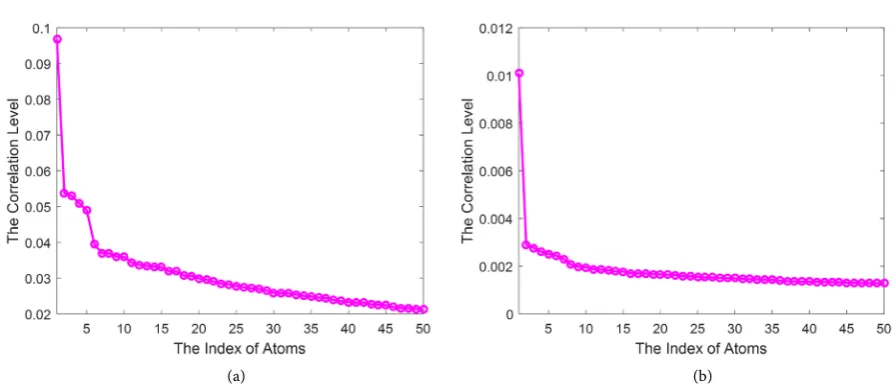
Figure 1. The correlation levels of the observation matrix and residuals. (a) The correlation level in first iteration; (b) The
correlation level after some iterations.
present ladder-form. Some atoms have the same correlation level such as atoms 2-5, and there is a big ladder between them and the other atoms. The ladder is especially obvious after some iterations. The correlation level of atom 1 is significantly higher than the others. With the above analysis, it is completely unnecessary selecting
α
atoms in every iteration. Only need to find the last obvious ladder and choose the atoms before it. We can reduceα
by this way and accelerate the algorithm.We adopt the backward acceleration strategy proposed by [16] in this paper. The main idea of this strategy is giving the atoms corresponding weights ac-cording to the correlation levels between atoms and residuals, and then reset-ting the atom into support set in backward step if its cumulative weight is greater than a threshold, so that we can select multiple atoms in each itera-tion.
3.2. Forward-Backward Synergistic Acceleration Pursuit
Algorithm
The details of FBSAP are shown in Algorithm 2. First, Calculate the correla-tion levels between atoms and residuals and represent them as set m, meanwhile, calculate the corresponding weights of atoms and save them to set
w
. Then, Calculate the differences between adjacent elements in w and represent as set g. In order to ensure the simplicity and effectiveness of the algorithm, we think there is a ladder between mi and mi+1 if an element gi in g is greater than threshold γ. If we cannot find any ladder or the index of the last ladder is greater thanα
, set the forward step size f as fixed step sizeα
. Otherwise, set f as the index of the last ladder. Next, select f atoms into support set and set the backward step size b as f −1. In the backward step,we eliminate b atoms from support set which have the smallest projection coefficients. Then reset the atom whose cumulative weight is greater than η
DOI: 10.4236/jcc.2017.510004 30 Journal of Computer and Communications
4. Experimental Results and Analysis
4.1. The Effect of Restructuring Sparse Signals
DOI: 10.4236/jcc.2017.510004 31 Journal of Computer and Communications algorithm. So the FBSAP is compared with FBP and AFBP in three aspects, exact reconstruction rate, average normalized mean squared error (ANMSE) and run-ning time. The signals we used are Gauss sparse signal and uniform sparse signal. The nonzero entries of Gaussian sparse signals are drawn from the standard Gaussian distribution. Nonzero elements of the uniform sparse signals are dis-tributed uniformly in
[
−1,1]
. A different observation matrix is drawn from the Gaussian distribution with mean 0 and standard deviation 1N for each test signal. The simulation system information is as follows. Matlab Version: 2016a, Operating System: Windows 10(64-bit), CPU: Intel(R) Core(TM) i7-6700HQ [email protected] GHz, Memory: 8 GB.The length of signal is N=512. The length of measurement vector is M =
200. The sparsity
K
is between 10 and 90. We repeat 1000 experiments anduse different sparse signal and measurement matrix for each sparsity
K
. Theexact reconstruction rate is the ratio of accurate reconstruction times and total experiment times. The condition of accurate reconstruction is 2
2 2
ˆ 10−
− ≤
x x x ,
where xˆ is the reconstruction vector of x. The ANMSE is represented as 2 1000 2 2 =1 2 ˆ 1 ANMSE 1000 i i i i −
=
∑
x xx (2)
The running time is represented as the total time of 1000 experiments. We set maximum support set size Kmax=M 2 and termination parameter ε
−6 =10 . It is pointed out in [15] that FBP have the best reconstruction effect while
[
0.2M, 0.3M]
α∈ and β α= −1. We find that FBP has the highest exact
re-construction rate while α =0.3M . So we select α =0.3M and β α= −1 in
the tests. [16] points out that algorithm has the best effect while η =1 0.07M,
1 2 3
η η< <η and only consider the first 0.2M atoms. So we set η =1 0.07M,
2 1 1
η = +η , η η3= +1 2, s1=0.05M , s2 =0.1M , s3=0.2M , w1=2.0, w2 =
1.5, w3=1.0. We set the ladder threshold parameter as γ =0.002. The
[image:6.595.62.531.574.706.2]influ-ence of γ will be discuss in 4.3.
Figure 2 shows the reconstruction result for Gauss sparse signals. It is shown that the exact reconstruction rate of FBSAP is almost same as AFBP and slightly higher than FBP, the ANMSE of FBSAP is slightly lower than FBP and almost equals to AFBP. So FBSAP can ensure the success rate of reconstruction. The
(a) (b) (c)
DOI: 10.4236/jcc.2017.510004 32 Journal of Computer and Communications running time is obviously shorter than FBP and AFBP. While the signal is very sparse, the running time of AFBP is almost same as FBP. It is mentioned in [16] that the size of η is close to
K
, there is almost no atom is selected into support [image:7.595.55.534.398.535.2]set through acceleration channel. But FBSAP has good performance, the reason is that FBSAP can greatly shorten the forward step size while the signal is very sparse.
Figure 3 are the result for uniform sparse signal. It is similar to restructuring Gauss sparse signal, FBSAP also has obvious acceleration effect while restruc-tures uniform sparse signal.
4.2. The Acceleration Effect of FBSAP
FBSAP is accelerated by shorten forward step size. Therefore, it performs better while the size of signal is large. In order to describe the acceleration effect better, we define acceleration rate as
1000
1 1000
1
Ta Ar
To
i i
i i
=
= =
∑
∑
(3)where Tai is the ith running time of acceleration algorithm, Toi is the ith run-ning time of original algorithm. The acceleration rate is lower, the acceleration effect is better.
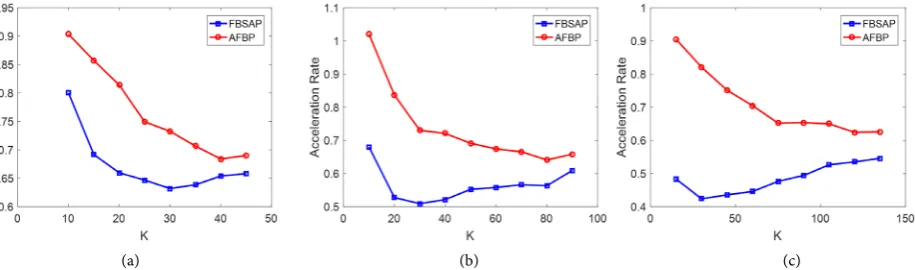
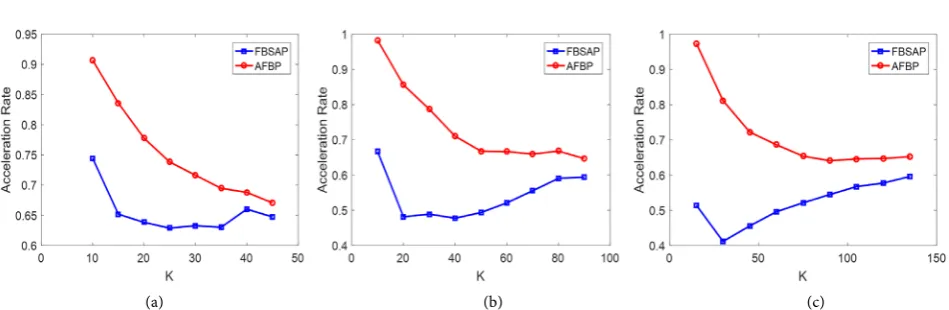
Figure 4 show the acceleration rate for Gauss sparse signals. Figure 5 are the
[image:7.595.72.530.570.705.2](a) (b) (c)
Figure 3. The reconstruction result for uniform sparse signals. (a) Exact reconstruction rate; (b) ANMSE; (c) Running time.
(a) (b) (c)
DOI: 10.4236/jcc.2017.510004 33 Journal of Computer and Communications (a) (b) (c)
Figure 5. Acceleration rate for uniform sparse signals. (a) N = 256, M = 100; (b) N = 512, M = 200; (c) N = 768, M = 300.
result for uniform sparse signals. The figures show that the acceleration effect of FBSAP is better than AFBP for all signal sizes and sparsity levels. The accelera-tion effect is particularly evident when the size of signal is large and the sparsity level is low. For example, while N=768 and K=30, the AFPB costs 80
per-cent of FBP’s running time, But FBSAP only costs 40 perper-cent. With the decrease of sparsity, AFBP gradually loses the acceleration effect, but the effect of FBSAP become more obvious.
4.3. The Influence of Ladder Threshold Parameter
The reconstruction effect is influenced by γ. The selection of γ depends on
the height of correlation ladder. If the value of γ is too large, we will not find
the accurate ladders, lose many correct atoms, and reduce the success rate of re-construction. If it is very large, we even cannot find any ladder and completely lose the acceleration effect. If it is too small, we will find many no obvious lad-ders, so that select too many atoms into support set, reduce the algorithm’s speed. Therefore, it is very important to select the appropriate γ.
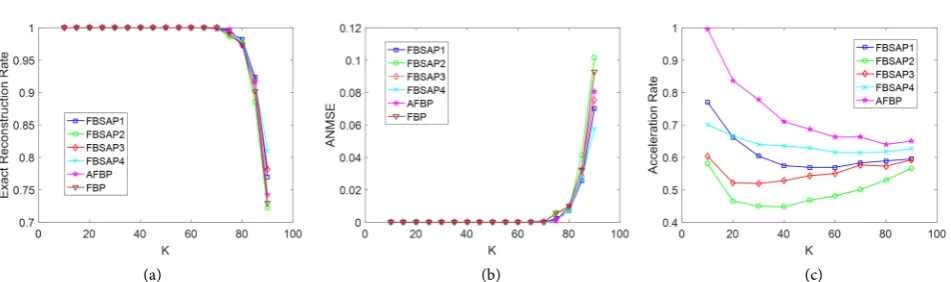
Figure 6 are the reconstruction effect for Gauss sparse signals. The parameters of FBSAP1 to FBSAP4 are γ =0.0001, γ =0.001, γ =0.002 and γ =0.004.
We find that the reconstruction speed is fastest while γ =0.001, but the exact
reconstruction rate and ANMSE is not good. A large number of experiments show that FBSAP has the best reconstruction effect when γ =0.002.
5. Conclusion
DOI: 10.4236/jcc.2017.510004 34 Journal of Computer and Communications (a) (b) (c)
Figure 6. The reconstruction effect for Gauss sparse signals with different parameter. (a) Exact reconstruction rate; (b) ANMSE; (c)
Acceleration rate.
Acknowledgements
This work was supported by Tianjin Key Laboratory of Optoelectronic Sensor and Sensing Network Technology.
References
[1] Donoho, D.L. (2006) Compressed Sensing. IEEE Transactions on Information Theory, 52, 1289-1306. https://doi.org/10.1109/TIT.2006.871582
[2] Candes, E.J., Romberg, J. and Tao, T. (2006) Robust Uncertainty Principles: Exact Signal Reconstruction from Highly Incomplete Frequency Information. IEEE Transactions on Information Theory, 52, 489-509.
https://doi.org/10.1109/TIT.2005.862083
[3] Candes, E.J. and Wakin, M.B. (2008) An Introduction To Compressive Sampling.
IEEE Signal Processing Magazine, 25, 21-30.
https://doi.org/10.1109/MSP.2007.914731
[4] Xie, R. and Jia, X. (2014) Transmission-Efficient Clustering Method for Wireless Sensor Networks Using Compressive Sensing. IEEE Transactions on Parallel and Distributed Systems, 25, 806-815. https://doi.org/10.1109/TPDS.2013.90
[5] Li, C., Wang, J. and Li, M. (2016) Efficient Data Transmission of Wireless Sensor Networks through Compressive Sensing and Matrix Completion. International Journal of Wireless Information Networks, 23, 135-140.
https://doi.org/10.1007/s10776-016-0303-6
[6] Zhang, Y., Wang, S., Ji, G. and Dong, Z. (2014) Exponential Wavelet Iterative Shrinkage Thresholding Algorithm with Random Shift for Compressed Sensing Magnetic Resonance Imaging. IEEJ Transactions on Electrical and Electronic Engi-neering, 10, 116-117. https://doi.org/10.1002/tee.22059
[7] Koller, R., Schmid, L., Matsuda, N., et al. (2015) High Spatio-Temporal Resolution Video with Compressed Sensing. Optics Express, 23, 15992.
https://doi.org/10.1364/OE.23.015992
[8] Mallat, S.G. and Zhang, Z. (1993) Matching Pursuits with Time-Frequency Dictio-naries. IEEE Transactions on Signal Processing, 41, 3397-3415.
https://doi.org/10.1109/78.258082
DOI: 10.4236/jcc.2017.510004 35 Journal of Computer and Communications [10] Chen, S.S., Donoho, D.L. and Saunders, M.A. (2001) Atomic Decomposition by Ba-sis Pursuit. SIAM Review, 43, 129-159.https://doi.org/10.1137/S003614450037906X
[11] Daubechies, I., DeVore, R., Fornasier, M., and Güntürk, C.S. (2010) Iteratively Re-weighted Least Squares Minimization for Sparse Recovery. Communications on Pure and Applied Mathematics, 63, 1-38.https://doi.org/10.1002/cpa.20303
[12] Dai, W. and Milenkovic, O. (2009) Subspace Pursuit for Compressive Sensing Sig-nal Reconstruction. IEEE Transactions on Information Theory, 55, 2230-2249.
https://doi.org/10.1109/TIT.2009.2016006
[13] Needell, D. and Tropp, J.A. (2009) CoSaMP: Iterative Signal Recovery from Incom-plete and Inaccurate Samples. Applied and Computational Harmonic Analysis, 26, 301-321.
[14] Blumensath, T. and Davies, M.E. (2009) Iterative Hard Thresholding for Com-pressed Sensing. Applied and Computational Harmonic Analysis, 27, 265-274. [15] Karahanoglu, N.B. and Erdogan, H. (2013) Compressed Sensing Signal Recovery via
Forward-Backward Pursuit. Digital Signal Processing, 23, 1539-1548.
[16] Wang, F., Sun, G., Zhang, J. and He, J.F. (2016) Acceleration Forward-Backward Pursuit Algorithm Based on Compressed Sensing. Journal of Electronics & Infor-mation Technology, 38, 2538-2545.
http://www.en.cnki.com.cn/Article_en/CJFDTotal-DZYX201610018.htm
Submit or recommend next manuscript to SCIRP and we will provide best service for you:
Accepting pre-submission inquiries through Email, Facebook, LinkedIn, Twitter, etc. A wide selection of journals (inclusive of 9 subjects, more than 200 journals)
Providing 24-hour high-quality service User-friendly online submission system Fair and swift peer-review system
Efficient typesetting and proofreading procedure
Display of the result of downloads and visits, as well as the number of cited articles Maximum dissemination of your research work
Submit your manuscript at: http://papersubmission.scirp.org/