Fine-Grained Emotion Recognition in Olympic Tweets
Based on Human Computation
Valentina Sintsovaa, b Claudiu Musata
aArtificial Intelligence Laboratory bHuman Computer Interaction Group
School of Computer and Communication Sciences Swiss Federal Institute of Technology (EPFL)
CH-1015, Lausanne, Switzerland
{valentina.sintsova, claudiu-cristian.musat, pearl.pu}@epfl.ch
Pearl Pub
Abstract
In this paper, we detail a method for do-main specific, multi-category emotion recog-nition, based on human computation. We cre-ate an Amazon Mechanical Turk1 task that elicits emotion labels and phrase-emotion as-sociations from the participants. Using the proposed method, we create an emotion lex-icon, compatible with the 20 emotion cate-gories of the Geneva Emotion Wheel. GEW is the first computational resource that can be used to assign emotion labels with such a high level of granularity. Our emotion annotation method also produced a corpus of emotion la-beled sports tweets. We compared the cross-validated version of the lexicon with existing resources for both the positive/negative and multi-emotion classification problems. We show that the presented domain-targeted lex-icon outperforms the existing general purpose ones in both settings. The performance gains are most pronounced for the fine-grained emo-tion classificaemo-tion, where we achieve an accu-racy twice higher than the benchmark.2
1 Introduction
Social media platforms such as Twitter.com have be-come a common way for people to share opinions and emotions. Sports events are traditionally ac-companied by strong emotions and the 2012 summer Olympic Games in London were not an exception. In this paper we describe methods to analyze and data mine the emotional content of tweets about this
1
www.mturk.com
2
The corpus and the lexicon are available upon email request
event using human computation. Our goal is to cre-ate an emotion recognition method, capable of clas-sifying domain specific emotions with a high emo-tion granularity. In the stated case, domain speci-ficity refers not only to the sport event, but also to the Twitter environment.
We focus on the categorical representation of emotions because it allows a more fine-grained anal-ysis and it is more natural for humans. In daily life we use emotion names to describe specific feelings rather than give numerical evaluations or specify po-larity. So far, the multi-item emotion classification problem has received much less attention.
One reason is that high quality training corpora are difficult to construct largely due to the cost of hu-man annotators. Further, if emotion representation is not carefully designed, the annotator agreement can be very low. The higher the number of consid-ered emotions is, the more difficult it is for humans to agree on a label for a given text. Low quality labeling leads to difficulties in extracting powerful classification features. This problem is further com-pounded in parsimonious environments, like Twit-ter, where the short text leads to a lack of emotional cues. All this presents challenges in developing a high-quality emotion recognition system operating with a fine-grained emotion category set within a chosen domain.
In this paper, we show how to tackle the above challenges through human computation, using an online labor market such as the Amazon Mechani-cal Turk or AMT (Snow et al., 2008). To overcome the possible difficulties in annotation we employ a well-designed emotion assessment tool, the Geneva
Emotion Wheel (GEW) (Scherer, 2005). Having20
separate emotion categories, it provides a desirable high level of emotion granularity. In a given task, we show the annotators the tweets, related to the afore-mentioned sports event, and ask them to classify the tweets’ emotional content into one of the provided emotion categories. The action sequence requires them to both label the tweets and to specify the tex-tual constructs that support their decision. We view the selected textual constructs as probable classifi-cation features. The proposed method thus simul-taneously producesan emotion annotated corpusof tweets and creates anemotion lexicon. The resulting weighted emotion lexicon is a list of phrases indica-tive of emotion presence. It consists solely of ones selected by respondents, while their weights were learnt based on their occurrence in the constructed Sports-Related Emotion Corpus (SREC).
We show that the human-based lexicon is well suited for the particularities of the chosen environ-ment, and also for an emotion model with a high number of categories. Firstly, we show that domain specificity matters, and that non-specialists, using their common sense, can extract features that are useful in classification. We use the resulting lexi-con, OlympLex, in a binary polarity classification problem on the domain data and show that it outper-forms several traditional lexicons.
In multi-emotion classification, we show that it is highly accurate in classifying tweets into 20
emotion categories of the Geneva Emotion Wheel (GEW) (Scherer, 2005). As a baseline for compar-ison we use the Geneva wheel compatible lexicon, the Geneva Affect Label Coder (GALC) (Scherer, 2005). The experiments show thatOlympLex sig-nificantly outperforms this baseline.
Such a detailed emotion representation allows us to create an accurate description of the sentiment the chosen event evokes in its viewers. For instance, we find thatPrideis the dominant emotion, and that it is2.3times more prevalent thanAnger.
2 Related Work
GEW Emotion Representation Model In our work we used the emotion categories from the Geneva Emotion Wheel (GEW, version 2.0). GEW was developed as a tool for obtaining self-reports of
emotional experience with a goal to structure the ex-haustive list of possible emotion names used in free-format self-reports with minimal loss in expressibil-ity. It presents 20 (10 positive/10 negative) emo-tion categories frequently answered in free-format self-reports as main options. Each emotion category is represented by two common emotion names to emphasize its family nature (e.g. Happiness/Joy3). These categories are arranged on the circle follow-ing the underlyfollow-ing 2-dimensional space of valence (positive-negative) and control (high-low). Several levels of intensity for each emotion category are pre-sented as answer options. Also,2other answers are possible: No emotionandOther emotionwith free-format input in the latter case.
Compared to raw dimensional models where emotion states are described as points in space (e.g. Pleasure-Arousal-Dominance model, PAD (Mehra-bian, 1996)) GEW has an advantage of categorical representation where emotion state is described in terms of discrete set of emotion names. It allows humans to measure their emotions in terms of emo-tion names they accustomed to instead of unnat-ural numerical measurements. Among commonly used emotion categories sets GEW categories are the most fine-grained, compared, for instance, to Ek-man’s (1992) or Plutchik’s (1980) basic emotions. While these models have been popular in emotion recognition research, their main shortcoming is their limited items. In sports events, fans and spectators not only feel strong emotions, but also likely want to express them in multitudes of expressions. Pride/E-lation,Envy/Jealousyare just two examples that are missed in those models with basic emotions.
Lexical Resources Emotion recognition is closely related to the positive/negative sentiment classifica-tion. In a traditional approach the units defining the polarity of the text are polarity-bearing terms. A list of such terms with corresponding polarity label or score forms a polarity lexicon. Commonly used ex-amples of polarity lexicons include GI (Stone et al., 1968), Bing Liu’s lexicon (Hu and Liu, 2004), and OpinionFinder (Wilson et al., 2009).
Similarly, emotion lexicons can be defined as lists of terms bearing emotions with their
corre-3In the paper text we often use one name per category for
sponding emotion information. Depending on the construction methods, they can be separated into those that constructed manually (GALC (Scherer, 2005)), semi-automatically (WordNet-Affect (Strap-parava and Valitutti, 2004)) or via human computa-tion (ANEW (Bradley and Lang, 1999), NRC (Mo-hammad and Turney, 2010; Mo(Mo-hammad and Turney, 2012)). Our work is most closely related to the NRC lexicon which was also extracted via human compu-tation on AMT. The authors developed a task where, for a given term, the annotators rated to what extent the term is associated to each emotion of Plutchik’s set. In contrast, in our work, we harvest emotional labels and features in context. The terms are associ-ated with emotions in the context of the tweet they appear in. We use the approach suggested by (Aman and Szpakowicz, 2007) where humans are asked to select an excerpt of the text expressing emotion. Moreover, we ask the annotators for additional inter-changeable, emotional expressions for the same sit-uation. Lexicons obtained from unsupervised learn-ing methods uslearn-ing automatically annotated Twitter data (Mohammad, 2012) have also been proposed, but their performance has been shown to be inferior to benchmarks such as NRC.
The underlying emotion representation model dif-fers from one emotion lexicon to another. For in-stance, ANEW uses the PAD dimensions, Plutchik’s basic categories are used by NRC and Ekman’s cat-egories in WordNet-Affect. However, such repre-sentations do not provide a sufficient emotion gran-ularity level. There is only one lexicon which incor-porates GEW emotion model: the GALC (Scherer, 2005) lexicon. It contains279unigram stems (e.g. happ*) explicitly expressing one of36emotion cate-gories (covering all GEW catecate-gories). We use there-fore this lexicon for benchmarking.
The main differences of our lexicon compared to its predecessors lie in the usage of new fine-grained emotion set, new methods of human computation employed in its construction and specificity to the context of Twitter posts and sport-related emotions.
3 Emotional Labeling and Emotion Feature Elicitation
We created a Human Computation method, using the online labor market (Amazon Mechanical Turk
or AMT) to simultaneously accomplish two goals. The first is to have a reliable, human annotation of the emotions within a text corpus. The second is to enable the respondents to provide us with the fea-tures needed to construct an emotion lexicon. In this section we describe the processes of data selection, annotation, and refinement, as well as provide the statistical description of the obtained data.
3.1 Data Collection
Our goal is to analyze the emotions of the spectators of Olympic games. We consider the tweets about the Olympics posted during the 2012 Olympic games as a data source for this analysis. We assume that the same emotions are expressed in the same way for all the sports. We thus narrow the scope of our analysis to a single sport – gymnastics.
Traditionally, the gymnastics teams from the USA have strong bid for victory. Thus, we assume that a large group of English-speaking nation may be in-terested in it. Then, gymnastics is a dynamic type of sport where each moment of performance can play a crucial role in final results, enhancing the emo-tional experience in audience. Also, it is less com-mon than, for instance, running or swimming, thus the occurrence of this term in tweets, at the time of the Olympics, will more likely signal a reference to the Olympic gymnasts.
We used the hashtag#gymnastics (hashtags rep-resent topics in tweets) to obtain the tweets related to the gymnastic competitions during the Olympics time resulting in 199,730 such tweets. An emo-tional example is“Well done #gymnastics we have a SILVER yeayyyyyyyyy!!!! Wohoooo”.
3.2 Annotation Process
We developed a Human-Intelligence Task (HIT) on the AMT for annotation of a subset of the collected tweets with emotion-related information.
3.2.1 Task description
One HIT consisted of the annotation of one pre-sented tweet. A worker was asked to read a tweet text and to fulfill the following subtasks:
Iteration 1 2(Ben) 2(Ball) 3 4 5 4+5
Polarity agreement 78.5 68 33.3 66.7 73.9 75.9 75.7
Emotion agreement 38.5 24.7 13.34 29.3 25.84 29.7 29.3
[image:4.612.73.542.58.129.2]Average number of emotion tweet 1.6 1.26 0.64 1.28 1.2 1.72 1.67 indicators per answera additional - 0.25 0.36 1.41 1.3 2.05 1.99
Table 1: Basic statistics on the data collected over the annotation iterations.
a
only among answers where non-neutral emotion label is assigned
be felt, a worker had to choose one emotion that pre-vailed all others. This kept him focused on one main emotion in the subtasks 2 and 3. To elicit this in-formation we employed the Geneva Emotion Wheel (GEW) described in the Related Work with minor changes: we used 3 strength labels (low, medium and high) instead of5in initial version. The set of emotion categories remained unchanged: 20GEW emotion categories plus2additional answer options: No emotionandOther emotion. We required work-ers to type the emotion name in latter case.
Subtask 2 In case an emotion was present, a worker was then asked to choose the excerpts of the tweet indicating its presence, the (tweet emotion indicators). She was asked to find all the expres-sions of the chosen emotion present in the tweet text. It could be one word, emoticon, or subsequence of the tweet words. We asked her to also include the words modifying the strength of emotion (e.g. to chooseso excitedinstead ofexcited).
Subtask 3Inputadditional emotion indicatorsof chosen emotion. Similarly to the previous subtask, a worker was asked to input the textual expressions of the chosen emotion. However, in this case the expressions had to be not from the tweet text, but generated based on personal experience. E.g. she could state that she usespoor thingto expressPity.
3.2.2 HIT Iterations
The design of annotation schema and correspond-ing instructions as well as search for the optimal HIT parameters took several iterations. Table 1 contains the statistics on inter-annotator agreements and on the number of provided emotion indicators for each iteration. Beside emotion agreement, we also con-sider polarity agreement. Thepolarity label of an answer is defined as the polarity of its emotion label. No emotionimplies aNeutralpolarity. For answers withOther emotionwe manually detected their
po-larity based on provided emotion name if applicable, or setNeutralpolarity otherwise.
Iteration 1Firstly, we annotated200 tweets (set
S1), using respondents within our laboratory, into a set of 12 emotion categories (SportEm) which we considered first to be representative for the emo-tions incited by sport events: Love, Pride, Excite-ment, Positive Surprise, Joy, Like, Other Positive, Anger/Hate, Shame, Anxiety, Shock, Sadness, Dis-like, Other Negative. For each tweet an annota-tor gave theemotion labeland chose corresponding tweet emotion indicators. The tweets ofS1included both tweets with predefined emotional words and without. The details of selection process are omit-ted due to space limitations.
Iteration 2We launched two batches of HITs on AMT:Ball and Ben. A HIT batch is defined by a
set of tweets to label, with some parameters specific for AMT, such as the number of different workers for each tweet (we used4 in all our experiments), the payment for one HIT, or specific worker require-ments, (e.g. forBen we also required that workers should be from the U.S.). We grouped 25 tweets fromS1with HIT payment of$0.05inBen, whereas
forBall we included only 10tweets with payment
of$0.03. The annotation schema used the emotions ofSportEm. For each tweet an annotator gave the emotion label and provided tweet emotion indica-tors. The field foradditionalemotion indicators in-put was presented as optional.
We discovered that the answers inBallhad an un-acceptable quality, with a low agreement and many impossible labels. This can be explained either by lower understanding of English or less reliability of workers from all around the world compared to the U.S. workers. Consequently, all our next iterations had the requirement on workers to be from the U.S.
an-notate the full S1 with emotions from SportEm. Starting with this iteration, the payment was set to
$0.04. Theadditional emotion indicators field was shown as compulsory. The experiment showed that AMT workers generally followed the instructions achieving emotion agreement only slightly worse than ours.
Iteration 4 We decided to use the more fine-grained and well researched GEW emotion cate-gories. Thus, we launched another HIT batch to annotate S1 again, in terms of GEW emotion cat-egories (with a schema given in Task Description). Even though a new task contained more answer op-tions emotion agreement stayed in the same range between0.25and0.3.
Iteration 5 We launched a final batch with the described GEW schema to annotate more tweets. We selected Olympics related tweets that had a high likelihood of being emotional. We first selected tweets using the emotion indicators obtained during the previous iterations and found more than5times in the collected corpus (418terms). For each key-word in this list we extracted up to3tweets contain-ing this term (1244tweets). In addition, we added the tweets without keywords from the list, but posted by the users who used these emotional keywords in their other tweets, supposing that these users are more likely to express their emotions. Overall,1800
tweets were selected, but13were excluded because they were not written in English.
The resulting corpus contains the data gathered during the iterations 4 and 5. It consists of 1987
tweets annotated each by 4 workers with emotion label, emotion strength, and related emotion indica-tors. The Fleiss Kappa (Fleiss, 1971) for emotion la-bels is0.24which is considered to be fair by Landis and Koch (1977), but quite low compared to usual kappa values in other tasks (e.g. polarity annotation usually has Kappa in a range of0.7–0.8). We con-clude that the annotation in terms of multi-category emotions is highly subjective and ambiguous task, confirming our assumptions on existence of emotion mixtures.
3.3 Quality Control
The results of crowdsourcing usually require addi-tional refinement. The workers who give malicious answers intentionally or due to lack of
understand-ing worsen the data quality. We detect such workers automatically using the following2criteria:
Average Polarity Conformity A worker’s answer has apolarity conformityof1if at least one worker indicated the same polarity for the same tweet (0
otherwise). A worker’s average polarity conformity is computed from all his answers. This criterion aims to detect the workers who repeatedly disagree with other workers.
Dominant Emotion Frequency The dominant emotion of a worker is the one which appears most frequently in his answers. The dominant emotion frequency, among the worker’s answers, is the cri-terion value. This cricri-terion aims to detect workers biased towards specific emotion.
A worker who has the average polarity conformity below a predefined threshold or the dominant emo-tion frequency above a threshold is considered to have an insufficient quality and all his answers are excluded from the corpus. The threshold for each criterion is computed as a percentile of an approxi-mated normal distribution of workers criterion val-ues for probability limit of0.01.
To increase the confidence in the computed cri-teria values, we establish a minimum number of tweetsTmin any worker should annotate to be
sub-jected to the criteria. To establish this number for each criterion, we use the following algorithm:
LetXn(w)be the criterion value computed using
only first nanswers of worker w in order of their submission. For each worker we detectNmin(w)– the minimum number of answers after which the cri-terion value stops varying greatly:
|Xn(w)−Xn−1(w)| ≤0.05, ∀n≥Nmin(w) (1)
We then computeTminas the ceiling of the average
value of ofNmin(w)among workers who annotated
at least20tweets.
The described procedure on detection of bad workers allowed the analysis of83%of the answers. Using it, we excluded8 workers, with their corre-sponding260answers.
Other emotionand the answers for12 tweets, that were left with only1answer by this stage.
As a result of quality control, there were excluded
14.2%of initial answers. Overall,1957tweets with corresponding6819annotations remained (3.48 an-swers per tweet in average). These anan-swers compose the final Sport-Related Emotion Corpus (SREC).
3.4 Emotion distribution in SREC
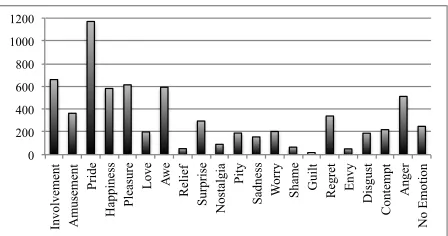
To provide a glimpse of the data we present the dis-tribution of emotion categories among all answers in the figure 1. The most frequently answered emotion category wasPride, followed byInvolvement. These emotions are natural in the context of sport events, however course-grained emotion models could not distinguish them. It highlights the advantage of fine-grained GEW emotion set to express the subtleties of the domain.
0 200 400 600 800 1000 1200 Invol ve m ent A m us em ent P ri de H appi ne ss P le as ure L
ove Awe
[image:6.612.75.299.304.422.2]Re li ef S urpri se N os ta lgi a P it y S adne ss W orry S ha m e G ui lt Re gre t E nvy D is gus t Cont em pt A nge r N o E m ot ion
Figure 1: Distribution of emotion labels in worker’s an-swers (after application of quality control)
4 Emotion Recognition Model
The output of our emotion recognition method is the distribution of emotions within a text, in terms of GEW emotion categories. It is represented as a tuple in the probability space
P= (
¯
p= (p1, . . . , p21), 21
X
i=1
pi= 1 )
(2)
wherepirepresents the percentage ofith emotion in
felt emotion mixture. The emotion set contains20
GEW categories andNo Emotionas21st category. We use a lexicon of emotion indicators, which are words or word sequences indicative of emotion presence. Each indicatortermt has attached emo-tion distribuemo-tion tuplep¯t ∈ P. To compute the re-sult tuplep¯ for a text d we sum up all the tuples
of emotion indicators found within this text with the number of times they were found:
¯
p(d) = X
termt∈d
nt(d) ¯pt (3)
If no indicators are present in the text, a full weight is given toNo emotioncategory (p21= 1). We also neglect all negated indicators occurrences detected by the negation words (no, not,*n’t,never) placed ahead of an indicator.
Lexicon Construction We construct the lexicon by selecting the emotion indicators and computing their emotion distributions. We use a training corpus that has a format described in the previous section. The training process consists of the following steps: Among all tweet and additionalemotion indica-tors provided by workers, we select those that were suggested more than once.
For each tweet we have several emotion labels from the data. We determine the emotion distribu-tion of the tweet by computing the frequency of each emotion label over all the answers corresponding to that tweet.
For each answer we construct a link between each term suggested in theadditionalemotion indicators field and the answer’s emotion label. This link is represented as a tuple p¯ ∈ P with weight 1 for linked emotion category. Then, for each detected emotion indicator we compute its emotion distribu-tion by averaging all the emodistribu-tion distribudistribu-tions it ap-peared in. This includes the emotion distributions of the tweets where this indicator occurred without a negation and the emotion distributions of the corre-sponding indicator-emotion links.
We define an indicator to be ambiguous if its dom-inant polarity (polarity having the highest sum of the weights for corresponding emotions) has sum-mary weight smaller than0.75. All such terms are removed from the result lexicon.
Result Lexicon Description Following the speci-fied process over the full SREC data, we computed an emotion lexicon,OlympLex, that contains3193
terms. The ratio of positive terms to negative ones is7:3(term polarity is defined as dominant polarity of term emotion distribution). Unigrams compose
5 Experimental Evaluation
We evaluated our lexicon on the SREC corpus as a classifier, using ten-fold cross-validation to avoid possible overfitting. The precompiled universal lex-icons were used for benchmarking. As no training is required, we tested them over the full data.
5.1 Polarity Classification
We considered the basic polarity classification task with3classes (Positive,NegativeandNeutral). We used only1826tweets that have one dominant ity based on workers’ answers. This dominant polar-ity was taken as a true polarpolar-ity label of a tweet.
The output polarity label of our classifier is dom-inant polarity of found emotion distribution: a po-larity having the highest sum of the weights for cor-responding emotions. The output of prior sentiment lexicons is computed analogously: we sum up the number of found lexicon terms in the tweet text for each emotion or polarity category (depending on which categorization is provided by the lexicon) and output the polarity having the highest sum value. If two polarities have the same sum weight, the output polarity isNeutral.
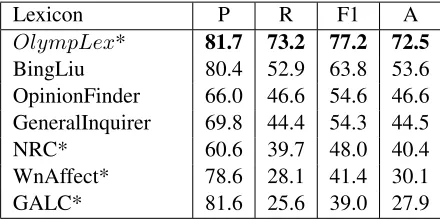
We used standard classification evaluation mea-sures: accuracy, precision, recall and F1-score. We considered only non-neutral classes (Positive and Negative) for precision and recall. Table 2 shows the results of our classifier, compared with other known sentiment lexicons. The proposed lexicon outper-forms every other one, both in terms of accuracy and F1-score. As it was the only lexicon fitted to the Olympic gymnastics data, its superiority reveals the advantage of domain-targeted lexicon construction.
Lexicon P R F1 A
OlympLex* 81.7 73.2 77.2 72.5
BingLiu 80.4 52.9 63.8 53.6
OpinionFinder 66.0 46.6 54.6 46.6 GeneralInquirer 69.8 44.4 54.3 44.5
NRC* 60.6 39.7 48.0 40.4
WnAffect* 78.6 28.1 41.4 30.1
[image:7.612.76.296.548.658.2]GALC* 81.6 25.6 39.0 27.9
Table 2: The results of polarity classification evaluation. P=precision, R=recall, F1 = F1-score, A=accuracy *A lexicon employing several emotion categories
5.2 Emotion Classification
We evaluated emotion recognition results in the set-ting of a multi-label classification problem. The out-put is a set of labels instead of a standard single label answer. In this case, the output of the clas-sifier (OC) was defined as a set of dominant emo-tions in the found emotion distributionp¯. This set contained the emotions having the highest weights
pi. The set of emotion labels given for this tweet
by workers formed a true output – a set of true la-bels (OT) of emotion classification. As a baseline
for multi-category emotion classification we consid-ered the GALC lexicon (Scherer, 2005).
Multi-label Evaluation We used the standard evaluation metrics adapted for multi-label output (Tsoumakas and Katakis, 2007). For each tweet, we first computed the precision P = |OC∩OT|
|OC| , which
shows how many of emotions outputted by the clas-sifier were correct. Then the recallR = |OC∩OT|
|OT| ,
which shows how many of true labels were found by classifier, and the accuracyA= |OC∩OT|
|OC∪OT|, which
shows how close the sets of classifier and true la-bels were. These values were averaged among all applicable tweets. For precision and recall we used only the tweets with non-neutral answers inOCand OT correspondingly (meaning thatNo emotionlabel
was not present in a set).
Table 3 shows the comparative results of our and GALC lexicons. Compared to the GALC baseline, our classifier has both higher precision and recall. Higher recall is explained by the fact that our lexi-con is larger and lexi-contains also ngram terms. In ad-dition, it includes not only explicit emotion expres-sions (e.g.sadorproud), but also implicit ones (e.g. yesormistakes).
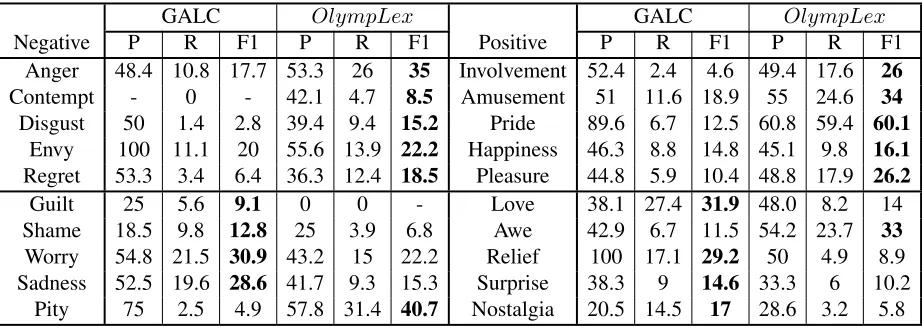
Per-Category Evaluation Another way to evalu-ate the output of multi-label classifier is to evaluevalu-ate it for each emotion category separately. For each cat-egory we computed precision, recall and F1-score.
Lexicon P R F1 A
GALC 49.0 10.2 16.8 12.5
[image:7.612.317.537.627.670.2]OlympLex 53.5 24.9 34.0 25.4
GALC OlympLex GALC OlympLex
Negative P R F1 P R F1 Positive P R F1 P R F1
Anger 48.4 10.8 17.7 53.3 26 35 Involvement 52.4 2.4 4.6 49.4 17.6 26
Contempt - 0 - 42.1 4.7 8.5 Amusement 51 11.6 18.9 55 24.6 34
Disgust 50 1.4 2.8 39.4 9.4 15.2 Pride 89.6 6.7 12.5 60.8 59.4 60.1
Envy 100 11.1 20 55.6 13.9 22.2 Happiness 46.3 8.8 14.8 45.1 9.8 16.1
Regret 53.3 3.4 6.4 36.3 12.4 18.5 Pleasure 44.8 5.9 10.4 48.8 17.9 26.2
Guilt 25 5.6 9.1 0 0 - Love 38.1 27.4 31.9 48.0 8.2 14
Shame 18.5 9.8 12.8 25 3.9 6.8 Awe 42.9 6.7 11.5 54.2 23.7 33
Worry 54.8 21.5 30.9 43.2 15 22.2 Relief 100 17.1 29.2 50 4.9 8.9 Sadness 52.5 19.6 28.6 41.7 9.3 15.3 Surprise 38.3 9 14.6 33.3 6 10.2
[image:8.612.76.537.57.221.2]Pity 75 2.5 4.9 57.8 31.4 40.7 Nostalgia 20.5 14.5 17 28.6 3.2 5.8
Table 4: Evaluation results at per-category level. P=precision, R=recall, F1 = F1-score
The results of this evaluation in comparison with benchmark GALC lexicon are presented in the ta-ble 4. Overall, our lexicon performs better on most of the categories (12out of20) in terms of F1-score. The highest F1-score is achieved for such Olympic related emotion asPride.
5.3 Discussion
The fact that the terms from the GALC lexicon are found in31%of tweets indicates that people do ex-press their emotions explicitly with emotional terms. However, a list of currently available explicit emo-tional terms is not extensive. For instance, it does not cover slang terms. Moreover, people do not limit themselves to only explicit emotional terms. Our lexicon constructed based on the answers pro-vided by non-expert humans achieves a significantly higher recall. This highlights the importance of em-ploying the human common knowledge in the pro-cess of extraction of emotion bearing features.
6 Conclusion
We presented a context-aware human computation method for emotion labeling and feature extrac-tion. We showed that inexpert annotators, using their common sense, can successfully attach tion labels to tweets, and also extract relevant emo-tional features. Using their answers, we carefully constructed a linguistic resource for emotion clas-sification. The suggested method can be reused to construct additional lexicons for different domains.
An important aspect that differentiates our work is the emotion granularity. To the best of our
knowl-edge, this was the first attempt to create lexical resources for emotion classification based on the Geneva Emotion Wheel (GEW), which has as many as20 emotion categories. This level of granularity enabled us to capture the subtleties of the emotional responses in the target domain, tweets regarding the 2012 summer Olympics in London. In this dataset, we found that the prevalent emotion isPride, a detail which is unattainable using previous methods.
Another differentiator is that, unlike most previ-ous approaches, we relied on human computation for both labeling and feature extraction tasks. We showed that human generated features can be suc-cessfully used in emotional classification, outper-forming various existing methods. A further differ-ence from prior lexicons is the fact that ours was built with a context-sensitive method. This led to a higher accuracy on the target domain, compared to the general purpose lexicon.
We benchmarked the cross-validated version of created OlympLex lexicon with the existing universal-domain lexicons for both polarity and multi-emotion problems. In suggested settings we showed that it can outperform general purpose lex-icons in the binary classification due to its domain specificity. We also obtained significant improve-ments over the baseline GALC lexicon, which was the only preexisting one compatible with the GEW.
References
Cecilia Ovesdotter Alm, Dan Roth, and Richard Sproat. 2005. Emotions from text: machine learning for text-based emotion prediction. InProceedings of the con-ference on Human Language Technology and Empir-ical Methods in Natural Language Processing, pages 579–586. Association for Computational Linguistics. Saima Aman and Stan Szpakowicz. 2007. Identifying
expressions of emotion in text. InText, Speech and Dialogue, pages 196–205. Springer.
Margaret M Bradley and Peter J Lang. 1999. Affective norms for english words (anew): Instruction manual and affective ratings. Technical report, Technical Re-port C-1, The Center for Research in Psychophysiol-ogy, University of Florida.
Taner Danisman and Adil Alpkocak. 2008. Feeler: Emo-tion classificaEmo-tion of text using vector space model. InAISB 2008 Convention Communication, Interaction and Social Intelligence, volume 1, page 53.
Paul Ekman. 1992. An argument for basic emotions.
Cognition & Emotion, 6(3-4):169–200.
Joseph L Fleiss. 1971. Measuring nominal scale agree-ment among many raters. Psychological bulletin, 76(5):378.
Minqing Hu and Bing Liu. 2004. Mining and summa-rizing customer reviews. InProceedings of the tenth ACM SIGKDD international conference on Knowl-edge discovery and data mining, pages 168–177. ACM.
Sunghwan Mac Kim, Alessandro Valitutti, and Rafael A Calvo. 2010. Evaluation of unsupervised emotion models to textual affect recognition. InProceedings of the NAACL HLT 2010 Workshop on Computational Approaches to Analysis and Generation of Emotion in Text, pages 62–70. Association for Computational Lin-guistics.
J Richard Landis and Gary G Koch. 1977. The mea-surement of observer agreement for categorical data.
Biometrics, pages 159–174.
Hugo Liu, Henry Lieberman, and Ted Selker. 2003. A model of textual affect sensing using real-world knowledge. InProceedings of the 8th international conference on Intelligent user interfaces, pages 125– 132. ACM.
Albert Mehrabian. 1996. Pleasure-arousal-dominance: A general framework for describing and measuring in-dividual differences in temperament. Current Psychol-ogy, 14(4):261–292.
Saif M Mohammad and Peter D Turney. 2010. Emo-tions evoked by common words and phrases: Using mechanical turk to create an emotion lexicon. In Pro-ceedings of the NAACL HLT 2010 Workshop on Com-putational Approaches to Analysis and Generation of Emotion in Text, pages 26–34.
Saif M Mohammad and Peter D Turney. 2012. Crowd-sourcing a word–emotion association lexicon. Com-putational Intelligence.
Saif M Mohammad. 2012. # emotional tweets. In Pro-ceedings of the First Joint Conference on Lexical and Computational Semantics-Volume 1: Proceedings of the main conference and the shared task, and Volume 2: Proceedings of the Sixth International Workshop on Semantic Evaluation, pages 246–255. Association for Computational Linguistics.
Alena Neviarouskaya, Helmut Prendinger, and Mitsuru Ishizuka. 2011. Affect analysis model: Novel rule-based approach to affect sensing from text. Natural Language Engineering, 17(1):95.
Robert Plutchik. 1980. A general psychoevolutionary theory of emotion. Emotion: Theory, research, and experience, 1(3):3–33.
Klaus R Scherer. 2005. What are emotions? and how can they be measured? Social science information, 44(4):695–729.
Rion Snow, Brendan O’Connor, Daniel Jurafsky, and An-drew Y Ng. 2008. Cheap and fast—but is it good?: evaluating non-expert annotations for natural language tasks. InProceedings of the Conference on Empirical Methods in Natural Language Processing, pages 254– 263. Association for Computational Linguistics. Phil J Stone, Dexter C Dunphy, Marshall S Smith, and
DM Ogilvie. 1968. The general inquirer: A computer approach to content analysis. Journal of Regional Sci-ence, 8(1).
Carlo Strapparava and Alessandro Valitutti. 2004. Wordnet-affect: an affective extension of wordnet. In
Proceedings of LREC, volume 4, pages 1083–1086. Grigorios Tsoumakas and Ioannis Katakis. 2007.
Multi-label classification: An overview. International Journal of Data Warehousing and Mining (IJDWM), 3(3):1–13.
Theresa Wilson, Janyce Wiebe, and Paul Hoffmann. 2009. Recognizing contextual polarity: An explo-ration of features for phrase-level sentiment analysis.