MASTER THESIS
DEVELOPMENT & INITIAL
VALIDATION OF THE
ATHLETE'S MENTAL SKILL
SCALE
Jan-Erik Schürmann
BEHAVIORAL SCIENCES PSYCHOLOGY
EXAMINATION COMMITTEE
Dr. Bernard Veldkamp, Josine Verhagen
DOCUMENT NUMBER
<DEPARTMENT> - <NUMBER>
MASTER THESIS
Development and initial validation of the Athlete’s Mental
Skills Scale
by Jan-Erik Schürmann
University of Twente
November 2010
Enschede, Netherlands
2
Development and initial validation of the Athlete’s
Mental Skills Scale
Abstract
Aim of this study was the development and initial validation of a Dutch instrument for
measuring the mental skills of athletes. After an extensive study of the literature written on
mental ability and the literature written on already existing English instruments measuring
mental ability of athletes a first version of an instrument to serve this purpose has been
developed: the Athlete’s Mental Skills Scale. The reliability of this instrument has been
controlled with findings from a first data gathering. This resulted in a revised version of this
instrument which has been controlled for its validity with findings from a second data
gathering. Results from this study provide support for the reliability and the validity of the
3
Ontwikkeling en initiale validatie van de Athlete’s
Mental Skills Scale
Abstract
Doel van deze studie was de ontwikkeling en de validatie van een Nederlands instrument om
mentale vaardigheden van sporters te meten. Na een uitgebreide studie van de literatuur over
mentale vaardigheden en de literatuur over bestaande Engelse vragenlijsten voor het meten
van mentale vaardigheden van sporters, is een eerste versie van een vragenlijst om mentale
vaardigheden te meten ontwikkeld: de Athlete’s Mental Skill Scale. De betrouwbaarheid van
dit instrument is gemeten op basis van verzamelde data. Dat resulteerde in een herziende
versie van het instrument. Om de validiteit van dit instrument te bepalen is het instrument
opnieuw afgenomen. De resultaten uit deze studie ondersteunden de betrouwbaarheid en de
4 Introduction
The field of sport psychology in the Netherlands converted from a relatively unknown or
even disdained science into a rapidly growing, well known and accepted one (Bakker, 2009).
The cornerstone was laid in 1989 with the foundation of an independent sport psychology
association, the Vereniging voor Sportpsychologie in Nederland (VSPN). This association
aimed at promoting scientific research in the field of sport psychology, the improvement of
university studies in this field and the embedding of psychological knowledge in the sport
practice (Bakker, 2009). The association began to release the sport psychology journal
„Sportpsychologie Bulletin“ to publish articles about new findings in sport psychology. The
number of members grew from 35 founders of the association in 1989 to 125 members in
2001 and has now reached a number of about 250 members in 2009 (Bakker, 2009).
Because of the work done by the Vereniging voor Sportpsychologie in Nederland (VSPN)
sport psychology in the Netherlands has become appreciated. Today there are educational and
research programs at several universities. In sport there is a positive attitude towards sport
psychology and it is realized that it positively influences professional as well as recreative
sports (Bakker, 2009).
Sport psychology questionnaires in the Netherlands
Despite the field of sport psychology has made great strides in the Netherlands (Bakker,
2009) the lack of proper sport psychological instruments is one problem Dutch sport
psychologists have to face. As well for mental skills training and consultancy of athletes as
for the research in the field of sport psychology high quality test and high quality
questionnaires are crucial (Companjen, 2003). But the usage of sport psychology
questionnaires in a relatively small language area like the Dutch area brings several problems
along. Because only a small group of people has a profession which deals with sport
psychology only few sport psychological questionnaires have been developed. As a result a
lot of foreign-language tests, often Americans, are translated and used by Dutch sport
psychologists (Companjen, 2003). This has for example been done with the „Test of
Attentional and Interpersonal Style“ (Nideffer, 1976) and the „Sport Orientation
5
„Nederlandse vertaling van de TAIS“ (Van der Knoop, 1987) and
„SportPrestatie-Motivatie-Vragenlijst“ (Boot, van Mechelen, van Rossum & Vedder, 1993) resulted.
Tests translated from American into Dutch are expected to have the same properties the
originals had but in fact content validity and reliability are mostly insufficient (Companjen,
2003). Furthermore there are no standardizations for a Dutch population so that the
interpretation of test outcomes by the use of unfitting norm groups leads to difficulties
(Bakker, 1995). So the development of sport psychology questionnaires in Dutch is of high
importance for research and the practice of mental skills training and consultancy of athletes
in the Netherlands. Purpose of this study is the development of a Dutch instrument that helps
advancing Dutch sport psychology.
Flow and optimal performance in sport
Sport psychology aims at optimizing athletic performance. One mental state that is closely
linked to optimal performance in sport is flow (Hammermeister & von Guenthner, 2005). It
has been defined by Csikszentmihalyi (1990) as “the state in which people are so involved in
an activity that nothing else seems to matter”. Nine fundamentals of the flow experience have
been identified (Jackson, 1992; Jackson, 1996; Jackson & Csikszentmihalyi, 1999). First, the
challenge of the situation matches the skills of the athlete. Second, awareness and action
merge. Third, the goals are clear. Fourth, the athlete is passively told that his performance is
correct by unambiguous feedback. Fifth, the athlete is absolutely concentrated. Sixth, the
athlete has a clear sense of being in control over his performance. Seventh, the athlete loses
his sense of self-consciousness. Eighth, the athlete experiences a transformation of time.
Finally, the athlete feels the flow experience as being automatic going along with the
experience being fun, enjoyable and highly motivating.
This flow experience is highly related to outstanding sport performances (Hammermeister
& von Guenthner, 2005). Jackson (1992) found evidence for this in interviews about top
performances with international elite level athletes. The athletes described their psychological
states in terms that match with the flow experience: being in total control, being confident,
being completely absorbed by the activity and perceiving a sense of „I can do no wrong“
6
Mental skills training and the flow experience
Mental skills training is a useful product to reach the flow experience and optimal
performance in sport. Bakker and Dudink defined mental skills training as a collective noun
for all activities aiming at learning mental skills to improve sport performance (1994). A
compact overview over mental training is given by Gabler, Jansen & Nitsch (1990). They
mention the intention, the subject and the methods of mental training. The intention of mental
training is reaching a goal like enhancing sport performance, health or quality of life. Subject
of mental training can be an individual or a team. The method of mental training is the
development of mental training program to reach formulated goals.
Support for the usefulness of mental skills training to reach the flow experience and
optimal performance in sport is found in studies. As well in a retrospective research from
1990 to 1998 with athletes from different sports as in a natural environment research during a
bowling tournament of the Dutch youth championship a positive effect of mental skills
training on sport performance was found by Schuijers (2004). Through the use of mental
skills training the performance of athletes improved. The execution of movements became
more effective, a higher personal level was reached and athletes using mental training won
more often. Decisive were the athlete’s change of his cognitive structure which means the
way the athlete perceived the game, the environment and himself. Mental training enhanced
the mental factors self-efficacy, reaching the right tension level in games, dealing with the
environment and the explanation of performance. These four factors in turn enhanced sport
performance (Schuijers, 2004). Orlick and Partington (1988) supported the idea that mental
preparation enhances sport performances in a study with over 200 Canadian athletes. Finally,
Greenspan and Feltz (1989) conducted a review of 23 published studies across diverse
competitive sport settings like golf, karate, skiing, boxing, basketball, volleyball, gymnastic,
baseball, tennis and figure skating. They found that sport psychology interventions produced
positive effects in 17 of the 23 studies and so supported the strong relation between sport
performance and mental skills training.
Research question
Based on the review of the literature written on sport psychology and mental skills given
7
performance. This leads to the research question how one can assess if competitive athletes
know the mental skills taught in mental skills training, if competitive athletes use the mental
skills taught in mental skills training and if competitive athletes use the mental skills taught in
mental skills training correctly. Maron et al. (2007) defined competitive athletes as „one who
participates in an organized team or individual sport that requires systematic training and
regular competition against others and places a high premium on athletic excellence and
achievement“. Consequently, the aim of this study is the development of a Dutch instrument
that is capable of measuring whether competitive athletes know the mental skills taught in
mental skills training, whether competitive athletes use the mental skills taught in mental
skills training and whether competitive athletes use the mental skills taught in mental skills
training correctly.
This development process will take place in three steps. First, the concepts underlying each
of the six mental skills taught in mental skills training will be revealed by an extensive study
of the literature written on the six mental skills improving athletic performance.
Second, based on the literature review a first version of the questionnaire measuring the
mental skills of athletes will be created. Items covering each concept of each mental skill will
be generated. The product will be a first version of a questionnaire measuring the mental
skills of athletes. Furthermore this first version of a questionnaire measuring the mental skills
of athletes will be presented to a group of athletes to examine the reliability of the instrument.
With the gathered data the questionnaire can be revised. It will be tested on internal
consistency and based on these findings redundant items can be taken out of the
questionnaire. This process will result in a shorter, improved version of the questionnaire
measuring the mental skills of athletes.
Finally, the revised version of the questionnaire will be presented to another group of
participants. Purpose of this final step is the examination of again internal consistency of the
8
Step 1: Literature review
The purpose of step one is to present a review of the literature written on mental skills
training and the improvement of athletic performance. Mental skills training is a useful
product to reach the flow experience and optimal performance in sport. There are six mental
skills that can improve sport performance: goal setting, visualization & imagery,
concentration & focus, self regulation & arousal control, self confidence and positive self talk.
Furthermore the personality trait perfectionism influences athletic performance.
Goal setting
The first skill goal setting is introduced by Locke in 1968. He presented a model of
motivation based on conscious goals and intentions. After that goal setting became one of the
most popular motivational techniques for improving performance and productivity
(Weinberg, Bruya, Garland & Jackson, 1990).
According to Locke’s goal setting theory task performance is regulated directly by goals
an athlete consciously sets to achieve (Locke & Latham, 1985). Goals can be seen as
immediately regulating human action (Weinberg, 1994). Through the goal setting process the
athlete can become motivated to focus his behavior and monitor progress or goal attainment
(Burton, 1992).
Difficulty is an aspect in which goals can differ. A difficult goal is defined by Locke
(1991) as a goal set at a level at which no more than 10% of participants can achieve. Locke
and Latham (1985) found that difficult goals that are unrealistic to achieve should not be set
because they could lead to continuous failure, decrease motivation and hence to worse
performance. But it seems to push the performance of athletes if they set challenging goals. A
study revealed that elite athletes set more challenging, yet realistic goals than their less skilled
rivals (Weinberg, Burton, Yukelson & Weigand, 1993).
Another aspect in which goals can differ is the temporal nature (short-term or long-term)
of the goals (Locke & Latham, 1985). Short-term goals result in longer-lasting self-regulated
behavioral changes (Bandura, 1982) and provide the athlete with immediate incentives and
feedback about his performances. Long-term goals on the contrary are often aiming too far
9
combination of short and long-term goals yields the greatest performance improvements as
compared to long-term goals or short-term goals alone (Tennenbaum, Pinchas, Elbaz, Bar-Eli
& Weinerg, 1991).
Another distinction can be made between outcome and performance goals (Kingston &
Hardy, 1994, 1997). Outcome goals are product orientated and characterized by social
comparison and object outcome like winning a certain match or competition. Performance
goals are progress focused and characterized by the emphasis on a certain execution,
movement or achievement of a performance standard (e.g. swimming a certain distance in a
certain time). These performance goals have been split into process and performance goals by
Kingston and Hardy (1994, 1997). Process goals focus on improving form, technique and
strategy (e.g. keeping the elbow high while front crawling) and performance goals focus on
improving overall performance (e.g. swimming faster split times). Perceived control and
increased self-confidence are the result from setting process and performance goals (Burton,
1992; Filby, Maynard & Graydon, 1999) so that goal setting is a useful tool taught in mental
skills training.
Important concepts of goal setting are consequently the difficulty of the goal, the temporal
nature of the goal and the distinction between outcome, process and performance goals.
A frequently used tool to assess the goal setting ability of athletes is the Goal Setting In
Sport Questionnaire (GSISQ: Weinberg, Burton, Yukelson & Weigand, 1993). This tool
measures how often athletes set various goals and how effective these goals are for improving
the actual performance of the athletes. The GSISQ consists of 57 items. 52 items are answered
on a 9-point Likert scale (1 = not often at all, 9 = very often) and relate to goal frequency,
goal effectiveness and goal commitment and effort. The remaining five items measure the
respondents’ goal setting preferences with two rank ordered and three open-ended questions.
A separate factor analyses on the frequency and the effectiveness scales conducted by Burton
et al. (1998) revealed quasi identical factors for each scale which were process-related goals,
10
Table 1. Goal setting concepts.
Goal setting concepts:
• Difficulty of goals: too easy, challenging, too difficult
• Temporal nature of goals: short term, long term
• Type of goals: outcome goals, process goals, performance goals
Visualization & imagery
The second skill visualization & imagery refers to the visual and kinesthetic properties of
movements that are rehearsed mentally without apparent physical movement (Hall, 2001).
The use of imagery has been found to enhance motor skill acquisition and the performing of
movements like in sport, arts (Cumming & Ramsey, 2009) and rehabilitation settings (Gregg,
Hall & Butler, 2007). It has been found that the ability to visually and kinesthetically image
physical movements can be a factor that discriminates between successful and less successful
athletes (Krane & Williams, 2006).
In 1999 Martin et al. presented a model of mental imagery for sport. According to this
model there are visual and kinesthetic sensory components of imagery. Individuals with
greater capacities to generate movement imagery will experience greater learning and
performance-related benefits. In other words movement imagery ability is moderating and
maybe mediating the effect of imagery used in training, competition and rehabilitation on the
acquisition and improvement of skills and strategies. The ability to visualize as well visual as
kinesthetic aspects of a movement are consequently important concepts of the visualization &
imagery skill to enhance sport performance.
A common scale to measure athletes’ movement imagery ability focusing on the visual and
kinesthetic aspects of imagery is the Movement Imagery Questionnaire (MIQ: Hall, Pongrac
& Buckolz, 1985). Reliability and validity of the MIQ was confirmed with adequate stability
coefficients (> .80 over one to three week intervals) of English (Hall et al., 1985), French
(Lorant & Gaillot, 2004) and Spanish (Atienza, Balaguer & Garcia-Merita, 1994) versions of
the MIQ. Exploratory and confirmatory factor analysis found evidence for the visual and
kinesthetic subscales of the MIQ. In 1997 Hall and Martin revised the Movement Imagery
11
different movements that have to be rated on the kinesthetic and the visual subscale.
Respondents have to assume a starting position, perform one of four simple motor movements
and then re-assume the starting position to either “see” or “feel” themselves performing the
movement without actually doing it a second time. On a 7-point Likert scale (1 = very hard to
imagine, 7 = very easy to imagine) respondents indicate the ease or difficulty of that task. The
MIQ-R has adequate psychometric properties with a Cronbach’s alpha coefficient ranging
above .79 for the visual and the kinesthetic scale (Abma, Fry, Li & Relyea, 2002; Atienza et
al., 1994; Vadocz, Hall & Moritz, 1997). Monsma et al. (2009) found a one-week interval
test-retest reliability coefficient of .80 for visual imagery ability and .81 for kinesthetic
imagery ability. The predictive utility of the MIQ and the MIQ-R has been demonstrated in
several studies. It was found that good movement imagers are able to learn a movement
pattern with fewer trials (Goss, Hall, Buckolz & Fishburne, 1986), that imagery abilities can
be improved with practice (Rodgers, Hall & Buckolz, 1991) and that kinesthetic imagery
ability separates successful performers from less successful performers (Vadocz et al, 1997).
Table 2. Visualization & imagery concepts.
Visualization & imagery concepts:
• Visual imagery: visual aspects of imagery
• Kinesthetic imagery: kinesthetic aspects of imagery
Concentration & focus
The third skill which facilitates to reach the flow experience is concentration and focus. In
1977 Morgan and Pollock introduced the concepts of association and dissociation as cognitive
strategies of middle- and long-distance runners. They found that elite runners monitored
physiological stimuli like breathing and muscle fatigue (i.e. associate) more than non-elite
runners. Non-elite runners more often mentally blocked this kind of sensory information from
awareness (i.e. dissociate) during competition. Association and dissociation are important
concepts of concentration and focus that refer to the degree to which sensory information is
processed by runners during a race. Association describes the monitoring of sensory
12
that runners block conscious processing of such information by focusing their attention
elsewhere.
After Morgan and Pollock (1977) revealed that the concepts of association and dissociation
were important factors in endurance sports these concepts quickly were found to be applicable
to a broader range of sports. It is obvious that attention plays a crucial role in performing well
in sport. Every sport enthusiast will have witnessed an event where a moment of inattention
made the difference between winning and losing for an individual or team. The ability to
focus and sustain attention determines the success of athletes in their sports.
A broadly applied scale to measure the focus of attention during an endurance run is the
Attentional Focus Questionnaire (AFQ: Brewer, Van Raalte & Linder, 1996). It is a 30-item
inventory and contains the three subscales association (11 items), dissociation (12 items) and
distress (7 items). On a 7-point Likert scale (1 = not at all, 7 = all the time) respondents
indicate in how far they engage in each of the three cognitive activities. Internal reliability
coefficients are in the acceptable range with Cronbach’s alpha = .79 and .66 for the
association scale, .77 and .66 for the dissociation scale and .85 and .88 for the distress scale
(Brewer et al., 1996).
Table 3. Concentration & focus concepts.
Concentration & focus concepts:
• Association: focus on bodily sensations
• Dissociation: focus away from bodily sensations
• Distress: focus on distress
Self regulation & arousal control
Self regulation and arousal control is the fourth skill taught in mental skills training. The
relationship between mood and athletic performance has been in focus of sport psychology
13
Early work in the field of sport and exercise psychology conducted by William Morgan
and various associates (Morgan & Johnson, 1978; Morgan & Pollock, 1977; Nagle, Morgan,
Hellickson, Serfass & Alexander, 1975) explored the mood states prior to competition among
US Olympians in three different sports. The instrument used for the assessment of the mood
of the athletes has been the Profile of Mood States (POMS; McNair, Lorr, & Droppleman,
1971), which measures six dimensions of mood (tension, depression, anger, vigor, fatigue,
confusion) based on a 5-point continuum from 0 (Not at all) to 4 (Extremely). In studies with
the 1972 and 1976 US Olympic teams in rowing, distance running and wrestling Morgan and
his colleagues found differences between Olympic team members and near-Olympians in
POMS scores. Successful athletes that were in the Olympic team were marginally lower in
tension, depression, anger, fatigue and confusion and substantially higher on vigor than the
athletes that nearly made it into the Olympic team. Morgan and his colleagues concluded that
this pattern of mood responses, which became known as the iceberg profile, is characteristic
of elite sport performers (Leunes & Burger, 2000).
Hanin extended the work of Morgan on the relationship between mood and athletic
performance by introducing his Individual Zones of Optimal Functioning (IZOF) model as a
sports specific conceptual framework and a methodological tool for the study of performance
related psychobiosocial states of athletes (Hanin, 2003). Hanin worked with the best Russian
divers who were preparing for their major competition of the season just before the selection
to the Olympic team in 1975. During this training camp Hanin recognized that there are
individual differences in how far heightened situational anxiety of the athletes influences their
performance. Using focused recall of their past, especially successful performances, it was
found that there were athletes performing very well while they experienced high levels of
situational anxiety, feelings of self confidence and feelings of relaxation at the same time. On
the other hand there were athletes who did not need high levels of situational anxiety to
perform best, or other athletes who performed very poorly under situations of high situational
anxiety. These findings challenged the traditional view that moderate levels of anxiety were
universally optimal for all athletes. With this systematic investigation of the relation of
pre-competition anxiety and performance with hundreds of athletes began. From Hanin’s work the
idea of individual athletes having their own optimal anxiety level and zones of intensity that
are facilitating good performance was developed. These levels can be low, moderate or high
14
This paper will focus only on the assessment of athletes’ individual zones of optimal
functioning of precompetitive anxiety in relation to their performance. An identification of
multidimensional state anxiety (Woodman, Albinson & Hardy, 1997), positive and negative
affect (Hanin & Syrja, 1995, 1996) and mood states (Prapavesis & Grove, 1991) by using a
stepwise recall scaling procedure (Hanin, 1997) would exceed the focus of this paper. Hanin
found a correlation of successful athletic performance and the degree to which each athlete
was able to reach his optimal pre-competitive state anxiety (Hanin, 1980, 1986) with the
State-Trait Anxiety Inventory (STAI; Spielberger, 1970, 1972). The STAI is an instrument
assessing actual (i.e. state) and habitual (i.e. trait) anxiety of respondents so that a relation
between these two can be revealed. It has two subscales, a state-subscale assessing the actual
state of the respondent with 20 items and a trait-subscale assessing the anxiety of the
respondent as a trait independent of the situation with 20 items. Measurement of the
psychometric properties of a German version of the STAI (Laux et al., 1981) found a
Cronbach’s alpha of .88 to .94 for the trait-subscale and a Cronbach’s alpha of .90 to .94 for
the state-subscale. Test-retest reliability gave a coefficient of .68 to .96 for the trait-subscale
Laux et al., 1981).
After the assessment of an athlete’s individual optimal levels of state anxiety athletes can
be taught to come into this zone via the right use of activation and relaxation. Activation is a
process in which individuals try to increase their physical and mental condition in situations
where more energy, motivation and focus are required (Zaichkowsky & Takenaka, 1993).
Relaxation makes individuals as well able to decrease physical arousal, muscle tension, heart
rate and fear as to control their attention (Williams & Harris, 1998).
Table 4. Self regulation & arousal control concepts.
Self regulation & arousal control concepts:
• Recognition of optimal level of arousal: high, moderate or low arousal
15
Self confidence
The fifths skill included in mental skills training is self confidence. Self confidence is a
factor influencing athletic success whereas lack of self confidence seems to be closely related
to athletic failure. One can conclude that self confidence plays an important role in
distinguishing successful athletes from unsuccessful ones as well in terms of their mental
states as in their performance. In an attempt to develop an operationalization of self
confidence in sport situations Vealey (1986) presented her model of sport confidence.
According to her model sport confidence is the belief in one’s ability to be successful in sport
(Feltz, 1988). This model makes more consistent predictions of behaviors across different
sport situations possible. In this interactional, sport specific model of self confidence sport
confidence is split in a trait and a state concept, as well as a competitive orientation concept to
account for individual differences in defining success in sport.
The sport confidence trait describes the general individual perception about one’s ability to
be successful in sport, whereas the sport confidence state describes the momentary individual
perception about one’s ability to be successful in sport at a particular moment. Additionally
competitive orientation has been included which describes an individual’s tendency to strive
to achieve performance oriented goals (performing well) or outcome oriented goals (winning
a certain match/competition).
To measure her three concepts derived from her sport confidence model Vealey developed
three instruments: the Trait Sport-Confidence Inventory (TSCI), the State Sport-Confidence
Inventory (SSCI) and the Competitive Orientation Inventory (COI). The TSCI and the SSCI
each contain 13 items and use a 5-point Likert scale to let respondents compare their own self
confidence with the most self-confident athlete they know. The TSCI gave a test-retest
reliability of .86 for 14 to 18-year old athletes. The SSCI gave an internal consistency
coefficient of .95 (Vealey, 1986).
Table 5. Self confidence concepts.
Self confidence concepts:
• General level of self confidence: trait self confidence
16
Positive self talk
The final skill taught in mental skills training is positive self talk. Positive self talk can
activate cognitions which enhance sport training and competitive performances. Self talk can
aim at two domains: cognition and motivation (Hardy et al., 2001). The cognitive function
aims at learning and performing sport skills and developing strategies to play. The motivation
function aims at focus, self encouragement, self confidence, mental readiness, arousal
regulation and coping (Zervas Stavrou & Psychountaki, 2007). Athletes use self-talk that
serve either the cognitive or motivational function. To measure the cognitive or motivational
functions of self talk used by athletes in competition to enhance their performance Zervas
(2007) has developed the Self-Talk Questionnaire (STQ; Zervas Stavrou & Psychountaki,
2007). With this scale including 14 items respondents can rate statements with a 5-point
Likert scale (1 = never, 5 = always) in how far they experience self talk. Cronbach’s alpha
gave a coefficient of .91 for the motivational self talk and a coefficient of .84 for the cognitive
self talk. Test-retest reliability indicated a coefficient of .89 for the self-talk questionnaire
(Zervas, Stavrou & Psychountaki, 2007).
Table 6. Positive self talk concepts.
Positive self talk concepts:
• Motivational function: focus, self encouragement, self confidence, mental readiness, arousal regulation & coping
• Cognitive function: learning & performing sport skills, learning strategies
Perfectionism
A personality trait that can influence athletic performance is perfectionism. Flett (2005)
found that perfectionism in athletes is primary maladaptive. There are several world-class
elite athletes who have demonstrated a history of extreme perfectionism (e.g. John McEnroe,
Serena Williams), but these athletes reported forms of distress that can directly be attributed
to their perfectionistic character. Only after developing emotional self control success
17
on athletic performance a measure of this personality trait has been included in this
18
Step 2: Development and analysis of the first version of the instrument
Purpose of step two is to develop an instrument measuring the mental skills of athletes and
to examine the reliability of the developed instrument. The instrument will be created by
combining self generated items with translated items from already existing questionnaires.
After revealing the concepts underlying each single mental skill it was possible to generate
items that are capable of measuring all important aspects that make up the mental skills of
athletes. Additionally, useful items from already existing English questionnaires have been
translated into Dutch items to complete the new instrument.
After that the instrument will be presented to a group of participants to test its internal
consistency by calculating Cronbach’s α for each scale, respectively subscale of the
instrument. Based on this analysis redundant items will be removed so that an improved,
shorter form of the instrument is available after step two.
Methods
Pilot
To control the questionnaire for understandability, misspelling or other mistakes before
handing it out to a larger number of people a pilot study has been conducted. Five students
from the University of Twente in Enschede, Netherlands, who engage in sports regularly,
have been contacted to fill in and evaluate the questionnaire. They were asked to report any
mistake or any indistinctness they face. This pilot revealed that the questionnaire had no
misspellings, mistakes or indistinctness, except one statement appearing twice. Furthermore
the questionnaire was evaluated as understandable by the respondents. Because of this pilot
the statement appearing twice had been deleted and consequently the certainty of having
developed an error free, understandable questionnaire was guaranteed.
Participants
Participants were 82 athletes from the Netherlands. There were 25 female and 57 male
19
Questionnaire
The questionnaire (see appendix B) consisted of twelve sections and 167 items in total. It
started with an instructions section followed by a general information section. After that the
participants were asked about their knowledge of mental skills training. Subsequently, the
participants’ mental skills (regarding goal setting, visualization & imagery, concentration &
focus, self regulation & arousal control, self confidence, positive self talk) were assessed in
six different sections with each section assessing one mental skill. A section measuring the
athlete’s perfectionism and a section controlling for the athlete’s test attitude followed.
Finally, participants were given the opportunity to leave their name and email address if they
would like to receive the results of their test.
Table 7. Structure of the questionnaire.
Structure questionnaire:
1. Instructions section 7. Self regulation & arousal control section
2. General information section 8. Self confidence section
3. Knowledge of mental skills training section 9. Positive self talk section
4. Goal setting section 10. Perfectionism section
5. Visualization & imagery section 11. test for social desirability section
6. Concentration & focus section 12. Name & email address for test results section
The first section introduced the participants to the questionnaire and offered an instruction
how to fill in this instrument. The participants were told that this questionnaire will contain
statements that people can use to describe thoughts and feelings in sport situations and that
each statement has to be rated on a five-point Likert scale (“Totally disagree”, “Disagree”,
“Neutral”, “Agree”, “Totally agree”). An example of a statement together with a five point
Likert scale was given (“Mental training to enhance sport performance is nonsense.”).
20
The second section asked the participants for some general information like their gender,
their age, whether they engage in individual or in team sport and for which sport they fill in
this questionnaire. After that is assessed at which professional level the participants engage in
their sport (“Recreative”, “Regional/Provincial”, “National”, or “International”). Finally the
participants were asked how many hours they spent on training every week on average during
this season (“During this season how many hours did you spend on training every week on
average?”), how many hours they spent on matches every week on average in this season
(“During this season how many hours did you spend on matches every week on average?”)
and finally since how many years they train for their sport (“How many years do you train for
your sport?”).
The third section asked the participants about their knowledge about mental skills training.
Participants were asked to indicate by choosing between “Yes” or “No” if they know mental
skills training (“I know mental skills training.”), if they receive mental skills training right
now (“I receive mental skills training right now.”) and if they ever received mental skills
training (“I received mental skills training before.”).
The fourth section contained 33 statements and measured the concepts related to the
athlete’s mental skill of goal setting. First, participants evaluated statements measuring the
usage of goal setting in general (e.g. “I set goals to enhance my sport performance.”, “Before
every match I set goals.”) with a five point Likert scale (“Totally disagree”, “Disagree”,
“Neutral”, “Agree”, “Totally agree”). After that different aspects of goal setting were
measured. It is asked whether the goals are too difficult (e.g. “I often fail in attaining my
goals.”), too easy (e.g. “I set goals that are too easy to achieve.”) or challenging (e.g. “I set
goals that can only be achieved with hard training.”). The temporal nature of these goals was
assessed by asking for short term goals (e.g. “I set goals that aim at daily achievements.”, “I
set goals that aim at weekly achievements.”, “I set goals that aim at monthly achievements.”)
and by asking for long term goals (e.g. “I set goals that aim at achievements three months in
the future or more.”). Finally it was assessed what type of goals the athletes set. It was asked
for outcome goals (e.g. “I set goals that aim at winning a certain competition.”, “I set goals
that aim at results.”, “I set goals that aim at a comparison with other athletes or teams.”), for
process goals (e.g. “I set goals that aim at improving my physical condition.”, “I set goals that
aim at improving my strategies.”, “I set goals that aim at improving a certain sport specific
skill.”) and for performance goals (e.g. “I set goals that aim at improving my performance.”,
21
In the fifth section the concepts regarding the athlete’s mental skill of visualization and
imagery were measured by twelve statements with a five point Likert scale (“Totally
disagree”, “Disagree”, “Neutral”, “Agree”, “Totally agree”). It was assessed if the athletes
make use of visualization & imagery (e.g. “I use visualization & imagery to enhance my sport
performance.”, “I visualize sport specific movements in my head to use them more effectively
during matches.”) and from which point of view they visualize (e.g. “If I visualize sport
specific situations, I see the visualization from my point of view.”, “If I visualize sport
specific situations, I see the visualization from a spectator’s point of view.”). The visual
aspect of this skill was assessed (e.g. “If I imagine me suddenly to be 2,50m big I can see a
clear and vivid picture of this.”) as well as the kinesthetic aspect of this skill (e.g. “If I
visualize a sport specific situation I can feel the associated bodily sensations of this
situation.”).
In the sixth section the concepts of the athlete’s mental skill of concentration and focus
were measured by 23 statements with a five point Likert scale (“Totally disagree”,
“Disagree”, “Neutral”, “Agree”, “Totally agree”). This part of the questionnaire measured the
focus of athletes during matches or training (e.g. “During sport I am focused on my sport
only.”) and if they feel distress during matches or training (e.g. “I sometimes want to stop
with my sport.”, “I have fun during my sport all the time.”). The concepts of association (e.g.
“During the sport I feel bodily sensations.”, “During the sport I focus my attention on my
body the whole time.”) and dissociation (e.g. “During a match I concentrate on things
happening around me.”, “During a match I ask myself what my family/friends would think of
a possible defeat.”) were assessed as well.
The seventh section of the developed instrument assessed the concepts that are important
for the athlete to self regulate and to control arousal. This section consisted of 24 statements
which had to be judged with a five point Likert scale (“Totally disagree”, “Disagree”,
“Neutral”, “Agree”, “Totally agree”). It was measured if the athlete recognizes different levels
of arousal (e.g. “I try to monitor my level of arousal before a match.”, “Shortly before
matches my heart beats faster than normal.”, “I feel anxious before matches.”) and if the
athlete is able to change his level of arousal by the correct use of activation and relaxation
(e.g. “If I am too relaxed I am able to push my arousal to an optimal level before a match.”, “I
22
The eighth section asked the athlete for the concepts that are important for the mental skill
of self confidence with 19 statements and the use of a five point Likert scale (“Totally
disagree”, “Disagree”, “Neutral”, “Agree”, “Totally agree”). It was measured if the athlete
uses self confidence to improve his sport performance (e.g. “I try to improve my self
confidence to enhance my sport performance.”, “Before a match I monitor my self
confidence.”), what the actual level of self confidence is right now (e.g. “Right now I feel
enough self confidence to perform well under pressure in the next match.”, “In comparison to
all athletes I know right now I am the one with the most self confidence.”) and if the athlete’s
level of self confidence is higher or lower in comparison to his general levels of self
confidence (e.g. “Generally I feel enough self confidence to perform well under pressure
during the next season.”, “In comparison to all athletes I know generally I am the one with the
most self confidence.” ).
The ninth section assessed the concepts that represent the athlete’s mental skill of positive
self talk with 20 statements and the use of a five point Likert scale (“Totally disagree”,
“Disagree”, “Neutral”, “Agree”, “Totally agree”). First, was measured if the athlete makes use
of the mental skill positive self talk at all (e.g. “I talk to myself positively to enhance my sport
performance.”). After that the concepts that serve the motivational functions like self
encouragement (e.g. “During an important match I talk to myself to motivate myself.”),
coping (e.g. “During an important match I talk to myself to stay positive.”), mental readiness
(e.g. “During an important match I talk to myself to focus on this match.”) and arousal
regulation (e.g. “During an important match I talk to myself to relax.”) were measured.
Finally, the cognitive functions of positive self talk like correcting mistakes (e.g. “During an
important match I talk to myself to correct mistakes.”) and performing strategies (e.g. “During
an important match I talk to myself to make use of learned strategies.”) were measured.
The tenth section measured the athlete’s perfectionism with ten statements and the use of a
five point Likert scale (“Totally disagree”, “Disagree”, “Neutral”, “Agree”, “Totally agree”).
These ten questions have been chosen from the Frost Multidimensional Perfectionism Scale
(Frost et al., 1990) and translated into Dutch. Statements like “I get mad when I make a
mistake.” or “I never meet my expectations.” measured this concept.
The eleventh section related to the participant’s test attitude and consisted of twelve
statements which had to be evaluated with a five point Likert scale (“Totally disagree”,
23
participants who try to answer socially desirable and/or unveil participants who answer all
statements in a certain pattern (e.g. always choosing “Totally agree”). The items have been
taken from the „SportPrestatie-Motivatie-Vragenlijst“ (SPMV; Boot, van Mechelen, van
Rossum & Vedder, 1993) which in turn are Dutch translations from the English „Sport
Orientation Questionnaire“ (Gill & Deeter, 1988). Examples of statements in this section
could be “I never ride faster than the speed limit.” or “I do not have any weaknesses as an
[image:24.595.68.529.286.590.2]athlete.”.
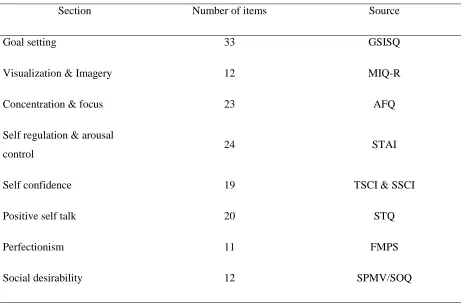
Table 8. Sources of items measuring the mental skills of athletes.
Section Number of items Source
Goal setting 33 GSISQ
Visualization & Imagery 12 MIQ-R
Concentration & focus 23 AFQ
Self regulation & arousal
control 24 STAI
Self confidence 19 TSCI & SSCI
Positive self talk 20 STQ
Perfectionism 11 FMPS
Social desirability 12 SPMV/SOQ
The last section thanked the participants for their participation in this study and offered
them the opportunity to leave their name and their email address if they are interested in the
24
Procedure
A letter informing possible participants about the content, reason and purpose of this
questionnaire has been written (see appendix A). The letter opened with a short introduction
to the development and state of sport psychology in the Netherlands. After that the persons
conducting this research have been introduced and the importance of this survey to advance
sport psychology in the Netherlands has been pointed out. A link to an electronic version of
the developed questionnaire has been attached. This letter has been distributed via email to
several sport teams and sport associations. Participation was voluntary and anonymous
without any kind of gratification.
Statistical Analysis
The Statistical Package for Social Science (SPSS; Version 14.0) has been used to analyze
the gathered data. The internal consistency of the developed instrument has been tested by
calculating Cronbach’s α coefficient. Internal consistency reliability controls for the
homogeneity of the items (i.e. measurement of the same phenomenon) within a scale,
respectively within a subscale. For an acceptable internal consistency the Cronbach’s α
coefficient should exceed .70 (Tabachnick & Fidell, 1996). As long as an increase in
Cronbach’s α was possible within a scale, respectively subscale, items have been removed
from the questionnaire. Additionally, to the statistical analysis each possible removal of an
item or even subscale has been examined logically and with regards to content by the author.
Through this process it was possible to ensure that each important concept of a mental skill
was still covered after the removal of redundant items. Result of this whole statistical and
25 Results
Internal Consistency
Cronbach’s α was examined for the total Mental Skills Questionnaire, for every of the
eight scales (goal setting, visualization & imagery, concentration & focus, self regulation &
arousal control, self confidence, positive self talk, perfectionism, social desirability), and for
every subscale of each skill.
Goal setting
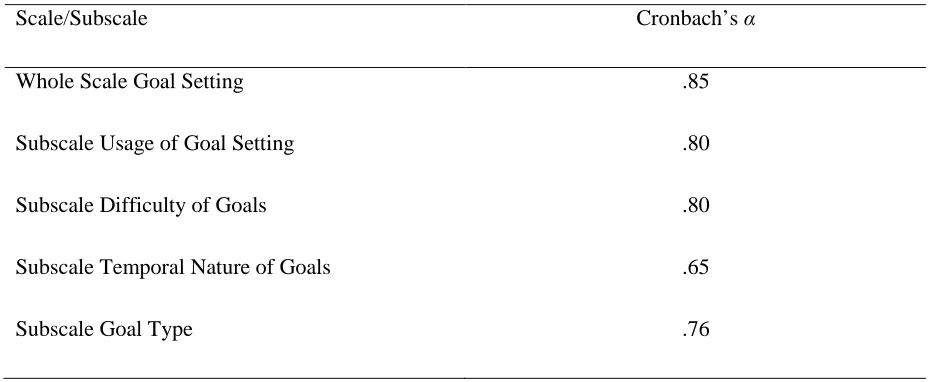
In the first version of the questionnaire the scale “goal setting“ consisted of 33 items in
total (5 items “usage of goal setting“, 9 items “difficulty of goals“, 7 items “temporal nature
of goals“, 12 items “goal type“) and has been completed by 82 participants. Through analysis
this number of items has been reduced to 26 items in total (2 items “usage of goal setting“, 6
items “difficulty of goals“, 6 items “temporal nature of goals“, 12 items “goal type“) with a
Cronbach’s α of .85 for the whole scale. The subscale “usage of goal setting“ has been
reduced from five items to two items which gave a Cronbach’s α of .80. The subscale
“difficulty of goals“ has been reduced from nine items to six items and gave a Cronbach’s α
of .80. The subscale “temporal nature of goals“ has been reduced from seven items to six
items and gave a Cronbach’s α of .65. Finally, the subscale “goal type“ stayed complete with
26
Table 9. Internal consistency goal setting scale (N = 82; 26 items).
Scale/Subscale Cronbach’s α
Whole Scale Goal Setting .85
Subscale Usage of Goal Setting .80
Subscale Difficulty of Goals .80
Subscale Temporal Nature of Goals .65
Subscale Goal Type .76
Visualization & imagery
The scale „visualization & imagery“ consisted of twelve items in total (4 items „usage of
visualization & imagery”, 4 items „visual imagery“, 4 items „kinesthetic imagery“) and has
been completed by 77 participants. After the statistical analysis the number of items has been
reduced to nine items in total (4 items „usage of visualization & imagery”, 2 items „visual
imagery“, 3 items „kinesthetic imagery“) with a Cronbach’s α of .88. The subscale „usage of
visualization & imagery“ kept its original number of four items with a Cronbach’s α of .89.
The subscale „visual imagery“ was reduced from four items to two items and gave a
Cronbach’s α of .64. One item has been taken from the subscale „kinesthetic imagery“ which
resulted in a Cronbach’s α of .90.
Table 10. Internal consistency visualization & imagery scale (N = 77; 9 items).
Scale/Subscale Cronbach’s α
Whole Scale Visualization & Imagery .88
Subscale Usage of Visualization & Imagery .89
Subscale Visual Imagery .64
[image:27.595.75.530.613.771.2]27
Concentration & focus
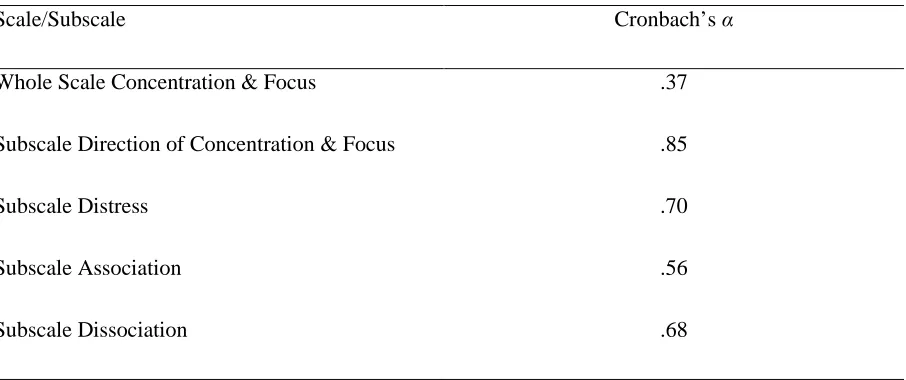
The scale „concentration & focus“ consisted of 23 items in total (5 items „direction of
concentration & focus“, 7 items „distress“, 6 items „association“, 5 items „dissociation“) and
was completed by 70 participants. Through the analysis the scale has been reduced to 13
items in total (4 items „direction of concentration & focus“, 3 items „distress“, 2 items
„association“, 4 items „dissociation“) with a Cronbach’s α of only .37, which can easily be
explained because association and dissociation are foci which are opposed. The contrary
nature of the subscales makes a high internal consistency of the whole scale impossible.
Accordingly, it is more important to have a good internal consistency within the subscales
than in the scale in total. The subscale „direction of concentration & focus“ was reduced from
five items to four items and gave a Cronbach’s α of .85. The subscale „distress“ was reduced
from seven items to three items and gave a Cronbach’s α of .70. The subscale „association“
was reduced from 6 items to two items and gave a Cronbach’s α of .56. Finally, the subscale
[image:28.595.74.527.444.634.2]„dissociation“ was reduced from five items to four items and gave a Cronbach’s α of .68.
Table 11. Internal consistency concentration & focus scale (N = 70; 13 items).
Scale/Subscale Cronbach’s α
Whole Scale Concentration & Focus .37
Subscale Direction of Concentration & Focus .85
Subscale Distress .70
Subscale Association .56
Subscale Dissociation .68
Self regulation & arousal control
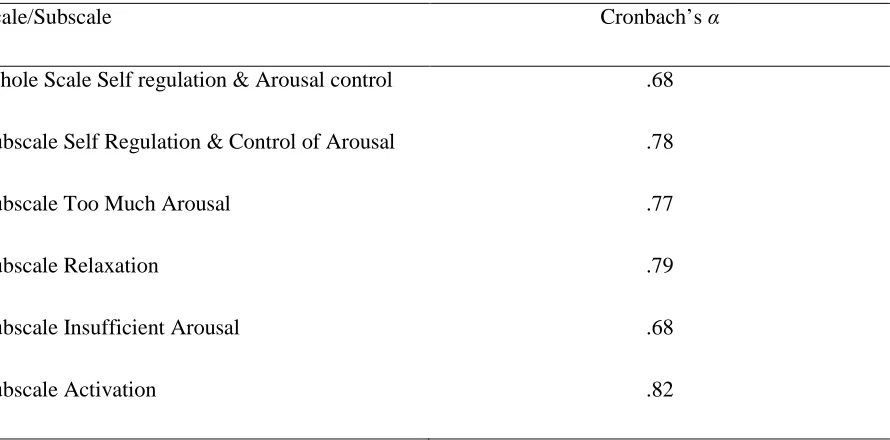
The scale „self regulation & arousal control“ consisted of 24 items in total (3 items „self
regulation & control of arousal“, 8 items „too much arousal“, 5 items „relaxation“, 6 items
28
had to be removed from the subscale „too much arousal“ so that the scale „self regulation &
arousal control“ finally consisted of 20 items (3 items „self regulation & control of arousal“, 4
items „too much arousal“, 5 items „relaxation“, 6 items „insufficient arousal“, 2 items
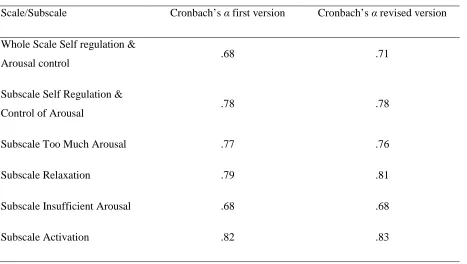
„activation“). Cronbach’s α of this scale in total was .68. The subscale „self regulation &
control of arousal“ had a Cronbach’s α of .78. The subscale „too much arousal“ had a
Cronbach’s α of .77. The subscale „relaxation“ had a Cronbach’s α of .79. The subscale
„insufficient arousal“ had a Cronbach’s α of .68. Finally, the subscale „activation“ had a
[image:29.595.81.526.309.529.2]Cronbach’s α of .82.
Table 12. Internal consistency self regulation & arousal control scale (N = 65; 20 items).
Scale/Subscale Cronbach’s α
Whole Scale Self regulation & Arousal control .68
Subscale Self Regulation & Control of Arousal .78
Subscale Too Much Arousal .77
Subscale Relaxation .79
Subscale Insufficient Arousal .68
Subscale Activation .82
Self confidence
The scale „self confidence“ consisted of 19 items in total (3 items „recognition self
confidence“, 10 items „state self confidence“, 6 items „trait self confidence“) and was
completed by 63 participants. After the analysis the subscale „recognition self confidence“
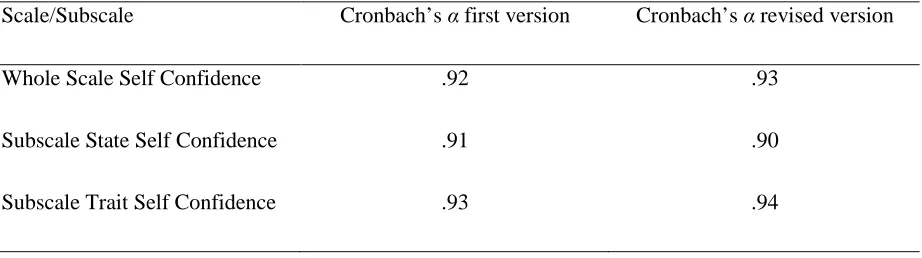
along with eight other items have been removed and the final eight items (4 items „state self
confidence“, 4 items „trait self confidence“) gave a Cronbach’s α of .92. The subscale „state
self confidence“ has been reduced from ten items to four items and gave a Cronbach’s α of
.91. The subscale „trait self confidence“ has been reduced from six items to four items and
29
consistency on its own (α = .87), but reduced the internal consistency of the whole scale „self
confidence“. Given the fact that this subscale was meant to measure present self confidence
which is also measured by the subscale „state self confidence“, this subscale was removed to
increase the overall internal consistency of this scale.
Table 13. Internal consistency self confidence scale (N = 63; 8 items).
Scale/Subscale Cronbach’s α
Whole Scale Self Confidence .92
Subscale State Self Confidence .91
30
Positive self-talk
The scale „positive talk“ consisted of 20 items in total (2 items „use of positive
self-talk, 14 items „motivational function“, 4 items „cognitive function“) and was completed by 61
participants. After the removal of the subscale „use of positive self-talk“ along with four other
items this scale has been reduced to 13 items (11 items „motivational function“, 2 items
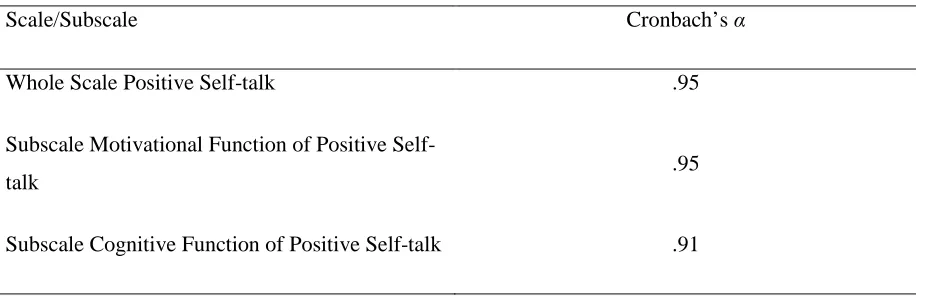
„cognitive function“) and gave a Cronbach’s α of .95. Because the subscale „use of positive
self-talk“ decreased Cronbach’s α and added no further information to the other two subscales
it was removed. The subscale „motivational function“ has been reduced from 14 items to
eleven items and had a Cronbach’s α of .95. The subscale „cognitive function“ has been
[image:31.595.68.544.361.509.2]reduced from four items to two items and gave a Cronbach’s α of .91.
Table 14. Internal consistency positive self-talk scale (N = 61; 13 items).
Scale/Subscale Cronbach’s α
Whole Scale Positive Self-talk .95
Subscale Motivational Function of Positive
Self-talk .95
31
Perfectionism
The scale „perfectionism“ consisted of eleven items and has been completed by 60
participants. After the analysis two items have been removed so that the final scale consisted
of nine items with a Cronbach’s α of .83.
Table 15. Internal consistency perfectionism scale (N = 60; 9 items).
Scale/Subscale Cronbach’s α
Whole scale Perfectionism .83
Social desirability
The scale „social desirability“ consisted of twelve items and has been completed by 56
participants. After the analysis eight items have been removed so that four items remained
with a Cronbach’s α of .81.
Table 16. Internal consistency social desirability scale (N = 56; 4 items).
Scale/Subscale Cronbach’s α
32
Total Athlete’s Mental Skill Scale
The improved Athlete’s Mental Skills Scale consists of 102 items in total, has been
completed by 56 participants and has a Cronbach’s α of .93. Through the analysis process 52
items have been removed from the original list.
Table 17. Internal Consistency Questionnaire Mental Skills (N = 56; 102 items).
Scale/Subscale Cronbach’s α
33
Step 3: Content validity of developed instrument
Purpose of this final step is the examination of the content validity of the instrument.
Because of the small size of the sample a factor analysis is not suitable for the validation of
the instrument in this study. Instead, correlations between the scales and the subscales of the
instrument will be calculated. But first of all the internal consistency of the instrument will be
calculated once more to control whether a change between the internal consistency of the first
instrument and the revised instrument occurs.
Methods
Participants
Participants were 92 athletes from the Netherlands. There were 31 female and 61 male
participants. The age ranged from 16 years to 71 years with an average of 25,7 years.
Questionnaire
The questionnaire used was a shorter form of the one described in the methods section of
step 2. Items that were found to be redundant during the analysis described in the results
section of step 2 have been removed. The shorter form of the questionnaire now consisting of
115 items can be seen in the appendix D.
Procedure
A second letter informing possible participants about the content, reason and purpose of
this shorter questionnaire has been written (see appendix C). The letter opened with a short
introduction to the development and state of sport psychology in the Netherlands. After that
the persons conducting this research have been introduced and the importance of a second
data gathering to complete the study has been made clear. A link to an electronic version of
34
email to several sport teams and sport associations. Participation was voluntary and
anonymous without any kind of gratification.
Statistical Analysis
The Statistical Package for Social Science (SPSS; Version 14.0) has been used to analyze
the gathered data. The internal consistency of the developed instrument has been tested by
calculating Cronbach’s α coefficient. As long as an increase in Cronbach’s α was possible
within a scale, respectively subscale, items have been removed from the questionnaire.
Additionally, to the statistical analysis each possible removal of an item or even subscale has
been examined logically and with regards to content by the author. Through this process it
was possible to ensure that each important concept of a mental skill was still covered after the
removal of redundant items. Result of this whole statistical and logical analysis will again be
a shorter, more internal consistent instrument than before.
After that the validity of the instrument has been controlled. To control the validity of an
instrument means to control for the degree the developed instrument measures what it claims
to measure. For this purpose total scores for every respondent on every single scale and its
subscales have been calculated. After that Person’s r has been calculated for the single scales
and its subscales. These correlations give an indication of how valid a scale measuring a
certain mental skill is.
Results
Internal Consistency
Again the internal consistency of the instrument has been controlled by calculating
Cronbach’s α for the revised version of the Mental Skills Questionnaire with its scales and
subscales.
Goal setting
In the revised version of the questionnaire the scale „goal setting“ consisted of 26 items in
35
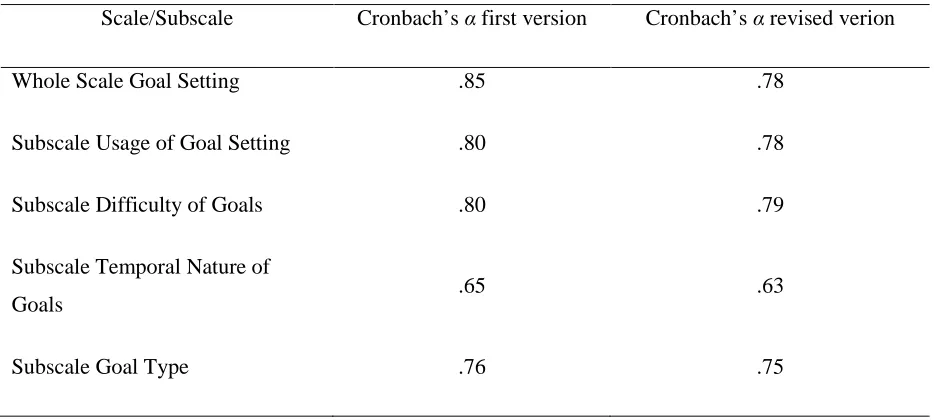
of goals“, 12 items „goal type“) and has been completed by 92 participants. Cronbach’s α for
the whole scale was .78. The subscale „usage of goal setting“ had a Cronbach’s α of .78, the
subscale „difficulty of goals“ had a Cronbach’s α of .79, the subscale temporal nature of the
goals had Cronbach’s α of .63 and the subscale „goal type“ had a Cronbach’s α of .75. The
analysis revealed that no major changes in the internal consistency between the two
[image:36.595.65.532.267.477.2]instruments could have been found.
Table 18. Internal consistency goal setting scale (N = 92; 26 items).
Scale/Subscale Cronbach’s α first version Cronbach’s α revised verion
Whole Scale Goal Setting .85 .78
Subscale Usage of Goal Setting .80 .78
Subscale Difficulty of Goals .80 .79
Subscale Temporal Nature of
Goals .65 .63
36
Visualization & Imagery
The scale „visualization & imagery“ consisted of nine items in total (4 items „usage of
visualization & imagery, 2 items „visual imagery“, 3 items „kinesthetic imagery“) and has
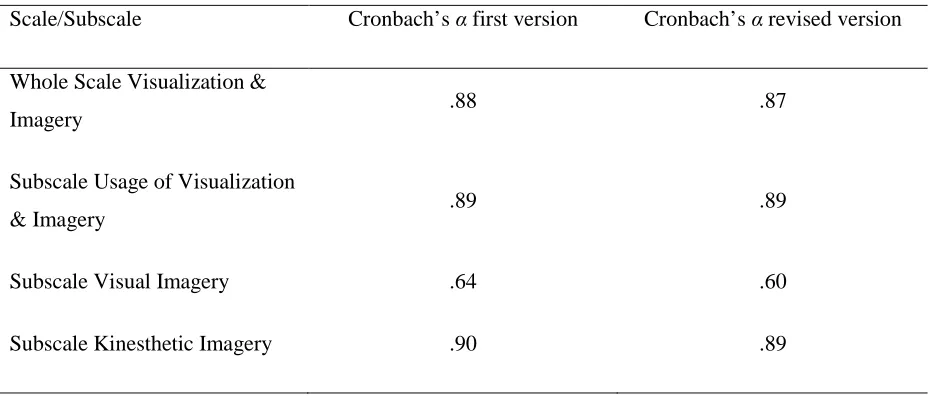
been completed by 86 participants. Cronbach’s α for the whole scale was .87. The subscale
„usage of visualization & imagery“ had a Cronbach’s α of .89, the subscale „visual imagery“
had a Cronbach’s α of .60 and the subscale „kinesthetic imagery“ had a Cronbach’s α of .89.
The analysis revealed that no major changes in the internal consistency between the two
[image:37.595.66.538.320.518.2]instruments could have been found.
Table 19. Internal consistency visualization & imagery scale (N = 86; 9 items).
Scale/Subscale Cronbach’s α first version Cronbach’s α revised version
Whole Scale Visualization &
Imagery .88 .87
Subscale Usage of Visualization
& Imagery .89 .89
Subscale Visual Imagery .64 .60
37
Concentration & Focus
The scale „concentration & focus“ consisted of 13 items in total (4 items „direction of
concentration & focus“, 3 items „distress“, 2 items „association“, 4 items „dissociation“) and
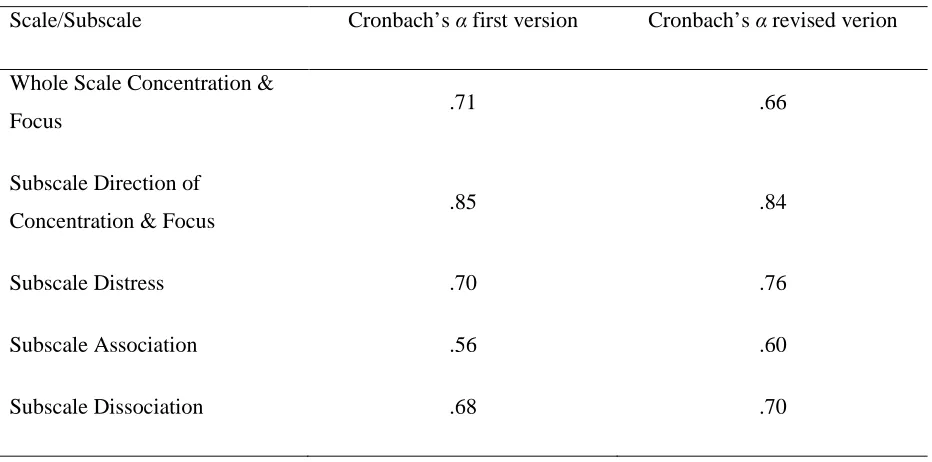
was completed by 78 participants. The analysis revealed a Cronbach’s α of .66 for the whole
scale. The subscale „direction of concentration & focus“ had a Cronbach’s α of .84, the
subscale „distress“ had a Cronbach’s α of .70, the subscale „association“ had a Cronbach’s α
of .60 and after the removal of the two redundant items the subscale „dissociation“ had a
Cronbach’s α of .70. The analysis revealed that no major changes in the internal consistency
[image:38.595.66.532.340.571.2]between the two instruments could have been found.
Table 20. Internal consistency concentration & focus scale (N = 78; 11 items).
Scale/Subscale Cronbach’s α first version Cronbach’s α revised verion
Whole Scale Concentration &
Focus .71 .66
Subscale Direction of
Concentration & Focus .85 .84
Subscale Distress .70 .76
Subscale Association .56 .60