Face Recognition in 2D and 2.5D using Ridgelets and
Photometric Stereo
Satyajit N. Kautkar, Gary A. Atkinson, Melvyn L. Smith
Machine Vision Laboratory, University of the West of England, Bristol, BS16 1QY, UK
Abstract
A new technique for face recognition –Ridgefaces – is presented. The method combines the well-known Fisherface method with the ridgelet transform and
high-speed Photometric Stereo (PS). The paper first derives ridgelet
projec-tions for 2D/2.5D face images before the Fisherface approach is used to
re-duce the dimensionality and increase the spread of the resulting feature vectors.
The ridgelet transform is attractive because it is efficient at extracting highly
discriminating low-frequency directional features. Best recognition is obtained
when Ridgefaces is performed on surface normals acquired from PS, although
good results are also found using standard 2D images and PS-derived albedo
maps.
Keywords: Face recognition, ridgelet transform, photometric stereo, dimensionality reduction
1. Introduction
Automatic face recognition is one of the most promising and potentially
widespread areas of computer vision. It has attracted a large amount of
re-search interest due to its non-intrusive nature compared to other biometrics.
Indeed, machines now consistently outperform humans in many face recognition
experiments [1]. However, despite great improvement in recognition accuracy
Email addresses: [email protected](Satyajit N. Kautkar),[email protected]
(Gary A. Atkinson),[email protected](Melvyn L. Smith)
*Manuscript
for contrived set-ups over recent years, a method that is robust to pose and
illumination changes and is efficient in processing time and memory remains a
major challenge.
In this paper, we make a significant contribution to automatic facial
recog-nition technology by proposing a novel face recogrecog-nition method which is
appli-cable to both 2D and 2.5D/3D face data. We call this method “Ridgefaces”.
The method uses a combination of the ridgelet transform [2] and the widely
known method of Fisherfaces [3] (using standard implementations of Principle
Components Analysis (PCA) and Linear Discriminant Analysis (LDA)). The
motivation for the use of ridgelets is that they achieve high levels of
dimension-ality reduction while maintaining highly discriminating directional information
and low-frequency data but suppressing the less useful high-frequency features.
While conventional data reduction methods, including PCA and LDA, are sta-tisticallyoptimised for generic data processing, we show that ridgelets are ideal for faces specifically, for the above reasons. Combining the methods gives the
best overall data representation.
Our novel method can be summarised as follows. Firstly, albedo and surface
normal data are acquired using Photometric Stereo (PS) [4]. We then apply the
ridgelet transform to each image before the Fisherface algorithm is applied to
the transformed images to further compress the data and maximise the distance
between classes in the new subspace (and minimise the intra-class distance).
Finally, the simple Euclidean distance between test and training images is used
for classification.
The hardware set-up for construction of the testing database (called the
“PhotoFace” database) is described in [5] and [6]. In summary, the device
constructs face models using PS hardware and algorithms [5, 4] in which facial
images are captured from the same viewpoint under different illumination
direc-tions. The albedo and surface normals are then estimated from the raw images
and we experiment with Ridgefaces on both these modalities.
Aside from the novel methodology, the other principal contributions and
• Our main testing dataset – the PhotoFace database – consists of face
im-ages captured as participants enter a busy workplace. Their presence is
automatically detected by a sensor and the device is automatically
trig-gered. This ensures that the data consists of a range of natural poses and
expressions [5, 6].
• We applied our method to a range of databases including the above
Photo-Face and several older 2D databases. This proves that our technique is
robust to a range of “everyday” poses, illumination conditions and
expres-sions, not just fully frontal faces with neutral expression.
• The paper reports a detailed set of experiments to investigate the
per-formance variation with different algorithm parameters (e.g. coarseness
of the discrete approximation to transforms, number of principal
compo-nents used, etc.). Indeed, one of the key contributions of the paper is the
optimisation of capture and processing methods and parameters.
• We prove that the nature of our ridgelet-based image representation is
able to maintain a near-constant degree of discriminatory information,
regardless of the coarseness of the approximation to the transforms and is
highly robust to image resolution.
• We show that our method is highly competitive to the state-of-the-art in
terms of recognition rate, processing time and storage requirements.
The remainder of the paper is organised as follows. Section 2 summarises
the related work in 2D and 3D face recognition techniques and algorithms,
in addition to relevant 3D reconstruction and representation methods. The
background theory for our novel method is then described in Section 3. Section 4
provides the new methodology of the proposed algorithm. Detailed experimental
results followed by a discussion are presented in Sections 5 and 6 respectively,
2. Related Work
The development of automatic face recognition systems started in the early
1960s when Bledsoe developed a system based on the geometrical information
of face parts [7]. Since then, a variety of algorithms based on PCA and LDA
have been developed, modified and tested consistently over the years. Turk
and Pentland developed a face recognition method called eigenfaces based on PCA [8]. Kirby and Sirovich developed a PCA-based technique in which face
images can be efficiently represented using eigenspace. In this method, accurate
face representations can be modelled using a relatively small number of
eigen-vectors, reducing storage and processing time considerably, whilst maintaining
high recognition rates [9].
One drawback of the eigenface method, is that while maximizing variances
along given principle components, it retains unwanted variation due to the
light-ning, facial expressions and other factors. Later, the Fisherface method was devised [3], which is an extension of the LDA method developed by Fisher for
class discrimination [10]. This method used Fisher discriminants to classify
dif-ferent feature vectors and produced well-separated classes in low dimensional
subspace, giving better performance in varying lightning conditions and facial
expressions. Unfortunately, LDA suffers from the small sample problem and so
is less effective if only a small training set is available [11, 12].
Much more recently, Jadhav and Holambe used a face recognition technique
based on Radon and wavelet transforms [13]. In this technique, directional
fea-tures of the facial images are calculated in different orientations using the Radon
transform which enhances low frequency components in that image. Then, a
wavelet transform is applied in Radon space which produces a multi-resolution
facial image. The ridgelet transform is the result of this 1D wavelet transform
in the Radon domain. Ridgelet transforms are suitable for describing signals
with high-dimensional singularities such as image lines. The Finite RIdgelet
Transform (FRIT) is the discrete form of the continuous ridgelet transform [2].
trans-forms suitable for images of dyadic length [14]. This method not only retains all
the properties of the traditional FRIT but also extends the application of FRIT
in image processing by improving the sensitivity to direction and increasing
the angular resolution. The advantages of these Radon/ridgelet-based methods
have partly motivated this paper, one of whose aims is to extend the methods
to more general settings and 3D data.
While all the above research has shown promise with 2D images of faces, a
large amount of current research into face recognition is based on the 3D
infor-mation of facial geometry [15]. The motivation for most of this 3D work is that
such geometric information can minimize the detrimental impact of changing
il-lumination conditions and viewing angles, while also providing an overall richer
dataset. The amount of research in the area is vast, so we concentrate on the
most closely related contributions for this review.
An obvious hurdle for 3D methods is the initial need to acquire the 3D
structure of each face – ideally from one or more 2D images. Early attempts
to recover the 3D information of objects were made in 1970s; for example when
Horn invented a technique to recover the shape of an object from its shading
information [16]. A variety of techniques have been developed since then to
es-timate the shape of objects using various cues such as occluding boundaries [17]
or texture [18].
One reconstruction technique that has proven practical for face recognition
is PS [4, 19]. In this method, an object (or face) is imaged several times
us-ing a fixed 2D camera. Each image must be captured usus-ing a different light
source direction. Hansen et al. have devised a near-real time PS system for
3D face capture that is easily deployable for many face recognition applications
[5]. Zafeiriou et al. subsequently used this method to acquire a novel 3D face
database with subjects captured under “natural” conditions [6]. A host of
varia-tions to PS for both general usage and faces specifically have also been suggested
in the literature [20, 21, 22, 23, 24, 25, 26].
Blanz and Vetter developed a form of analysis-by-synthesis method for face
scanner [27]. Smith and Hancock also use a statistical model, this time based on
surface normals acquired using shape-from-shading [28]. Reiter et al. developed
a method based on Canonical Correlation Analysis (CCA) which reconstructs
3D faces from RGB colour images [29]. They predicted the 3D depth map
of faces using the CCA approach by relating the depth information of a face
image with the appearance of the face. They modelled the combined effect of
illumination direction, albedo and shape with correlated linear features in the
space of depth images and colour images. Kim et al. developed a non-intrusive
3D face data acquisition system which uses an infrared line sensor pattern [30].
Mayo and Zhang developed a face recognition system which uses a 3D point
cloud for recognition. They rotated the face points about thex, y andz axes
and projected them iteratively onto a 2.5D image, thus extracting a small set
of points for recognition [31]. Another method which uses local shape variation
information is proposed by Xu et al. [32]. They also represent faces as 3D point
clouds and construct feature vectors by combining the global geometric features
and the local shape variation information.
Abate et al. developed a simple, fast and accurate recognition method in
which a difference map is calculated from the comparison of normal maps of two
faces [33]. The surface normals and curvature are represented by a polygonal
mesh and then projected as an RGB image which is a 2D representation of
a 3D mesh. Therefore, 3D recognition is effectively posed as a more efficient
2D recognition problem. Lu et al. developed a system in which both shape
and texture information from a 2.5D scan are used [34]. The shapes of the
two faces are matched using a modified Iterative Closest Point (ICP) algorithm
[35]. From this, they select a set of closely matched candidates and apply
LDA which reduces the complexity of the classification. A related approach by
Papatheodorou and Rueckert can be seen in [36].
It is not always the case that 3D recognition will outperform 2D face
recog-nition [37]. Consequently, in order to preserve the advantages of these two
complementary modalities, Xue and Ding developed a multi-model boosting
This algorithm can detect features including faces, noses, eyes etc., which can
then be used for recognition. Similar fusion of depth and texture information is
used and compared by BenAbdelkader and Griffin [39]. Depth and texture maps
are used separately and together for identification and verification. The best
recognition rate of 100% for their particular dataset is achieved when the the
information is combined. Kusuma and Chua implemented PCA based 2D+3D
multimodal face recognition method which uses texture and shape information
[40]. Both 2D and 3D images are recombined by projecting them into PCA
subspace and then into fisherfaces to maximise the scatter. Related approaches
can be found in [41, 42, 43, 44, 37, 45, 46].
Further reviews on 3D face recognition techniques in general are presented
in [47, 48, 15, 49].
3. Background Theory
This section summarizes the main concepts and background theory used in
the proposed method. This includes ridgelet transforms, subspace methods and
PS.
3.1. Theory of Ridgelet Transforms
In many image processing tasks, a sparse representation of an image is used
in order to compact the data into a relatively small number of samples while
maintaining discriminating information. Wavelets are a good example of sparse
geometrical image representation. But despite the success of wavelets, they
exhibit efficiency limitations when applied in more than one dimension. In
particular, wavelets fail to efficiently represent objects with highly anisotropic
2D elements such as lines or curvilinear structures (e.g. intensity edges). The
reason is that wavelets are non-geometrical and do not exploit the regularity of
the edge curve. Wavelets are therefore good at representing zero-dimensional or
point singularities. However, two-dimensional piecewise smooth signals (such as
face images) have one-dimensional singularities meaning that wavelets will not
0 0.2 0.4 0.6 0.8 1 0 0.2 0.4 0.6 0.8 1 -0.4 -0.2 0 0.2 0.4 0.6 x1 x2
Figure 1: An example ridgelet function [50].
Motivated by the above limitations, Candies and Donoho recently developed
ridgelets to deal with line singularities of the image in 2D [50]. The idea is to
map a line singularity into a point singularity using the Radon transform. A
wavelet transform can then be used to effectively handle the point singularity
in the Radon domain. Their initial proposal was intended for functions defined
in the continuousR2 space [51, 52].
The Continuous Ridgelet Transform (CRT) of a functionf(x) inR2 is
de-fined as
CRTf(a, b, θ) =
Z
R2
Ψa,b,θ(x)f(x) dx (1)
wherex= (x1, x2) T
is the position vector and the ridgelets Ψa,b,θ(x) in 2D are
defined from a 1D wavelet-type function,ψ(x), as
Ψa,b,θ(x) =
1
√
aψ
x
1cosθ+x2sinθ−b
a
(2)
In Eqns. (1) and (2), the parameters a, b and θ relate to scaling, shift and
rotation transforms respectively. Fig. 1 shows an example ridgelet function
which is oriented at an angleθand is constant along the linesx1cosθ+x2sinθ
(the “ridges”). Note that the wavelets appear perpendicularly to the ridges.
In 2D, ridgelets and wavelets are linked by the Radon transform. The Radon
transform off(x) inR2space is given by
Rf(θ, t) =
Z
R2
whereδis the Dirac distribution which forms projection lines at an angleθacross
the image at perpendicular distancet to the origin. The ridgelet transform is
then equivalent to the application of a 1D wavelet transform to the projection
lines of the Radon transform:
CRTf(a, b, θ) =
Z
R
ψa,b(t)Rf(θ, t) dt (4)
So the ridgelet function can be realised by applying 1D wavelet transforms to
the projections in Radon space.
For image processing applications, we clearly need to apply the various
trans-formations in discrete form. We use the construct known as the Finite RAdon
Transform (FRAT) for this due to its relative ease of implementation [2]. The
2D FRAT uses sums of pixel intensities to represent the integral in Eqn. (4).
The summations are over “projection lines” in the image, as implied by the
above theory. Following the same approach as [2], we define the pixels on a
finite gridZp={0,1, p−1}and the transform is
rk[l] =F RATf(k, l) =
1
√ p
X
i,j∈Lk,l
f[i, j] (5)
whereLk,l denotes the pixels that form a projection line in the image,f[i, j]:
Lk,l={(i, j) : j=ki+l(modp), i∈Zp}, 0≤k < p
Lp,l={(l, j) : j∈Zp}
(6)
To complete the ridgelet transform we need to take the discrete wavelet
transform (DWT) on each FRAT projection sequence,rk[0], rk[1], . . . rk[p−1].
This is called the Finite RIdgelet Transform (FRIT). It is the result of this
FRIT that we later use as the basis of our feature vectors, described in Section
4.
3.2. Subspace methods for data reduction
PCA and LDA are the most commonly used data reduction techniques for
face recognition. Both are data-based techniques and require no prior
experiments involve various combinations of PCA and LDA to supplement the
ridgefaces algorithm, so we briefly outline these two powerful methods.
3.2.1. Principle Component Analysis
Also termed the K-L transform, PCA was originally developed for
dimen-sionality reduction and noise reduction. Turk and Pentland developed a method
which captured the variance of the whole face within a given dataset rather than
concentrating on specific facial features [8]. PCA aims to calculate a set of
or-thonormal basis dimensions of the dataset. The first dimension corresponds to
the maximal variance; the second dimension corresponds to the maximal
vari-ance in an orthogonal direction to that of the first, and so on. The dataset can
then be projected onto a subspace where more discriminating features lie in the
lower dimensions.
Written formally, the eigenvectors of the covariance matrix, Ω, of the
distri-bution, spanned by training a set of face images is calculated. The projection
into the subspace is then expressed as an eigenvalue problem:
ΩV =λV (7)
where λ is a diagonal matrix containing the eigenvalues and V contains the
eigenvectors corresponding to the eigenvalues inλ. Each image can be projected
into the eigenspace with the resultant vectors acting as low dimensional
person-specific feature vectors.
3.2.2. Linear Discriminant Analysis
This related technique [3] also involves projecting the image dataset into a
subspace with high discriminating properties. LDA projects the images in such
a way that those of same class are grouped close together in the subspace and
those of different classes are separated from each other. In this respect, LDA
is different to PCA in that it utilises class information to perform this task.
PCA by contrast aims to maximize the overall scatter of all the images in lower
dimensions and makes no attempt to distinguish images in the same class from
LDA calculates two matrices: the between-class scatter matrix (Sb) which
captures the variation between the classes of images and the within-class scatter
matrix (Sw) which captures variation in the images of same class. LDA then
solves the generalized eigenvalue problem forSb andSw such that
SbV =λSwV (8)
In other words, LDA aims to maximise det|Sb|/det|Sw|. As with the eigenface
method discussed in Section 3.2.1, images can be projected into the new space
and used as low-dimensional feature vectors.
3.3. Photometric Stereo
First introduced by Woodham in 1980 [4], PS is a reflectance map based
technique in which the intensity values from multiple images are obtained from
the same viewpoint under different lightning directions. This intensity
informa-tion is used to determine the surface geometry of the object. Essentially, PS
uses three or more images to solve the under-determined problem of
shape-from-shading [53] to recover surface geometry via the surface normal map. While the
ridgelet-based method we describe in this paper is applicable to any 2D or 3D
database (indeed we perform extensive experiments on several existing methods
in Section 5), one of our key contributions is to show that it is especially
effec-tive when combined with surface normals estimated from PS. Next, we briefly
cover the basic theory of the PS surface normal acquisition procedure used in
this paper.
The standard form of PS (used in this paper) assumes that Lambert’s Law
applies:
I=ρcosθs=ρs·N=ρ
sx sy sz T Nx Ny Nz (9)
where ρ is the albedo, θs is the angle between the surface normal and the
light source direction, N = [Nx Ny Nz]T is the unit surface normal and s =
FEATURE EXTRACTION DIMENSIONALITY REDUCTION SCATTER MAXIMISATION CLASSIFICATION Capture and Preprocessing Ridgelet
transform PCA LDA
[image:12.612.193.421.124.168.2]Distance Calculation
Figure 2: System architecture of the Ridgefaces algorithm for face recognition.
For this paper, we have captured a range of face images under four different
light sources so we can re-write Eqn. (9) in matrix form:
I1 I2 I3 I4 =ρ sT 1 sT 2 sT 3 sT 4 N (10)
where si is the ith light source vector and Ii is the corresponding measured
pixel intensity. The albedo and surface normal components can therefore be
estimated by solving this equation for each pixel [54].
4. Methodology
As explained in Section 2, ridgelets have been proven effective for 2D face
recognition [13]. This paper extends the power of ridgelet transform to 3D
images by using photometric stereo data. It also optimises the data
acquisi-tion, processing and parameter/storage requirements. This section describes
our novel algorithm, which combines the ridgelet transform with linear
sub-space techniques. We call this newly proposed algorithm “Ridgefaces”. The
architecture of this algorithm is shown in Fig. 2.
4.1. Capture and Preprocessing
Our data was acquired using the photometric stereo capture device presented
in [5]. In summary, the hardware used consists of a camera operating at 200fps,
which is synchronised to four separate flash lights as shown in Fig. 3. This
Figure 3: Photograph of the data capture device [5]. The highlighted regions show close-ups
of one of the flash lights and an ultrasound trigger. The trigger detects the presence of a
subject to instruct the device when to capture an image set.
which can be used to estimate the albedo and surface normals using the theory
summarised in Section 3.3.
Aside from a few initial tests with older databases, we use a subset of the
data captured using this device in [6]. The device was placed at the entrance to
a busy workplace and employees we asked to “casually walk through the device”
for their automatic scan. The database therefore contains a multitude of natural
expressions and poses as would be expected in a real-world environment. This
is in contrast to most previous work, which used highly controlled poses and
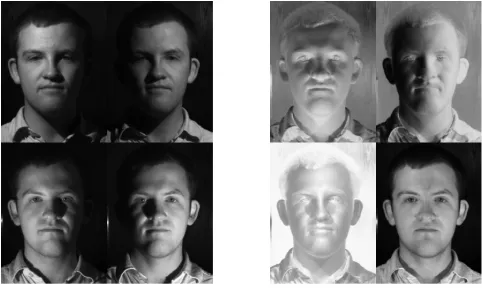
ex-pressions. Fig. 4 shows an example of both the raw and processed data captured
by the device. Fig. 5 shows the albedo images of a few more challenging faces
that were captured. It is worth noting at this point that our high recognition
rates reported in Section 5 demonstrate that the method is robust to typical
expressions and pose variations expected to be found in real-world applications.
Furthermore, as our method is inherently three-dimensional in nature, we do
not suffer from illumination changes, as in most two-dimensional approaches.
Carefully designed preprocessing can significantly improve the performance
of many face recognition systems. In particular, the method by which the face
Figure 4: Left: example of four raw images captured by the PhotoFace device. Right:
[image:14.612.187.416.479.580.2]pro-cessed data comprising ofx,yandzcomponents of the surface normals and the albedo map.
Figure 5: Examples of typical expressions and pose variations encountered in the PhotoFace
recognition rates. In a similar fashion to other work in the field, we chose to
manually crop the faces using a specific set of rules to include the main facial
features [55]. We do this manually because it means our reported recognition
rates are representative of our actual recognition algorithm, rather than being
influenced by the unrelated face detection and cropping process. Down-sampling
the images can also form a crucial preprocessing step as the resolution can have
a significant effect on the performance of the algorithm, as we show in Section
5. Apart from cropping and (for some of our experiments) rescaling, we do no
further pre-processing.
4.2. Feature extraction
Our feature extraction method essentially consists of applying the FRIT to
the face images in our database to obtain a discriminating feature vector. As
discussed in Section 3.1, the ridgelet transform is the application of a 1D wavelet
transform on Radon space projections of the image, and can be approximated
in discrete space using Eqn. (5). The result of the FRIT is reshaped into a
feature vector for further analysis. The number projection angles (θin Eqn. (1))
determines the amount of data conserved, and therefore the size of the image
in discrete Radon space. The number of angles is determined by the angular
interval between projections, θinterval. Obviously smaller values for θinterval
correspond to increased computation time, but also the classification accuracy
is affected in a highly nonlinear fashion. The effect of varying the number
of projection angles on recognition accuracy and computational efficiency is
discussed in detail in Section 5.
It is worth noting here, that as points in the Radon space are based on
integrals of real space over a line, the Radon transform of several noise types
is constant for all displacements and directions. This constant is equal to the
mean noise value along the line which is typically zero. This robustness to noise
4.3. Dimensionality reduction
While the above technique of the ridgelet transform is an effective
discrim-inatory representation of face images (as proven in Section 5), the size of the
feature vectors are still relatively large (e.g. length of image = 23,348 for typical
case of θinterval = 3◦). We therefore apply PCA to further reduce the
dimen-sionality of our feature vectors. This allows us to discard a tunable number of
components depending on specific application requirements.
Belhumeur et al. [3] suggested that the first three principal components
typically capture the image variation due to lighting effects. Discarding these
components therefore may reduce such detrimental effects. Indeed, we test this
in Section 5 of this paper. Note however, that the key results in this paper
are based on surface normal data, not intensity, and so this step should be
unnecessary. This is an important advantage of our method, along with other
3D face recognition techniques.
4.4. Scatter maximisation
In order to maximise scatter between individuals (classes), we apply the
technique of LDA to the selected number of principle components. This has
the effect of projecting training images of identical subjects closer together in
the subspace, while forcing different subjects further apart. This stage of our
method is identical to the standard Fisherface technique [3].
4.5. Classification
Face recognition is carried out by projecting the FRIT of training and probe
images into the PCA then LDA subspaces and computing the Euclidean distance
between the resulting feature vectors and the probe image feature vector. The
identity of the probe is simply taken as the closest matching feature vector in
the training set. In our experiments, we also show classification results without
applying all the stages of the method. For example, we compare the results of
the full method to those without projecting the feature vectors into LDA space.
We also compare the results to standard PCA and Fisherfaces (i.e. without
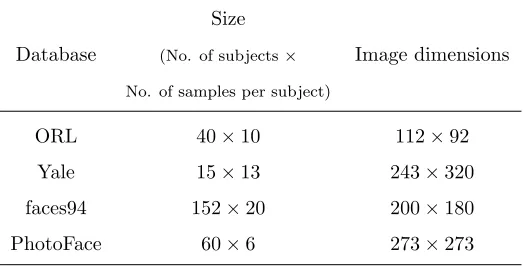
Table 1: Size of different databases and image format in each database.
Size
Database (No. of subjects× Image dimensions
No. of samples per subject)
ORL 40×10 112×92
Yale 15×13 243×320
faces94 152×20 200×180
PhotoFace 60×6 273×273
5. Results
In this section, we present experimental validation of our method and
op-timise the recognition procedure. Our experiments consist of (1) applying our
methods to existing 2D databases, (2) applying the methods to the albedo
im-ages from our own PhotoFace database [6], and (3) application to the surface
normals in the PhotoFace database. Note that we would generally expect better
results using the albedo image compared to raw 2D images since the albedo map
is inherent to the subject, while the raw images are illumination dependent. For
the existing databases, we use ORL [56] (uniform lightning condition, different
poses with no expression variations), Yale [57] (frontal images, varying
light-ning conditions, single pose with strong expression changes) and faces94 [58]
(frontal images, uniform lightning conditions, single pose with little expression
variation). Table 1 summarises the size and format of these databases. N.B. We
only use the subset of the available PhotoFace data described in [6] as we select
the subjects with sufficient training images only.
5.1. Experiments on 2D databases
5.1.1. Experiment 1: Variation of number of projections
Our first experiments relate to the application of the ridgelet transform on
180
4526 14 10 7 6 5 4 3 3 2 2 2 2 2 2
40 50 60 70 80 90 100
Number of projections
Recognit
ion
Rate
(%)
[image:18.612.201.412.139.274.2]ORL faces94 Yale
Figure 6: Recognition rates as a result of varying the number of projections. Equal number
of projections marked onx-axis indicates projections taken at different angles.
into PCA subspace, but used directly for classification. The recognition results
are shown in Fig. 6, which also presents the effect of the number of projections on
performance. For 180, 45 and 26 projections, we get almost the same accuracy,
suggesting that a low-resolution representation of the faces in Radon space is
sufficient to maintain reasonable recognition. The faces94 database has the
best overall results due to the inclusion of less expression, lightning and pose
variation as mentioned in the descriptions above.
For the cases where only two or three projections are used (for which it is
debatable whether or not “Radon space” is a suitable name), the recognition rate
depends on which specific projection angles we choose. Clearly some projections
are better in capturing directional features than others. A few variations of
projection angles are shown in Fig. 6 to illustrate this.
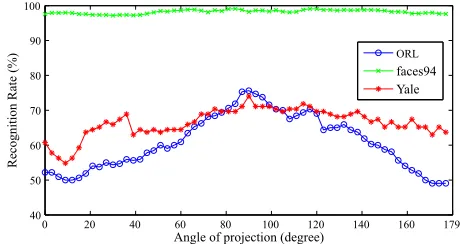
5.1.2. Experiment 2: Variation of angle of projection
Motivated by the decreasing recognition rates to the right-hand-side of Fig. 6,
we next present results of a simple experiment that uses only one Radon
pro-jection to obtain the feature vector. This allows us to specify which projecting
angle best extracts the most discriminating information. The graph shown in
0 20 40 60 80 100 120 140 160 179 40
50 60 70 80 90 100
Angle of projection (degree)
Recognition Rate (%)
[image:19.612.189.419.124.246.2]ORL faces94 Yale
Figure 7: Recognition rates as a result of varying a single projection angle.
(horizontal). As the ridgelet transform specifically extracts the directional
fea-tures of the face images, this result suggests that directional feafea-tures of faces
along horizontal lines such as eye brows, lips and eyes offer useful information
to effectively distinguish faces. This result is conducive to the findings of Dakin
and Watt [59] who show through psychological experiments that human
ob-servers rely more on horizontal features that other directions. In addition, it
may be that pose variation (the most common in practice is yaw) is cancelled
out best with such horizontal integrations (sums). Confirmation and expansion
of this point remains the focus of future work. Finally of note for Fig. 7 is that
a surprisingly high recognition rate is possible from just a single projection.
5.2. Experiments on the PhotoFace database – albedo images
The PhotoFace database [6] consists of grayscale albedo images as well as
a dataset of surface normals, [px, py, pz]T. Various experiments are performed
using the dataset and different algorithm combinations are compared to each
other (by comparing the effects of omitting various blocks from Fig. 2).
5.2.1. Experiment 3: Preliminary tests
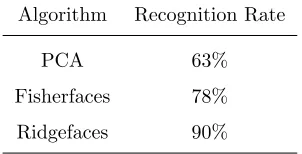
To commence, we tested standard PCA and Fisherfaces on the PhotoFace
database to set a benchmark for Ridgefaces algorithm. The results are presented
Table 2: Result of testing standard algorithms and ridgefaces on the PhotoFace database.
Algorithm Recognition Rate
PCA 63%
Fisherfaces 78%
Ridgefaces 90%
60 Radon projections and 300 principle components. The ridgefaces algorithm
vastly outperforms the classical methods here.
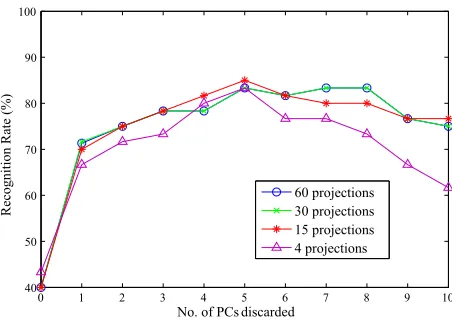
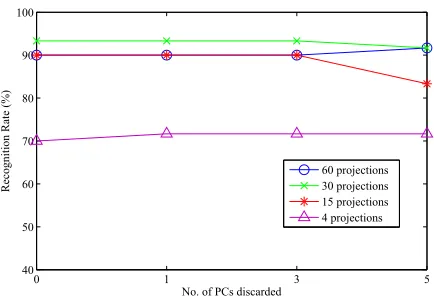
5.2.2. Experiment 4: Effect of discarding principle components
As mentioned in Section 4.3, discarding several first principle components
(PCs) can significantly reduce effects due to lightning variation in some
circum-stances. However, one would expect this to have little effect on our data since
the albedos and surface normals should be illumination invariant (one of the
strengths of our method). To verify this, we have plotted the recognition rates
resulting from the various algorithms, with several PCs discarded, in Fig. 8. The
results are as expected, with the exception of a significant increase in recognition
for the ridgefaces algorithm when the first PC is discarded. The precise reason
for this is not clear at present. Figs. 9 and 10 shows the result of discarding
PCsand using fewer projections.
5.2.3. Experiment 5: Effect of scaling images
This section demonstrates the effect of image resolution on the algorithms.
Fig. 11 shows this effect by plotting the recognition rate for each method
af-ter the albedo images have undergone a linear subsampling. In order to make
the comparisons fair, we use the number of projections and discarded PCs that
gave best overall results for each algorithm. The number of projections for
Ridgelet-PCA is 15 and for ridgefaces is 30. The number of principle
compo-nents discarded are 1 for PCA, 3 for Fisherfaces, 5 for Ridgelet-PCA and 1 for
0 1 2 3 4 5 40
50 60 70 80 90 100
Number of PC’s discarded
Recognition
Rat
e
(%)
[image:21.612.204.411.176.290.2]PCA Fisherfaces Ridgelet−PCA Ridgefaces
Figure 8: Result of discarding PCs on recognition rate using different algorithms
(ridgelet-PCA refers to the ridgeface algorithm with the omission of LDA projection). N.B. number of
projections = 60, full resolution images, total number of PCs = 300.
0 1 2 3 4 5 6 7 8 9 10
40 50 60 70 80 90 100
No. of PCs discarded
Recognition Rate (%)
60 projections 30 projections 15 projections 4 projections
[image:21.612.192.418.443.604.2]0 1 3 5 40
50 60 70 80 90 100
No. of PCs discarded
Recognit
ion
Rate
(%)
[image:22.612.198.415.178.329.2]60 projections 30 projections 15 projections 4 projections
Figure 10: Result of discarding PCs on recognition rate (Ridgefaces).
0.1 0.2 0.3 0.4 0.5 0.6 0.7 0.8 0.9 1 40
50 60 70 80 90 100
Scaling factor
Recognition
Rat
e
(%)
PCA Fisherfaces Ridgelet−PCA Ridgelet−PCA−LDA
[image:22.612.197.400.467.598.2]0.1 0.2 0.3 0.4 0.5 0.6 0.7 0.8 0.9 1 40
50 60 70 80 90 100
Scale factor
Recognition Rate (%)
[image:23.612.192.419.123.276.2]60 projections 30 projections 15 projections 4 projections
Figure 12: Result of varying number of projections on recognition accuracy (Ridgefaces).
From the plots, it can be observed that the Ridgefaces algorithm gives the
consistently best recognition accuracy. It can also be seen that for PCA and
Fisherfaces, the recognition accuracy increases as the images are scaled down.
However, the Ridgefaces and ridgelet-PCA algorithms show little of this
ef-fect. This effect may be due to PCA and Fisherfaces benefiting from the
high-frequency suppressing effects of the downsampling, while the other two methods
have already filtered out the high-frequencies during the ridgelet transform
pro-cedure.
5.2.4. Experiment 6: Effect of varying the number of projections
The number of projections has a significant effect on the performance of
the algorithms. The effect of varying the number of projections on recognition
accuracy for the Ridgefaces algorithm is shown in Fig. 12 at various resolutions.
Not surprisingly, a larger number of projections results in higher recognition
accuracy. At the same time however, a very high recognition rate is possible
using a relatively small number of projection angles. This result is conducive to
the results in Fig. 6.
5.2.5. Experiment 7: Computation time
In this experiment, the computation time of the various algorithms are
Table 3: Time taken to recognize a single albedo probe image for different algorithms (using
optimum parameters).
Algorithm Time Recognition Rate
Fisherfaces 19.34 ms 90%
PCA 27.36 ms 83%
Ridgefaces 27.93 ms 93%
Ridgelet-PCA 34.25 ms 85%
the number of projections are set to give the best recognition rate for each
al-gorithm as before. The computation time to recognise a single probe image
is measured for different algorithms. The corresponding recognition accuracy
is also calculated and both are shown in Table 3. The Fisherfaces algorithm
shows the best speed performance for this test, followed by PCA, Ridgefaces
and ridgelet-PCA. Note however, that all four computation times are
competi-tive and that the Ridgefaces algorithm gives best recognition rate. The purpose
of this experiment was to give a relative time, rather than absolute. For
refer-ence however, these tests were carried out on a Windows 7 PC with dual core
1.67 GHz processor under MATLAB v7.10.
5.3. Experiments on the PhotoFace database – surface normals
Surface normals provide orientation information of the surface at each pixel
location. This experiment is carried out to examine the contribution of
ori-entation information to the face recognition accuracy and performance. We
experiment on each of the x, y and z components of surface normals (px, py
andpz respectively) as well as their`n-norms. Recognition rates for individual
components are shown in Fig. 13 and Table 4. Referring to these results, we
note that the surface normals yield better results compared to the albedo data.
Note that the most suitable combination of surface normal components to use
was the`1-norm of [px, py] T
orpyalone. Indeed, the best case was able to attain
0.1 0.2 0.3 0.4 0.5 0.6 0.7 0.8 0.9 1 80
85 90 95 100
Scaling factor
Recognition Rate (%)
[image:25.612.192.419.123.245.2]px py pz
Figure 13: Plot of recognition rate vs. scale factor for individual components of surface
nor-mals.
Table 4: Recognition rates for different combinations ofpx, pyandpz
Recognition rate
(px, py) (py, pz) (px, pz) (px, py, pz)
`1-norm 100% 98.67% 95.33% 98.33%
`2-norm 93.33% 90% 80% –
`∞-norm 98.33% 93.33% 96.67% 96.67%
topx is conducive to the results in Section 5.1.2.
6. Discussion
The controlling parameters for the ridgelet algorithm are the number of
projections and angle of projections (the latter is only significant if there are
just few projections used). We adjusted these parameters to test how they affect
the recognition accuracy and computation time. The results showed that even
with a relatively small number of projections, the system can be very accurate to
give high recognition rate. Indeed, the recognition rate was almost identical for
the cases where 180, 60 and 30 projections were used. The number of projections
is directly proportional to the size of the transformed image in Radon space and
[image:25.612.184.425.315.432.2]we attained a very high recognition rate (97%), even with a single projection
of the ridgelet transform. A single projection therefore has a great deal of
information content to correctly recognise a face. This is an important aspect
of the ridgelet transform for face representation which has been largely ignored
until now. We also attained different recognition rates using the same number
of projections but at different angles. However, we are not yet certain about the
causes of this behaviour and so we reserve further discussion for future research.
The experiments on varying the number of discarded PCs for albedo images
confirmed little variation as expected. The performance of PCA and
ridgelet-PCA however, did show significant improvement when the first PC was
dis-carded. On the other hand, Fisherfaces and Ridgefaces algorithms showed little
effect of this variation. Scaling the image was another crucial parameter in the
tests, showing major effect on the recognition accuracy for the classical methods
of PCA and LDA. For these cases, lower resolution images yielded significantly
better recognition accuracy than higher resolution images. This is perhaps due
to poor image alignment having a greater effect on high-frequency features.
However, when the ridgelet transform was used, this effect did not manifest.
Our final experiments showed that surface normals recovered from PS provide
convincingly better recognition rate than any other form of data we considered.
The computation times were competitive to state-of-the-art for all methods,
although the ridgelet methods were slightly slower than standard Fisherfaces.
Finally, we showed that our method is highly robust to low resolution images
and fewer projections. This permits flexibility in our algorithm, providing a
useful trade-off between accuracy and efficiency.
From all the results and the overall discussion, we defined the best system
parameters as shown in Table 5. We have compared this to another
state-of-the-art method that has shown great promise for our type of data: that of
Elastic Graph Matching (EGM) [60]. Specifically, we have applied the Elastic
Bunch Graph Map [61] where the face is represented as a graph and the nodes
are feature vectors generated via Gabor filters or, as in our case, morphological
Table 5: Optimum system parameters.
Parameters Value
Algorithm Ridgefaces
Modality px andpy (`1-norm)
Recognition accuracy 100%
Scale factor 0.1
Number of projections 30
Number of PCs discarded 0
Indeed, the EGM approach has the advantage that image registration is built
into the algorithm, diminishing the need for image cropping. However, this
advantage comes at the expense of processing time: the EGM method requires
sequential face matching, taking approximately 1.5 seconds per comparison (or
90 seconds to compare to our gallery of 60 faces).
7. Conclusion
This work has made several major contributions to existing technologies for
automated face recognition. The paper has proposed a novel technique that
combines the classical method of Fisherfaces, the modern concept of ridgelet
transforms and the 2.5D shape estimation technique of photometric stereo.
De-tailed experiments have been conducted to test the algorithm under different
critical conditions. The results showed the superiority of the algorithm over the
standards methods. We considered the ridgelet transform, PCA and LDA as
separate blocks and integrated them into one complete system. Each block has
its own advantages which contribute to the overall performance: the ridgelet
transform is able to represent the face image data in such a way as to maximise
its discriminating features; PCA allows large-scale dimensionality reduction;
LDA maximises the feature vector difference between subjects; and
than greyscale images alone. In future work, we hope to study the fusion of
albedo and surface normals in more detail and consider the effects of pose and
how integrating the surface normals may help to correct for its detrimental
effects.
In summary, our Ridgefaces algorithm, combined with the PS “PhotoFace”
capture device, offers a competitive face recognition technology. The system
works at low dimensionality, is computationally efficient, is deployable in the
real world and provides high recognition rate. Furthermore, since we are using
3D data, there is potential for pose correction in future work. The primary
weakness of the method is the need for highly controlled illumination to facilitate
the PS process.
Acknowledgements
The authors would like to thank Rahulkumar Koche, Tushar Keskar, Aniket
Pande and Milind Rane for their valuable contribution towards the initial
de-velopment of this research. We also thank the UK Engineering and Physical
Sciences Research Council for funding the project that made this work possible.
References
[1] A. J. O’Toole, P. J. Phillips, F. Jiang, J. Ayyad, N. P´enard, H. Abdi,
Face recognition algorithms surpass humans matching faces over changes
in illumination, IEEE Trans. Pattern Anal. Mach. Intell. 29 (9) (2007)
1642–1646.
[2] M. N. Do, M. Vetterli, The Finite Ridgelet Transform for Image
Represen-tation, IEEE Trans. Image Processing 12 (2003) 16–28.
[3] P. N. Belhumeur, J. P. Hespanha, D. J. Kriegman, Eigenfaces vs.
fish-erfaces: Recognition using class specific linear projection, IEEE Trans.
[4] R. J. Woodham, Photometric method for determining surface orientation
from multiple images, Optical Engineering 19 (1) (1980) 139–44.
[5] M. F. Hansen, G. A. Atkinson, L. N. Smith, M. L. Smith, 3D face
recon-structions from photometric stereo using near infrared and visible light,
Comput. Vis. Image Underst. 114 (8) (2010) 942–951.
[6] S. Zafeiriou, M. F. Hansen, G. A. Atkinson, V. Argyriou, M. Petrou, M. L.
Smith, L. N. Smith, The PhotoFace Database, in: Proc. Biometrics
Work-shop of Computer Vision and Pattern Recognition., 2011, pp. 161–168.
[7] W. W. Bledsoe, Man-machine facial recognition, Technical Report PRI 22,
Panoramic Research, Inc., Palo Alto, California (August 1966).
[8] M. A. Turk, A. P. Pentland, Eigenfaces for Recognition, J. Cognitive
Neu-roscience 3 (1) (1991) 71–86.
[9] M. Kirby, L. Sirovich, Application of Karhunen–Loeve procedure for the
characterization of human faces, IEEE Trans. Pattern Anal. Mach. Intell.
12 (1) (1990) 103–108.
[10] R. A. Fisher, The use of multiple measures in taxonomic problems, Annals
of Eugenics 7 (1936) 170–188.
[11] A. M. Mart´ınez, A. C. Kak, PCA versus LDA, IEEE Trans. Pattern Anal.
Mach. Intell. 23 (2) (2001) 228–233.
[12] M. Sharkas, M. A. Elenien, Eigenfaces vs. Fisherfaces vs. ICA for Face
Recognition: A Comparative Study, in: Proc. IEEE Int. Conf. Signal
Pro-cessing, 2008, pp. 914–919.
[13] D. V. Jadhav, R. S. Holambe, Feature extraction using Radon and Wavelet
transforms with application to face recognition, J. Neurocomputing 72
[14] X. J. Jun, N. Lin, Y. Miao, A New Digital Implementation of Ridgelet
Transform for Images of Dyadic Length, in: Proc. IEEE Int. Conf.
Infor-mation Technology and Applications, 2005, pp. 613 –616.
[15] K. W. Bowyer, K. Chang, P. Flynn, A survey of approaches and challenges
in 3D and multi-modal 3D + 2D face recognition, Comput. Vis. Image
Underst. 101 (1) (2006) 1–15.
[16] B. K. P. Horn, Shape from shading: A method for obtaining the shape of a
smooth opaque object from one view, Ph.D. thesis, Massachusetts Institute
of Technology (1970).
[17] K. Ikeuchi, B. Horn, Numerical shape from shading and occluding
bound-aries, Artificial Intelligence 17 (1981) 141–184.
[18] A. P. Witkin, Recovering surface shape and orientation from texture,
Ar-tificial Intelligence 17 (1-3) (1981) 17–45.
[19] E. Coleman, Jr., R. Jain, Obtaining 3-dimensional shape of textured and
specular surfaces using four-source photometry, Computer Graphics Image
Processing 18 (1982) 309–328.
[20] A. S. Georghiades, P. N. Belhumeur, D. J. Kriegman, From few to many:
illumination cone models for face recognition under variable lighting and
pose, IEEE Trans. Pattern Anal. Mach. Intell. 23 (2001) 643–660.
[21] A. S. Georghiades, Incorporating the torrance-sparrow model of reflectance
in uncalibrated photometric stereo, in: Proc. IEEE Int. Conf. Computer
Vision, 2003, pp. 816–825.
[22] S. Zhou, R. Chellappa, D. Jacobs, Characterization of human faces under
illumination variations using rank, integrability and symmetry constraints,
in: Proc. European Conf. Computer Vision, 2004, pp. 588–601.
[23] S. Barsky, M. Petrou, The 4-source photometric stereo technique for
three-dimensional surfaces in the presence of highlights and shadows, IEEE
[24] J. Sun, M. L. Smith, L. N. Smith, S. Midha, J. Bamber, Object surface
re-covery using a multi-light photometric stereo technique for non-Lambertian
surfaces subject to shadows and specularities, Im. Vis. Comp. 25 (2007)
1050–1057.
[25] S. Zhou, G. Aggarwal, R. Chellappa, D. Jacobs, Appearance
character-ization of linear lambertian objects, generalized photometric stereo, and
illumination-invariant face recognition, IEEE Trans. Pattern Anal. Mach.
Intell. 29 (2007) 230–245.
[26] M. Chandraker, J. Bai, R. Ramamoorthi, A theory of differential
photo-metric stereo for unknown isotropic BRDFs, in: Proc. Computer Vision
and Pattern Recognition, 2011, pp. 2505–2512.
[27] V. Blanz, T. Vetter, A morphable model for the synthesis of 3d faces, in:
Proc. SIGGRAPH, 1999, pp. 87–194.
[28] W. A. P. Smith, E. R. Hancock, Recovering facial shape using a statistical
model of surface normal direction, IEEE Trans. Pattern Anal. Mach. Intell.
28 (12) (2006) 1914–1930.
[29] M. Reiter, R. Donner, G. Langs, H. Bischof, 3D and Infrared Face
Recon-struction from RGB data using Canonical Correlation Analysis, in: Proc.
IEEE Int. Conf. Pattern Recognition, 2006, pp. 425–428.
[30] J. Kim, S. Yu, J. Hwang, S. Kim, S. Lee, Nonintrusive 3-D face data
acquisi-tion system, in: Proc. IEEE Conf. Industrial Electronics and Applicaacquisi-tions,
2009, pp. 642–646.
[31] M. Mayo, E. Zhang, 3D face recognition using multiview keypoint
match-ing, in: Proc. IEEE Int. Conf. Advanced Video and Signal Based
Surveil-lance, 2009, pp. 290–295.
[32] C. Xu, Y. Wang, T. Tan, L. Quan, Automatic 3D face recognition
Proc. IEEE Int. Conf. Automatic Face and Gesture Recognition, 2004, pp.
308–313.
[33] A. F. Abate, M. Nappi, S. Ricciardi, G. Sabatino, Fast 3D face recognition
based on normal map, in: Proc. IEEE Int. Conf. Image Processing, Vol. 2,
2005, pp. 946–949.
[34] X. Lu, A. K. Jain, D. Colbry, Matching 2.5D face scans to 3D models,
IEEE Trans. Pattern Anal. Mach. Intell. 28 (1) (2006) 31–43.
[35] P. J. Besl, N. D. McKay, A method for registration of 3D shapes, IEEE
Trans. Pattern Anal. Mach. Intell. 14 (1992) 239–256.
[36] T. Papatheodorou, D. Rueckert, Evaluation of automatic 4D face
recog-nition using surface and texture registration, in: Proc. IEEE Int. Conf.
Automatic Face and Gesture Recognition, 2004, pp. 321–326.
[37] M. H¨usken, M. Brauckmann, S. Gehlen, C. Von der Malsburg, Strategies
and benefits of fusion of 2D and 3D face recognition, in: Computer Vision
and Pattern Recognition, 2005, p. 174.
[38] F. Xue, X. Ding, 3D+2D face localization using boosting in multi-modal
feature space, in: Int. Conf. Pattern Recognition, Vol. 3, 2006, pp. 499–502.
[39] C. BenAbdelkader, P. A. Griffin, Comparing and combining depth and
texture cues for face recognition, Im. Vis. Comput. 23 (3) (2005) 339–352.
[40] G. P. Kusuma, C.-S. Chua, PCA-based image recombination for
multi-modal 2D+3D face recognition, Im. Vis. Comput. 29 (5) (2011) 306–316.
[41] Y. Wang, C.-S. Chua, Face recognition from 2D and 3D images using 3D
Gabor filters, Im. Vis. Comput. 23 (11) (2005) 1018–1028.
[42] Y. Wang, C.-S. Chua, Robust face recognition from 2D and 3D images
using structural Hausdorff distance, Im. Vis. Comput. 24 (2) (2006) 176–
[43] C. Xu, S. Li, T. Tan, L. Quan, Automatic 3D face recognition from depth
and intensity Gabor features, Pattern Recognition 42 (9) (2009) 1895–1905.
[44] S. Malassiotis, M. G. Strintzis, Robust face recognition using 2D and 3D
data: Pose and illumination compensation, Pattern Recognition 38 (12)
(2005) 2537–2548.
[45] F. Tsalakanidou, S. Malassiotis, Real-time 2D+3D facial action and
ex-pression recognition, Pattern Recognition 43 (5) (2010) 1763–1775.
[46] L. Nanni, A. Lumini, RegionBoost learning for 2D+3D based face
recogni-tion, Pattern Recognition Letters 28 (15) (2007) 2063–2070.
[47] B. G¨okberk, H. Duta˘gaci, A. Ula¸s, L. Akarun, B. Sankur, Representation
Plurality and Fusion for 3-D Face Recognition, IEEE Trans. Systems, Man,
and Cybernetics 38 (1) (2008) 155–173.
[48] A. F. Abate, M. Nappi, D. Riccio, G. Sabatino, 2D and 3D face recognition:
A survey, Pattern Recognition Letters 28 (14) (2007) 1885–1906.
[49] D. Smeets, P. Claes, D. Vandermeulen, J. G. Clement, Objective 3D face
recognition: Evolution, approaches and challenges, Forensic Science
Inter-national 201 (1–3) (2010) 125–132.
[50] E. J. Candies, Ridgelets: Theory and Applications, Ph.D. thesis,
Depart-ment of Statistics, Stanford University (1998).
[51] S. R. Deans, The Radon Transform and some of its applications, John
Wiley and Sons, 1983.
[52] J. L. Starck, E. J. Candies, D. Donoho, The Curvelet transform for image
denoising, IEEE Trans. Image Processing 11 (2002) 670–684.
[53] R. Zhang, P. S. Tsai, J. E. Cryer, M. Shah, Shape from shading: A survey,
[54] V. Argyriou, M. Petrou, Photometric stereo: An overview, Advances in
Imaging and Electron Physics 156 (2009) 1–54.
[55] M. F. Hansen, G. A. Atkinson, Biologically inspired 3D face recognition
from surface normals, in: Proc. Intl. Conf. Exhibition Biometrics
Technol-ogy, 2010, pp. 26–34.
[56] AT & T Laboratories Cambridge,http://www.cl.cam.ac.uk/research/
dtg/attarchive/facedatabase.html(Accessed: 10 November 2011).
[57] University of California San Diego, http://vision.ucsd.edu/~leekc/
ExtYaleDatabase/ExtYaleB.html(Accessed: 10 November 2011).
[58] University of Essex,http://cswww.essex.ac.uk/mv/allfaces/faces94.
html (Accessed: 10 November 2011).
[59] S. C. Dakin, R. J. Watt, Biological “bar codes” in human faces, J. Vision
9 (2009) 1–10.
[60] P. J. Phillips, H. Moon, S. A. Rizvi, P. J. Rauss, The FERET evaluation
methodology for face recognition algorithms, IEEE Trans. Pattern Anal.
Mach. Intell. 22 (2000) 1090–1104.
[61] L. Wiskott, J. M. Fellous, N. Kr¨uger, C. von der Malsburg, Face recognition
by elastic bunch graph matching, IEEE Trans. Pattern Anal. Mach. Intell.
19 (1997) 775–779.
[62] S. Zaferiou, A. Tefas, I. Pitas, The discriminant elastic graph matching
algorithm applied to frontal face verication, Pattern Recognition 40 (2007)
Satyaji Kautkar
Satyajit Kautkar has a Bachelor of Engineering degree from VIT, University of Pune, India and a Master of Science in Advanced Technologies in Electronics from the University of the West of England, Bristol, UK. He has worked on several other projects including creating a power quality benchmark and an SMS-based voting sytem. Satyajit won the best paper in session award at the International Conference and Exhibition on Biometrics Technology 2010 and the autonomous line tracer robot competition at national level “VITality” in Pune.
Gary A. Atkinson
Gary Atkinson completed an MSci degree in physics at the University of Nottingham in 2003. Upon graduation, he moved to the University of York to study for a PhD degree in the Department of Computer Science, under the supervision of Edwin Hancock. His research was concerned with
improving shape recovery algorithms and reflectance function estimation for computer vision. Most of his work involved the exploitation of the polarising properties of reflection from surfaces.
Gary has been working at the UWE Machine Vision Laboratory on face reconstruction and recognition research in collaboration with Imperial College since June 2007 and has been supervising Mark Hansen's PhD studies since November 2008. He works in close collaboration with Imperial College London on face recognition and also has ties with the University of Bath, the University of York and the University of Central Lancashire and several industrial partners. In addition to his computer vision research, for which he has published seven major international journal papers, Gary has worked in the medical field to develop new means of assessing head deformations of babies affected by
plagiocephaly. He hopes to initiate a major new study in this area in the near future.
In 2010, Gary acted as the UK and Europe co-convener for the International Conference and Exhibition on Biometrics Technology.
Melvyn L. Smith
Melvyn L. Smith is a Professor of Machine Vision at the Bristol Institute of Technology and Director of the Centre for Intelligent Manufacturing and Machine Vision Systems (CIMMS) at UWE. He received his BEng(Hons) degree in Mechanical Engineering from the University of Bath in 1987, MSc in Robotics and Advanced Manufacturing Systems from the Cranfield Institute of Technology in 1988 and PhD from the UWE in 1997. He acts as associate editor for four leading international journals, including Image and Vision Computing and Computers in Industry , and is a program committee member for two international conferences. He has published a book together with numerous book chapters, patents, and journal / conference papers in connection with his work. He regularly presents his work through invited seminars, as well as articles and interviews to the popular media. He has been a member of the EPSRC Peer Review College since 2003, served as European commission candidate evaluator for the Sixth Framework and is currently a programme and evaluator / review expert and monitoring expert for EU Framework 7 Programme. Prof. Smith is a Chartered Engineer and an active member of the IET.
![Figure 1: An example ridgelet function [50].](https://thumb-us.123doks.com/thumbv2/123dok_us/644696.565823/8.612.222.383.135.264/figure-an-example-ridgelet-function.webp)

![Figure 3: Photograph of the data capture device [5]. The highlighted regions show close-upsof one of the flash lights and an ultrasound trigger](https://thumb-us.123doks.com/thumbv2/123dok_us/644696.565823/13.612.235.378.123.283/figure-photograph-capture-device-highlighted-regions-ultrasound-trigger.webp)