Building compositional semantics and higher-order inference system
for a wide-coverage Japanese CCG parser
Koji Mineshima1
[email protected] Ribeka Tanaka
1
Pascual Mart´ınez-G´omez2
[email protected] Yusuke Miyao
3
[email protected] Daisuke Bekki
1
1Ochanomizu University
Tokyo, Japan
2AIST
Tokyo, Japan
3National Institute of Informatics
The Graduate University for Advanced Studies Tokyo, Japan
Abstract
This paper presents a system that compo-sitionally maps outputs of a wide-coverage Japanese CCG parser onto semantic represen-tations and performs automated inference in higher-order logic. The system is evaluated on a textual entailment dataset. It is shown that the system solves inference problems that focus on a variety of complex linguistic phe-nomena, including those that are difficult to represent in the standard first-order logic.
1 Introduction
Logic-based semantic representations have played an important role in the study of semantic parsing and inference. For English, several methods have been proposed to map outputs of parsers based on syntactic theories like CCG (Steedman, 2000) onto logical formulas (Bos, 2015). Output formulas have been used in various tasks, including Question An-swering (Lewis and Steedman, 2013) and Recog-nizing Textual Entailment (RTE) (Bos and Markert, 2005; Beltagy et al., 2013; Bjerva et al., 2014).
Syntactic and semantic parsing for Japanese, by contrast, has been dominated by chunk-based de-pendency parsing and semantic role labelling (Kudo and Matsumoto, 2002; Kawahara and Kurohashi, 2011; Hayashibe et al., 2011). Recently, the method of inducing wide-coverage CCG resources for En-glish (Hockenmaier and Steedman, 2007) has been applied to Japanese and a robust CCG parser based on it has been developed (Uematsu et al., 2015). However, building a method to map CCG trees in Japanese onto logical formulas is not a trivial task,
mainly due to the differences in syntactic structures between English and Japanese (Section 3).
There are two primary contributions of this pa-per. First, based on an in-depth analysis of the syntax-semantics interface in Japanese, we present the first system that compositionally derives seman-tic representations for a wide-coverage Japanese CCG parser. Output representations are formulas in higher-order logic (HOL) combined with Neo-Davidsonian Event Semantics (Parsons, 1990). Sec-ond, we demonstrate the capacity of HOL for textual entailment. We evaluate the system on a Japanese textual entailment dataset (Kawazoe et al., 2015), a dataset constructed in a similar way to the FraCaS dataset for English (Cooper et al., 1994; MacCartney and Manning, 2007). Although it is usually thought that HOL is unfeasible for practical applications, the results show that the entire system is able to perform efficient logical inference on complex linguistic phe-nomena such as generalized quantifiers and inten-sional modifiers — phenomena that pose challenges to the standard first-order-logic-based approaches.
2 Background and system overview
This section provides a brief overview of the en-tire system as applied to RTE, a task of determin-ing whether a given text (T) entails, contradicts, or
is just consistent with, a given hypothesis (H). In
logic-based approaches, the meanings ofT andH
are represented by logical formulas; whether the en-tailment relation holds is typically determined by
checking whetherT →H is a theorem in a logical
system with the help of a knowledge base.
Currently, first-order logic (FOL) is the most
ular logical system used for RTE (Bos and Mark-ert, 2005; Lewis and Steedman, 2013; Bjerva et al., 2014). One advantage of systems based on FOL is that practical general-purpose theorem provers and model-builders are available. However, a drawback is that there are linguistic phenomena that cannot be represented in the standard FOL; a typical example is a generalized quantifier such asmost(Barwise and Cooper, 1981). Accordingly, it has been standard in formal semantics of natural language to use HOL as a representation language (Montague, 1974). Al-though HOL does not have general-purpose theorem provers, there is room for developing an automated reasoning system specialized for natural language inference. In general, a higher-order representation makes the logical structure of a sentence more ex-plicit than a first-order encoding does and hence can simplify the process of proof search (Miller and Na-dathur, 1986). Recently, based on the evaluation on the FraCaS dataset (Cooper et al., 1994), Mineshima et al. (2015) showed that a higher-order inference system outperformed the Boxer/Nutcracker’s first-order system (Bos, 2008) in both speed and ac-curacy. Likewise, Abzianidze (2015) developed a higher-order prover based on natural logic tableau system and showed that it achieved high accuracy comparable to state-of-the-art results on the SICK dataset (Marelli et al., 2014).
There are three main steps in our pipeline. The focus of this paper is on the last two components. 1. Syntactic parsing Input sentences are mapped onto CCG trees. We use a Japanese CCG parser Jigg (Noji and Miyao, 2016)1, a statistical parser
based on Japanese CCGbank (Uematsu et al., 2015). 2. Semantic parsing CCG derivation trees are compositionally mapped onto semantic representa-tions in HOL. The compositional mapping is
imple-mented via simply typedλ-calculus in the standard
way (Bos, 2008; Mart´ınez-G´omez et al., 2016). 3. Logical inference Theorem proving in HOL is performed to check for entailment and contra-diction. Axioms and proof-search procedures are largely language-independent, so we use the
higher-order inference system of Mineshima et al. (2015)2
and adapt it for our purpose.
1https://github.com/mynlp/jigg 2https://github.com/mynlp/ccg2lambda
Syntactic category Semantic representation
N P λN F.∃x(N(Base, x)∧F(x))
S\N Pga λQK.Q(λI.I, λx.∃v(K(Base, v)∧(Nom(v) =x))) S\N Pga\N Po λQ2Q1K.Q1(λI.I, λx1.Q2(λI.I, λx2.∃v(K(Base, v)
∧(Nom(v) =x1)∧(Acc(v) =x2))))
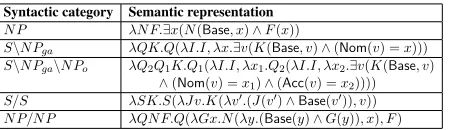
[image:2.612.317.542.56.121.2]S/S λSK.S(λJv.K(λv′.(J(v′)∧Base(v′)), v)) N P/N P λQN F.Q(λGx.N(λy.(Base(y)∧G(y)), x), F) Table 1:Examples of semantic templates.Baseis the position in which the base form of a word appears.
3 Compositional Semantics and HOL 3.1 CCG and semantic lexicon
Combinatory Categorial Grammar (CCG) (Steed-man, 2000) is a lexicalized grammar formalism suitable for implementing a compositional mapping from syntax to semantics. A syntactic category of
CCG is either a basic category such as S and NP
or a functional category of the form X/Y or X\Y.
The meaning of a sentence is computed from a small number of combinatory rules and the meanings of constituent words. In addition to standard combi-natory rules, the Japanese CCG parser uses a small number of unary type-shifting rules (e.g., the rel-ativization rule that changes the category S\NP to
NP/NP), to which suitable meaning composition
rules are given.
We follow the standard method of building a semantic lexicon in CCG-based logical seman-tics (Bos, 2008). There are two kinds of lexical en-tries: (1)semantic templatesthat are schematic en-tries assigned to syntactic categories, possibly with syntactic features and (2)lexical entriesdirectly as-signed to a limited number of logical and functional expressions. Lexical entries can be sensitive to a POS tag, a surface form, and other information con-tained in the parser output. Table 1 shows semantic templates for main syntactic categories. More de-tails will be provided in Section 3.2 and 3.3.
We use a language of standard higher-order logic (simple type theory) (Carpenter, 1997) as a represen-tation language. Expressions in HOL are assigned
semantic types. We use three basic types: E
(En-tity),Ev(Event), andProp(Proposition). Thus, the
semantic types of expressions in our system are de-fined by the rule
T ::= E|Ev|Prop|T1 ⇒T2
whereT1 ⇒T2is a function type.
N P•= ((E⇒Prop)⇒E⇒Prop)⇒(E⇒Prop)⇒Prop
S•= ((Ev⇒Prop)⇒Ev⇒Prop)⇒Prop
(C1/C2)•= (C1\C2)•= C2•⇒C1•
Figure 1: The mapping from syntactic categories to semantic types.⇒is right-associative.
quantifiers, all primitive expressions in first-order logic are confined to constant symbols of typeEand
predicates of typeE⇒ Prop,E⇒ E⇒ Prop, and
so on. Thus, adopting higher-order language does not lead to the loss of the expressive power of first-order language.
The Japanese CCG parser simplifies the standard
CCG and uses two basic categories,SandNP.
Ac-cordingly, a mapping(·)• from syntactic categories
to semantic types can be defined as in Figure 1. Keeping the correspondence between syntactic cat-egories and semantic types in the semantic lexicon guarantees that a well-formed formula is compo-sitionally derived from the meaning assignment to each leaf of a CCG derivation tree.
3.2 Semantic composition for VPs
To model a semantics for VPs in Japanese, we adopt Neo-Davidsonian Event Semantics (Parsons, 1990; Jurafsky and Martin, 2009), which is widely used in the NLP field. For instance, the sentence (1) is analyzed as having the logical form in (2):
(1) ジョン
John
が NOM
ゆっくり
slowly
歩い
walk
た。 PAST
‘John walked slowly’
(2) ∃v(walk(v)∧(Nom(v) =john)∧slow(v)∧Past(v)) In this approach, verbs are analyzed as 1-place pred-icates over events; arguments and adjuncts of VPs are also analyzed as event predicates. This seman-tic uniformity is suitable to handling Japanese syn-tactic structures in which the arguments of a VP is often implicit and thus the argument-adjunct dis-tinction is less transparent than languages like En-glish (Pietroski, 2005). As is seen in (2), we adopt the unique-role requirement for case markers (Carl-son, 1984); for instance, the nominative case marker
does not denote the relation Nom(v, x), as in the
event semantics in Boxer (Bos, 2008), but the func-tionNom(v) =x. This treatment allows us to make
use of logical properties of equality and hence is more suited to theorem-proving in our setting.
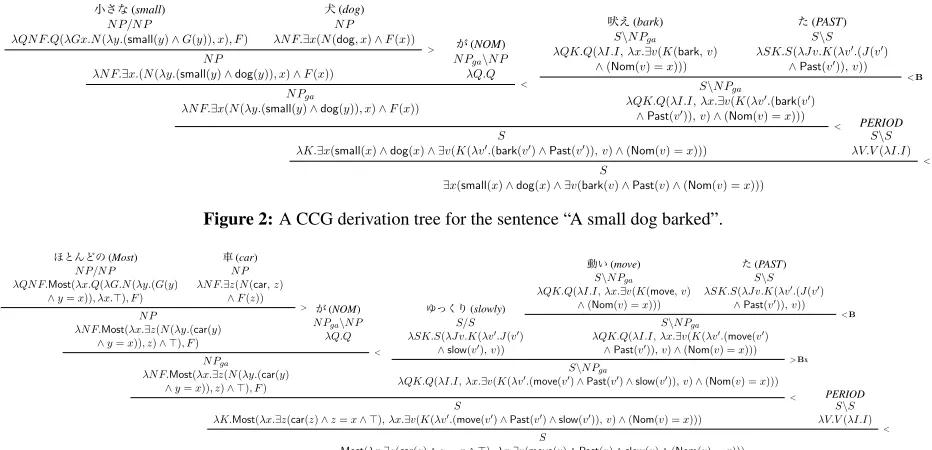
To derive a semantic representation in event se-mantics compositionally, we adopt the composi-tional semantics of VPs in Champollion (2015) and analyze VPs themselves as introducing existential quantification over events. To derive the correct meaning for VP modifiers, the semantic type of a verb is raised so that the verb takes a modifier as argument but not vice versa. Figures 2 and 3 give example derivations.
VP modifiers such asslowlylicense an inference
fromJohn walked slowlytoJohn walked, an infer-ence correctly captured by the formula in (2). In En-glish and Japanese, however, there are intensional VP modifiers that do not license this inference
pat-tern. Thus, the sentence John almost walked does
not entailJohn walked (Dowty, 1979). While it is
not easy to provide a desirable analysis in first-order language (Hobbs, 1985), HOL gives a perspicuous representation:
(3) ∃v(almost(walk, v)∧(Nom(v) =john)∧Past(v))
Here,almostis a higher-order predicate having the
semantic type (Ev ⇒ Prop) ⇒ Ev ⇒ Prop. The
meaning assignment to VP modifiers of category
S/S in Table 1 is for extensional modifiers; an
intensional modifier is assigned the representation
λSK.S(λJv.K(Base(J), v)) in the lexical entry,
which results in a representation as in (3).
3.3 Semantic composition for NPs
The quantificational structure of an NP plays a cru-cial role in capturing basic entailment patterns such as monotonicity inference. In the case of English, quantificational structures are specified by the type
of determiners (e.g.a, the, every, some, no);
to-gether with the category distinction betweenN and
NP, which is supported in English CCGbank
(Hock-enmaier and Steedman, 2007), one can provide a correct representation for NPs.
By contrast, Japanese is a classifier language, where NPs freely occur without determiners in ar-gument position (Chierchia, 1998). For example, the subject in (4) appears in argument position without accompanying any determiner.
(4) 小さな
small
犬
dog
が NOM
吠え
bark
た。 PAST
小さな(small)
N P/N P
λQN F.Q(λGx.N(λy.(small(y)∧G(y)), x), F)
犬(dog)
N P λN F.∃x(N(dog, x)∧F(x)) N P
λN F.∃x.(N(λy.(small(y)∧dog(y)), x)∧F(x))
> が(NOM)
N Pga\N P
λQ.Q N Pga
λN F.∃x(N(λy.(small(y)∧dog(y)), x)∧F(x))
<
吠え(bark)
S\N Pga
λQK.Q(λI.I, λx.∃v(K(bark, v)
∧(Nom(v) =x)))
た(PAST)
S\S λSK.S(λJv.K(λv′.(J(v′)
∧Past(v′)), v)) S\N Pga
λQK.Q(λI.I, λx.∃v(K(λv′.(bark(v′)
∧Past(v′)), v)∧(Nom(v) =x)))
<B
S
λK.∃x(small(x)∧dog(x)∧ ∃v(K(λv′.(bark(v′)∧Past(v′)), v)∧(Nom(v) =x)))
< PERIOD
S\S λV.V(λI.I) S
∃x(small(x)∧dog(x)∧ ∃v(bark(v)∧Past(v)∧(Nom(v) =x)))
[image:4.612.73.539.56.281.2]<
Figure 2:A CCG derivation tree for the sentence “A small dog barked”.
ほとんどの(Most)
N P/N P λQN F.Most(λx.Q(λG.N(λy.(G(y)
∧y=x)), λx.⊤), F)
車(car)
N P λN F.∃z(N(car, z)
∧F(z)) N P
λN F.Most(λx.∃z(N(λy.(car(y)
∧y=x)), z)∧ ⊤), F)
> が(NOM)
N Pga\N P
λQ.Q
N Pga
λN F.Most(λx.∃z(N(λy.(car(y)
∧y=x)), z)∧ ⊤), F)
<
ゆっくり(slowly)
S/S λSK.S(λJv.K(λv′.J(v′)
∧slow(v′), v))
動い(move)
S\N Pga
λQK.Q(λI.I, λx.∃v(K(move, v)
∧(Nom(v) =x)))
た(PAST)
S\S λSK.S(λJv.K(λv′.(J(v′)
∧Past(v′)), v)) S\N Pga
λQK.Q(λI.I, λx.∃v(K(λv′.(move(v′)
∧Past(v′)), v)∧(Nom(v) =x)))
<B
S\N Pga
λQK.Q(λI.I, λx.∃v(K(λv′.(move(v′)∧Past(v′)∧slow(v′)), v)∧(Nom(v) =x)))
>Bx
S
λK.Most(λx.∃z(car(z)∧z=x∧ ⊤), λx.∃v(K(λv′.(move(v′)∧Past(v′)∧slow(v′)), v)∧(Nom(v) =x)))
< PERIOD
S\S λV.V(λI.I) S
Most(λx.∃z(car(z)∧z=x∧ ⊤), λx.∃v(move(v)∧Past(v)∧slow(v)∧(Nom(v) =x)))
[image:4.612.80.539.59.143.2]<
Figure 3:A CCG derivation tree for the sentence “Most cars moved slowly”.⊤denotes the tautology.
Bekki (2010) provides a comprehensive CCG
gram-mar for Japanese that adopts the N-NP distinction
and analyzes Japanese bare NPs as accompanying the null determiner. The Japanese CCGbank, by contrast, simplifies Bekki’s (2010) grammar and avoids the use of the null determiner; it does not
use the categoryNand takes all NPs in Japanese to
have the syntactic categoryNP. This discrepancy in NP-structure between English and Japanese poses a challenge to the standard approach to building com-positional semantics.
To provide a compositional semantics adapted for the Japanese CCG, we take NPs themselves as in-troducing quantification over individuals, along the same lines as the semantics for VPs. The semantic type of NPs needs to be raised so that they take NP-modifiers as argument (cf. the template forNPin Ta-ble 1). Figure 2 shows a derivation for the sentence in (4), where the adjectivesmallmodifies the NPdog
to form a bare NP small dog. It should be noted
that the predicatesmall(x) is correctly inserted
in-side the scope of the existential quantification intro-duced by the NPdog. The so-called privative adjec-tives (e.g. fakeandformer) are analyzed in the same way as intensional VP modifiers.
Following the analysis in Mineshima et al. (2015), we analyze non-first-order generalized quantifier
most as having the higher-order logical form
Most(F, G), where Most has the type of
general-ized quantifier(E⇒Prop)⇒(E⇒Prop)⇒Prop.
Figure 3 shows an example derivation for a sentence
containing a generalized quantifiermost. Our
sys-tem also handles floating quantifiers in Japanese.
4 Experiments
We evaluate our system3on Japanese Semantics test
suite (JSeM)4 (Kawazoe et al., 2015), a Japanese
dataset for textual entailment designed in a simi-lar way to the FraCaS dataset for English. These datasets focus on the types of logical inferences that do not require world knowledge. JSeM has Japanese translations of FraCaS problems and an extended set of problems focusing on Japanese syntax and se-mantics. Each problem has one or more premises, followed by a hypothesis. There are three types of answer:yes(entailment),no(contradiction), and un-known(neutral). Each problem is annotated with the types of inference (logical entailment, presupposi-tion, etc.) and of linguistic phenomena.
We evaluate the system on 523 problems in the dataset. We focus on problems tagged with one of the five phenomena: generalized quantifier,
plu-3The system will be available at https://github.
com/mynlp/ccg2lambda.
4http://researchmap.jp/community-inf/
Section #Problem Gold System SLC Quantifier 337 92.3 78.0 88.4
Plural 41 68.3 56.1 51.2
Adjective 65 67.7 63.1 44.6
Verb 36 77.8 75.0 55.5
Attitude 44 88.6 86.4 75.0
[image:5.612.339.520.56.136.2]Total 523 86.0 75.0 76.7
Table 2:Accuracy on each section of JSeM.
Acc. Prec. Rec. Time Gold parses 86.0 94.9 81.3 3.30s
w/o HOL axioms 69.8 93.3 56.5 2.47s
System parses 75.0 92.7 65.4 3.58s
SLC 76.7 77.5 79.3 n/a
Most common class (yes) 56.8 56.8 85.6 n/a Table 3:Accuracy, precision, recall, and average proof time.
ral, adjective, verb, and attitude. We use problems whose inference type is logical entailment,
exclud-ing anaphora and presupposition. We use Kuromoji5
for morphological analysis. To focus on the evalua-tion of semantic parsing and inference, we use gold syntactic parses, which show an upper bound on the performance of the semantic component. Gold syn-tactic parses are manually selected fromn-best out-puts of the CCG parser. For the higher-order infer-ence system, we use the axioms presented in Mi-neshima et al. (2015) adapted with the necessary modification for our event semantics.
Given premisesP1, ... ,Pnand a hypothesisH, the
system outputsyes(P1∧ · · · ∧Pn→His proved),no
(P1∧ · · · ∧Pn→¬His proved), orunknown(neither
is proved in a fixed proof-search space).6 We set a
30 seconds timeout for each inference run; the
sys-tem outputsunknownafter it. The current semantic
lexicon has36templates and113lexical entries. Table 2 and 3 show the results. The system with
gold syntactic parses achieved86%accuracy on the
total523problems, with high precision and
reason-able speed. There was no timeout.7 The accuracy
dropped to70%when ablating HOL axioms (Table
3). SLC refers to the performance of a supervised learning classifier8based on 5-fold cross-validation
for each section. Although direct comparison is not
5http://www.atilika.org/
6Note that natural-logic-based systems (MacCartney and
Manning, 2008) do not handle multi-premised problems.
7Our pipeline was run single-threaded on Ubuntu Linux 64
bits with a CPU at 2.67GHz.
8We used NTCIR RITE baseline tools (http://www.cl.
ecei.tohoku.ac.jp/rite2/doku.php).
Section #Problem Gold System M15 Quantifier 335 92.5 78.2 78.4
Plural 38 65.8 52.6 66.7
Adjective 21 57.1 47.6 68.2
Verb 9 66.7 66.7 62.5
Attitude 14 78.6 78.6 76.9
[image:5.612.97.279.56.136.2]Total 417 87.3 74.1 73.3
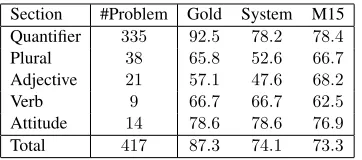
Table 4:The results on a subset of JSeM that is a translation of FraCaS. M15 refers to the accuracy of Mineshima et al. (2015) on the corresponding sections of FraCaS.
possible, our system with gold parses outperforms it for all sections.
Out of the 523 problems, 417 are Japanese trans-lations of the FraCaS problems. Table 4 shows a comparison between the performance of our system on this subset of the JSeM problems and the perfor-mance of the RTE system for English in Mineshima et al. (2015) on the corresponding problems in the FraCaS dataset. Mineshima et al. (2015) used sys-tem parses of the English C&C parser (Clark and Curran, 2007). The total accuracy of our system is comparable to that of Mineshima et al. (2015).
Most errors we found are due to syntactic parse errors caused by the CCG parser, where no cor-rect syntactic parses were found inn-best responses.
Comparison between gold parses and system parses shows that correct syntactic disambiguation im-proves performance.
5 Conclusion
References
Lasha Abzianidze. 2015. A tableau prover for natural logic and language. InProceedings of the 2015 Con-ference on Empirical Methods in Natural Language Processing, pages 2492–2502.
Jon Barwise and Robin Cooper. 1981. Generalized quan-tifiers and natural language. Linguistics and Philoso-phy, 4(2):159–219.
Daisuke Bekki. 2010. A Formal Theory of Japanese Grammar: The Conjugation System, Syntactic Struc-tures, and Semantic Composition. Kuroshio. (In Japanese).
Islam Beltagy, Cuong Chau, Gemma Boleda, Dan Gar-rette, Katrin Erk, and Raymond Mooney. 2013. Mon-tague meets Markov: Deep semantics with probabilis-tic logical form. In 2nd Joint Conference on Lexi-cal and Computational Semantics: Proceeding of the Main Conference and the Shared Task, pages 11–21. Johannes Bjerva, Johan Bos, Rob van der Goot, and
Malvina Nissim. 2014. The Meaning Factory: Formal semantics for recognizing textual entailment and deter-mining semantic similarity. InProceedings of the 8th International Workshop on Semantic Evaluation (Se-mEval 2014), pages 642–646.
Johan Bos and Katja Markert. 2005. Recognising textual entailment with logical inference. InProceedings of the conference on Human Language Technology and Empirical Methods in Natural Language Processing, pages 628–635.
Johan Bos. 2008. Wide-coverage semantic analysis with Boxer. InProceedings of the 2008 Conference on Se-mantics in Text Processing, pages 277–286.
Johan Bos. 2015. Open-domain semantic parsing with Boxer. InProceedings of the 20th Nordic Conference of Computational Linguistics, pages 301–304. Greg Carlson. 1984. Thematic roles and their role in
semantic interpretation. Linguistics, 22(3):259–280. Bob Carpenter. 1997. Type-Logical Semantics. MIT
press.
Lucas Champollion. 2015. The interaction of composi-tional semantics and event semantics. Linguistics and Philosophy, 38(1):31–66.
Gennaro Chierchia. 1998. Reference to kinds across lan-guage. Natural Language Semantics, 6(4):339–405. Stephen Clark and James R. Curran. 2007.
Wide-coverage efficient statistical parsing with CCG and log-linear models. Computational Linguistics, 33(4):493–552.
Robin Cooper, Richard Crouch, Jan van Eijck, Chris Fox, Josef van Genabith, Jan Jaspers, Hans Kamp, Manfred Pinkal, Massimo Poesio, Stephen Pulman, et al. 1994. FraCaS — a framework for computational semantics.
Deliverable, D16.
David Dowty. 1979. Word Meaning and Montague Grammar. Springer.
Yuta Hayashibe, Mamoru Komachi, and Yuji Matsumoto. 2011. Japanese predicate argument structure analysis exploiting argument position and type. InProceedings of IJCNLP 2011, pages 201–209.
Jerry R. Hobbs. 1985. Ontological promiscuity. In Pro-ceedings of the 23rd annual meeting on Association for Computational Linguistics, pages 60–69.
Julia Hockenmaier and Mark Steedman. 2007. CCG-bank: a corpus of CCG derivations and dependency structures extracted from the Penn Treebank. Compu-tational Linguistics, 33(3):355–396.
Daniel Jurafsky and James H. Martin. 2009. Speech and Language Processing. Prentice-Hall, Inc.
Daisuke Kawahara and Sadao Kurohashi. 2011. Genera-tive modeling of coordination by factoring parallelism and selectional preferences. In Proceedings of IJC-NLP 2011, pages 456–464.
Ai Kawazoe, Ribeka Tanaka, Koji Mineshima, and Daisuke Bekki. 2015. An inference problem set for evaluating semantic theories and semantic processing systems for Japanese. In Proceedings of LENLS12, pages 67–73.
Taku Kudo and Yuji Matsumoto. 2002. Japanese de-pendency analysis using cascaded chunking. In Pro-ceedings of the 6th Conference on Natural Language Learning, pages 63–69.
Mike Lewis and Mark Steedman. 2013. Combining distributional and logical semantics. Transactions of the Association for Computational Linguistics, 1:179– 192.
Bill MacCartney and Christopher D. Manning. 2007. Natural logic for textual inference. In Proceedings of the ACL-PASCAL Workshop on Textual Entailment and Paraphrasing, pages 193–200.
Bill MacCartney and Christopher D. Manning. 2008. Modeling semantic containment and exclusion in nat-ural language inference. In Proceedings of the 22nd International Conference on Computational Linguis-tics, pages 521–528.
Marco Marelli, Stefano Menini, Marco Baroni, Luisa Bentivogli, Raffaella Bernardi, and Roberto Zampar-elli. 2014. A SICK cure for the evaluation of composi-tional distribucomposi-tional semantic models. InProceedings of LREC2014, pages 216–223.
Pascual Mart´ınez-G´omez, Koji Mineshima, Yusuke Miyao, and Daisuke Bekki. 2016. ccg2lambda: a compositional semantics system. In Proceedings of ACL 2016 System Demonstrations, pages 85–90. Dale Miller and Gopalan Nadathur. 1986. Some uses
of higher-order logic in computational linguistics. In
Koji Mineshima, Pascual Mart´ınez-G´omez, Yusuke Miyao, and Daisuke Bekki. 2015. Higher-order log-ical inference with compositional semantics. In Pro-ceedings of the 2015 Conference on Empirical Meth-ods in Natural Language Processing, pages 2055– 2061.
Richard Montague. 1974. Formal Philosophy: Selected Papers. Yale University Press New Haven.
Hiroshi Noji and Yusuke Miyao. 2016. Jigg: a frame-work for an easy natural language processing pipeline. In Proceedings of ACL 2016 System Demonstrations, pages 103–108.
Terence Parsons. 1990. Events in the Semantics of En-glish. MIT Press.
Paul Pietroski. 2005. Events and Semantic Architecture. Oxford University Press.
Mark Steedman. 2000. The Syntactic Process. MIT Press.