946
O
rthostatic hypotension (OH) is defined as a sustained drop in systolic blood pressure (BP) by at least 20 mm Hg or diastolic BP by at least 10 mm Hg within 3 minutes of stand-ing.1,2 OH is common, affecting 1 in 5 people aged ≥65 years, and this prevalence increases with further advancing age.3Normally, when we stand from a seated or lying position, blood pools in the legs, causing a drop in venous return, cardiac filling pressure, cardiac output, and systemic BP. This drop in BP causes activation of baroreceptors, which act to normalize BP by increasing sympathetic outflow and reducing parasym-pathetic activity, resulting in peripheral vasoconstriction and tachycardia.4 In later life, this baroreflex can become less sen-sitive, leading to prolonged times to stabilize BP and resulting in OH.5 Prolonged hypotension can cause cerebral hypoperfu-sion, and OH increases the risk of conditions related to cerebral perfusion deficits, including dementia, falls, and stroke.6–8
Cerebral hypoperfusion has been implicated in late-life depression (LLD).9,10 Decline in cerebral blood flow is
associated with increased depressive symptoms in older peo-ple with chronic cardiovascular disease.11,12 Reduced cerebral blood flow measured by transcranial Doppler ultrasound pre-dicted incident depression in a sample of almost 1500 older people.13 In a cohort with Parkinson disease, single-photon emission computed tomography demonstrated cerebral per-fusion deficits in fronto-temporo-limbic regions in depressed participants compared with nondepressed controls.14
Studies in LLD have also demonstrated increased burden of cerebral white matter disease, specifically strategic white matter hyperintensities (WMH),15 which can be caused by ischemic insults because of cerebral hypoperfusion.16,17 WMH are more common and severe in older people with depres-sion,18 and higher burden of WMH is predictive of increased severity of depressive symptoms, as well as poorer response to treatment in older people.19,20 Conditions predisposing to cerebral hypoperfusion and resultant WMH may, therefore, represent modifiable risk factors for LLD. Initial studies with
Received October 26, 2017; first decision November 9, 2017; revision accepted January 18, 2018.
From the Irish Longitudinal Study on Ageing, Trinity College Dublin, Ireland (R.B., D.C., R.A.K.); Mercer’s Institute for Successful Ageing, St James’s Hospital, Dublin, Ireland (R.B., R.A.K.); and Age-Related Health Care, Tallaght Hospital, Dublin, Ireland (R.B., S.P.K.).
The funders had no involvement in the study design, collection, analysis, and interpretation of data; writing of the article; or submission for publication. Any views expressed in this report are not necessarily those of the Department of Health and Children or of the Minister for Health.
The online-only Data Supplement is available with this article athttp://hyper.ahajournals.org/lookup/suppl/doi:10.1161/HYPERTENSIONAHA. 117.10542/-/DC1.
Correspondence to Robert Briggs, Mercer’s Institute for Successful Ageing, St James’s Hospital, Dublin, Ireland. E-mail [email protected]
See Editorial Commentary, pp 816–818
Abstract —There is an established cross-sectional association between orthostatic hypotension (OH) and late-life depression.
The aim of this observational study was to clarify the longitudinal association between baseline symptomatic OH (sOH-30) and incident depression in a sample of >3000 older people without baseline depression (mean age: 62 years at baseline). This study was embedded within the Irish Longitudinal Study on Ageing using data from waves 1 to 3, collected between 2009 and 2014. At 2- and 4-year follow-up, a score ≥9 on the 8-item Center for Epidemiological Studies Depression Scale was used to define incident depression. sOH-30 was defined as a drop in systolic blood pressure ≥20 mm Hg or diastolic blood pressure ≥10 mm Hg at 30 seconds post-standing in conjunction with orthostatic symptoms, such as dizziness, using beat-to-beat measurements. Almost one fifth (proportion, 18%; 95% confidence interval [CI], 16–20) of the study sample had sOH-30. One tenth (proportion, 10%; 95% CI, 9–12) had incident depression. Participants with incident depression were twice as likely to have sOH-30 at baseline compared with those without incident depression (linear regression, 13% [95% CI, 8–19] versus 7% [95% CI, 6–8]). Weighted logistic regression models demonstrated that sOH-30 predicted incident depression with an odds ratio of 1.90 (95% CI, 1.15–3.15) after controlling for covariates, including subthreshold depression, hypotension, cognitive impairment, and antidepressant use. Asymptomatic OH at 30 seconds and initial OH did not predict depression. This study demonstrates that sOH-30 predicts incident depression in a population-representative sample of older people and may, therefore, represent a potentially modifiable risk factor for late-life depression. (Hypertension. 2018;71:946-954. DOI: 10.1161/HYPERTENSIONAHA.117.10542.)
•
Online Data SupplementKey Words: blood pressure ◼ depression ◼ dizziness ◼ hypotension, orthostatic ◼ risk factors
Longitudinal Association Between Orthostatic Hypotension
at 30 Seconds Post-Standing and Late-Life Depression
Robert Briggs, Daniel Carey, Sean P. Kennelly, Rose Anne Kenny
© 2018 American Heart Association, Inc.
Hypertension is available at http://hyper.ahajournals.org DOI: 10.1161/HYPERTENSIONAHA.117.10542
some methodological limitations have demonstrated a cross-sectional association between OH and LLD, but a longitudinal relationship has yet to be investigated.21–23
A further orthostatic BP pattern, initial OH (IOH), has also been described and is defined as a transient BP drop within 15 seconds of standing, of >40 mm Hg systolic BP or >20 mm Hg diastolic BP, with symptoms of cerebral hypoperfusion.24 Typically, BP has recovered within 30 seconds of standing. IOH is a common benign cause of dizziness and syncope in younger people but can also be seen in older adults, par-ticularly those taking medications that may interfere with BP recovery after standing.25 Prior evidence from TILDA (The Irish Longitudinal Study on Ageing) has shown that IOH does not predict unexplained or injurious falls within the TILDA cohort of older people, however.8 The role of IOH in incident depression has not yet been investigated.
An important limitation of many studies of OH is the method used to measure orthostatic BP.21 Noninvasive beat-to-beat BP measurement by active stand using a finometer is a more sensi-tive diagnostic test for OH as it allows real-time continuous track-ing of BP and gives waveform measurements similar to those seen in invasive intra-arterial monitoring.26 It captures dynamic BP changes that are often missed with other techniques.27
Our hypothesis was that OH may represent a modifiable risk factor for depression in later life, and the aim of this study, therefore, is to clarify whether OH and IOH, divided into symptomatic and asymptomatic based on the presence or absence of orthostatic symptoms, measured by continuous BP values, predict incident depression in a cohort of community-dwelling older people.
Methods
Ethics
The study was approved by the Faculty of Health Sciences Research Ethics Committee at Trinity College Dublin, and all participants gave informed written consent. All experimental procedures adhered to the Declaration of Helsinki. All assessments were performed by trained research nurses.
Anonymized data and materials have been made publicly available at the Irish Social Science Data Archive based in University College Dublin and the Interuniversity Consortium for Political and Social Research based in the University of Michigan and can be accessed at www.tilda.ie.
Study Design
This study is embedded within TILDA, a large population-based study of a nationally representative sample of community-dwelling older adults aged ≥50 years, with an initial study population of >8000 participants.
The TILDA design has been outlined previously.28 We analyzed
data from the first, second, and third wave of TILDA collected be-tween 2009 and 2014. Participants were included in this study if they were ≥50 years of age and underwent a complete health assessment at wave 1, including measurement of orthostatic BP and screening for depression. Participants were excluded if they did not complete 4-year follow-up, including assessment of mood at both waves 2 and 3. Participants were also excluded at wave 1 if they had a preexisting diagnosis of dementia.
This is a longitudinal study establishing whether OH at baseline (wave 1), measured at 30 seconds post-standing, is a predictor of in-cident depression by 4-year follow-up. Therefore, participants with depression at wave 1 were excluded. The remaining participants were screened for depression at waves 2 and 3.
Orthostatic Hypotension
Orthostatic BP was measured by active stand using a Finometer MIDI as described previously.29 The Finometer device has been validated
against British Hypertension Society protocol and the criteria of the Association for the Advancement of Medical Instrumentation for measurement of finger BP noninvasively on a beat-to-beat basis.30
Although clinical practice has generally shifted toward use of con-tinuous BP measurement for OH rather than sphygmomanometer-based readings, it must be noted that these measurements also show low-to-moderate reliability and natural variation at short-term follow-up.31 Furthermore, although continuous BP measurement is validated
extensively as a reliable method to track changes in BP, because of differences between arterial waveforms at the finger compared with central arteries, finger systolic BP may be higher than invasive bra-chial BP, whereas finger diastolic BP may be lower.24
Briefly, participants lay in the supine position for 10 minutes in a quiet room, before standing in a timely manner (<5 seconds) and were aided by a research nurse to mobilize as necessary. After standing, systolic BP, diastolic BP, and heart rate were monitored for a further 120 seconds. Throughout the recording, subjects stood quietly. After the 2-minute period, subjects were asked to report occurrence of or-thostatic symptoms (dizziness, light-headedness, or unsteadiness).
OH at 30 seconds (OH-30) was defined as a drop in systolic BP ≥20 mm Hg or drop in diastolic BP ≥10 mm Hg at 30 seconds compared with baseline BP. Time point values were 5-second moving averages, that is, the 30-second time point was the average of 27.5 to 32.5 sec-onds. Symptomatic OH at 30 seconds (sOH-30) was defined as OH at 30 seconds with associated orthostatic symptoms. Asymptomatic OH at 30 seconds (aOH-30) was defined as OH at 30 seconds with-out associated orthostatic symptoms. Thirty seconds was chosen as the cutoff point post-stand for several reasons. A recent large study has demonstrated that measurements of OH performed within 60 seconds of standing were the most strongly related to dizziness and adverse out-comes, such as syncope, injury, or death.32 Furthermore, a prior study
looking at normative changes in phasic BP in the TILDA cohort estab-lished that an initial BP drop immediately after standing is common but nonrecovery of BP should be considered abnormal by 30 seconds.29
IOH was defined as a drop in systolic BP >40 mm Hg or a drop in diastolic BP >20 mm Hg at 10 seconds post-standing compared with baseline BP with full recovery of BP to baseline BP value or higher by 30 seconds. Symptomatic IOH was defined as IOH with associated orthostatic symptoms.
Depression
Depressive symptoms were assessed at wave 1 using the 20-item Center for Epidemiological Studies Depression Scale (CES-d-20). A score of ≥16 was used to define cases of depression.33 Participants
with depression at wave 1 were excluded from the study.
At waves 2 and 3, the 8-item CES-d-8 was used to screen for de-pression. The CES-d-8 was introduced in the TILDA study at waves 2 and 3 to reduce the time taken to conduct participant assessments and to reduce respondent burden and fatigue, and previous work has confirmed its reliability in comparison to the CES-d-20 in terms of internal consistency and factor structure within the TILDA cohort.34
A score of ≥9 on this scale was used to define cases of depression, and participants with a CES-d-8 score ≥9 at either wave 2 or 3 were defined as having incident depression.35
Other Measures
Detailed social and biological data were collected at wave 1. Functional impairment was defined as impairment in ≥1 instrumen-tal activities of daily living, which includes cleaning and maintain-ing the house, managmaintain-ing money, movmaintain-ing within the community, and preparing meals. Alcohol abuse was defined as a score of ≥2 on the CAGE Alcohol Scale. Gait was assessed using the Timed Up and Go Test, where a score of ≥12 seconds was considered abnormal.36 BP
was measured twice in a seated position by a trained research nurse using the OMRON digital automatic BP monitor, and the mean value was used for the analysis. Cardiac disease was defined as self-report of prior myocardial infarct, cardiac failure, or cardiac arrhythmia.
Self-report was also elicited for prior stroke, diabetes mellitus, and Parkinson disease, as well as recent unintentional weight loss of ≥10 pounds. Participants were asked about physical activity within the last week, and those who were inactive for the full 7 days were defined as having low physical activity, compared with moderate (active 1–3 days) and high (active ≥4 days) physical activity levels. Medication records were examined for antihypertensive use (specifically for those with Anatomic Therapeutic Chemical Classification C02, C03, C07, C08, or C09) and antidepressant use (Anatomic Therapeutic Chemical Classification N06A). Cognitive impairment was defined as a Mini-Mental State Examination (MMSE) score ≤24.
Statistical Analysis
Data were analyzed using Stata (Stata Corp). Cross-sectional analy-sis was weighted. Weights were estimated by comparing the counts of individuals in the sample across age, sex, highest level of educa-tional attainment, marital status, and urban or rural dwelling, with the counts in the population with the same characteristics using infor-mation from the Central Statistics Office of Ireland 2011 Census. Differences in baseline binary demographic and clinical variables between study groups were, therefore, presented as weighted preva-lence estimates using proportional estimation. Continuous variables were analyzed by linear regression with study group as a predictor. To correct for non-normality of the distribution, reciprocal transfor-mation was applied to the Timed Up and Go Test variables because they demonstrated a highly positive skew. Marginal mean values cal-culated post-estimation, and data were presented by recalculating as 1/(marginal mean).
Additionally, attrition weights were applied to the longitudinal analysis. These weights corrected for the difference in attrition rates over subgroups and reduced the bias caused by this difference in at-trition rates. These weights are calculated based on the reciprocal of the probability of a wave 1 health assessment respondent completing a computer-assisted personal interview at waves 2 and 3.
Logistic regression models were used to estimate odds ratios (with 95% confidence intervals [CI]) for sOH-30 as a predictor of incident depression. Covariates were chosen a priori, based on their hypoth-esized role in modifying the relationship between baseline OH and incident depression.
On the basis of these regression models, average marginal effects were calculated for relevant predictor variables post-estimation. Per subject, each nominal predictor of interest was first assigned its base category level value while holding values of all other variables in the regression model for that subject constant; the probability of outcome was calculated. The process was then repeated, assigning the predictor of interest to its next value. The difference between the calculated prob-abilities for the levels of the predictor variable was the marginal effect; the average marginal effect for the sample was calculated as the mean of these values over the different levels of the predictor of interest.
To ensure findings were not related to antidepressant use, subgroups of participants taking antidepressant medication were excluded from the analysis, and logistic regression models were rerun to ensure that findings were not significantly different when these groups were omitted. Similarly, analysis was rerun excluding participants with an MMSE score <28 to ensure that findings were not affected by those with early or undetected cognitive impairment.
A P value ≤0.05 was considered statistically significant.
Results
Three thousand nine hundred and eighty-two participants met initial criteria for inclusion at wave 1. A further 8% of this group screened positive for depression at wave 1(CES-d
-20 score ≥16) and were, therefore, excluded from the study, yielding an initial study sample of 3662 participants. Thirteen percent (488/3662) of this group did not complete 4-year follow-up, leaving a final study sample of 3174 participants. See Figure S1 in the online-only Data Supplement for flow diagram of study recruitment and attrition.
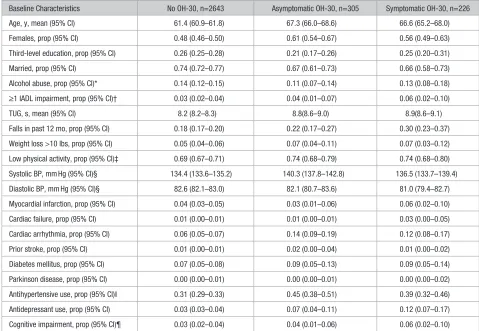
Over one sixth (proportion, 18%; 95% CI, 16–20) of the study sample had OH-30 and >40% (proportion, 42%; 95% CI, 38–47) of these were symptomatic. The baseline charac-teristics of the study sample by diagnosis of OH-30 are shown in Table 1. Participants with OH-30 were older and more likely to be female, functionally impaired, have a history of falls, and prescribed antidepressant and antihypertensive medication.
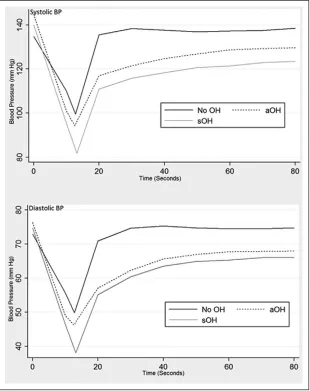
In terms of differences between those with sOH-30 and aOH-30, participants with sOH-30 had a lower systolic BP nadir (linear regression, 80.7 [95% CI, 68.7–92.7] versus 94.3 [95% CI, 91.1–97.4] mm Hg) and diastolic BP nadir (linear regression, 37.5 [95% CI, 26.4–48.7] versus 46.3 [95% CI, 44.5–48.1] mm Hg) during active stand testing compared with the aOH-30 group. Participants with sOH-30 were also more likely to have an initial drop (ie, at 10 seconds post-standing) in systolic BP >40 mm Hg compared with those with aOH-30 (61% [95% CI, 55–68] versus 58% [95% CI, 52–64]). There were similar rates of cardiovascular disease and antihyperten-sive use between groups (Figure 1; Table 1).
Does OH-30 at Wave 1 Predict Incident Depression?
One tenth (proportion, 10%; 95% CI, 9–12) of the study sample had incident depression by 4-year follow-up, that is, depression at either wave 2 or 3. This includes 138 partici-pants with depression at wave 2 and a further 162 with inci-dent depression at wave 3.
Participants with incident depression were almost twice as likely to have sOH-30 at wave 1 compared with those with-out incident depression (linear regression, 13 [95% CI, 8–19] versus 7% [95% CI, 6–8]). Proportions of participants with incident depression by OH-30 group are shown in Figure 2.
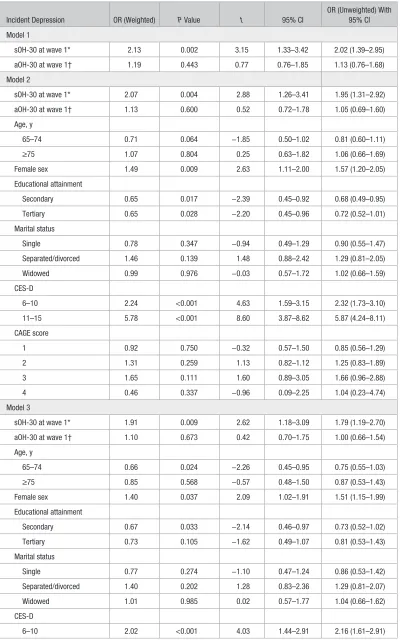
Weighted logistic regression models demonstrated that sOH-30 predicted incident depression with an odds ratio of 1.92 (95% CI, 1.18–3.11) after controlling for covariates. Other significant predictors of incident depression were female sex, high-normal CES-D scores, and current antidepressant use. aOH-30 did not predict incident depression (Table 2).
Average marginal effects, calculated post-estimation, demonstrated that the average marginal probability of inci-dent depression in participants with sOH-30 was 0.16 (95% CI, 0.11–0.21; z=5.84; P<0.001), compared with 0.10 (95% CI, 0.08–0.11) and 0.10 (95% CI, 0.07–0.14) for those with both no OH-30 and aOH-30, respectively. The dy/dx for the sOH group (with no OH-30 group as a reference) was, there-fore, 0.06 (95% CI, 0.01–0.12; z=2.25; P=0.025), suggesting that the probability of developing incident depression in those with sOH-30 at baseline is >6% in those without OH-30.
Subgroup Analysis
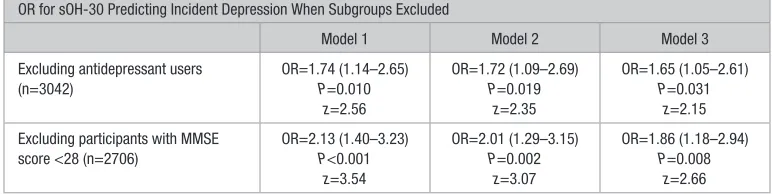
For OH-30 as a predictor of incident depression, separate anal-yses were also performed excluding participants taking anti-depressants (n=132), as well as those with MMSE score <28 (n=468), and results were not attenuated significantly (Table 3).
Does IOH at Wave 1 Predict Incident Depression?
Almost half (proportion, 46%; 95% CI, 44–48) of the study sample had IOH, with 40% of these participants having
symptomatic IOH. The baseline characteristics of the study sample by diagnosis of IOH are shown in Table S1. There was no significant age or sex difference across groups defined by diagnosis of IOH.
Weighted logistic regression models demonstrated that neither symptomatic IOH nor asymptomatic IOH predicted incident depression (Table S2).
Discussion
This study shows that in a large sample of nondepressed com-munity-dwelling older people, participants with sOH-30 after standing had a 2-fold higher risk of incident depression dur-ing 4-year follow-up after controlldur-ing for covariates includdur-ing cognitive impairment and antidepressant use. Average mar-ginal effects scores demonstrate that, in a group of otherwise average individuals, sOH-30 at baseline increases the prob-ability of incident depression by 6%.
This is the first longitudinal study to investigate the rela-tionship between OH and depression.21 Our findings are supported by prior studies that identified a cross-sectional
association between finometer-defined OH and LLD but were limited by small numbers and high prevalence of current anti-depressant use among participants.22,37 A larger cross-sectional study of the TILDA cohort also identified an association between current depression and symptomatic OH diagnosed with sphygmomanometer-based BP data.23
Although our findings are not sufficient to imply causa-tion, OH-related cerebral hypoperfusion may represent the mechanism for this association. Orthostatic drops in BP are associated with higher burden of frontal WMH in older people with depression.38 Several studies have demonstrated loss of frontal lobe integrity in LLD.9,39,40 The frontal lobe is relatively sensitive to hypoperfusion,41 and age-related changes in cere-bral perfusion are most marked in this region,42 increasing the likelihood that reductions in cerebral blood flow because of OH would lead to loss of white matter integrity there. Damage to the frontal–subcortical pathway, which links the frontal lobe to the subcortex, can result in executive dysfunction, as well as psychomotor retardation, loss of interest, and func-tional impairment, hallmarks of depression in later life.43 Prior Table 1. Baseline Characteristics of Study Sample by Diagnosis of OH-30 at Wave 1
Baseline Characteristics No OH-30, n=2643 Asymptomatic OH-30, n=305 Symptomatic OH-30, n=226
Age, y, mean (95% CI) 61.4 (60.9–61.8) 67.3 (66.0–68.6) 66.6 (65.2–68.0)
Females, prop (95% CI) 0.48 (0.46–0.50) 0.61 (0.54–0.67) 0.56 (0.49–0.63)
Third-level education, prop (95% CI) 0.26 (0.25–0.28) 0.21 (0.17–0.26) 0.25 (0.20–0.31)
Married, prop (95% CI) 0.74 (0.72–0.77) 0.67 (0.61–0.73) 0.66 (0.58–0.73)
Alcohol abuse, prop (95% CI)* 0.14 (0.12–0.15) 0.11 (0.07–0.14) 0.13 (0.08–0.18)
≥1 IADL impairment, prop (95% CI)† 0.03 (0.02–0.04) 0.04 (0.01–0.07) 0.06 (0.02–0.10)
TUG, s, mean (95% CI) 8.2 (8.2–8.3) 8.8(8.6–9.0) 8.9(8.6–9.1)
Falls in past 12 mo, prop (95% CI) 0.18 (0.17–0.20) 0.22 (0.17–0.27) 0.30 (0.23–0.37)
Weight loss >10 lbs, prop (95% CI) 0.05 (0.04–0.06) 0.07 (0.04–0.11) 0.07 (0.03–0.12) Low physical activity, prop (95% CI)‡ 0.69 (0.67–0.71) 0.74 (0.68–0.79) 0.74 (0.68–0.80) Systolic BP, mm Hg (95% CI)§ 134.4 (133.6–135.2) 140.3 (137.8–142.8) 136.5 (133.7–139.4)
Diastolic BP, mm Hg (95% CI)§ 82.6 (82.1–83.0) 82.1 (80.7–83.6) 81.0 (79.4–82.7)
Myocardial infarction, prop (95% CI) 0.04 (0.03–0.05) 0.03 (0.01–0.06) 0.06 (0.02–0.10)
Cardiac failure, prop (95% CI) 0.01 (0.00–0.01) 0.01 (0.00–0.01) 0.03 (0.00–0.05)
Cardiac arrhythmia, prop (95% CI) 0.06 (0.05–0.07) 0.14 (0.09–0.19) 0.12 (0.08–0.17)
Prior stroke, prop (95% CI) 0.01 (0.00–0.01) 0.02 (0.00–0.04) 0.01 (0.00–0.02)
Diabetes mellitus, prop (95% CI) 0.07 (0.05–0.08) 0.09 (0.05–0.13) 0.09 (0.05–0.14)
Parkinson disease, prop (95% CI) 0.00 (0.00–0.01) 0.00 (0.00–0.01) 0.00 (0.00–0.02)
Antihypertensive use, prop (95% CI)‖ 0.31 (0.29–0.33) 0.45 (0.38–0.51) 0.39 (0.32–0.46)
Antidepressant use, prop (95% CI) 0.03 (0.03–0.04) 0.07 (0.04–0.11) 0.12 (0.07–0.17)
Cognitive impairment, prop (95% CI)¶ 0.03 (0.02–0.04) 0.04 (0.01–0.06) 0.06 (0.02–0.10) Differences in categorical variables presented as weighted prevalence estimates using proportional estimation. Continuous variables were analyzed by linear regression with study group as a predictor. ATC indicates anatomic therapeutic chemical; BP, blood pressure; CI, confidence interval; IADL, instrumental activities of daily living; OH-30, orthostatic hypotension at 30 s post-stand during active stand test; Prop, proportion; and TUG, Timed Up and Go Test.
*Alcohol abuse defined as a score ≥2 on the CAGE alcohol scale.
†IADL impairments include impairments in cleaning and maintaining the house, managing money, moving within the community, and preparing meal. ‡Low physical activity defined as no physical activity on any day in the past week.
§BP was measured twice with sphygmomanometer in seated position, and the average of 2 readings was used.
‖Antihypertensive use defined as being prescribed any antihypertensive medication with ATC Classification Codes C02, C03, C07, C08, and C09. ¶Cognitive impairment defined as Mini-Mental State Examination score <24.
[image:4.585.52.531.79.410.2]studies have also identified an association between other con-ditions potentially caused by low BP and deficits in cerebral perfusion, including stoke, syncope, and unexplained falls.44–46
aOH-30 did not predict depression. There were no sig-nificant differences between those with sOH-30 and aOH-30 in terms of age, sex, cardiovascular disease, or use of culprit medications. However, the sOH-30 group had a lower nadir BP on active stand testing, as well as a more prolonged BP recov-ery, reflecting a greater degree of hypotensive burden, caus-ing orthostatic symptoms, and potentially increascaus-ing the risk of cerebral hypoperfusion.47 IOH also did not predict incident depression. This is not surprising given prior evidence dem-onstrating that IOH does not increase the risk of falls in the same TILDA population8 and that although the IOH group had a profound initial drop in BP, in almost two thirds of partici-pants with IOH, BP had recovered to baseline by 30 seconds after standing.
[image:5.585.48.358.66.457.2]After exclusion for baseline depression by CES-D, almost 9% of participants with OH-30 were prescribed antidepres-sants, 3 times more than those without OH-30. Antidepresantidepres-sants, particularly tricyclic antidepressants, increase the risk of OH and are prescribed regularly for indications other than depres-sion, such as chronic pain or anxiety.48 We, therefore, reran our regression analyses to demonstrate that our findings were not significantly attenuated when antidepressant users were excluded. It is apparent, therefore, that this association is inde-pendent of antidepressant use.
Figure 1. Mean blood pressure (BP) values from active stand comparing symptomatic orthostatic hypotension (sOH) and asymptomatic orthostatic hypotension (aOH) at 30 s post-standing (OH-30) groups to non–OH-30 group. Time represents seconds post-stand during active stand test.
Figure 2. Proportion of participants (with 95% confidence intervals) with incident depression by orthostatic hypotension at 30 s post-standing at wave 1 (30) group. n=3174 (no OH-30=2643; asymptomatic orthostatic hypotension at 30 s post-standing [aOH]-30=305; symptomatic orthostatic hypotension at 30 s post-standing [sOH]-30=226). Differences in incident depression presented as weighted prevalence estimates using proportional estimation. Incident depression defined as 8-item Center for Epidemiological Studies Depression Scale ≥9 at wave 2 or 3.
[image:5.585.47.280.502.660.2]Table 2. Logistic Regression Reporting OR for Association Between Symptomatic Orthostatic Hypotension at Wave 1 and Incident Depression
Incident Depression OR (Weighted) P Value t 95% CI
OR (Unweighted) With 95% CI Model 1
sOH-30 at wave 1* 2.13 0.002 3.15 1.33–3.42 2.02 (1.39–2.95)
aOH-30 at wave 1† 1.19 0.443 0.77 0.76–1.85 1.13 (0.76–1.68)
Model 2
sOH-30 at wave 1* 2.07 0.004 2.88 1.26–3.41 1.95 (1.31–2.92)
aOH-30 at wave 1† 1.13 0.600 0.52 0.72–1.78 1.05 (0.69–1.60)
Age, y
65–74 0.71 0.064 −1.85 0.50–1.02 0.81 (0.60–1.11)
≥75 1.07 0.804 0.25 0.63–1.82 1.06 (0.66–1.69)
Female sex 1.49 0.009 2.63 1.11–2.00 1.57 (1.20–2.05)
Educational attainment
Secondary 0.65 0.017 −2.39 0.45–0.92 0.68 (0.49–0.95)
Tertiary 0.65 0.028 −2.20 0.45–0.96 0.72 (0.52–1.01)
Marital status
Single 0.78 0.347 −0.94 0.49–1.29 0.90 (0.55–1.47)
Separated/divorced 1.46 0.139 1.48 0.88–2.42 1.29 (0.81–2.05)
Widowed 0.99 0.976 −0.03 0.57–1.72 1.02 (0.66–1.59)
CES-D
6–10 2.24 <0.001 4.63 1.59–3.15 2.32 (1.73–3.10)
11–15 5.78 <0.001 8.60 3.87–8.62 5.87 (4.24–8.11)
CAGE score
1 0.92 0.750 −0.32 0.57–1.50 0.85 (0.56–1.29)
2 1.31 0.259 1.13 0.82–1.12 1.25 (0.83–1.89)
3 1.65 0.111 1.60 0.89–3.05 1.66 (0.96–2.88)
4 0.46 0.337 −0.96 0.09–2.25 1.04 (0.23–4.74)
Model 3
sOH-30 at wave 1* 1.91 0.009 2.62 1.18–3.09 1.79 (1.19–2.70)
aOH-30 at wave 1† 1.10 0.673 0.42 0.70–1.75 1.00 (0.66–1.54)
Age, y
65–74 0.66 0.024 −2.26 0.45–0.95 0.75 (0.55–1.03)
≥75 0.85 0.568 −0.57 0.48–1.50 0.87 (0.53–1.43)
Female sex 1.40 0.037 2.09 1.02–1.91 1.51 (1.15–1.99)
Educational attainment
Secondary 0.67 0.033 −2.14 0.46–0.97 0.73 (0.52–1.02)
Tertiary 0.73 0.105 −1.62 0.49–1.07 0.81 (0.53–1.43)
Marital status
Single 0.77 0.274 −1.10 0.47–1.24 0.86 (0.53–1.42)
Separated/divorced 1.40 0.202 1.28 0.83–2.36 1.29 (0.81–2.07)
Widowed 1.01 0.985 0.02 0.57–1.77 1.04 (0.66–1.62)
CES-D
6–10 2.02 <0.001 4.03 1.44–2.91 2.16 (1.61–2.91)
(Continued )
[image:6.585.94.494.88.729.2]Our findings also mirror those seen in studies of OH and dementia, where OH has also been shown to predict incident dementia in older people.6 There is a complex relationship between depression and dementia in later life with recent research suggesting that LLD represents a prodromal phase
before the onset of clinically significant cognitive deficits.49 This is supported by the overlapping clinical features between LLD and early dementia, particularly vascular dementia, including executive dysfunction and apathy, and our study suggests a potentially shared mechanistic pathway.43
11–15 5.44 <0.001 7.96 3.58–8.25 5.49 (3.95–7.64)
CAGE score
1 0.87 0.588 −0.54 0.51–1.46 0.81 (0.53–1.24)
2 1.29 0.309 1.02 0.79–2.12 1.22 (0.80–1.86)
3 1.67 0.112 1.59 0.89–3.13 1.71 (0.98–2.98)
4 0.36 0.249 −1.15 0.07–2.03 0.92 (0.20–4.29)
Weight loss >10 lbs 2.02 0.007 2.70 1.21–3.36 1.82 (1.15–2.89)
IADL impairment‡ 0.70 0.442 −0.77 0.28–1.74 0.72 (0.36–1.46)
Gait abnormality§ 1.44 0.349 0.94 0.67–3.08 1.55 (0.85–2.82)
Cardiac disease‖ 1.24 0.141 1.47 0.93–1.66 1.17 (0.90–1.52)
Hypotension¶ 1.38 0.510 0.66 0.53–3.61 1.11 (0.54–2.26)
Stroke 0.62 0.556 −0.59 0.13–3.01 0.58 (0.13–2.57)
Diabetes mellitus 1.06 0.823 0.22 0.63–1.79 1.39 (0.87–2.22)
Parkinson disease 4.10 0.173 1.36 0.54–31.26 4.08 (0.72–23.04)
Antidepressant use 1.87 0.037 2.10 1.04–3.35 1.97 (1.23–3.15)
Cognitive impairment# 1.22 0.646 0.46 0.52–2.91 1.30 (0.60–2.81) n=3174. aOH-30 indicates asymptomatic orthostatic hypotension at 30 s; BP, blood pressure; CES-D, Center for Epidemiological Studies Depression Scale; CI, confidence interval; IADL, instrumental activities of daily living; OR, odds ratio; and sOH-30, symptomatic orthostatic hypotension at 30 s.
*Drop in systolic BP ≥20 mm Hg or diastolic BP ≥10 mm Hg from baseline at 30 s post-standing during active stand test with associated orthostatic symptoms.
†Drop in systolic BP ≥20 mm Hg or diastolic BP ≥10 mm Hg from baseline at 30 s post-standing during active stand test without associated orthostatic symptoms.
‡Impairment in cleaning and maintaining the house, managing money, moving within the community, or preparing meal by self-report.
§Timed Up and Go Test score ≥12 s.
‖Self-report of prior myocardial infarction, cardiac arrhythmia, congestive heart failure, or hypertension. ¶BP measured in seated position of systolic <100 mm Hg or diastolic <60 mm Hg.
#Mini-Mental State Examination score ≤24.
Table 2. Continued
Incident Depression OR (Weighted) P Value t 95% CI
OR (Unweighted) With 95% CI
Table 3. Logistic Regression Reporting ORs (With 95% CIs) of Symptomatic Orthostatic Hypotension Predicting Incident Depression
OR for sOH-30 Predicting Incident Depression When Subgroups Excluded
Model 1 Model 2 Model 3
Excluding antidepressant users (n=3042)
OR=1.74 (1.14–2.65) P=0.010
z=2.56
OR=1.72 (1.09–2.69) P=0.019
z=2.35
OR=1.65 (1.05–2.61) P=0.031
z=2.15 Excluding participants with MMSE
score <28 (n=2706)
OR=2.13 (1.40–3.23) P<0.001
z=3.54
OR=2.01 (1.29–3.15) P=0.002
z=3.07
OR=1.86 (1.18–2.94) P=0.008
z=2.66
Model 1 is unadjusted. Model 2 controls for age, sex, marital status, CAGE score, and baseline depression scores. Model 3 controls for model 2 covariates and functional impairment, gait abnormalities, heart disease, low blood pressure, weight loss, physical activity, stroke, diabetes mellitus, Parkinson disease, antidepressant use, and cognitive impairment. CI indicates confidence interval; OR, odds ratio; MMSE, Mini-Mental State Examination; sOH-30, symptomatic orthostatic hypotension at 30 s post-standing.
[image:7.585.93.492.77.342.2] [image:7.585.99.485.597.694.2]This study has some limitations that must be noted. Incident depression was defined by 8-item CES-D and not by gold-standard psychiatric interview. The shortform 8-item CES-D has been validated against the 20-item CES-D within the TILDA population, however.50 Several variables, includ-ing cardiovascular disease, are based on self-report and may, therefore, be limited by recall bias.51
Additionally, although participants with preexisting clini-cally diagnosed dementia were excluded at wave 1 from the TILDA study, it is well recognized that cognitive impairment is often undetected and underdiagnosed.52 Furthermore, an MMSE cutoff score of 24, which we used in this study, may not be sensitive enough to detect cognitive impairment in a well older population.53 We, therefore, performed our regres-sion analysis excluding all participants with MMSE score <28, and sOH-30 remained a significant predictor of depression.
The strengths of this study include the large study sample, with detailed social and biological data, allowing us to robustly control for important covariates, as well as the continuous measurement of orthostatic BP, which is unique for a study of this scale.
Depression confers significant disability on the older peo-ple, as well as an increased mortality risk.54 These findings are important because OH may, therefore, represent a potentially modifiable risk factor for LLD. Forty percent of participants with OH-30 in this study were prescribed antihypertensive therapy, whereas almost one tenth were prescribed antidepres-sant medication, despite the absence of clinically significant depressive symptoms at baseline. Treatment of OH in the first instance often involves discontinuation of culprit medica-tions.1 Increased awareness of the risks of overtreatment of BP in older people and resultant hypotension is imperative especially in the context of recent large international research advocating more aggressive BP lowering in this group.55
Perspectives
This study demonstrates that symptomatic OH at 30 seconds post-standing is associated with a 2-fold increased risk of incident depression in a large population-representative sam-ple of older peosam-ple. This finding is important because, given the higher burden of cerebral white matter disease in LLD, cerebral hypoperfusion caused by OH may be the mecha-nism for this association, and OH may, therefore, represent a modifiable risk factor for depression in older people.
Sources of Funding
Financial support was provided by Irish Government, the Atlantic Philanthropies, and Irish Life, plc.
Disclosures
None.References
1. Shibao C, Lipsitz LA, Biaggioni I; American Society of Hypertension Writing Group. Evaluation and treatment of orthostatic hypotension. J Am Soc Hypertens. 2013;7:317–324. doi: 10.1016/j.jash.2013.04.006. 2. Freeman R, Wieling W, Axelrod FB, et al. Consensus statement on the
definition of orthostatic hypotension, neurally mediated syncope and the postural tachycardia syndrome. Clin Auton Res. 2011;21:69–72. doi: 10.1007/s10286-011-0119-5.
3. Rutan GH, Hermanson B, Bild DE, Kittner SJ, LaBaw F, Tell GS. Orthostatic hypotension in older adults. The Cardiovascular Health Study. CHS Collaborative Research Group. Hypertension. 1992;19(6 pt 1):508–519.
4. Naschitz JE, Rosner I. Orthostatic hypotension: framework of the syndrome. Postgrad Med J. 2007;83:568–574. doi: 10.1136/pgmj.2007.058198. 5. Monahan KD. Effect of aging on baroreflex function in humans.
Am J Physiol Regul Integr Comp Physiol. 2007;293:R3–R12. doi: 10.1152/ajpregu.00031.2007.
6. Wolters FJ, Mattace-Raso FU, Koudstaal PJ, Hofman A, Ikram MA; Heart Brain Connection Collaborative Research Group. Orthostatic hypotension and the long-term risk of dementia: a population-based study. PLoS Med. 2016;13:e1002143. doi: 10.1371/journal.pmed.1002143.
7. Yatsuya H, Folsom AR, Alonso A, Gottesman RF, Rose KM; ARIC Study Investigators. Postural changes in blood pressure and incidence of isch-emic stroke subtypes: the ARIC study. Hypertension. 2011;57:167–173. doi: 10.1161/HYPERTENSIONAHA.110.161844.
8. Finucane C, O’Connell MD, Donoghue O, Richardson K, Savva GM, Kenny RA. Impaired orthostatic blood pressure recovery is associated with unexplained and injurious falls. J Am Geriatr Soc. 2017;65:474–482. doi: 10.1111/jgs.14563.
9. Taylor WD, Aizenstein HJ, Alexopoulos GS. The vascular depression hypothesis: mechanisms linking vascular disease with depression. Mol Psychiatry. 2013;18:963–974. doi: 10.1038/mp.2013.20.
10. Tiemeier H, Bakker SL, Hofman A, Koudstaal PJ, Breteler MM. Cerebral haemodynamics and depression in the elderly. J Neurol Neurosurg Psychiatry. 2002;73:34–39.
11. Alosco ML, Spitznagel MB, Cohen R, Raz N, Sweet LH, Josephson R, Hughes J, Rosneck J, Gunstad J. Reduced cerebral perfusion predicts greater depressive symptoms and cognitive dysfunction at a 1-year follow-up in patients with heart failure. Int J Geriatr Psychiatry. 2014;29:428– 436. doi: 10.1002/gps.4023.
12. Doraiswamy PM, MacFall J, Krishnan KR, O’Connor C, Wan X, Benaur M, Lewandowski M, Fortner M. Magnetic resonance assessment of cere-bral perfusion in depressed cardiac patients: preliminary findings. Am J Psychiatry. 1999;156:1641–1643. doi: 10.1176/ajp.156.10.1641. 13. Direk N, Koudstaal PJ, Hofman A, Ikram MA, Hoogendijk WJ, Tiemeier
H. Cerebral hemodynamics and incident depression: the Rotterdam Study. Biol Psychiatry. 2012;72:318–323. doi: 10.1016/j.biopsych.2012.01.019. 14. Kim YD, Jeong HS, Song IU, Chung YA, Namgung E, Kim YD. Brain
perfusion alterations in depressed patients with Parkinson’s disease. Ann Nucl Med. 2016;30:731–737. doi: 10.1007/s12149-016-1119-2. 15. Teodorczuk A, O’Brien JT, Firbank MJ, Pantoni L, Poggesi A, Erkinjuntti
T, Wallin A, Wahlund LO, Gouw A, Waldemar G, Schmidt R, Ferro JM, Chabriat H, Bäzner H, Inzitari D; LADIS Group. White matter changes and late-life depressive symptoms: longitudinal study. Br J Psychiatry. 2007;191:212–217. doi: 10.1192/bjp.bp.107.036756.
16. Jefferson AL, Tate DF, Poppas A, Brickman AM, Paul RH, Gunstad J, Cohen RA. Lower cardiac output is associated with greater white matter hyperintensities in older adults with cardiovascular disease. J Am Geriatr Soc. 2007;55:1044–1048. doi: 10.1111/j.1532-5415.2007.01226.x. 17. Marstrand JR, Garde E, Rostrup E, Ring P, Rosenbaum S, Mortensen
EL, Larsson HB. Cerebral perfusion and cerebrovascular reactivity are reduced in white matter hyperintensities. Stroke. 2002;33:972–976. 18. Herrmann LL, Le Masurier M, Ebmeier KP. White matter
hyperinten-sities in late life depression: a systematic review. J Neurol Neurosurg Psychiatry. 2008;79:619–624. doi: 10.1136/jnnp.2007.124651.
19. Firbank MJ, O’Brien JT, Pakrasi S, Pantoni L, Simoni M, Erkinjuntti T, Wallin A, Wahlund LO, van Straaten I, Inzitari D. White matter hyperin-tensities and depression–preliminary results from the LADIS study. Int J Geriatr Psychiatry. 2005;20:674–679. doi: 10.1002/gps.1342.
20. Taylor WD, Steffens DC, MacFall JR, McQuoid DR, Payne ME, Provenzale JM, Krishnan KR. White matter hyperintensity progression and late-life depression outcomes. Arch Gen Psychiatry. 2003;60:1090– 1096. doi: 10.1001/archpsyc.60.11.1090.
21. Briggs R, Kenny RA, Kennelly SP. Systematic review: the association between late life depression and hypotension. J Am Med Dir Assoc. 2016;17:1076–1088. doi: 10.1016/j.jamda.2016.06.027.
22. Richardson J, Kerr SR, Shaw F, Kenny RA, O’Brien JT, Thomas AJ. A study of orthostatic hypotension in late-life depression. Am J Geriatr Psychiatry. 2009;17:996–999. doi: 10.1097/JGP.0b013e3181b4bf35. 23. Regan CO, Kearney PM, Cronin H, Savva GM, Lawlor BA, Kenny R.
Oscillometric measure of blood pressure detects association between orthostatic hypotension and depression in population based study of older adults. BMC Psychiatry. 2013;13:266. doi: 10.1186/1471-244X-13-266. 24. van Wijnen VK, Finucane C, Harms MPM, Nolan H, Freeman RL,
Westerhof BE, Kenny RA, Ter Maaten JC, Wieling W. Noninvasive beat-to-beat finger arterial pressure monitoring during orthostasis: a compre-hensive review of normal and abnormal responses at different ages. J Intern Med. 2017;282:468–483. doi: 10.1111/joim.12636.
25. Wieling W, Krediet CT, van Dijk N, Linzer M, Tschakovsky ME. Initial orthostatic hypotension: review of a forgotten condition. Clin Sci (Lond). 2007;112:157–165. doi: 10.1042/CS20060091.
26. Langewouters GJ, Settels JJ, Roelandt R, Wesseling KH. Why use Finapres or Portapres rather than intra-arterial or intermittent non-invasive techniques of blood pressure measurement? J Med Eng Technol. 1998;22:37–43. 27. Cooke J, Carew S, O’Connor M, Costelloe A, Sheehy T, Lyons D.
Sitting and standing blood pressure measurements are not accurate for the diagnosis of orthostatic hypotension. QJM. 2009;102:335–339. doi: 10.1093/qjmed/hcp020.
28. Whelan BJ, Savva GM. Design and methodology of the Irish Longitudinal Study on Ageing. J Am Geriatr Soc. 2013;61(suppl 2):S265–S268. doi: 10.1111/jgs.12199.
29. Finucane C, O’Connell MD, Fan CW, Savva GM, Soraghan CJ, Nolan H, Cronin H, Kenny RA. Age-related normative changes in phasic ortho-static blood pressure in a large population study: findings from The Irish Longitudinal Study on Ageing (TILDA). Circulation. 2014;130:1780– 1789. doi: 10.1161/CIRCULATIONAHA.114.009831.
30. Schutte AE, Huisman HW, van Rooyen JM, Malan NT, Schutte R. Validation of the Finometer device for measurement of blood pressure in black women. J Hum Hypertens. 2004;18:79–84. doi: 10.1038/sj.jhh.1001639.
31. Finucane C, Savva GM, Kenny RA. Reliability of orthostatic beat-to-beat blood pressure tests: implications for population and clinical studies. Clin Auton Res. 2017;27:31–39. doi: 10.1007/s10286-016-0393-3.
32. Juraschek SP, Daya N, Rawlings AM, Appel LJ, Miller ER, Windham BG, Griswold ME, Heiss G, Selvin E. Comparison of early versus late ortho-static hypotension assessment times in middle-age adults. JAMA Intern Med. 2017;177:1316–1323.
33. Vilagut G, Forero CG, Barbaglia G, Alonso J. Screening for depression in the general population with the Center for Epidemiologic Studies Depression (CES-D): a systematic review with meta-analysis. PLoS One. 2016;11:e0155431. doi: 10.1371/journal.pone.0155431.
34. O’Halloran, Kenny RA, King-Kallimanis BL. The latent factors of depression from the short forms of the CES-D are consistent, reliable and valid in community-living older adults. Eur Geriatr Med. 2014;5:97–102. 35. Briggs R, Carey D, O'Halloran AM, Kenny RA, Kennelly SP. Validation of
the 8-item Centre for Epidemiological Studies Depression Scale in a cohort of community-dwelling older people: data from The Irish Longitudinal Study on Ageing (TILDA). Eur Geriatr Med. 2018;9:121–126.
36. Bischoff HA, Stähelin HB, Monsch AU, Iversen MD, Weyh A, von Dechend M, Akos R, Conzelmann M, Dick W, Theiler R. Identifying a cut-off point for normal mobility: a comparison of the timed ‘up and go’ test in community-dwelling and institutionalised elderly women. Age Ageing. 2003;32:315–320.
37. Vasudev A, O’Brien JT, Tan MP, Parry SW, Thomas AJ. A study of orthostatic hypotension, heart rate variability and baroreflex sensitiv-ity in late-life depression. J Affect Disord. 2011;131:374–378. doi: 10.1016/j.jad.2010.11.001.
38. Colloby SJ, Vasudev A, O’Brien JT, Firbank MJ, Parry SW, Thomas AJ. Relationship of orthostatic blood pressure to white matter hyperintensi-ties and subcortical volumes in late-life depression. Br J Psychiatry. 2011;199:404–410. doi: 10.1192/bjp.bp.110.090423.
39. Tang WK, Chen YK, Lu JY, Mok VC, Chu WC, Ungvari GS, Wong KS. Frontal lobe atrophy in depression after stroke. Stroke Res Treat. 2013;2013:424769. doi: 10.1155/2013/424769.
40. Disabato BM, Sheline YI. Biological basis of late life depression. Curr Psychiatry Rep. 2012;14:273–279. doi: 10.1007/s11920-012-0279-6. 41. Payabvash S, Souza LC, Wang Y, Schaefer PW, Furie KL, Halpern EF,
Gonzalez RG, Lev MH. Regional ischemic vulnerability of the brain to hypoperfusion: the need for location specific computed tomography per-fusion thresholds in acute stroke patients. Stroke. 2011;42:1255–1260. doi: 10.1161/STROKEAHA.110.600940.
42. Oda K, Okubo Y, Ishida R, Murata Y, Ohta K, Matsuda T, Matsushima E, Ichimiya T, Suhara T, Shibuya H, Nishikawa T. Regional cerebral blood flow in depressed patients with white matter magnetic resonance hyperin-tensity. Biol Psychiatry. 2003;53:150–156.
43. Alexopoulos GS, Kiosses DN, Klimstra S, Kalayam B, Bruce ML. Clinical presentation of the “depression-executive dysfunction syndrome” of late life. Am J Geriatr Psychiatry. 2002;10:98–106.
44. Robinson RG, Spalletta G. Poststroke depression: a review. Can J Psychiatry. 2010;55:341–349. doi: 10.1177/070674371005500602. 45. Bhangu JS, King-Kallimanis B, Cunningham C, Kenny RA. The
relation-ship between syncope, depression and anti-depressant use in older adults. Age Ageing. 2014;43:502–509. doi: 10.1093/ageing/afu003.
46. Briggs R, Kennelly SP, Kenny RA. Does baseline depression increase the risk of unexplained and accidental falls in a cohort of community-dwelling older people? Data from The Irish Longitudinal Study on Ageing (TILDA). Int J Geriatr Psychiatry. 2018;33:e205–e211. doi: 10.1002/gps.4770. 47. Duschek S, Schandry R. Reduced brain perfusion and cognitive
perfor-mance due to constitutional hypotension. Clin Auton Res. 2007;17:69–76. doi: 10.1007/s10286-006-0379-7.
48. Pacher P, Kecskemeti V. Cardiovascular side effects of new antidepres-sants and antipsychotics: new drugs, old concerns? Curr Pharm Des. 2004;10:2463–2475.
49. Singh-Manoux A, Dugravot A, Fournier A, Abell J, Ebmeier K, Kivimäki M, Sabia S. Trajectories of depressive symptoms before diagnosis of dementia: a 28-year follow-up study. JAMA Psychiatry. 2017;74:712– 718. doi: 10.1001/jamapsychiatry.2017.0660.
50. O’ Halloran AM, Kenny RA, King-Kallimanis BL. The latent factors of depression from the short forms of the CES-D are consistent, reli-able and valid in community-living older adults. Eur Geriatr Med. 2015;34:681–692.
51. Cigolle CT, Nagel CL, Blaum CS, Liang J, Quinones AR. Inconsistency in the self-report of chronic diseases in panel surveys: developing an adjudica-tion method for the Health and Retirement Study [published online ahead of print June 3, 2016]. J Gerontol B Psychol Sci Soc Sci. doi: 10.1093/geronb/ gbw063. https://academic.oup.com/psychsocgerontology/advance-article/ doi/10.1093/geronb/gbw063/2631911.
52. Briggs R, Dyer A, Nabeel S, Collins R, Doherty J, Coughlan T, O’Neill D, Kennelly SP. Dementia in the acute hospital: the prevalence and clinical outcomes of acutely unwell patients with dementia. QJM. 2017;110:33– 37. doi: 10.1093/qjmed/hcw114.
53. O’Bryant SE, Humphreys JD, Smith GE, Ivnik RJ, Graff-Radford NR, Petersen RC, Lucas JA. Detecting dementia with the mini-mental state examination in highly educated individuals. Arch Neurol. 2008;65:963– 967. doi: 10.1001/archneur.65.7.963.
54. Blazer DG. Depression in late life: review and commentary. J Gerontol A Biol Sci Med Sci. 2003;58:249–265.
55. Wright JT Jr, Williamson JD, Whelton PK, et al; SPRINT Research Group. A randomized trial of intensive versus standard blood-pressure control. N Engl J Med. 2015;373:2103–2116. doi: 10.1056/NEJMoa1511939.
What Is New?
•
This is the first study to investigate the longitudinal relationship between orthostatic hypotension and depression in older people.•
It includes a large, well-described population-representative sample of older people with a diagnosis of orthostatic hypotension based on con-tinuous beat-to-beat readings.What Is Relevant?
•
Orthostatic hypotension may be a modifiable risk factor for depression in later life.•
These findings are also relevant in the context of recent international research demonstrating better outcomes after more aggressive blood pressure control in older people.Summary
Participants with symptomatic orthostatic hypotension had a 2-fold increased risk of depression during 4-year follow-up, independent of other risk factors including subthreshold depressive symptoms.