370
Multi-task Learning for Multi-modal
Emotion Recognition and Sentiment Analysis
Md Shad Akhtar†, Dushyant Singh Chauhan†, Deepanway Ghosal†, Soujanya Poria+,
Asif Ekbal†and Pushpak Bhattacharyya†
†Department of Computer Science & Engineering
Indian Institute of Technology Patna, India
{shad.pcs15, 1821CS17, deepanway.ee14, asif, pb}@iitp.ac.in
+School of Computer Science and Engineering, Nanyang Technological University, Singapore
Abstract
Related tasks often have inter-dependence on each other and perform better when solved in a joint framework. In this paper, we present a deep multi-task learning framework that jointly performs sentiment and emotion analysis both. The multi-modal inputs (i.e.,
text, acoustic and visual frames) of a video convey diverse and distinctive information, and usually do not have equal contribution in the decision making. We propose a context-level inter-modal attention framework for si-multaneously predicting the sentiment and ex-pressed emotions of an utterance. We evalu-ate our proposed approach on CMU-MOSEI dataset for multi-modal sentiment and emotion analysis. Evaluation results suggest that multi-task learning framework offers improvement over the single-task framework. The proposed approach reports new state-of-the-art perfor-mance for both sentiment analysis and emo-tion analysis.
1 Introduction
With the rapid growth of social media video plat-forms such as Youtube, Vimeo, users now tend to upload videos on these platforms. Such video platforms offer users an opportunity to express their opinions on any topic. Videos usually con-sist of audio andvisual modalities, and thus can be considered as a source of multi-modal infor-mation. Although videos contain more infortion than text, fusing multiple modalities is a ma-jor challenge. A common practice in sentiment analysis and emotion recognition or affective com-puting, in general, is to analyze textual opinions. However, in recent days multi-modal affect anal-ysis has gained a major attention (Poria et al., 2017b, 2016). In these works, in addition to the
visual frames, other sources of information such asacousticandtextual (transcript) representation of the spoken languages are also incorporated in
the analysis. Multi-modal analysis (e.g. sentiment analysisZadeh et al. 2018c, emotion recognition Poria et al. 2016, question-answeringTeney et al. 2017etc.) is an emerging field of study, that uti-lizes multiple information sources for solving a problem. These sources (e.g., text, visual, acous-tic, etc.) offer a diverse and often distinct piece of information that a system can leverage on. For ex-ample, ‘text’ carries semantic information of the spoken sentence, whereas ‘acoustic’ information reveals the emphasis (pitch, voice quality) on each word. In contrast, the ‘visual’ information (image or video frame) extracts the gesture and posture of the speaker.
Traditionally, ‘text’ has been the key factor in any Natural Language Processing (NLP) tasks in-cluding sentiment and emotion analysis. However, with the recent emergence of social media plat-forms and their available multi-modal contents, an interdisciplinary study involvingtext, acoustic
andvisualfeatures have drawn significant interest among the research community. Effectively fusing this diverse information is non-trivial and poses several challenges to the underlying problem.
In our current work, we propose a multi-task model to extract both sentiment (i.e. positive or
negative) and emotion (i.e. anger, disgust, fear,
happy, sad or surprise) of a speaker in a video.
In multi-task framework, we aim to leverage the inter-dependence of these two tasks to increase the confidence of individual task in prediction. For e.g., information aboutangeremotion can help in prediction ofnegativesentiment and vice-versa.
emo-tion) for an utterance can assist in classifying its neighbor utterances. We utilize all three modali-ties (i.e. text, acousticandvisual) for the analy-sis. Although all these sources of information are crucial, they are not equally beneficial for each in-dividual instance. Few examples are presented in Table1. In the first example,visual framesprovide important clues thantextualinformation for find-ing the sentiment of a sarcastic sentence “Thanks for putting me on hold! I’ve all the time in the world.”. Similarly, the textual representation of second example “I’m fine.’ does not reveal the ex-act emotion of a sad person. For this particular case, acousticor visual information such as low tone voice, facial expression etc. have bigger role to play for the classification.
Utterance Feeling T A V
Thanks for putting me on hold! I’ve all the time in the world.
Sentiment (Negative) - - X
[image:2.595.77.286.291.332.2]I’m fine. Emotion (Sad) - X X
Table 1: Contributing modalities for different scenario. Tick represents the most contributing information.
2 Problem Definition
Multi-task learning paradigm provides an efficient platform for achieving generalization. Multiple tasks can exploit the inter-relatedness for improv-ing individual performance through a shared rep-resentation. Overall, it provides three basic ad-vantages over the single-task learning paradigm a). it helps in achieving generalization for mul-tiple tasks; b). each task improves its performance in association with the other participating tasks; and c). offers reduced complexity because a sin-gle system can handle multiple problems/tasks at the same time.
Sentiments (Pang et al., 2005) and emotions (Ekman, 1999) are closely related. Most of the emotional states have clear distinction of being a positive or negative situation. Emotional states e.g. ‘anger’, ‘fear’, ‘disgust’, ‘sad’ etc. belong to negative situations, whereas ‘happy’ and ‘ sur-prise’ reflect the positive situations. Motivated by the association of sentiment & emotion and the advantages of the multi-task learning paradigm, we present a multi-task framework that jointly learns and classifies the sentiments and emotions in a video. As stated earlier, contextual-utterances and/or multi-modal information provide important cues for the classification. Our proposed approach
applies attention over both of these sources of in-formation simultaneously (i.e., contextual utter-ance and inter-modal information), and aims to re-veal the most contributing features for the classifi-cation. We hypothesize that applying attention to contributing neighboring utterances and/or multi-modal representations may assist the network to learn in a better way.
Our proposed architecture employs a recurrent neural network based contextual inter-modal at-tention framework. In our case, unlike the pre-vious approaches, that simply apply attention over the contextual utterance for classification, we take a different approach. Specifically, we attend over the contextual utterances by computing correla-tions among the modalities of the target utterance and the context utterances. This particularly helps us to distinguish which modalities of the relevant contextual utterances are more important for the classification of the target utterance. The model facilitates this modality selection process by at-tending over the contextual utterances and thus generates better multi-modal feature representa-tion when these modalities from the context are combined with the modalities of the target utter-ance. We evaluate our proposed approach on the recent benchmark dataset of CMU-MOSEI (Zadeh et al.,2018c). It is the largest available dataset (ap-prox. 23K utterances) for multi-modal sentiment and emotion analysis (c.f. Dataset Section). The evaluation shows that contextual inter-modal at-tention framework attains better performance than the state-of-the-art systems for various combina-tions of input modalities.
3 Related Work
A survey of the literature suggests that multi-modal sentiment prediction is a relatively new area as compared to textual based sentiment prediction (Morency et al., 2011;Poria et al.,2017b;Zadeh et al.,2018a). A good review covering the litera-ture from uni-modal analysis to multi-modal anal-ysis is presented in (Poria et al.,2017a).
Zadeh et al.(2016) introduced the multi-modal dictionary to understand the interaction between facial gestures and spoken words better when expressing sentiment. In another work, Zadeh et al. (2017) proposed a Tensor Fusion Net-work (TFN) model to learn the intra-modality and inter-modality dynamics of the three modalities (i.e., text, visual and acoustic). Authors reported improved accuracy using multi-modality on the CMU-MOSI dataset. These works did not take contextual information into account. Poria et al. (2017b) proposed a Long Short Term Memory (LSTM) based framework for sentiment classifi-cation that leverages the contextual information to capture the inter-dependencies between the ut-terances. Zadeh et al. (2018a) proposed multi-attention blocks (MAB) to capture the informa-tion across the three modalities (text, visual and acoustic) for predicting the sentiments. Authors evaluated their approach on the different datasets and reported improved accuracies in the range of 2-3% over the state-of-the-art models. Blanchard et al.(2018) proposed a multi-modal fusion model that exclusively uses high-level visual and acous-tic features for sentiment classification.
An application of multi-kernel learning based fusion technique was proposed in (Poria et al., 2016), where the authors employed deep convo-lutional neural network (CNN) for extracting the textual features and fused it with other modali-ties (visual & acoustic) for emotion prediction. Ranganathan et al. (2016) proposed a convolu-tional deep belief network (CDBN) models for multi-modal emotion recognition. The author used CDBN to learn salient multi-modal (acous-tic and visual) features of low-intensity expres-sions of emotions. Hazarika et al. (2018) intro-duced a self- attention mechanism for multi-modal emotion detection by feature level fusion of text and speech. Recently, Zadeh et al.(2018c) intro-duced the CMU-MOSEI dataset for multi-modal sentiment analysis and emotion recognition. They effectively fused the tri-modal inputs through a
dynamic fusion graph and also reported compet-itive performance w.r.t. various state-of-the-arts on MOSEI dataset for both sentiment and emotion classification.
The main difference between the proposed and existing methods is contextual inter-modal atten-tion. Systems (Poria et al., 2016; Zadeh et al., 2016, 2017;Blanchard et al., 2018) do not con-sider context for the prediction. System ( Po-ria et al., 2017b) uses contextual information for the prediction but without any attention mecha-nism. In contrast, (Zadeh et al.,2018a) uses multi-attention blocks but did not account for contex-tual information. Our proposed model is novel in the sense that our approach applies attention over multi-modal information of the contextual utter-ances in a single step. Thus, it ensures to reveal the contributing features across multiple modalities
andcontextual utterancessimultaneously for sen-timent and emotion analysis. Further, to the best of our knowledge, this is the first attempt at solving the problems of multi-modal sentiment and emo-tion analysis together in a multi-task framework.
com-parative analysis over the single-task vs. multi-task learning; and d) we present state-of-the-art for both sentiment and emotion analysis.
4 Multi-task Multi-modal Emotion
Recognition and Sentiment Analysis
In our proposed framework, we aim to leverage multi-modal and contextual information for pre-dicting sentiment and emotion of an utterance simultaneously in a multi-task learning frame-work. As stated earlier, a video consists of a sequence of utterances and their semantics often have inter-dependencies on each other. We em-ploy three bi-directional Gated Recurrent Unit (bi-GRU) network for capturing the contextual in-formation (i.e., one for each modality). Subse-quently, we introduce pair-wise inter-modal atten-tion mechanism (i.e. visual-text,text-acousticand
acoustic-visual) to learn the joint-association be-tween the multiple modalities & utterances. The objective is to emphasize on the contributing fea-tures by putting more attention to the respective utterance and neighboring utterances. Motivated by the residual skip connection (He et al., 2016) the outputs of pair-wise attentions along with the representations of individual modalities are con-catenated. Finally, the concatenated representa-tion is shared across the two branches of our pro-posed network- corresponding to two tasks, i.e., sentiment and emotion classification for predic-tion (one for each task in the multi-task frame-work). Sentiment classification branch contains a
softmaxlayer for final classification (i.e. positive
&negative), whereas for emotion classification we use sigmoid layer. The shared representation will receive gradients of error from both the branches (sentiment & emotion) and accordingly adjust the weights of the models. Thus, the shared represen-tations will not be biased to any particular task, and it will assist the model in achieving general-ization for the multiple tasks. Empirical evidences support our hypothesis (c.f. Table4).
4.1 Contextual Inter-modal (CIM) Attention Framework
Our contextual inter-modal attention framework works on a pair of modalities. At first, we cap-ture the cross-modality information by comput-ing a pair of matchcomput-ing matricesM1, M2 ∈Ru×u,
where ‘u’ is the number of utterances in the video. Further, to capture the contextual
depen-dencies, we compute the probability distribution scores (N1, N2 ∈ Ru×u) over each utterance of
cross-modality matricesM1, M2 using a softmax function. This essentially computes the attention weights for contextual utterances. Subsequently, we apply soft attention over the contextual inter-modal matrices to compute the inter-modalitiy-wise at-tentive representations (O1&O2). Finally, a multi-plicative gating mechanism (Dhingra et al.,2016) (A1&A2) is introduced to attend the important components of multiple modalities and utterances. The concatenated attention matrix ofA1&A2then acts as the output of our contextual inter-modal attention framework. The entire process is re-peated for each pair-wise modalities i.e. text-visual,acoustic-visualandtext-acoustic. We illus-trate and summarize the proposed methodology in Figure1and Algorithm1, respectively.
Algorithm 1Multi-task Multi-modal Emotion and Sentiment (MTMM-ES)
procedureMTMM-ES(t, v, a)
d←100 .GRU dimension
T ←biGRUT(t, d) V ←biGRUV(v, d) A←biGRUA(a, d)
AtnT V ←CIM-Attention(T, V) AtnAV ←CIM-Attention(A, V) AtnT A←CIM-Attention(T, A)
Rep←[AtnT V, AtnAV, AtnT A, T, V, A] polarity←Sentiment(Rep)
emotion←Emotion(Rep)
returnpolarity, emotion
procedureCIM-ATTENTION(X, Y) /*Cross-modality information*/
M1←X.YT
M2←Y.XT
/*Contextual Inter-modal attention*/ fori, j ∈1, ..., udo . u= #utterances
N1(i, j)← e M1(i,j)
Pu
k=1eM1(i,k)
N2(i, j)← e M2(i,j)
Pu
k=1eM2(i,k)
O1 ←N1.Y
O2 ←N2.X
/*Multiplicative gating*/
A1 ←O1X .Element-wise mult.
Figure 1: Overall architecture of the proposed framework. Contextual inter-modal (CIM) attention computation betweenvisualandtextmodality.
5 Datasets, Experiments, and Analysis
In this section, we describe the datasets used for our experiments and report the results along with necessary analysis.
5.1 Datasets
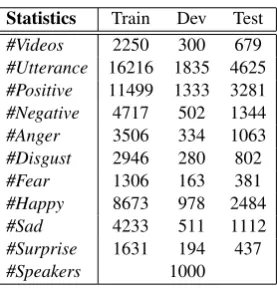
We evaluate our proposed approach on the bench-mark datasets of sentiment and emotion analysis, namely CMU Multi-modal Opinion Sentiment and Emotion Intensity (CMU-MOSEI) dataset (Zadeh et al., 2018c). CMU-MOSEI dataset consists of 3,229 videos spanning over 23,000 utterances from more than 1,000 online YouTube speakers. The training, validation & test set comprises of 16216, 1835 & 4625 utterances, respectively.
Each utterance has six emotion values associ-ated with it, representing the degree of emotion foranger, disgust,fear,happy, sadandsurprise. Emotion labels for an utterance are identified as all non-zero intensity values, i.e. if an utterance has three emotions with non-zero values, we take all three emotions as multi-labels. Further, an ut-terance that has no emotion label represents the absence of emotion. For experiments, we adopt 7-classes (6emotions+ 1no emotion) and pose it as multi-label classification problem, where we try to
Statistics Train Dev Test
#Videos 2250 300 679
#Utterance 16216 1835 4625
#Positive 11499 1333 3281
#Negative 4717 502 1344
#Anger 3506 334 1063
#Disgust 2946 280 802
#Fear 1306 163 381
#Happy 8673 978 2484
#Sad 4233 511 1112
#Surprise 1631 194 437
[image:5.595.348.487.394.539.2]#Speakers 1000
Table 2: Dataset statistics for CMU-MOSEI. Each ut-terance contains multi-modal information.
Single emotion 11050 Two emotions 5526 Three emotions 2084 Four emotions 553
Five emotions 84 Six emotions 8
No emotion 3372
Table 3: Statistics of multi-label emotions.
[image:5.595.327.510.584.630.2]Tasks F1-score Acc (Sentiment) & Weighted-Acc (Emotion)
T A V T+V T+A A+V T+A+V T A V T+V T+A A+V T+A+V
[image:6.595.71.525.61.130.2]Sent STL 75.1 67.9 66.3 77.0 76.5 69.6 77.6 78.2 74.8 75.8 79.4 79.7 76.6 79.8 MTL 77.5 72.1 69.1 78.7 78.6 75.8 78.8 79.7 75.7 76.5 80.4 80.2 77.4 80.5 Emo STL 75.9 72.3 73.6 77.5 76.8 76.0 77.7 58.0 56.7 53.7 60.1 59.6 58.0 60.8 MTL 76.9 74.6 75.4 78.5 77.6 77.0 78.6 60.2 56.2 57.5 62.5 60.5 59.3 62.8
Table 4: Single-task learning (STL) and Multi-task (MTL) learning frameworks for the proposed approach. T: Text, V: Visual, A:Acoustic. Weighted accuracy as a metric is chosen due to unbalanced samples across various emotions and it is also in line with the other existing works (Zadeh et al.,2018c).
5.2 Feature extraction
We use the CMU-Multi-modal Data SDK1 for downloading and feature extraction. The dataset was pre-tokenized and a feature vector was pro-vided for each word in an utterance. The tex-tual, visual and acoustic features were extracted byGloVe(Pennington et al.,2014),Facets2& Co-vaRep(Degottex et al.,2014), respectively. There-after, we compute the average of word-level fea-tures to obtain theutterance-levelfeatures.
5.3 Experiments
We evaluate our proposed approach on the datasets of CMU-MOSEI. We use the Python based Keras library for the implementation. We compute F1-scoreand accuracy values for sentiment classifi-cation andF1-scoreandweighted accuracy(Tong et al.,2017) for emotion classification. Weighted accuracy as a metric is chosen due to unbalanced samples across various emotions and it is also in line with the other existing works (Zadeh et al., 2018c). To obtain multi-labels for emotion clas-sification, we use 7 sigmoid neurons (corresponds to 6 emotions + 1 no-emotion) with binary cross-entropy loss function. Finally, we take all the emotions whose respective values are above a
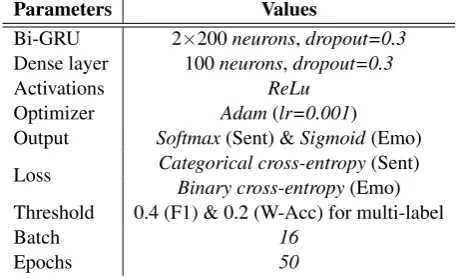
threshold. We optimize and cross-validate both the evaluation metrics (i.e. F1- score and weighted accuracy) and set the threshold as 0.4 &0.2 for F1-score and weighted accuracy, respectively. We show our model configurations in Table5.
As stated earlier, our proposed approach re-quires at least two modalities to compute modal attention. Hence, we experiment with bi-modal and tri-bi-modal input combinations for the proposed approach i.e. taking text-visual, text-acoustic, acoustic-visual and text-visual-acoustic
at a time. For completeness (i.e., uni-modal
in-1
https://github.com/A2Zadeh/ CMU-MultimodalDataSDK
2https://pair-code.github.io/facets/
Parameters Values
Bi-GRU 2×200neurons,dropout=0.3 Dense layer 100neurons,dropout=0.3
Activations ReLu
Optimizer Adam(lr=0.001) Output Softmax(Sent) &Sigmoid(Emo)
Loss Categorical cross-entropy(Sent) Binary cross-entropy(Emo) Threshold 0.4 (F1) & 0.2 (W-Acc) for multi-label
Batch 16
Epochs 50
Table 5: Model configurations
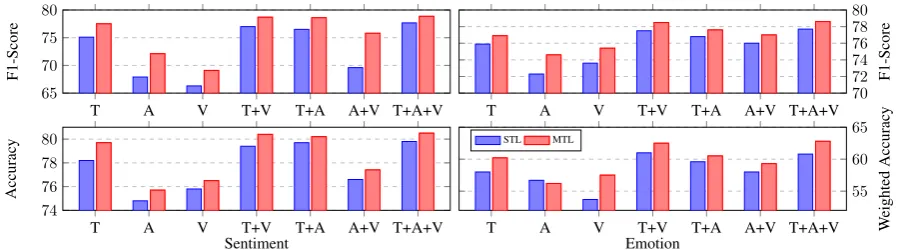
puts), we also experiment with a variant of the pro-posed approach where we apply self-attention on the utterances of each modality separately. The self-attention unit utilizes the contextual informa-tion of the utterances (i.e., it receivesu×dhidden representations), applies attention and forward it to the output layer for classification. We report the experimental results of both single-task (STL) and multi-task (MTL) learning framework in Ta-ble4. In the single-task framework, we build sep-arate systems for sentiment and emotion analysis, whereas in multi-task framework a joint-model is learned for both of these problems. For senti-ment classification, our single-task framework re-ports an F1-score of 77.67% and accuracy value of 79.8% for the tri-modal inputs. Similarly, we obtain 77.71% F1-score and 60.88% weighted ac-curacy for emotion classification.
[image:6.595.306.536.197.336.2]T A V T+V T+A A+V T+A+V
65 70 75 80
F1-Score
T A V T+V T+A A+V T+A+V
70 72 74 76 78 80
F1-Score
T A V T+V T+A A+V T+A+V
74 76 78 80
Sentiment
Accurac
y
T A V T+V T+A A+V T+A+V
55 60 65
Emotion
W
eighted
Accurac
y
[image:7.595.74.524.63.188.2]STL MTL
Figure 2: Single-task learning (STL) and Multi-task (MTL) learning frameworks for the proposed approach.
Sentiment Emotion
Utterances Actual MTL Actual MTL
1 line hello my name is sarah and i will be doing my video opinion on the movie shall we dance uhh starring jennifer
Pos Pos Anger Anger
2 richard gere and susan umm you i really didn’t enjoy this movie at all it kinda boring for
Neg Neg Anger, Disgust Anger, Disgust,
Happy, Sad
3 for umm it kinda felt as if there were parts in there they Pos Neg No class Anger, Disgust, Happy, Sad
4 they just put in there to kinda pass the time on basically the movie is about umm richard character and him being a
Pos Pos Happy Anger, Disgust,
Happy,Sad
5 umm looking for some some stutter extra sizzle to add into his life he meets up with a dance instructor who is played by jennifer lopez and basically she convinces him to sign up for some ballroom he gets into it he enjoys it a lot but still a secret from his family
Pos Pos Anger Anger Disgust,
Happy, Sad
6 family he is trying to cope with having this this stutter Neg Neg Anger, Disgust Anger, Disgust,
[image:7.595.77.524.220.389.2]Happy, Sad
Table 6: Example video for heatmap analysis of the contextual inter-modal (CIM) attention mechanism of the proposed MTMM-ES framework. Figure3depicts the heatmaps for the above video.
u1 u2 u3 u4 u5 u6 u1 u2 u3 u4 u5 u6
u1
u2
u3
u4
u5
u6
0.006 0.012 0.018 0.024 0.030
(a)Softmax attention weightsN1&N2 for TV.
u1 u2 u3 u4 u5 u6 u1 u2 u3 u4 u5 u6
u1
u2
u3
u4
u5
u6
0.15 0.30 0.45 0.60
(b)Softmax attention weightsN1&N2 for AV.
u1 u2 u3 u4 u5 u6 u1 u2 u3 u4 u5 u6
u1
u2
u3
u4
u5
u6
0.04 0.08 0.12 0.16 0.20
(c)Softmax attention weightsN1&N2 for TA.
Figure 3: (a), (b) & (c): Pair-wise softmax attention weightsN1 &N2 of visual-text, acoustic-visual & text-acousticfor multi-task learning framework. Solid line at the center represents boundary ofN1&N2. The heatmaps
represent attention weights of a particular utterance with respect to other utterances inN1&N2. Each cell (i, j)
of the heatmap signifies the weights of utterance ‘j’ for the classification of utterance ‘i’ of the pair-wise modality matrices, hence, assists in predicting the labels concisely by incorporating contextual inter-modal information.
in the multi-task framework. It is evident from Figure2 that multi-task learning framework suc-cessfully leverages the inter-dependence of both the tasks in improving the overall performance in comparison to single-task learning. The improve-ments of MTL over STL framework is also statis-tically significant withp-value<0.05(c.f. Table 7).
We also present attention heatmaps of the multi-task learning framework in Figure3. For illustra-tion, we take the video of the first utterance of Table 6. It has total six utterances. We depict three pair-wise attention matrices of2×(6×6)
dimension-one each fortext-visual,text-acoustics
[image:7.595.82.515.445.556.2]Emotion Sentiment Anger Disgust Fear Happy Sad Surprise Average†
System F1 W-Acc F1 W-Acc F1 W-Acc F1 W-Acc F1 W-Acc F1 W-Acc F1 W-Acc F1 Acc
Blanchard et al.(2018) - - - 63.2 60.0
Zadeh et al.(2018b)? - - 71.4 65.2 89.9 - - - 60.8 - 85.4 53.3 - - 76.0 76.0 Nojavanasghari et al.(2016)? 71.4 - - 67.0 - - - - - - - - - - - -Rajagopalan et al.(2016)? - 56.0 - - - - - - - - - - - - 76.4 76.4
EF-LSTM (Zadeh et al.,2018c)? - - - - - 56.7 - 57.8 - 59.2 - - - - -
-TFN (Zadeh et al.,2017)? - 60.5 - - - - 66.6 66.5 - 58.9 - 52.2 - - -
-Random Forest (Breiman,2001)? 72.0 - 73.2 - 89.9 - - - 61.8 - 85.4 - - - -
-SVM (Zadeh et al.,2016)? - - - - - 60.0 - - - - - - - - -
-Zadeh et al.(2018a)? - - - - - - 71.0 - - - - - - - - -Zadeh et al.(2018c) 72.8 62.6 76.6 69.1 89.9 62.0 66.3 66.3 66.9 60.4 85.5 53.7 76.3 62.3 77.0 76.9 Proposed (Single-task learning) 75.6 64.5 81.0 72.2 87.7 51.5 59.3 61.6 67.3 65.4 86.5 53.0 76.2 61.3 77.6 79.8
Proposed (Multi-task learning) 75.9 66.8 81.9 72.7 87.9 62.2 67.0 53.6 72.4 61.4 86.0 60.6 78.6 62.8 78.8 80.5
SignificanceT-testw.r.t.SOTA - - - 0.0240 0.0420 0.0012 0.0046
[image:8.595.79.522.61.199.2]SignificanceT-testw.r.t.STL - - - 0.0171 0.0312 0.0015 0.0278
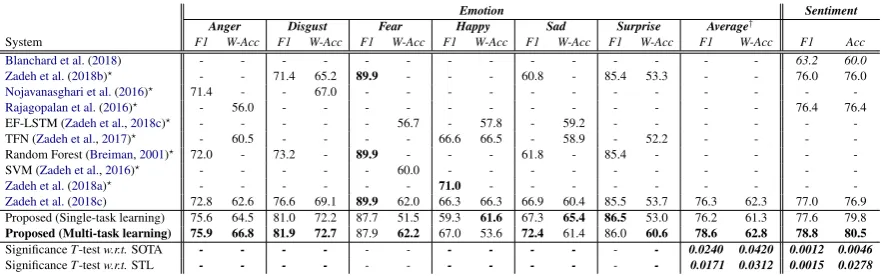
Table 7: Comparative results: Proposed multi-task framework attains better performance as compared to the state-of-the-art (SOTA) systems in both the tasks i.e. emotion recognition (average) and sentiment analysis.?Values are
taken fromZadeh et al.(2018c).†Six-class average. SignificanceT-test (<0.05). STL: Single-task learning.
side of Figure3a representstextmodality and right side represents thevisualmodality. The heatmaps represent the contributing features for the classi-fication of utterances. Each cell (i,j) of Figure 3 signifies the weights of utterance ‘j’ for the classi-fication of utterance ‘i’ of the pair-wise modality matrices. For example, for the classification of ut-terance ‘u4’ in Figure3a, model puts more focus on the textual features of ‘u2’ and ‘u6’ than others and more-or-less equal focus on the visual features of all the utterances.
5.4 Comparative Analysis
We compare our proposed approach against vari-ous existing systems (Nojavanasghari et al.,2016; Rajagopalan et al., 2016; Zadeh et al., 2017, 2018a,b,c;Blanchard et al., 2018) that made use of the same datasets. A comparative study is shown in Table 7. We report the results of the top three existing systems (as reported in Zadeh et al. 2018c) for each case. In emotion classifica-tion, the proposed multi-task learning framework reports the best F1-score of 78.6% as compared to the 76.3% and Weighted Accuracy of 62.8% as compared to the 62.3% of the state-of-the-art. Similarly, for sentiment classification, the state-of-the-art system reports 77.0% F1-score and 76.9% accuracy value in the multi-task framework. In comparison, we obtain the best F1-score and accu-racy value of 78.8% and 80.4%, respectively, i.e., an improvement of 1.8% and 3.5% over the state-of-the-art systems.
During analysis, we make an important obser-vation. Small improvements in performance do not reveal the exact improvement in the number of instances. Since there are more than 4.6K test samples, even the improvement by one point
re-flects that the system improves its predictions for 46 samples.
We also perform test-of-significance (T-test) and observe that the obtained results are statisti-cally significantw.r.t. the state-of-the-art and pro-posed single-task results withp-values<0.05.
5.5 STL v/s MTL framework
In this section, we present our analysis w.r.t.
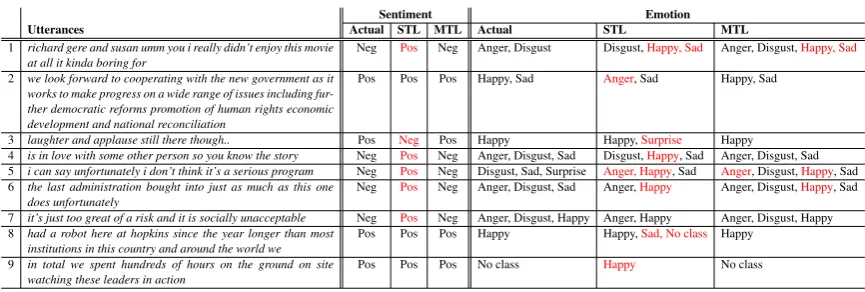
single-task and multi-task frameworks. Table 8 lists a few example cases where the proposed multi-task learning framework shows how it yields better performance for both sentiment and emo-tion, while the single-task framework finds it non-trivial for the classification. For example, first ut-terance has gold sentiment label as negative which was misclassified by STL framework. However, the MTL framework improves this by correctly predicting ‘positive’. Similarly, in emotion analy-sis STL predicts three emotions i.e.disgust,happy
andsad, out of which only one emotion (disgust) matches the gold emotions of anger anddisgust. In comparison, MTL predicts four emotions (i.e.
anger,disgust,happyandsad) for the same utter-ance. The precision (2/4) and recall (2/2) for MTL framework is better than the precision (1/3) and re-call (1/2) for the STL framework. These analyses suggest that the MTL framework, indeed, captures better evidences than the STL framework.
posi-Sentiment Emotion Utterances Actual STL MTL Actual STL MTL
1 richard gere and susan umm you i really didn’t enjoy this movie at all it kinda boring for
Neg Pos Neg Anger, Disgust Disgust,Happy, Sad Anger, Disgust,Happy, Sad
2 we look forward to cooperating with the new government as it works to make progress on a wide range of issues including fur-ther democratic reforms promotion of human rights economic development and national reconciliation
Pos Pos Pos Happy, Sad Anger, Sad Happy, Sad
3 laughter and applause still there though.. Pos Neg Pos Happy Happy,Surprise Happy 4 is in love with some other person so you know the story Neg Pos Neg Anger, Disgust, Sad Disgust,Happy, Sad Anger, Disgust, Sad 5 i can say unfortunately i don’t think it’s a serious program Neg Pos Neg Disgust, Sad, Surprise Anger, Happy, Sad Anger, Disgust,Happy, Sad 6 the last administration bought into just as much as this one
does unfortunately
Neg Pos Neg Anger, Disgust, Sad Anger,Happy Anger, Disgust,Happy, Sad
7 it’s just too great of a risk and it is socially unacceptable Neg Pos Neg Anger, Disgust, Happy Anger, Happy Anger, Disgust, Happy 8 had a robot here at hopkins since the year longer than most
institutions in this country and around the world we
Pos Pos Pos Happy Happy,Sad, No class Happy
9 in total we spent hundreds of hours on the ground on site watching these leaders in action
[image:9.595.82.515.59.205.2]Pos Pos Pos No class Happy No class
Table 8: Comparison with task learning and single-task learning frameworks. Few error cases where multi-task learning framework performs better than the single-multi-task framework. First utterance: Improved MTL (Pre: 0.5, Rec: 1.0) performance over STL (Pre: 0.3, Rec: 0.5). Second utterance: Sentiment (i.e. Pos) assists in emotion classification (i.e.Happy). Red color represents error in classification.
tivescenario and predicted labelangeris related to negative, knowledge of sentiment is a crucial piece of information. Our MTL framework identifies this relation and leverage the predicted sentiment for the classification of emotion i.e.positive senti-ment assists in predictinghappyemotion. This is an example of inter-dependence between the two related tasks and the MTL framework successfully exploits it for the performance improvement.
We also observe that the system puts com-paratively more focus on some classes in MTL framework than the STL framework. As an in-stance, MTL predicts ‘anger’ class for 1173 ut-terances, whereas STL predicts it for 951 utter-ances (1063 anger utterutter-ances in the gold dataset). Further, we observe contrasting behavior for the ‘sad’ class, where MTL predicts 1618 utterances as ‘sad’ compared to the 2126 utterances of STL. For ‘disgust’ and ‘happy’ classes, both STL and MTL frameworks predict the approximately equal number of utterances.
Further, we observe that MTL performs poorly for the ‘fear’ and ‘surprise’ classes, where it could not predict a significant number of utterances. A possible reason would be the under-representation of these instances in the given dataset.
6 Conclusion
In this paper, we have proposed a deep multi-task framework that aims to leverage the inter-dependence of two related tasks, i.e., multi-modal sentiment and emotion analysis. Our proposed ap-proach learns a joint-representation for both the tasks as an application of GRU based inter-modal attention framework. We have evaluated our
pro-posed approach on the recently released bench-mark dataset on multi-modal sentiment and emo-tion analysis (MOSEI). Experimental results sug-gest that sentiment and emotion assist each other when learned in a multitask framework. We have compared our proposed approach against the vari-ous existing systems and observed that multi-task framework attains higher performance for all the cases.
In the future, we would like to explore the other dimensions to our multi-task framework, e.g., Sentiment classification & intensity prediction, Emotion classification & intensity prediction and all the four tasks together.
Acknowledgement
Asif Ekbal acknowledges the Young Faculty Re-search Fellowship (YFRF), supported by Visves-varaya Ph.D. scheme for Electronics and IT, Min-istry of Electronics and Information Technol-ogy (MeitY), Government of India, being imple-mented by Digital India Corporation (formerly Media Lab Asia).
References
Nathaniel Blanchard, Daniel Moreira, Aparna Bharati, and Walter Scheirer. 2018.Getting the subtext with-out the text: Scalable multimodal sentiment classifi-cation from visual and acoustic modalities. In Pro-ceedings of Grand Challenge and Workshop on Hu-man Multimodal Language, pages 1–10, Melbourne, Australia.
Leo Breiman. 2001. Random forests. Machine Learn-ing, 45(1):5–32.
S. Scherer. 2014. Covarep - a collaborative voice analysis repository for speech technologies. In
2014 IEEE International Conference on Acoustics, Speech and Signal Processing, pages 960–964. Bhuwan Dhingra, Hanxiao Liu, Zhilin Yang,
William W Cohen, and Ruslan Salakhutdinov. 2016. Gated-attention readers for text comprehen-sion.arXiv preprint arXiv:1606.01549.
Paul Ekman. 1999. Basic Emotions. The handbook of cognition and emotion.
Deepanway Ghosal, Md Shad Akhtar, Dushyant Chauhan, Soujanya Poria, Asif Ekbal, and Pushpak Bhattacharyya. 2018. Contextual inter-modal atten-tion for multi-modal sentiment analysis. In Proceed-ings of the 2018 Conference on Empirical Methods in Natural Language Processing, pages 3454–3466, Brussels, Belgium.
D. Hazarika, S. Gorantla, S. Poria, and R. Zimmer-mann. 2018. Self-attentive feature-level fusion for multimodal emotion detection. In2018 IEEE Con-ference on Multimedia Information Processing and Retrieval, pages 196–201.
Kaiming He, Xiangyu Zhang, Shaoqing Ren, and Jian Sun. 2016. Deep residual learning for image recog-nition. In Proceedings of the IEEE conference on computer vision and pattern recognition, pages 770– 778.
Louis-Philippe Morency, Rada Mihalcea, and Payal Doshi. 2011. Towards multimodal sentiment anal-ysis: harvesting opinions from the web. In
Proceedings of the 13th International Conference on Multimodal Interfaces (ICMI-2011, pages169− −176, Alicante, Spain.
Behnaz Nojavanasghari, Deepak Gopinath, Jayanth Koushik, Tadas Baltruˇsaitis, and Louis-Philippe Morency. 2016. Deep multimodal fusion for per-suasiveness prediction. InProceedings of the 18th ACM International Conference on Multimodal Inter-action, pages 284–288, New York, NY, USA. Bo Pang, , and Lillian Lee. 2005. Seeing stars:
Ex-ploiting class relationships for sentiment categoriza-tion with respect to rating scales. InProceedings of ACL, pages 115–124.
Jeffrey Pennington, Richard Socher, and Christo-pher D. Manning. 2014. Glove: Global vectors for word representation. InEmpirical Methods in Nat-ural Language Processing (EMNLP), pages 1532– 1543.
Soujanya Poria, Erik Cambria, Rajiv Bajpai, and Amir Hussain. 2017a. A review of affective computing: From unimodal analysis to multimodal fusion. In-formation Fusion, 37:98–125.
Soujanya Poria, Erik Cambria, Devamanyu Hazarika, Navonil Majumder, Amir Zadeh, and Louis-Philippe Morency. 2017b. Context-dependent sentiment
analysis in user-generated videos. InProceedings of the 55th Annual Meeting of the Association for Com-putational Linguistics (Volume 1: Long Papers), volume 1, pages 873–883.
Soujanya Poria, Iti Chaturvedi, Erik Cambria, and Amir Hussain. 2016. Convolutional mkl based mul-timodal emotion recognition and sentiment analysis. In Data Mining (ICDM), 2016 IEEE 16th Interna-tional Conference on, pages 439–448. IEEE. Shyam Sundar Rajagopalan, Louis-Philippe Morency,
Tadas Baltrusaitis, and Roland Goecke. 2016. Ex-tending long short-term memory for multi-view structured learning. In European Conference on Computer Vision (ECCV-2016), pages 338–353. Hiranmayi Ranganathan, Shayok Chakraborty, and
Sethuraman Panchanathan. 2016. Multimodal emo-tion recogniemo-tion using deep learning architectures. In Applications of Computer Vision (WACV), 2016 IEEE Winter Conference on, pages 1–9. IEEE. Damien Teney, Peter Anderson, Xiaodong He, and
An-ton van den Hengel. 2017. Tips and tricks for visual question answering: Learnings from the 2017 chal-lenge.CoRR, abs/1708.02711.
Edmund Tong, Amir Zadeh, Cara Jones, and Louis-Philippe Morency. 2017. Combating Human Traf-ficking with Multimodal Deep Models. In Proceed-ings of the 55th Annual Meeting of the Association for Computational Linguistics, pages 1547–1556, Vancouver, Canada.
A Zadeh, PP Liang, S Poria, P Vij, E Cambria, and LP Morency. 2018a. Multi-attention recurrent net-work for human communication comprehension. In
Thirty-Second AAAI Conference on Artificial Intelli-gence, pages 5642 – 5649, New Orleans, LA, USA. A. Zadeh, R. Zellers, E. Pincus, and L. P. Morency. 2016. Multimodal Sentiment Intensity Analysis in Videos: Facial Gestures and Verbal Messages.IEEE Intelligent Systems, 31(6):82–88.
Amir Zadeh, Minghai Chen, Soujanya Poria, Erik Cambria, and Louis-Philippe Morency. 2017. Ten-sor fusion network for multimodal sentiment analy-sis. InProceedings of the 2017 Conference on Em-pirical Methods in Natural Language Processing, pages 1103–1114, Copenhagen, Denmark.
Amir Zadeh, Paul Pu Liang, Navonil Mazumder, Soujanya Poria, Erik Cambria, and Louis-Philippe Morency. 2018b. Memory fusion network for multi-view sequential learning. In Proceedings of the Thirty-Second AAAI Conference on Artificial Intel-ligence, New Orleans, Louisiana, USA.