4565
MCapsNet: Capsule Network for Text with Multi-Task Learning
Liqiang Xiao1,2, Honglun Zhang1,2, Wenqing Chen1,2, Yongkun Wang3, Yaohui Jin1,2
1 State Key Lab of Advanced Optical Communication System and Network,
Shanghai Jiao Tong University
2 MoE Key Lab of Artificial Intelligence, AI Institute, Shanghai Jiao Tong University 3Network and Information Center, Shanghai Jiao Tong University
{jinyh}@sjtu.edu.cn
Abstract
Multi-task learning has an ability to share the knowledge among related tasks and implic-itly increase the training data. However, it has long been frustrated by the interference among tasks. This paper investigates the per-formance of capsule network for text, and pro-poses a capsule-based multi-task learning ar-chitecture, which is unified, simple and ef-fective. With the advantages of capsules for feature clustering, proposed task routing algo-rithm can cluster the features for each task in the network, which helps reduce the interfer-ence among tasks. Experiments on six text classification datasets demonstrate the effec-tiveness of our models and their characteristics for feature clustering.
1 Introduction
Multi-task learning (MTL) has achieved a great success in the field of natural language processing, which can share the knowledge among multiple tasks, implicitly increasing the volume of training data. The combination of multi-task learning and deep neural networks (DNNs) generates a further synergy via the regularization effect on the DNNs (Collobert and Weston,2008), which helps allevi-ate the overfitting and learn a more universal pre-sentation.
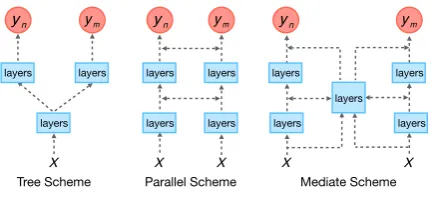
Inspired by this, more DNN-based multi-task learning models are proposed to improve the per-formance. As depicted in Figure 1, they can be categorized into three groups by structure: tree scheme (Collobert and Weston, 2008; Liu et al.,
2015), parallel scheme (Liu et al.,2016) and me-diate scheme (Zhang et al., 2017). Tree scheme reuses some shallow layers of network and sepa-rates the higher layers for different tasks, which is the most common architecture for MTL but can only share the low-level knowledge. To share deeper level knowledge among the tasks, more layers are linked in parallel and mediate schemes.
Tree Scheme Parallel Scheme Mediate Scheme
yn ym
X
yn ym
X
X X X
yn ym
layers layers
layers
layers layers layers layers
[image:1.595.309.526.203.304.2]layers layers layers layers layers
Figure 1: Three schemes of multi-task learning
But this would severely suffer from the interfer-ence among tasks. Useless features following the helpful ones are fully shared among tasks, which may contaminate the feature spaces of tasks by useless ones. Besides, models under these two schemes usually employ multiple subnets in the structures, which would contain more parameters and are hard to train.
Apparently, there is a contradiction between knowledge sharing and interference. Sharing too much between tasks would inevitably bring about the interference that feature space for each task may be contaminated by others. Shared useless features may mislead the prediction of network. This dilemma is caused by the lack of manage-ment for sharing process, in which the network can not discriminate the features and collect the appropriate features for each task.
Capsule network (Hinton et al., 2011; Mousa et al.,2017;Hinton et al.,2018) embeds the fea-tures into capsules and connects the neighbor lay-ers via “routing-by-agreement”. The dynamic routing algorithm has an ability to decide the routes of capsules, namely, to cluster the features for each category. So, intuitively this property of capsule network can be employed in MTL to dis-criminate the features for tasks.
cap-sule network for NLP. Then we mainly propose a capsule-based architecture for multi-task learn-ing (McapsNet), which is unified, simple, effec-tive and can cluster the feature for tasks. We designed a Task Routing algorithm to route the feature flows to tasks and vote for the classes, which can reduce the interference. In extensive ex-periences, our approach achieves competitive re-sults in single-task scenario and shows obvious improvement in multi-task scenario, which proves our approach effective and its ability to reduce the interference among multiple tasks. Also, our visu-alization experiments intuitively show the feature clustering mechanism and how it helps make right predictions.
The contribution of this paper are three-folds:
• This paper investigates the performance of capsule network on text and designs two ef-fective capsule-based models for text classifi-cation, which give clear improvement to sev-eral benchmarks.
• We novelly combine the capsule and multi-task learning, which can help reduce the in-terference among tasks.
• Proposed task routing algorithm can route the capsules to multiple tasks, by which the fea-tures is clustered into groups for tasks.
2 Convolutional Neural Network and Multi-Task Learning
Capsule network is based on the convolutional neural network (CNN) and uses a lot of convo-lution operations. The main differences between them are that capsule network uses vectors to rep-resent the features and discards the pooling oper-ation. CNN is good at feature extraction and can capture short and long range relations through the feature graph over text sequence (Kalchbrenner et al.,2014;Kim, 2014). In this section, we pro-vide some formulations for CNN and some back-ground knowledge for multi-task learning.
2.1 Single-Task CNN for Text Classification
Given a text sequencex1:l=x1x2· · ·xlof length
l, the target of CNN is to predict the categoryyˆof
x1:lfrom a set{y1, y2,· · · , yC}, or a one-hot form
of yˆ, where C is the class number. Using f(·)
denote the network, the prediction process can be formalized asf(x1, x2,· · · , xl) = ˆy.
For details, convolutional neural network f(·)
first uses a lookup table to embed the word se-quence x1:l into vectors x. Then CNN produces
the representation of the input sequence by stack-ing the layers of convolution, poolstack-ing and fully-connected in order.
F=K∗x (1)
ˆ
F=p(F) (2)
ˆ
y=wFˆ +b, (3)
whereKis the kernel of convolution operation∗;
p(·)denotes the pooling operation;FandFˆ repre-sent the feature maps;wandbdenote the weight and bias respectively in fully connected layer.
The parameters of the network are optimized via all kinds of SGD (stochastic gradient decent) algorithms to minimize the loss between predic-tionyˆ and ground truth labely˜
l(ˆy,y˜) =− N
∑
i=1 C
∑
j=1
˜
yjilog(ˆyij), (4)
where i, j enumerate the training samples and classes respectively.
2.2 Multi-Task Learning
Multi-task learning model is usually the vari-ant or combination of single-task ones (CNNs, RNNs or DNNs) like the architectures illustrated in Figure 1. Given K text classification tasks {T1, T2,· · · , TK}, a multi-task learning model
f(·)shall have the ability to make prediction for samplesx(ik)from each taskTk.
ˆ
y(ik)=f(x(ik)) (5) And the overall loss for all the tasks is usually a linear combination of the costs for each.
L=−
K
∑
k=1 λk
Nk
∑
i=1 Ck
∑
j=1
˜
y(i,jk)log ˆy(i,jk) (6)
where λk,Nk and Ck denote the weight, number
of training samples and class number of taskTk.
3 Capsule Networks for Text
Capsule network (CapsNet) is first proposed by
comprised of convolutional layer, primary capsule layer and class capsule layer. In the rest of this sec-tion, we will first give the formulation of single-task capsule networks (1 and CapsNet-2) for text classification, and then transfer it into a multi-task version (McapsNet).
3.1 Primary Capsule Layer
Given an embedded sample of x ∈ Rl×d with length ofland word vectors ofd-dimension, cap-sule network first employs a plain convolution layer to extract the local features from N-grams. Each kernelKiwith a biasbemits a feature maps
Fiby convolution.
Fi =x∗Ki+b (7)
By assemblingIfeature maps together, we have a
I-channel layer
F= [F1,F2,· · · ,FI] (8)
The generated feature maps are then fed into the primary capsule layer, piecing the instantiated parts together via another convolution. Primary capsules use vectors instead of scales to preserve the instantiated parameters for each feature, which can not only represent the intensity of activation but also record some details of the instantiated parts in input. In this way, capsule can be regarded as a short representation of instantiated parts that are detected by kernel.
Sliding over the feature mapF, each kernelKj
would output a series of capsulespj ∈ Rd ofd
-dimension. These capsules comprise a channelPj
of primary capsule layer.
Pj =g(Kj∗F+b) (9)
whereg is the nonlinear squash function andbis the capsule bias term. All theJ channels can be arranged as
P= [P1,P2,· · ·,PJ] (10)
3.2 Connection Between Capsule Layers
Capsule network generates the capsules in next layer using “routing-by-agreement”. This pro-cess takes the place of pooling operation that usu-ally discards the location information, which helps augment the robust of the network and also helps cluster features for prediction.
Between two neighbor layers l and l + 1, a “prediction vectors” uˆj|i is first computed from
the capsuleui in lower layer l, by multiplying a
weight matrixWij
ˆ
uj|i =Wijui (11)
Then, in the higher layerl+1a capsulesjis
gener-ated by the linear combination of all the prediction vectors with weightscij
sj =
∑
i
cijuj|i (12)
wherecij are coupling coefficients decided by the
iterativedynamic routingprocess.
Coupling coefficients are calculated by a “rout-ing softmax” function on original logitsbij, which
are the log prior probability that capsuleishould be coupled to capsulej.
cij =
exp(bij)
∑
jexp(bij)
(13)
This process of “routing softmax” guarantee the sum of all the coefficients for capsulejis1.
The length of capsule represents the probability that the input sample has the object capsule de-scribes, that is the activation of capsule. So the length of capsule is limited in range[0,1] with a non-linear squashing function.
vj = ∥
sj∥2 1 +∥sj∥
sj
∥sj∥2
(14)
By that, the short vectors are pushed to shrink to zero length, and long ones are pushed to one.
3.3 Dynamic Routing
Suppose capsule layer l has been generated. We have to decide the intensity of the connections be-tween capsuleiandjfroml-th layer to(l+ 1)-th layer, that is the coupling coefficientcij. The
ini-tial digit of coupling coefficientbij is updated with
routing by agreementaij, which is calculated by a
scale product between capsules in two layers.
aij = ˆuj|i·vj (15)
Value of agreement aij is added to the digit to
calculated the capsules in the next layer.
bij ←bij+aij (16)
……
Conv1 PrimaryCaps
ClassCaps
Length
Dynamic
Routing
Word Vector
256 8×32 16
||L2||
Concat
3
4
5 100{
{
300Conv2
……
Task 1
Task 2
Task K
……
ClassCaps
Task
Routing
16 Task Routing
{
{
{
……
Capsule
Scale
……
Length ||L2|| kernel
size
CapsNet-1
[image:4.595.88.511.66.334.2]CapsNet-2 MCapsNet
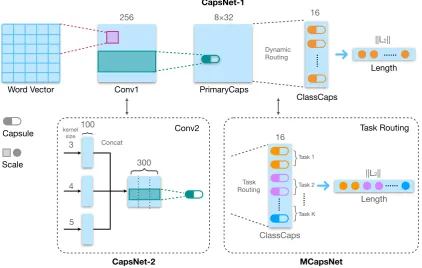
Figure 2: Architectures of capsule networks for text
3.4 Class Capsule Layer and Loss
Class capsule layer, as the top-level layer, is com-prised ofCclass capsules, in which each one cor-responds to a category. The length of instantiated parameters in each capsule represents the proba-bility that the input sample belongs to this cate-gory, and the direction of each set of instantiated parameters preserves the characteristics of the fea-tures, which could be regarded as an encoded vec-tor for the input sample.
Margin Loss To increase the difference between the lengths of classes, CapsNet utilizes a separated margin loss:
Lj =Gjmax(0, m+− ∥vj∥)2+
λ(1−Gj) max(0, m−− ∥vj∥)2
(17)
wherevj is the capsule for class j;m+ andm−
is the top and bottom margins respectively, which help push the length to shrink beyond two mar-gins; Gj = 1if and only if class j is the ground
truth:
Gj =
{
1 y˜j = 1
0 y˜j = 0 (18)
λ is the weight for the absent classes, which reduces the weight of absent classes, avoiding
shrinking the lengths of all the capsules too much at prophase training. In this paper,λis set to0.5.
Orphan Category A drawback of CapsNet is that it tends to account for everything in the input sampling, including some “background” informa-tion such as stop word and punctuainforma-tions that would interfere the prediction. So an orphan category is added in class capsules in the output layer, which belongs to none of the categories of the task. The orphan category would help collect the less con-tributive capsules that contain too much “back-ground” information, which reduces the interfer-ence for normal categories.
3.5 Substitutional Modules for Multi-Task
Task Routing
Dynamic routing algorithm is first proposed by
Sabour et al.(2017), which displaces the pooling operation used in conventional convolution neural network. It maintains the position information for features, which is beneficial to both image and text representation. More importantly, this routing-by-agreement method has an ability to cluster the fea-tures into each class.
Algorithm 1Task Routing Algorithm
1: functionROUTING(uˆ(jk|i),a(ijk),r,l)
2: fori= 0→rdo
3: for all capsuleiin layerland capsule
4: jin taskk:
5: c(ik)=sof tmax(b(ik))
6: for all capsulejin layerl+ 1:
7: v(jk) =g(∑icj(k|i)uˆ(jk|i))
8: for all capsuleiin layerland capsule
9: jin taskk:
10: b(ijk)=bij(k)+a(ijk),a(ijk)= ˆuj(k|i)·v(jk)
11: end for
12: returnv(jk)
13: end function
MTL models (Liu et al.,2017;Ruder et al.,2017;
Fang et al., 2017) want to address: “What fea-ture should be shared and what should not among tasks?” By that, network can decide the contri-bution of the features for each tasks and set the appropriate coupling coefficients between features and tasks.
More concretely, we introduce a coupling coef-ficientc(ijk)between capsuleiinl-th layer and cap-sulej in class capsule(l+ 1)-th layer for taskk, which is the result of a softmax function onb(ijk).
c(ijk)=sof tmax(b(ijk)) (19)
Then, instantiated parameterv(jk) of capsule j in taskkis calculated by
vj(k)=∑ i
c(ijk)·uˆ(jk|i) (20)
whereuˆ(jk|i) =Wk,j,iui
Coupling coefficient c(ijk) is restricted in range
[0,1], which represents the probability that cap-sule i belongs to class capsule j in task k. And it is update by the algorithm is described in Algo-rithm3.5.
Multi-Task Loss
The loss for each task is the sum of margin losses for all the classes∑Cj=1L(jk). By linearly combin-ing the loss for every task, we get multi-task loss
L=
K
∑
k=1 β(k)
C
∑
j=1
L(jk). (21)
where β(k) is the weight for each loss and ∑K
k=1β(k) = 1. In this paper, all theβ(k)are set
to be1/K to make a balance amongKtasks.
Multi-Task Training
In order to juggle several tasks in a unified net-work, following (Collobert and Weston, 2008), each task is trained alternatively in a stochastic manner. The steps can be described as follows: 1. Pick up a task krandomly; 2. Select an arbi-trary samplesfrom the taskk; 3. Feed the sample
sinto the McapsNet and update the parameters; 4. Go back to 1.
3.6 Architectures of CapsNets for Text
As illustrated in Figure 2, we propose a capsule-based multi-task learning architecture Mcap-sNet, which is base on the single-task structures CapsNet-1 and CapsNet-2. Architectures for them are detailed as following.
CapsNet-1 As depicted in Figure2, CapsNet-1 is a fundamental framework with three layers. The first layer is a plain convolution operation with256
kernels with window size of3and stride of1. For activation function, we use ReLU to augment non-linearity. This layer helps extract local features from the input sequences, which is the base to con-struct primary capsules.
Primary capsule layer employs32kernels with window size of3and stride of1. The emitted pri-mary capsules are8-dimensional, which have big-ger respective field, helping reassemble the piece features into wholes.
Last one is the class capsule layer, which is comprised of 16-dimensional capsules for the classes. They are connected to PrimaryCaps with routing-by-agreement and the coupling coef-ficients are updated by dynamic routing algorithm.
CapsNet-2 On this basis of CapsNet-1, CapsNet-2 upgrades the convolutional layer and uses multiple kernel sizes, which enriches the features. And concatenating1 them up allows primary capsule see the features with different kernel sizes in the same time.
MCapsNet McapsNet is a unified multi-task structure based on CapsNet-2. It replaces the dy-namic routing with task routing (Algorithm3.5), which enables the network to route the features to
1We use padding to ensure the sizes of feature maps are
Dataset Train Dev Test Classes Type
MR 9500 - 1100 2 review
SST-1 8544 1101 2210 5 sentiment
SST-2 6920 872 1821 2 sentiment
Subj 9000 - 1000 2 subjectivity
TREC 5900 - 500 6 question
[image:6.595.307.525.62.171.2]AG’s 120k - 7600 4 news
Table 1: Statistics for six datasets
each tasks. And the whole network is optimized in a stochastic way with multi-task training (Section
3.5).
Implement Details For word embedding, we use the word vectors inWord2Vec(Mikolov et al.,
2013), which is 300-dimensional and has 3M vo-cabularies. And all the routing logits b(ijk) is ini-tialized to zero, so that all the capsules in adjacent layers (uˆj|i,vj) are connected with equal
possi-bility cij. The coupling coefficients are updated
by routing with3iterations, which performs best for our approach. For training, we use Adam opti-mizer (Kingma and Ba,2014) with exponentially decaying learning rate. Moreover, we use mini-batch with size of8for all the datasets.
4 Experiment
We test our capsule-based models on six datasets in both single-task and multi-task scenarios to demonstrate the effectiveness of our approaches. We also in this section conduct some investiga-tions like ablation study and visualization to give a comprehensive understanding to the characteris-tics of our models.
4.1 Datasets
For both single-task and multi-task scenarios, we conduct extensive experiments on six benchmarks: movie reviews (MR) (Bo and Lee,2005), Stanford Sentiment Treebank (SST-1 and SST-2) (Socher et al., 2013), subjectivity classification (Subj) (Pang et al., 2004), question dataset (TREC) (Li and Roth,2002), AG’s news corpus (Mousa et al.,
2017). These datasets cover a wide range of text classification tasks, which can fully test a model and the details are listed in Table1.
4.2 Competitors
To demonstrate the effectiveness of our capsule network, we compare the single-task architec-tures with several state-of-the-art models, involv-ing LSTM/BiLSTM (Cho et al., 2014), LSTM
Dataset MR SST-1 SST-2 Subj TREC AG’s
LSTM 75.9 45.9 80.6 89.3 86.8 86.1
BiLSTM 79.3 46.2 83.2 90.5 89.6 88.2
LR-LSTM 81.5 48.2 87.5 89.9 -
-VD-CNN - - - 91.3
DCNN - 48.5 86.8 - 93.0
-CNN-MC 81.1 47.4 88.1 93.2 92.2
-CapsNet-1 81.5 48.1 86.4 93.3 91.8 91.1
CapsNet-2 82.4 48.7 87.8 93.6 92.9 92.3
[image:6.595.73.293.62.145.2]- Orphan 81.9 48.3 87.2 93.4 92.6 91.7
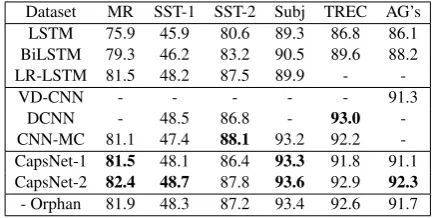
Table 2: Single-task results. Row “- Orphan category” denotes a variant of CapsNet-2 without orphan cate-gory
regularized by linguistic knowledge (LR-LSTM) (Qian et al.,2016), very deep network (VD-CNN) (Conneau et al., 2016), dynamic CNN (DCNN) (Kalchbrenner et al., 2014), CNN with multiple channels (CNN-MC) (Kim,2014). Also, we com-pare the multi-task architecture (Figure 2) with several strong baselines of multi-task learning, in-cluding a general architecture for multi-task learn-ing (MT-GRNN) (Zhang et al., 2017), recurrent neural network based multi-task learning (MT-RNN) (Liu et al.,2016), convolutional neural net-work with multi-task learning (MT-DNN) ( Col-lobert and Weston, 2008), deep neural network with multi-task learning (MT-CNN) (Liu et al.,
2015).
4.3 Single-Task Learning Results
We first test our approach on six datasets for text classification under the scheme of single-task. As Table2shows, our single-task network enhanced by capsules is already a strong model. CapsNet-1 that has one kernel size obtains the best accu-racy on2 out of6 datasets, and gets competitive results on the others. And CapsNet-2 with multi-ple kernel sizes further improves the performance and get best accuracy on4 datasets. This proves our capsule networks are effective for text. Partic-ularly, our capsule network outperforms conven-tional CNNs like DCNN, CNN-MC and VD-CNN with a large margin (by average 1.1%, 0.7% and 1.0% respectively), which shows the advantages of capsule network over conventional CNNs for clustering features and leveraging the position in-formation.
Routing Iteration The coupling coefficientscij
co-4571 mr_iter3_loss
step 1 iteration 2 iteration 3 iteration 4 iteration 5 iteration 7 iteration
0 0.31990772 0.32777038 0.35708323 0.30876166 0.33376288 0.43252164
100 0.2165044 0.22952877 0.19316821 0.22000548 0.21656269 0.22370228
200 0.21138513 0.22009197 0.23139681 0.2095856 0.22682545 0.21267971
300 0.22478297 0.2110215 0.24012111 0.21540533 0.21765772 0.21499902
400 0.21555959 0.22160663 0.21874493 0.2191698 0.23053917 0.21699865
500 0.20600384 0.21363162 0.18633538 0.21734108 0.21815333 0.21746612
600 0.2130103 0.20203112 0.17911553 0.21643545 0.21735527 0.21233499
700 0.19938451 0.23581365 0.17411417 0.21574022 0.21573226 0.21654496
800 0.19907556 0.227563 0.14065415 0.21677263 0.21779424 0.21902196
900 0.19709052 0.1909296 0.22373466 0.21057303 0.21403673 0.22480017
1000 0.18997657 0.19407482 0.24778445 0.21447049 0.2167942 0.21594681
1100 0.20069836 0.22341812 0.17452972 0.21565828 0.21165203 0.21713184
1200 0.1358376 0.19161437 0.12416928 0.22827208 0.21767393 0.1865164
1300 0.24192365 0.2502587 0.14073405 0.21395075 0.1956843 0.2076964
1400 0.24594069 0.17846859 0.15433379 0.21534327 0.19485447 0.19316548
1500 0.14343393 0.23199289 0.058949206 0.21565448 0.20615155 0.2027618
1600 0.13204841 0.07546147 0.13606499 0.21872896 0.1940549 0.18980762
1700 0.078342795 0.1006265 0.1095981 0.21600798 0.24048766 0.21178418
1800 0.19616298 0.084692195 0.13713281 0.21660198 0.20626166 0.2086841
1900 0.18376194 0.1457739 0.108214475 0.21599032 0.17014022 0.18203387
2000 0.2505575 0.15862198 0.13291651 0.22306885 0.20859854 0.16577458
2100 0.20313756 0.150289 0.16300716 0.21577688 0.21566515 0.21336424
2200 0.113498576 0.17007406 0.12576085 0.21669921 0.19889027 0.21370491
2300 0.08823628 0.18244454 0.09739958 0.21900685 0.19862902 0.13970172
2400 0.18449302 0.13019164 0.059194855 0.2158218 0.21441466 0.24924363
2500 0.14137962 0.027922168 0.06349837 0.21553266 0.18297584 0.15660347
2600 0.06318494 0.0083872555 0.13506271 0.22020619 0.049219918 0.06674059
2700 0.12604533 0.057891004 0.0863096 0.21330038 0.09685729 0.075393796
2800 0.06678611 0.056647964 0.11831023 0.211519 0.034514483 0.11877781
2900 0.013979337 0.055679005 0.043369725 0.21656843 0.11880093 0.139684
3000 0.09075422 0.01834401 0.069736615 0.20968968 0.06694293 0.11415998
3100 0.071527496 0.071867496 0.04040062 0.21676293 0.062198877 0.13664688
3200 0.053069513 0.011909003 0.074893095 0.21546358 0.2097177 0.09671463
3300 0.13160191 0.05359852 0.105486326 0.21507561 0.0346353 0.103552915
3400 0.05588995 0.041564412 0.066810705 0.21444169 0.11614575 0.13282628
3500 0.049774844 0.023115948 0.07867427 0.21574582 0.24141549 0.015245671
3600 0.00533909 0.07540489 0.070457004 0.21627496 0.111639 0.09389045
3700 0.06328302 0.0769447 0.03755875 0.21654026 0.13476305 0.08049823
3800 0.037597798 0.015297024 0.024833435 0.21532282 0.019858109 0.07756405
3900 0.017376851 0.03153728 0.028519789 0.21998401 0.19239725 0.0706502
4000 0.015832186 0.06606675 0.019566512 0.22106846 0.081912905 0.07202703
4100 0.024164455 0.015849056 0.025040613 0.21752763 0.10874183 0.021766221
4200 0.05139856 0.013023706 0.011992501 0.20341182 0.04201607 0.1068824
4300 0.03430857 0.059574388 0.019949485 0.21218589 0.10918676 0.047409087
4400 0.06850299 0.05789706 0.03192132 0.1934472 0.060641877 0.017321965
4500 0.028439771 0.04577714 0.06652445 0.18472269 0.031587753 0.02464495
4600 0.00997417 0.005764379 0.01647066 0.17637597 0.028014591 0.01935349
4700 0.04940702 0.032073725 0.07881074 0.1750345 0.13018186 0.023507616
4800 0.020413583 0.07540906 0.029650116 0.2195204 0.038481377 0.045384612
4900 0.019826425 0.031753153 0.021980677 0.1424555 0.03871046 0.019794926
5000 0.028047139 0.009816681 0.01173399 0.14830378 0.034620147 0.060023524
5100 0.03570168 0.022174701 0.013476413 0.18717153 0.010447311 0.014840336
5200 0.050749723 0.005398215 0.033909425 0.2046503 0.011018614 0.024433482
5300 0.099622525 0.004649097 0.047538925 0.2092239 0.03152306 0.0054741725
5400 0.0053426665 0.008371854 0.006597732 0.15079452 0.006303721 0.0047035264
5500 0.05191873 0.016815454 0.016768238 0.07482985 0.0057420097 0.040190328
5600 0.049730867 0.02349401 0.008496291 0.13487497 0.033842973 0.006400237
5700 0.031844895 0.03890676 0.042231962 0.16211028 0.035531938 0.017351853
5800 0.011545923 0.012152319 0.007615051 0.09252592 0.09976231 0.014460339
5900 0.018437417 0.021393463 0.03422167 0.1987526 0.013888625 0.011644581
6000 0.018853988 0.005956734 0.07615088 0.091175675 0.005306372 0.0042689797
6100 0.018992342 0.010288426 0.053335432 0.16724806 0.0107863145 0.010407194
6200 0.0056506954 0.00776174 0.020618532 0.08833132 0.034110814 0.012261426
6300 0.011831854 0.009550323 0.009947613 0.09596658 0.01110738 0.020155292
6400 0.006566655 0.013650014 0.012848858 0.11858772 0.021222282 0.014613601
6500 0.024205782 0.012546196 0.0048239767 0.16028889 0.00926006 0.0149123315
6600 0.014806292 0.0058124983 0.041874792 0.039060276 0.021106286 0.011592761
6700 0.012256767 0.00361195 0.008751678 0.2021615 0.026892414 0.008640145
6800 0.004717383 0.017772006 0.007069681 0.09619468 0.0032965664 0.004729362
6900 0.014133487 0.031820357 0.01449428 0.037848447 0.020252377 0.01289978
7000 0.019541442 0.06382499 0.023019891 0.050981153 0.017323725 0.0105407955
7100 0.021704191 0.01138805 0.023877008 0.051143013 0.03438755 0.054347344
7200 0.012751048 0.012124202 0.0038398597 0.043297127 0.018402876 0.029276593
7300 0.006295314 0.021420598 0.029609926 0.041524984 0.02546952 0.0075945454
7400 0.0075894385 0.006048003 0.0075462335 0.067313015 0.0053267237 0.0069935857
7500 0.006741333 0.0040838285 0.0066743465 0.059338994 0.03350287 0.006115186
7600 0.014603565 0.029511223 0.015551431 0.0480805 0.0073549934 0.0062353685
7700 0.015592159 0.016174346 0.014908929 0.03194722 0.006968726 0.009626625
7800 0.013729516 0.01248635 0.011632278 0.045669746 0.019316316 0.004811878
7900 0.017690767 0.006325948 0.020566542 0.06595372 0.01010148 0.007357938
8000 0.011015004 0.010788693 0.00907688 0.009306814 0.01526524 0.008390946
8100 0.03067701 0.006466888 0.036440548 0.091463834 0.0040217703 0.0048725065
8200 0.0068208063 0.021921193 0.030572822 0.031231066 0.013773766 0.025552973
8300 0.07634035 0.013739873 0.008865972 0.043190647 0.033992216 0.005076555
8400 0.02858127 0.004716243 0.02021956 0.02758816 0.013960054 0.0045451336
8500 0.008293323 0.004557795 0.007140737 0.0143441325 0.019154403 0.018727811
8600 0.06278364 0.016065609 0.005512653 0.010879653 0.006276448 0.008771067
8700 0.0069642887 0.0069935825 0.018281303 0.0067787454 0.008038342 0.0049465247
8800 0.015416967 0.025033943 0.011917496 0.038743842 0.0135429185 0.0123538375
8900 0.011273504 0.011572633 0.014581191 0.015278485 0.0037106564 0.0046575256
9000 0.036496855 0.0129312975 0.017274378 0.01666871 0.0052732183 0.0149699785
9100 0.0076952637 0.0111958925 0.012719973 0.0069943983 0.011427318 0.004719188
9200 0.011958325 0.0049098213 0.008090422 0.0062036156 0.030276377 0.053471938
9300 0.007843321 0.026734378 0.012808654 0.02021877 0.0037612547 0.009854263
9400 0.014780243 0.007878659 0.0062521882 0.014980534 0.0062496727 0.017763212
Training Loss 0 0.1 0.2 0.3 0.4 Training Step
0 1200 2400 3600 4800 6000 7200 8400 9600
[image:7.595.73.291.58.228.2]3 iteration 5 iteration 1 iteration
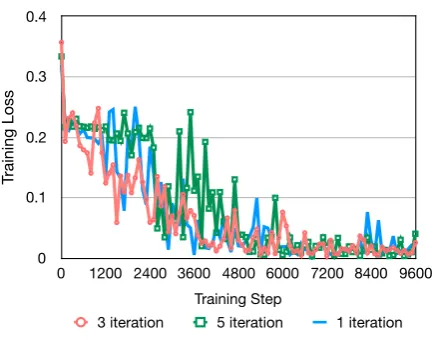
Figure 3: Influence of routing iteration
efficients, we test the CapsNet-2 with a series of iterations (1, 3 and 5) on MR dataset. As shown in Figure3, network with 3iterations convergences fast and performs best, which stays in line with the conclusion in (Sabour et al.,2017). So we utilize
3iterations in all our experiments.
Ablation Study on Orphan Category Orphan category in class capsule layer helps collect the noise capsules that contain the ‘background’ infor-mation like stop words, punctuations or any unre-lated words. We conduct the ablation experiment on orphan category, and result (Table2) shows that network with orphan category perform better than the without one by 0.4%. This demonstrates the effectiveness of orphan category.
4.4 Multi-Task Learning Results
Up to now, we have obtained an optimized single-task architecture. In this section, we equip CapsNet-2 with the task routing and multi-task training procedure, namely the model MCapsNet, so that this capsule based architecture can learn several datasets in a unified network. Exten-sive experiments are conducted in this section to demonstrate the effectiveness of our multi-task learning architecture, as well as its ability for fea-ture clustering.
Multi-Task Performance
We simultaneously train our model McapsNet on six tasks in Table 1 and compare it with single-task scenario (Table3). We can see that our multi-task architecture clearly improves the performance over the single task models, which demonstrates the benefits of our multi-task architecture.
Dataset MR SST-1 SST-2 Subj TREC AG’s Avg.△
BiLSTM 79.3 46.2 83.2 90.5 89.6 88.2 +0
MT-GRNN - 49.2 87.7 89.3 93.8 - +2.6
MT-RNN - 49.6 87.9 94.1 91.8 - +3.5
MT-DNN 82.1 48.1 87.3 93.9 92.2 91.8 +2.9
MT-CNN 81.6 49.0 86.9 93.6 91.8 91.9 +3.0
CapsNet-1 81.5 48.1 86.4 93.3 91.8 91.1 +2.5
CapsNet-2 82.4 48.7 87.8 93.6 92.9 92.3 +3.3
MCapsNet 83.5 49.7 88.6 94.5 94.2 93.8 +4.6
Table 3: Multi-task results of MCapsNet. In column Avg.△, we use BiLSTM as baseline and calculate the average improvements over it.
As Table3shows, MCapsNet also outperforms the state-of-the-art multi-task learning models by at least 1.1%. This shows the advantages of our task routing algorithm, which can cluster the fea-tures for each task, instead of freely sharing the features among tasks.
4.5 Routing Visualization
To show the mechanism how capsule benefits the multi-task learning, we visualize the coupling co-efficient c(ijk) ∈ [0,1]between primary and class capsules. We use kernel with size 1 for primary capsule layer so that every capsule represents only one 3-gram phrase. The strength of these connec-tions indicates the importance of these 3-grams to their corresponding task and class.
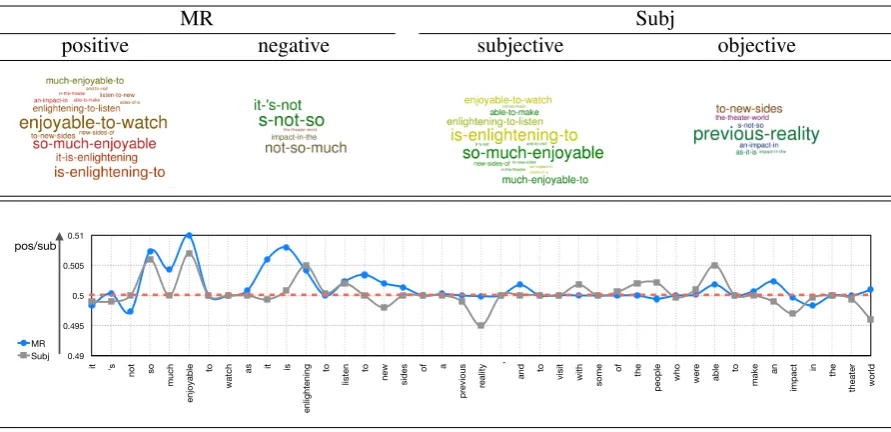
We feed a random sample from the dataset MR into MCapsNet. In the first row of Table 4, we show the most important 3-gram phrases for two tasks MR and Subj (two classes for each) with word cloud. The sizes of the grams represent the weights of coupling coefficients. We can see that task routing algorithm helps lead the grams into the most related tasks, which allows each task only consider the helpful features for them. In another word, task routing builds a feature space for each task and avoids they contaminate each other. This demonstrates that MCapsNet has the ability of fea-ture clustering, which can benefit MTL by reduc-ing the interference.
[image:7.595.309.525.61.147.2]MR Subj
positive negative subjective objective
0.49
0.495
0.5
0.505
0.51
it
's
not
so
much
enjoyable
to
watch
as
it
is
enlightening
to
listen
to
new
sides
of
a
pr
evious
reality
,
and
to
visit
with
some
of
the
people
who
wer
e
able
to
make
an
impact
in
the
theater
world
MR
Subj
[image:8.595.76.522.60.276.2]pos/sub
Table 4: Visualization of the task routing for a positive sample from MR, “it 's not so much enjoyable to watch as it is enlightening to listen to new sides of a previous reality , and to visit with some of the people who were able to make an impact in the theater world”
5 Related Work
Related work can be divided into two threads. The first thread is capsule network, which has been proven effective on many classification tasks.
Concept of capsule is first proposed by Hin-ton et al. (2011), which first use vector to de-scribe the pose of object. This work improves the representation ability of the neural networks against the vanilla CNNs and also enhances the robust of network for transformation. Then dy-namic routing algorithm is proposed in (Sabour et al.,2017), which is aimed to displace the pool-ing operation, buildpool-ing a part-whole relationship for object recognition. Dynamic routing can main-tain the position information of features for objects that pooling operations generally discard. And the result shows the proposed method improves the state-of-the-art performance for MNIST dataset. Next,Hinton et al. (2018) employs the matrix to depict the pose and, based on EM algorithm de-signs a new routing procedure between capsule layers. This work shows strong ability for address-ing transformation problem and gains significant improvement on smallNORB dataset.
All these methods are proposed for computer vi-sion, while in this paper we investigate the benefits of capsules for text.
The other thread is about multi-task learning. The earliest idea can be traced back to (Caruana,
1997) and there have been some work completed
in this field to augment the performance.Collobert and Weston(2008) develop a multi-task learning model based on CNN. It shares only one lookup table to train a better word embedding. And Liu et al. (2015) propose a DNN-based model for multi-task learning, which shares some low lay-ers but separate the high-level laylay-ers to complete several different tasks.
Some models are proposed to share deeper lay-ers of networks, which can exchange high-level knowledge among tasks and gain better perfor-mance. (Zhang et al.,2017) and (Liu et al.,2016) introduce some RNN architectures and design dif-ferent schemes for knowledge sharing. These tri-als promote the performance of models, but they give no consideration to the interference in multi-task learning. Liu et al.(2017) add the adversar-ial losses in multi-task RNNs, which can allevi-ate the interference among tasks by finding a com-mon feature space for tasks. However, the model has multiple subnets and various losses, which re-quires more computation and training skills.
6 Conclusion and Future Work
This paper investigates the performance of capsule network for text representation, and proposes sev-eral effective architectures. By means of the char-acteristics of capsule network, we design a unified, sample yet effective architecture with task routing for multi-task learning, which has the ability to clustering the features, building a private feature space for every task.
In future work, we would like to investigate the relations of various tasks in multi-task learning by exploiting the potential of capsule network.
7 Acknowledge
We appreciate the valuable comments from anony-mous reviewers. We also thank Xuan Luo for building and maintaining the GPU platforms. And this research was funded by Major State Re-search Development Program under Grant No. 2018YFC0830400.
References
Pang Bo and Lillian Lee. 2005. Seeing stars: exploit-ing class relationships for sentiment categorization with respect to rating scales. pages 115–124.
Rich Caruana. 1997. Multitask learning. Machine Learning, 28(1):41–75.
Kyunghyun Cho, Bart Van Merrienboer, Caglar Gul-cehre, Dzmitry Bahdanau, Fethi Bougares, Holger Schwenk, and Yoshua Bengio. 2014. Learning phrase representations using rnn encoder-decoder for statistical machine translation. Computer Sci-ence.
Ronan Collobert and Jason Weston. 2008. A unified architecture for natural language processing: deep neural networks with multitask learning. In Ma-chine Learning, Proceedings of the Twenty-Fifth In-ternational Conference (ICML 2008), Helsinki, Fin-land, June 5-9, 2008, pages 160–167.
Alexis Conneau, Holger Schwenk, Loc Barrault, and Yann Lecun. 2016. Very deep convolutional net-works for text classification. pages 1107–1116.
Yuchun Fang, Zhengyan Ma, Zhaoxiang Zhang, Xu-Yao Zhang, and Xiang Bai. 2017. Dynamic multi-task learning with convolutional neural network. In
Proceedings of the Twenty-Sixth International Joint Conference on Artificial Intelligence, IJCAI 2017, Melbourne, Australia, August 19-25, 2017, pages 1668–1674.
Geoffrey Hinton, Nicholas Frosst, and Sara Sabour. 2018. Matrix capsules with em routing.
Geoffrey E. Hinton, Alex Krizhevsky, and Sida D. Wang. 2011. Transforming auto-encoders. In Inter-national Conference on Artificial Neural Networks, pages 44–51.
Nal Kalchbrenner, Edward Grefenstette, and Phil Blun-som. 2014. A convolutional neural network for modelling sentences. In Proceedings of the 52nd Annual Meeting of the Association for Computa-tional Linguistics, ACL 2014, June 22-27, 2014, Baltimore, MD, USA, Volume 1: Long Papers, pages 655–665.
Yoon Kim. 2014. Convolutional neural networks for sentence classification. InProceedings of the 2014 Conference on Empirical Methods in Natural Lan-guage Processing, EMNLP 2014, October 25-29, 2014, Doha, Qatar, A meeting of SIGDAT, a Special Interest Group of the ACL, pages 1746–1751.
Diederik P Kingma and Jimmy Ba. 2014. Adam: A method for stochastic optimization. Computer Sci-ence.
Xin Li and Dan Roth. 2002. Learning question classi-fiers. Coling, 12(24):556–562.
Pengfei Liu, Xipeng Qiu, and Xuanjing Huang. 2016. Recurrent neural network for text classification with multi-task learning.
Pengfei Liu, Xipeng Qiu, and Xuanjing Huang. 2017. Adversarial multi-task learning for text classifica-tion. InProceedings of the 55th Annual Meeting of the Association for Computational Linguistics, ACL 2017, Vancouver, Canada, July 30 - August 4, Vol-ume 1: Long Papers, pages 1–10.
Xiaodong Liu, Jianfeng Gao, Xiaodong He, Li Deng, Kevin Duh, and Ye Yi Wang. 2015. Representation learning using multi-task deep neural networks for semantic classification and information retrieval. In
Conference of the North American Chapter of the Association for Computational Linguistics: Human Language Technologies, pages 912–921.
Tomas Mikolov, Ilya Sutskever, Kai Chen, Greg Cor-rado, and Jeffrey Dean. 2013. Distributed represen-tations of words and phrases and their composition-ality. Advances in Neural Information Processing Systems, 26:3111–3119.
Amr Mousa, Bjrn Schuller, Amr Mousa, Bjrn Schuller, Amr Mousa, and Bjrn Schuller. 2017. Contex-tual bidirectional long short-term memory recurrent neural network language models: A generative ap-proach to sentiment analysis. InConference of the European Chapter of the Association for Computa-tional Linguistics: Volume 1, Long Papers, pages 1023–1032.
Qiao Qian, Minlie Huang, and Xiaoyan Zhu. 2016. Linguistically regularized lstms for sentiment clas-sification.CoRR, abs/1611.03949.
Sebastian Ruder, Joachim Bingel, Isabelle Augenstein, and Anders Sgaard. 2017. Sluice networks: Learn-ing what to share between loosely related tasks.
Sara Sabour, Nicholas Frosst, and Geoffrey E Hinton. 2017. Dynamic routing between capsules.
R. Socher, A. Perelygin, J. Y. Wu, J. Chuang, C. D. Manning, A. Y. Ng, and C. Potts. 2013. Recursive deep models for semantic compositionality over a sentiment treebank.