Effective use of WordNet semantics via kernel-based learning
Roberto Basili and Marco Cammisa and Alessandro Moschitti
Department of Computer Science University of Rome ”Tor Vergata”, Rome, Italy {basili,cammisa,moschitti}@info.uniroma2.it
Abstract
Research on document similarity has shown that complex representations are not more accurate than the simple
bag-of-words. Term clustering, e.g. using latent
semantic indexing, word co-occurrences or synonym relations using a word ontol-ogy have been shown not very effective. In particular, when to extend the similar-ity function external prior knowledge is used, e.g. WordNet, the retrieval system decreases its performance. The critical is-sues here are methods and conditions to integrate such knowledge.
In this paper we propose kernel func-tions to add prior knowledge to learn-ing algorithms for document classifica-tion. Such kernels use a term similarity measure based on the WordNet hierarchy. The kernel trick is used to implement such space in a balanced and statistically co-herent way. Cross-validation results show the benefit of the approach for the Support Vector Machines when few training data is available.
1 Introduction
The large literature on term clustering, term sim-ilarity and weighting schemes shows that docu-ment similarity is a central topic in Information Re-trieval (IR). The research efforts have mostly been directed in enriching the document representation by using clustering (term generalization) or adding compounds (term specifications). These studies are based on the assumption that the similarity between two documents can be expressed as the similarity be-tween pairs of matching terms. Following this idea,
term clustering methods based on corpus term dis-tributions or on external prior knowledge (e.g. pro-vided by WordNet) were used to improve the basic term matching.
An example of statistical clustering is given in (Bekkerman et al., 2001). A feature selection tech-nique, which clusters similar features/words, called the Information Bottleneck (IB), was applied to Text Categorization (TC). Such cluster based representa-tion outperformed the simple bag-of-words on only one out of the three experimented collections. The effective use of external prior knowledge is even more difficult since no attempt has ever been suc-cessful to improve document retrieval or text classi-fication accuracy, (e.g. see (Smeaton, 1999; Sussna, 1993; Voorhees, 1993; Voorhees, 1994; Moschitti and Basili, 2004)).
The main problem of term cluster based represen-tations seems the unclear nature of the relationship between the word and the cluster information lev-els. Even if (semantic) clusters tend to improve the system recall, simple terms are, on a large scale, more accurate (e.g. (Moschitti and Basili, 2004)). To overcome this problem, hybrid spaces containing terms and clusters were experimented (e.g. (Scott and Matwin, 1999)) but the results, again, showed that the mixed statistical distributions of clusters and terms impact either marginally or even negatively on the overall accuracy.
In (Voorhees, 1993; Smeaton, 1999), clusters of synonymous terms as defined in WordNet (WN) (Fellbaum, 1998) were used for document retrieval. The results showed that the misleading information due to the wrong choice of the local term senses causes the overall accuracy to decrease. Word sense disambiguation (WSD) was thus applied beforehand by indexing the documents by means of disam-biguated senses, i.e. synset codes (Smeaton, 1999;
Sussna, 1993; Voorhees, 1993; Voorhees, 1994; Moschitti and Basili, 2004). However, even the state-of-the-art methods for WSD did not improve the accuracy because of the inherent noise intro-duced by the disambiguation mistakes. The above studies suggest that term clusters decrease the pre-cision of the system as they force weakly related or unrelated (in case of disambiguation errors) terms to give a contribution in the similarity function. The successful introduction of prior external knowledge relies on the solution of the above problem.
In this paper, a model to introduce the semantic lexical knowledge contained in the WN hierarchy in a supervised text classification task has been pro-posed. Intuitively, the main idea is that the docu-mentsdare represented through the set of all pairs in the vocabulary< t, t0 >∈V ×V originating by the termst ∈ dand all the wordst0 ∈ V, e.g. the WN nouns. When the similarity between two docu-ments is evaluated, their matching pairs are used to account for the final score. The weight given to each term pair is proportional to the similarity that the two terms have in WN. Thus, the termtof the first docu-ment contributes to the docudocu-ment similarity accord-ing to its relatedness with any of the terms of the second document and the prior external knowledge, provided by WN, quantifies the single term to term relatedness. Such approach has two advantages: (a) we obtain a well defined space which supports the similarity between terms of different surface forms based on external knowledge and (b) we avoid to explicitly define term or sense clusters which in-evitably introduce noise.
The class of spaces which embeds the above pair information may be composed by O(|V|2) dimen-sions. If we consider only the WN nouns (about
105), our space contains about 1010 dimensions which is not manageable by most of the learning al-gorithms. Kernel methods, can solve this problem as they allow us to use an implicit space representation in the learning algorithms. Among them Support Vector Machines (SVMs) (Vapnik, 1995) are kernel based learners which achieve high accuracy in pres-ence of many irrelevant features. This is another im-portant property as selection of the informative pairs is left to the SVM learning.
Moreover, as we believe that the prior knowledge in TC is not so useful when there is a sufficient
amount of training documents, we experimented our model in poor training conditions (e.g. less equal than 20 documents for each category). The improve-ments in the accuracy, observed on the classification of the well known Reuters and 20 NewsGroups cor-pora, show that our document similarity model is very promising for general IR tasks: unlike previous attempts, it makes sense of the adoption of semantic external resources (i.e. WN) in IR.
Section 2 introduces the WordNet-based term similarity. Section 3 defines the new document simi-larity measure, the kernel function and its use within SVMs. Section 4 presents the comparative results between the traditional linear and the WN-based kernels within SVMs. In Section 5 comparative dis-cussion against the related IR literature is carried out. Finally Section 6 derives the conclusions.
2 Term similarity based on general knowledge
In IR, any similarity metric in the vector space mod-els is driven by lexical matching. When small train-ing material is available, few words can be effec-tively used and the resulting document similarity metrics may be inaccurate. Semantic generaliza-tions overcome data sparseness problems as con-tributions from different but semantically similar words are made available.
Methods for the induction of semantically in-spired word clusters have been widely used in lan-guage modeling and lexical acquisition tasks (e.g. (Clark and Weir, 2002)). The resource employed in most works is WordNet (Fellbaum, 1998) which contains three subhierarchies: for nouns, verbs and adjectives. Each hierarchy represents lexicalized concepts (or senses) organized according to an
”is-a-kind-of ” relation. A concept s is described by a set of words syn(s) called synset. The words
w ∈ syn(s) are synonyms according to the sense
s.
For example, the words line, argumentation,
logi-cal argument and line of reasoning describe a synset
which expresses the methodical process of logical reasoning (e.g. ”I can’t follow your line of
reason-ing”). Each word/term may be lexically related to
more than one synset depending on its senses. The word line is also a member of the synset line,
also a conceptual separation (e.g. ”there is a
nar-row line between sanity and insanity”). The Wordnet
noun hierarchy is a direct acyclic graph1 in which the edges establish the direct isa relations between two synsets.
2.1 The Conceptual Density
The automatic use of WordNet for NLP and IR tasks has proved to be very complex. First, how the topo-logical distance among senses is related to their cor-responding conceptual distance is unclear. The per-vasive lexical ambiguity is also problematic as it im-pacts on the measure of conceptual distances be-tween word pairs. Second, the approximation of a set of concepts by means of their generalization in the hierarchy implies a conceptual loss that affects the target IR (or NLP) tasks. For example, black and white are colors but are also chess pieces and this impacts on the similarity score that should be used in IR applications. Methods to solve the above problems attempt to map a priori the terms to spe-cific generalizations levels, i.e. to cuts in the hier-archy (e.g. (Li and Abe, 1998; Resnik, 1997)), and use corpus statistics for weighting the resulting map-pings. For several tasks (e.g. in TC) this is unsatis-factory: different contexts of the same corpus (e.g. documents) may require different generalizations of the same word as they independently impact on the document similarity.
On the contrary, the Conceptual Density (CD) (Agirre and Rigau, 1996) is a flexible semantic simi-larity which depends on the generalizations of word senses not referring to any fixed level of the hier-archy. TheCD defines a metrics according to the topological structure of WordNet and can be seem-ingly applied to two or more words. The measure formalized hereafter adapt to word pairs a more gen-eral definition given in (Basili et al., 2004).
We denote by ¯sthe set of nodes of the hierarchy rooted in the synsets, i.e.{c∈S|c isa s}, whereS is the set of WN synsets. By definition∀s∈S, s∈
¯
s. CD makes a guess about the proximity of the senses,s1 ands2, of two wordsu1 andu2, accord-ing to the information expressed by the minimal sub-hierarchy,s¯, that includes them. LetSibe the set of
1
As only the 1% of its nodes own more than one parent in the graph, most of the techniques assume the hierarchy to be a tree, and treat the few exception heuristically.
generalizations for at least one sensesi of the word ui, i.e. Si = {s ∈ S|si ∈ ¯s, ui ∈ syn(si)}. The CDofu1andu2is:
CD(u1, u2) =
0 iffS1∩S2 =∅
maxs∈S1∩S2 Ph
i=0(µ(¯s))i |s¯|
otherwise (1)
where:
• S1∩S2is the set of WN shared generalizations (i.e. the common hypernyms) ofu1andu2 • µ(¯s)is the average number of children per node
(i.e. the branching factor) in the sub-hierarchy
¯
s.µ(¯s)depends on WordNet and in some cases its value can approach 1.
• h is the depth of the ideal, i.e. maximally dense, tree with enough leaves to cover the two senses,s1ands2, according to an average branching factor ofµ(¯s). This value is actually estimated by:
h=
½
blogµ(¯s)2c iffµ(¯s)6= 1
2 otherwise (2)
Whenµ(s)=1,h ensures a tree with at least 2 nodes to covers1ands2(height= 2).
• |s¯|is the number of nodes in the sub-hierarchy
¯
s. This value is statically measured on WN and it is a negative bias for the higher level general-izations (i.e. largers¯).
CD models the semantic distance as the density of the generalizationss∈S1 ∩S2. Such density is the ratio between the number of nodes of the ideal
tree and|¯s|. The ideal tree should (a) link the two senses/nodes s1 and s2 with the minimal number of edges (isa-relations) and (b) maintain the same branching factor (bf ) observed in¯s. In other words, this tree provides the minimal number of nodes (and isa-relations) sufficient to connects1ands2 accord-ing to the topological structure ofs¯. For example, if
¯
It is worth noting that for each pairCD(u1, u2) determines the similarity according to the closest
lexical senses,s1,s2∈¯s: the remaining senses ofu1 andu2 are irrelevant, with a resulting semantic dis-ambiguation side effect. CD has been successfully applied to semantic tagging ((Basili et al., 2004)). As the WN hierarchies for other POS classes (i.e. verb and adjectives) have topological properties dif-ferent from the noun hyponimy network, their se-mantics is not suitably captured by Eq. 1. In this paper, Eq. 1 has thus been only applied to noun pairs. As the high number of such pairs increases the computational complexity of the target learn-ing algorithm, efficient approaches are needed. The next section describes how kernel methods can make practical the use of the Conceptual Density in Text Categorization.
3 A WordNet Kernel for document similarity
Term similarities are used to design document simi-larities which are the core functions of most TC al-gorithms. The term similarity proposed in Eq. 1 is valid for all term pairs of a target vocabulary and has two main advantages: (1) the relatedness of each term occurring in the first document can be com-puted against all terms in the second document, i.e. all different pairs of similar (not just identical) to-kens can contribute and (2) if we use all term pair contributions in the document similarity we obtain a measure consistent with the term probability distri-butions, i.e. the sum of all term contributions does not penalize or emphasize arbitrarily any subset of terms. The next section presents more formally the above idea.
3.1 A semantic vector space
Given two documentsd1andd2∈D(the document-set) we define their similarity as:
K(d1, d2) =
X
w1∈d1,w2∈d2
(λ1λ2)×σ(w1, w2) (3)
whereλ1 andλ2 are the weights of the words (fea-tures) w1 and w2 in the documentsd1 and d2, re-spectively and σ is a term similarity function, e.g. the conceptual density defined in Section 2. To prove that Eq. 3 is a valid kernel is enough to show that it is a specialization of the general defi-nition of convolution kernels formalized in
(Haus-sler, 1999). Hereafter, we report such definition. Let
X, X1, .., Xm be separable metric spaces, x ∈ X
a structure and ~x = x1, ..., xm its parts, where xi ∈ Xi ∀i = 1, .., m. Let R be a relation on
the setX×X1×..×Xmsuch thatR(~x, x)is ”true”
if~xare the parts of x. We indicate withR−1(x)the set{~x: R(~x, x)}. Given two objectsxandy∈ X their similarityK(x, y)is defined as:
K(x, y) = X ~x∈R−1(x)
X
~
y∈R−1(y) m
Y
i=1
Ki(xi, yi) (4)
If X defines the document set (i.e. D = X), andX1the vocabulary of the target document corpus (X1=V), it follows that:x=d(a document),~x=
x1 =w∈V (a word which is a part of the document
d) and R−1(d) defines the set of words in the doc-ument d. As Qmi=1Ki(xi, yi) = K1(x1, y1), then
K1(x1, y1) = K(w1, w2) = (λ1λ2)×σ(w1, w2), i.e. Eq. 3.
The above equation can be used in support vector machines as illustrated by the next section.
3.2 Support Vector Machines and Kernel
methods
Given the vector space in Rη and a set of positive and negative points, SVMs classify vectors accord-ing to a separataccord-ing hyperplane,H(~x) =~ω·~x+b= 0, where~xand~ω ∈Rηandb∈Rare learned by apply-ing the Structural Risk Minimization principle (Vap-nik, 1995). From the kernel theory we have that:
H(~x) =³ X h=1..l
αhx~h
´
·~x+b= X h=1..l
αh~xh·~x+b=
X
h=1..l
αhφ(dh)·φ(d) +b=
X
h=1..l
αhK(dh, d) +b
(5) where,dis a classifying document anddhare all the l training instances, projected in ~x and~xh
respec-tively. The product K(d, dh) =<φ(d)·φ(dh)>is
the Semantic WN-based Kernel (SK) function asso-ciated with the mappingφ.
Eq. 5 shows that to evaluate the separating hy-perplane inRηwe do not need to evaluate the entire vectorx~h or~x. Actually, we do not know even the
mapping φ and the number of dimensions, η. As it is sufficient to compute K(d, dh), we can carry
use the explicit representation in theRη space. The real advantage is that we can consider only the word pairs associated with non-zero weight, i.e. we can use a sparse vector computation. Additionally, to have a uniform score across different document size, the kernel function can be normalized as follows:
SK(d1,d2)
√
SK(d1,d1)·SK(d2,d2)
4 Experiments
The use of WordNet (WN) in the term similarity function introduces a prior knowledge whose impact on the Semantic Kernel (SK) should be experimen-tally assessed. The main goal is to compare the tradi-tional Vector Space Model kernel againstSK, both within the Support Vector learning algorithm.
The high complexity of the SK limits the size of the experiments that we can carry out in a fea-sible time. Moreover, we are not interested to large collections of training documents as in these train-ing conditions the simple bag-of-words models are in general very effective, i.e. they seems to model well the document similarity needed by the learning algorithms. Thus, we carried out the experiments on small subsets of the 20NewsGroups2 (20NG) and the Reuters-215783 corpora to simulate critical learning conditions.
4.1 Experimental set-up
For the experiments, we used the SVM-light software (Joachims, 1999) (available at
svmlight.joachims.org) with the default linear kernel on the token space (adopted as the baseline evaluations). For the SK evaluation we imple-mented the Eq. 3 withσ(·,·) = CD(·,·) (Eq. 1) inside SVM-light. As Eq. 1 is only defined for nouns, a part of speech (POS) tagger has been previ-ously applied. However, also verbs, adjectives and numerical features were included in the pair space. For these tokens a CD = 0 is assigned to pairs made by different strings. As the POS-tagger could introduce errors, in a second experiment, any token with a successful look-up in the WN noun hierarchy was considered in the kernel. This approximation has the benefit to retrieve useful information even
2Available at www.ai.mit.edu/people/jrennie/
20Newsgroups/.
3
The Apt´e split available at kdd.ics.uci.edu/ databases/reuters21578/reuters21578.html.
for verbs and capture the similarity between verbs and some nouns, e.g. to drive (via the noun drive) has a common synset with parkway.
For the evaluations, we applied a careful SVM parameterization: a preliminary investigation sug-gested that the trade-off (between the training-set er-ror and margin, i.e.coption in SVM-light) parame-ter optimizes theF1measure for values in the range [0.02,0.32]4. We noted also that the cost-factor
pa-rameter (i.e. j option) is not critical, i.e. a value of 10 always optimizes the accuracy. The feature se-lection techniques and the weighting schemes were not applied in our experiments as they cannot be ac-curately estimated from the small available training data.
The classification performance was evaluated by means of theF1measure5for the single category and the MicroAverage for the final classifier pool (Yang, 1999). Given the high computational complexity of
SKwe selected 8 categories from the 20NG6and 8 from the Reuters corpus7
To derive statistically significant results with few training documents, for each corpus, we randomly selected 10 different samples from the 8 categories. We trained the classifiers on one sample, parameter-ized on a second sample and derived the measures on the other 8. By rotating the training sample we obtained 80 different measures for each model. The size of the samples ranges from 24 to 160 documents depending on the target experiment.
4.2 Cross validation results
TheSK(Eq. 3) was compared with the linear kernel which obtained the best F1 measure in (Joachims, 1999). Table 1 reports the first comparative results for 8 categories of 20NG on 40 training documents. The results are expressed as the Mean and the Std.
Dev. over 80 runs. TheF1 are reported in Column 2 for the linear kernel, i.e. bow, in Column 3 forSK without applying POS information and in Column 4
4
We used all the values from 0.02 to 0.32 with step 0.02.
5F
1assigns equal importance to PrecisionP and RecallR, i.e.F1= 2PP+·RR.
6
We selected the 8 most different categories (in terms of their content) i.e. Atheism, Computer Graphics, Misc Forsale,
Autos, Sport Baseball, Medicine, Talk Religions and Talk Poli-tics.
7
We selected the 8 largest categories, i.e. Acquisition, Earn,
forSKwith the use of POS information (SK-POS). The last row shows the MicroAverage performance for the above three models on all 8 categories. We note that SK improves bow of 3%, i.e. 34.3% vs. 31.5% and that the POS information reduces the im-provement ofSK, i.e. 33.5% vs. 34.3%.
To verify the hypothesis that WN information is useful in low training data conditions we repeated the evaluation over the 8 categories of Reuters with samples of 24 and 160 documents, respectively. The results reported in Table 2 shows that (1) againSK
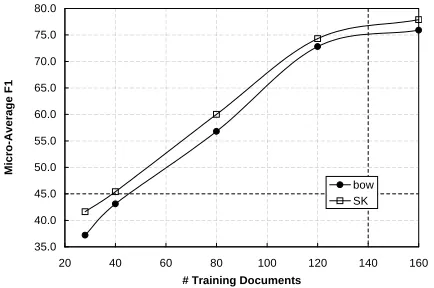
improves bow (41.7% - 37.2% = 4.5%) and (2) as the number of documents increases the improvement decreases (77.9% - 75.9% = 2%). It is worth noting that the standard deviations tend to assume high val-ues. In general, the use of 10 disjoint training/testing samples produces a higher variability than the n -fold cross validation which insists on the same docu-ment set. However, this does not affect thet-student confidence test over the differences between the Mi-croAverage ofSK and bow since the former has a higher accuracy at 99% confidence level.
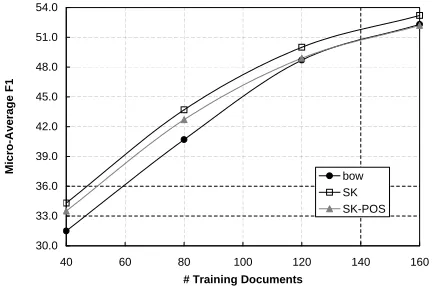
The above findings confirm thatSKoutperforms the bag-of-words kernel in critical learning condi-tions as the semantic contribution of theSK recov-ers useful information. To complete this study we carried out experiments with samples of different size, i.e. 3, 5, 10, 15 and 20 documents for each category. Figures 1 and 2 show the learning curves for 20NG and Reuters corpora. Each point refers to the average on 80 samples.
As expected the improvement provided by SK
decreases when more training data is available. However, the improvements are not negligible yet. The SK model (without POS information) pre-serves about 2-3% of improvement with 160 training documents. The matching allowed between noun-verb pairs still captures semantic information which is useful for topic detection. In particular, during the similarity estimation, each word activates60.05 pairs on average. This is particularly useful to in-crease the amount of information available to the SVMs.
Finally, we carried out some experiments with 160 Reuters documents by discarding the string matching from SK. Only words having different surface forms were allowed to give contributions to the Eq. 3.
Category bow SK SK-POS
Atheism 29.5±19.8 32.0±16.3 25.2±17.2
Comp.Graph 39.2±20.7 39.3±20.8 29.3±21.8
Misc.Forsale 61.3±17.7 51.3±18.7 49.5±20.4
Autos 26.2±22.7 26.0±20.6 33.5±26.8
Sport.Baseb. 32.7±20.1 36.9±22.5 41.8±19.2
Sci.Med 26.1±17.2 18.5±17.4 16.6±17.2
Talk.Relig. 23.5±11.6 28.4±19.0 27.6±17.0
[image:6.612.316.539.56.162.2]Talk.Polit. 28.3±17.5 30.7±15.5 30.3±14.3 MicroAvg.F1 31.5±4.8 34.3±5.8 33.5±6.4
Table 1:Performance of the linear and Semantic Kernel with 40 training documents over 8 categories of 20NewsGroups col-lection.
Category 24 docs 160 docs
bow SK bow SK
Acq. 55.3±18.1 50.8±18.1 86.7±4.6 84.2±4.3
Crude 3.4±5.6 3.5±5.7 64.0±20.6 62.0±16.7
Earn 64.0±10.0 64.7±10.3 91.3±5.5 90.4±5.1
Grain 45.0±33.4 44.4±29.6 69.9±16.3 73.7±14.8
Interest 23.9±29.9 24.9±28.6 67.2±12.9 59.8±12.6
Money-fx 36.1±34.3 39.2±29.5 69.1±11.9 67.4±13.3
Trade 9.8±21.2 10.3±17.9 57.1±23.8 60.1±15.4
[image:6.612.315.562.221.336.2]Wheat 8.6±19.7 13.3±26.3 23.9±24.8 31.2±23.0 Mic.Avg. 37.2±5.9 41.7±6.0 75.9±11.0 77.9±5.7
Table 2:Performance of the linear and Semantic Kernel with 40 and 160 training documents over 8 categories of the Reuters corpus.
30.0 33.0 36.0 39.0 42.0 45.0 48.0 51.0 54.0
40 60 80 100 120 140 160
# Training Documents
M
ic
ro
-A
v
e
ra
g
e
F
1
bow SK SK-POS
Figure 1: MicroAverageF1 of SVMs usingbow, SK and
SK-POS kernels over the 8 categories of 20NewsGroups.
[image:6.612.317.533.400.543.2]35.0 40.0 45.0 50.0 55.0 60.0 65.0 70.0 75.0 80.0
20 40 60 80 100 120 140 160
# Training Documents
M
ic
ro
-A
v
e
ra
g
e
F
1
[image:7.612.76.293.56.200.2]bow SK
Figure 2:MicroAverageF1of SVMs usingbowandSKover the 8 categories of the Reuters corpus.
5 Related Work
The IR studies in this area focus on the term similar-ity models to embed statistical and external knowl-edge in document similarity.
In (Kontostathis and Pottenger, 2002) a Latent
Se-mantic Indexing analysis was used for term
cluster-ing. Such approach assumes that values xij in the
transformed term-term matrix represents the simi-larity (>0) and anti-similarity between termsiand
j. By extension, a negative value represents an anti-similarity betweeniandjenabling both positive and negative clusters of terms. Evaluation of query ex-pansion techniques showed that positive clusters can improve Recall of about 18% for the CISI collection, 2.9% for MED and 3.4% for CRAN. Furthermore, the negative clusters, when used to prune the result set, improve the precision.
The use of external semantic knowledge seems to be more problematic in IR. In (Smeaton, 1999), the impact of semantic ambiguity on IR is stud-ied. A WN-based semantic similarity function be-tween noun pairs is used to improve indexing and document-query matching. However, the WSD al-gorithm had a performance ranging between 60-70%, and this made the overall semantic similarity not effective.
Other studies using semantic information for im-proving IR were carried out in (Sussna, 1993) and (Voorhees, 1993; Voorhees, 1994). Word seman-tic information was here used for text indexing and query expansion, respectively. In (Voorhees, 1994) it is shown that semantic information derived di-rectly from WN without a priori WSD produces poor results.
The latter methods are even more problematic in TC (Moschitti and Basili, 2004). Word senses tend to systematically correlate with the positive exam-ples of a category. Different categories are better characterized by different words rather than differ-ent senses. Patterns of lexical co-occurrences in the training data seem to suffice for automatic disam-biguation. (Scott and Matwin, 1999) use WN senses to replace simple words without word sense disam-biguation and small improvements are derived only for a small corpus. The scale and assessment pro-vided in (Moschitti and Basili, 2004) (3 corpora us-ing cross-validation techniques) showed that even the accurate disambiguation of WN senses (about 80% accuracy on nouns) did not improve TC.
In (Siolas and d’Alch Buc, 2000) was proposed an approach similar to the one presented in this ar-ticle. A term proximity function is used to design a kernel able to semantically smooth the similarity between two document terms. Such semantic ker-nel was designed as a combination of the Radial Ba-sis Function (RBF) kernel with the term proximity matrix. Entries in this matrix are inversely propor-tional to the length of the WN hierarchy path link-ing the two terms. The performance, measured over the 20NewsGroups corpus, showed an improvement of 2% over the bag-of-words. Three main differ-ences exist with respect to our approach. First, the term proximity does not fully capture the WN topo-logical information. Equidistant terms receive the same similarity irrespectively from their generaliza-tion level. For example, Sky and Locageneraliza-tion (direct hyponyms of Entity) receive a similarity score equal to knife and gun (hyponyms of weapon). More ac-curate measures have been widely discussed in lit-erature, e.g. (Resnik, 1997). Second, the kernel-based CD similarity is an elegant combination of lexicalized and semantic information. In (Siolas and d’Alch Buc, 2000) the combination of weighting schemes, the RBF kernel and the proximitry matrix has a much less clear interpretation. Finally, (Siolas and d’Alch Buc, 2000) selected only 200 features via Mutual Information statistics. In this way rare or non statistically significant terms are neglected while being source of often relevant contributions in theSKspace modeled over WN.
2002; Kandola et al., 2002). Two methods for in-ferring semantic similarity from a corpus were pro-posed. In the first a system of equations were de-rived from the dual relation between word-similarity based on document-similarity and viceversa. The equilibrium point was used to derive the semantic similarity measure. The second method models se-mantic relations by means of a diffusion process on a graph defined by lexicon and co-occurrence in-formation. The major difference with our approach is the use of a different source of prior knowledge. Similar techniques were also applied in (Hofmann, 2000) to derive a Fisher kernel based on a latent class decomposition of the term-document matrix.
6 Conclusions
The introduction of semantic prior knowledge in IR has always been an interesting subject as the examined literature suggests. In this paper, we used the conceptual density function on the Word-Net (WN) hierarchy to define a document similar-ity metric. Accordingly, we defined a semantic kernel to train Support Vector Machine classifiers. Cross-validation experiments over 8 categories of 20NewsGroups and Reuters over multiple samples have shown that in poor training data conditions, the WN prior knowledge can be effectively used to im-prove (up to 4.5 absolute percent points, i.e. 10%) the TC accuracy.
These promising results enable a number of future researches: (1) larger scale experiments with differ-ent measures and semantic similarity models (e.g. (Resnik, 1997)); (2) improvement of the overall ef-ficiency by exploring feature selection methods over theSK, and (3) the extension of the semantic sim-ilarity by a general (i.e. non binary) application of the conceptual density model.
References
E. Agirre and G. Rigau. 1996. Word sense disambiguation using conceptual density. In Proceedings of COLING’96,
Copenhagen, Danmark.
R. Basili, M. Cammisa, and F. M. Zanzotto. 2004. A similar-ity measure for unsupervised semantic disambiguation. In
In Proceedings of Language Resources and Evaluation Con-ference, Lisbon, Portugal.
Ron Bekkerman, Ran El-Yaniv, Naftali Tishby, and Yoad Win-ter. 2001. On feature distributional clustering for text cat-egorization. In Proceedings of SIGIR’01 , New Orleans, Louisiana, US.
Stephen Clark and David Weir. 2002. Class-based probability estimation using a semantic hierarchy. Comput. Linguist., 28(2):187–206.
Nello Cristianini, John Shawe-Taylor, and Huma Lodhi. 2002. Latent semantic kernels. J. Intell. Inf. Syst., 18(2-3):127– 152.
Christiane Fellbaum. 1998. WordNet: An Electronic Lexical
Database. MIT Press.
D. Haussler. 1999. Convolution kernels on discrete struc-tures. Technical report ucs-crl-99-10, University of Califor-nia Santa Cruz.
Thomas Hofmann. 2000. Learning probabilistic models of the web. In Research and Development in Information
Re-trieval.
T. Joachims. 1999. Making large-scale SVM learning practical. In B. Sch¨olkopf, C. Burges, and A. Smola, editors, Advances
in Kernel Methods - Support Vector Learning.
J. Kandola, J. Shawe-Taylor, and N. Cristianini. 2002. Learn-ing semantic similarity. In NIPS’02) - MIT Press.
A. Kontostathis and W. Pottenger. 2002. Improving retrieval performance with positive and negative equivalence classes of terms.
Hang Li and Naoki Abe. 1998. Generalizing case frames using a thesaurus and the mdl principle. Computational
Linguis-tics, 23(3).
Alessandro Moschitti and Roberto Basili. 2004. Complex linguistic features for text classification: a comprehensive study. In Proceedings of ECIR’04, Sunderland, UK. P. Resnik. 1997. Selectional preference and sense
disambigua-tion. In Proceedings of ACL Siglex Workshop on Tagging
Text with Lexical Semantics, Why, What and How?, Wash-ington, 1997.
Sam Scott and Stan Matwin. 1999. Feature engineering for text classification. In Proceedings of ICML’99, Bled, SL. Morgan Kaufmann Publishers, San Francisco, US.
Georges Siolas and Florence d’Alch Buc. 2000. Support vector machines based on a semantic kernel for text categorization. In Proceedings of IJCNN’00. IEEE Computer Society. Alan F. Smeaton. 1999. Using NLP or NLP resources for
in-formation retrieval tasks. In Natural language inin-formation
retrieval, Kluwer Academic Publishers, Dordrecht, NL.
M. Sussna. 1993. Word sense disambiguation for free-text in-dexing using a massive semantic network. In CKIM’93,. V. Vapnik. 1995. The Nature of Statistical Learning Theory.
Springer.
Ellen M. Voorhees. 1993. Using wordnet to disambiguate word senses for text retrieval. In Proceedings SIGIR’93 Pitts-burgh, PA, USA.
Ellen M. Voorhees. 1994. Query expansion using lexical-semantic relations. In Proceedings of SIGIR’94, ACM/Springer.