Semi-Supervised Chinese Word Segmentation Using Partial-Label
Learning With Conditional Random Fields
Fan Yang
Nuance Communications Inc. [email protected]
Paul Vozila
Nuance Communications Inc. [email protected]
Abstract
There is rich knowledge encoded in on-line web data. For example, punctua-tion and entity tags in Wikipedia data define some word boundaries in a sen-tence. In this paper we adopt partial-label learning with conditional random fields to make use of this valuable knowledge for semi-supervised Chinese word segmenta-tion. The basic idea of partial-label learn-ing is to optimize a cost function that marginalizes the probability mass in the constrained space that encodes this knowl-edge. By integrating some domain adap-tation techniques, such as EasyAdapt, our result reaches an F-measure of95.98%on the CTB-6 corpus, a significant improve-ment from both the supervised baseline and a previous proposed approach, namely
constrained decode. 1 Introduction
A general approach for supervised Chinese word segmentation is to formulate it as a character se-quence labeling problem, to label each charac-ter with its location in a word. For example, Xue (2003) proposes a four-label scheme based on some linguistic intuitions: ‘B’ for the beginning character of a word, ‘I’ for the internal characters, ‘E’ for the ending character, and ‘S’ for single-character word. Thus the word sequence “洽谈会 很 成功” can be turned into a character sequence
with labels as洽\B谈\I 会\E很\S成\B功\E.
A machine learning algorithm for sequence label-ing, such as conditional random fields (CRF) (Laf-ferty et al., 2001), can be applied to the labelled training data to learn a model.
Labelled data for supervised learning of Chi-nese word segmentation, however, is usually ex-pensive and tends to be of a limited amount. Re-searchers are thus interested in semi-supervised
learning, which is to make use of unlabelled data to further improve the performance of supervised learning. There is a large amount of unlabelled data available, for example, the Gigaword corpus in the LDC catalog or the Chinese Wikipedia on the web.
Faced with the large amount of unlabelled data, an intuitive idea is to use self-training or EM, by first training a baseline model (from the supervised data) and then iteratively decoding the unlabelled data and updating the baseline model. Jiao et al. (2006) and Mann and McCallum (2007) further propose to minimize the entropy of the predicted label distribution on unlabeled data and use it as a regularization term in CRF (i.e. entropy reg-ularization). Beyond these ideas, Liang (2005) and Sun and Xu (2011) experiment with deriv-ing a large set of statistical features such as mu-tual information and accessor variety from un-labelled data, and add them to supervised dis-criminative training. Zeng et al. (2013b) experi-ment with graph propagation to extract informa-tion from unlabelled data to regularize the CRF training. Yang and Vozila (2013), Zhang et al. (2013), and Zeng et al. (2013a) experiment with co-training for semi-supervised Chinese word seg-mentation. All these approaches only leverage the distribution of the unlabelled data, yet do not make use of the knowledge that the unlabelled data might have integrated in.
There could be valuable information encoded within the unlabelled data that researchers can take advantage of. For example, punctuation creates natural word boundaries (Li and Sun, 2009): the character before a comma can only be labelled as either ‘S’ or ‘E’, while the character after a comma can only be labelled as ‘S’ or ‘B’. Fur-thermore, entity tags (HTML tags or Wikipedia tags) on the web, such as emphasis and cross refer-ence, also provide rich information for word seg-mentation: they might define a word or at least
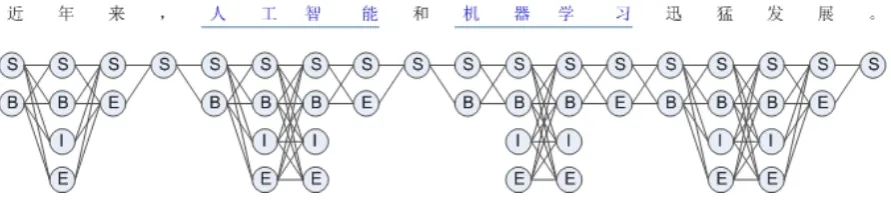
Figure 1: Sausage constraint (partial labels) from natural annotations and punctuation
give word boundary information similar to punc-tuation. Jiang et al. (2013) refer to such structural information on the web as natural annotations, and propose that they encode knowledge for NLP. For Chinese word segmentation, natural annotations and punctuation create a sausage1 constraint for
the possible labels, as illustrated in Figure 1. In the sentence “近年来,人工智能和机器学习迅 猛发展。”, the first character近can only be
la-belled with ‘S’ or ‘B’; and the characters来before
the comma and展before the Chinese period can
only be labelled as ‘S’ or ‘E’. “人工智能” and “机 器学习” are two Wikipedia entities, and so they
define the word boundaries before the first char-acter and after the last charchar-acter of the entities as well. The single character和 between these two
entities has only one label ‘S’. This sausage con-straint thus encodes rich information for word seg-mentation.
To make use of the knowledge encoded in the sausage constraint, Jiang et al. (2013) adopt a con-strained decode approach. They first train a base-line model with labelled data, and then run con-strained decode on the unlabelled data by binding the search space with the sausage; and so the de-coded labels are consistent with the sausage con-straint. The unlabelled data, together with the labels from constrained decode, are then selec-tively added to the labelled data for training the final model. This approach, using constrained de-code as a middle step, provides an indirect way of leaning the knowledge. However, the middle step, constrained decode, has the risk of reinforc-ing the errors in the baseline model: the decoded labels added to the training data for building the final model might contain errors introduced from the baseline model. The knowledge encoded in
1Also referred to as confusion network.
the data carrying the information from punctuation and natural annotations is thus polluted by the er-rorful re-decoded labels.
A sentence where each character has exactly one label is fully-labelled; and a sentence where each character receives all possible labels is zero-labelled. A sentence with sausage-constrained la-bels can be viewed as partially-labelled. These partial labels carry valuable information that re-searchers would like to learn in a model, yet the normal CRF training typically uses fully-labelled sentences. Recently, T¨ackstr¨om et al. (2013) pro-pose an approach to train a CRF model directly from partial labels. The basic idea is to marginal-ize the probability mass of the constrained sausage in the cost function. The normal CRF training us-ing fully-labelled sentences is a special case where the sausage constraint is a linear line; while on the other hand a zero-labelled sentence, where the sausage constraint is the full lattice, makes no con-tribution in the learning since the sum of proba-bilities is deemed to be one. This new approach, without the need of using constrained re-decoding as a middle step, provides a direct means to learn the knowledge in the partial labels.
base-line (corresponding to 15.19% relative error re-duction), and 0.33% over the constrained decode approach (corresponding to 7.59% relative error reduction). We conduct a detailed error analy-sis, illustrating how partial-label learning excels constrained decode in learning the knowledge en-coded in the Wikipedia data. As a note, our result also out-performs (Wang et al., 2011) and (Sun and Xu, 2011).
2 Partial-Label Learning with CRF In this section, we review in more detail the partial-label learning algorithm with CRF pro-posed by (T¨ackstr¨om et al., 2013). CRF is an exponential model that expresses the conditional probability of the labels given a sequence, as Equation 1, whereydenotes the labels,xdenotes the sequence, Φ(x, y) denotes the feature func-tions, and θ is the parameter vector. Z(x) = ∑
yexp(θTΦ(x, y))is the normalization term.
pθ(y|x) = exp(θ
TΦ(x, y))
Z(x) (1)
In full-label training, where each item in the se-quence is labelled with exactly one tag, maximum likelihood is typically used as the optimization tar-get. We simply sum up the log-likelihood of then
labelled sequences in the training set, as shown in Equation 2.
L(θ) =∑n i=1
log pθ(y|x)
=∑n i=1
(θTΦ(xi, yi)−log Z(xi)) (2)
The gradient is calculated as Equation 3, in which the first term 1
n ∑n
i=1Φj is the empirical expectation of feature functionΦj, and the second termE[Φj]is the model expectation. Typically a forward-backward process is adopted for calculat-ing the latter.
∂
∂θjL(θ) = 1
n
n ∑
i=1
Φj−E[Φj] (3)
In partial-label training, each item in the se-quence receives multiple labels, and so for each sequence we have a sausage constraint, denoted as
ˆ
Y(x,y˜). The marginal probability of the sausage is defined as Equation 4.
pθ( ˆY(x,y˜)|x) = ∑
y∈Yˆ(x,y˜)
pθ(y|x) (4)
The optimization target thus is to maximize the probability mass of the sausage, as shown in Equa-tion 5.
L(θ) = n ∑
i=1
logpθ( ˆY(xi,y˜i)|xi) (5)
A gradient-based approach such as L-BFGS (Liu and Nocedal, 1989) can be employed to op-timize Equation 5. The gradient is calculated as Equation 6, whereEYˆ(x,y˜)[Φj]is the empirical ex-pectation of feature functionΦjconstrained by the sausage, andE[Φj]is the same model expectation as in standard CRF.EYˆ(x,y˜)[Φj]can be calculated via a forward-backward process in the constrained sausage.
∂
∂θjL(θ) =EYˆ(x,y˜)[Φj]−E[Φj] (6) For fully-labelled sentences, EYˆ(x,y˜)[Φj] =
1
n ∑n
i=1Φj, and so the standard CRF is actually a special case of the partial-label learning.
3 Experiment setup
In this section we describe the basic setup for our experiments of semi-supervised Chinese word segmentation.
3.1 Data
We use the CTB-6 corpus as the labelled data. We follow the official CTB-6 guideline in splitting the corpus into a training set, a development set, and a test set. The training set has 23420 sentences; the development set has 2079 sentences; and the test set has 2796 sentences. These are fully-labelled data.
mediawiki-zhconverter2. We then randomly select
7737 sentences and reserve them as the test set. To create the partial labels in the Wikipedia data, we use the information from cross-reference, emphasis, and punctuation. In our pilot study we found that it’s beneficial to force a cross-reference or emphasis entity as a word when the item has 2 or 3 characters. That is, if an entity in the Wikipedia has three characters it receives the bels of “BIE”; and if it has two characters it is la-belled as “BE”.3
3.2 Supervised baseline model
We create the baseline supervised model by using an order-1 linear CRF with L2 regularization, to label a character sequence with the four candidate labels “BIES”. We use the tool wapiti (Lavergne et al., 2010).
Following Sun et al. (2009), Sun (2010), and Low et al. (2005), we extract two types of tures: character-level features and word-level fea-tures. Given a character c0 in the character
se-quence...c−2c−1c0c1c2...:
Character-level features :
• Character unigrams: c−2,c−1,c0,c1,c2
• Character bigrams: c−2c−1, c−1c−0, c0c1,c1c2
• Consecutive character equivalence: ?c−2 = c−1, ?c−1 = c−0 , ?c0 = c1,
?c1 =c2
• Separated character equivalence: ?c−3 = c−1, ?c−2 = c0, ?c−1 = c1,
?c0 =c2,?c1 =c3
• Whether the current character is a punc-tuation: ?Punct(c0)
• Character sequence pattern:
T(C−2)T(C−1)T(C0)T(C1)T(C2).
We classify all characters into four types. Type one has three characters ‘年’ (year) ‘月’ (month) ‘日’ (date).
Type two includes number characters. Type three includes English characters. All others are Type four characters. Thus “去年三月S” would generate the
character sequence pattern “41213”. 2https://github.com/tszming/mediawiki-zhconverter 3Another possibility is to label it as “SS” but we find that it’s very rare the case.
Word-level features :
• The identity of the stringc[s:i](i−6< s < i), if it matches a word from the list of word unigrams; multiple features could be generated.
• The identity of the string c[i : e] (i < e < i+6), if it matches a word; multiple features could be generated.
• The identity of the bi-gram c[s : i − 1]c[i : e] (i−6 < s, e < i+ 6), if it matches a word bigram; multiple fea-tures could be generated.
• The identity of the bi-gramc[s:i]c[i+ 1 :e](i−6< s, e < i+6), if it matches a word bigram; multiple features could be generated.
• Idiom. We use the idiom list from (Sun and Xu, 2011). If the current character
c0 and its surrounding context compose
an idiom, we generate a feature forc0of
its position in the idiom. For example, if
c−1c0c1c2is an idiom, we generate
fea-ture “Idiom-2” forc0.
The above features together with label bigrams are fed to wapiti for training. The supervised base-line model is created with the CTB-6 corpus with-out the use of Wikipedia data.
3.3 Partial-label learning
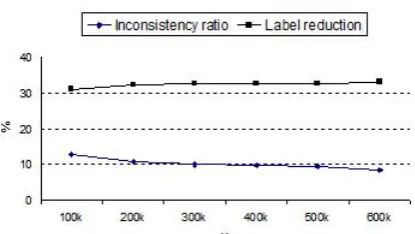
Figure 2: Encoded knowledge: inconsistency ratio and label reduction
K sentences together with their partial labels are then added to the CTB-6 training data to build a new model, using partial-label learning.4 In our
experiments, we try six data points with K = 100k, 200k, 300k, 400k, 500k, 600k. Figure 2 gives a rough idea of the knowledge encoded in Wikipedia for these data points with inconsistency ratio and label reduction. Inconsistency ratio is the percentage of characters that have inconsistent la-bels; and label reduction is the percentage of the labels reduced in the full lattice.
We modify wapiti to implement the partial-label learning as described in Section 2. Same as base-line, L2 regularization is adopted.
Algorithm 1Partial-label learning 1. Train supervised baseline modelM0
2. For each sentence x in Wiki-Train: 3. y←Decode(x,M0)
4. diff←Inconsistent(y,Yˆ(x,y˜)) 5. if diff>0:
6. C←C∪(Yˆ(x,y˜), diff) 7. Sort(C, diff, reverse)
8. Train modelMpl with CTB-6 and top K sen-tences in C using partial-label learning
3.4 Constrained decode
Jiang et al. (2013) implement the constrained de-code algorithm with perceptron. However, CRF is generally believed to out-perform perceptron, yet the comparison of CRF vs perceptron is out 4Knowledge is sparsely distributed in the Wikipedia data. Using the Wikipedia data without the CTB-6 data for partial-label learning does not necessarily guarantee convergence. Also the CTB-6 training data helps to learn that certain la-bel transitions, such as “B B” or “E E”, are not legal.
of the scope of this paper. Thus for fair compar-ison, we re-implement the constrained decode al-gorithm with CRF.
Algorithm 2 shows the constrained decode im-plementation. We first train the baseline model with the CTB-6 data. We then use this baseline model to run normal decode and constrained de-code for each sentence in the Wikipedia training set. If the normal decode and constrained decode have different labels, we add the constrained de-code together with the number of different labels to the filtered Wikipedia training corpus. The fil-tered Wikipedia training corpus is then sorted us-ing the number of different labels, and the top K sentences with constrained decoded labels are then added to the CTB-6 training data for building a new model using normal CRF.
Algorithm 2Constrained decode 1. Train supervised baseline modelM0
2. For each sentence x in Wiki-Train: 3. y←Decode(x,M0)
4. y¯←ConstrainedDecode(x,M0)
5. diff←Difference(y,y¯) 6. if diff>0:
7. C←C∪(y¯, diff) 8. Sort(C, diff, reverse)
9. Train modelMcd with CTB-6 and top K sen-tences in C using normal CRF
4 Evaluation on Wikipedia test set
en-coded knowledge in the test set and so can better represent the model’s capability of learning from the partial labels.
Results are shown in Figure 3 with the Full
measurement and in Figure 4 with theLabel mea-surement. The x axes are the size of Wikipedia training data, as explained in Section 3.3. As can be seen, both constrained decode and partial-label learning perform much better than the base-line supervised model that is trained from CTB-6 data only, indicating that both of them are learning the encoded knowledge from the Wikipedia train-ing data. Also we see the trend that the perfor-mance improves with more data in training, also suggesting the learning of encoded knowledge. Most importantly, we see that partial-label learn-ing consistently out-performs constrained decode in all data points. With the Label measurement, partial-label learning gives 1.7% or higher abso-lute improvement over constrained decode across all data points. At the data point of 600k, con-strained decode gives an accuracy of 97.14%, while partial-label learning gives 98.93% (base-line model gives 87.08%). The relative gain (from learning the knowledge) of partial-label learning over constrained decode is thus 18% ((98.93 − 97.14)/(97.14 −87.08)). These results suggest that partial-label learning is more effective in learning the encoded knowledge in the Wikipedia data than constrained decode.
5 CTB evaluation
5.1 Model adaptation
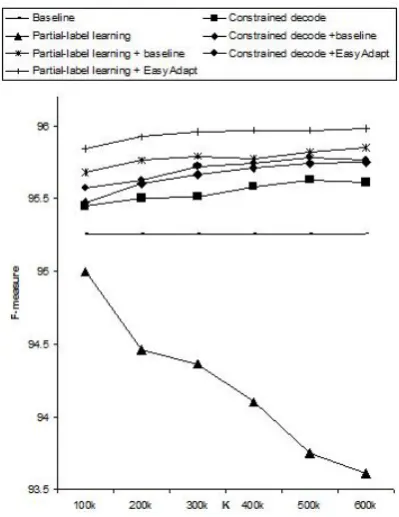
Our ultimate goal, however, is to determine whether we can leverage the encoded knowledge in the Wikipedia data to improve the word seg-mentation in CTB-6. We run our models against the CTB-6 test set, with results shown in Fig-ure 5. Because we have fully-labelled sentences in the CTB-6 data, we adopt the F-measure as our evaluation metric here. The baseline model achieves 95.26% in F-measure, providing a state-of-the-art supervised performance. Constrained decode is able to improve on this already very strong baseline performance, and we see the nice trend of higher performance with more unlabeled data for training, indicating that constrained de-code is making use of the ende-coded knowledge in the Wikipedia data to help CTB-6 segmentation.
[image:6.595.314.510.100.214.2]When we look at the partial-label model, how-ever, the results tell a totally different story.
[image:6.595.315.510.268.377.2]Figure 3: Wiki label evaluation results: Full
Figure 4: Wiki label evaluation results: Label
[image:6.595.311.511.481.740.2]First, it actually performs worse than the base-line model, and the more data added to train-ing, the worse the performance is. In the previ-ous section we show that partial-label learning is more effective in learning the encoded knowledge in Wikipedia data than constrained decode. So, what goes wrong? We hypothesize that there is an out-of-domain distribution bias in the partial la-bels, and so the more data we add, the worse the in-domain performance is. Constrained decode actually helps to smooth out the out-of-domain distribution bias by using the re-decoded labels with the in-domain supervised baseline model. For example, both the baseline model and con-strained decode correctly give the segmentation “提供/了/运输/和/给排给给排排水水水/之/便”, while
partial-label learning gives incorrect segmentation “提 供/了/运 输/和/给给给/排排排 水水水/之/便”. Looking at the
Wikipedia training data,排水is tagged as an
en-tity 13 times; and 给 排 水, although occurs 13
times in the data, is never tagged as an entity. Partial-label learning, which focuses on the tagged entities, thus overrules the segmentation of 给排 水. Constrained decode, on the other hand, by
us-ing the correctly re-decoded labels from the base-line model, observes enough evidence to correctly segment给排水as a word.
To smooth out the out-of-domain distribution bias, we experiment with two approaches: model interpolation and EasyAdapt (Daum´e III, 2007).
5.1.1 Model interpolation
We linearly interpolate the model of partial-label learningMplwith the baseline modelM
0to create
the final modelM+pl, as shown in Equation 7. The interpolation weight is optimized via a grid search between0.0and1.0with a step of 0.1, tuned on the CTB-6 development set. Again we modify wapiti so that it takes two models and an interpo-lation weight as input. For each model it creates a search lattice with posteriors, and then linearly combines the two lattices using the interpolation weight to create the final search space for decod-ing. As shown in Figure 5, model M+pl consis-tently out-performs constrained decode in all data points. We also see the trend of better performance with more training data.
M+pl=λ∗M0+ (1−λ)∗Mpl (7)
5.1.2 EasyAdapt
EasyAdapt is a straightforward technique but has been shown effective in many domain adaptation tasks (Daum´e III, 2007). We train the model
Meapl with feature augmentation. For each out-of-domain training instance < xo, yo >, where xo is the input features andyo is the (partial) labels, we copy the features and file them as an additional feature set, and so the training instance becomes< xo, xo, yo>. The in-domain training data remains the same. Consistent with (Daum´e III, 2007), EasyAdapt gives us the best performance, as show in Figure 5. Furthermore, unlike in (Jiang et al., 2013) where they find a plateau, our results show no harm adding more training data for partial-label learning when integrated with domain adaptation, although the performance seems to saturate after 400k sentences.
Finally, we search for the parameter setting of best performance on the CTB-6 development set, which is to use EasyAdapt withK = 600k sen-tences of Wikipedia data. With this setting, the performance on the CTB-6 test set is 95.98% in F-measure. This is 0.72% absolute improve-ment over supervised baseline (corresponding to 15.19% relative error reduction), and 0.33% ab-solute improvement over constrained decode (cor-responding to 7.59% relative error reduction); the differences are both statistically significant (p <
0.001).5 As a note, this result out-performs (Sun
and Xu, 2011) (95.44%) and (Wang et al., 2011) (95.79%), and the differences are also statistically significant (p <0.001).
5.2 Analysis with examples
To better understand why partial-label learning is more effective in learning the encoded knowledge, we look at cases whereM0 andMcdhave the in-correct segmentation while Mpl (and its domain adaptation variance M+pl and Meapl) have the cor-rect segmentation. We find that the majority is due to the error in re-decoded labels outside of en-coded knowledge. For example,M0andMcdgive
the segmentation “地震/为/里里里/氏氏氏/6.9/级”, yet the
correct segmentation given by partial-label learn-ing is “地 震/为/里里里 氏氏氏/6.9/ 级”. Looking at the
Wikipedia training data, there are 38 tagged enti-ties of里氏, but there are another 190 mentions of
里氏that are not tagged as an entity. Thus for
con-strained decode it sees 38 cases of “里\B 氏\E”
and 190 cases of “里\S 氏\S” in the Wikipedia
training data. The former comes from the encoded knowledge while the latter comes from re-decoded labels by the baseline model. The much bigger number of incorrect labels from the baseline re-decoding badly pollute the encoded knowledge. This example illustrates that constrained decode reinforces the errors from the baseline. On the other hand, the training materials for partial-label learning are purely the encoded knowledge, which is not impacted by the baseline model error. In this example, partial-label learning focuses only on the 38 cases of “里\B 氏\E” and so is able to learn
that里氏is a word.
As a final remark, we want to make a point that, although the re-decoded labels serve to smooth out the distribution bias, the Wikipedia data is indeed not the ideal data set for such a purpose, because it itself is out of domain. The performance tends to degrade when we apply the baseline model to re-decode the out-of-domain Wikipedia data. The errorful re-decoded labels, when being used to train the model Mcd, could lead to further er-rors. For example, the baseline modelM0is able
to give the correct segmentation “电脑/元元元器器器件件件”
in the CTB-6 test set. However, when it is ap-plied to the Wikipedia data for constrained de-code, for the seven occurrences of元器件, three of
which are correctly labelled as “元\B器\I件\E”,
but the other four have incorrect labels. The fi-nal model Mcd trained from these labels then gives incorrect segmentation “两/市/生 产/的/电 脑/元元元/器器器件件件/大量/销往/世界/各地” in the
CTB-6 test set. On the other hand, model interpolation or EasyAdapt with partial-label learning, focusing only on the encoded knowledge and not being im-pacted by the errorful re-decoded labels, performs correctly in this case. For a more fair comparison between partial-label learning and constrained de-code, we have also plotted the results of model in-terpolation and EasyAdapt for constrained decode in Figure 5. As can be seen, they improve on con-strained decode a bit but still fall behind the cor-respondent domain adaptation approach of partial-label learning.
6 Conclusion and future work
There is rich information encoded in online web data. For example, punctuation and entity tags
de-fine some word boundaries. In this paper we show the effectiveness of partial-label learning in digest-ing the encoded knowledge from Wikipedia data for the task of Chinese word segmentation. Unlike approaches such as constrained decode that use the errorful re-decoded labels, partial-label learn-ing provides a direct means to learn the encoded knowledge. By integrating some domain adap-tation techniques such as EasyAdapt, we achieve an F-measure of 95.98%in the CTB-6 corpus, a significant improvement from both the supervised baseline and constrained decode. Our results also beat (Wang et al., 2011) and (Sun and Xu, 2011).
In this research we employ a sausage constraint to encode the knowledge for Chinese word seg-mentation. However, a sausage constraint does not reflect the legal label sequence. For exam-ple, in Figure 1 the links between label ‘B’ and label ‘S’, between ‘S’ and ‘E’, and between ‘E’ and ‘I’ are illegal, and can confuse the machine learning. In our current work we solve this issue by adding some fully-labelled data into training. Instead we can easily extend our work to use a lat-tice constraint by removing the illegal transitions from the sausage. The partial-label learning stands the same, by executing the forward-backward pro-cess in the constrained lattice. In future work we will examine partial-label learning with this more enforced lattice constraint in depth.
Acknowledgments
The authors would like to thank Wenbin Jiang, Xi-aodong Zeng, and Weiwei Sun for helpful discus-sions, and the anonymous reviewers for insightful comments.
References
Hal Daum´e III. 2007. Frustratingly easy domain adap-tation. InAnnual meetingassociation for computa-tional linguistics, pages 256–263. Association for Computational Linguistics.
Wenbin Jiang, Meng Sun, Yajuan Lv, Yating Yang, and Qun Liu. 2013. Discriminative learning with natural annotations: Word segmentation as a case study. In Proceedings of The 51st Annual Meet-ing of the Association for Computational LMeet-inguis- Linguis-tics, pages 761–769.
Com-putational Linguistics and the 44th Annual Meet-ing of the Association for Computational LMeet-inguis- Linguis-tics, ACL-44, pages 209–216.
John D. Lafferty, Andrew McCallum, and Fernando C. N. Pereira. 2001. Conditional random fields: Probabilistic models for segmenting and labeling se-quence data. InProceedings of the Eighteenth In-ternational Conference on Machine Learning, pages 282–289, San Francisco, CA, USA.
Thomas Lavergne, Olivier Capp´e, and Franc¸ois Yvon. 2010. Practical very large scale CRFs. In Proceed-ings the 48th Annual Meeting of the Association for Computational Linguistics (ACL), pages 504–513. Association for Computational Linguistics, July.
Zhongguo Li and Maosong Sun. 2009. Punctuation as implicit annotations for Chinese word segmentation. Computational Linguistics, 35:505–512.
Percy Liang. 2005. Semi-supervised learning for natu-ral language. Master’s thesis, MASSACHUSETTS INSTITUTE OF TECHNOLOGY, May.
D. C. Liu and J. Nocedal. 1989. On the limited mem-ory bfgs method for large scale optimization. Math-ematical Programming, 45(3):503–528, December.
Jin Kiat Low, Hwee Tou Ng, and Wenyuan Guo. 2005. A maximum entropy approach to chinese word seg-mentation. In Proceedings of the Fourth SIGHAN Workshop on Chinese Language Processing, pages 161–164, San Francisco, CA, USA.
Gideon S. Mann and Andrew McCallum. 2007. Ef-ficient computation of entropy gradient for semi-supervised conditional random fields. In Human Language Technologies 2007: The Conference of the North American Chapter of the Association for Computational Linguistics; Companion Volume, Short Papers, NAACL-Short ’07, pages 109–112.
Weiwei Sun and Jia Xu. 2011. Enhancing chinese word segmentation using unlabeled data. In Pro-ceedings of the 2011 Conference on Empirical Meth-ods in Natural Language Processing, pages 970– 979, Edinburgh, Scotland, UK., July.
Xu Sun, Yaozhong Zhang, Takuya Matsuzaki, Yoshi-masa Tsuruoka, and Jun’ichi Tsujii. 2009. A dis-criminative latent variable Chinese segmenter with hybrid word/character information. InProceedings of Human Language Technologies: The 2009 An-nual Conference of the North American Chapter of the Association for Computational Linguistics, pages 56–64.
Weiwei Sun. 2010. Word-based and character-based word segmentation models: comparison and com-bination. InProceedings of the 23rd International Conference on Computational Linguistics: Posters, pages 1211–1219.
Oscar T¨ackstr¨om, Dipanjan Das, Slav Petrov, Ryan McDonald, and Joakim Nivre. 2013. Token and type constraints for cross-lingual part-of-speech tag-ging. Transactions of the Association for Computa-tional Linguistics, 1:1–12.
Yiou Wang, Jun’ichi Kazama, Yoshimasa Tsuruoka, Wenliang Chen, Yujie Zhang, and Kentaro Tori-sawa. 2011. Improving chinese word segmentation and POS tagging with semi-supervised methods us-ing large auto-analyzed data. InProceedings of the 5th International Joint Conference on Natural Lan-guage Processing, pages 309–317.
Nianwen Xue. 2003. Chinese word segmentation as character tagging. Computational Linguistics and Chinese Language Processing, pages 29–48. Fan Yang and Paul Vozila. 2013. An empirical study
of semi-supervised Chinese word segmentation us-ing co-trainus-ing. In Proceedings of the 2013 Con-ference on Empirical Methods in Natural Language Processing, pages 1191–1200, Seattle, Washington, USA, October. Association for Computational Lin-guistics.
Xiaodong Zeng, Derek F. Wong, Lidia S. Chao, and Isabel Trancoso. 2013a. Co-regularizing character-based and word-character-based models for semi-supervised chinese word segmentation. InProceedings of The 51st Annual Meeting of the Association for Compu-tational Linguistics, pages 171–176.
Xiaodong Zeng, Derek F. Wong, Lidia S. Chao, and Isabel Trancoso. 2013b. Graph-based semi-supervised model for joint chinese word segmen-tation and part-of-speech tagging. In Proceedings of The 51st Annual Meeting of the Association for Computational Linguistics, pages 770–779.