Affinity-Preserving Random Walk for Multi-Document Summarization
Kexiang Wang, Tianyu Liu, Zhifang Sui and Baobao Chang Key Laboratory of Computational Linguistics, Ministry of Education School of Electronics Engineering and Computer Science, Peking University Collaborative Innovation Center for Language Ability, Xuzhou 221009 China
{wkx,tianyu0421,szf,chbb}@pku.edu.cn
Abstract
Multi-document summarization provides users with a short text that summarizes the information in a set of related doc-uments. This paper introduces affinity-preserving random walk to the summa-rization task, which preserves the affin-ity relations of sentences by an absorb-ing random walk model. Meanwhile, we put forward adjustable affinity-preserving random walk to enforce the diversity con-straint of summarization in the random walk process. The ROUGE evaluations on DUC 2003 topic-focused summarization task and DUC 2004 generic summariza-tion task show the good performance of our method, which has the best ROUGE-2 recall among the graph-based ranking methods.
1 Introduction
Multi-document summarization provides users with summary that reflects the main information in a set of given documents. The documents are often related and talk about more than one top-ics. Generic multi-document summarization and topic-focused multi-document summarization are two typical kinds of summarization. The former is a summarization delivering the main information of the documents with no bias while the latter is a one delivering the main information biased to a given topic description (a few sentences or even phrases). Most existing summarization systems are designed for these two kinds of summariza-tion.
There are two goals for generic multi-document summarization. The first one is saliency. Sum-mary sentences should be central sentences that capture the majority of information in a
docu-ment cluster. The sentences with little informa-tion about the document cluster should not be in-cluded in the summary. The second one is di-versity. The information overlap between sum-mary sentences should be as minimal as possi-ble due to the length limit of summary. In other words, the information coverage of summary is a determinant, which requires that the summary sentences should cover diverse aspects of infor-mation. Besides the two goals, there is another goal for the topic-focused summarization and that is relevancy. It requires that the summary sen-tences be relevant to the topic description. A se-ries of conferences and workshops on automatic text summarization (e.g. NTCIR, DUC), special topic sessions in ACL, EMNLP and SIGIR have advanced the techniques to achieve these goals and many approaches have been proposed so far.
In this paper, we focus on the extractive summa-rization methods, which extract the summary sen-tences from the input document cluster. We pro-pose affinity-preserving random walk for multi-document summarization. The method is a graph-based ranking method, which takes into account the global information collectively computed from the entire sentence affinity graph. Different from the previous graph-based ranking methods, our method adopts “global normalization” to trans-form sentence affinity matrix into sentence tran-sition matrix and formulates the sentence rank-ing process in an absorbrank-ing random walk model. Meanwhile, the adjustable affinity-preserving ran-dom walk is proposed to facilitate the diversity of summary by adjusting the sentence transition ma-trix after each iteration of random walk. Experi-mental results on DUC generic and topic-focused multi-document summarization tasks show the competitive performance of our method. To our best knowledge, our system has the best ROUGE-2 recall on both tasks among all existing
based ranking methods, which defeats most other methods.
We summarize our contributions as follows. (1) We preserve the original affinity relations be-tween sentences in a novel affinity-preserving ran-dom walk view for multi-document summariza-tion. The preservation of affinity leads to a more salient summary. And it is applicable to both generic and topic-focused summarization. (2) We propose adjustable affinity-preserving random walk to enforce the diversity constraint of summa-rization in the random walk process. (3) Experi-ments on DUC 2003 and DUC 2004 tasks demon-strate the competitive performance of our method. The rest of the paper is organized as follows. Section 2 discusses the related work. Section 3 describes traditional random walk model for sum-marization. Section 4 proposes affinity-preserving random walk for the saliency goal of summa-rization and this section also proposes adjustable affinity-preserving random walk to produce both salient and diverse summary. Section 5 gives our evaluation results and the conclusion is made in Section 6.
2 Related Work
Our method belongs to the graph-based ranking methods to select sentences in the documents to produce the summary. Erkan and Radev (2004) proposed LexPageRank to compute the sentence saliency based on the concept of eigenvector cen-trality. It constructs the sentence affinity graph and computes the sentence saliency based on an al-gorithm similar to PageRank (Page et al., 1999). Like PageRank, the affinity matrix is converted into the row-stochastic matrix, which is used as the transition matrix of random walk on the weighted graph. Wan (2007) proposed manifold ranking for topic-focused multi-document summarization. It makes full use of both the relationships among all sentences in the documents and the relationships between the given topic description and the sen-tences. Manifold ranking conducts a different nor-malization on the sentence affinity matrix to guar-antee the algorithm’s convergence. GRASSHOP-PER (Zhu et al., 2007) ranks sentences with an emphasis on the diversity constraint of summa-rization. It turns already ranked sentences into absorbing states, which effectively prevents re-dundant sentences from receiving a high rank. The algorithm is based on an absorbing random
walk and produces only one summary sentence af-ter one particular random walk becomes station-ary. And the normalization from sentence affinity matrix to sentence transition matrix is the same as PageRank. DivRank (Mei et al., 2010) is a method to balance the saliency and diversity of the top ranked sentences in a reinforced random walk model. Also, the normalization in DivRank from affinity matrix to transition matrix is the same as PageRank. Another notable diversified graph-based ranking method GCD (Dubey et al.,2011) relies on large amounts of training data to learn edge conductances.
Our method formulates the multi-document summarization as an affinity-preserving random walk and uses the “global normalization” to trans-form sentence affinity matrix into sentence transi-tion matrix, which is different from all those pro-posed methods. And the adjustable transition ma-trix in our method balances the saliency and diver-sity goals of summarization. Like GRASSHOP-PER, our method relies on the absorbing random walk model. The difference is that our method does not turn the sentence vertex into absorbing state but add an absorbing vertex to the original sentence affinity graph. And all summary sen-tences are extracted after the random walk reaches a stationary state in our method. Like DivRank, the sentence transition matrix is adjustable in our method to enforce the diversity constraint of sum-marization. However, our method differs from Di-vRank in the mechanism to adjust the transition matrix.
3 Traditional Random Walk for Summarization
SupposeG = (S, E)is a graph with vertex setS
and edge set E ⊂ S2. Suppose there is a con-ductancec(si, sj) > 0associated with each edge (si, sj)∈Eandc(si, sj) = 0associated with the setS2−E (the conductance of nonexistent edge is zero). Let
C(si) =
X
sj∈S
c(si, sj), si ∈S (1)
so thatC(si)is the total conductance of the edges coming fromsi. And the traditional random walk
on graph is defined as
Definition 3.1. The discrete-time Markov chain
tran-sition probability matrixPgiven by
P(si, sj) = cC(s(i, ssi)j), (si, sj)∈S2 (2)
is called a random walk on the graphG.
This chain governs a particle moving along the vertices of G. If the particle in the state Xm is at vertex si ∈ S, it will be at a neighbor of si in the next stateXm+1, which is chosen randomly in proportion to the conductance. We can prove that
P
sj∈SP(si, sj) = 1for anysi ∈S (C(si) 6= 0) so P is a row-stochastic matrix by P = D−1W, where Dis a diagonal matrix with entriesDii = C(si)andWis the adjacency matrix ofGwhere
Wij =c(si, sj).
For the summarization task, G is the sentence affinity graph. The vertex setS ={s1, s2, ..., sn}
contains every sentence in the document cluster and the edge setE contains the pairwise affinity between sentences. We use the tf*isf formula to calculate the weight associated with each term occurring in the sentence, wheretfis the term fre-quency in the sentence andisf is the inverse sen-tence frequency of the term among all sensen-tences.
isfis often calculated as1+log(n/nt), wherenis
the total number of sentences andntis the number
of sentences containing the term t. Wij is
com-puted using the standard cosine measure ( Baeza-Yates et al.,1999).
Wij =simcosine(vi,vj) = kvikvi·vj
2× kvjk2 (3) where vi andvj are the corresponding term
vec-tors of si and sj. Two vertices are connected if their affinity is larger than0andWiiis set as0to
avoid self transition. We get an undirected graph
Gas well as a symmetric sentence affinity matrix W in this way. Then we transformW into P by P = D−1W and use the stationary distribution of random walk as sentence ranking scores. The tra-ditional random walk model is a simple practice of PageRank algorithm for multi-document sum-marization.
4 Affinity-Preserving Random Walk for Summarization
4.1 Prior of Multi-Document Summarization In the above traditional random walk on graph, the normalization from affinity matrixW to tran-sition matrixPis to makePa row-stochastic
ma-trix. This can be interpreted as a democratic nor-malization because the surfer of a traditional ran-dom walk visits neighbors of a vertex with prob-ability 1. The surfer has to choose a neighbor to visit next although it is a random choice w.r.t. the conductance distribution of the vertex. How-ever this democratic normalization is not suitable for multi-document summarization due to the fact that most sentences are not salient and should not be normalized democratically as the few salient ones. The prior here is that the number ratio of good candidate sentences over bad candidate sen-tences is very low due to the summary length limit. Good candidate sentences are the sentences highly overlapping with sentences in the reference sum-mary written by humans. And the remaining sen-tences are bad candidate sensen-tences. The demo-cratic normalization of P = D−1W will extend the adverse effect of bad candidate sentences and suppress the effect of good candidate sentences, because the total conductance of the bad candi-date sentence is usually smaller than that of the good candidate sentence. In this case, the random surfer has to choose a neighbor to visit even when she is currently at a bad candidate sentence, which will direct her to visit other bad candidate sen-tences neighboring to the current sentence. The invariant behavior of the surfer at all vertices in the graph is not consistent with the prior which makes a distinction between good and bad candidate sen-tences. It may pervert the random walk process to get an ideal distribution in which only few sen-tences are assigned with a high ranking score.
It is worth noting here that manifold ranking (Wan et al., 2007) for summarization uses a dif-ferent normalization: P = D−1
2WD−12. It is a symmetric normalization on both endpoints of an edge, which makesP a suitable choice in the manifold ranking process to smooth the scores of neighboring vertices. The symmetric normaliza-tion can be deduced from the objective funcnormaliza-tion of manifold ranking (Zhou et al.,2003) and does not make a distinction between the good and bad candidate sentences. It is also not consistent with the prior. We can conclude that existing graph-based ranking methods can not well characterize the prior of multi-document summarization.
4.2 Affinity-Preserving Random Walk
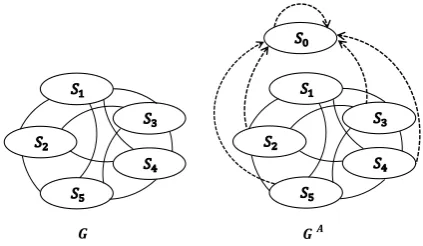
sen-𝑮 𝑮𝑨
Figure 4.1: Sentence graphs for summarization.
G: sentence affinity graph constructed from the document cluster.GA: sentence augmented graph
with an absorbing vertexs0.Cmaxequals toC(s1) indicating that sentences1 has the maximum con-ductance, so there is no edge(s1, s0).
tences to satisfy the prior of multi-document sum-marization. Affinity-preserving random walk has an intrinsic mechanism that preserves the original affinity relations between sentences in the docu-ments, which is proposed and defined as follows. Definition 4.1. For the graphG, the vertex setS
has(n+ 1)vertices: s0, s1, s2, ..., sn. The
max-imum conductance Cmax = maxi=1,2,...nC(si).
Of the(n+ 1)vertices,s0is an absorbing vertex
withc(si, s0) > 0, c(s0, si) = 0,andc(s0, s0) =
Cmax fori = 1,2, ..., n. The remaining vertices are the normal vertices with c(si, sj) > 0 for i, j = 1,2, ..., n. The discrete-time Markov chain
X = (X0, X1, X2, ...) with state space and
tran-sition probability matrixPgiven by
P(si, sj) = c(Csi, sj) max P(si, s0) = 1−CC(si)
max ,P(s0, si) = 0 P(s0, s0) = 1
fori, j= 1,2, ..., n
(4)
is called an affinity-preserving random walk on the graphG.
For our summarization task, we construct a sen-tence augmented graph GA (as shown in
Fig-ure 4.1) by adding an absorbing vertexs0 to the sentence affinity graph G. The unabsorbed ver-tices si (i = 1,2, ..., n) represent sentences in the documents. The affinity-preserving random walk process as defined above is implemented on
GA to rank sentences in the documents. In the
affinity-preserving random walk, once the surfer
reaches the absorbing vertex, she cannot walk out of there. Because P(si, s0) is small for the ver-texsiwith a large conductance, it is less likely for the surfer at si to walk into s0. As for the ver-tex with a small conductance, the surfer has a ten-dency to be absorbed by s0. The absorbing ver-tex here plays a role of soaking unreliable rank-ing scores from large numbers of bad candidate sentences and highlighting the few good candidate sentences. The affinity matrixWis normalized by its first norm (equivalent toCmax) in the
affinity-preserving random walk, which results in a kind of “soft” stochastic matrix fornunabsorbed vertices. “soft” here means that the sum of row elements in the matrix can be less than1. By contrast,Pin the traditional random walk is a “hard” stochastic ma-trix in which every sum of row elements has to be
1. Meanwhile, Pin this absorbing Markov chain (Seneta,2006) preserves the original affinity rela-tions in W as all sentences are globally normal-ized by the same factor (i.e. Cmax). We call this approach an “affinity-preserving random walk” as it is used in (Cho et al., 2010), which deals with a graph matching problem that aims at assigning
1-vs-1correspondences between two graphs. The similar idea is also applied in the case of ontology matching (Xiang et al.,2015). Transition matrix Pincluding the absorbing vertex is formulated in (Cho et al.,2010) as follows
P=
1 0T
e−c/kWk1 W/kWk1
(5) where 0T is a 1×n vector with all elements 0,
e is an n ×1 vector with all elements 1, c = [C(s1), C(s2), ..., C(sn)]T is a vector containing
the conductances of n sentences and W/kWk1 is the n × n soft substochastic matrix. How-ever, the stationary distribution of such a random walk on graph with one absorbing vertex is always
1 0T, which is not a good characterization of the sentence ranking distribution. We turn to the quasi-stationary distribution ¯x (Cho et al., 2010; Darroch and Seneta, 1965) of absorbing random walk for ranking sentences.¯x(K)is defined as
¯
xi(K)=P rob(X(K) =s
i|X(K) 6=s0)
= Pxi(K) jxj(K)
(6)
stationary distribution¯xif Wis irreducible ( Dar-roch and Seneta,1965). We remove the sentences that have the total conductance0(i.e. the isolated sentences) when constructing the sentence affinity graphG. In this way,Gwill be strongly connected and has an irreducible adjacency matrixW.
We introduce the teleport vector y as used in personalized PageRank (Page et al.,1999; Haveli-wala,2002;Jeh and Widom,2003) for the summa-rization task. In the generic summasumma-rization case, we define the vector y in a way that reflects the position of each sentence in a document. If the sentence si+1 is right after the sentencesi in the
same document, then yi+1
yi =λ−1,λ >1 (7) whereλis the decay factor. In the topic-focused summarization case, we incorporate the topic de-scription as a vertex in the random walk process, which is a standard way of achieving the rele-vancy goal of this kind of summarization. Vector y is defined to be[y1, y2, ..., yn, yn+1]T in which
yi = 0(1 6 i6 n)andyn+1 = 1when the first
nelements represent sentences in the documents and the last one represents the topic description. We normalize y by its first norm to get a prior sentence ranking for multi-document summariza-tion. Based onWandy, sentence ranking scores in affinity-preserving random walk can be formu-lated in a recursive form as follows
x= µWT/kWk1x+ (1−µ)y
kµWT/kWk1x+ (1−µ)yk1 (8)
where x = [Score(si)]n×1 is the vector of sen-tence ranking scores. µis the damping factor that trades off between two actions: the transition ac-cording toWT/kWk
1and the teleport specified by y. Transpose operation in Eq.(8) can be removed because of symmetry of W. The final transition matrix of affinity-preserving random walk is given byA=µW/kWk1+ (1−µ)y·eT andxshould be normalized by its first norm after each itera-tion of random walk. Like PageRank, the quasi-stationary distribution is obtained by the normal-ized principal eigenvector ofA.
For implementation, the initial ranking scores of all sentences are set to1/n and the iterative pro-cess in Eq.(8) is adopted to compute new ranking scores of sentences. Usually convergence of the it-erative algorithm is achieved when the difference between scores computed at two successive itera-tions falls below a given threshold.
4.3 Adjustable Affinity-Preserving Random Walk for Summarization
Affinity-preserving random walk preserves the affinity relations between sentences and gives high ranking scores to the salient sentences. However, the diversity constraint of summarization has not been taken into account. The surfer of affinity-preserving random walk has no knowledge about what a diverse summary should be. If we just take redundancy removing as the post-processing separate step to improve diversity, sentences that highly overlap with other summary sentences may be chosen and sentences that include information about different topics may be submerged. This phenomenon can be explained by the theorem as follows.
Theorem 4.1. Suppose ¯x is the quasi-stationary distribution of affinity-preserving random walk
as defined in Sec.4.2 and x is the solution
of a continuous quadratic optimization problem
argmax(xTA x)s.t. x ∈ [0,1]n, kxk
2 = 1and
A has definition in Sec.4.2. The following
equa-tion holds
¯
x=x/kxk1 (9)
whenµ= 1.
Proof. In mathematics, for a given symmetric real matrixA(whenµ= 1) and nonzero real vectorx, the Rayleigh quotientR(A,x)is defined as
R(A,x) = xxTTAxx
and it reaches its maximum value when x is the principal eigenvector ofA. Ifkxk2 = 1,R(A,x) is equivalent to xTA x. So the solutionx is the
principal eigenvector ofA. From Section 4.2,¯xis the normalized principal eigenvector ofA. ¯x and x have the relation in Eq.(9). The conclusion is made.
From Theorem4.1, affinity-preserving random walk tends to produce a stationary distribution in which the total sum of affinity between sentences (i.e. xTAx) is large if there is a subtle
be highlighted by the random walk process. An extreme example is that a cluster of sentences will all get high ranking scores if they are very sim-ilar to each other. However, only one sentence in this cluster should be included in the summary and the others should be suppressed. The random surfer is caught in a trap of larger sentence clus-ter, which operates against the exploration of good candidates in smaller cluster.
We introduce adjustable affinity-preserving ran-dom walk to enforce the diversity constraint of summarization. In the original affinity-preserving random walk, sentence transition matrixAis fixed and set asµW/kWk1+(1−µ)y·eT. Edge(si, s0) (if C(si) 6= Cmax) always exists and has an in-variant conductance c(si, s0), which means that the surfer atsi walks intos0 in the same manner for the entire random walk process. The random surfer makes her decision only based on invariant A to select salient sentences and form the sum-mary. To equip the surfer with knowledge about what a diverse summary should be, we propose to adjust sentence transition matrix Ain each itera-tion of random walk. The key point is that good candidate sentences should be normalizedlocally
while bad ones should be normalized globallyin the transformation from affinity matrixWto tran-sition matrixA.
A “virtual” summary V is produced based on x in each iteration of affinity-preserving random walk. “Virtual” here means thatV is a summary based on transient distribution x, which differs from the final summary based on quasi-stationary distribution¯x. The method of diversity penalty im-position (Wan et al.,2007) is used to produceV, which is denoted by theproducingSummary func-tion in Algorithm 4.1. It is a simple greedy al-gorithm to select sentences that are both salient and diverse, which often plays a role of greedy post-processing step to produce the final summary. Rather, we use it to produce virtual summary V
that satisfies both the saliency and diversity con-straints based on a specific iteration. V is an indi-cator for the diversity constraint of summarization. The sentence transition matrixAin the iteration
(K+1)is then constructed with help of the virtual summaryV in the iterationK. Here, different nor-malization methods are used to transformWinto A. IfV includes the sentencesi, elements in the
corresponding i-th row of W will be normalized by the sum of the row (i.e. C(si)). Otherwise,
el-ements will be normalized by the maximum sum of row elements in W (i.e. Cmax). In this way,
“local normalization” is adopted for the sentences inV while “global normalization” is adopted for the sentences not inV. We differentiate the nor-malization methods to lead the surfer of affinity-preserving random walk to explore more in the neighborhood of the sentences in V rather than end in the absorbing vertexs0. As a result, the sen-tences that satisfy the saliency and diversity con-straints will be highlighted even though they are in a small sentence cluster. We characterize
differ-Algorithm 4.1: Adjustable Affinity-Preserving Random Walk for Multi-Document Summarization
Input:The sentence affinity matrix,W; The starting and maximum number of iteration,BandM; The teleport vector,y; The damping factor,µ; Output: The multi-document summary,V; 1 A←µW/Cmax+ (1−µ)y·eT
2 Initialize the starting distributionxas uniform 3 fori←1,2, ..., M do
4 ifi > Bthen
5 V ←producingSummary(x) 6 D←adjustingNormalization(V) 7 A←µ(D−1W)T + (1−µ)y·eT
8 ¯x←Ax
9 ¯x←¯x/k¯xk1
10 ifk¯x−xk1 < εthen
11 break
12 x←¯x
13 V ←producingSummary(x) 14 ReturnV
ent normalizations in the diagonal matrixD.Diiis C(si)ifsi ∈V andDiiisCmaxifsi ∈/ V ,which
is denoted by theadjustingNormalizationfunction in Algorithm4.1. Din the current iteration is here dependent onxin the previous iteration. We will have different sentence augmented graphs GA in
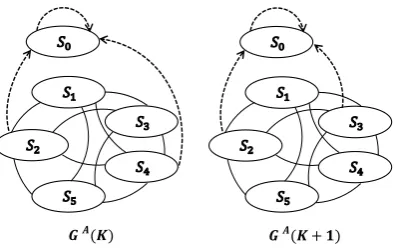
each iteration. Figure 4.2 shows an example of
GA(K) and GA(K + 1) in the respective
itera-tionsKand(K+ 1). The probability distribution in the adjustable affinity-preserving random walk is updated as follows.
x= µ(D−1W)Tx+ (1−µ)y kµ(D−1W)Tx+ (1−µ)yk
1
𝑮𝑨(𝑲 + 𝟏)
𝑮𝑨(𝑲)
Figure 4.2: Sentence augmented graphs for sum-marization in two successive iterations. GA(K):
augmented graph in the iterationK. Virtual sum-maryV ={s1, s3, s5}, which is constructed from x in the iteration(K−1)by producingSummary. D = diag([C(s1), Cmax, C(s3), Cmax, C(s5)]).
GA(K + 1): augmented graph in the iteration (K+1). V ={s1, s4, s5}, which is constructed fromxin the iterationK by producingSummary. D = diag([C(s1), Cmax, Cmax, C(s4), C(s5)]). In both cases, Cmax equals to C(s1) indicating that sentences1has the maximum conductance.
This is an adjustable Markov chain for which the transition matrixAisµ(D−1W)T+ (1−µ)y·eT.
In this setting, A is dependent on the transient distributionxin the previous iteration, which dif-fers from the invariant transition matrix in Eq.(8). As the diversity constraint is embedded in A, subsequent random walks move to the solution that induces a better summary. The algorithm of the adjustable affinity-preserving random walk for multi-document summarization is demonstrated in Algorithm4.1.
The parameter B in Algorithm 4.1 is used to produce a transient distribution which is reliable enough to adjust the transition matrix. To get the final multi-document summary, we use the same
producingSummaryfunction.
5 Experiments 5.1 Data Sets
Generic and topic-focused multi-document sum-marization have been the main tasks in DUC1.
Task 2 of DUC 2004 is a generic summarization task and task 3 of DUC 2003 is a topic-focused summarization task. Both tasks are used for per-formance evaluation of our method. In the exper-iments, task 2 of DUC 2003 is used for the
pa-1http://www-nlpir.nist.gov/projects/duc/intro.html
rameter tuning of our method. We preprocess the document data sets by removing stopwords from each sentence and stemming the remaining words using the Porter’s stemmer2. Also, the sentences
containing the said clause (if a said, says, told, tells word and quotation marks appear simultaneously) are filtered out.
For evaluation, four reference summaries gen-erated by human judges for each document cluster are provided by DUC as the ground truth. A brief summary over the evaluation datasets is shown in Table 5.1. According to (Hong et al., 2014), we adjust the length limit of summary in DUC 2004 from 665 bytes to 100 words as it provides the same setting for system evaluations.
DUC 2003
DUC 2003
DUC 2004
Task Task 2 Task 3 Task 2
Type Generic focusedTopic- Generic
Cluster numbers 30 30 50
Data source TDT TREC TDT
Summary length 100 words 100 words 100 words Table 5.1: Summary of data sets used in our ex-periments.
5.2 Evaluation Metric
We use the ROUGE-1.5.5 (Lin and Hovy, 2003) toolkit for evaluation, which has been officially adopted by DUC for automatic summarization evaluation. The toolkit measures summary qual-ity by counting overlapping units such as the n-gram, word sequences and word pairs between the candidate summary and the reference summary. ROUGE-N is an n-gram based measure and the ROUGE-N recall is computed as follows
ROUGE-NR= P
S∈{RefSum}
P
n-gram∈SCountmatch(n-gram)
P
S∈{RefSum}
P
n-gram∈SCount(n-gram)
(11)
wherenstands for the length of the n-gram, and
Countmatch(n-gram)is the maximum number of
n-grams co-occurring in the candidate summary and the set of reference summaries. Count(n-gram)
is the number of n-grams in the reference sum-maries.
We conduct our ROUGE experiments following the recommended standard in (Owczarzak et al.,
[image:7.595.91.289.61.185.2]2012;Hong et al.,2014)3. We compute ROUGE-2
recall with stemming and stopwords not removed, which provides the best agreement with manual evaluations. We also compute ROUGE-1 recall which has the highest recall of ability to identify the better summary in a pair, and ROUGE-4 recall which has the highest precision of ability to iden-tify the better summary in a pair (Owczarzak et al., 2012).
5.3 Experimental Results
In the experiments, the parameters of our method are set as follows: the decay factorλis2, the max-imum number of iterationMis100, the number of starting iterationB is30, the damping factorµis
0.85and the minimum errorεis 1E-30.
System R-1 R-2 R-4
Cont. LexPageRank* 35.95 7.47 0.82 FreqSum 35.30 8.11 1.00 CLASSY 04 37.62 8.96 1.51 CLASSY 11 37.22 9.20 1.48 GRASSHOPPER* 37.20 9.26 1.50 DivRank* 37.60 9.30 1.52
GCD* 38.68 9.31 1.45
Submodular 39.18 9.35 1.39 APRW* 38.10 9.39 1.35
DPP 39.79 9.62 1.57
[image:8.595.76.287.293.508.2]ICSISumm 38.41 9.78 1.73 AAPRW* 38.92 10.06 1.61 WFS-NMF 39.24 10.94 1.65 Table 5.2: System comparisons on task 2 of DUC 2004 (%). *: Graph-based ranking methods.
Table5.2shows the performance of our method and other eleven well-known systems on task 2 of DUC 2004 according to ROUGE-1,2,4 recall, sorted by ROUGE-2 recall in the ascending order. Some of the results are from (Hong et al.,2014).
Cont. LexPageRank(Erkan and Radev,2004) is a graph-based ranking method and a representative of traditional random walk approach. Here we em-ploy the continuous version of LexPageRank. Fre-qSum(Nenkova et al.,2006) is a simple approach to approximate the importance of words with their probability in the input and then select sentences with high average word probability. CLASSY 04 3ROUGE-1.5.5 with the parameters: -n 4 -m -a -l 100 -x
-c 95 -r 1000 -f A -p 0.5 -t 0
(Conroy et al.,2004) was the participant of the of-ficial DUC 2004 evaluation with the best evalua-tion score. It employs a Hidden Markov Model us-ing topic signature feature and requires a lus-inguis- linguis-tic preprocessing component. CLASSY 11( Con-roy et al., 2011) is the successor of CLASSY 04
and selects the non-redundant sentences using the non-negative matrix factorization algorithm. In
the Submodular system (Lin and Bilmes, 2011),
multi-document summarization is formulated as a submodular set function maximization prob-lem. DPP (Lin and Bilmes, 2011) combines a sentence saliency model with a global diversity model encouraging non-overlapping information.
ICSISumm(Gillick and Favre,2009) aims at find-ing the globally optimal summary by formulatfind-ing the summarization task in Integer Linear Program-ming. WFS-NMF(Wang et al.,2010) extends the non-negative matrix factorization algorithm and provides a good framework for weighting different terms and documents. GRASSHOPPER,DivRank
andGCDare the three graph-based ranking mod-els mentioned in Section 2. APRW andAAPRW
are our methods.APRW is the method of affinity-preserving random walk described in Section 4.2
andAAPRW is the method of adjustable
affinity-preserving random walk described in Section 4.3.
System R-1 R-2 R-4
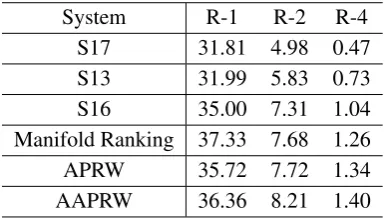
S17 31.81 4.98 0.47 S13 31.99 5.83 0.73 S16 35.00 7.31 1.04 Manifold Ranking 37.33 7.68 1.26 APRW 35.72 7.72 1.34 AAPRW 36.36 8.21 1.40 Table 5.3: System comparisons on task 3 of DUC 2003 (%).
Table5.3shows the evaluation results on task 3 of DUC 2003 according to ROUGE-1,2,4 recall, sorted also by ROUGE-2 recall in the ascending order.S13,S16andS17are the system IDs of the top performing systems in the official DUC 2003 evaluation, whose details are described in DUC publications (Zhou and Hovy, 2003;Chali et al.,
2003). Manifold Rankingis the method proposed
[image:8.595.320.513.454.563.2]de-scription and the sentences. APRW andAAPRW
are our methods.
From Tables 5.2 and 5.3, our method has the best ROUGE-2 score among all graph-based rank-ing methods for generic multi-document summa-rization, and it also has the best ROUGE-2 score for topic-focused multi-document summarization.
AAPRWhas the ROUGE-2 score10.06%on DUC
2004 task 2, which is 0.28% higher than the best system ICSISummreported by (Hong et al., 2014) and1.1%higher than the official best
sys-temCLASSY 04. WFS-NMF has the overall best
score on DUC 2004 task 2 due to the sentence feature selection and the weights on the document side, which is reported by (Wang et al.,2010; Al-guliev et al., 2013). AAPRW has the ROUGE-2 score8.21%on DUC 2003 task 3, which is0.53%
higher than Manifold Ranking and 0.9% higher than the official best system S16. In DUC 2004
AAPRW has 0.67% more ROUGE-2 score than
APRW and the gap is0.49%in DUC 2003, which proves the effectiveness of the adjustable transi-tion matrix in the random walk process. It is worth mentioning that our method has the best ROUGE-4 score on the DUC 2003 topic-focused summa-rization task.
We conducted the two-sided Wilcoxon signed-rank tests between each pair ofAAPRW and other methods. For the generic summarization in DUC 2004, our method provides a significant improve-ment over the official best systemCLASSY 04on ROUGE-2 (with p-value lower than0.05). For the query-focused summarization in DUC 2003, our method also provides a significant improvement overS17,S13andS16on ROUGE-2.
In order to further investigate the influences of the parameter in our proposed method, the damp-ing factor µ is varied from 0 to 1. Figures 5.1 and 5.2 show the ROUGE-1 and ROUGE-2 call curves of our method on the two data sets, re-spectively. We can see from the figures that the damping factor has an effect on the performance of multi-document summarization.
6 Conclusion and Future Work
In this paper we propose the adjustable affinity-preserving random walk for generic and topic-focused multi-document summarization, which deals with the saliency and diversity goals in a uni-fied framework. Experiments demonstrate the ef-fectiveness of our method.
0.0 0.2 0.4 0.6 0.8 1.0
µ
0.34 0.35 0.36 0.37 0.38 0.39
ROUGE-1
[image:9.595.310.524.66.223.2]DUC 2003 DUC 2004
Figure 5.1: ROUGE-1 recall scores vs. µof our method.
0.0 0.2 0.4 0.6 0.8 1.0
µ
0.06 0.07 0.08 0.09 0.10
ROUGE-2
DUC 2003 DUC 2004
Figure 5.2: ROUGE-2 recall scores vs. µof our method.
In the future work, we will focus on the self transition of adjustable affinity preserving random walk, which could be used to remove the redun-dancy between summary sentences.
Acknowledgements
We would like to thank our three anonymous reviewers for their helpful advice on various aspects of this work. This research is sup-ported by National Key Basic Research Pro-gram of China (No.2014CB340504) and Na-tional Natural Science Foundation of China (No.61375074,61273318). The contact authors for this paper are Zhifang Sui and Baobao Chang.
References
[image:9.595.309.525.284.438.2]based on evolutionary optimization algorithm. Ex-pert Systems with Applications, 40(5):1675–1689. Ricardo Baeza-Yates, Berthier Ribeiro-Neto, et al.
1999. Modern information retrieval, volume 463. ACM press New York.
Yllias Chali, Maheedhar Kolla, Nanak Singh, and Zhenshuan Zhang. 2003. The university of leth-bridge text summarizer at duc 2003. In the Pro-ceedings of the HLT/NAACL workshop on Automatic Summarization/Document Understanding Confer-ence (DUC 2003).
Minsu Cho, Jungmin Lee, and Kyoung Lee. 2010. Reweighted random walks for graph matching. Computer Vision–ECCV 2010, pages 492–505. John M Conroy, Judith D Schlesinger, Jade
Gold-stein, and Dianne P Oleary. 2004. Left-brain/right-brain multi-document summarization. In Proceed-ings of the Document Understanding Conference (DUC 2004).
John M Conroy, Judith D Schlesinger, Jeff Kubina, Pe-ter A Rankel, and Dianne P O’Leary. 2011. Classy 2011 at tac: Guided and multi-lingual summaries and evaluation metrics. TAC, 11:1–8.
John N Darroch and Eugene Seneta. 1965. On quasi-stationary distributions in absorbing discrete-time fi-nite markov chains. Journal of Applied Probability, 2(1):88–100.
Avinava Dubey, Soumen Chakrabarti, and Chiranjib Bhattacharyya. 2011. Diversity in ranking via resis-tive graph centers. InProceedings of the 17th ACM SIGKDD international conference on Knowledge discovery and data mining, pages 78–86. ACM.
G¨unes Erkan and Dragomir R Radev. 2004. Lexrank: Graph-based lexical centrality as salience in text summarization. Journal of Artificial Intelligence Research, 22:457–479.
Dan Gillick and Benoit Favre. 2009. A scalable global model for summarization. In Proceedings of the Workshop on Integer Linear Programming for Natu-ral Langauge Processing, pages 10–18. Association for Computational Linguistics.
Taher H Haveliwala. 2002. Topic-sensitive pagerank. InProceedings of the 11th international conference on World Wide Web, pages 517–526. ACM.
Kai Hong, John M Conroy, Benoit Favre, Alex Kulesza, Hui Lin, and Ani Nenkova. 2014. A repos-itory of state of the art and competitive baseline sum-maries for generic news summarization. InLREC, pages 1608–1616.
Glen Jeh and Jennifer Widom. 2003. Scaling person-alized web search. In Proceedings of the 12th in-ternational conference on World Wide Web, pages 271–279. ACM.
Chin-Yew Lin and Eduard Hovy. 2003. Auto-matic evaluation of summaries using n-gram co-occurrence statistics. In Proceedings of the 2003 Conference of the North American Chapter of the Association for Computational Linguistics on Hu-man Language Technology-Volume 1, pages 71–78. Association for Computational Linguistics.
Hui Lin and Jeff Bilmes. 2011. A class of submodu-lar functions for document summarization. In Pro-ceedings of the 49th Annual Meeting of the Associ-ation for ComputAssoci-ational Linguistics: Human Lan-guage Technologies-Volume 1, pages 510–520. As-sociation for Computational Linguistics.
Qiaozhu Mei, Jian Guo, and Dragomir Radev. 2010. Divrank: the interplay of prestige and diversity in information networks. In Proceedings of the 16th ACM SIGKDD international conference on Knowl-edge discovery and data mining, pages 1009–1018. Acm.
Ani Nenkova, Lucy Vanderwende, and Kathleen McK-eown. 2006. A compositional context sensitive multi-document summarizer: exploring the factors that influence summarization. In Proceedings of the 29th annual international ACM SIGIR confer-ence on Research and development in information retrieval, pages 573–580. ACM.
Karolina Owczarzak, John M Conroy, Hoa Trang Dang, and Ani Nenkova. 2012. An assessment of the accuracy of automatic evaluation in summariza-tion. In Proceedings of Workshop on Evaluation Metrics and System Comparison for Automatic Sum-marization, pages 1–9. Association for Computa-tional Linguistics.
Lawrence Page, Sergey Brin, Rajeev Motwani, and Terry Winograd. 1999. The pagerank citation rank-ing: Bringing order to the web. Technical report, Stanford InfoLab.
Eugene Seneta. 2006. Non-negative matrices and Markov chains. Springer Science & Business Me-dia.
Xiaojun Wan, Jianwu Yang, and Jianguo Xiao. 2007. Manifold-ranking based topic-focused multi-document summarization. In IJCAI, volume 7, pages 2903–2908.
Dingding Wang, Tao Li, and Chris Ding. 2010. Weighted feature subset non-negative matrix factor-ization and its applications to document understand-ing. InData Mining (ICDM), 2010 IEEE 10th Inter-national Conference on, pages 541–550. IEEE. Chuncheng Xiang, Baobao Chang, and Zhifang Sui.
2015. An ontology matching approach based on affinity-preserving random walks. In IJCAI, pages 1471–1478.
Liang Zhou and Eduard Hovy. 2003. Headline summa-rization at isi. InDocument Understanding Confer-ence (DUC-2003), Edmonton, Alberta, Canada. Xiaojin Zhu, Andrew B Goldberg, Jurgen Van Gael,