Statistical Script Learning with Multi-Argument Events
Karl Pichotta
Department of Computer Science The University of Texas at Austin [email protected]
Raymond J. Mooney
Department of Computer Science The University of Texas at Austin
Abstract
Scripts represent knowledge of stereotyp-ical event sequences that can aid text un-derstanding. Initial statistical methods have been developed to learn probabilis-tic scripts from raw text corpora; how-ever, they utilize a very impoverished rep-resentation of events, consisting of a verb and one dependent argument. We present a script learning approach that employs events with multiple arguments. Unlike previous work, we model the interactions between multiple entities in a script. Ex-periments on a large corpus using the task of inferring held-out events (the “narrative cloze evaluation”) demonstrate that mod-eling multi-argument events improves pre-dictive accuracy.
1 Introduction
Scriptsencode knowledge of stereotypical events, including information about their typical ordered sequences of sub-events and corresponding argu-ments (Schank and Abelson, 1977). The clas-sic example is the “restaurant script,” which en-codes knowledge about what normally happens when dining out. Such knowledge can be used to improve text understanding by supporting in-ference of missing actions and events, as well as resolution of lexical and syntactic ambiguities and anaphora (Rahman and Ng, 2012). For example, given the text “John went to Olive Garden and or-dered lasagna. He left a big tip and left,” an infer-ence that scripts would ideally allow us to make is “John ate lasagna.”
There is a small body of recent research on auto-matically learning probabilistic models of scripts from large corpora of raw text (Manshadi et al., 2008; Chambers and Jurafsky, 2008; Chambers and Jurafsky, 2009; Jans et al., 2012). However,
this work uses a very impoverished representation of events that only includes a verb and a single de-pendent entity. We propose a more complex multi-argument event representation for use in statistical script models, capable of directly capturing inter-actions between multiple entities. We present a method for learning such a model, and provide ex-perimental evidence that modeling entity interac-tions allows for better prediction of events in docu-ments, compared to previous single-entity “chain” models. We also compare to a competitive base-line not used in previous work, and introduce a novel evaluation metric.
2 Background
The idea of representing stereotypical event se-quences for textual inference originates in the seminal work of Schank and Abelson (1977). Early scripts were manually engineered for spe-cific domains; however, Mooney and DeJong (1985) present an early knowledge-based method for learning scripts from a single document. These early scripts (and methods for learning them) were non-statistical and fairly brittle.
Chambers and Jurafsky (2008) introduced a method for learning statistical scripts that, using a much simpler event representation that allows for efficient learning and inference. Jans et al. (2012) use the same simple event representation, but in-troduce a new model that more accurately predicts test data. These methods only model the actions of a single participant, called theprotagonist. Cham-bers and Jurafsky (2009) extended their approach to the multi-participant case, modeling the events in which all of the entities in a document are volved; however, their method cannot represent in-teractions between multiple entities.
Balasubramanian et al. (2012; 2013) describe the Rel-gram system, a Markov model similar to that of Jans et al. (2012), but with tuples instead of (verb, dependency) pairs. Our approach is
ilar, but instead of modeling a distribution over co-occurring verbs and nominal arguments, we model interactions between entities directly by incorpo-rating coreference information into the model.
Previous statistical script learning systems pro-ceed broadly as follows. For a documentD:
1. Run a dependency parser onD, to match up verbs with their argument NPs.
2. Run a coreference resolver onDto determine which NPs likely refer to the same entity. 3. Construct a sequence of event objects, using
syntactic and coreference information. One can then build a statistical model of the event sequences produced by Step 3. Such a model may be evaluated using the narrative cloze evaluation, described in Section 4.1, in which we hold out an event from a sequence and attempt to infer it.
The major difference between the current work and previous work is that the event sequences pro-duced in Step 3 are of a different sort from those in other models. Our events are more structured, as described in Section 3.1, and we produce one event sequence per document, instead of one event sequence per entity. This requires a different sta-tistical model, as described in Section 3.2.
3 Script Models
In Section 3.1, we describe the multi-argument events we use as the basis of our script models. Section 3.2 describes a script model using these events, and Section 3.3 describes the baseline sys-tems to which we compare.
3.1 Multi-Argument Events
Statistical scripts are models of stereotypical se-quences of events. In Chambers and Juraf-sky (2008; 2009) and Jans et al. (2012), events are (verb, dependency) pairs, forming “chains,” grouped according to the entity involved. For ex-ample, the text
(1) Mary emailed Jim and he responded to her immediately.
yields two chains. First, there is a chain for Mary: (email, subject)
(respond, object)
indicating that Mary was the subject of an email-ing event and the object of a responding event. Second, there is a chain for Jim:
(email, object) (respond, subject)
indicating that Jim was the object of anemailing event and the subject of arespondingevent. Thus, one document produces many chains, each cor-responding to an entity. Note that a single verb may produce multiple pair events, each present in a chain corresponding to one of the verb’s ar-guments. Note also that there is no connection between the different events produced by a verb: there is nothing connecting (email, subject) in Mary’s chain with (email, object) in Jim’s chain.
We propose a richer event representation, in which a document is represented as a single se-quence of event tuples, the arguments of which are entities. Each entity may be mentioned in many events, and, unlike previous work, each event may involve multiple entities. For example, sentence (1) will produce a single two-event sequence, the first event representing Mary emailing Jim, and the second representing Jim responding to Mary.
Formally, an entity is represented by a con-stant, and noun phrases are mapped to entities, where two noun phrases are mapped to the same constant if and only if they corefer. A multi-argument eventis a relational atomv(es, eo, ep),
where v is a verb lemma, andes, eo, and ep are
possibly-null entities. The first entity, es, stands
in a subject relation to the verbv; the second,eo,
is the direct object of v; the third ep stands in
a prepositional relation to v. One of these enti-ties isnull(written as “·”) if and only if no noun phrase stands in the appropriate relation tov. For example, Mary hopped would be represented as hop(mary,·,·), whileMary gave the book to John would begive(mary,book,john). In this formula-tion, Example (1) produces the sequence
email(m,j,·)
respond(j,m,·)
3.2 Multi-argument Statistical Scripts
We now describe our script model. Section 3.2.1 describes our method of estimating a joint prob-ability distribution over pairs of events, modeling event co-occurrence, and Section 3.2.2 shows how this co-occurrence probability can be used to infer new events from a set of known events.
3.2.1 Estimating Joint Probabilities
Suppose we have a sequence of multi-argument events, each of which is a verb with entities as ar-guments. We are interested in predicting which event is most likely to have happened at some point in the sequence. Our model will require a conditional probability P(a|a0), the probability
of seeing event a after event a0, given we have
observed a0. However, as described below,
di-rectly estimating this probability is more compli-cated than in previous work because events now have additional structure.
By definition, we have
P(a2|a1) = PP(a(1a, a2) 1)
where P(a1, a2) is the probability of seeing a1 and a2, in order. The most straightforward way to estimateP(a1, a2) is, if possible, by counting the number of times we observe a1 and a2 co-occurring and normalizing the function to sum to 1 over all pairs (a1, a2). For Chambers and Ju-rafsky (2008; 2009) and Jans et al. (2012), such a Maximum Likelihood Estimate is straightforward to arrive at: events are (verb, dependency) pairs, and two events co-occur when they are in the same event chain, relating to the same entity (Jans et al. (2012) further require a1 anda2 to be near each other). One need simply traverse a training corpus and count the number of times each pair(a1, a2) co-occurs. The Rel-grams of Balasubramanian et al. (2012; 2013) admit a similar strategy: to arrive at a joint distribution of pairwise co-occurrence, one can simply count co-occurrence of ground re-lations in a corpus and normalize.
However, given two multi-argument events of the formv(es, eo, ep), this strategy will not suffice.
For example, if during training we observe the two co-occurring events
(2) ask(mary,bob,question)
answer(bob,·,·)
we would like this to lend evidence to the co-occurrence of events ask(x, y, z) and
Algorithm 1Learning with entity substitution 1: fora1, a2 ∈evsdo
2: N(a1, a2)←0 3: end for
4: forD∈documentsdo
5: fora1, a2∈coocurEvs(D)do 6: forσ ∈subs(a1, a2)do 7: N(σ(a1), σ(a2)) += 1
8: end for
9: end for
10: end for
answer(y,·,·) for all distinct entities x, y, andz. If we were to simply keep the entities as they are and calculate raw co-occurrence counts, we would get evidence only for x = mary, y=bob, andz=question.
One approach to this problem would be to de-ploy one of many previously described Statistical Relational Learning methods, for example Logi-cal Hidden Markov Models (Kersting et al., 2006) or Relational Markov Models (Anderson et al., 2002). These methods can learn various statisti-cal relationships between relational logistatisti-cal atoms with variables, of the sort considered here. How-ever, we investigate a simpler option.
The most important relationship between the entities in two multi-argument events concerns their overlapping entities. For example, to de-scribe the relationship between the three entities in (2), it is most important to note that the object of the first event is identical with the subject of the second (namely, both arebob). The identity of the non-overlapping entitiesmaryandquestionis not important for capturing the relationship between the two events.
We note that two multi-argument events v(es, eo, ep)andv0(e0s, e0o, e0p), share at most three
entities. We thus introduce four variablesx, y, z, and O. The three variables x, y, and z repre-sent arbitrary distinct entities, and the fourth, O, stands for “Other,” for entities not shared between the two events. We can rewrite the entities in our two multi-argument events using these variables, with the constraint that two identical (i.e. corefer-ent) entities must be mapped to the same variable in{x, y, z}, and no two distinct entities may map to the same variable in{x, y, z}. This formulation simplifies calculations while still capturing pair-wise entity relationships between events.
learn-ing method. This populates a co-occurrence matrix N, where entry N(a1, a2) gives the co-occurrence count of events a1 anda2. The vari-able evs in line 1 is the set of all events in our model, which are of the formv(es, eo, ep), withv
a verb lemma and es, eo, ep ∈ {x, y, z, O}. The
variable documents in line 4 is the collection of documents in our training corpus. The func-tioncooccurEvsin line 5 takes a documentD and returns all ordered pairs of co-occurring events inD, where, following the 2-skip bigram model of Jans et al. (2012), and similar to Balasubrama-nian et al. (2012; 2013), two eventsa1 anda2are said to co-occur if they occur in order, in the same document, with at most two intervening events be-tween them.1 The function subsin line 6 takes
two events and returns all variable substitutionsσ mapping from entities mentioned in the eventsa1 anda2 to the set{x, y, z, O}, such that two coref-erent entities map to the same element of{x, y, z}. A substitutionσ applied to an eventv(es, eo, ep),
as in line 7, is defined as v(σ(es), σ(eo), σ(ep)),
with the null entity mapped to itself.
Once we have calculatedN(a1, a2)using Algo-rithm 1, we may defineP(a1, a2) for two events a1 and a2, giving an estimate for the probability of observinga2occurring aftera1, as
P(a1, a2) = P N(a1, a2)
a0
1,a02N(a
0
1, a02). (3) We may then define the conditional probability of seeinga2aftera1, given an observation ofa1:
P(a2|a1) = PP(a1, a2)
a0P(a1, a0)
= PN(a1, a2)
a0N(a1, a0). (4)
3.2.2 Inferring Events
Suppose we have a sequence of multi-argument events extracted from a document. A natural task for a statistical script model is to infer what other events likely occurred, given the events explic-itly stated in a document. Chambers and Jurafsky (2008; 2009) treat the events involving an entity as an unordered set, inferring the most likely ad-ditional event, with no relative ordering between the inferred event and known events. We adopt the model of Jans et al. (2012), which was demon-strated to give better empirical performance. This
1Other notions of co-occurrence could easily be
substi-tuted here.
model takes an ordered sequence of events and a position in that sequence, and guesses events that likely occurred at that position. In that work, events are (verb, dependency) pairs, and an event sequence consists of all such pairs involving a par-ticular entity. We use this model in the multi-argument event setting, in which a document pro-duces a single sequence of multi-argument events. LetAbe an ordered list of events, and letpbe an integer between1and|A|, the length ofA. Fori= 1, . . . ,|A|, define ai to be the ith element of A.
We follow Jans et al. (2012) by scoring a candidate eventaaccording to its probability of following all of the events before positionp, and preceding all events after positionp. That is, we rank candidate eventsaby maximizingS(a), defined as
S(a) = p−1 X
i=1
logP(a|ai) +
|A|
X
i=p
logP(ai|a) (5)
with conditional probabilities P(a|a0) calculated
using (4). Each event in ai ∈ A independently
contributes to a candidatea’s score; the ordering betweenaandaiis taken into account, but the
or-dering between the different events ai ∈ Adoes
not directly affecta’s score.
3.3 Baseline Systems
We describe the baseline systems against which we compare the performance of the multi-argument script system described in section 3.2. These systems infer new events (either multi-argument or pair events) given the events con-tained in a document.
Performance of these systems is measured using the narrative cloze task, in which we hold out a sin-gle event (either a multi-argument or pair event), and rate a system by its ability to infer this event, given the other events in a document. The narra-tive cloze task is described in detail in Section 4.1.
3.3.1 Random Model
The simplest baseline we compare to is the ran-dom baseline, which outputs randomly selected events observed during training. This model can guess either multi-argument or pair events.
3.3.2 Unigram Model
over events, this baseline corresponds to a bag-of-words unigram model. In this model, events are assumed to occur independently, drawn from a sin-gle distribution. This model can be used to guess either multi-argument or pair events.
3.3.3 Single Protagonist Model
We refer to the system of Jans et al. (2012) as the
single protagonist system. This model takes a single sequence of (verb, dependency) pair events, all relating to a single entity. It then produces a list of pair events, giving the model’s top pre-dictions for additional events involving the entity. This model maximizes the objective given in (5), with the sequenceA(and the candidate guessesa) comprised of pair events.
3.3.4 Multiple Protagonist Model
The multiple protagonist system infers multi-argument events. While this method is not de-scribed in previous work, it is the most direct way of guessing a full multi-argument event using a single protagonist script model.
The multiple protagonist system uses a single-protagonist model, which models pair events, to predict multi-argument events, given a sequence of known multi-argument events. Suppose we have a non-empty setE of entities mentioned in the known events. We describe the most direct method of using a single-protagonist system to in-fer additional multi-argument events involvingE. A multi-argument eventa=v(es, eo, ep)
repre-sents three pairs: (v, es),(v, eo), and(v, ep). The
multiple protagonist model scores an eventa ac-cording to the score the single protagonist model assigns to these three pairs individually.
For entitye∈E in some multi-argument event in a document, we first extract the sequence of (verb, dependency) pairs corresponding toefrom all known multi-argument events. For a pair d, we calculate the score Se(d), the score the
sin-gle protagonist system assigns the paird, given the known pairs corresponding toe. Ifehas no known pairs corresponding to it (in the cloze evaluation described below, this will happen ifeoccurs only in the held-out event), we fall back to calculating Se(d)with a unigram model, as described in Sec-tion 3.3.2, over (verb, dependency) pair events.
We then rank a multi-argument event a =
v(es, eo, ep), withes, eo, ep ∈E, with the
follow-ing objective function:
M(a) =Ses((v,subj)) +Seo((v,obj))+
Sep((v,prep)) (6)
where, for null entitye, we defineSe(d) = 0for alld. In the cloze evaluation,Ewill be the entities in the held-out event. Each entity inacontributes independently to the score M(a), based on the known (verb, dependency) pairs involving that en-tity. This model scores a multi-argument eventa by combining one independent single-protagonist model for every entity ina.
This model is similar to the multi-participant narrative schemas described in Chambers and Ju-rafsky (2009), but whereas they infer bare verbs, we infer an entire multi-argument event.
4 Evaluation 4.1 Evaluation Task
We follow previous work in using the narrative cloze task to evaluate statistical scripts (Chambers and Jurafsky, 2008; Chambers and Jurafsky, 2009; Jans et al., 2012). The task is as follows: given a sequence of eventsa1, . . . , anfrom a document,
hold out some eventap and attempt to predict that
event, given the other events in the sequence. As we cannot automatically evaluate the prediction of truly unmentioned events in a document, this eval-uation acts as a straightforward proxy.
In the aforementioned work, the cloze task is to guess a pair event, given the other events in which the held-out pair’s entity occurs. In Section 4.2.2, we evaluate directly on this task of guess-ing pair events. However, in Section 4.2.1, we evaluate on the task of guessing a multi-argument event, given all other events in a document and the entities mentioned in the held-out event. This is, we argue, the most natural way to adapt the cloze evaluation to the multi-argument event setting: in-stead of guessing a held-out pair event based on the other events involving its lone entity, we will guess a held-out multi-argument event based on the other events involving any of its entities.
held-out event shares an entity with another event, this remains true after rewriting.
We perform entity rewriting relative to a single held-out event, proceeding as follows:
• Any entity in the held-out event that is men-tioned at least once in another event gets rewritten consistently to one of x, y, or z, such that distinct entities never get rewritten to the same variable.
• Any entity mentioned only in the held-out event is rewritten asO.
• All entities not present in the held-out event are rewritten asO.
This simplification removes structure from the original sequence, but retains the important pair-wise entity relationships between the held-out event and the other events.
4.2 Experimental Evaluation
For each document, we use the Stanford depen-dency parser (De Marneffe et al., 2006) to get syn-tactic information about the document; we then use the Stanford coreference resolution engine (Raghunathan et al., 2010) to get (noisy) equiva-lence classes of coreferent noun phrases in a doc-ument.2 We train on approximately 1.1M
arti-cles from years 1994-2006 of the NYT portion of the Gigaword Corpus, Third Edition (Graff et al., 2007), holding out a random subset of the arti-cles from 1999 for development and test sets. Our test set consists of 10,000 randomly selected held-out events, and our development set is 500 disjoint randomly selected held-out events. To remove du-plicate documents, we hash the first 500 characters of each article and remove any articles with hash collisions. We use add-one smoothing on all joint probabilities. To reduce the size of our model, we remove all events that occur fewer than 50 times.3
We evaluate performance using the following two metrics:
1. Recall at 10: Following Jans et al. (2012), we measure performance by outputting the top 10 guesses for each held-out event and calculating the percentage of such lists
con-2We use version 1.3.4 of the Stanford CoreNLP system. 3A manual inspection reveals that the majority of these
removed events come from noisy text or parse errors.
taining the correct answer.4 This value will
be between0and1, with1indicating perfect system performance.
2. Accuracy: A multi-argument event
v(es, eo, ep) has four components; a pair
event has two components. For a held-out event, we may judge the accuracy of a system’s top guess by giving one point for getting each of its components correct and dividing by the number of possible points. We average this value over the test set, yielding a value between 0 and 1, with 1
indicating perfect system performance. This is a novel evaluation metric for the script learning task.
These metrics target a system’s most confident predicted events: we argue that a script system is best evaluated by its top inferences.
In Section 4.2.1, we evaluate on the task of in-ferring multi-argument events. In Section 4.2.2, we evaluate on the task of guessing pair events.
4.2.1 System Comparison on Multi-argument Events
We first compare system performance on inferring multi-argument events, evaluated on the narrative cloze task as described in Section 4.1, using the corpora and metrics described in Section 4.2. We compare against three baselines: the uninformed
randombaseline from Section 3.3.1, theunigram
system from 3.3.2, and themultiple protagonist
system from Section 3.3.4.
The joint system guesses the held-out event, given the other events in the document that involve the entities in that held-out tuple. The system or-ders candidate events a by their scoresS(a), as given in Equation (5). This is the primary sys-tem described in this paper, modeling full multi-argument events directly.
Table 1 gives the recall at 10 (“R@10”) and ac-curacy scores for the different systems. The uni-gram system is quite competitive, achieving per-formance comparable to the multiple protagonist system on accuracy, and superior performance on recall at 10.
Evaluating by the recall at 10 metric, the joint system provides a 2.9% absolute (13.2% relative) improvement over the unigram system, and a 3.6%
4Jans et al. (2012) instead use recall at 50, but we observe,
Method R@10 Accuracy
Random 0.001 0.334
Unigram 0.216 0.507
Multiple Protagonist 0.209 0.504
[image:7.595.81.283.61.139.2]Joint 0.245 0.549
Table 1: Results for multi-argument events.
absolute (17.2% relative) improvement over the multiple protagonist system. These differences are statistically significant (p < 0.01) by McNe-mar’s test. By accuracy, the joint system provides a 4.2% absolute (8.3% relative) improvement over the unigram model, and a 4.5% absolute (8.9% relative) improvement over the multiple protago-nist model. Accuracy differences are significant (p <0.01) by a Wilcoxon signed-rank test.
These results provide evidence that directly modeling full multi-argument events, as opposed to modeling chains of (verb, dependency) pairs for single entities, allows us to better infer held-out verbs with all participating entities.
4.2.2 System Comparison on Pair Events
In Section 4.2.1, we adapted a baseline pair-event system to the task of guessing multi-argument events. We may also do the converse, adapting our multi-argument event system to the task of guess-ing the simpler pair events. That is, we infer a full multi-argument event and extract from it a (sub-ject,verb) pair relating to a particular entity. This allows us to compare directly to previously pub-lished methods.
Therandom,unigram, andsingle protagonist
systems are pair-event systems described in Sec-tions 3.3.1, 3.3.2, and 3.3.3, respectively. The
joint pairsystem takes the multi-argument events guessed by the joint system of Section 4.2.1 and converts them to pair events by discarding any in-formation not related to the target entity; that is, if the held-out pair event relates to an entitye, then every occurrence ofeas an argument of a guessed multi-argument event will be converted into a sin-gle pair event, scored identically to its original multi-argument event. Ties are broken arbitrarily.
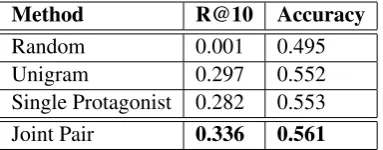
Table 2 gives the comparative results for these four systems. The test set is constructed by ex-tracting one pair event from each of the 10,000 multi-argument events in the test set used in Sec-tion 4.2.1, such that the extracted pair event relates to an entity with at least one additional known pair
Method R@10 Accuracy
Random 0.001 0.495
Unigram 0.297 0.552
Single Protagonist 0.282 0.553
Joint Pair 0.336 0.561
Table 2: Results for pair events.
event. Evaluating by recall at 10, the joint sys-tem provides a 3.9% absolute (13.1% relative) im-provement over the unigram baseline, and a 5.4% absolute (19.1% relative) improvement over the single protagonist system. These differences are significant (p < 0.01) by McNemar’s test. By accuracy, the joint system provides a 0.9% abso-lute (1.6% relative) improvement over the unigram model, and a 0.8% absolute (1.4% relative) im-provement over the single protagonist model. Ac-curacy differences are significant (p <0.01) by a Wilcoxon signed-rank test.
These results indicate that modeling multi-argument event sequences allows better inference of simpler pair events. These performance im-provements may be due to the fact that the joint model conditions on information not representable in the single protagonist model (namely, all of the events in which a multi-argument event’s entities are involved).
5 Related Work
The procedural encoding of common situations for automated reasoning dates back decades. The frames of Minsky (1974), schemas of Rumelhart (1975), and scripts of Schank and Abelson (1977) are early examples. These models use quite com-plex representations for events, with many differ-ent relations between evdiffer-ents. They are not statis-tical, and use separate models for different scenar-ios (e.g. the “restaurant script” is different from the “bank script”). Generally, they require humans to encode procedural information by hand; see, however, Mooney and DeJong (1985) for an early method for learning scripts automatically from a document. Miikkulainen (1990; 1993) gives a hi-erarchical Neural Network system which stores sequences of events from text in episodic memory, capable of simple question answering.
[image:7.595.322.514.62.137.2]help alleviate the bottleneck of the knowledge-engineering required for traditionally conceived script systems. These systems are precision-oriented: they create small, highly accurate scripts for very limited scenarios. The current work, in contrast, focuses on building high-recall mod-els of general event sequences. There are also a number of systems addressing the related problem of modeling domain-specific human-human dia-log for building diadia-log systems (Bangalore et al., 2006; Chotimongkol, 2008; Boyer et al., 2009).
There have been a number of recent approaches to learning statistical scripts. Chambers and Ju-rafsky (2008) and Jans et al. (2012) give methods for learning models of (verb, dependency) pairs, as described above. Manshadi et al. (2008) give an n-gram model for sequences of verbs and their patients. McIntyre and Lapata (2009; 2010) use script objects learned from corpora of fairy tales to automatically generate stories. Chambers and Jurafsky (2009) extend their previous model to incorporate multiple entities, but do not directly model the different arguments of an event. Bam-man et al. (2013) learn latent character personas from film summaries, associating character types with stereotypical actions; they focus on identify-ing persona types, rather than event inference.
Manshadi et al. (2008) and Balasubramanian et al. (2012; 2013) give approaches similar to the current work for modeling sequences of events as n-grams. These methods differ from the current work in that they do not model entities directly, in-stead modeling co-occurrence of particular nouns standing as arguments to particular verbs. Lewis and Steedman (2013) build clusters of relations similar to these events, finding such clusters help-ful to question answering and textual inference.
There has also been recent interest in the related problem of automatically learning event frames (Bejan, 2008; Chambers and Jurafsky, 2011; Che-ung et al., 2013; Chambers, 2013). These ap-proaches focus on identifying frames for infor-mation extraction tasks, as opposed to inferring events directly. Balasubramanian et al. (2013) give an event frame identification method, developed in parallel with the current work, using sequences of tuples similar to our multi-argument events, noting coherence issues with pair events. Their formu-lation differs from ours primarily in that they do not incorporate coreference information into their event co-occurrence distribution, and evaluate
us-ing human judgments of frame coherence rather than a narrative cloze test.
6 Future Work
We have evaluated only one type of multi-argument event inference, in which a script infers an event given a set of entities and the events in-volving those entities. We claim that this is the most natural adaptation of the cloze evaluation to the multi-argument event setting. However, other types of inferences would be useful as well for question-answering. Additional script inferences, and their applications to question answering, are worth investigating more fully.
The evaluation methodology used here has two serious benefits: it is totally automatic, and it does not require labeled data. The cloze evaluation is intuitively reasonable: a good script system should be able to predict stated events as having taken place. Basic pragmatic reasoning, however, tells us that the most obvious inferable events are not typically stated in text. This evaluation thus fails to capture some of the most important common-sense inferences. Further investigation into evalu-ation methodologies for script systems is needed.
7 Conclusion
We described multi-argument events for statisti-cal scripts, which can directly encode the pair-wise entity relationships between events in a doc-ument. We described a script model that can han-dle the important aspects of the additional com-plexity introduced by these events, and a baseline model that can infer multi-argument events using single-protagonist chains instead of directly mod-eling full relations. We introduced the novel uni-gram baseline model for comparison, as well as the novel accuracy metric, and provided empir-ical evidence that modeling full multi-argument events provides more predictive power than mod-eling event chains individually.
Acknowledgments
References
Corin R Anderson, Pedro Domingos, and Daniel S Weld. 2002. Relational Markov models and their application to adaptive web navigation. In Proceed-ings of the Eighth ACM SIGKDD International Con-ference on Knowledge Discovery and Data Mining (KDD-2002), pages 143–152.
Niranjan Balasubramanian, Stephen Soderland, Mausam, and Oren Etzioni. 2012. Rel-grams: a probabilistic model of relations in text. In Proceed-ings of the Joint Workshop on Automatic Knowledge Base Construction and Web-scale Knowledge Extraction at NAACL-HLT 2012 (AKBC-WEKEX 2012), pages 101–105.
Niranjan Balasubramanian, Stephen Soderland, Mausam, and Oren Etzioni. 2013. Generating coherent event schemas at scale. In Proceedings of the 2013 Conference on Empirical Methods in Natural Language Processing (EMNLP-2013). David Bamman, Brendan O’Connor, and Noah A.
Smith. 2013. Learning latent personas of film char-acters. In Proceedings of the 51st Annual Meet-ing of the Association for Computational LMeet-inguistics (ACL-13), pages 352–361.
Srinivas Bangalore, Giuseppe Di Fabbrizio, and Amanda Stent. 2006. Learning the structure of task-driven human–human dialogs. In Proceedings of the 21st International Conference on Computational Linguistics and 44th Annual Meeting of the Associa-tion for ComputaAssocia-tional Linguistics (COLING/ACL-06), pages 201–208.
Cosmin Adrian Bejan. 2008. Unsupervised discov-ery of event scenarios from texts. InProdeedings of the 21st International Florida Artificial Intelligence Research Society Conference (FLAIRS-2008), pages 124–129.
Kristy Elizabeth Boyer, Robert Phillips, Eun Young Ha, Michael D. Wallis, Mladen A. Vouk, and James C. Lester. 2009. Modeling dialogue structure with adjacency pair analysis and Hidden Markov Models. InProceedings of Human Language Tech-nologies: The Conference of the North American Chapter of the Association for Computational Lin-guistics, Companion Volume: Short Paper (NAACL-HLT-09 Short), pages 49–52.
Nathanael Chambers and Daniel Jurafsky. 2008. Un-supervised learning of narrative event chains. In Proceedings of the 46th Annual Meeting of the As-sociation for Computational Linguistics (ACL-08), pages 789–797.
Nathanael Chambers and Dan Jurafsky. 2009. Un-supervised learning of narrative schemas and their participants. In Joint Conference of the 47th An-nual Meeting of the Association for Computational Linguistics and the 4th International Joint Confer-ence on Natural Language Processing of the Asian
Federation of Natural Language Processing (ACL-IJCNLP), pages 602–610.
Nathanael Chambers and Dan Jurafsky. 2011. Template-based information extraction without the templates. InProceedings of the 49th Annual Meet-ing of the Association for Computational LMeet-inguis- Linguis-tics: Human Language Technologies (ACL-HLT-11), pages 976–986.
Nathanael Chambers. 2013. Event schema induc-tion with a probabilistic entity-driven model. In Proceedings of the 2013 Conference on Empirical Methods in Natural Language Processing (EMNLP-2013).
Jackie Chi Kit Cheung, Hoifung Poon, and Lucy Van-derwende. 2013. Probabilistic frame induction. In Proceedings of the 2013 Conference of the North American Chapter of the Association for Computa-tional Linguistics: Human Language Technologies (NAACL-13).
Ananlada Chotimongkol. 2008. Learning the struc-ture of task-oriented conversations from the corpus of in-domain dialogs. Ph.D. thesis, Carnegie Mellon University.
Marie-Catherine De Marneffe, Bill MacCartney, Christopher D Manning, et al. 2006. Generat-ing typed dependency parses from phrase structure parses. In Proceedings of the 5th International Conference on Language Resources & Evaluation (LREC-2006), volume 6, pages 449–454.
David Graff, Junbo Kong, Ke Chen, and Kazuaki Maeda. 2007. English Gigaword Third Edition. Linguistic Data Consortium.
Bram Jans, Steven Bethard, Ivan Vuli´c, and Marie Francine Moens. 2012. Skip n-grams and ranking functions for predicting script events. InProceedings of the 13th Conference of the Euro-pean Chapter of the Association for Computational Linguistics (EACL-12), pages 336–344.
Kristian Kersting, Luc De Raedt, and Tapani Raiko. 2006. Logical Hidden Markov Models. Journal of Artificial Intelligence Research, 25:425–456. Mike Lewis and Mark Steedman. 2013. Combined
distributional and logical semantics. Transactions of the Association for Computational Linguistics, 1:179–192.
Boyang Li, Stephen Lee-Urban, Darren Scott Appling, and Mark O Riedl. 2012. Crowdsourcing narrative intelligence. Advances in Cognitive Systems, 2:25– 42.
Neil McIntyre and Mirella Lapata. 2009. Learn-ing to tell tales: A data-driven approach to story generation. In Joint Conference of the 47th An-nual Meeting of the Association for Computational Linguistics and the 4th International Joint Confer-ence on Natural Language Processing of the Asian Federation of Natural Language Processing (ACL-IJCNLP), pages 217–225.
Neil McIntyre and Mirella Lapata. 2010. Plot induc-tion and evoluinduc-tionary search for story generainduc-tion. In Proceedings of the 48th Annual Meeting of the As-sociation for Computational Linguistics (ACL-10), pages 1562–1572.
Risto Miikkulainen. 1990. DISCERN: A Distributed Artificial Neural Network Model of Script Process-ing and Memory. Ph.D. thesis, University of Cali-fornia.
Risto Miikkulainen. 1993. Subsymbolic Natural Lan-guage Processing: An Integrated Model of Scripts, Lexicon, and Memory. MIT Press, Cambridge, MA. Marvin Minsky. 1974. A framework for representing
knowledge. Technical report, MIT-AI Laboratory. Raymond J. Mooney and Gerald F. DeJong. 1985.
Learning schemata for natural language processing. InProceedings of the Ninth International Joint Con-ference on Artificial Intelligence (IJCAI-85), pages 681–687, Los Angeles, CA, August.
Karthik Raghunathan, Heeyoung Lee, Sudarshan Ran-garajan, Nathanael Chambers, Mihai Surdeanu, Dan Jurafsky, and Christopher Manning. 2010. A multi-pass sieve for coreference resolution. In Proceed-ings of the Conference on Empirical Methods in Nat-ural Language Processing (EMNLP-2010), pages 492–501.
Altaf Rahman and Vincent Ng. 2012. Resolving complex cases of definite pronouns: the Winograd schema challenge. InProceedings of the 2012 Con-ference on Empirical Methods in Natural Language Processing and Computational Natural Language Learning (EMNLP-CoNLL-12), pages 777–789. Michaela Regneri, Alexander Koller, and Manfred
Pinkal. 2010. Learning script knowledge with web experiments. In Proceedings of the 48th Annual Meeting of the Association for Computational Lin-guistics (ACL-10), Uppsala, Sweden, July.
David Rumelhart. 1975. Notes on a schema for sto-ries. Representation and Understanding: Studies in Cognitive Science.