THE PHENOMENON OF LAND-USE CHANGE AND THE
APPLICATION OF CORPORATE SOCIAL RESPONSIBILITY
(CSR) BY SUPPLEMENTARY ACCOMMODATIONS IN
NORTH KUTA REGENCY, BALI, INDONESIA
Komang Ratih Tunjungsari, A.A. Ayu Arun Suwi Arianty.International Bali Tourism Institute.
[email protected], [email protected].
ABSTRACT
The phenomenon in North Kuta is the tourist accomodations such as restaurants, villas, and housing residents, furthermore said with supplementary accomodations, are increasingly growing in number. This issue of tourism development and land-use change brought some impacts, especially in the environmental, social and economical issue. This research will discuss about the CSR concept in order to balance the effect of the land -use change especially in social and economic issues. The aim of this research is to discover the phenomenon of land use change in North Kuta regency and the application of CSR in developing and supporting local community. We use observation, questionnaires, and interview to data collection instruments or research instruments. Based on our research, we found that, the supplementary accommodations and restaurants in North Kuta regency are applied the CSR’s programs, still they do not provide structured CSR programs as the hotels provide.
Keywords: Bali, North Kuta, Tourism development, CSR, Land-use change, Sustainable Tourism
Introduction
research will discuss about the CSR concept in order to balance the effect of the land -use change especially in social and economic issues.
The aim of this research is to discover the phenomenon of land use change in North Kuta regency and the application of CSR in developing and supporting local community, since the land-use change seems increase each year. Besides, the study will explore the concern of tourism businesses toward local in order to held sustainable tourism in North Kuta. The purpose of this research locus in North Kuta because of North Kuta area still has considerable natural land that can be transformed from green rice-fields into hotels or restaurants. Besides, North Kuta area is in strategic location, where we can go to Ngurah Rai Airport and reachable from the tourist destination, it makes North Kuta as a good option as an area to locate tourist accommodation
Literature Review
Tourism in Bali and Badung Regency
The tourism industry in Bali takes nearly two-third of the economic matters and agriculture fall of until less then 20%. (Vickers, 2012, p.280). Badung Regency is one of the touristic places in Bali that is located in the central of Bali. Badung has an area of 418.52 km2which is divided into smaller governmental area as the district and the sub districts such as: North Badung (Petang and Abiansemal), Center Badung (Mengwi), and South Badung (Kuta, North Kuta, and South Kuta) (Bureau of Indonesian Republic Statistic, 2015). As the tourism development in Bali during the 1980’s by the French consultancy firm, Kuta, South Kuta, and Sanur were designated destination for large-scale tourism (Yamashita, 2003, p.53).
The main source of income in Badung Regency comes from the tourism industry. As a popular tourist destination, several international accommodations were developed, such as restaurants, hotels, villas, bars, and travel agency. Kuta and Nusa Dua are very famed as a tourist destination. Where Kuta is located in Kuta District and Nusa Dua is located in South Kuta. (Bureau of Indonesian Republic Statistic, 2015).
Land-use change Issue in Bali
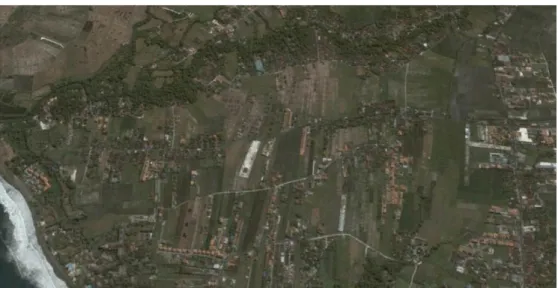
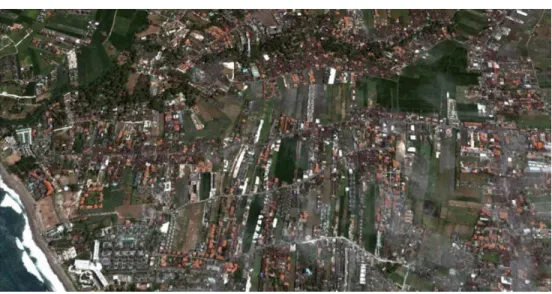
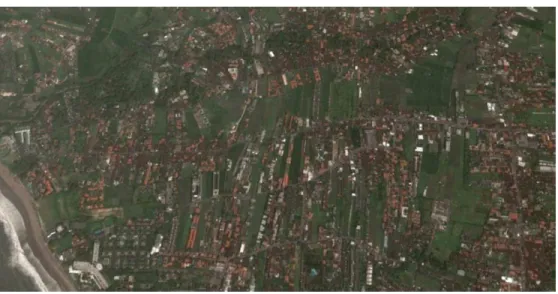
However, not only the companies should be addressed to concern the issue of the land-use change, because the owner also can be the agent of the change. As it is said by Kustiawan (1997), that land owners will maximize the use of their land if the activities in the land are considered unproductive and unprofitable by replacing the activities into more productive and profitable activities. In addition, the competition occurs for the utilization of the most profitable activities, and it turns out into land-use change. Sunarta (n.d) found that North Kuta became the widest changes of land transformation, especially in the Southern side (Kerobokan Kelod). The paddy fields that changed into building areas were generally dominated by tourist accommodations. Based on Sunarta’s research, the land transformation in North Kuta between 2003 until 2008 ( during 5 years) was 690.64 hectares is bigger number than the land transformation between eleven years ( 1992- 2003) was 571.62 hectares (Sunarta, DR. I.N., n.d). The changes of the land use will be more clearly shown in the Figure 1, 2, 3, 4, 5 and 6 below in the result.
Supplementary Accommodations and Restaurant
According to Tsyganok, (n.d) Accommodation industry can be divided into three features such as traditional (hotel) accommodation, supplementary accommodation and new accommodation concepts. These three types of accommodation differed by its services, namely in supplementary accommodation (such as: dormitories, villas, youth hostels and travellers lodge and inns) not necessarily provide the hotel services. Poudel (2013, p. 4-5) found that the supplementary accommodations are more economic for the visitor reasoning for the cost. Beside, this type of accommodation services enable guest to interact with the local community and culture easily. While the type of restaurant according to the owner (Economic Planning Group, 2005, p. 7), differed into two types of restaurant, which are individual restaurant and chain restaurant.
Corporate Social Responsibility (CSR)
Methodology
Data collection instruments or research instruments means the techniques or tools used to collect data such as observation, questionnaires, and interview (Fitzpatrick and McCarthy, 2016).
According to Adams et. al (2007), secondary data is data collected by someone else and the data can be found in the books, libraries, journals, web, government produced records, personnel records and financial histories. Primary data are data that were previously unknown and which have been directly obtained by the research for the particular project (Currie, 2005). This study will use both of these two types of data collection in which will be specified below. This study will provide secondary data that obtained from the government document in Badung regency and literature sources.
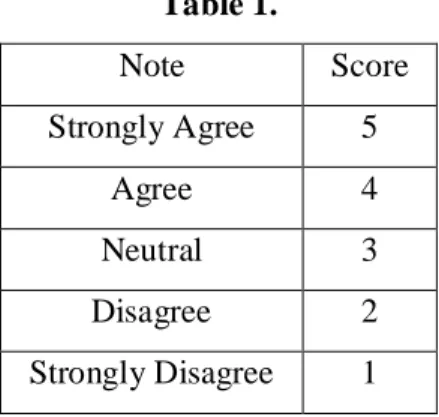
In addition, the authors use description to analyze the result of the questionnaires, or it is known as descriptive statistics. Descriptive statistics will include calculation of means, standard deviations, and describes the results within the percentage and narration (Burns and Bush, 2003, p.434). The questionnaires will include the respondent demographic within dimensions of the CSR (impact in social, economic and environment). Each variables utilize Likert-type questions, in which each single questions may be used in research instruments and given numbers that represents agreement with the statement given as variables as shown in the Table 1 (Boone and Boone, 2012, p. 2).
Table 1.
Note Score
Strongly Agree 5
Agree 4
Neutral 3
Disagree 2
Strongly Disagree 1
interview in which the list of question is already prepared and encourage the respondents to talk (Veal, 2011)
Results
North Kuta Sub District
North Kuta sub district divided into 6 villages that each villages have smaller community that bound by the traditional system called Desa Dinas. There are six Desa Dinas such as, Kerobokan Kelod, Kerobokan, Kerobokan Kaja, Tibubeneng, Canggu and Dalung.
Figure 1. Map of North Kuta and Map of Bali
Land-use change has already been an issue in North Kuta as it is seen from the figure 1, 2, 3, 4, and 5 about the image of North Kuta regency from years to years.1
1
Figure 2. Map of North Kuta year 2002
Figure 4. North Kuta in 2012
Figure 6. North Kuta in 2015
The development of tourism in Bali can cause the land -use change as the data from the Department of agriculture in Bali province showed that in the recent 7 years there were already 5.000 ha of the agricultural land area transformed into suburban area (Sunarta, 2015, p. 124). In addition, Sunarta (2015, p. 131) found that the number of the land-use in Bali change from the year 2011 to 2012 has increased from 8 ha into 29 hectares. The total number of population in North Kuta in 2010 is 61.926 while the table 2 shows the number of population according to the villages.
Table 2. Number of the population in North Kuta sub district in 2010
Village Number of Population
Kerobokan Kelod 8.009
Kerobokan 7.880
Kerobokan Kaja 13.240
Tibubeneng 9.666
Canggu 5.337
Dalung 17.794
Source: Sunarta, 2015, p. 119.
Table 3. Number of Tourist Accommodation in North Kuta in 2015
We find that most of the tourist accommodations in North Kuta are supplementary accommodations, where they do not provide structured CSR programs as the hotels provide. It will affect the contribution of CSR to the local community in the terms of the form and reason.
Respondents Characteristics
Out of the 40 respondents, male respondents more than female respondents. In this study, there are 21 male respondents (Male / M) and 19 female respondents (Female / F). For more details can be seen at picture below.
Figure 7. Gender
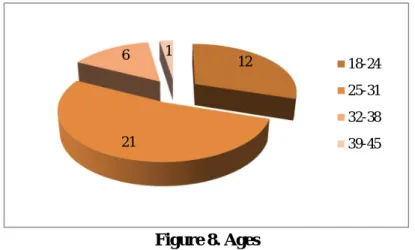
For range of the age, in this research there are four categories. First category is the age of 18 – 24 years, second category is 25-31 years, third 32- 38 years, and the last is 39- 45 years. Out of 40 respondents, there are 12 people are in the 18-24 age category, 21 people at the age of 25-31 years, 6 at the age of 32-38, and one person in the age category 39-45 years. Figure 8 shows the number of respondents who are in each age category.
No Types of Accommodation Numbers
1 Hotel 12
2
Supplementary
Accommodation 367
3 Restaurant 83
TOTAL 462
0 5 10 15 20 25
M F
21 19
Figure 8. Ages
We can conclude our respondent as, for male respondents, there are 11 respondents in ages between 18-24 years, 5 people between age 25-31 years, and five people between age 32-38 years. Out of 21 male respondents, none of them are in age between 39-45 years. For the female respondents, there are 7 people in ages between18-24 years, 10 people were in ages between 25-31 years, and one person in ages between 32-38 years and one person in ages between 39-45 years. For more details it can be seen in Figure 9 and Figure 10.
Figure 9. Male Respondents Figure 10. Female Respondents
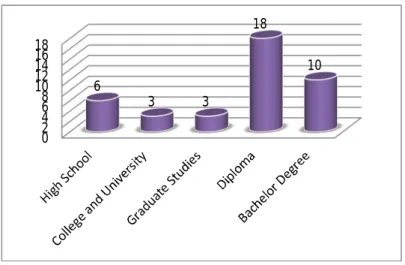
For the education level shown in Figure 11, generally from 40 respondents in this study, there were 18 respondents who had a recent education is a diploma, in bachelor degree for 10 respondents. There are 6 respondents who had a recent education is High School (SMA). While there are 3 respondents each who have a university education, post graduate, college graduate studies.
12
21
6 1
18-24
25-31
32-38
39-45
0 5 10 15
18-24 25-31 32-38 39-45
11 5
5 0
0 5 10
18-24 25-31 32-38 39-45
7
10 1
Figure 11. Education
Out of 40 respondents, , 90% ( 36 respondents) respondents work as an employee in the supplementary accomodation and restaurant and 10% ( 4 respondents) are entrepreneur of the supplementary accomodation and restaurants . When we devided in to the type of business it will 70% or 28 respondents working at the supplementary accomodation, 30% or 12 respondents working at restaurants. In general. For more detail it shown at figure above:
Figure 12: Type of Occupation Figure 13: Type of Business
From the characteristic of the respondents, we can concluded that our respondents are mostly come from 40 employees of the supplementary accommodation, from ages of 25 – 31 years old, with diploma latest education. Where the employee is at human resources department. Why we took the employee at human resources department is because the CSR programs arrange at human resources department, therefore the human resources department is who are responsible for the CSR programs.
0 2 4 6 8 10 12 14 16 18
6
3 3
18
10
Employ ee 90% Entrepr
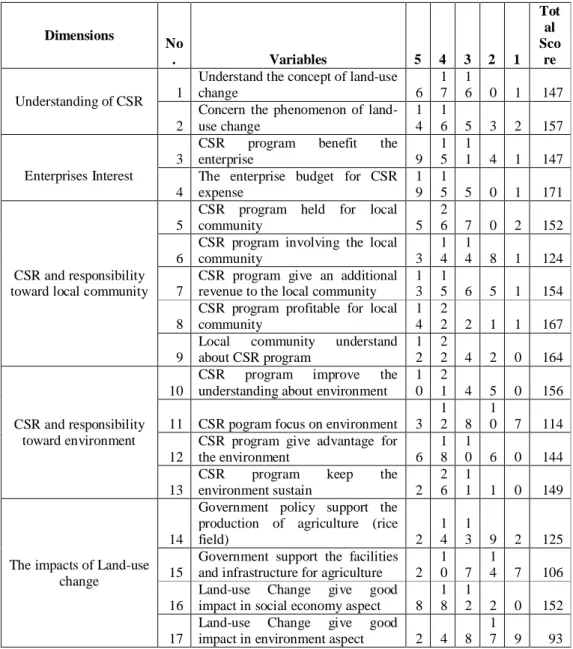
Table 4. Results of the Questionnaires
Authors uses forty (40) respondents according to 10% of the total number of supplementary accommodation in North Kuta in Table 3. The questionnaires consist seventeen (17) questions that also utilize as variables regarding the CSR points. The author calculates the score for each variable according to descriptive statistics shown below.
Score Maximum : 40 x 5 = 200 Score Minimum : 40 x 1 = 40
The interval = Score Maximum – Score Minimum 200 – 40 = 32
Dimensions
No
. Variables 5 4 3 2 1
Tot al Sco
re
Understanding of CSR 1
Understand the concept of land-use
change 6
1 7
1
6 0 1 147
2
Concern the phenomenon of land-use change
1 4
1
6 5 3 2 157
Enterprises Interest 3
CSR program benefit the
enterprise 9
1 5
1
1 4 1 147
4
The enterprise budget for CSR expense
1 9
1
5 5 0 1 171
CSR and responsibility toward local community
5
CSR program held for local
community 5
2
6 7 0 2 152
6
CSR program involving the local
community 3
1 4
1
4 8 1 124
7
CSR program give an additional revenue to the local community
1 3
1
5 6 5 1 154
8
CSR program profitable for local community
1 4
2
2 2 1 1 167
9
Local community understand about CSR program
1 2
2
2 4 2 0 164
CSR and responsibility toward environment
10
CSR program improve the understanding about environment
1 0
2
1 4 5 0 156
11 CSR pogram focus on environment 3 1 2 8
1
0 7 114
12
CSR program give advantage for
the environment 6
1 8
1
0 6 0 144
13
CSR program keep the
environment sustain 2
2 6
1
1 1 0 149
The impacts of Land-use change
14
Government policy support the production of agriculture (rice
field) 2
1 4
1
3 9 2 125
15
Government support the facilities and infrastructure for agriculture 2
1 0 7
1
4 7 106
16
Land-use Change give good impact in social economy aspect 8
1 8
1
2 2 0 152
17
Land-use Change give good
impact in environment aspect 2 4 8
1
5 5
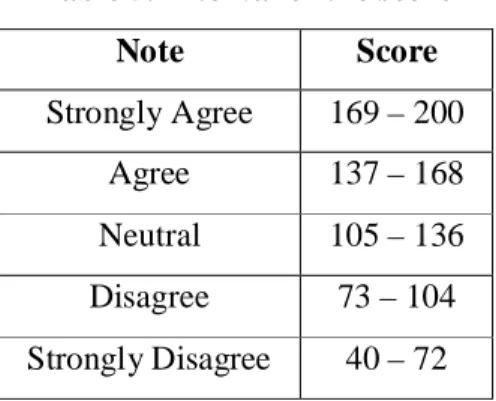
From the interval, then the authors divine the interval of the score as shown below in Table 5.
Table 5. Interval of the score
Note Score
Strongly Agree 169 – 200
Agree 137 – 168
Neutral 105 – 136 Disagree 73 – 104 Strongly Disagree 40 – 72
It can be concluded in Table 4, that the average of the respondents give score to agree in the dimensions of the understanding in land-use change concepts. The respondents also give the opinion in dimension of the enterprise interest, for the variable number three (3) in agree and variable number four (4) in strongly agree. In the point of CSR and responsibility toward local community variable number five (5), seven (7), eight (8) and nine (9) scored in agree. Meanwhile, variable number six (6) remains neutral about the involvement of local community in CSR. Most of the variable regarding the CSR program related to responsibility toward environment said agree, such as variable number ten (10), twelve (12), and thirteen (13). However, the variable number eleven (11), regarding the focus of CSR about the environment scored in neutral. The dimension of the impacts’ of land use change scored neutral in variable number fourteen (14). It can be concluded that respondents disagree with the statement says government support facilities and infrastructure for agriculture development. The result shows that respondents agreed that land-use change give positive impact in social economy. In contrary to that, respondents disagreed that land-use change give positive impact to the environment.
From the depth interview that the author held with the head of the environment, the term of land-use change will be no longer affect harm to the community. As he said below,
So that, some of the community will choose to sell or lease their land area instead of cultivate them selves to overcome the money.” (M. Suarka, personal communication, March 4, 2016)
This point of view also agreed by the other chief of the sub district,
“The land-use change has been agreed by the local community since the high cost to cultivate the rice field and the land area also not too big that cannot produce the wanted revenue. It also cause the production cost higher than the revenue when the community decide to cultivate their own area. They’d better choose to rent and lease their area if they get better stage of life through renting or selling the land.” (I.M.S, personal communication, March 4, 2016)
The chief also gives opinion and tries to give solution to the land-use change issue in North Kuta to the government as shown below.
“The solution accordingly is to ask the government whether they have to buy the land of the community to be kept green and to decrease the number of the land-use change. Or, they have to discipline every building that already rose in the ‘green’ area. Because whenever the building already rose in the green area, and the government has not taken any purposive acts to stop the development of the building in the ‘green area’. The worse is when the government already collected the taxes of the building in the green area and we can assume that the government already permitted the building to keep stand still in that area. However, I already told the community to leasing the land, rather than selling the land accordingly (maximum 30 years based on the agrarian law).” (M. S, personal communication, March 4, 2016)
The authors confirm the phenomenon of land-use change to the government, who rules the regulation and understand the position of the land-use change issue.
government and the owner of the villa, restaurant that supported by the landlord and the head of the environment. (WM., personal communication, March 14, 2016)
According to the interview with the peasant in the North Kuta said about the impact of the environment,
“The development of the Villa and restaurant already grew fast since couple years ago. And nowadays it is very difficult to find the water to plan the rice field because of the development of the building that close the source of the water.” (W, personal communication, March 20, 2016)
Answering the type of the CSR that has been done, due to the phenomenon of land-use change that happened in North Kuta sub district as recorded from the interview below.
“The contribution of the hotel, villa, and restaurant still takes form of the informal contribution that collected by the village governor (in this case by their Kelian Banjar) as a security payment. However, the nominal of the monthly payment has not been described and depend on the size of the villa, hotel and restaurant. The monthly contribution also gives the commitment from the villages’ community toward the business owner to avoid the illegal monthly payment from unknown group. Sometimes, when the Banjar needs fund in purpose to support some cultural activities, they will also again asking the fund toward the business’ owner to participate in the activities. The local community needs to be trained in order to obtain the job in the villa, hotel and restaurant that already built in the area. I already tried to ask the possibilities to absorb the local community as the supporting manpower in their own area. However, the problem that in the area, the youth has been less trained and the skill level is still below the industry requirements.” (MS, personal communication, March 4, 2016)
Discussion
community as part of the tourism industry, the problem is the local community unable to take up the chance. The local community’s capabilities not yet meet with the tourism industry’s requirements. For the environment impact, we found some rice-fields are discommodity of water. Beside our result, hereafter we come across with two problems, first, how to prepare the local community to compete in the tourism industry and second, how much the land-use change in North Kuta effecting the environment.
References
Adams J., Khan, H. T.A., Raeside, R. and White, D. (2007).Research methods for graduate business and social science students. New Delhi: Response Books.
Anderson, D. R. et al. (2013). Quantitive Methods for Business. Cengage Learning: South Western.
Argandoña, A. (2010). Corporate social responsibility in the tourism industry: some Spanish experience. Working paper (WP-844), January: IESE Business School.
Berg, B. L. (2001).Qualitative Research Methods for the social sciences. Unied States: Allyn & Bacon.
Boone, H. N and Boone, D.A. (2012). Analyzing Likert Data. Journal of Extension 50 (2), 2TOT2, p. 1-5.
Burns, A.C and Bush, R.F. (2003). Marketing Research Applications. 4th ed. Pearson Prentice, Hall.
Bureau of Indonesian Republic Statistic,Number of International Tourist Arrival according to the Embarkation Gate 2012. Retrieved from http://www.bps.go.id/tab_sub/view.php?kat=2&tabel=1&daftar=1&id_subye k=16¬ab=14,
Currie, D. (2005). Developing and applying study skills writing assignments, dissertations and management reports. London: Chartered Institute of Personnel and Development.
Doods, R. and Joppe, M. (2005). CSR in the Tourism industry? The status of and Potential for Certification, Codes of Conduct and Guidelines.
http://insights.ccl.org/wp-content/uploads/2015/04/CorporateSocialResponsibility.pdf
Fitzpatrick, J. J. And Mccarthy, G. (2016). Nursing Concept Analysis: Applications to research and practice. New York: Springer.
Golja, T. and Niži , K. (2010). Corporate social responsibility in tourism : The most popular tourism destinations in Croatia: Comparative analysis. Management, 15 (2), 107-121.
Kustiawan, I. (1997). Permasalahan Konversi Lahan Pertanian dan Implikasinya Terhadap Penataan Ruang Wilayah, Studi Kasus: Wilayah Pantura Jawa Barat.Jurnal PWK, 8 (1).
Poudel, S. (2013). The influence of the accommodation sector in tourism development and its sustainability: Case study: Strand Camping, Larsmo. Thesis, Austria university of applied sciences. Degree programme in tourism. https://publications.theseus.fi/bitstream/handle/10024/61014/Thesis_Final_SP .pdf?sequence=1
Saunders, M., Lewis, P., and Thornhill, A. (2012).Research methods for business students (6th ed). England: Pearson.
Snape, D. And Spencer, L. (2003). The foundations of qualitative research, in RITCHIE, Jane and LEWIS, Jane (eds) Qualitative Research practive: a guide for social science researchers and students. Sage Publications, Ltd. London, pp. 1-23.
( Study of Land – Use Change in Tourism Areas Using High Spatial Resolution Remote Sensing, DR.I Nyoman Sunarta)
Sunarta, I. N. (2015). Dampak Perkembangan Usaha Akomodasi Terhadap Sumber Daya Air di Kecamatan kuta Utara Kabupaten Badung Bali. (Program Pascasarjana, Universitas Udayana, Bali).
Tsyganok, I. Accommodation as a basic component of tourism. (website: http://dspace.nuft.edu.ua/jspui/bitstream/123456789/8801/1/Accommodation. pdf) p. 2
Veal, A. J. (2011). Research methods for leisure and tourism: A practical guide (4th ed). Prentice Hall: England.
Verburg, P.H and Veldkamp, A. (2001). The role of spatially explicit model in land use change research: A case study for cropping pattern in China. Agriculture, Ecosystem and Environment, 85, pp. 177-190.
Vickers, A. (2012). Bali: A Paradise Created. 2nd Ed. Tuttle Publishing: Singapore.