VOCAL INTEILFACE FOR A MAN-MACHINE DIALOG Dominique BEROULE
LIMSI (CNRS), B.P. 30, 91406 ORSAY CEDEX, FRANCE
ABSTRACT
We describe a dialogue-handling module used as an interface between a vocal terminal and a task- oriented device (for instance : a robot manipula- ting blocks). This module has been specially desi- gned to be implanted on a single board using micro- processor, and inserted into the vocal terminal which already comprises a speech recognition board and a synthesis board. The entire vocal system is at present capable of conducting a real time spo- ken dialogue with its user.
I INTRODUCTION
A great deal of interest is actually being shown in providing computer interfaces through dia- log processing systems using speech input and out- put (Levinson and Shipley, 1979). In the same time, the amelioration of the microprocessor technology has allowed the implantation of word recognition and text-to-speech synthesis systems on single boards (Li~nard and Mariani, 1982 ; Gauvain, 1983 ; Asta and Li~nard, 1979) ; in our laboratory, such modules have been integrated into a compact unit that forms an autonomous vocal processor which has applications in a number of varied domains : vocal command of cars, of planes, office automation and computer-aided learning (N~el et al., 1982).
Whereas most of the present language under- standing systems require large computational re- sources, our goal has been to implement a dialog- handling board in the LIMSI's Vocal Terminal.
The use of micro-systems introduces memory si- ze and real-time constraints which have incited us to limit ourselves in the use of presently availa- ble computational linguistic techniques. Therefore, we have taken inspiration from a simple model of semantic network ; for the same reasons, the ini- tial parser based on an Augmented Transition Net- work (Woods, 1970) and implemented on an IBM 370
(Memmi and Mariani, 1982) was replaced by another less time- and memory-consuming one.
The work presented herein extends possible application fields by allowing an interactive vocal relation between the machine and its user for the execution of a specific task : the application that we have chosen is a man-machine communication with a robot manipulating blocks and using a Plan Gene- rating System.
SPEECH
I
RECOGNIZER
SEMANTIC
[
SYNTACTIC
PROCESSING
ANALYSISSEMANTIC ]
TREATMENT
I 8"ANC"INO.,I
\
'I o .t.E
.AsE
I
QOEST,ON
i
i
i
l
I
I
ASSERT~N
B
ANSWER i
t
/ . / f
I
SENTENCE I
!'
PRODUCTION
(
t
(
SPEECH
J
SYNTHESIZER
Figure I. Block diagram of ~he system
II SYNTACTIC PROCESSING
A. Prediction Device
Once the acoustic processing of the speech si- gnal is performed by the 250 word-based recognition board, syntactic analysis is carried out.
[image:1.612.306.558.224.508.2]B. Parameters Transfer
In order to build a representation of the deep structure of an input sentence, parameters reque- sted by the s e m a n t i c p r o c e d u r e s must be filled with the correct values. The parsing method that we de ~ velopped considers the naturel language utterances as a set of noun phrases connected with function words (prepositions, verbs ...) which specify their
relationships. At the present time, the set of noun phrases is obtained by segmenting the utterance at each function word.
Sl
f
Le petit chat gris a t t r a p ~ l a s o u r i ~ J
S I I • S12 (the small grey cat is catching the mouse) parameters :
O11 * - c h a t ~ 012 ~ - s o u r i s Pll * - ( p e t i t gris)
P I 2 * - N I L
$22
S11 • S12 ~$21 ~$221 ~ $222
Pr~-~end"la pyranlide e t ' p o s e l ~ - ~ s u r ~ e g r o s cube"
t SI t S2
(grasp the pyramid and put it on the big cub) parameters :
X O 1 1 . - N I L • O21 * - N I L P I I * - NIL ~ P21 ~ - N I L V1 4-- prendre { V2 4- poser O12 * - p y r a m i d e • 0 2 2 1 ÷ p y r a m i d e PI2 ~ (petite) X P221~(petite)
Figure 2. Parameters transfer
VI ~ - a t t r a p e r
0222 ~ cube P 2 2 2 ~ - (gros)
III SEMANTIC PROCESSING
A. S[stem knowledge data
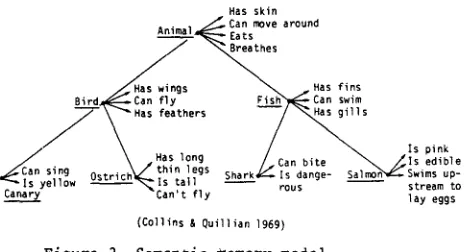
The computational semantic memory is inspired by the Collins and Quillian model, a hierarchical network in which each node represents a concept. Properties can be assigned to each node, which al- so inherits those of its ancestors. Our choice has been influenced by the desire to design a system which would be able to easily learn new conceptS ; that is, to complete or to modify its knowledge according to information coming from a vocal input/ output system.
Each noun of the vocabulary is represented by a node in such a tree structure. The meaning of any given verb is provided by rules that indicate the type of objects that can be related. As far as ad- jectives are concerned, they are arranged in exclu- sive property groups.
Has s k i n
• ~ Can move around
Anlmmal A ~ . Eats
BirdJ~---Can f l y F i s h ' ~ C a n swim
Is pink
/
\
,as,oog
/. an hi.
Z,s edible
Can sing . thin legs
~ C a n , ,, O s t r i c h ~ t h i n ~ ~ gs S h a r k ~ IS dange- Sa I mon~",i~ S . . . p-
Is yellOW "- - ~--Is ~al ~ _ . rous stream to
Canary Can't f l y lay eggs
{C0]]ins & Quil|ian 1969)
Figure 3. Semantic memory model
The knowledge-based data (which may be enlar- ged by information provided by the vocal channel) is complemented by temporary data which chronologi- c a l l y contain, in abbreviated form, events evoked during the dialogue.
B. Assertion processin~
The small amount of data representing a given universe allows us to approach the computational
treatment of these two complementary and contrary components of dialogue: learning and contestation.
Every time an assertion is proposed by the user a procedure parses its semantic validity by answering the question "Does this sentence fit with the current state of the knowledge data ?". If a contradiction is detected, it is pointed out to the user who must justify his proposal. If the user persists in his declaration, the machine m a y then m o d i f y its universe knowledge, otherwise the utte-
rance is not taken into account.
W h e n no contradiction is encountered, the pro- gram enters into a learning process adding to the temporary data or knowledge-based data.
User : U n poisson poss~de des plumes (A fish has got feathers)
System : J'ai compris ... As-tu quelque chose ajouter ?
(I have understood ... Would you like to say something else ?)
U : Une truite poss~de des ~cailles (A trout has got scales)
S : Je croyais qu'un poisson poss~dait des plumes (I thought that a fish had got feathers) U : Non (No)
S : D'accord ... (All right)
U : Qu'est-ce qu'un poisson ? (What is a fish ?) S : C'est un animal qui poss~de des ~cailles
[image:2.612.323.555.101.227.2] [image:2.612.68.298.218.495.2]I. Teaching utterances
These assertions, characterized by the pre- sence of a non-action verb, permit both the com- plete construction of the semantic network and of the concept relation rules specifying the possible entities that can serve as arguments for a predi- cate.
Although m o s t of our knowledge results from long nurturing and frequent interactions with the outside world, it is possible to give an approxi- mate meaning to concrete objects and verbs by using an elementary syntax. A new concept may be taught by filling in its position w i t h i n the se- mantic network and possibly associating it with properties that will differentiate it from its brother nodes. Concept relation rules can be learn- ed, too.
U : Le caf~ ... (coffee ...)
S : Qu'est ce qu'un caf~ (What is coffee) U : Le caf~ ressemble ~ du lait
(Coffee looks like milk) S : ...
U : Le caf~ est noir (coffee is black) S : Je pense avoir compris ... ~ toi
(I think that I have understood ...) U : Qu'est ce que du caf~ ? (What is coffee ?) S : Le caf~ est un liquide noir
(Coffee is a black liquid)
U : Tu bois du caf~ (You are drinking coffee) S : C'est impossible (It is impossible) U : Un ordinateur peut boire un liquide
(A computer is able to drink a liquid) S : C'est bon ... j'ai compris
(That's right ... I have understood) U : Tu bois du caf~ (You are drinking coffee) S : D'accord (Okay)
U : Qui bois du caf~ ? (Who is drinking coffee ?) S : Je le bois (I am drinking it)
2. Descriptive utterances
Sentences involving an action verb are trans- lated into an unambiguous representation which con- denses and organizes information into the very same form as that of the concept relation rules from knowledge data. Therefore, semantic validity can be easily tested by a pattern-matching process. A se- mantic event reduced to a nested-triplet structure
and considered as valid is then inserted in the dynamic-events memory, and can be requested later on by the question-answering process.
Although the language is limited to a small subset of natural French, several equivalent syn- tactic structures are allowed to express a given event ; in order to avoid storing multiple repre- sentations of the same event, paraphrases of a given utterance are reduced to a single standard form.
One of the task effected by a language under- standing system consists of recognizing the concepts that are evoked inside the input utterances. As soon as ambiguities are detected, they are resolved through interaction with the user.
U : Je prends le cube I (I am taking the cube I) S : S'agit-il du petit cube I ?
(Is the small cube I in question ?)
U : ~ i (Yes it is) S : O . K .
Relative~ clauses are not represented in the canonical form of the utterance in which they appear, but they are only used to determine which concept is in question.
a r t i c l e i - Nun ! - Adjective I - Verb - a r t i c l e 2 - Adjec. 2 - Nun 2
abbreviated form : @ (( NI A1 )( N2 A2 ))) = semantic event E
relation rule n ° i :
i p~2) )
((o~2 p~2) (022
E allowable ( ~ 3 ( i , j ) / V k = i , 2
i V .= R
0 i
N k
E ~ (kj)
Pkj E ~ - ~ (N k) Pkj ~ Ak
Figure 4. Pattern-matching of a simple sentence
Relation Object Property
( ~ : Descendants)
{ . ~ : Property group)
( ~ : Compatible with)
saisis les cubes 2 et 5 (grasp cubes 2 and 5) prends le cube 2 et le 5
(take hold of the cube 2 and the 5 one) attrape le cube 2 et saisis le cube 5
(lay hold of the cube 2 and grasp the cube 5)
canonical form :
(ASK((YOU)((TAKE((1)(CUBE(2))&(CUBE(5))))))) Figure 5. Paraphrases translation
3. Orders
Input utterances beginning with an action verb specify an order that the machine connected to the vocal interface is supposed to execute ; in addi- tion to the deep structure of this natural language message, a formal command language message is built and then sent to the machine. The task universe memory is modified in order to reflect the execu- tion of a user's command.
User : Prends la pyramide qui est sur la table et pose. la sur le gros cube (grasp the pyramid which is on the table and put it on the big cube)
Machine : S'agit-il du gros cube 3 ?
(are you talking of the big cube 3 ?) User : Oui (yes)
(ASK((YOU)((TAKE((1)(PYRAMID(SMALL))))) &((PUT((1)((ON((PYRAMID(SMALL))(CUBE(GROS 3)) formal command : ((HOLD PYR2)(ON PYR2 CUB3)) User : Qu'ai je fait (What did I do)
Deep structure : (DO ((YOU) ?)
Machine : Tu as demand~ que je prenne la petite pyramide et que je pose la petite pyra- mide sur le gros cube 3 (You have asked me to grasp the small pyramid and put
the small pyramid on the big cube 3) User : Q u i a saisi un objet (Who has taken an
object)
Deep structure : (TAKE ( ? (OBJ)))
Machine : J'ai pris la petite pyramide (I have grasped the small pyramid)
User : Qu'as-tu fait apr~s ? (What have you done afterwards ?)
Deep structure : (DO ((I) ?))
Machine : J'ai pos~ la petite pyramide sur le gros cube 3 (I put the small pyramid on the big cube 3)
C. Question processing
In everyday language, intonation often conti- tutes the m a r k e r that discriminates between ques- tions and assertions. Since prosody information is not presently taken into account by the word recog- nition system, the presence of an interrogative pronoun switches on the information research pro- cessing in permanent knowledge-data or in dynamic- events memory.
I. Research in permanent k n o w l e d g e - d a t a The program is allowed to express its know- ledge at the user's request, for instance, on con- cept meanings, or the systems abilities.
U : Qui es-tu ? (Who are you ?)
S : Je suis un ordinateur bavard (I am a talkative computer)
U : Puis-je parler avec toi ? (Can I speak with you ?)
S : Oui, c'est possible (Yes, that is possible) U : Tu es une souris (You are a mouse)
S : Je pensais que j'~tais un ordinateur (I thought that I was a computer) U : C'est faux (That's false)
S : O.K.
U : Qui es-tu ? (Who are you ?) S : Je suis une souris bavarde
(I am a talkative mouse)
U : Est-ce qu'un chat peut parler avec toi ? (Is a cat able to speak with you ?) S : Bien ~ r que non (Of course not)
2. Research in d~na~nic-events data
The abbreviated semantic events list is close- ly examined, from recent to older data, until the question-pattern approximately matches one of the memorized events. Possible analogy between a memo-
rized event and one evoked by the question is then analysed. Coincidences rarely happen, so the system must be able to ask for full specifications about
the event that interests the user ; at that time there is a vocal discussion aimed at leading the system to that event in a step-wise manner. U : Une femme blonde cherche une brosse
( A blond w o m a n is looking for a brush) S : D'accord, je comprends (All right, I under-
stand)
U : Je cherche un peigne (I am looking for a comb) S : Tr~s int~ressant ... (Very interesting ...) U : Quel ~tre h u m a i n cherche quelque chose ?
(What human being is looking for something ?) S : S'agit-il de toi ? (Are you talking about
yourself ?) U : Non (No)
S : S'agit-il d'une femme blonde ? (Are you talking about a blond w o m a n ?)
U : Oui (Yes)
S : Elle cherche une brosse (She is looking for a brush)
D. Processing a user's incomplete utterance An important specific quality of the semantic process is that it is able to accomodate bad acous-
tical recognition through intelligent interactive feedback.
So, w h e n one part of a given sentence has not been recognized, because of m i s p r o n u n c i a t i o n or background noise, the system produces a suitable question bringing the user to repeat the unrecogni- zed word w i t h i n his answer.
Two cases can occur :
if the word is again unrecognized, the system assumes that the entity is not in the prescribed vocabulary (containing the acoustic features of
the words). A n explanatory m e s s a g e is then produced through the synthesis module.
if the lexical entity is well recognized this time, it is added to the previous utterance and computed in the same manner as the others.
U "
S •
U : S :
S :
U :
S : U :
S :
S : U :
S :
Je (?) un livre (I am (?) a book) Que fais-tu avec le livre ?
(What are you doing with the book) Je le m a n g e (I am eating it)
C'est impossible ... je ne te crois pas (It is impossible ... I do not believe you) Une (?) femme boit du th~
(A (?) w o m a n is drinking tea)
Comment est la femme ? (What is the woman like ?)
Elle est grande (She is tall) O.K.
Est-ce qu'une fen~ne bolt du th~ ? (Is a w o m a n drinking tea ?)
Oui, la grande femme (Yes, a fat w o m a n is) U n honm~e lit un gros (?)
U : Qui lit un livre ? (Who is reading a book ?) S : Un homme lit u n gros livre
(A m a n is reading a thick book)
When a certain amount of acoustical components in a sentence have not been recognized, the system asks for the user to repeat his assertion.
U : Le (?) (?) un petit (?)
s : Peux-tu r~p~ter s'il te plait ?
E. Sentence production
1. Translation of a deep structure into an output sentence
This process consists of inserting semantic entities into the suitable syntactic diagram which depends on the computational procedure that is ac- tivated (question answering, contradiction, learn- ing, asking for specifications ...). Since each syntactic variation of a word corresponds to a sin- gle semantic representation, sentence generation makes use of verb conjugation procedures and con- cordance procedures.
In order to improve the natural quality of speech, different types of sentences expressing one same idea may be generated in a pseudo-random man- ner. The same question asked to the system several times can thus induce different formulated respon- ses.
2. Text-to-speech transcription ambiguities A module of the synthesis process takes any French text and determines the elements necessary for the diphone synthesis, with the help of a dic- tionnary containing pronunciation rules and their exceptions (Prouts, 1979). However, some ambigui- ties concerning text-to-speech transcription can still remain and cannot be resolved without syn- tactico-semantic information ; for instance : "Les poules du couvent couvent" (the convent hens are sitting on their eggs) is pronounced by the synthesizer : / I £ p u I d y k u v ~ k u v E / (the convent hens ~onvent).
To deal with that problem, we may send the synthesizer the phonetic form of the words.
IV CONCLUSION
The dialog experiment is presently running on a PDP 11/23 MINC and on an INTEL development system with a VLISP interpreter in real-time and using a series interface with the vocal terminal.
The isolated word recognition board we are using for the moment makes the user pause for appro- ximately half a second between each word he pronoun- ces. In the near future we plan to replace this module by a connected word system which will make
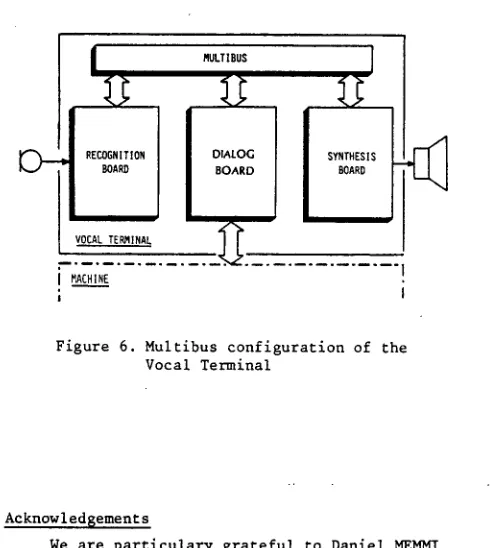
the dialog more natural. It may be noted that the compactness of the understanding program allows its implantation on a microprocessor board which is to be inserted in the vocal terminal.
At present we apply ourselves to m a k e the dialog-handling module easily adaptable to various domains of application.
D
1
MACHINE
Figure 6. Multibus configuration of the Vocal Terminal
Acknowledgements
We are particulary grateful to Daniel MEMMI, Jean-Luc GAUVAIN and Joseph MARIANI for their pre- cious help during the course of this work. Special thanks to Maxine ESKENAZI, Fran~oise NEEL and Mich~le CHASTAGNER.
REFERENCES
V. ASTA, J.S. LIENARD - L'icophone logiciel : un synth~tiseur par formes d'ondes - 10e JEP, Grenoble, 1979.
E. CHARNIAK, Y. WILKS (editors) - Computational Semantics - North-Holland, 1976.
A.M. COLLINS, M.R. QUILLIAN - Retrieval time from semantic memory - Journal of Verbal Learning and Verbal Behavior, 1969.
J . L . G A U V A I N - Reconnaissance de mots enchaln~s et d~tection de mots dans la parole continue - Th~se 3e cycle, Orsay, 1982.
S.E. LEVINSON, K.L. SHIPLEY - A conversational system using speech input end output - The Bell System Technical Journal, vol. 59, n ° I, january 1980.
[image:5.612.305.550.130.404.2]D. M E M M I , J.J. M A R I A N I - A R B U S : A tool for d e v e - l o p i n g a p p l i c a t i o n g r a m m a r s - C o l i n g , P r a g u e , 1982.
F. NEEL, J.S. L I E N A R D , J.J. M A R I A N I - A n e x p e r i m e n t of v o c a l con~nunicatinn a p p l i e d to c o m p u t e r - a i d e d l e a r n i n g - IFIP W C C E S ] , j u i l l e t 1981.
B. P R O U T S - T r a d u c t i o n p h o n ~ t i q u e de t e x t e s ~ c r i t s
e n f r a n g a i s - l Oe JEP, G r e n o b l e , 1979.
R. S C H A N K - C o n c e p t u a l i n f o r m a t i o n p r o c e s s i n g - N o r t h H o l l a n d , 1975.
T . W I N O G R A D - U n d e r s t a n d i n g n a t u r a l l a n g u a g e -
A c a d e m i c P r e s s , 1972.
W . A . W O O D S - T r a n s i t i o n n e t w o r k g r a m m a r for n a t u -