https://www.scirp.org/journal/fns ISSN Online: 2157-9458
ISSN Print: 2157-944X
DOI: 10.4236/fns.2019.1012099 Dec. 17, 2019 1389 Food and Nutrition Sciences
Effects of Rations Containing Maggot
Concentrate as a Fish Substitute on the
Technical and Economic Performance of
Large White’s Piglets in Burkina Faso
Timbilfou Kiendrébéogo
1*, Isidor Z. Ouédraogo
2, Salimata Pousga
2, Drissa Barry
3,
Chantal Yvette Kaboré-Zoungrana
41Institut de l’Environnement et de Recherches Agricoles, Station de Farako-bâ, Bobo-Dioulasso, Burkina Fasso 2Université Nazi Boni, Bobo-Dioulasso, Burkina Faso
3Université de Dédougou, Dédougou, Burkina Faso
4Laboratoire d’Etudes et de Recherches sur les Ressources Naturelles et les Sciences de l’Environnement (LERNSE), Université
Nazi Boni (UNB), Bobo-Dioulasso, Burkina Faso
Abstract
The study evaluated the effects of rations incorporating maggot concentrate (CA) as a substitute for fishmeal on growth performance and post-weaning piglet’s production costs. To do this, twenty-four (24) weanlings of large white breed were divided into 3 batches of 8 pigs each for a comparative ra-tioning test in 2 phases. Four (04) experimental rations containing CA, two experimental rations (RI10 and RI5-5) for the 1st phase and two others (RII5 and RII10) for the 2nd phase were tested in comparison with 2 control ra-tions RTI10 and RTII5 for the respective Phases I and II. The results show that in all phases piglet growth was continuous from the beginning to the end of each phase. In Phase I, the ADGs of piglets fed RI5-5 (138.64 g), RI10 (131.28 g) and RTI10 (104.78 g) were homogeneous (p > 0.05). The food production costs of one kg of live weight (FCkgLW) of the RI5-5 (671.39 CFAF) and RI10 (690.57 CFAF) rations were significantly lower than the RTI10 (1083.68 CFAF) ration (p < 0.05). In Phase II, the ADG of RII5 (249.85 g), RII10 (260.36 g), and RTII5 (248.00 g) were homogeneous (p > 0.05). The FCkgLWs of RII10 (506.73 FCFA), RII5 (583.43 FCFA) and RTII5 (815.53 FCFA) were homogeneous (p > 0.05). The maggot concentrate can be used as a source of animal protein in the feeding of piglets in partial or total substitu-tion for fish. The evaluasubstitu-tion of the effects of its use on the quality of carcasses and meat will be necessary.
How to cite this paper: Kiendrébéogo, T., Ouédraogo, I.Z., Pousga, S., Barry, D. and Kaboré-Zoungrana, C.Y. (2019) Effects of Rations Containing Maggot Concentrate as a Fish Substitute on the Technical and Economic Performance of Large White’s Piglets in Burkina Faso. Food and Nutrition Sciences, 10, 1389-1399.
https://doi.org/10.4236/fns.2019.1012099
Received: November 3, 2019 Accepted: December 14, 2019 Published: December 17, 2019
Copyright © 2019 by author(s) and Scientific Research Publishing Inc. This work is licensed under the Creative Commons Attribution International License (CC BY 4.0).
http://creativecommons.org/licenses/by/4.0/
DOI: 10.4236/fns.2019.1012099 1390 Food and Nutrition Sciences
Keywords
Diets, Maggoots Concentrate, Fish Meal, Growth, Piglets, Burkina Faso
1. Introduction
Livestock is an important part of the economy of the Sahelian countries of West
Africa, for which it is one of the main sources of foreign exchange [1]. Among
the animal species raised, pigs occupy a prominent place and their breeding is a source of protein for an ever-increasing population. Also, this animal is bred and
consumed in major cities in sub-Saharan Africa [2]. In Burkina Faso, pig
farm-ing is a major activity with an annual growth rate of about 18.6% and estimated
at 2,489,317 head in 2017 [3]. However, this breeding remains of low
productiv-ity. Many constraints justify this poor performance. Among these, food in terms of low food availability, and high food input costs are very often cited as the
main constraint [4]. Moreover, the lack of protein rations and the high cost of
animal protein sources are constraints to the development of this sector [5],
par-ticularly the optimal development of pig zootechnical performances. Of course, the lack of protein rations and the high cost of animal protein sources are
con-straints to the development of this sector [5], particularly to the optimal
devel-opment of pig zootechnical performances. In Burkina Faso, imported fish sold at an expensive price of CFAF 400/kg is the main source of animal protein used in intensive monogastric livestock farming, in this case pigs and poultry. In addi-tion, the poor mastery of rationing techniques by technicians and breeders makes it necessary to simplify formulas by making premixes or concentrates available. There is then a need to seek new sources of animal protein, easily
ac-cessible, not consumed by humans, but likely to enrich livestock feed [6]. Several
studies have shown the possibility of producing maggots in tropical areas [7][8]
[9] and using them in meal form in livestock farming as a source of food protein
[10]. In this perspective, a concentrate based on maggots of houseflies has been
developed for use in feeding monogastric animals, in particular pigs and poultry
[11][12]. The study aims to evaluate the effects of the use of this concentrate on
the growth performance and production costs of post-weaning piglets in Burki-na Faso.
2. Materials and Methods
2.1. Presentation of the Study Site
av-DOI: 10.4236/fns.2019.1012099 1391 Food and Nutrition Sciences
erage altitude of 405 m. The station is located in the southern Sudanese climatic
zone between isohyets 1000 and 1200 [13]. Its climate is characterized by two
seasons: a rainy season that lasts six (06) months, from May to October and a dry season that also lasts six (06) months. The latter includes a cool dry period (November to February) and another hot dry period (March to April).
2.2. Animals’ Habitat
The experiment took place in a pigsty 16 m long and 8 m wide. It is a semi-open
type with low walls 1.2 m high, and divided into ten (10) 9 m2 boxes, six of
which were used for this study. Each dressing room is equipped with a water trough and a feeder. The roof is made of double-sloped sheet metal and the ground is cemented with a gentle slope oriented towards a channel for the evac-uation of urine and dirty water which is led into a manure pit.
2.3. Animal Material
Twenty-four (24) Large White piglets weaned at 50 days of age were used for the test. The piglets were identified using earrings, weighed and divided into three (03) batches of eight (08) piglets (4 whole males and 4 females) each, including two experimental batches and a control batch. The initial average weights of the pigs were homogeneous between batches (p > 0.05). The allocation of the three (03) rations to the different batches was done randomly by drawing. Before the trial began, an injection of fercobsang® was given to prevent iron deficiency at-tacks. During the study, the animals were regularly monitored for health.
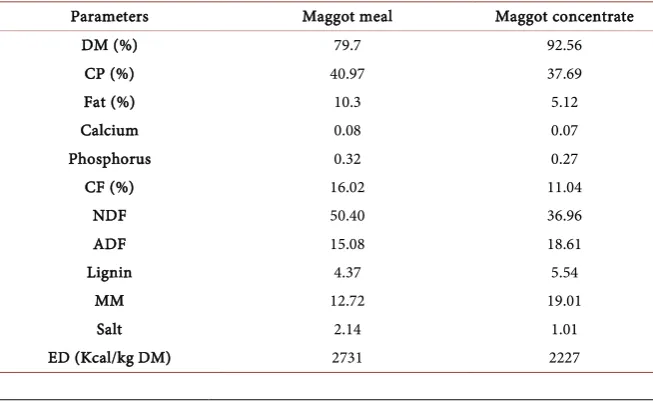
2.4. Characteristics of the Maggot Concentrate Incorporated in
Experimental Rations
The maggot concentrate is a food based on housefly larvae produced according
to the process of [3]. Some nutritional Characteristics and energy intake are
[image:3.595.209.536.538.742.2]shown in Table 1.
Table 1. Chemical composition of the maggot concentrate and its raw materials.
Parameters Maggot meal Maggot concentrate
DM (%) 79.7 92.56
CP (%) 40.97 37.69
Fat (%) 10.3 5.12
Calcium 0.08 0.07
Phosphorus 0.32 0.27
CF (%) 16.02 11.04
NDF 50.40 36.96
ADF 15.08 18.61
Lignin 4.37 5.54
MM 12.72 19.01
Salt 2.14 1.01
DOI: 10.4236/fns.2019.1012099 1392 Food and Nutrition Sciences
2.5. Rationing and Rationing
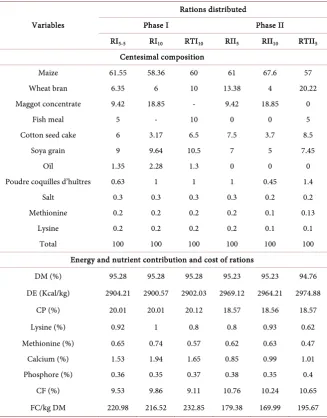
The study was conducted in two phases (I and II). For each phase, three iso-protein and iso-energy rations were composed and served to the pigs in the dif-ferent batches. The first phase, which goes from 50 - 92 days of age, corresponds to the immediate post-weaning phase, where the need for protein is greater. The
formulations were made according to the recommandations of [14]. They were
made in such a way as to have rations according to the phases of experimenta-tion:
- Phase I: In this phase we tested the joint use of fishmeal and maggot meal
contained in the maggot concentrate.
o RI5-5: Ration incorporating 9.42% of the maggot concentrate (CA) (so as to
obtain 5% maggot flour and 5% fish meal in the ration);
o RI10: Ration incorporating 18.85% CA (so as to obtain 10% maggot meal in
the ration), it does not incorporate fish meal;
o RTI10: Control ration without maggot incorporating 10% fish meal;
- Phase II: In this phase, we tested the effects of the total substitution of fish by
maggots concentrate in piglet feeding.
o RII5: Ration incorporating 9.42% of the maggot concentrate (CA) (so as to
obtain 5% of maggot flour in the ration);
o RII10: Ration incorporating 18.85% of the turnover to obtain a ration
con-taining 10% maggots;
o RTII5: Control ration without maggots measuring 5% of fish meal.
Table 2 shows the centesimal composition of ingredients and nutritional
in-takes of rations.
The meal service was served twice a day, with 2/3 of the amount of food dis-tributed per day being served in the morning at 7 am and 1/3 in the afternoon at 2 pm. Water was served ad libitum. Every morning, the boxes, feeders and water troughs were washed before the meal was served.
2.6. Zootechnical and Economic Parameters
- The weight change was assessed by the weekly weight gain of the piglets.
Weighing is done in the morning from 6 am. before the ration is served. The piglets were weighed individually;
- The Average Daily Gain (ADG): it was calculated from the live weights (LW)
of the weights carried out during the growing period. ADG = (FW − IW)/ND of days of experimentation;
- The Consumption Index (CI) was calculated according to the formula: CI =
(DFC (g)/ADG (g)), (with DFC = food consumption per day) obtained by the difference between the amount of food distributed and the refusal and ADG = average daily gain defined above. It makes it possible to calculate the produc-tion cost per kg of live weight for each raproduc-tion from the purchase cost per kg of dry matter (DM) of the ration;
DOI: 10.4236/fns.2019.1012099 1393 Food and Nutrition Sciences
Table 2. Percentage composition, nutritional and energy intake of rations.
Variables
Rations distributed
Phase I Phase II
RI5-5 RI10 RTI10 RII5 RII10 RTII5
Centesimal composition
Maize 61.55 58.36 60 61 67.6 57
Wheat bran 6.35 6 10 13.38 4 20.22
Maggot concentrate 9.42 18.85 - 9.42 18.85 0
Fish meal 5 - 10 0 0 5
Cotton seed cake 6 3.17 6.5 7.5 3.7 8.5
Soya grain 9 9.64 10.5 7 5 7.45
Oïl 1.35 2.28 1.3 0 0 0
Poudre coquilles d’huîtres 0.63 1 1 1 0.45 1.4
Salt 0.3 0.3 0.3 0.3 0.2 0.2
Methionine 0.2 0.2 0.2 0.2 0.1 0.13
Lysine 0.2 0.2 0.2 0.2 0.1 0.1
Total 100 100 100 100 100 100
Energy and nutrient contribution and cost of rations
DM (%) 95.28 95.28 95.28 95.23 95.23 94.76
DE (Kcal/kg) 2904.21 2900.57 2902.03 2969.12 2964.21 2974.88
CP (%) 20.01 20.01 20.12 18.57 18.56 18.57
Lysine (%) 0.92 1 0.8 0.8 0.93 0.62
Methionine (%) 0.65 0.74 0.57 0.62 0.63 0.47
Calcium (%) 1.53 1.94 1.65 0.85 0.99 1.01
Phosphore (%) 0.36 0.35 0.37 0.38 0.35 0.4
CF (%) 9.53 9.86 9.11 10.76 10.24 10.65
FC/kg DM 220.98 216.52 232.85 179.38 169.99 195.67
RI5-5 = Ration incorporating 5% maggot meal and 5% fish meal; RI10 = Ration incorporating 10% maggot
meal; RTI10 = Control ration incorporating 10% fish; RII5 = Ration incorporating 5% maggot meal; RII10 =
Ration incorporating 10% maggot meal; RTII5 = Control ration incorporating 5% fish.
2.7. Statistical Analyses
The data was entered into the Microsoft Office Excel 2010 spreadsheet. The sta-tistical analyses were performed using XLSTAT software version 2016. Analyses of variance (ANOVA) using the Fisher model (Smallest Significant Difference” or lsd at the 5% threshold were done for the separation of the means.
3. Results
3.1. Phase 1
3.1.1. Weight Evolution of Piglets
Figure 1 shows the weight evolution of piglets according to rations. The weight
DOI: 10.4236/fns.2019.1012099 1394 Food and Nutrition Sciences
Figure 1. Weight evolution of piglets according to the ration.
The average weekly weights of piglets were homogeneous between rations (p > 0.05). The results show that the initial (PI) and final average weights (FP) were
homogeneous (p > 0.05) (Table 3).
3.1.2. Zoo-Economic Production Parameters of the First Growth Phase
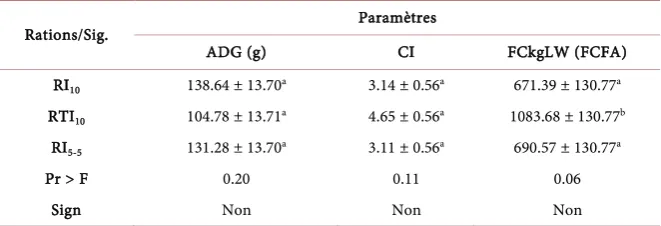
Table 4 presents the growth and economic performance of piglets by ration. No
significant differences were observed for ADGs, CIs between rations (p > 0.05).
The feed cost per kg live weight (FCkgLW) of the RTI10 ration was significantly
higher than those of RI5-5 and RI10.
3.2. Phase II
3.2.1. Weight Evolution of Piglets
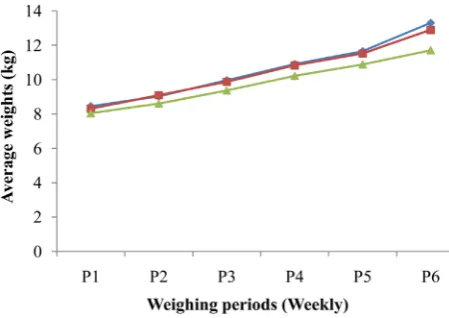
Figure 2 shows that the weight evolution of piglets fed the three (03) rations was continuous from the beginning to the end of the 2nd phase. The average weekly weights of piglets were homogeneous between rations (p > 0.05). The growth of
piglets in the RTII5 ration was low compared to the growth of experimental
ra-tions RII5 and RII10. The results presented in Table 5 show that no significant
differences were observed for initial and final mean weights between rations (p > 0.05).
3.2.2. Zoo-Economic Production Parameters of the Second Growth Phase
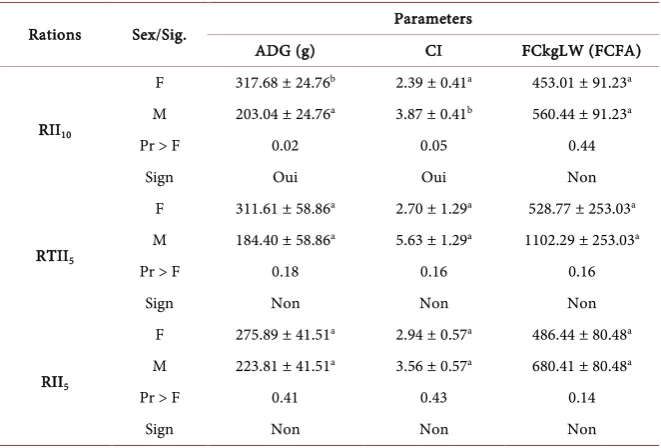
The results presented in Table 6 show that no significant differences were
ob-served for ADGs(p > 0.05). The ADG of females in the RII10 ration was
signifi-cantly higher than that of males (p < 0.05). The CI of males in the RII10 diet was
significantly higher than that of females (p < 0.05) (Table 7).
4. Discussion
4.1. Growth Performance of Piglets
DOI: 10.4236/fns.2019.1012099 1395 Food and Nutrition Sciences
[image:7.595.209.538.317.427.2]Figure 2. Weight evolution of piglets according to the ration.
Table 3. Initial and final weights of piglets according to ration.
Rations/Sig. Parametters
IW (kg) FW (kg)
RI10 8.45 ± 0.44a 13.30 ± 0.71a
RTI10 8.04a ± 0.44a 11.70 ± 0.71a
RI5-5 8.29 ± 0.44a 12.89 ± 0.71a
Pr > F 0.81 0.29
Sign Non Non
Averages with the same letter in the same column are not significantly different at the 5% threshold; RI5-5 =
Ration incorporating 5% maggot meal and 5% fish meal, RI10 = Ration incorporating 10% maggot meal,
RTI10 = Control ration incorporating 10% fish; IW = Initial Weight, FW = Final Weight; x = ± Standard
Error.
Table 4. Zootechnical parameters and food cost of production of one kg live weight ac-cording to rations.
Rations/Sig. Paramètres
ADG (g) CI FCkgLW (FCFA)
RI10 138.64 ± 13.70a 3.14 ± 0.56a 671.39 ± 130.77a
RTI10 104.78 ± 13.71a 4.65 ± 0.56a 1083.68 ± 130.77b RI5-5 131.28 ± 13.70a 3.11 ± 0.56a 690.57 ± 130.77a
Pr > F 0.20 0.11 0.06
Sign Non Non Non
Averages with the same letter in the same column are not significantly different at the 5% threshold; RI5-5 =
Ration incorporating 5% maggot meal and 5% fish meal, RI10 = Ration incorporating 10% maggot meal,
RTI10 = Control ration incorporating 10% fish; x = ± Standard Error.
[image:7.595.208.539.517.630.2]DOI: 10.4236/fns.2019.1012099 1396 Food and Nutrition Sciences
Table 5. Initial and final weights of piglets according to ration.
Rations/Sig. Parametters
IW (kg) FW (kg)
RII10 13.30 ± 0.72a 24.23 ± 2.04a
RTII5 11.70 ± 0.72a 22.12 ± 2.041a
RII5 12.89 ± 0.72a 23.38 ± 2.04a
Pr > F 0.29 0.77
Sign Non Non
Averages with the same letter in the same column are not significantly different at the 5% threshold; RII5
= Ration incorporating 5% maggot flour. RII10 = Ration incorporating 10% maggot flour. RTII5 = Control
[image:8.595.208.540.280.389.2]ration incorporating 5% fish; x = ± Standard Error.
Table 6. Average daily gain (ADG). Consumption Index (CI) and Food Production Cost of 1 kg of live weight (FCkgLW) by ration (p > 0.05).
Rations/Sig. Parametters
ADG (g) CI FCkgLW (FCFA)
RII10 260.36 ± 34.79a 3.13 ± 0.66a 506.73 ± 125.55a RTII5 248.00 ± 34.79a 4.17 ± 0.66a 815.53 ± 125.55a RII5 249.85 ± 34.79a 3.25 ± 0.66a 583.43 ± 125.55a
Pr > F 0.96 0.49 0.22
Sign Non Non Non
Averages with the same letter in the same column are not significantly different at the 5% threshold; RII5=
Ration incorporating 5% maggot flour. RII10 = Ration incorporating 10% maggot flour. RTII5 = Control
ra-tion incorporating 5% fish; x = ± Standard Error.
Table 7. Zoo-economic production parameters of the second growth phase according to sex and rations.
Rations Sex/Sig. Parameters
ADG (g) CI FCkgLW (FCFA)
RII10
F 317.68 ± 24.76b 2.39 ± 0.41a 453.01 ± 91.23a M 203.04 ± 24.76a 3.87 ± 0.41b 560.44 ± 91.23a
Pr > F 0.02 0.05 0.44
Sign Oui Oui Non
RTII5
F 311.61 ± 58.86a 2.70 ± 1.29a 528.77 ± 253.03a M 184.40 ± 58.86a 5.63 ± 1.29a 1102.29 ± 253.03a
Pr > F 0.18 0.16 0.16
Sign Non Non Non
RII5
F 275.89 ± 41.51a 2.94 ± 0.57a 486.44 ± 80.48a M 223.81 ± 41.51a 3.56 ± 0.57a 680.41 ± 80.48a
Pr > F 0.41 0.43 0.14
Sign Non Non Non
Averages with the same letter in the same column are not significantly different at the 5% threshold; RII5 =
Ration incorporating 5% maggot flour; RII10 = Ration incorporating 10% maggot flour; RTII5 = Control
[image:8.595.208.539.468.692.2]DOI: 10.4236/fns.2019.1012099 1397 Food and Nutrition Sciences
the use of maggots in food has a beneficial effect on the growth of monogastric
animals. In this sense [15], by substituting 5% of fish meal for maggot meal in
turkey feed reported a ADG of 10.02 g vs 6 g for a control diet incorporating 5%
fish. Ref [16] also reports that a ration incorporating 5% of dried maggot meal is
the most appropriate for optimal growth of young rats. Comparison of the ADGs and CIs of piglets during the two phases of the study shows that they showed a significant improvement in the second phase of the study compared to the first phase both in rations incorporating the maggot concentrate and in the control rations. The increase in ADGs in Phase 2 can be justified by the fact that in this phase. The digestive organs of the piglet are developed to receive and bet-ter value solid foods compared to the first phase, which was a phase of initiation
of the body to solid foods [17].
4.2. Effects of the Incorporation of Maggot Concentrate on
Zoo-Economic Performances
In absolute terms, the FCkgLW and CI of control rations incorporating fishmeal in both phases were higher than those of the two (02) experimental rations in-corporating maggot concentrate; in other words. The use of maggot concentrate as a partial or complete substitute for fish allows a better value to be added to the rations while reducing production costs. Indeed, there was a reduction effect on the chain, namely the positive influence of the low production cost of the con-centrate of 160 CFAF/kg DM against the acquisition cost of fishmeal (350 - 400
CFAF i.e. 1.19 to 1.5 times higher). The decrease in FCkgLW in Phase 2
com-pared to Phase 1 would be justified by the fact that production costs per kg of ra-tions were seen to be decreasing and piglets were able to better value solid feed. This decrease in the production costs per kg of rations is relatively related to the decrease in the protein content of rations in Phase 2. The low production cost of the maggot concentrate has in turn lowered the cost of the rations that incorpo-rate it which is ultimately decisive for obtaining low FCkgLW. The FCkgLW of experimental rations incorporating maggot concentrate was lower than the
FCkgLW of 977 FCFA obtained by [18] and 797.90 FCFA obtained by [19] who
had fed growing pigs with respective mango and pineapple waste diets in which fish was the only source of animal protein. The use of maggot concentrate ap-pears to be an alternative to both the low protein content of mango pineapple skin waste and pulp and cassava peels and tubers. All of the above shows that maggot concentrate can partially or totally replace fish in the piglet ration. Its use is necessary to reduce the production costs of pig farms.
5. Conclusion
DOI: 10.4236/fns.2019.1012099 1398 Food and Nutrition Sciences
both the cost of rations and the cost of producing one kg of live weight. The use of maggot concentrate is an opportunity to diversify animal protein sources and make protein feed more available to animals at lower costs in piglet breeding. It can be recommended in the feeding of piglets and more generally monogastric animals. The use of maggot concentrate reduces the number of ingredients used in rationing operations, making it easier for low-tech farmers. Studies will be needed to assess the effects of its use on the quality of pig carcass and meat with a view to making better technical recommendations.
Conflicts of Interest
The authors declare no conflicts of interest regarding the publication of this pa-per.
Publication Ethics Statement
This work was carried out in accordance with my program of activities for 2018, which was previously approved by the Institut de Recherches Environmentales et Agricoles (INERA), where I work as a Researcher. The publication of this ar-ticle is approved by my institution.
References
[1] MRA (Ministère des Ressources Animales) (2010) Politique nationale de développement durable de l’élevage au Burkina Faso 2010-2025. MRA, Ouagadougou, Burkina Faso, 54, 78.
[2] Mopaté, L.Y. and Kaboré-Zoungrana, C.Y. (2013) Production. Commerce et consommation de la viande porcine dans quelques villes d’Afrique de l’Ouest et du Centre. Revue scientifique du Tchad, 34-44.
[3] Kiendrébéogo, T., Zampaligré, N., Ouédraogo, S., Mopaté Logtenné, Y. and Kaboré-Zoungrana, C.Y. (2019) Cassava By-Products as Feed for Pigs in Burkina Faso: Production Processes, Nutritive Values and Economic Costs. Open Acces
Library Journal, 6, 1-14.https://doi.org/10.4236/oalib.1105711
[4] Kiendrébéogo, T., Mopaté, L.Y. and Kabore-Zoungrana, C.Y. (2014) The Typology of the Pig Breeding in Burkina Faso: Cases of the Towns of Bobo-Dioulasso and Gaoua in Soudanian Area: Kaya and Dori in Sahelian Area. International Journal of
Agronomy and Agricultural Research, 4, 119-136.
[5] Loa, C. (2000) Production et utilisation contrôlées d’asticots. Tropicultura, 18, 215-219.
[6] Mpoame, M., Téguia, A. and Nguemfo, E.L. (2004) Essai comparé de production d’asticots dans les fientes de poule et dans la bouse de vache. Tropicultura, 22, 84-87.
[7] Bouafou, K.G.M., Kouame, K.G. and Offoumou, A.M. (2007) Bilan azoté chez le rat en croissance de la farine d’asticots séchés. Tropicultura, 25, 70-74.
[8] Pomalégni, S.C.B. (2017) Performances zootechniques et qualité nutritionnelle de la viande de poulets locaux (Gallus gallus) nourris avec des rations alimentaires à base de larves de mouche (Musca domestica. Linnaeus 1758) au Bénin. Thèse de Doctorat, Université d’Abomey-Calavi, 260 p.
DOI: 10.4236/fns.2019.1012099 1399 Food and Nutrition Sciences
Variabilité climatique et stratégies d’adaptation à la rentabilité: Les défis de la mobilité du bétail dans le sud-est du Burkina Faso. Open Acess Library Journal, 5, e4372.
[10] Pomalégni, S.C.B., Gbemavo, D.S.J.C., Babatoundé, S., Chrysostome, C.A.A.M., Koudandé, O.D., Glèlè Kakaï, R.L. and Mensah, G.A. (2016) Synthèse bibliographique sur les insectes et autres invertébrés comestibles utilisés dans l’alimentation des animaux monogastriques d’élevage. Bulletin de la Recherche Agronomique du Bénin, 80, 43-53.
[11] Ouédraogo, I. (2019) Effets de rations incorporant un concentré à base de larves de mouches (Musca domestica) en substitution à la farine de poisson sur les performances de croissance de porcelets Large White sevrés (50 à 127 jours) et sur les coûts alimentaires de production à Bobo-Dioulasso (Burkina Faso). Mémoire d’ingénieur du Développement Rural. Option Elevage. IDR. Université Nazi BONI. 44 p.
[12] Oumsaoré, R. (2019) Effets de rations incorporant un concentré à base de larves de mouches (Musca domestica) en substitution à la farine de poisson sur les performances de croissance des poules pondeuses et les paramètres biométriques des œufs au Burkina Faso. Mémoire du diplôme d’Ingénieur du Développement Rural. Centre Universitaire Polytechnique de Dédougou. 45 p.
[13] Guinko, S. (1984) Végétation de la Haute Volta. Thèse de doctorat. Sciences naturelles. Université de Bordeaux III. 2 tomes. 394 pages + annexes.
[14] Chaloub, Y. (2010) Guide pratique d’alimentation des monogastriques. Reproduction réalisée avec l’appui du CTA (Centre Technique de Coopération Agricole et Rurale ACP-CEE. BP 380. 6700 AJ Wageningen. Pays-Bas). 18 p.
[15] Agodokpessi, B.J., Toukourou, Y., Alkoiret, I.T. and Senou, M. (2016) Performances zootechniques de dindonneaux nourrit avec de la farine d’asticots. Tropicultura, 34, 253-261.
[16] Bouafou, K.G.M., Konan, B.A., Meite, A., Kouame, K.G. and Katy-Coulibally, S. (2011) Détermination du taux optimal de farine d’asticots séchés dans le régime du rat en croissance. Journal of Animal & Plant Sciences, 12, 1553-1559.
[17] FEEDIA (2015) L’aliment premier âge, un gage de performances au sevrage du porcelet.
https://www.feedia-techna.com/fr/aliment-qualite/porc/aliment-premier-age-perfor
mances-sevrage
[18] Silga, V. (2016) Effets de rations à base de déchets de mangue sur les performances pondérales et des carcasses de porcs métis. Mémoire d’ingénieur de conception en Elevage. UPB/IDR. Bobo-Dioulasso. Burkina Faso. 41 p.