Analysis of Rectangular Notch Antenna for Dual-Band
Operation
Rajesh Kumar Vishwakarma1, Sanjay Tiwari2
School of Studies in Electronics, Pt. Ravishankar Shukla University, Raipur, Chhattisgarh (C.G) E-mail: rkv_786@yahoo.com, [email protected]
Received August 27, 2009; revised September 14, 2009; accepted September 20, 2009
Abstract
In this paper a design of single layer rectangular notch microstrip antenna for dual-band is proposed and ex-perimentally investigated. This antenna is excited by microstrip line. Direct microstrip coupling with proper matching transformer has been used. Design is made for optimized notch dimension for two resonant fre-quencies. These resonance frequencies change with the variation in length and width of the notch. The input impedance and VSWR have been measured with the help of Network analyzer. It is found that the input im-pedance and VSWR depends variation in length and width of the notch microstrip antenna.
Keywords: Microstrip Antenna, Notch Antenna, Dual-Band Antenna, Matching Transformer
1. Introduction
Microstrip antennas are receiving much attention at pre-sent because they offer many practical advantages such as small size, lightweight, low cost and a low profile ease of fabrication and integration with RF devices [1]. In the recent years, radar, satellite communication wireless net-works such as global positioning system (GPS), synthetic aperture radar (SAR), often require dual frequency patch antenna to avoid the use of two different antennas. An ideal dual-frequency antenna should have similar per-formance in both operating modes. One of the principal disadvantages of such antenna is narrow bandwidth. Re-cently several papers [2–4] have been published treating notch microstrip antenna to achieve dual band character-istics. The major limitation of microstrip antenna lies in its limited bandwidth. Several methods have been re-ported in the literature [5–7] to improve the bandwidth of the microstrip antenna such as thicker substrate use of parasitic elements, proximity coupling of the feed line, and stacked microstrip antennas. Recently Palit [8] et al has reported a microstrip antenna by properly cutting a notch inside the radiating element. This properly fields enough BW for dual band frequency and broadband op-eration. In this case dual resonance is obtained by a dipole loaded notch antenna [9], notch loaded patch antenna [10], and notch triangular microstrip antenna [11] at the radiat-ing edge of patch. The idea is extended by designradiat-ing variation of length and width of the notch antenna. In the present work, and the effect of notch length and width on
the resonance frequencies have been carried out.
2. Feeding Network
The microstrip line method is easy to fabricate simple to model and match by controlling the inset cut position in the patch in the (Figure 1). Matching transformers trans-form the input resistance of patch to 50 ohm coaxial ca-ble. The ratio W/h of the microstrip line used for feeding network can patch to found as to follows. The effective dielectric constant change with the ratio of strip width W
to thickness h as [12]
0.5
w h 10 1 2
1 r
ε
2 1 r
ε
eff
ε
(1)
when then define
eff o Z ε
Z (2) where Z is the strip impedance. The formula for Z0 = for
W/h 1 can be given as
4h w w 8H 60In
Z0 for 1
h
W (3)
6 0
W h 1 W
h 0.44 2.42 h W
120π
Z
for W 1
h (4)
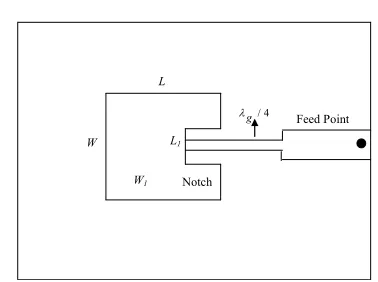
L W Notch Feed Point L1 W1 4 / g
Figure 1. The notch rectangular microstrip antenna.
fin W/h, So Equations (1) and (3) or (4) in an interactive process are used to find W/h when W/h =1, We first find
Z0 of W/h =1 and then
eff and impedance are calculatedas. 2 1 r ε 2 1 r ε eff ε 1 h W (5) eff o Z
Z and ) 1 ( eff o Z
Z (6) where
126.6 1
0 h
W Z
If Z0 is greater than Z0 (1) then W/h using is less or equal 1
Case 1 When 1
h W then 8 60 Z exp 60 Z exp 2 h
W 0 0 2 (7)
starting with eff
1 we solve forh
W using this
value. We find h W eff
from equation. Then it is
sub-stituted back in 13 to find a new value of
h W
Case 2 when 1 h
W we use Newton’s method of the
finding function zero to form an integration equation. Let X=
h W
0.44
1 1 6 44 . 0 120 1 1 42 . 2 1 5 2 0 6 2 X X Z X X X X h W new (8)
using the new
h
W we find h W
eff
and a new value of
. A good starting value for the iteration is found from
0 Z 198 120 0 Z h
W (9)
Iteration method has been done from Equations 1 to 9 and converges in a few cycles.
3. Measurement Techniques
The network analyzer is used to perform the measure-ment. Glass epoxy substrate with thickness of h=1.59 mm and approximate dielectric constant r 4.5 was used. Several patches were fabricated with the variation of notch length and width. The variation of lower and upper resonance frequencies with notch length and width are shown in the Figures 6(a) and 6(b). The variation of upper and lower resonance frequencies ratio (f2/f1) with notch length and width are shown in the Figures 7(a) and 7(b). The resulting data are shown in Tables 1 to 2.
4. Design Procedure and Design Parameters
[image:2.595.318.528.549.621.2]The actual dimension of the antenna designed is magni-fied two times in order to achieve the desired accuracy in the final design. The antenna shape of enlarged dimen-sion is taken times in rubylith film. This enlarge shape is photo reduced using a high precision camera to produce a high-resolution negative, which is later used for ex-posing the photo resist. The laminate is cleaned to insure proper adhesion of the photo resist and necessary resolu-tion in the photo development process. The photo resist is now applied to both sides of the laminate using a laminator. After wards, the laminate is allowed to stand to normalize to room temperature prior to exposure and development. The photographic negative is now held in a very close contact with the cover sheet of the applied Table 1. Variation of resonance frequencies with notch length for a given width =10mm.
Length
(mm) Frequency (f1) GHz
Frequency (f2) GHz
Frequencies ratio
(f2/f1) GHz
[image:2.595.318.526.651.721.2]2 2.998 4.525 1.527 3 2.993 4.606 1.613 4 3.01 4.523 1.513 5 3.01 4.619 1.609
Table 2. Variation of resonance frequencies with notch width for a given length =2mm.
Width (mm)
Frequency (f1) GHz
Frequency (f2) GHz
Frequencies ratio (f2/f1) GHz
photo resist, to assure the fine line resolution required with exposure to proper wave length light, polymeriza-tion of the exposed photo resist occurred, making it in-soluble in developer solution. The backside of the an-tenna is completely exposed without a mask, since the copper foil is retained to act as a ground plane. The pro-tective cover sheet of the photo resist is removed and the antenna is now developed in developer, which remove the soluble photo resist material.
Then the antenna is etched. Visual inspection is used to assure proper etching. Then excess photo resist is re-moved using a stripping solution. For stack antenna, the passive antenna are made with single side PCB same as done for active antenna.
The various design parameters of the antenna are as follows:
Substrate material used Glass Epoxy
Thickness of the dielectric substrate h = 1.59 mm Relative permittivity of the substrate r = 4.5 Design frequency f = 3.0 GHz
Thickness of the patch t = 0.0018cm and designed val-ues were calculated using the standard equations, which are
The width of the rectangular patch W = 30.15 mm The length of the rectangular patch L = 23.04 mm The length of the notch L1=1.0 mm to 5 mm at fixed width = 10mm
The width of the notch W1= 6 mm to 10 mm at fix-edlength = 2 mm
5. Discussion of Results
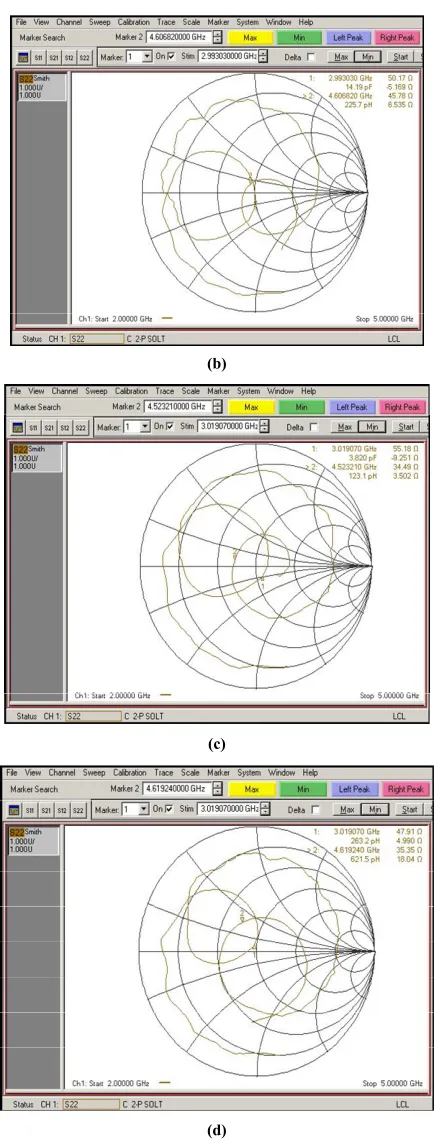
1) The variation of input impedance with frequency for different notch length for a given width is shown in Fig-ures 2(a) to 2(d). It is observed that notch microstrip an-tenna shows dual resonance in which lower and upper resonance frequencies increases with increasing notch length from 2mm to 5mm.
2) The variation of input impedance with frequency for different notch width for a given length is shown in Figures 3(a) to 3(d). It is observed that notch microstrip
(a)
(b)
(c)
(d)
[image:3.595.315.532.71.641.2]antenna shows dual resonance in which lower resonance frequency increases with increasing notch width from 6mm to 9mm,where as upper resonance is all most con-stant with varying notch width.
(a)
(b)
(c)
(d)
Figure 3. (a) Variations of input impedance with frequency for notch width = 6mm at length =2mm; (b) Variations of input impedance with frequency for notch width = 7mm at length =2mm; (c) Variations of input impedance with fre-quency for notch width = 8mm at length =2mm; (d) Varia-tions of input impedance with frequency for notch width = 9mm at length =2mm.
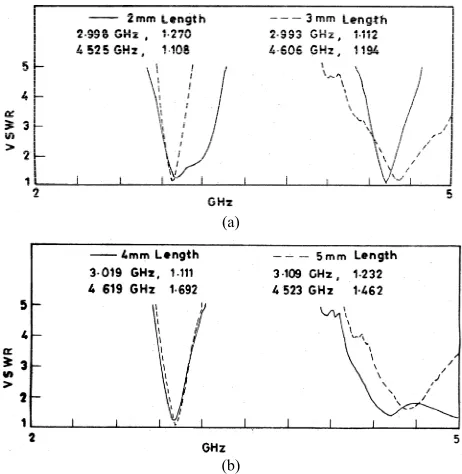
3) The variation of VSWR with frequency for differ-ent notch length for a given width are shown in Figures 4(a) to 4(d) It is observed that the value of VSWR cor-responding to lower resonance frequency is decreased from 1.27 to 1.11 with increasing notch length where as
(a)
(b)
[image:4.595.315.531.76.271.2] [image:4.595.308.539.436.673.2]corresponding to the upper resonance frequency the value of VSWR is increased from 1.10 to 1.69.
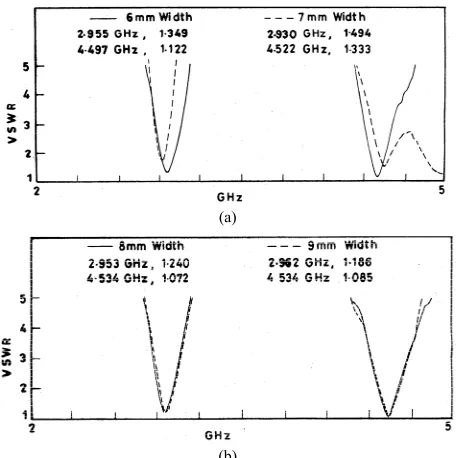
4) The variation of VSWR with frequency for differ-ent notch width for given length are shown in Figures 5(a) to 5(d). It is observed that the value of VSWR corre-sponding to lower resonance frequency is decreased from 1.12 to 1.08.
5) The variation of resonance frequencies with notch dimensions is shown in the Figures 6(a) to 6(b). It is ob-served that both resonance frequencies are increased with notch dimensions.
6) The variation of resonance frequency ratio f2/f1 with notch dimensions is shown in the Figures 7(a) to 7(b). It is observed that both resonance frequencies are increases with notch dimensions.
(a)
(b)
Figure 5. (a) Variations of VSWR with frequency for notch width = 6 mm and 7 mm at notch length =2 mm; (b) Varia-tions of VSWR with frequency for notch width = 8 mm and 9 mm at notch length =2 mm.
2.9 3.1 3.3 3.5 3.7 3.9 4.1 4.3 4.5 4.7
2 3 Notch Length (mm) 4 5
f1 f2
F
re
que
nc
ie
s (
G
H
z)
(a)
2.9
3.1 3.3 3.5 3.7 3.9 4.1 4.3 4.5 4.7
6 7 8 9
f1 f2
Notch widths (mm)
F
re
que
nc
ie
s (
GHz
)
(b)
Figure 6. (a) Variations of resonance frequencies with notch lengths for a given width; (b) Variations of resonance fre-quencies with notch width for a given length.
1 1.5 2 2.5 3
2 3 Notch lengths (mm) 4 5
f2/f1
Freq
uency (
f2 /f1
) (GHz)
(a)
1 1.5 2 2.5 3
6 7 Notch widths (mm) 8 9
f2/f1
F
requ
ency (f
2
/f1
) (GH
z)
(b)
Figure 7. (a) Variation of frequency ratios (f2/f1) with notch
length for a given width; (b) Variation of frequency ratios (f2/f1) with notch width for a given length.
6. Acknowledgment
[image:5.595.312.539.78.240.2] [image:5.595.58.288.263.492.2] [image:5.595.310.541.293.615.2]providing the measurement facilities.
7. References
[1] I. J. Bahl and P. Bharta, Microstrip Antenna, Artech House, Massachusetts, USA, 1980.
[2] S. K. Polit and A. Hamad, “Dual-band notch microstrip antenna for mobile communications,” Asia Pacific Mi-crowave Conference Proceeding New Delhi, Vol. 2, pp. 299–302, pp. 17–20, December 1996.
[3] H. Nakano and K. Vichien, “Dual-frequency square patch antenna with rectangular notch,” Electronics Letters, Vol. 25, No. 16, pp. 1067–1068, August 1989.
[4] L. I. Basilio, A. K. Jeffery, T. Williams, and A. S. Long, “The dependence of the input impedance on feed position of probe and microstrip line fed patch antenna,” IEEE Transactions on Antennas Propagation, Vol. AP–49, pp. 45–47 January 2001.
[5] E. Chang, S. A. Zong, and W. F. Richards, “An experi-mental investigation of electrically thick rectangular mi-crostrip antenna,” IEEE Transactions on Antennas Propa-gation, Vol. AP–34, pp. 767–772, 1986.
[6] D. M. Pozar and B. Kaufman, “Increasing the band width of a microstrip antenna by proximity coupling,” Elec-tronics Letters, Vol. 23, No. 8, pp. 368–369, April 1987. [7] H. F. Pues and A. V. V. De Capelle, “An impedance
matching technique increasing the band width of microstrip antenna,” IEEE Transactions on Antenna and Propagation, Vol. AP–37, No. 11, pp. 1345–1354, November 1989. [8] S. K. Palit “Broad band microstrip antenna design,
Chi-nese Journal of radio science, August 1995.
[9] C. L. Li, C. F. Wen, and Y. K. Ling, “Dual-band di-pole-loaded notch antenna,” The 23rd International Tech-nical Conference on Circuits/Systems, Computers and Communications (ITC-CSCC 2008), pp. No–1797–1800. [10] Shivnarayan and B. R. Vishvakarma, “Analysis of notch
loaded patch for dual-band operation,” Indian journal of Radio and Space Physics, Vol. 35, pp. 435–442, 2006. [11] J. Y. Hui, and Z. S. shi, “Notch triangular microstrip
an-tenna for dual-frequency operation,” Journal of Shanghai University, pp. No–375–378, 2003.