*Contacto:
ISSN: 1696-4713 www.rinace.net/reice/
Recibido: 1ª Evaluación: 2ª Evaluación: Aceptado:
1 de septiembre 2014 13 de septiembre 2014 6 de octubre 2014 7 de octubre 2014
Sustaining the turnaround: what capacity building
means in practice
Sostener el cambio de rumbo: qué significa la construcción de
capacidades en la práctica
Christopher Day* University of Nottingham
The purpose of this paper is to show how successful, sustained school improvement in schools in urban settings which serve highly disadvantaged communities relies upon the qualities and skills of their principals to engage, simultaneously, in capacity building at individual, collective and community levels. Definitions of capacity building as, ‘the interplay between personal abilities, interpersonal relationships, and organisational structures’ (Mitchell and Sackney, 2000:11) are limited in their application for they often fail to acknowledge that over the course of the time needed to build stable and successful learning and achievement environments, principals are likely to have to move through a number of ‘layered’ development phases, each one of which will contain priorities; and that during this change process, principals will likely also need to maintain, articulate and communicate a clear set of values upon which their strategies will be based.
Keywords: School improvement, Turnaround, Capacity building.
10
Introduction
The literature on school improvement is replete with good advice on change: it cannot be mandated (yet policy makers continue to do so); best practice must be modelled by school leaders (yet it often is not); existing, unacceptable, norms, structures and processes must be displaced and replaced by those which more accurately reflect the school values and moral and ethical purposes (difficult to achieve, especially in large schools); system change needs to be championed (certainly, though by whom and for how long); behavioural change happens mostly by speaking to or influencing people’s emotions (always a difficult nettle to grasp for those without empathetic qualities). The list is exhaustive.
There have been observations that huge financial investments by governments in ‘top-down’ models of systemic change have given little return. They identify the need to, “reframe our entire reform strategy so that it focuses relentlessly and deeply on capacity building and accountability” (Fullan, 2006:28). This and similar calls emphasis the need to bring together internal and external change agendas as well as recognising that real change that is sustained involves everyone in the school, that it takes time and that, whilst there may be many leaders, the principal is key. The successful principal knows that for change to work students, teachers, non-teaching staff and parents must all have a sense of ownership of the process and the product. Without such commitment, sustaining change will be difficult if not impossible.
Whilst there are a number of conditions associated with turning around schools e.g. appointing a new principal, injecting additional resources or ‘re-badging’ (Ansell, 2004), there are also a number of warnings. The new leader’s agenda may be too daunting; ‘quick-fix’ changes may lead to temporary recoveries, which cannot be sustained; and these often exhaust the staff (and principal) rather than re-energizing them (Hargreaves and Fink, 2006; Kanter, 2004). This may be the case, especially when change processes do not acknowledge people’s emotions, (Hargreaves, 1998), vulnerabilities (Kelchtermans, 1996) or values (Jackson et al., 1993; Sockett, 1993); when they do not seek to renew their passion for teaching (Day, 2004); or when they fail to provide the training and development opportunities and ongoing support necessary for staff to learn new skills and acquire new knowledge, in other words, when they fail to build the individual and collective power of the staff to improve student well-being and achievement, otherwise known as ‘capacity building’.
Despite the plethora of good research and experience generated advice such as that listed above, if we observe studies of the effects of new public management agenda and the accountability driven systems that accompany this, it would appear that we know little about the performance of ‘turnaround’ schools in the longer term i.e. whether change is sustained (National Audit Office, 2006). Nor, it appears, can we readily find the skills and talents necessary to effect the sustained improvement of schools, which, in American terms, are ‘on probation’:
11
which was under threat of closure when she was first appointed. She is neither ‘charismatic’ nor a ‘hero’ in the traditional sense these terms are often used in the literature on school principalship. However, she does have a resolute sense of moral purpose, her focus is upon both the instrumental and the personal, she is herself a good classroom teacher and is brave enough to model this for others, and she possesses a range of intra and interpersonal qualities.
1. The context
Oasis Primary and Nursery School is located in an inner city area of extreme social and economic deprivation. 71% of the pupils live in the most deprived 1% and 96% in the most deprived 5% of areas nationally. Household income is in the lowest 10% nationally, and 80% of pupils are eligible for free school meals. The crime and disorder statistics are in the worst 3% nationally. Armed police patrol the streets because of the high number of shootings and there is a significant drug problem. In the past the school has had problems with hypodermic needles being buried ‘needle’ up in the school grounds. A number of pupils aged 7-11 are involved in drug dealing for street gangs at night. Pupils tell the school that many spend their school holidays in the City Centre. Few parents have a history of accessing further education.
There are 169 pupils in this smaller than average school. Pupil mobility is high, with 42% not completed the full four-year education programme in 2005. 40% of pupils have social services involvement and 35% are classified as having special educational needs (SEN). The school has an increasing number of pupils whose parents are asylum seekers and many of these are not fluent English speakers. There are 13 different languages spoken and the proportion of pupils from minority ethnic backgrounds is almost three times higher than the national average. 80% of pupils come from one-parent families and the same percentage is eligible for free school meals. Attainment on entry is well below average.
12
2. The principal
The principal (Diana) has been described as having achieved, ‘remarkable success’…and her school is described as being, ‘incomparably better for the years you have been there’ (Urban Leaders Assessment Centre, 2005). Previously she worked in inner city schools in London and her present city before taking up the headship of this, ‘derelict, unpromising and challenging’ school. In order to reach the level of success that has been achieved, she had to overcome the ‘embedded pessimism’ of staff, quickly deal with two staff whose teaching was consistently poor and transform the ethos and environment. A key strength of Diana’s leadership is the generation of a shared vision for the education of the pupils and this is accompanied by close working relationships with parents, governors, and external agencies.
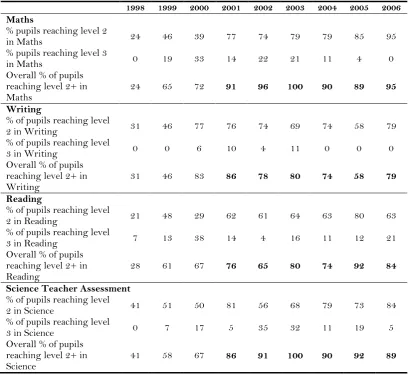
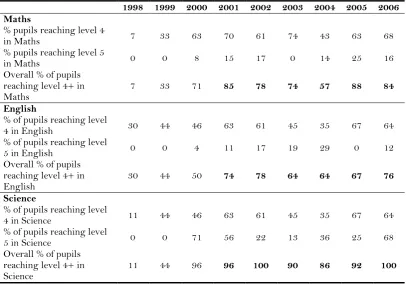
[image:4.595.79.488.332.707.2]At Oasis, one tangible result of the new ways forward has been the rise in Key Stage 1 (table 1) and 2 (table 2) national test results of 7 and 11 year old students in Literacy, Numeracy and Science.
Table 1. Key Stage 1 SAT Results
1998 1999 2000 2001 2002 2003 2004 2005 2006
Maths
% pupils reaching level 2
in Maths 24 46 39 77 74 79 79 85 95
% pupils reaching level 3
in Maths 0 19 33 14 22 21 11 4 0
Overall % of pupils reaching level 2+ in
Maths 24 65 72 91 96 100 90 89 95
Writing
% of pupils reaching level
2 in Writing 31 46 77 76 74 69 74 58 79
% of pupils reaching level
3 in Writing 0 0 6 10 4 11 0 0 0
Overall % of pupils reaching level 2+ in
Writing 31 46 83 86 78 80 74 58 79
Reading
% of pupils reaching level
2 in Reading 21 48 29 62 61 64 63 80 63
% of pupils reaching level
3 in Reading 7 13 38 14 4 16 11 12 21
Overall % of pupils reaching level 2+ in
Reading 28 61 67 76 65 80 74 92 84
Science Teacher Assessment % of pupils reaching level
2 in Science 41 51 50 81 56 68 79 73 84
% of pupils reaching level
3 in Science 0 7 17 5 35 32 11 19 5
Overall % of pupils reaching level 2+ in
Science 41 58 67 86 91 100 90 92 89
13
Table 2. Key Stage 2 SAT Results
1998 1999 2000 2001 2002 2003 2004 2005 2006 Maths
% pupils reaching level 4
in Maths 7 33 63 70 61 74 43 63 68
% pupils reaching level 5
in Maths 0 0 8 15 17 0 14 25 16
Overall % of pupils reaching level 4+ in
Maths 7 33 71 85 78 74 57 88 84
English
% of pupils reaching level
4 in English 30 44 46 63 61 45 35 67 64
% of pupils reaching level
5 in English 0 0 4 11 17 19 29 0 12
Overall % of pupils reaching level 4+ in
English 30 44 50 74 78 64 64 67 76
Science
% of pupils reaching level
4 in Science 11 44 46 63 61 45 35 67 64
% of pupils reaching level
5 in Science 0 0 71 56 22 13 36 25 68
Overall % of pupils reaching level 4+ in
Science 11 44 96 96 100 90 86 92 100
Note: Elaborated by the author.
Tables 1 and 2 show clearly what a difference this head and her staff made. Over a seven year period results improved in KS1 Mathematics from 24% to 95%; and in KS2 from 70% to 84%, in KS1 Science from 41% to 89% and in KS2 from 11% to 100%; and in KS1 Literacy from 31% (writing) and 28% (reading) to 79% and 84% respectively and in KS2 from 30% to 76%.
It is important to note that whilst the persistence of “external challenges remained constant”, the nature of “internal” challenges –over which Diana had more direct influence– “did not”. Diana’s response was to manage both in tandem over a number of development phases:
Had to go into everything to make sure that things are moving forward…You have to be realistic about the pace of improvement…Initially, it was a constant ‘hands on’ approach. I did not leave the school for a year. I was wrapped up in the school, couldn’t think beyond it.
3. Four Phases of Development
3.1. Development Phase 1: Coming out of Special Measures (1999–2000)
14
address low aspirations and expectations of achievement held by staff, parents and students themselves. Moreover, she did this in an area where, ‘the high crime rate and gang culture has an effect on some pupils’ performance as they become emotionally traumatized after witnessing or being involved in crime’, and in a school which provided an impoverished setting for teaching and learning.
I talked a lot about my beliefs and expectations…I acknowledged that I had just come out of the classroom…So I knew what it was like, and that there are days when some people work better at different times and that there would be flexibility as long as the job’s done…I talked about working habits…and I brought some examples of the standards of work that I would expecting…I talked about the ethos of displays as part of the classroom learning environment.
3.1.1. Five First Steps
• Enriching the teaching and learning environment
Diana redecorated the school building, including reshaping the interior so that It became a welcoming, rich environment (and provided a direct contrast to the external worlds of the students) with quality resources in classrooms. She transformed the school into a learning ‘oasis’, with brightly coloured furniture, carpeted corridors, walls adorned with photographs and children’s’ work clearly mounted, inner courtyards and a staffroom which looked more like a well appointed business lounge. As Corrie Giles observes in his case studies of three American schools in this issue, ‘in schools where order had or could easily break down, effective management of the learning environment was a crucial first step in winning the support of teachers and parents.
• Providing security
The school site was secured; used hypodermics littering the field became a forgotten nightmare. Investment in a child friendly playing area was made (with consultation with staff and students) and the entrance into the school itself was both secured and made more friendly for parents and other visitors through the provision of a chaired, carpeted area. Diana built close, regular meetings with the police so that the knowledge gained would help understand the behaviour of certain students.
• Establishing a student behaviour policy and improving attendance Prior to Diana’s arrival, according to parents:
Children spent more time out of their classrooms than in. She introduced a positive behaviour system, insisting upon standards of talking by teachers to children, classroom organisation (particularly routines for the beginning and ending of lessons), and behaviour in corridors, playground and classrooms.
• Gaining community acceptance
Diana invested considerable time in talking with and –wherever possible– visiting parents in order to increase interest in attendance. However, many parents did not value education due to their own negative school experiences. Many had poor parenting skills and few had accessed formal education beyond school.
• Improving teaching and learning in classrooms with staff and students: leading by example
15
Early on, she worked with staff to created detailed job descriptions so that everyone was clear about their roles and responsibilities. More importantly, she went into classrooms to observe and feedback upon teaching and to work with students herself. She wanted to be observed by the teachers, “to show staff what they can do and what’s expected”. She also modelled high standards of the display for students’ work, working with the students to, “show the staff that they can do it”.
These five steps were taken as a school and accompanied by sustained discussion and consultations with key stakeholders –staff, parents, community groups and the local authority through a planned programme of formal meetings and many informal, one-to-one conversations.
It would be a mistake, however, to conclude that there were no ‘bumpy moments’ in these early stages of the journey to success. Two teaching staff were encouraged to resign, other teaching and non-teaching staff who had lost their motivation under the previous regimes had to be won over. Focussing on continuing professional development for all staff, principally through organising a range of in-house training to improve the quality of teaching and keep knowledge, skills and practices up-to-date was, and remains, a key developmental strategy. But it was the combination of external imperatives to improve together with modelling high standards of teaching and learning and creating the internal conditions (security, behaviour and the physical environment) for students and staff to do their best that was the key to early success.
3.2. Phase 2 Taking Ownership: an inclusive agenda (2000 - 2002)
When the school was released from the ‘special measures’ category in 2000, initiatives which had been began in Phase 1 began to yield dividends. The school achieved ‘Investors in People’ (IIP) status in 2001 – a recognition of the investment Diana had made in the continuing development of all staff. Year on year improvement of the national test results vindicated Diana’s strategies and increased staff and student motivation, commitment and sense of recognition of achievement.
Sustained change and improvement rarely occur as the result of a single action or combination of actions at any given time. Rather, success occurs over time as a result of incremental, sustained changes as a result of the planning and implementation of a range of strategies in a number of key areas identified by the headteacher as being crucial to success. Phase 1 was primarily about achieving short-term success in such key areas as expectations, attendance, behaviour, teaching and learning standards, and the physical environment. Creating the conditions for longer-term success required, also, however, for a number of capacity building initiatives to be seeded during the first period. Among these were ‘performance management’; lesson observation, distributed leadership, training staff to collect and analyse classroom level data about student progress and relate this to their teaching and learning decisions whilst continuing to provide personal and emotional support to staff, parents and students. These next five steps together built staff’s capacity to sustain improvement within a sense of agreed common purpose.
• Vision and values: developing the school’s mission
16
• Distributing leadership
This phase began with two key actions affecting the leadership and management of the school. First, a new deputy headteacher was appointed to work alongside her and to teach Literacy to Year 6 (11 year old) pupils. Second, leadership of various strands of the school’s work was distributed through the establishment of a new leadership team, entrusting staff with greater responsibilities. This included a member of with responsibility for overseeing inclusion, ensuring that all students have equal access to the curriculum. Distributed leadership, especially at this point in the school’s history, provided two messages. First, it communicated a belief that many people, rather than one, are able to take responsibility for leading change. Second, it demonstrated the confidence and trust of the headteacher.
• Inclusivity: integrating students from different social and cultural environments Diana’s policy of including students as well as other key stakeholders in discussing ways forward for the school continued and the strong ethos of inclusion meant that equality of opportunity was central to all aspects of the curriculum. Special attention was given to the inclusion of students with emotional and behavioural difficulties. Incidents of racism or bullying were dealt with fairly and consistently. The multi-cultural population provided the school, in Diana’s view, with an invaluable resource from which to help students learn about each other’s cultures.
• Performance management and continuing professional development
Government legislation ensures that all staff is interviewed (appraised) on an annual basis in order to set and evaluate targets for work related to whole school, classroom and individual needs. Diana ensured not only that the system of performance management was linked to school priorities, but that staff’s individual concerns and needs were supported through planned continuing professional development (CPD). CPD was both inward and outward looking in its focus. For example, Diana created a strategic plan of focussed staff meetings, some of which involved staff forming working groups to conduct action research on various aspects of learning. Classroom observation was used to identify both individual and whole school teaching and learning issues that were then supported by training opportunities. ICT expertise was developed – with a member of staff responsible for its leadership throughout the school.
External sources were also used to support and raise staff expectation for what it was possible to achieve. The school became a member of the Local Authority [school district] Education Improvement Partnership. Through this a range of extended activities for students were able to be offered before and after school; School governors dedicated a considerable amount of the school budget to helping children achieve their full potential through the provision of teaching assistants to assist teachers in the classroom. Again, Diana led by example, becoming involved in out-of-school education projects (e.g. as a Primary Strategy Consultant leader working with other city headteachers and their leadership teams to raise standards of literacy and numeracy).
• Persisting priority on teaching and learning: becoming a thinking school
17
colleagues in classrooms was not only used as a means of ‘purging poor teaching’ but also showing staff, ‘how students could be empowered to take greater responsibility for their learning’. What had initially met with resistance from some staff was now beginning to become second nature to them as they experienced the benefits. Diana was to develop the use of classroom data much further in the next phase of the school’s journey to success.
3.3. Phase 3 Going Deeper and Wider: sustaining the momentum (2002-2005) As Oasis continued to improve in its physical environment, test results and teaching and learning, there might be some expectation that it could sit back on its laurels a little. However, this was not the case. Diana and her staff were committed to sustaining and developing further the strategies for improvement. The school went deeper and wider in its efforts to continue to improve. Induction packages were introduced for new staff, curricular targets were set with teachers for particular children as teaching and learning became more personalised:
As a result of the success of foundational strategies used in Phase 1 and 2, confidence and self esteem had grown and staff were ready to engage in more detailed analysis of their work. Diana and her management team prioritised issues related to school culture (leadership development, recruitment and retention, workforce reform – a government initiative design to enable all staff to spend the equivalent of half a day each week out of the classroom. Additionally, the ‘Investor in People’ status gained in the previous phase continued with significant investment in the ongoing development of staff. Perhaps the most significant development in this phase, however, was the increasing use of classroom data to inform decision making. Further fiver steps of the journey may be identified: restructuring the leadership; involving the community; assessment for (personalised) learning; staff development; and broadening horizons. Again, it is important to note that these were not new nor were they suddenly introduced. Rather, they were the development of journeys which had been begun in previous phases.
• Restructuring the leadership
Two distinctive teams were established –a senior leadership team and a management team. The former focused upon the strategic development of teaching and learning throughout the school; whereas the latter was mainly concerned with the successful implementation and evaluation of procedures and systems.
• Involving the community
18
• Assessment for (personalised) learning
From the beginning, Diana’s vision had been to encourage pupils to take more ownership of their own learning, but in order to do so, the conditions in which they learned and were taught had to provide psychological and social security and they had to begin to believe in their own abilities to achieve. Earlier phases had, as we have seen, established these conditions, through behaviour policies, raising expectations, increasing resource availability and accessibility and raising standard of teaching and learning. It was a combination of success in these, together with the new government policies which supported personalised learning, which now created opportunity in Oasis for students to take more responsibilities. Involving students in evaluating their own progress and learning needs through formative assessment methods had been a first step.
• Placing staff development and well-being at the centre of school improvement Having created and nurtured over time a common sense of purpose and matched teaching and learning relationships and practices to this, continuing professional development and wellbeing remained key drivers for Diana’s strategies for facilitating and stimulating change and improvement. There was a well planned programme of meetings to ensure regular communication and staff development relevant to the needs of school and individual:
• Broadening horizons
Children from highly disadvantaged communities are often deprived of experiences from outside their immediate environment, and as part of the whole vision for the school was to extend their view of what might be possible for them by looking outside their normal environment. As part of this, the NQT (newly qualified teacher) with whom Diana had worked in the early years of her headship had bid successfully for an externally funded European project in which partner schools from five countries worked together on ways of recycling and saving the environment. Video-conferencing links and visits bought experiences of new and different worlds to the students, which, together with a range of other visits to locations outside the school, had the effect of extending students’ experiences beyond their classrooms and normal life environments.
3.4. Phase 4 Excellence and Creativity: everyone a leader (2005-present)
19
the final steps in an improvement ‘cycle’, for those already begun and development in earlier phases will continue. The improvement journey is not one which will end.
4. Discussion
Attend initially to three basics…literacy, numeracy, and wellbeing of students (sometimes called emotional intelligence, character education, safe schools). These are the three legs of the improvement school. (Fullan, 2006:46)
At one level, what Michael Fullan recommends in discussing turnaround success is what this school principal seems to have done. Yet this account of her work over seven years demonstrates that creating conditions, achieving and sustaining success is far more complex than the image of a three legged stool suggests. Whilst Kanter’s (2004) three ‘cornerstones’ solutions of accountability (in which people seek feedback and self-improvement); collaboration (where interpersonal bonds are strong and where there is a sense of belonging); and initiative (in which expectations of success produce the energy to put in extra effort and keep going under pressure) apply, they also provide an oversimplified image of conditions for successful change. What we learn from Diana’s story is that the challenges for schools located in areas of high deprivation and crime are persistent. Schools themselves cannot be responsible for solving these. What we also learn, however, is that school principals and their staff can: i) affect the life chances of their students through providing environments and teaching which raise expectations for achievement; ii) provide opportunities for students to fashion a broader view of future life and work prospects (some of the Oasis students are, for example, aspiring to become doctors, politicians and lawyers); and iii) instil in all students the willingness, will and self confidence to succeed. However, the process of change is not linear, nor does it involve the application of discrete strategies, however potentially powerful their individual or collective impact might be. Rather, as we have seen, it is likely that a layered approach with more emphasis being placed on certain strategies during particular phases whilst others are “seeded” will be more effective. As “milestones” are reached, so further progress, with more emphasis on different strategies, whilst continuing with those already in place, can be made.
I think what drives me is thinking that we give these children an opportunity to make a choice…to have a good education. They’re not going to have an equal chance but they’ve got as good a chance as we can give them…the academic side is important but so is the social. They have to have good social and interpersonal skills if they are to survive and hold their own.
20
References
Ansell, D. (2004). Improving schools facing challenging circumstances. Nottingham: National College for School Leadership.
Day, C. (2004). A passion for teaching. London: Routledge Falmer.
Fullan, M. (2006). Turnaround leadership. San Francisco, CA: Jossey-Bass.
Fullan, M., Hill, P., and Crévola, C. (2006). Breakthrough. San Francisco, CA: Corwin Press. Hargreaves, A. (1998). The emotional practice of teaching. Teaching and Teacher Education, 14(8),
835-54.
Hargreaves, A., and Fink, D. (2006). Sustainable leadership. San Francisco, CA: Jossey-Bass. Jackson, P.W., Boostrom, R.E., and Hansen, D.T. (1993). The moral life of schools. San Francisco,
CA: Jossey-Bass.
Kanter, R.M. (2004). Confidence: how winning and losing streaks begin and end. New York: Crown Business.
Kelchtermans, G. (1996). Teacher vulnerability: understanding its moral and political roots. Cambridge Journal of Education, 26(3), 307-24.
Milnthrop, H. (2004). Schools on Probation. New York: Teachers College Press.
Mitchell, C., and Sackney, L. (2000). Profound improvement: building capacity for a learning community. Lisse: Zeitlinger.
National Audit Office (2006). Improving poorly reforming schools in England. London: Department for Education and Skills.