ZACH WEBER AND A. J. COTNOIR
Abstract. Mereotopology is a theory of connected parts. The existence ofboundaries, as parts of everyday objects, is basic to any such theory; but in classical mereotopology, there is a problem: if boundaries exist, then either distinct entities cannot be in contact, or else space is not topologically connected [Varzi, 1997]. In this paper we urge that this problem can be met with aparaconsistent
mereotopology, and sketch the details of one such approach. The resulting theory focuses attention on the role ofemptyparts, in delivering a balanced and bounded metaphysics of naive space.
1. Introduction: Boundary Disputes
There is a Great Red Spot on the planet Jupiter. It is a gigantic anticyclonic vortex, rotating
counterclockwise. Although the Spot is a dynamic storm, fluctuating remarkably in size and shape,
it is persistent and stark, visible through Earth-based telescopes.1 What is it that makes the Great
Red Spot a distinctive and easily grasped object in our macrophysical experience?
A basic and compelling answer to this question is: aboundary. It goes back to Euclid, who tells
us, “a figure is given by its boundaries” (Book I, Def 14). The boundary is what makes there be
a figure there at all, and not merely a disenfranchised mess of unrelated stuff. If there is anything
to such a proposal, then boundaries would seem to do explanatory work. The notion of boundary
is pervasive in ordinary thought about objects. As Varzi puts it, “whether sharp or blurry, natural
or artificial, for every object there appears to be a boundary that marks it off from the rest of the
world” [Varzi, 2004]. In terms of understanding or representing the world, boundaries appear to be
a crucial aspect of the ‘naive space’ of experience.2
Ubiquitous, ordinary and helpful as they may be, however,boundaries are puzzling. Perhaps the
most famous problem concerning boundaries is Peirce’s Puzzle [Peirce, 1933]. Consider the Great
Red Spot on Jupiter, and trace a path from a red-colored point inside the Spot to a non-red colored
point outside the Spot. What happens as we pass through the boundary of the Spot? One might
think we simply pass through the last red point and then through the first non-red point. But on
the assumption that space is continuous, there would be an infinite number of points in between.
1See [Rogers, 1995, pp. 191–196].
2This project can be taken as an exercise in pure metaphysics, naive physics, or spatial representation (at least). By not committing to whether e.g. the problems raised are epistemic, or ontological, etc., our results may be useful to researchers in any of the above areas. Our aim is to work with a naive view of things like the Great Red Spot as continuous objects in continuous space, treatingobjects as regions of space, andspaces as objects.
What color are they? Are they colorless? Could there be a single point that is both red and not
red? Similarly, to which of the Great Red Spot and the rest of the Jovian atmosphere does the
boundary belong? Perhaps it belongs to both. Perhaps it belongs to neither. But then either some
point both is and is not part of the Great Red Spot, or else there is a gap, a conceptual and spatial
hole on the face of Jupiter. It isarbitrarysimply to assign the boundary to the Spot, say, and leave
its complement in the atmosphere boundariless [Varzi, 2004], or vice versa; it isincomplete not to
assign the boundary at all; but the remaining alternative isinconsistent.
These puzzles are symptomatic of the fact that the that following pre-theoretic notions are jointly
inconsistent [Varzi, 1997], [Casati and Varzi, 1999, p 74]:
(i) boundaries exist
(ii) space is topologically connected
(iii) discrete entities can be in contact
The purpose of this paper is make these intuitive conditions formally precise in such a way as
to be all co-tenable. Section §2 makes the problem acute by explaining the relevant notions of
connectedness, contact, and symmetry that drive the puzzle. Section §3 considers the options,
arguing that there is prima facie reason for a non-classical ‘glutty’ approach to be investigated.
Section§4 develops paraconsistent mereology, putting focus on the need forempty parts. Section§5
then sketches the mathematics of boundaries in paraconsistent mereotopology, showing how these
‘empty parts’ make connected space with bounded subspaces possible. Finally, section§6 discusses
the metaphysics of these results.
We do not pretend to prove that a glut-based approach is the only workable option for a
meta-physics of boundaries. Given the state of play, something more basic suffices: to show that a
glut-based approach is tenable.3
2. Symmetry and Connection in Naive Space
Once we begin thinking seriously about bounded objects, we find two basic, interrelated
con-straints: a strong intuition aboutsymmetry, stemming from the principle of sufficient reason; and
a conviction that space is continuous—or topologicallyconnected. These two constraints seem
in-alienable. They are also incompatible. Thus we have the makings of a precise and perplexing
dilemma, of the sort amenable to treatment by non-classical logic.
The purpose of this section is to motivate a formal development of paraconsistent
mereotopol-ogy. No formal theory—classical, paraconsistent, or otherwise—is presumed; we are comparing
3This is to set aside other views and issues involving vagueness, the ‘problem of the many’, supersubstantivalism, and
some pre-theoretic notions about space and objects with their standard formalization, using
math-ematical/philosophical English. The pre-theoretic notions are meant to be graspable enough to
understand the problem, and to see the mis-match with orthodox treatment, thus calling out for
(but not presupposing) a rigorous treatment.
2.1. Symmetry. G¨odel once remarked that, if a geometric line segment is divided evenly at a point, it would be natural and intuitive to expect the two halves of the line to be perfectly symmetric
mirror images.4 As the continuum is classically constructed, this is not so. The ‘center’ point must
fall either to the left or to the right, leaving one side open and the other side closed; these are
the basic notions of topology, wherein a closed object contains its boundary, and an open object
does not. (Lines that can be symmetrically divided, such as the rational line around ‘
2, are not
continuous.) And what goes in one dimension, also goes in higher dimensions: the Great Red
Spot of Jupiter is, on the received model of space, a set of points that must be open or closed. A
boundary seems to split a (connected) space into two parts—but, crucially, one part will be open
and the other closed(see§2.2 below).
The problem now is simple: given no other facts about the space,whydo the open/closed
prop-erties fall where they do? Neither macroscopic analysis nor mathematical argument would seem
to settle the matter, since physically the object loses its definition at very small scales, and
logi-cally, the properties of being open and closed may be interchanged without any rational difference
[Pratt-Harmon, 2007, p. 14]. We feel the force of the following constraint:
Symmetry: If there is no principled difference between two objects, then there is no princi-pled difference regarding their boundaries, either.
To clarify what Symmetryis notclaiming, consider the division of the surface of Jupiter into to halves, one the fusion of points strictly above the equator, and the other the fusion of the equator
with the points below the equator. The asymmetry between these two halves in this instance is
not at all surprising.5 Rather, what is cries for an explanation of some sort is that there isnoway
to divide the surface in two without one being open and the other closed wherever they meet; the
Symmetry intuition is that there should be some way to divide an object without requiring one
half to be different from the other.6 Symmetry is violated when every way of dividing objects forces an arbitrary difference.
To putSymmetry the other way around, then, if there is a difference between the boundaries of two objects, a principled and explicable difference that persists across all cases, then there is an
4According to Putnam, citing a short unpublished note [Putnam, 1994]. 5Thanks to referees for pressing this point.
6If neither an object nor its complement are fully bounded, both are partly open and partly closed. As such, the
explicable difference between the objects after all.7 Where one object is open and another is closed,
there should be some reason as to why; but to ask which is which about Jupiter and its Spot is
to ask is “an embarrassing question” [Casati and Varzi, p 87]. Without some further mitigating
reason, it is hard to take as a brute fact that some objects include their boundary as a part while
others do not.8 The
Symmetryproblem is the postulation of adistinction without a difference.
2.2. Connectivity. The bite of Peirce’s Puzzle comes from the assumption that space is connected. The key fact is just this:
Separation: A space isseparatediff there is an exclusive and exhaustive division of the space into two closed parts.
(Cf. [Hocking and Young, 1961, p.14].) Spaces that are not separable are connected. (As per
footnote 2, all this goes equally for objects.) Since the basics of topology tell us that the complement
of a closed set is open [Kelley, 1955, p. 40], both parts of the partition in a separation are open,
too. Connectivity is enmeshed with the concepts of open and closed sets.
Let us draw the conventionally-understood interplay of these concepts a bit more sharply, by
imagine the following scenario. There is about to be peace in the middle east. The leaders of three
countries have struck an agreeable deal, and are about to shake hands. FirstA shakes withB, so
their hands are in contact; therefore (without loss of generality)A’s hand is topologically open, and
B’s hand is topologically closed. Then B shakes with C; so (again, without loss of generality) B
is closed and C is open. Finally, Ashakes with C. EitherC’s hand changes from open to closed,
or else both have open hands, and therefore cannot come into contact. That is, no matter how
hard they push, they cannot truly shake hands! As far as naive spatial representation goes, this is
nonsense.
What this shows is that a space that satisfies the symmetry intuition cannot, apparently, be connected.9 And this is itself a problem, because the space of naive experience is connected. There
are no rips or tears. But here is the important part. In classical topology, that is, topology
embedded in classical logic, Separation can be rephrased: a topological space is connected (not separable) if and only if the only the only sets that are both open and closed are the entirety of
space, and the empty set [Kelley, 1955, p. 53], [Hocking and Young, 1961, p.14, lemma 1-11].
Why? How is this rather recondite expression of connectivity a re-statement of intuitive claims
about space? Well, consider an apparently connected space like Jupiter, and some non-empty proper
subset of it, like the Great Red Spot,G. Suppose Gis both open and closed. The boundary ofG,
7Interestingly, this is itself a continuity intuition – roughly, ifais very similar tob, thenBpaqis very similar toBpbq,
making the boundary operator like a continuous function.
8See [Dummett, 2000, p. 505] and [Zimmerman, 1996, p. 12] for more problematizing the metaphysics, and [Sider, 2000] for a possible reply.
9Casati and Varzi try to relocate the asymmetry [Casati and Varzi, 1999, p.80, 87], but the fundamental forced
intuitively, is made up of all the points that are ‘extremely close’ to bothGand its complementG.
WriteBpGqfor the boundary ofG. (A precise definition ofBis given in §5.) Now, ifGincludes its
boundary, if it isclosed, then this meansBpGqis a subset ofG. IfGis open, thenBpGqis a subset
ofG. Ergo ifGis both open and closed, then for anyxP BpGq,
xPG and xRG
which is a contradiction. By classical reductio, then, the boundary isempty,BpGq “ H. Therefore
if the Great Red Spot is really a non-empty proper subspace of Jupiter’s surface, then there is a rip
in the fabric of the space, and so the space is not connected. The existence of bounded, discrete
entitiesseems to grate against the connectivity of space (cf. §5.2).
Our reasoning seems to have led us into a corner. On the one hand, objects that are touching
share a boundary; space is connected. On the other hand, objects do not arbitrarily differ. But
given our two objects, if the boundary belongs to one, then that object is closed, andipso factothe
other, by virtue of connection. If a sub-object in space is both open and closed, then the space is
not connected at all.
The task ahead is to disentangle this thicket of intuitions, so that proper, non-empty subspaces
of a connected space may be both open and closed.
3. Options
Aristotle famously defined the boundary of an object as “the first thing outside of which no part
is to be found, and the first thing inside of which every part is to be found” (Metaphysics 1022a),
and the germ of his definition is retained in modern topology. But we have seen that modern
topology may not settle the matter. Assuming the connectivity of space, there are some theoretical
options:
(1) Classical: A boundary may be part of an objector its complement, but not both. (2) Glutty: A boundary may be part ofboth an object and its complement.
(3) Gappy: A boundary may be neither part of an object nor part of its complement. (4) Coincidence: There are two coinciding boundaries: one that is part of an object, and one
that is part of its complement.
(5) Eliminativist: An object really has no boundary at all; boundaries are either abstractions (equivalence classes) of convergent series of nested bodies, or the boundary of the space-time
Philosophers have defended each of these views.10 Only three of these theories have been
made mathematically precise. The Classical view — which is so called due to its ba-sis in ‘classical’ mereotopology — has been historically dominant, and developed formally
in [Casati and Varzi, 1999]. Following Chisholm, the Coincidence view is formalized in [Smith, 1997]. At least two versions of Eliminativismhave been given precise formalizations. The Whiteheadian theory is fully formalized in [Clarke, 1985], and extended in [Randell et al., 1992].11
However, to our knowledge there have been noGappyor Gluttyformal theories put forward.12 As we have been arguing, the Classical view fails to satisfy the symmetry intuition that a boundary never arbitrarily belong to an object over its complement. The other options all appear
to satisfy this constraint. We think the Glutty view has the best chance of modeling our naive intuitions about space, objects, and their boundaries. To motivate that, we now point out certain
costs of adopting (3)-(5)—not to raise these challenges as if they were insuperable, but to give
evidence that the Gluttyview has someprima facie advantages over its rivals.
3.1. Coincident Boundaries. Recall that theCoincidence approach claims that any two con-nected objects have two distinct but coincident boundaries separating them. Indeed, the theory
claims that all entities whatsoever have boundaries as parts as a matter of metaphysical necessity.13
That is, all entities are closed. In this way, there is no arbitrary choice between two adjacent
ob-jects as to which is to be open and which closed. Both must be closed, each containing their own
boundary.
It is worth noting that theCoincidenceapproach requires a great deal more coincident objects than one might expect.
Each point within the interior of a two- or three-dimensional continuum is in fact an
infinite (and as it were maximally compressed) collection of distinct but coincident
points: punctiform boundaries of straight and crooked lines, of two-dimensional
seg-ments of surfaces and of interior regular and irregular cone-shaped portions within
three-dimensional continua, etc. (Not for nothing were the scholastic philosophers
10The standard account of boundary in point-set topology reflects the
Classicalview, defended in [Bolzano, 1950]. The Gluttyview seems to be found first in [Peirce, 1933], and then [Priest, 2006]. [Varzi, 1997] cites Leonardo as holding a Gappy view, with additional possible adherents being [Hestevold, 1986] and [Sorensen, 1986]. The
Coincidence view is in [Brentano, 1988] and [Chisholm, 1984]. Finally, the Eliminativist is most notably in [Whitehead, 1919]. NB that the use of the termClassicaldoes not indicate that all other approaches are based in a non-classical logic.
11To be accurate, there are a number of different boundary-free theories. Lumping all such theories under the
category of Eliminativismis simply for ease of explication, and because below we will prefer boundaried theories
over boundariless ones.
12The closest thing anyone has put forward is the bi-Heyting algebraic theory of Stell and
Wor-boys [Stell and WorWor-boys, 1997]. This algebra is developed primarily to yield point-free models of the Region Con-nection calculus of [Randell et al., 1992]. This structure is importantly different from the one we propose below. In particular, it is based in classical logic. But a full examination of those differences will have to wait for another time.
exercised by the question as to how many zero-dimensional beings might be fitted
onto the head of a pin.) [Smith, 1997, p. 10]
Again, consider the real lineR. Consider the boundary between the intervalsr´1,0sandr0,1s, and
the boundary between the intervalsr´2,0sandr0,2s, and the boundary betweenr´3,0sandr0,3s,
and so on. Even simply considering only the natural number intervals, there are infinitely many
coincident boundaries stacked up at 0. For those with concerns of ontological parsimony, the view
appears ontologically inelegant, other things being equal. Of course, ontologically bloated theories
are sometimes much more elegant than parsimonious ones, when other things aren’t equal; and
those unconcerned with parsimony considerations of this kind will not find the view inelegant.
Of more pressing importance is that the Coincidence tells us that there are many otherwise indistinguishable boundaries, all co-located and doing the same work. So this is going astray in the
same way that violations ofSymmetrydo, namely by postulating a distinction without a difference. Indeed, there is a sense in which Coincidence theory does not, in fact, satisfy the symmetry constraint. While there is no arbitrary choice between bounded and boundariless objects, there
still is a choice as to which object a given boundary belongs. The Great Red Spot has a boundary
b1 and so does its complementb2. But given their coincidence, what makes it the case that it is
b1 and notb2 that is the Spot’s boundary? Is there any non-arbitrary answer? A given boundary
is always directed toward the (only) entity that it bounds; boundaries are essentially directional
without any metaphysical explanation for their direction. Of course, boundaries may have only
one direction (e.g. the intersecting point of a circle and a tangential line is a boundary in only one
direction) or many directions (e.g. a point in the interior of a solid sphere is a boundary in every
direction). But the problem remains that, according toCoincidence, boundaries are attached to their objects in an essentially asymmetrical way.
3.2. Eliminativism about Boundaries. TheEliminativistviews also do not commit the error of assigning boundaries arbitrarily, simply because they do not assign boundaries at all. It may
seem that this way of accommodatingsymmetryresults intoo few boundaries.
First, on such a view, all objects are unbounded and thus, it is unclear how the open/closed
distinction can be recovered in full generality. Now, perhaps some boundariless systems are able to
recover some topological notions, and here is not the place to launch a full investigation into the
issue. It is worth noting, however, that the above problem regarding the impossibility of handshakes
at peace talks arises again with a vengeance. Assuming the connectedness of space, no two objects
can touch as neither includes their boundary. The call for explanation rings as loudly as ever.
Secondly, the openness of all objects gives rise to a new puzzle. Imagine a completely
homoge-neous sphere (in the Eliminativist case, imagine it is open); but consider it as already divided into two halves. Since there are no boundaries, neither half is bounded on its inside. It seems
shape. But if it is possible, then fusing the two halves together will have to be a process of creating
the ‘missing’ boundary points without which there would be a gap in the center of the sphere. To
put the point differently, consider the open intervals p´1,0qand p0,1q in R. Note that the point
0 cannot exist, otherwise the boundary of the intervals would exist,contra eliminativism. What is
the mereological sum of these two objects? Presumably, the intended sum is the interval p´1,1q.
But that includes 0 which was supposed not to exist. And if a sum fails to include 0, why the gap
in the center?
Eliminativism may yet be tenable, but something must be said to explain the newfound
awk-wardness. As it stands, the proposed solution fails to solve the originalsymmetrypuzzle.
3.3. Gappy Boundaries. Finally, we consider theGappyoption. As this option is closest to our preferred theory, we won’t have much to say against it. There are, however, some puzzles that
gappiness raises that are not faced by the glutty approach.
What separates Great Red Spot from its complement? Well, since we’re not being eliminativists,
a boundary exists between them. If a ‘gap’, the boundary is neither part of the Spot nor its
complement. But now we seem to have a new question: since the boundary and the Spot are disjoint,
what separates the boundary from the Spot itself (alternatively, what separates the boundary from
the Spot’s complement)? Presumably, by parity of reasoning, there must be a new boundary
between the Spot and its boundary. And if a ‘gap’, this boundary is part of neither the Spot, nor
the boundary of the Spot. So what separates the Spot from this new boundary? As is obvious, we
have found ourselves in a regress such that there are infinitely many distinct gaps between any two
objects in contact.14 Now, whether this regress is vicious is an interesting question. But it is an
open question nonetheless. A related problem arises with the gappy view in light of the classical
truth that the boundary of the boundary of an object is part of that object. But theGappyview seems to imply that the boundary of a boundary cannot be part of the object.
All other options considered, we propose that it is time for a serious investigation of aGlutty account, according to which the boundary between two objects in contact is part of both.
4. Mereology: Parts, Overlap, and Identity
The formally precise treatment of concepts surrounding parts in connected space is called
mereotopology, built by adding standard topological operators to mereology. Work in this formal
discipline until now has been conducted under the auspices ofclassical logic. In this section, we will
develop a paraconsistent mereology which forms the basis for a metaphysics of glutty boundaries.15
14Thanks to Marcus Rossberg for raising this point, which is reminiscent of the problem of higher-order vagueness. 15There is a school of thought, owing to Poincar´e, Weyl, and Whitehead, that the problems associated with boundaries
4.1. Basic Mereology. Here is a brief introduction to classical mereology, using a slightly non-standard axiomatization from [Hovda, 2009, Part 4]. This axiomatization is equivalent to those in
more standard presentations such as the axiomatization of ‘general extensional mereology’ (GEM)
in [Casati and Varzi, 1999], or that of ‘classical extensional mereology’ (CEM) in [Simons, 1987].
The axiomatization highlights some features which will be important when we move to aGlutty
approach.
Let HM0 be an axiomatization of classical logic with identity “, and with Ąthe material
con-ditional. Then HM0–HM6 below is an axiomatization of classical mereology. Parthood,ď, is taken
to be primitive and is a partial order.
HM1: @x xďx
HM2: @x@yppxďy^yďxq Ąx“yq HM3: @x@y@zppxďy^yďzq Ąxďzq
From parthood, we can define notions likeoverlap,disjoint, andproper part.
x‚y “df Dzpzďx^zďyq
xêy “df x‚y
xăy “df xďy^ Dzpz‚y^zêxq
Two objects overlap when they have a common part, and two objects are disjoint when they have no
parts in common. Proper parthood is the corresponding strict order to parthood; the definition here
is slightly unorthodox, but it turns out to be better to work with in a paraconsistent setting, since
it makes the difference betweenxandy explicit. Given extensionality, this definition is classically
equivalent to the more usual ones likexďy^yęx.
A basic axiom guarantees the existence ofcomplements:
HM4: @xpDypyęxq Ą Dzpzêx^ @yppyêxĄyďzq ^ pyêzĄyďxqqqq
The axiom states that if an object y isn’t part of another x, then there is an object, x, made
up of all and only the non-x-overlapping parts of y. The antecedent allows there not to be a
complement to the whole universe, which would be the ‘empty object’ were it to exist (as such, this
axiom is consistent with HM6, below). The axiom asserts that objects do not overlap their own
complements. One can prove thaty ďxĄyêxby reductio.16 Moreover, this axiom entails the
standard equivalence ofxďy with@zpz‚xÑz‚yq.17
16Strictly speaking, HM1 is redundant, since the Boolean complement axiom HM4 implies the reflexivity of parthood. Proof: If@xpDy yęxqis false, thenDx@y yďx. Hence,xis the universe, andxďx. If@xpDy yęxq, then find the complementx. As above,xêx. By HM4,@ypyêxĄyďxq, soxďx.
17Cf. Remark 4 below. Standard axiomatizations of mereology usually include asupplementationaxiom—the usual
Fusions of definable collections of objects exist; such objects combine to make a whole. Here,
fusions areleast upper bounds:
lubpt, Aq “df@xpAĄxďtq ^ p@w@xpAĄxďwq Ątďwq
So a lubof theAs is just an object that has all theAs as parts (i.e. an upper bound), and is part
of any other upper bound of the As (i.e. least). Classical mereology stipulates that fusions always
exists for any (definable) collection ofAs:
HM5: DxAĄ Dz lubpz, Aq
A classical axiomatization, finally, ensures there is no empty object; that is no object which is a
part of everything. This is a standard part of classical mereology, and it is usually derived from
supplementation principles.18
HM6: DxDypy‰xq Ą Dx@ypxďyq
HM6 states that, so long as there are at least two things, there is nothing which is a part of
everything.
Empty objects have almost always been excluded from mereology, on the grounds that an
‘empty fusion’ is highly counterintuitive, although there are some who have argued in its favor
(e.g. [Carnap, 1947], [Bunge, 1966], [Bunt, 1985], [Martin, 1965], and in a paraconsistent context,
[Priest, 2014]; cf. [Oliver and Smiley, 2013]). Calling it a ‘fiction’, Simons calls advocates of it
“culprit[s] in propounding this absurdity”, and is relieved to find “the idea is neatly dispatched
in Geach 1949 and we need not take it seriously” [Simons, 1987, p. 13]. The matter is not so
neatly dispatched, however. Geach devotes only a few lines to this thought [Geach, 1949, p. 522],
exclaiming that “the null thing is described as ... existing nowhen and nowhere!” Incredulity is not
an argument. In what follows, empty parts will be play a distinctive role in a Gluttyapproach. Axioms HM1–HM6 makes plain the fact that models of classical mereology are complete Boolean
algebras without a ‘zero’ element.
4.2. Enter Paraconsistency. We have argued that there is a sufficiently intuitive conception of boundaries to be formalized. One aspect of that conception is expressed by the symmetry
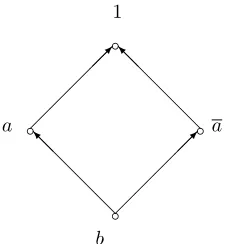
constraint, as illustrated by the simple universe in Figure 1. Call the whole universe 1; we also
have an objecta, an objectawhich isa’s complement in1, and the intuitive, non-empty boundary
between them,b. (All these notions will be made precise in§5.) Where doesbbelong? Isbďaor
is bďa? According to classical mereology cannot be part of both. If b were part of both thena
would overlap its complement. But such overlap violates HM4, and is classically impossible.
Our competing intuitions are irreconcilable in a theory with classical logic in the background.
What of a theory with a paraconsistent logic in the background? Paraconsistent logics reject ex
18Assume for reductio that there are at least two objects 0 and 1, and
a a
[image:11.612.240.333.94.185.2]b
Figure 1. A Simple Universe
falso quodlibet, the inferenceA^ A $B, by weakening the classical Boolean negation to a De
Morgan negation. This negation satisfies double-negation elimination, the De Morgan laws, and
excluded middle; it does, however, allow for some types of inconsistency. The crucial property,
which will emerge in constructions as we go, is the invalidity of disjunctive syllogism:
A_B, A&B
(LetAand Aboth hold; thenB could be absurd.) The logic is found in§Appendix 1.
By moving to a paraconsistent logic with its corresponding De Morgan negation, we can have a
diagram of our Simple Universe (Figure 2) that satisfies symmetry. The nodes are objects, and paths via upward arrows indicate proper parthood.19
@ @ @ @ @ I
@ @ @ @ @
I
b b
b b
b 1
a a
Figure 2. Paraconsistent Model of a Simple Universe
We can allow that b ď a and b ď a, even in the presence of complementation axioms. This
is because now being disjoint, a ê a, may hold simultaneously with overlap, a‚a. Indeed, in
general complementation does not rule out disjoint objectsaandasharing parts. What follows is
a‚a^ a‚a. The boundary ofais inconsistent; the boundary is also symmetric.
19This diagram and others below are intended to be illustrative only — i.e. not presented as a consistency argument
[image:11.612.230.343.391.513.2]In classical theory, HM6 rules out an empty object because nothing would be disjoint from it
— an empty object is part of everything. In the proposed paraconsistent recasting, Figure 2 has
an obvious bottom element, b. But it is important to note that this sort of ‘emptiness’ is distinct
from the ‘empty object’ . In a paraconsistent context, an object’s parts (thexs for whichxďy)
are independent of itsnon-parts(thexs for whichxęy). That is, it is paraconsistently acceptable
that an object’s part might also be a non-part. This is precisely the case withbandaabove: bďa
whilebęa. Now, aclassicallyempty object would be such that ďxfor allxand ęxfor nox.
In the case above,bisn’t classically empty, since it is amonga’s non-parts. Another way of putting
the point is that b satisfies the axiom HM6, which rules out the ‘empty object’.20 As we will see
again,b is not truly ‘empty’ even though it is part of everything else.
That the algebra for a paraconsistent mereology naturally points to the existence of such ‘empty’
elements, turns out to be the skeleton key unlocking the whole metaphysical riddle. (See§6.)
Let PM0 be an axiomatization for a paraconsistent logic (given in the§Appendix 1). Then:
PM1: @x xďx
PM2: @x@yppxďy^yďxq Øx“yq PM3: @x@y@zppxďy^yďzq Ñxďzq
PM4: @xpDypyęxq ÞÑ Dzpzêx^ @yppyêxÑyďzq ^ pyêzÑyďxqqqq PM5: DxAÞÑ Dz lubpz, Aq
PM6: DxDypy‰xq ÞÑ Dx@ypxďyq PM7: xďyÞÑ @zpz‚xÑz‚yq
where‚ andêare defined as above, and
lubpt, Aq “df@xpAÞÑxďtq ^ p@w@xpAÞÑxďwq ÞÑtďwq
PM0–PM7 axiomatizes our paraconsistent mereology. Again, PM1–PM3 give a partial order. PM5
generates a lubfor every (definable) subset. PM6 rules out the purely empty object , and likewise
forces any bottom element of our structures to be among the non-parts of some other object. With a
non-classical negation, PM4 gives De Morgan complements,xfor everyx(excluding the universe).
So these structures correspond to complete De Morgan Algebras without 0. PM7 expresses an
important relationship between parthood and overlap; it is a theorem of classical mereology, but
fails to be provable from PM1–PM6 due to the relative weakness of the paraconsistent background
logic.
Note on metatheory. The theory PM to be developed is non-trivial (or ‘absolutely consistent’), in the sense that it has a classical model in which some sentence is not satisfied. This is shown, via
a classical metatheoretic argument, in§Appendix 2. In the next sections, when we describe things
over paraconsistent mereology by giving models, we are availing ourselves of that same classical
20Why? Well, since we have more than one object around, HM6 gives
metatheory, and flag this by labeling them ‘Fact’. When we give axiomatic proofs, these are taken to be entirelywithinthe theory, and are numbered theorems.
4.3. Basics: Parthood, Overlap, and Extensionality. Mereological objects have several im-portant properties. A fundamental relationship is
xďyÞÑx‚y
For xďy^xďxÑ Dzpz ďy^z ďxq. Since x ďxalways holds by PM1, the enthymematic
ÞÑconditional lets us suppress the assumption. The contrapositive does not hold: the proof shows only that x‚y Ñ x ę y_x ę x. Classically, PM1 would eliminate the x ę x disjunct, by
disjunctive syllogism — but not so here. Similarly, if xďy and z‚x, then z‚y, by transitivity
PM3. But this argument is a long way from establishing anything with the stronger paraconsistent
conditionalÑ.
To give more of a feel for the system, then, let us look at other classically expected properties
that do not hold in the paraconsistent setting. In classical mereology, we have the extensionality
of proper parthood: any composite objects—objects xsuch that Dypy ă xq—that have the same
proper parts are identical. Not so here:
Fact 1Some composite objects have the same proper parts, but are not identical.
Consider again the Simple Universe as depicted in Figure 1, and its model in Figure 2. Notice
thataandaare both composed objects — that is, they have proper parts. But they have the same
proper parts: băawhilebăa, and neitheranorahave any other proper parts. But clearly,a‰a.
So we have a failure of the extensionality of proper parthood. So, we know generally that having
the same parts is not sufficient for identity; things additionally need to have the samenon-partsas
well. In the above example,a’s non-parts include onlyb and1whereasb’s non-parts include only
aand1. Hence, they are distinct.
For a second divergence from classical mereology, consider extensionality of overlap:
Fact 2Some objects overlap all the same things, but are not identical.
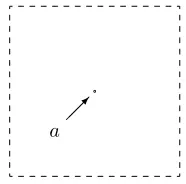
Take an extremely simple two-element model, with a point-sized boundaryaand the universe1
– which can be thought of the space with a‘removed’. Intuitively,a is its own boundary; as such
it is an inconsistent object—that is,aďabut alsoaďa, and soa‚a. The paraconsistent model
for this scenario is depicted in Figure 4.
This model verifies Fact 2. Since a‚1 and 1‚1 while a‚a anda‚1, botha and 1 overlap
exactly the same things. But a‰1, in particular because they do not have the same non-parts,
1ęabut aď1. Moreover, despite overlapping all the same things, aand 1 differ with in what they are disjoint from: aê awhereas 1 is disjoint from nothing. Thus, we have a failure of the
`
[image:14.612.277.370.94.186.2]a
Figure 3. A Simpler Universe
6
b b
a
1
Figure 4. Paraconsistent Model of the Simpler Universe
The model also violates the classically-minded notion of supplementation: that whenever an
object has a proper part, it must have another disjoint from the first.Butaă1with no other proper
parts. This may seem strange when thinking of parthood classically; but on the paraconsistent
picture it makes sense—sinceais part of1but it is also anon-partof1. There need be no remainder
of1withouta, sinceais already ‘removed’ so to speak. Since boundaries are inconsistent objects,
they need not require any further parts of that object to exist (though see Remark 4 below).
A third property is the uniqueness of fusion. This is the first proper theorem of PM; from
here on, we will be working entirely inside the paraconsistent mereology, and move to numbered
theorems to signal that they are ‘official’ parts of the (object) theory.21
Theorem 1. @u@vpplubpu, Aq ^lubpv, Aqq Ñu“vq
This holds in paraconsistent mereology. Letlubpt, Aqandlubpt1, Aq. By the definition of fusion,
we have tďt1 andt1ďt, which by PM2 givest“t1.
4.4. Sums, Products, and Complements. Fusions are guaranteed to exist (by PM5) and are unique (by Theorem 1); so they license definite descriptions: we writelubrz:Asfortheleast upper
21Proving a proposition inside a paraconsistent theory means, as elsewhere, that it is true in that theory. (In the
bound of thezs s.t. Apzqholds. The existence of agreatest lower bound,
glbpt, Aq “df @xpAÞÑtďxq ^ p@w@xpAÞÑwďxq ÞÑwďtq
follows from the PM5, too: providedx andy have a lower bound, which they do if they overlap,
the fusion (lub) of all their lower bounds is theglbofxandy.22 By Theorem 1,glbrz:Asis unique,
too.
This in hand, the lattice properties come to the fore. The binary sum ofxandy is
x\y“df lubrz:z“x_z“ys
and a (binary) product operation[, meaning greatest lower bound—the maximal common part—is
x[y“df glbrz:z“x_z“ys
provided thatx‚y.23 These have standard behaviors.
Proposition 2. Lattice properties hold:
(i) xďy iffx[y“xiffx\y“y
(ii) x“x\x;xďx\y
(iii) x\y“y\x
(iv) x\ py\zq “ px\yq \z
(v) x\ py[zq “ px\yq [ px\zq
These follow from the algebra of the underlying logic, e.g. for (iii),
x\y“lubrz:z“x_z“ys “lubrz:z“y_z“xs “y\x
Further, from (ii), ifxďy then by transitivity (PM3),xďy\z.
Complements are guaranteed to exist by PM4, abbreviated thus:
x “df lubrz:zêxs
Then it is assumed in PM4 that nothing overlaps with its own complement—although this last, as
we will see, needs to be understood as a paraconsistently violable claim when it comes to boundaries
22Specifically,t
“lubrx:w“a_w“aÞÑxďwsiff
@xpp@zpz“a_z“bÞÑxďzq ÞÑxďtq ^ @w@xp@zppz“a_z“bÞÑxďzq ÞÑxďwq ÞÑtďwq
i.e. ifxis a lower bound ofaandb, thentis an upper bound ofx, and any upper bound of lower bounds ofaandb
is abovet. The second conjunct entails thattis a lower bound ofaandb, i.e.@xppx“a_x“bq ÞÑtďxq. Uniform variable relabeling of the first conjunct gives: @w@xppx“a_x“bÞÑwďxq ÞÑwďtq. Conjoining (in a different order): @xppx“a_x“bq ÞÑtďxq ^ @w@xppx“a_x“bÞÑwďxq ÞÑwďtqifft“glbrw:w“a_w“bsby definition ofglb.
23Cf. [Casati and Varzi, 1999, p. 46]. In some cases, the defining condition may not be met, but we will ignore this
in connected space.24 The productx[xexists only to the extent that someuďx^uďx. (That
there is at least one suchxis explicitly assumed in the logic; see§Appendix 1).
Complementation is extensional enough, from PM7, to help prove standard theorems:
Proposition 3. The binary operations are De Morgan:
(i) xďyÞÑyďx
(ii) x“x
(iii) x\y“x[y
(iv) x[y“x\y
(v) For allu,uďx\xanduêx[x.
Proof. Compute. For (i), assume xďy. Then@zpz‚xÑz‚yqby PM7, which is equivalent to
@zp z‚yÑ z‚xq. Since y‚y by PM4, it follows that y‚xby modus ponens. Then yďx follows, again by PM4.
The antisymmetry axiom PM2 and complementation axiom PM4 yield (ii):
xêx^xêxÑxďx^xďx
For (iii),xďx\y, sox\yďx, by (i). Similarly,x\yďy; i.e. x\yis a lower bound of both
xandy. To show it is greatest, supposeais also a lower bound: aďxandaďy. Thenxďaand
yďaby (ii) and (i) again. Sox\yďa, and henceaďx\y. Sox\y is the greatest such lower
bound; i.ex\y“x[y.
Then (iv) is similar. The last, (v) is from the law of excluded middle and PM4.
Remark 4. If @zpz‚xÑz‚yqthenxďy; if@zpz‚xØz‚yqthen x“y.
Why? The same argument for Prop 3(i) shows that if @zp z‚y Ñ z‚xq, then y‚x, and
so xďy by double negation. Identity follows from the biconditional by PM2. But this does not
undermineFact 2, which claimed a failure of extensionality. There, the claim was that overlapping all the same things is insufficient for identity, and the explanation was that identity requires things
have the same non-parts. That is what full complementation and the contraposing biconditional
deliver. The proof shows that explicit negation facts are required to confirm identities.
Therestricted complementofy inxis
x´y“df x[y
From the existence of fusions, axiom PM5, there is a universal object,1, such that@xpxď1q. This
object may be thought of as the least upper bound of theJs, whereJis a no-place connective that
24Indeed, that the following fails is instructive: x
is satisfied by everything. Then unrestricted complements can be understood as x“1´x. The
limiting case “1´1 “1[1 “1 fails to exist. Were to exist, it would naturally correspond
to the least upper bound of the no-place absurdity constantK, which nothing satisfies on pain of
triviality: K ÑAfor allA. There is no least upper bound whatsoever of ‘absurd’ objects.
A non-paraconsistent algebra for mereotopology has it that x[x always fails to exist. Since
the idea of paraconsistency is to allow the possibility of coherent inconsistency,1[1fails, but not
necessarily for otherx. We take the notation as invitation for an object satisfying it, and therefore
introduce names for arestricted self-complement,
0x“dfx´x
to keep track of the ‘bottom element’ for each objectxunder consideration. For different a, b, c, ...
there are different0a,0b,0c, .... Ifaďxthen0aďx.
In general,x´xis only ‘empty’ to the extent that x‚x. (Again, by PM4, thisalwaysholds,
even ifx‚xtoo.) Unless inconsistent parthood or overlap are trivializing, in the sense ofK, then
0x can exist. In a small abuse of language, ifxhas inconsistent overlap,0x isnon-trivial.
What is0x? It is the distinctive ‘shape’ of the empty space left whenxis gone, the inconsistent residue ofx(see§6). The following lemma sheds a bit more light.
Lemma 5. Let aďx. The following hold:
(i) x´ px´aq “a\0x (ii) x´0x“x
(iii) 0x“0x[a anda“a\0x if and only if a“x
Proof. These are exercises in applying lattice and De Morgan laws, Props 2 and 3. For (i),
x´ px´aq “ x[ px[aq
“ x[ px\aq
“ px[xq \ px[aq
“ 0x\a
Then (ii) is a special cases of (i), and (iii) is computed similarly.25
A theory of parthood is a good start. Now the parts need to be connected, via topological
notions. Relative self-complements will be salient.
25Hints for calculating: While bothx
5. Topology: Boundaries in Connected Space
The task of this section is to provide a way to understand how bounded objects can sit in
connected space.
5.1. Adding Topological Structure. To make precise the idea of connection, we add unary interior and closure operators that satisfy the Kuratowski closure axioms,26
CA1: xďcpxq CA2: cpcpxqq “cpxq
CA3: cpx\yq “cpxq \cpyq CA4: cp0xq “0x
when0xexists. The dual ofcis theinterior operator, ipxq “dfcpxq. It therefore satisfiesipxq ďx, ipipxqq “ipxq,ipx[yq “ipxq [ipyq, andipx\xq “x\x. In general, the interior and closure have
an orderly relationship,
ipxq ďxďcpxq
Call x open iff ipxq “ x and closed iff cpxq “ x; then x is both open and closed, or clopen, iff
ipxq “x “cpxq. By duality of c and i, an object will be open iff its complement is closed.27 A
topologyon a space is a collection of open objects, closed under fusions and finite products, including
the whole space itself, and all the relative self-complements of proper parts of the space.
Lemma 6. Every 0x in the topology is clopen.
Proof. 0x is open by the definition of a topology, and closed by CA4: ip0xq “0x“cp0xq 5.2. Boundaries. Define a boundary operator: foraďx,
Bpaq “df cpaq [cpx´aq
In classical topology, the boundary of the empty space is empty, a space shares its boundary with
its complement, and boundaries are fixed points for B. In the paraconsistent framework, these
properties appear as follows.
Proposition 7. Let xbe the entire space, andaďx. The following conditions hold:
(i) Bpxq “ Bp0xq “0x (ii) BpBpxqq “ Bpxq
(iii) Bpa\0xq “ Bpx´aq
26In the classical case, adding CA1–CA4 to HM0–HM6 would result in the mereotopological theory calledGEM T C in [Casati and Varzi, 1999, p. 59]. For related structures, see for example, the De Morgan algebras with interior and closure operators as given in [Zhang and Yao, 2007] developed for quite different applications, and based in classical logic.
27Additionally, objects may beregular open, meaning thatx
Proof. First, note that0zďzfor anyz. For (i), a space shares its boundary with its self-complement by Lemmas 5 and 6:
Bp0xq “ cp0xq [cpx´0xq
“ 0x[cpxq
“ cpxq [cp0xq “ Bpxq
And since 0x ď xď cpxq, then by transitivity and lattice properties (Prop 2), 0x[cpxq “ 0x. Then (ii) is obtained by substitution on (i).
These hold only as a special properties for the wholex-universe; proper partsaofxare affected
by the other parts of x, making the general proof fail. But clause (iii) holds for all aďx, and is
theraison d’ˆetre for relativized bottom elements: since
x´ pa\0xq “ x[a\ px[xq
“ x[ pa[ px\xqq
“ px[aq [ px\xq
“ x´a
then, using Lemma 5,
Bpa\0xq “ cpa\0xq [cpx´ pa\0xqq
“ cpx´ px´aqq [cpx´aq
“ Bpx´aq
Thus, once inconsistency is explicitly tracked, a boundary operator behaves as expected,
pre-serving the intuition that two objects can abut by sharing their boundary.
Boundaries give us an alternative characterization of fundamental notions: the boundary ofais
a’s closure without its interior;awith or without its boundary isa’s closure or interior, respectively
[Kelley, 1955, p. 46]. Crucially, ais open iffBpaq ďa, andais closed iff Bpaq ďa. Thus ais both
open and closed iff
Bpaq ďa[a
The idea that clopen objects have empty boundaries has been rather deeply recast. This brings us
to our central goal.
overlap, or if one overlaps the closure of the other [Casati and Varzi, 1999, p.52–58]:
xăąy“dfx‚y_x‚cpyq _cpxq ‚y
Objects areseparatediff they are not connected. More generally, a whole spacexis separated iff it
has open partsa,b that sum tox, but that are not connected;
(1) x“a\b
(2) aăąb
(3) aandb are both open
A space isself-connectediff it is not separated:
ą
ă pxq “df @a@bpx‰a\b _ aąăb _ Bpaq ęx´a _ Bpbq ęx´bq
Self-connected spaces exist: paradigmatically,Ris the real number line with standard features, as
paraconsistently developed in [McKubre-Jordens and Weber, 2012].
The sketch up to here suggests that paraconsistent mereotopology is robust enough to sustain
a mathematical conception of a (self) connected space. Our main theorem now shows that the
concept of connected space has been relaxed enough to allow closed objects in contact with one
another.
Theorem 8. Some connected spaces have properparts that are both open and closed.
Proof. Figure 1 (‘A Simple Universe’) is the paradigm case. The following more pathological
ex-ample is to prove the point.
For someafor whicha‚a, take our space to be a single point, the object0a. This is a connected space, since 0a ąă0a. By Lemma 6, 0a is open and closed. But since 0a‚0a (since everything overlaps itself by PM1), and 0a‚0a(since nothing overlaps0aby Prop 3), then
0aď0a^ Dzpz‚0a^zê0aq
showing that 0ais a properpart of the space, as required.
Since the three condition for being separated also hold—0a “0a\0a, 0a ăą0a, and 0a is open—then we have our last fact, an inconsistency at the level of theorizing about inconsistent
boundaries:
Corollary 9. There are connected spaces upon which exists a partition into disjoint, non-empty open parts. Some spaces are both connected and not.
5.4. Peirce’s Puzzle Revisited. There are empty parts, indexed to a space, such that boundaries of clopen objects are both empty and not, and the whole space ends up being both connected and
not. This existence claim suffices to show that on at least some spaces, the naive intuitions about
These results amount to a ‘proof of concept’. To illustrate how it helps with our initial problem,
return to the Great Red Spot on Jupiter. The mathematical modeling tools at our disposal now
allow the Spot to have aninconsistent boundary. This means it is possible to have all the intuitive
constraints hold jointly, as follows. The Spot and its complement share a boundary, modulo
incon-sistency of its relative self-complement (Proposition 7). Any points on the boundary are included
in the Spot, and so are red; boundary points are also included in the Spot’s complement, and so are
not red. Nevertheless, the whole surface of Jupiter can remain connected (Theorem 8). Inconsistent
boundaries are enough to preservesymmetry(§2.1), without separating their host space (§2.2). To conclude, then, it remains to turn to a few questions about the meaning and role of empty
parts in this framework.
6. Conclusion: Empty Parts
By accepting empty parts in a suitable form, namely as the inconsistent aspect of an object,
enough technical control is restored in the algebra to make some sense of puzzles in the metaphysics
of naive space. Paraconsistent mereotopology puts focus on highly localized properties: for an object
and its complement to share a boundary completely, we must consider the empty parts ofthatobject
explicitly. Then, symmetry is restored and connected spaces can have closed, nonempty subspaces.
The question is, what to make of this notion of emptiness?
The usual point-set definition of a topology makes indispensable use of the empty set. To prevent
confusion, we recall the difference between an emptysetand an empty object: His stillsomething,
namely, a set. This is no more mysterious than the number zero. (Thequantityof pink elephants
exists, not in spite of butbecauseof the fact that no pink elephants exist.) Matters are a little less
clear with an empty object, which is nothing. Even that locution sounds incoherent: ‘it’ overlaps
everything, ‘it’ is a part of everything, but only because ‘it’ is the punchline of a Lewis Carroll joke.
‘It’isn’t. Zero and the empty set mightrepresentnull things, but a null thing is neither a number
nor a set.28
Nevertheless, an empty object seems almostforcedon us, by the algebraic structure that a decent
topology demands. Many versions of mereology have a universe, an individual of which everything
is a part, mainly because it improves the algebraic structure; in fact, the use of an empty object
is not so uncommon.29 While algebraic utility is presented as if it were the crudest of reasons for
supposing a null individual to exist, the same was once said of zero, negative integers, and complex
numbers. The argument from algebraic utility may be enough on its own, to justify the involvement
of empty parts. But we think that in the paraconsistent setting, there is a more direct explanation.
28A null individual is proposed by Carnap as the designatum of an empty name, where he says that the null thing
“corresponds to the null class of space-time points” [Carnap, 1947, p. 36].
29[Casati and Varzi, 1999, p. 45]. Arntzenius uses a bottom element with only parenthetical comment
We can begin to make conceptual, and not merely instrumental, sense of what these objects are
like, tying together these two mereological and topological threads as follows.
In apparent contrast to empty parts, the notion of aboundaryis much more accepted by
mere-ologists (§3). But, we have seen, a boundary in connected space is best thought of as involving the overlap of something with its complement. The collusion of symmetryand separationsuggest that boundaries are inconsistent objects. This was our puzzle. On classical-leaning views, of course,
inconsistent objects are a nonsense. There simply are no such things, not even as fictions;
inconsis-tent theories have no models. And so, on these views, boundaries remain problematic. Not so on a
glutty, paraconsistent view: there are inconsistent objects—or at least, objects that faithfully track
real, inconsistent properties. But bear in mind that pA^ Aqis still a theorem of paraconsistent
logic; so formally, the objects corresponding to inconsistency are (both) empty (and not). Even
dialetheically, inconsistency is “nowhere and nowhen.”30The explanation, then, for the presence of
empty objects in paraconsistent mereotopology is thatinconsistencyturns up in the mathematics as
emptiness. Boundaries must be empty; they cannot be empty. The apparent, and perhaps strange,
appeal to empty parts is in fact an acknowledgement of the contradiction inherent in boundaries.
Mereotopologically, then, empty parts come to the fore around boundaries in connected space—
that is, when they aren’t so empty after all. When it exists, the bottom0ais emphaticallynotgoing to be a part of every other thing; the alternative would validate the inference of ex contradictione
quodlibet. A main tenet of paraconsistency is that not all falsity is absurd; and so some objects can
be paraconsistently empty (to the degree ‘false’) without being purely empty (to the degree ‘K’).
Classical mereotopologies cannot make sense of an empty part because they are only looking at the
most bizarre, singularly absurd one (namely, ), of which we agree there is little sense to be made.
For a non-classical mereotopology, meanwhile, there are lots of empty parts around, many of which
are day-to-day calledboundaries.
Acknowledgements: Thanks to audiences at the25 Years In Contradiction Conference at Glas-gow University, theMetaphysical Indeterminacy Worskshop VI at the University of Leeds, the 2009
Mereology Workshop at the University of St Andrews, the Australian Metaphysics Conference at
Kioloa, the Pukeko Logic Group, and the University of Otago for comments and discussion on
var-ious versions of these ideas. Thanks especially to Ralf Bader, Guillermo Badia, Elizabeth Barnes,
Can Baskent, Jc Beall, Franz Berto, Ben Burgis, Ross Cameron, Filippo Casati, Katherine Hawley,
Cory Johnson, Manuel Lechthaler, Hitoshi Omori, Graham Priest, Adam Reiger, David Ripley,
Marcus Rossberg, Lionel Shapiro, Stewart Shapiro, Reed Solomon, Diego Tajer, Jason Turner,
Gabriel Uzquiano, Achille Varzi, Alan Weir, Robbie Williams, and Gareth Young. Research on this
paper was supported by a grant from the Marsden Fund, Royal Society of New Zealand.
Appendix 1: Logic
The logic for our paraconsistent mereology is the weak relevant logic DKQ, previously applied
to paraconsistent set theory; see [Priest, 2006, p.251], [Weber, 2012]. Set theory in DKQ is
non-trivial—it has a relative ‘consistency’ proof—because it has a classical model in which some sentence
is not satisfied [Brady, 2006].
The language is that of first order logic with identity and membership. The usual shorthand is
used: A_B for p A^ Bq;AØB forpAÑBq ^ pB ÑAq;Dis @ .
Axioms. All instances of the following schemata are theorems:
I AÑA
IIa A^BÑA
IIb A^BÑB
III A^ pB_Cq Ñ pA^Bq _ pA^Cq pdistributionq
IV pAÑBq ^ pBÑCq Ñ pAÑCq pconjunctive syllogismq
V pAÑBq ^ pAÑCq Ñ pAÑB^Cq
V I pAÑBq Ø p BÑ Aq pcontrapositionq
V II AØ A pdouble negation eliminationq
V III A_ A pexcluded middleq
IX p@xqAÑApa{xq
X p@xqpAÑBq Ñ pAÑ p@xqBq (withxnot free inA)
XI p@xqpA_Bq ÑA_ p@xqB (withxnot free inA)
The law of excluded middle implies the law of non-contradiction, pA^ Aq.
Rules. The following rules are valid:
I A, B$A^B padjunctionq
II A, AÑB$B pmodus ponensq
III A$ p@xqA puniversal generalizationq
IV AÑB, C ÑD$ pB ÑCq Ñ pAÑDq phypothetical syllogismq
V x“y$Apxq ØApyq psubstitutionq
Structural Rules. The followingmeta-rulespreserve validity: A$B
A_C$B_C
A$B
DxA$ DxB This validates argument by cases, and, excluded middle, reductio:
A$C B$C
A_B$C
A$ A
Enthymematic conditional. Add at-constant that obeys the two-way rule A%$tÑA
Thet-constant may be thought of as the conjunction of all truths. Then defineAÞÑB:“A^tÑB.
This defined operator has the property of weakening:
A$BÞÑA
However, it does not contrapose: AÞÑB& BÞÑ A.
Inconsistency and absurdity. For ease of presentation, we adopt an axiom asserting the truth of at least one contradiction:
p^ p
for some fixed p. After all, the axiom set PM is no more than a classical set re-written with
paraconsistent conditionals. So there is no reason to expect that it generates a contradiction on its
own. Within the language of PM so defined, then, there is at least one 0x, which is required for the theorems above. Otherwise they would simply read thatif0xexists then..., which is classically true too, by ex falso quodlibet! By the same token, to ensure that there is at least one unacceptable
sentence, a constant Kis added to the language, and a final axiom
K ÑA
asserts thatKis never designated.
Appendix 2: Non-Triviality
Here we present an interpretationMof the formal theory, showing that even if it is inconsistent it
is not trivial. The presentation and proof thatMis a non-trivial model are conducted in standard
classical logic, following standard practice in the relevant logic and mathematics literature (e.g.
[Priest, 2006, Ch 17]); the model is suggested by Meyer and Mortensen’s two-element model for
relevant arithmetic. This model is not presented as theintendedmodel of paraconsistent mereology.
The axiomatization PM is not complete with respect to the model. Our only concern is soundness,
which in the present context is non-triviality.
Fact. Paraconsistent mereology has a model.
Proof. To interpret the logic, we use truth tables for the paraconsistent logic RM3:
t f
b b
f t
^ t b f
t t b f
b b b f
f f f f
Ñ t b f
t t f f
b t b f
The designated values of RM3 are t and b. RM3 validity is preservation of designated values.
An argument is invalid if there is a valuation making all the premises designated, but not the
conclusion. The conditional of DK does not have a truth table, but DK is sound with respect to
RM3. Anything invalid by RM3 truth tables is DK invalid.
The enthymematic conditional,AÞÑB, should be thought of as having an antecedent that is no
more than ‘b’, since the connective t is the conjunction of all truths, and some of these are false
[Beall et al., 2011]. So the conditional never has an antecedent that is tonly, and the only way it
can get anf is if the consequent isf.
To define a modelM“ xD, Vy, let the domainD“ t0,1uandVpďqbe as follows:
ď 0 1
0 b t
1 f b
That is, 1ď0 is just false, 0ď1 is just true, and it is both true and false that things are parts of
themselves. For identity,
“ 0 1
0 b f
1 f b
Because the domain is finite, quantifiers@andDcan be understood as conjunctions and
disjunc-tions, respectively.
Now it is just a matter of verifying the axioms, showing that they have designated values.
For PM1,Vp0ď0q “Vp1ď1q “b, soVp0ď0^1ď1q “band thereforeVp@xpxďxqq “b.
For PM2, anti-symmetry, we consider all the possible values ofxandy:
Vp0ď1^1ď0q “Vp0“1q “ f
or Vp0ď0^0ď0q “Vp0“0q “ b
or Vp1ď1^1ď1q “Vp1“1q “ b
In all cases, the required biconditional holds.
For PM3, transitivity, the only case where the consequent fails is Vp1 ď 0q “ f. Then the
antecedentVp1ďy^yď0q “f whetheryis 1 or 0. There is no case whereVpxďy^yďxq “t.
For PM4, we set 1 as the complement of 0, and vice versa. Well,Vp1ê0q “bbecause
Vp0ę0_0ę1q “b
and
so the conjunction of the two isb. And to show@ypp y‚0Ñyď1q ^ p y‚1Ñyď0qq, we have
Vp0ê0Ñ0ď1q “ t
Vp0ê1Ñ0ď0q “ b
Vp1ê0Ñ1ď1q “ b
Vp1ê1Ñ1ď0q “ t
making the conjunction of these four b, designated. To show the converses of all these, note that
they all work asÑexcept the first, which would beVp0ď1Ñ0ê0q “f since the antecedent is
t and the consequent is b. But theÞÑrendering drops the antecedent down to b and the sentence
is satisfied. The same reasoning applies to show that 0 is the complement of 1.
For PM5, we need a witness to playlub. Now,VpAqis t, b, or f. Then take thelub of the As
to be 0 whenAis f, and the lubof theAs is 1 otherwise. In more detail, consider the case where
VpAqis t or b. Well, Vpxď1qis always designated, so VpAÞÑxď1qis always designated. And
then 1 isleastsince a check of truth tables shows
VppAÞÑ0ď1q ^ pAÞÑ1ď1q ÞÑ1ď1q “ b
VppAÞÑ1ď0q ^ pAÞÑ0ď0q ÞÑ1ď0q “ t
Otherwise,VpAq “f. ThenVpAÞÑ0ď0q “VpAÞÑ1ď0q “t. And to show that 0 is least here,
VppAÞÑ0ď0q ^ pAÞÑ1ď0q ÞÑ0ď0q “ t
VppAÞÑ0ď1q ^ pAÞÑ1ď1q ÞÑ0ď1q “ t
Thus PM5 is always designated.
For PM6, Vp1 ę 1q “ b and Vp0 ę 0q “ b, so VpDxpx ę 1qq and VpDxpx ę 0qq are both
designated; and then so is their conjunction.
For PM7, we have Vp0‚0q “Vp0‚1q “Vp1‚0q “b, and Vp1‚1q “t. Then the cases are all
designated:
0ď0ÞÑ p0‚0Ñ0‚0q ^ p1‚0Ñ1‚0q
0ď1ÞÑ p0‚0Ñ0‚1q ^ p1‚0Ñ1‚1q
1ď0ÞÑ p0‚1Ñ0‚0q ^ p1‚1Ñ1‚0q
1ď1ÞÑ p0‚1Ñ0‚1q ^ p1‚1Ñ1‚1q
noting that the second case wouldnotbe designated with anÑas the main connective.
For the topology, we need to interpret Kuratowski’s closure axioms. This can be done very easily:
let
Again, this overdoes it, but suffices to show the existence of a model. For CA1, this follows from
PM1; for CA2, cpcpxqq “cpxqfor both 0 and 1; and so forth. The interior operator, ipxq, is then
cpxq “x“x, which satisfiers the dual interior properties.
Fact. Not every sentence of the language of PM is provable.
Proof. The sentence@x@ypxďyqgets value f in the model. All we need is one; but there are many,
e.g. @x@ypx‚yÑxďyqgets f, too.
This completes the proof.
References
[Arntzenius, 2012] Arntzenius, F. (2012).Space, Time, and Stuff. Oxford University Press.
[Beall et al., 2011] Beall, J., Priest, G., and Weber, Z. (2011). Can u do that? Analysis, 71(2):280 – 285. [Bolzano, 1950] Bolzano, B. (1950).Paradoxes of the Infinite. Routledge, London.
[Brady, 2006] Brady, R. (2006).Universal Logic. CSLI Publications, Stanford.
[Brentano, 1988] Brentano, F. (1988). Philosophical Investigations on Space, Time and the Continuum. Croom Helm, London.
[Bunge, 1966] Bunge, M. (1966). On null individuals.Journal of Philosophy, 63:776–778.
[Bunt, 1985] Bunt, H. C. (1985).Mass Terms and Model-Theoretic Semantics. Cambridge University Press, Cam-bridge.
[Carnap, 1947] Carnap, R. (1947).Meaning and Necessity. University of Chicago Press.
[Casati and Varzi, 1999] Casati, R. and Varzi, A. C. (1999).Parts and Places: The Structures of Spatial Represen-tation. MIT Press, Cambridge (MA).
[Chisholm, 1984] Chisholm, R. M. (1984). Boundaries as dependent particulars. Grazer philosophische Studien, 10:87–95.
[Clarke, 1985] Clarke, B. L. (1985). Individuals and points.Notre Dame Journal of Formal Logic, 26:61–75. [Dainton, 2010] Dainton, B. (2010).Time and Space. McGill-Queen’s University Press. Second edition. [Dummett, 2000] Dummett, M. (2000). Is time a continuum of instants? Philosophy, 75(4):497 – 515.
[Forrest, 2002] Forrest, P. (2002). Non-classical mereology and its application to sets.Notre Dame Journal of Formal Logic, 43:79–94.
[Geach, 1949] Geach, P. (1949). On rigour in semantics.Mind, 58(232):518–522.
[Hestevold, 1986] Hestevold, H. S. (1986). Boundaries, surfaces, and continuous wholes.Southern Journal of Philos-ophy, 24:235–245.
[Hocking and Young, 1961] Hocking, J. G. and Young, G. S. (1961).Topology. Dover.
[Hovda, 2009] Hovda, P. (2009). What is classical mereology? Journal of Philosophical Logic, 38(1):55–82. [Hudson, 2005] Hudson, H. (2005).The Metaphysics of Hyperspace. Oxford University Press.
[Kelley, 1955] Kelley, J. L. (1955).General Topology. Springer-Verlag, New York. [Koslicki, 2008] Koslicki, K. (2008).The Structure of Objects. Oxford University Press.
[Martin, 1965] Martin, R. (1965). Of time and the null individual.Journal of Philosophy, 62:723–736.
[McKubre-Jordens and Weber, 2012] McKubre-Jordens, M. and Weber, Z. (2012). Real analysis in paraconsistent logic.Journal of Philosophical Logic, x(x):xx.
[Oliver and Smiley, 2013] Oliver, A. and Smiley, T. (2013). Zilch.Analysis, 73:601–613.
[Pratt-Harmon, 2007] Pratt-Harmon, I. (2007). First order mereotopology. In Aiello, M., Pratt-Harmon, I. E., and van Benthem, J., editors,Handbook of Spatial Logics, pages 13–98. Springer, Dordrecht.
[Priest, 2006] Priest, G. (2006).In Contradiction. Oxford University Press., 2nd edition.
[Priest, 2014] Priest, G. (2014). Much ado about nothing.Australasian Journal of Logic, 11(2):146–158.
[Putnam, 1994] Putnam, H. (1994). Peirce’s continuum. In Ketner, K., editor,Peirce and Contemporary Thought: Philosophical Inquiries. Fordham University Press.
[Randell et al., 1992] Randell, D., Cui, Z., and Cohn, A. (1992). A spatial logic based on regions and connection. In B. Nebel, e. a., editor,Principles of Knowledge Representation and Reasoning: Proceedings of the Third Interna-tional Conference, pages 165–176, Cambridge, MA.
[Roeper, 1997] Roeper, P. (1997). Region-based topology.Journal of Philosophical Logic, 26:251–309. [Rogers, 1995] Rogers, J. (1995).The Giant Planet Jupiter. Cambridge University Press.
[Sider, 2000] Sider, T. (2000). Simply possible.Philosophy and Phenomenological Research, 60(3):585—590. [Simons, 1987] Simons, P. M. (1987).Parts: A Study In Ontology. Clarendon, Oxford.
[Smith, 1997] Smith, B. (1997). Boundaries: An essay in mereotopology. In Hahn, L., editor, The Philosophy of Roderick Chisholm, Library of Living Philosophers, pages 534–561. Open Court, LaSalle.
[Sorensen, 1986] Sorensen, R. A. (1986). Transitions.Philosophical Studies, 50:187–193.
[Stell and Worboys, 1997] Stell, J. and Worboys, M. (1997). The algebraic structure of sets of regions. InSpatial Information Theory: A Theoretical Basis for GIS, volume 1329, pages 163–174. Springer, Berlin.
[Varzi, 1997] Varzi, A. (1997). Boundaries, continuity, and contact.Noˆus, 31:26 – 58.
[Varzi, 2004] Varzi, A. (Spring 2004). Boundary. In Zalta, E. N., editor,The Stanford Encyclopedia of Philosophy. [Weber, 2012] Weber, Z. (2012). Transfinite cardinals in paraconsistent set theory. Review of Symbolic Logic,
5(2):269–293.
[Whitehead, 1919] Whitehead, A. N. (1919).An Enquiry Concerning the Principles of Human Knowledge. Cam-bridge University Press, CamCam-bridge.
[Zhang and Yao, 2007] Zhang, X. and Yao, G. (2007). Generalized rough set model on de morgan algebras. volume 0, page 205, Los Alamitos, CA, USA. IEEE Computer Society.