Biomolecular Chemistry
PAPER
Cite this:Org. Biomol. Chem., 2013,11, 5673
Received 28th June 2013, Accepted 4th July 2013
DOI: 10.1039/c3ob41221k
www.rsc.org/obc
Conversion of a non-selective adenosine receptor
antagonist into A
3-selective high a
ffi
nity
fl
uorescent
probes using peptide-based linkers
†
Andrea J. Vernall,
‡
aLeigh A. Stoddart,
‡
bStephen J. Briddon,
bHui Wen Ng,
cCharles A. Laughton,
aStephen W. Doughty,
cStephen J. Hill*§
band Barrie Kellam*§
aAdvances influorescence-based imaging technologies have helped propel the study of real-time biologi-cal readouts and analysis across many different areas. In particular the use offluorescent ligands as chemical tools to study proteins such as G protein-coupled receptors (GPCRs) has received ongoing inter-est. Methods to improve the efficient chemical synthesis offluorescent ligands remain of paramount importance to ensure this area of bioanalysis continues to advance. Here we report conversion of the non-selective GPCR adenosine receptor antagonist Xanthine Amine Congener into higher affinity and more receptor subtype-selectivefluorescent antagonists. This was achieved through insertion and opti-misation of a dipeptide linker between the adenosine receptor pharmacophore and thefluorophore. Fluorescent probe27containing BODIPY 630/650 ( pKD= 9.12 ± 0.05 [hA3AR]), and BODIPY
FL-contain-ing 28( pKD = 7.96 ± 0.09 [hA3AR]) demonstrated clear, displaceable membrane binding usingfl
uor-escent confocal microscopy. Fromin silicoanalysis of the docked ligand-receptor complexes of27, we suggest regions of molecular interaction that could account for the observed selectivity of these peptide-linker based fluorescent conjugates. This general approach of converting a non-selective ligand to a selective biological tool could be applied to other ligands of interest.
Introduction
Discrete molecular probes are one mechanism by which a receptor’s role and function in biological processes can be interrogated, and as such, rational design-based approaches to develop these chemical tools are vital. In particular, developing molecular probes with a high affinity and selectivity for a par-ticular cell surface receptor target is paramount for unravelling processes of interest in physiologically relevant systems that contain mixed receptor subtype populations. G
protein-coupled receptors (GPCRs) are the largest family of transmem-brane signalling proteins in the human genome and are the target of 30–40% of currently marketed drugs. Probes that target these receptors are therefore regarded as extremely valu-able tools. Unsurprisingly therefore, fluorescent ligands have been increasingly used in studying GPCRs; for example to determine receptor expression levels in diseased tissues,1 real-time receptor–receptor interactions and signaling,2,3 and as a tracer ligand in a competition binding assay.4 A common approach to the design and synthesis of receptor probes involves tethering a known orthosteric binding moiety to a second ligand or fluorophore via a linker to form a conju-gate.5,6 It is desirable to develop general methods that can increase conjugate affinity and selectivity for a target receptor, especially if a receptor subtype-selective pharmacophore is not available. Indeed, recent advances in X-ray crystallography of GPCRs7–11 have further reignited interest in structure-based design approaches for more selective synthetic ligands.12
From the earlier observations of Jacobson et al.,13we were encouraged to investigate whether minor chemical changes to a peptide-based linker component of a fluorescent ligand con-jugate could potentially be used to fine tune affinity and/or selectivity of the final fluorescent probe for a given receptor; since the linker passes through regions of the receptor capable
†Electronic supplementary information (ESI) available: Experimental details and characterisation of synthetic compounds, further pharmacological analysis, and details of the homology modelling and docking. See DOI: 10.1039/c3ob41221k
‡These authors contributed equally to this work.
§ B.K. and S.J.H. are founding directors of the University of Nottingham spinout company CellAura Technologies Ltd.
a
School of Pharmacy, Centre for Biomolecular Sciences, University of Nottingham, University Park, Nottingham NG7 2RD, UK. E-mail: [email protected] ; Tel: +44(0)-115-9513026
bSchool of Pharmacy, University of Nottingham Malaysia Campus, Jalan Broga,
43500 Semenyih, Selangor Darul Ehsan, Malaysia.
E-mail: [email protected]; Tel: +44-115-8230082
cInstitute of Cell Signalling, School of Biomedical Science, Queen’s Medical Centre,
University of Nottingham, Nottingham NG1 1GF, UK
Open Access Article. Published on 04 July 2013. Downloaded on 24/04/2014 18:08:46.
This article is licensed under a
Creative Commons Attribution 3.0 Unported Licence.
of engaging in productive molecular recognition events by the very nature of the functional group chemistries present there. In this study, we chose to explore our hypothesis by using the human A1adenosine receptor (AR) and hA3AR subtypes as our model system. The ARs are Class A GPCRs, and there are four characterised receptor subtypes – the A1, A2A, A2B, and A3.14 There is growing interest in the A1AR15and A3AR16as AR drug targets,17 therefore it remains pertinent to further refine chemical methods to produce high affinity and selective tools to probe these receptors. In addition, these receptors are closely related in terms of amino acid sequence and therefore pose a significant challenge in terms of designing selective probes.18
Following the now well established chemical biology prac-tice of exploiting amino acids in biological conjugates, for example in drug delivery systems19and hydrogels,20we herein report that the affinity and selectivity of fluorescent conjugates for the human A1ARversusA3AR can be modulated by single amino acid changes in a dipeptide linker region connecting the orthosteric binding moiety and fluorophore. This approach for increasing affinity and tuning selectivity is likely to have a broad applicability for developing fluorescent probes for other biological targets, in particular, ligands for other Class A GPCRs.
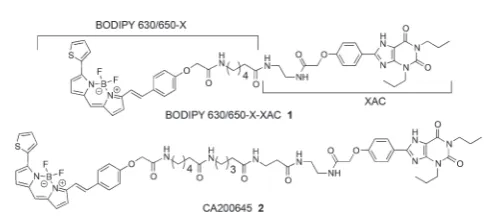
We commenced this study by considering the previously reported AR fluorescent antagonist121alongside the recently reported24 (CA200645) (Fig. 1), which are based on the non-subtype-selective xanthine amine congener (XAC) (3) and are themselves non-selective for the A3AR/A1AR. Previously, Baker et al.indicated that when 3 was tethered to different fluoro-phores using the same linker, significant differences in conju-gate affinity for the human A1AR were detected.22 Here we sought to expand upon this observation by also addressing receptor affinity and selectivity imparted by subtle changes in linker composition for conjugates containing the boron-dipyrromethene moiety. The BODIPY 630/650-X (6-(((4,4- difluoro-5-(2-thienyl)-4-bora-3a,4a-diaza-s-indacene-3-yl)styryloxy)-acetyl)amino hexanoic acid) fluorophore was selected based on previous successes with a number of A3AR and A1AR agonists and antagonists.4,21–24 However, multicolour imaging appli-cations are made easier if a range of ligands with varying emis-sion wavelengths are available, and we were conscious that the only previously reported example of pharmacophore3tethered to the BODIPY-FL
(4,4-difluoro-5,7-dimethyl-4-bora-3a,4a-diaza-s-indacene-3-propionic acid) fluorophore22exhibited low affinity for the A1AR and made a poor imaging tool due to substantial membrane penetration. Therefore in this study we also sought to optimise the linker component in order to generate a usable green fluorescent imaging tool with improved receptor affinity.
Results and discussion
SynthesisWe had become increasingly mindful that synthesis of any fluorescent compound library containing different linkers could become very costly, as large amounts of fluorophore (for example BODIPY 630/650-X) are often required. We therefore chose to investigate whether the inexpensive and commonly available amino-protecting group 9-fluorenylmethyloxycarbo-nyl (Fmoc) could be employed as an inexpensive alternative for the hydrophobic BODIPY 630/650 moiety, enabling a ‘ pre-screening’ of the optimal peptide-linker congener prior to introduction of the expensive fluorophore. As BODIPY 630/650-X is only commercially available with an internal 6-aminohexa-noyl linker already present, N-Fmoc-aminohexanoic acid (Fmoc-Ahx) was proposed as an alternative to BODIPY 630/650-X in order to mirror the hexanoyl linker present in any final conjugates. To assess the suitability of this fluorophore substi-tute approach, commercially available 3 was coupled to N-Fmoc-aminohexanoic acid using O-(7-azabenzotriazol-1-yl)-N,N,N′N′-tetramethyluronium hexafluorophosphate (HATU) to furnish4(Scheme 1). The Fmoc-protected congener5was syn-thesised by coupling 3 to N-protected aminopentanoic acid, followed by N-deprotection and coupling to N-Fmoc-amino-hexanoic acid. Congener5represents the hydrocarbon chain-length equivalent of the dipeptide moiety we planned to introduce.
The encouraging pharmacology observed for Fmoc-Ahx-con-geners4and5(see later discussion) encouraged us to investi-gate if replacement of the aminopentanoyl moiety of5with a dipeptide could modulate receptor affinity and/or selectivity. Our rationale being that introduction of functional side chains (viathe chosen amino acids) would provide additional regions of molecular interactivity between the conjugate and the region of receptor space it navigates through. A library of N-Fmoc-aminohexanoic-dipeptidyl-XAC conjugates was there-fore synthesised (Scheme 1).
Initially, alanine–alanine (Ala–Ala) linked6was synthesised to ascertain if introduction of a dipeptide maintained affinity for the AR. As the pharmacology of this ligand confirmed this was the case, theN-terminal alanine residue from6was substi-tuted with serine (Ser) (7), tyrosine (Tyr) (8), or asparagine (Asn) (9). The same three substitutions were also performed at theC-terminal amino acid position, to generate10,11, and12. The prerequisite for amino acid selection was that the side-chain functional group should be polar but not requiring a protecting group for a coupling reaction with a fluorophore-succinimidyl ester (SE) (Scheme 2). Ser, Tyr, and Asn were selected as their side-chain functional groups are capable of
Fig. 1 Previously reportedfluorescent adenosine receptor ligands121and2.4
Open Access Article. Published on 04 July 2013. Downloaded on 24/04/2014 18:08:46.
This article is licensed under a
[image:2.595.44.291.595.704.2]hydrogen bonding interactions. Additionally, with Tyr we could explore potential cation–pi or pi–pi interactions between the aromatic side-chain and receptor. Based on the observed structure–activity relationships (Table 1), two other Fmoc-Ahx-dipeptide-XAC compounds were synthesised; containing a Tyr– Ser (13) or Tyr–Tyr (14) dipeptide linker.
The Fmoc-Ahx-dipeptide-XAC compounds were not direct precursors for conjugation to our chosen fluorophore, since BODIPY 630/650 is commercially available with the aminohexa-noyl linker pre-installed. Preliminary pharmacological evalu-ation of the N-Fmoc-aminohexanoyl-dipeptidyl-XAC library conjugates showed a general trend of higher affinity for the A3AR rather than the A1AR. Therefore the three dipeptide linkers that imparted the highest affinity and selectivity for the A3AR were selected for incorporation into an equivalent BODIPY 630/650 fluorescent conjugate; Ser–Ala from 7, Tyr– Ala from8, and Tyr–Ser from13. The Ala–Asn dipeptide from 12was also chosen, as it was one of the least selective Fmoc-dipeptide-congeners, and thereby allowed us to investigate if this translated into a comparably non-selective fluorescent conjugate.
Compounds15–17 and18 (intermediates in the synthesis of6–14, Scheme 1) were therefore globally deprotected to gene-rate20–23respectively, and coupled to commercially available BODIPY 630/650-X-SE to afford24–27(Scheme 2). For comple-teness, and to analyse how effectively the affinity and selecti-vity profile of the Fmoc-Ahx compounds matched the BODIPY-630/650-X-compounds, Fmoc-containing19 (the ana-logous compound to13lacking the aminohexanoyl linker) was also synthesised. Preliminary pharmacological evaluation of these four BODIPY 630/650 conjugates indicated that27 pos-sessed superior selectivity for the A3AR over the A1AR,
there-fore Tyr–Ser-based 23 was additionally coupled to
commercially available BODIPY-FL-X-SE to afford the green fluorescent conjugate28.
Pharmacology
Pharmacological characterisation of the compounds was carried out in Chinese Hamster Ovary (CHO) cells expressing either the human A1AR (CHO-A1 cells25), or the human A3AR and a reporter gene consisting of 6 × cyclic adenosine mono-phosphate response elements (6 × CRE) promoting the
Scheme 1 Synthesis of Fmoc-Ahx-XAC scaffold containing varying linkers. (i)N-Fmoc-Ahx-OH, HATU,N,N-diisopropylethylamine, DMF, 83%; (ii) Three steps from3, 35% over three steps; (iii) (a)N-Fmoc-amino acid-OH (side-chain protected), HATU,N,N-diisopropylethylamine, DMF; (b). Diethylamine, CH2Cl2; (c) Repeat steps
(a) and (b); (d) Fmoc-Ahx-OH, HATU, DIPEA, DMF; (e) Trifluoroacetic acid, CH2Cl2.
Scheme 2 Synthesis offluorescent dipeptide-XAC conjugates. (i) Diethylamine, CH2Cl2, quantitative. (ii) Trifluoroacetic acid, CH2Cl2, quantitative. (iii) BODIPY 630/
650-X-SE,N,N-diisopropylethylamine, DMF;20gave24(40% after RP-HPLC purification),21gave25(28% after RP-HPLC purification),22gave26(52% after RP-HPLC purification), 23 gave 27 (25% after RP-HPLC purification). Or BODIPY-FL-X-SE, N,N-diisopropylethylamine, DMF; 23 gave 28 (25% after RP-HPLC purification).
Open Access Article. Published on 04 July 2013. Downloaded on 24/04/2014 18:08:46.
This article is licensed under a
expression of a human-secreted placental alkaline phospha-tase (SPAP; CHO-A3 SPAP cells23). The affinity of each of the non-fluorescent compounds (3–14,19,23) for the human A1AR and A3AR was determined in an established fluorescence-based live cell competition binding assay4 using the fluo-rescent adenosine receptor antagonist2as the labelling ligand (as detailed in the ESI†).
It was not possible to obtain affinity values of the new BODIPY 630/650-containing compounds using tracer2in this particular assay as 2 also contained the BODIPY 630/650 fluorophore. Affinity values of all the BODIPY-containing com-pounds at the A1AR were therefore determined using a [3 H]1,3-dipropyl-9-cyclopentylxanthine ([3H]DPCPX) whole cell compe-tition binding assay in CHO-A1cells. Affinity estimates for the new BODIPY-containing compounds at the A3AR were initially obtained by measuring their ability to antagonise agonist-stimulated functional responses in CHO-A3 SPAP cells. SPAP levels are driven through the CRE promoter in these cells and can be used as an indirect measure of cyclic 3′,5′-adenosine monophosphate (cAMP) levels. The agonist adenosine-5-N-ethylcarboxamide (NECA) effected a dose-dependent inhi-bition of forskolin (FSK) stimulated SPAP production in these cells (ESI Fig. S1†), which was antagonised by all of the fluo-rescent XAC conjugates (Table 1). It has already been demon-strated that pKi values obtained with this fluorescence-based competition binding assay show an excellent correlation to affinity values measured using different assay platforms,4and this was confirmed for non-fluorescent compounds 3, 8,13, and 19 (ESI Table S2†). In addition, we later show in this
report that, after confirming28possessed suitable fluorescent confocal imaging properties (refer to Confocal Microscopy section), it could be used as the competing ligand to measure and cross-validate the affinity of the new BODIPY 630/650-containing ligands for the AR (refer to later discus-sion, and Fig. 3). All test compounds were confirmed as stable under the fluorescent binding assay conditions as no signifi-cant degradation was seen when analysed using reversed-phase high-performance liquid chromatography (RP-HPLC) (ESI Fig. S2†).
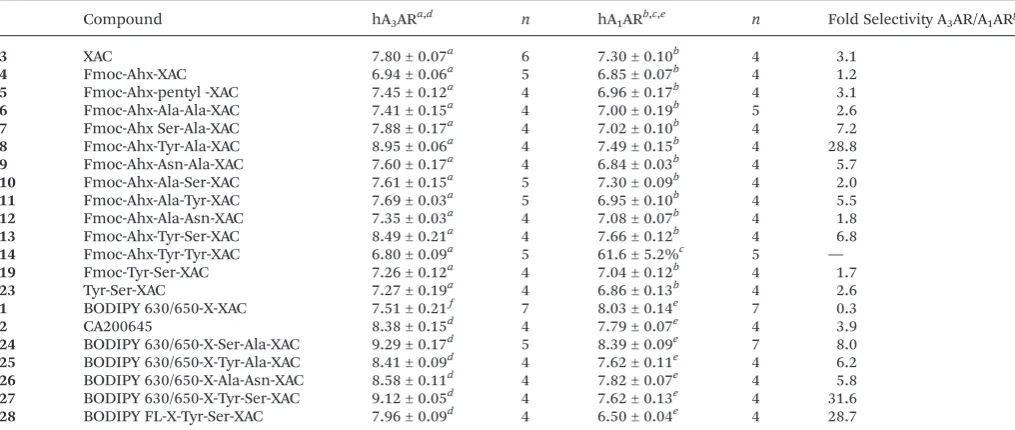
[image:4.595.43.551.64.279.2]All of the Fmoc-compounds (4–19), with the exception of14 at the A1AR, were able to displace the binding of 2 to non-specific levels at both A1AR and A3AR. The affinity of the Fmoc-containing conjugate4was similar at both receptor sub-types ( pKi≈6.9) and addition of the BODIPY 630/650 moiety to afford conjugate1increased affinity at both receptors and displayed only marginal A1-receptor selectivity. Likewise, Fmoc-containing5was 3-fold A3-AR selective and displayed a slightly increased affinity for each receptor subtype on conver-sion to the BODIPY 630/650 conjugate 2, but maintained a similar A3AR/A1AR selectivity. These initial examples suggested that Fmoc-Ahx might potentially be suitable as an alternative to the BODIPY 630/650-X fluorophore in permitting a cost-effective pre-screening for optimal linker composition. We therefore set out to address two questions– (i) can introduc-tion of a dipeptide moiety in the linker tune the affinity and/or selectivity of the conjugate, and (ii) does the use of Fmoc in place of BODIPY 630/650 give a translatable affinity/selectivity profile for dipeptide-containing conjugate screening?
Table 1 Binding affinities of XAC-derived compounds at human A3AR and A1AR
Compound hA3ARa,d n hA1ARb,c,e n Fold Selectivity A3AR/A1ARg
3 XAC 7.80 ± 0.07a 6 7.30 ± 0.10b 4 3.1
4 Fmoc-Ahx-XAC 6.94 ± 0.06a 5 6.85 ± 0.07b 4 1.2
5 Fmoc-Ahx-pentyl -XAC 7.45 ± 0.12a 4 6.96 ± 0.17b 4 3.1
6 Fmoc-Ahx-Ala-Ala-XAC 7.41 ± 0.15a 4 7.00 ± 0.19b 5 2.6
7 Fmoc-Ahx Ser-Ala-XAC 7.88 ± 0.17a 4 7.02 ± 0.10b 4 7.2
8 Fmoc-Ahx-Tyr-Ala-XAC 8.95 ± 0.06a 4 7.49 ± 0.15b 4 28.8
9 Fmoc-Ahx-Asn-Ala-XAC 7.60 ± 0.17a 4 6.84 ± 0.03b 4 5.7
10 Fmoc-Ahx-Ala-Ser-XAC 7.61 ± 0.15a 5 7.30 ± 0.09b 4 2.0
11 Fmoc-Ahx-Ala-Tyr-XAC 7.69 ± 0.03a 5 6.95 ± 0.10b 4 5.5
12 Fmoc-Ahx-Ala-Asn-XAC 7.35 ± 0.03a 4 7.08 ± 0.07b 4 1.8
13 Fmoc-Ahx-Tyr-Ser-XAC 8.49 ± 0.21a 4 7.66 ± 0.12b 4 6.8
14 Fmoc-Ahx-Tyr-Tyr-XAC 6.80 ± 0.09a 5 61.6 ± 5.2%c 5 —
19 Fmoc-Tyr-Ser-XAC 7.26 ± 0.12a 4 7.04 ± 0.12b 4 1.7
23 Tyr-Ser-XAC 7.27 ± 0.19a 4 6.86 ± 0.13b 4 2.6
1 BODIPY 630/650-X-XAC 7.51 ± 0.21f 7 8.03 ± 0.14e 7 0.3
2 CA200645 8.38 ± 0.15d 4 7.79 ± 0.07e 4 3.9
24 BODIPY 630/650-X-Ser-Ala-XAC 9.29 ± 0.17d 5 8.39 ± 0.09e 7 8.0
25 BODIPY 630/650-X-Tyr-Ala-XAC 8.41 ± 0.09d 4 7.62 ± 0.11e 4 6.2
26 BODIPY 630/650-X-Ala-Asn-XAC 8.58 ± 0.11d 4 7.82 ± 0.07e 4 5.8
27 BODIPY 630/650-X-Tyr-Ser-XAC 9.12 ± 0.05d 4 7.62 ± 0.13e 4 31.6
28 BODIPY FL-X-Tyr-Ser-XAC 7.96 ± 0.09d 4 6.50 ± 0.04e 4 28.7
apK
ivalues were calculated from inhibition of the binding of2(A3ARKi= 3.11 nM) to CHO-A3CRE-SPAP cells.bpKivalues were calculated from inhibition of the binding of2(A1ARKi= 17.0 nM) to CHO-A1cells.c% inhibition of binding of2by 10μM14. dpKDvalues were obtained from global Schild analysis of NECA-mediated inhibition of FSK-stimulated CRE-SPAP responses in CHO-A3CRE-SPAP cells.epKivalues calculated from inhibition of [3H]DPCPX (K
i= 2.0 nM) binding in CHO-A1cells. All values represent mean ± SEM fornseparate experiments performed in duplicate (a–c) or triplicate (dande).fDue to apparent non-competitive antagonism at higher concentrations of 1, the pKDvalue was estimated from a shift in the NECA concentration response curves to a single concentration of 100 nM of1as described in the ESI.gFold selectivity was calculated from theKi(nM) value at A1AR divided by theKiat A3AR.
Open Access Article. Published on 04 July 2013. Downloaded on 24/04/2014 18:08:46.
This article is licensed under a
Ala–Ala-linked 6represented an equivalent congener to 5, but with the 5-aminopentanoyl moiety of the latter replaced with a dipeptide. The selectivity profile and affinity of6at the A1AR and A3AR was comparable to5, demonstrating that this linker substitution was tolerated but offered no benefit in relation to either conjugate affinity or selectivity. This result was encouraging however, since it provided scope to change the amino acid side-chains in an iterative fashion, and there-fore an Fmoc-based mini-library was synthesised (Scheme 1). Changing theN-terminal Ala of6to Ser (7), Tyr (8), or Asn (9) resulted in an interesting spectrum of pharmacological effects. For 7, the additional side chain hydroxyl resulted in an increased affinity at the A3AR whilst exerting no significant change at the A1AR. Taken together, this effected a 4-fold enhancement in selectivity for the former receptor. With 8, insertion of the phenol moiety produced an even more pro-nounced enhancement of A3AR affinity ( pKi = 8.95 ± 0.06) coupled with a modest affinity increase at the A1AR; when taken together however this ultimately resulted in a 26-fold increase in A3AR selectivity. For conjugate 9, the observed improvement in A3AR selectivity is born out of a modest increase in A3AR affinity coupled with the only example in this ligand series of a drop in A1AR affinity.
Alternatively, swapping theC-terminal Ala of6to Ser (10), Tyr (11), or Asn (12) resulted in a less pronounced effect on receptor affinity than theN-terminal amino acid substitution described above. Of these three compounds,10and11showed a small increase in affinity for the A3AR compared to6, with12 possessing the lowest A3AR affinity ( pKi= 7.35 ± 0.03) of the Fmoc-Ahx-dipeptide compounds tested. Conjugates10and12 therefore displayed decreased A3AR/ A1AR selectivity profiles; the former as a result of a marginally greater enhancement of A1AR affinity compared to A3AR affinity, whereas for12it was a consequence of a modest decrease in A3AR affinity being coupled with a correspondingly small increase in A1AR affinity. From the results of these N- and C-terminal iterations, we elected two additional dipeptide-linked compounds for syn-thesis; Tyr–Ser containing13(N-terminal Tyr-conjugate 8 dis-played the highest affinity A3AR, whilst the C-terminal Ser-conjugate10displayed the second highest affinity at the A3AR for their respective 3-ligand series) and Tyr–Tyr containing14 (N-terminal Tyr-conjugate 8 displayed the highest affinity A3AR, whilst the C-terminal Tyr-conjugate 11 exhibited the highest affinity at the A3AR for their respective 3-ligand series). The Tyr–Ser-linked 13 revealed a modest decrease in A3AR affinity alongside a slight increase in A1AR affinity when com-pared to Tyr–Ala-linked8. Compared to the Ala–Ser-containing 10however,13showed a higher affinity at both receptors and a 5-fold increase in selectivity towards the A3AR. The remaining dipeptide-conjugate containing Tyr–Tyr (14) showed a substan-tial loss of affinity for both the A1AR and A3AR compared to8 and11. Taken together these results identify a complex inter-play between each of the two amino acid side-chain contri-butions to the ultimate observed receptor affinity.
The pharmacology of the Fmoc-Ahx-dipeptide series
demonstrated that inclusion and subsequent amino acid
iteration of a dipeptide linker does indeed influence the affinity and selectivity of the conjugate towards the A3AR and A1AR. Before investigating if an Fmoc-dipeptide conjugate library is a good predictor of the pharmacological properties of the corresponding BODIPY 630/650 conjugates, we first con-sidered the influence of the Ahx linker and Fmoc group in a Fmoc-Ahx-dipeptide conjugate. A Tyr–Ser-congener without the Ahx linker (19) and another with a free N-terminus (23) were synthesised. Congeners 19 and 23 both showed very similar receptor subtype affinities and hence selectivities, yet a sub-stantial reduction in affinity for the A3AR and a minor drop in affinity for the A1AR when compared to Fmoc-Ahx-linked13. This suggests that the potentially protonatedN-terminus of23 may not be a significant factor in the loss of AR affinity com-pared to13, but rather the lack of an“optimally positioned” Ahx and/or Fmoc moiety.
The Fmoc-dipeptide based mini-compound library
members (6–14) showed a general trend of A3AR selectivity over the A1AR. The three Fmoc-compounds that possessed the highest A3AR affinity and selectivity (Ser–Ala7, Tyr–Ala8and Tyr–Ser 13) were subsequently selected for conversion of the Fmoc moiety to BODIPY 630/650 (giving24,25, and27 respect-ively). The Fmoc moiety of the compound with the lowest A3AR affinity and minimal selectivity (Ala–Asn-12) was also exchanged with BODIPY 630/650 to give26, to ascertain if the non-selective and lower affinity profile of 12 was faithfully translated into the fluorescent conjugate. Parallel shifts in the agonist concentration-response curves at the A3AR were observed for fluorescent XAC-conjugates2and24–27(Table 1, ESI Fig. S2†), with a Schild slope value not differing from unity; indicating that they act as competitive antagonists. However non-parallel shifts in the NECA concentration-response curves were observed in the presence of the pre-viously reported1, suggesting non-competitive antagonism at the A3AR. In a [3H]DPCPX whole cell binding assay all com-pounds (2, 24–27) including 1 could displace radio-ligand binding to non-specific levels, indicating that they were binding to the same site on the A1AR.
BODIPY 630/650 conjugate 24, containing the Ser–Ala linkage, displayed the highest affinity for both the A3AR ( pKD= 9.29 ± 0.17) and A1AR ( pKi= 8.39 ± 0.09) of all the compounds in this study. There was a substantial increase in the affinity of 24(1.4 log unit increase in pKiat each receptor) compared to Fmoc-analogue7. The selectivity profile was reproduced, with both 24 and 7 showing 7- and 8-fold A3AR/A1AR selectivity respectively. An enhanced A3AR and A1AR affinity of the BODIPY 630/650 conjugate compared to the Fmoc analogue was also observed for the4/1and 5/2 compound pairs. It is interesting to note this gain in affinity by the presence of BODIPY 630/650 has also been observed for other fluorescent AR ligands, for example quinoxaline-based antagonists23and even for agonist-based conjugates.24Tyr–Ala-linked25was the only BODIPY 630/650-conjugate that had a reduced affinity (0.5 log unit decrease) for the A3AR compared to the corres-ponding Fmoc-compound (8). Therefore since the A1AR affinity of25was unchanged, there was a resultant decrease in
Open Access Article. Published on 04 July 2013. Downloaded on 24/04/2014 18:08:46.
This article is licensed under a
A3AR selectivity from 29-fold to 6-fold. The Ala–Asn dipeptide was chosen based on 12 being the least selective of all the Fmoc-Ahx-dipeptide compounds. When Ala–Asn was incorpor-ated into BODIPY 630/650 conjugate 26, again its affinity increased and its A3AR selectivity shifted from 2-fold to 6-fold. The BODIPY 630/650-conjugate with the greatest A3AR selecti-vity (32-fold) was Tyr–Ser-linked27(A3AR, pKD= 9.12 ± 0.05; A1AR, pKi= 7.62 ± 0.13) (Fig. 2). Compared to Fmoc-containing
13,27retained a similar affinity for the A1AR but an increased affinity for the A3AR, thereby improving its A3AR selectivity. A
comparison of the BODIPY 630/650-peptide conjugates
(24–27), highlighted the significant effect of the dipeptide linker composition on their pharmacological profile, as pre-viously observed for the Fmoc-dipeptide compound series (6–14).
Returning to our original hypothesis, iterative chemical changes in the linker component of a conjugate can therefore be used to fine tune affinity and/or selectivity for a given recep-tor. However results obtained in this study clearly suggest that the Fmoc-conjugate pharmacology does not reliably predict the corresponding BODIPY 630/650-conjugate pharmacology. It is interesting to note though that in the majority of cases, addition of the BODIPY fluorophore increased the affinity by more than 3-fold; adding further substance to the hypothesis that the fluorophore is implicated in some form of exosite binding, with a significant influence on overall ligand affinity for the receptor. It is highly likely that the BODIPY fluorophore is sampling different AR residues to the Fmoc moiety. Indeed, when one considers the molecular overlay of the two groups it is conceivable that the Fmoc portion could be interacting with
Fig. 2 Live cell confocal imaging of the human A3AR expressed in CHO cells using (a)24(b)27(c)28and compared to (d) the non-peptide linked1. CHO-A3SPAP
cells were incubated withfluorescent ligand for 30 min at 22 °C in the absence (left columns) or presence (right columns) of MRS1220. Single equatorial confocal images (BODIPY 630/650 or BODIPY FL) and their corresponding transmitted light images (Transmitted Light, lower rows) were obtained in the continued presence of thefluorescent ligand and/or unlabelled antagonist. For each compound, images in the presence and absence of MRS1220 were obtained using identical settings for laser power, detector offset and gain. Images shown are from a single experiment representative of 3–5 performed. Scale bars = 20μm.
Open Access Article. Published on 04 July 2013. Downloaded on 24/04/2014 18:08:46.
This article is licensed under a
[image:6.595.51.544.261.662.2]similar AR residues to the styryl group that is contained within the BODIPY 630/650 entity.
Since conjugate27 was our leading fluorescent compound in terms of the maximum A3AR selectivity, we incorporated the same Tyr–Ser linker into a BODIPY-FL conjugate to furnish28 (Scheme 2, Table 1). Previous attempts in our laboratory to construct a BODIPY-FL-containing AR fluorescent tool have been unsuccessful. For example Bakeret al.22reported that a conjugate of 3linked to BODIPY-FL via an 8-(2-aminoethyla-mino)-8-oxooctanoyl spacer showed no displacement of [3H] DPCPX specific binding at concentrations up to 10 μM in a CHO-A1 whole-cell binding assay. Utilising our new peptidic-linker approach, BODIPY-FL conjugate28 showed an affinity for the A3AR (A3AR, pKD= 7.96 ± 0.09) that was acceptable and promising in terms of an exploitable fluorescent probe for imaging, albeit with a reduced affinity for the A3AR and A1AR compared to both13and27. The 29-fold A3AR/A1AR selectivity of 28 was similar to the 32-fold selectivity observed for the equivalent BODIPY 630/650 conjugate (27).
Live cell confocal microscopy
The measured A3AR affinity of24,27, and28does not necess-arily imply that these conjugates will be useful as fluorescent probes for the A3AR, as the physiochemical and photochemical properties must also be appropriate. A good fluorescent ligand must show low levels of nonspecific membrane binding, should not significantly diffuse into the cell cytosol and should have a sufficiently high quantum yield when bound to the receptor to provide a good signal to noise ratio when imaged.
We therefore used confocal microscopy to examine the ability of24,27and28to detect the human A3AR in CHO-A3 SPAP cells, and in particular to compare their imaging pro-perties to those of our original non-peptide conjugated XAC-derivative 121(Fig. 2). In each case, CHO-A3 SPAP cells were incubated with fluorescent ligand at a concentration equi-valent to itsKDfor the receptor (Table 1) to ensure equivalent receptor occupancies. Following incubation of CHO-A3 SPAP cells with 0.5 nM24and 1 nM27for 30 min, strong defined membrane fluorescence was seen, whilst levels of intracellular fluorescence remained low (Fig. 2a,b). The bulk of the observed membrane binding was to the A3AR, since when cells were pre-treated with the non-fluorescent A3AR antagonist MRS1220, the binding was significantly reduced. The conju-gate28containing the BODIPIY-FL fluorophore also produced clear distinct and displaceable membrane binding. In com-parison to the dipeptide-linked conjugates (24,27,28), whilst a 30 min incubation with 1 also produced significant and bright membrane-localised fluorescence, there was also sub-stantially more cytoplasmic fluorescence. This was particularly evident in cells pre-treated with MRS1220, where the mem-brane-localised fluorescence was prevented, but there was a substantial increase in cytoplasmic signal (Fig. 2d).
Fluorescent binding assay using compound 28
The success of24,27and28as fluorescent chemical tools for the A3AR demonstrates that this design-based approach of
using side-chain functionalised peptidic linkers has signifi-cant benefits over non-peptidic linkers. In addition to tuning the affinity and selectivity of the conjugate, the increased levels of specific membrane binding at the low concentrations and the propensity of the compounds to remain localised to cell membrane even after extended incubation is a significant advantage over earlier non-peptidic fluorescent derivatives of3 (for example 1). Because of the refined imaging properties, now for the first time we were able to use a green ligand,28, as the tracer ligand in place of the previously employed 2 (Table 1) in an analogues competition binding assay (Fig. 3). This enabled measurement of the affinity values for the new BODIPY 630/650-containing compounds (24, 25, 27) for the A3AR using 28as the tracer, as there is a large separation in the excitation/emission wavelengths of the BODIPY FL and BODIPY 630/650 fluorophores.
Clear concentration-dependent displacement of 28 by increasing concentrations of 24, 25 and 27 was observed, which enabled generation of competition binding curves and estimation of pKivalues ( pKi= 8.96 ± 0.03, 8.20 ± 0.06, 8.70 ± 0.10 for 24,25and27 respectively (Fig. 3a i–iii, 4b). The pKi values measured for24,25and27using28as the competing tracer are of the same order of magnitude as the values obtained for24,25, and27at the A3AR in the CRE-SPAP gene transcription assay (Table 1). Using the same competition assay that was originally used to analyse the Fmoc-based com-pounds with tracer2(Table 1) the affinity of the BODIPY FL-labelled 28 for the A3AR was also determined ( pKi = 7.55 ± 0.19) (Fig. 3a iv, 3c), and again showed good correlation with the A3AR CRE-SPAP measurements (Table 1).
Molecular modelling
Molecular modelling of the A1AR and A3AR as well as docking of the BODIPY 630/650-containing compounds 27 and 26 (greatest and least A3AR/A1AR selectivity respectively) was carried out in an attempt to rationalise the pharmacological data obtained in this study in terms of the selectivity imbued by the peptide linker. The homology models for the two pro-teins (see ESI Fig. S3–S6, Tables S3–S4†) were generally quite similar, however in the A3AR model the extracellular end of helix I was predicted to be further away from the neighbouring helix VII, generating a cleft and groove that was absent in the A1AR model (Fig. 4) and as is discussed below, this difference proved to be significant.
Docking of 27 to the A1AR failed to reveal a single high-scoring pose. While the XAC-component of the molecule remained in its crystallographic position, the dipeptide linker and terminal BODIPY sampled a variety of alternative confor-mations, none of which featured particularly significant ligand–protein interactions, and all of which placed the BODIPY moiety in a rather solvent-exposed environment (Fig. 5a). However for the A3AR, docking of 27 produced a clear single cluster of poses (Fig. 5b) which revealed similar interacting regions within the pocket and featured the dipep-tide/BODIPY portion exiting through the transmembrane (TM)
Open Access Article. Published on 04 July 2013. Downloaded on 24/04/2014 18:08:46.
This article is licensed under a
I/ TM VII cleft and groove to the space otherwise occupied by the aliphatic chains of the membrane lipids (ESI Fig. S7†).
Docking of 26 to both the A1AR and the A3AR provided some rationalisation for why this compound possesses the
lowest A3AR/A1AR selectivity. Only two poses could be gener-ated for26bound to A1AR (Fig. 5c) and three for it bound to A3AR (Fig. 5d). In neither case was a single, well-defined binding mode identified, nor was the BODIPY portion buried deep in the lipid bilayer. In the absence of single, well-defined predictions for the binding poses it is not appropriate to make detailed analyses of how the various structural features in these two proteins and ligands contribute to the patterns of affinity and selectivity, however some general insights are poss-ible. Primarily, the cleft and groove between helices I and VII of the A3AR may provide an opportunity for a suitably designed fluorescent ligand to bury its fluorophore in the lipid environ-ment in a way much harder to achieve for the A1AR. For effective binding to the A3AR the nature of the dipeptide linker is important for two separate reasons. Firstly, the amino acids present in the ligand should have suitable functionality to interact with the protein in the region of the cleft and groove. Secondly, the docking studies suggest that the dipeptide moiety of the conjugate is quite exposed to the surrounding environment as it exits the protein and this environment includes areas within the lipid bilayer, and in close proximity to the phospholipid headgroups. Interestingly, it has been established that certain amino acids, such as serine and in particular tyrosine, have a greater propensity to feature in this environment26while in contrast amino acids such as aspara-gine are not as favourable.
Fig. 3 Measurement of the affinity of24,25,27and28at the A3AR using afluorescence based competition binding assay. (a) Representative montages of images
of CHO-A3SPAP cells with increasing concentrations of24(i),25(ii) or27(iii) using tracer28and BODIPY-FLfluorescence measured; or with increasing
concen-trations of 28 (iv) using tracer2and BODIPY 630/650fluorescence measured. Competition curves generated from the total BODIPY FL (b) or BODIPY 630/650 (c) image intensity. Data are normalised to maximal28(b) or2(c)fluorescence in the absence of any competing ligand. Each data point represents the mean ± SEM from four (24),five (25,27and28) or six (d) experiments performed in duplicate.
Fig. 4 Comparison of the homology models of the A1AR (yellow) and A3AR
(green), highlighting the different positions of the extracellular ends of helix I (red for A1AR, cyan for A3AR). For the latter protein this results in the formation
of a cleft and groove at the interface with helix VII (grey for A1AR, pink for
A3AR) that is absent in the A1AR model.
Open Access Article. Published on 04 July 2013. Downloaded on 24/04/2014 18:08:46.
This article is licensed under a
[image:8.595.105.496.51.329.2] [image:8.595.48.246.407.595.2]Conclusions
A key feature of the current state of research into GPCRs is an increasing awareness of the need to scrutinise their cellular location and involvement in complex signalling interactions. As such, fluorescence-based approaches have developed apace to meet these needs.27 The necessity to supply high quality fluorescent ligands as chemical tools to study this important area of bioanalysis therefore remains a primary research goal.28 The methods applied to fluorescent ligand chemical synthesis have matured significantly and this study has further highlighted the important contribution of the linker to the overall pharmacology of fluorescently labelled GPCR ligands. Specifically we have shown that the non-selective A1AR and A3AR antagonist 3 can be used as the parent ligand to ulti-mately generate higher affinity and subtype-selective fluo-rescent probes (for example 27 and 28) using advantageous amino acid selection within a dipeptide linker.
We have also demonstrated that fluorescent ligand
measurements can be undertaken using live cells with ligands conjugated to spectrally separated fluorophores. This allowed
affinity data to be obtained for each ligand using the alter-native as the competing probe. In silico analysis of BODPIY-630/650-X dipeptide-conjugates docked into homology models of the A1AR and A3AR has identified potential sites of molecular interaction between the peptidic linker moiety and the receptor, which may help rationalise their observed selecti-vity. For GPCRs where there are no subtype discriminating orthosteric ligands to select as a starting point for conjugate synthesis, the methods established here could prove even more valuable for the design of sub-type selective fluorescent probes. One could postulate that further SAR refinement of the dipeptide sequence, or extending the peptide length may impart even greater subtype selectivity and this is the on-going focus of work within our laboratories.
Acknowledgements
This work was support by the Medical research Council, UK (Grant Number G0800006).
Fig. 5 Docking offluorescent conjugates using Glide into the AR homology models. (a) Five poses generated for27in A1AR, (b) six poses generated for27in
A3AR, (c) two poses generated for26in A1AR, (d) three poses generated for26in A3AR. The phosphorus atoms of the POPC upper leaflet headgroups are shown in
orange, to mark the water–lipid interface.
Open Access Article. Published on 04 July 2013. Downloaded on 24/04/2014 18:08:46.
This article is licensed under a
[image:9.595.122.480.51.391.2]Notes and references
1 V. O. Nikolaev, A. Moshkov, A. R. Lyon, M. Miragoli, P. Novak, H. Paur, M. J. Lohse, Y. E. Korchev, S. E. Harding and J. Gorelik,Science, 2010,327, 1653–1657.
2 L. T. May, T. J. Self, S. J. Briddon and S. J. Hill,Mol. Pharma-col., 2010,78, 511–523.
3 L. T. May, L. J. Bridge, L. A. Stoddart, S. J. Briddon and S. J. Hill,FASEB J., 2011,25, 3465–3476.
4 L. A. Stoddart, A. J. Vernall, J. L. Denman, S. J. Briddon, B. Kellam and S. J. Hill,Chem. Biol., 2012,19, 1105–1115. 5 K. A. Jacobson,Bioconjugate Chem., 2009,20, 1816–1835. 6 R. J. Middleton and B. Kellam, Curr. Opin. Chem. Biol.,
2005,9, 517–525.
7 V. Cherezov, D. M. Rosenbaum, M. A. Hanson,
S. G. F. Rasmussen, F. S. Thian, T. S. Kobilka, H.-J. Choi, P. Kuhn, W. I. Weis, B. K. Kobilka and R. C. Stevens, Science, 2007,318, 1258–1265.
8 V.-P. Jaakola, M. T. Griffith, M. A. Hanson, V. Cherezov, E. Y. T. Chien, J. R. Lane, A. P. Ijzerman and R. C. Stevens, Science, 2008,322, 1211–1217.
9 E. Y. T. Chien, W. Liu, Q. Zhao, V. Katritch, G. W. Han, M. A. Hanson, L. Shi, A. H. Newman, J. A. Javitch, V. Cherezov and R. C. Stevens,Science, 2010,330, 1091–1095. 10 S. Granier, A. Manglik, A. C. Kruse, T. S. Kobilka,
F. S. Thian, W. I. Weis and B. K. Kobilka,Nature, 2012,485, 400–404.
11 A. C. Kruse, J. Hu, A. C. Pan, D. H. Arlow,
D. M. Rosenbaum, E. Rosemond, H. F. Green, T. Liu, P. S. Chae, R. O. Dror, D. E. Shaw, W. I. Weis, J. Wess and B. K. Kobilka,Nature, 2012,482, 552–556.
12 J. S. Mason, A. Bortolato, M. Congreve and F. H. Marshall, Trends Pharmacol. Sci., 2012,33, 249–260.
13 (a) K. A. Jacobson, K. L. Kirk, W. L. Padgett and J. W. Daly, Mol. Pharmacol., 1986,29, 126–133.
14 B. B. Fredholm, A. P. Ijzerman, K. A. Jacobson, J. Linden and C. E. Müller,Pharmacol. Rev., 2011,63, 1–34.
15 S. Schenone, C. Brullo, F. Musumeci, O. Bruno and M. A. Botta,Curr. Top. Med. Chem., 2010,10, 878–901. 16 S. Cohen, S. M. Stemmer, G. Zozulya, A. Ochaion,
R. Patoka, F. Barer, S. Bar-Yehuda, L. Rath-Wolfson, K. A. Jacobson and P. Fishman,J. Cell. Physiol., 2011,226, 2438–2447.
17 J-F. Chen, H. K. Eltzschig and B. B. Fredholm, Nat. Rev. Drug Discovery, 2013,12, 265–286.
18 B. B. Fredholm, A. P. Ijzerman, K. A. Jacobson, K. N. Klotz and J. Linden,Pharmacol. Rev., 2001,53, 527–552.
19 D. Xin, Y. Wang and J. Xiang,Pharm. Res., 2010,27, 380– 389.
20 S.-H. Lee, J. J. Moon, J. S. Miller and J. L. West, Biomater-ials, 2007,28, 3163–3170.
21 S. J. Briddon, R. J. Middleton, Y. Cordeaux, F. M. Flavin, J. A. Weinstein, M. W. George, B. Kellam and S. J. Hill,Proc. Natl. Acad. Sci. U. S. A., 2004,101, 4673–4678.
22 J. G. Baker, R. J. Middleton, L. Adams, M. T. May, S. J. Briddon, B. Kellam and S. J. Hill, Br. J. Pharmacol., 2010,159, 772–786.
23 A. J. Vernall, L. A. Stoddart, S. J. Briddon, S. J. Hill and B. Kellam,J. Med. Chem., 2012,55, 1771–1782.
24 C. L. Dale, S. J. Hill and B. Kellam, MedChemCommun, 2012,3, 333.
25 Y. Cordeaux, S. J. Briddon, A. E. Megson, J. McDonnell, J. M. Dickenson and S. J. Hill, Mol. Pharmacol., 2000,58, 1075–1084.
26 S. Mitaku, T. Hirokawa and T. Tsuji,Bioinformatics, 2002, 18, 608–616.
27 S. J. Briddon and S. J. Hill,Trends Pharmacol. Sci., 2007,28, 637–645.
28 M. Leopoldo, E. Lacivita, F. Berardi and R. Perrone, Drug Discovery Today, 2009,14, 706–712.
Open Access Article. Published on 04 July 2013. Downloaded on 24/04/2014 18:08:46.
This article is licensed under a