SOCIO-TECHNICAL ANALYSIS OF SYSTEM-OF-SYSTEMS USING RESPONSIBILITY MODELLING
David Greenwood
A Thesis Submitted for the Degree of PhD at the
University of St. Andrews
2012
Full metadata for this item is available in Research@StAndrews:FullText
at:
http://research-repository.st-andrews.ac.uk/
Please use this identifier to cite or link to this item: http://hdl.handle.net/10023/3176
Socio-Technical Analysis of System-of-Systems
Using Responsibility Modelling
David Greenwood
This thesis is submitted in partial fulfilment for the degree of PhD
at the
University of St Andrews
Socio-Technical Analysis of System-of-Systems Using
Responsibility Modelling
David Greenwood
School of Computer Science, University of St Andrews
A thesis submitted to the University of St. Andrews for the degree of PhD.
Keywords: system-of-systems; socio-technical systems engineering; responsibility modelling; threat identification; troubleshooting.
Declaration: No portion of the work in this thesis has been submitted in support of an application for another degree or qualification of this or any other university or other institute of learning. Portions of this thesis have appeared previously in the following published articles.
Publications:
1. Greenwood, Sommerville (2011) "Expectations and Reality: Why an enterprise software system didn't work as planned", 20th International Conference on Information Systems Development, Edinburgh
2. Greenwood, Sommerville (2011) “Using Complex Network Analysis and Visualisation to Analyse Problematic Enterprise Scale Information Systems?”, 55th Meeting of the International Society for the Systems Sciences, Hull
3. Greenwood, Sommerville (2011) “Responsibility Modeling for Identifying Sociotechnical Threats to the Dependability of Coalitions of Systems”, 6th IEEE International
Conference on Systems-of-Systems Engineering, Albuquerque
Candidate’s Declarations
I, David Greenwood hereby certify that this thesis, which is approximately 70,000 words in length, has been written by me, that it is the record of work carried out by me and that it has not been submitted in any previous application for a higher degree.
I was admitted as a research student in September, 2008 and as a candidate for the degree of PhD in September, 2009; the higher study for which this is a record was carried out in the University of St Andrews between 2008 and 2012.
Date 07/06/2012 signature of candidate ………
Supervisor’s Declaration
I, Professor Ian Sommerville, hereby certify that the candidate has fulfilled the conditions of the Resolution and Regulations appropriate for the degree of PhD in the University of St Andrews and that the candidate is qualified to submit this thesis in application for that degree.
Permission for Electronic Publication
In submitting this thesis to the University of St Andrews I understand that I am giving permission for it to be made available for use in accordance with the regulations of the University Library for the time being in force, subject to any copyright vested in the work not being affected thereby. I also understand that the title and the abstract will be published, and that a copy of the work may be made and supplied to any bona fide library or research worker, that my thesis will be electronically accessible for personal or research use unless exempt by award of an embargo as requested below, and that the library has the right to migrate my thesis into new electronic forms as required to ensure continued access to the thesis. I have obtained any third-party copyright permissions that may be required in order to allow such access and migration, or have requested the appropriate embargo below.
The following is an agreed request by candidate and supervisor regarding the electronic publication of this thesis:
(i) Access to printed copy and electronic publication of thesis through the University of St Andrews.
Date 07/06/2012
signature of candidate ……
Acknowledgements
This work would not have been possible without the help, generosity and encouragement of many people.
I would like to thank my supervisor, Ian Sommerville, for his patience, inspiration and guidance throughout my studies at the University of St Andrews. I am grateful to the many members of LSCITS project, and particularly Dave Cliff (LSCITS project director), for providing memorable discussions and opportunities to share ideas in a friendly and supportive environment. I am also indebted to my industrial partners for enabling this work to be performed - particularly Paul Packard and Hillary Sillitto.
Abstract
Society is challenging systems engineers by demanding increasingly complex and integrated IT systems (Northrop et al., 2006; RAE, 2004) e.g. integrated enterprise resource planning systems, integrated healthcare systems and business critical services provisioned using cloud based resources. These types of IT system are often systems-of-systems (SoS). That is to say they are composed of multiple systems that are operated and managed by independent parties and are distributed across multiple organisational boundaries, geographies or legal jurisdictions (Maier, 1998).
SoS are notorious for becoming problematic due to interconnected technical and social issues. Practitioners claim that they are ill equipped to deal with the socio-technical challenges posed by system-of-systems. One of these challenges is to identify the socio-technical threats associated with building, operating and managing systems whose parts are distributed across organisational boundaries. Another is how-to troubleshoot these systems when they exhibit undesirable behaviour.
This thesis aims to provide a modelling abstraction and an extensible technique that enables practitioners to identify socio-technical threats prior to implementation and troubleshoot SoS post-implementation. This thesis evaluates existing modelling abstractions for their suitability to represent SoS and suggests that an agent-responsibility based modelling abstraction may provide a practical and scalable way of representing SoS for socio-technical threat identification and troubleshooting. The practicality and scalability of the abstraction is explored through the use of case studies that motivate the extension of existing responsibility-based techniques so that new classes of system (coalitions-of-systems) and new classes of threat (agent-related threats) may be analysed.
Contents
Candidate’s Declarations...i
Permission for Electronic Publication...ii
Acknowledgements... iii
Abstract ...iv
Contents...v
1. Thesis Overview...1
1.1 Introduction...1
1.2 Academic Merit ...2
1.3 Problem Space ...2
1.4 Solution Space ...3
1.5 Thesis & General Approach ...4
1.6 Aim and Objectives ...4
1.7 Novel Contributions...5
1.8 Thesis Structure ...6
2. System-of-Systems and their Socio-Technical Analysis ...9
2.1 Introduction...9
2.2 System-of-Systems ...9
2.3 Paradigms for Representing and Analysing Socio-Technical Systems ..10
2.4 Modelling Abstractions for representing Socio-Technical Systems...13
2.5 Comparative Analysis...37
2.6 Chapter Summary ...42
3. Research Methods ...43
3.1 Introduction...43
3.2 Data Collection ...43
3.3 Data Analysis ...47
3.4 Chapter Summary ...54
4.1 Introduction...55
4.2 A Strategy for the Socio-Technical Analysis of a SoS ...56
4.3 Requirements of the Modelling Abstraction...58
4.4 Responsibility Modelling...59
4.5 Why Responsibilities are a Useful Abstraction ...68
4.6 A Comparison with other Modelling Abstractions...69
4.7 Chapter summary ...76
5. Responsibility Modelling for Threat Identification ...78
5.1 Introduction...78
5.2 Coalitions of Systems and Socio-Technical Threat Identification ...78
5.3 Developing Responsibility Models for Threat Identification ...80
5.4 Case Study ...82
5.5 Conclusion ...93
6. Responsibility Modelling for Identifying Threats to Cooperation ...94
6.1 Introduction...94
6.2 Background ...95
6.3 A Framework for Identifying Conflict-related Threats ...96
6.4 Responsibility Modelling for Conflict Analysis ...107
6.5 The Case Study Investigations...108
6.6 Conclusion ...126
7. Structural-Intentional Responsibility Modelling for Troubleshooting a Problematic Enterprise-scale System ...128
7.1 Introduction...128
7.2 Social Analysis to Inform System Implementation ...129
7.3 Research Design ...130
7.4 Our Findings ...132
7.5 Discussion ...144
7.6 Conclusion ...148
8. Scaling Structural-Intentional Responsibility Modelling Using Network Analysis 149 8.1 Introduction...149
8.5 Research Findings...157
8.6 Conclusion ...167
9. Conclusion and Future Work...168
9.1 Conclusion ...168
9.2 Threats to the Validity ...169
9.3 Future Work ...170
Thesis References ...171
Appendix A – Example Conflict Analysis Template...186
Appendix B – Risk Tables for LASCAD92/96...188
Appendix C – Mapping of Identified Causes and Conflict Analysis Risks...191
Appendix D - Risk Tables for Oil/Gas Case Study...193
1. Thesis Overview
1.1 Introduction
Society is challenging systems engineers by demanding increasingly complex and integrated IT systems (Northrop et al., 2006; RAE, 2004) e.g. integrated enterprise resource planning systems, integrated healthcare systems and business critical services provisioned using cloud based resources. These types of IT system are often systems-of-systems (SoS). That is to say they are composed of multiple systems that are operated and managed by independent parties and are distributed across multiple organisational boundaries or legal jurisdictions (Maier, 1998). SoS are notorious for becoming problematic due to interconnected technical and social issues. An exemplar is the NHS ‘Care Record Service’ - a failing attempt to integrate patient care records across NHS organisations in England. When the ‘Care Record Service’ contracts were awarded in 2003/4 it was intended that a detailed and integrated patient care record system would be delivered to all NHS trusts and GP practices by 2010. In 2009 the project was 4-5 years behind schedule, Accenture and Fujitsu – two of the four suppliers - had pulled out due to their inability to deliver, and the other suppliers, BT and CSC, had to revise their deliver schedules having recognised that more customisation was required than originally envisaged to meet each individual NHS organisations’ needs (Committee, 2009; Health, 2011; NAO, 2011; Office, 2011). Analyses of this project suggest that it is suffering from socio-technical issues (Currie & Guah, 2007).
The above example suggests, and practitioners claim, that they are ill equipped to deal with the socio-technical challenges posed by system-of-systems. One of these challenges is to identify the socio-technical risks associated with building, operating and managing systems whose parts are distributed across organisational boundaries. Another is how-to troubleshoot these systems when they exhibit undesirable behaviour.
1.2 Academic Merit
System-of-systems are worthy of academic study as many of the challenges these systems pose are relevant to the engineering of large-scale IT systems. This is especially the case today as we live in an era where:
• commercial pressures are driving the acquisition of ever more interconnected and sophisticated systems;
• the proliferation of technologies such as cloud computing create dependencies across multiple organisations with often differing commercial interests;
• consortia build, operate and maintain systems whose ongoing dependability is reliant on a ‘coalition’ of partners fulfilling obligations. Perhaps the following five challenges are indicative of the academic and industrial significance of this research area:
• ‘How do we identify and understand threats to the dependability of a SoS when it is dependent on the actions of multiple technical and non-technical agents operating in multiple organisations, whom may have differing self-interests or reside in different jurisdictions?’
• ‘What modelling abstractions are suitable for representing these situations in a meaningful way to key stakeholders?’
• ‘How do we take into account groups of human agent’s abilities to resist/conflict with organisational changes when assessing the risks of deploying and operating a particular socio-technical configuration of an IT system?’
• ‘What technical or non-technical structures can we put in place to facilitate the deployment and adoption of a large-scale IT system thus reducing risk?’
• ‘How do we investigate and troubleshoot a large-scale IT system when it may be influenced by interactions between technical and non-technical elements, and where each stakeholder has a partial view of the situation?’
1.3 Problem Space
cooperation of humans interacting across organisational boundaries must be understood. These factors are not just technical since there is a need to identify and analyse problems that can arise due to interactions between groups or organisations that hold different commercial interests and perhaps operate in accordance to different laws, norms or domain standards.
Because of this need to understand interactions between socio-technical elements that span organisational boundaries, SoS may be seen as a difficult class of socio-technical systems to model. This is because they tend to be challenging to describe and understand due to their under-specification and their low comprehensibility. SoS are under-specified because:
• their specific operating conditions and exact configuration are too vast or ephemeral to completely specify (Hollnagel, 2008).
• their parts and interactions change over time and thus creating/maintaining complete structural and behavioural descriptions is too costly/difficult (Hollnagel, 2008).
• the number and nature of parts and interactions may be disputed, or no one person has a complete view of the system, and so multiple potentially inconsistent views of the system may exist.
SoS have a low comprehensibility because:
• interactions between system parts may be non-linear and emergent (Hollnagel, 2008)
• no individual stakeholder has a complete view of the system and its operating conditions
• stakeholders may need to make sense of a large number of parts, interactions and views to understand the system’s structure and behaviour.
1.4 Solution Space
Modelling abstractions can help address the challenges of understanding SoS. They can help by minimising the effort or cost of describing and analysing them. A key challenge is to create modelling abstractions that provide the level of understanding required whilst being economical with respect to the quantity of information that must be collected and kept up-to date. To achieve this, a strategy for eliciting and representing a minimal set of necessary and sufficient parts and interactions is required.
claims can be made as to whether it is possible, or likely, that the SoS will act in a troublesome manner. To do this we postulate and test the hypothesis that a system’s structure (as represented by a responsibility model) constrains the kinds of behaviour a system exhibits.
1.5 Thesis & General Approach
This thesis argues that the notion of ‘responsibility’ provides a suitable abstraction for the socio-technical analysis of SoS. We argue that it facilitates the enquiry, representation and understanding of situations by teasing out potentially intricate dependencies between technical and non-technical agents, whilst providing a suitable language for representing and discussing obligations, liabilities and norms which are important for understanding socio-technical threats and troubleshooting SoS. Our argument is evidenced by means of qualitative case studies that illustrate how the responsibility abstraction was used, or extended, to facilitate the analysis of real world systems.
A case study approach was selected, as the plausibility of this thesis’ findings are dependent upon the phenomena of study being representative of SoS. Representative situations can only be found in-situ due to their nature and therefore a case study approach was selected. A mainly qualitative approach was selected as this enabled the exploration of situations via means of interviews and informal dialogue. Interviews and informal dialogue were selected because they are particularly effective at understanding the richness of ‘messy’, intricate and subtle situations.
1.6 Aim and Objectives
The principal aim of this research was to develop a modelling abstraction and an extensible technique that enables SoS to be analysed for socio-technical threats and troubleshot post-implementation. The objectives of this research were to:
1. investigate how responsibilities can be used for understanding socio-technical situations;
2. carry out case studies to investigate the practicality and scalability of the agent-responsibility modelling abstraction.
troubleshoot and identify threats in systems that are composed of multiple systems that are operated and managed by independent parties and are distributed across organisational boundaries or legal jurisdictions.
This thesis claims that the ‘responsibility’ abstraction is practical as it provides ways of troubleshooting problematic socio-technical situations as well as ways of identifying socio-technical threats. This is illustrated through case studies that show that responsibility modelling can be used to:
• identify socio-technical interactions contributing to problematic system behaviour
• identify threats to system behaviour due to coalition partners holding incompatible commercial interests and so reneging on responsibilities
• identify threats to system deployment and operational effectiveness due to human agents’ interests conflicting with those of the system being deployed/ in operation.
This thesis claims that the ‘responsibility’ abstraction may be scalable, as when combined with techniques from network analysis, situations with non-trivial numbers of elements may be analysable without an analyst having to manually inspect each and every interaction thus reducing the burden of human effort. This thesis demonstrates that metrics can be used to rank the importance of interactions and thus enable an analyst to understand a situation. This may therefore increase the scale of situation an analyst may analyse, or decrease the time required for an analyst to understand a situation. This use of metrics to rank elements is illustrated through a case study of a problematic enterprise document management system in a multinational systems engineering organisation.
1.7 Novel Contributions
This thesis provides four key contributions. Firstly, that the notion of responsibility provides a suitable abstraction for assessing the socio-technical dependability of coalitions-of-systems – that is to say, systems whose continuing operation are dependent upon a coalition of technical and organisational agents fulfilling obligations. This contribution is illustrated in chapter 5 via means of a cloud computing based case study and is also discussed in (Greenwood & Sommerville, 2011b).
The second contribution is that the notion of ‘responsibility’ provides a suitable abstraction for identifying threats to system deployment and adoption situations where threats to human agents’ cooperative behaviour need to be taken into account. This contribution is illustrated in chapter 6 via means of a health sector case study and a cloud computing based case study.
enterprise document management system in a multinational systems engineering organisation and is also discussed in (Greenwood & Sommerville, 2011a).
The fourth contribution is that responsibilities form part of a potentially scalable abstraction when used with techniques from network analysis. This contribution is illustrated in chapter 8 via means of re-analysing the case study in chapter 7 to demonstrate that a problematic situation can be represented as a directed graph and that analytical techniques may be used as indicators of element ‘importance’ and ‘complexity’. These techniques aid an analyst by indicating elements that may be important in situations where the number of nodes and their interconnections is to too large for a human to be able to analyze in a timely manner. This research is also discussed in (Greenwood & Sommerville, 2011c).
1.8 Thesis Structure
This thesis is structured so that chapter 2 reviews work related to system-of-systems (SoS) and their socio-technical analysis. The reader is introduced to the notion of system-of-systems and the problems faced when attempting to model SoS, followed by a survey of modelling paradigms and techniques from systems engineering and related disciplines. The survey considers approaches from systems engineering including functional decomposition based approaches (such as IDEF0 and FRAM) and agent-based approaches (such as responsibility modelling, I* and Tropos). Approaches from information systems and operations research are surveyed including Cultural Historical Activity Theory, Actor Network Theory, Rich Pictures and Cognitive maps.
Chapter 3 consists of a review of research methods suitable for the study of system-of-systems. It investigates the advantages and disadvantages of quantitative and qualitative data collection techniques, including surveys, interviews, participant observation, and data analysis approaches including multivariate statistics, network analysis and qualitative approaches such as grounded theory and hermeneutics.
coalitions-of-typical SoS. Assessing the socio-technical dependability of CoS is an open research question of societal importance as existing socio-technical dependability analysis techniques typically do not assess threats associated with coalition partners reneging on responsibilities or leaving a coalition. We use a cloud computing based case study to demonstrate that a responsibility modelling based threat identification approach enables the identification of these threats. We provide first evidence that inspecting the distribution of liabilities among coalition partners may indicate the fragility of overlapping self-interests.
Chapter 6 is concerned with extending responsibility modelling to take into account threats to human agents’ cooperative behaviour. Current approaches to threat analysis view stakeholders from a mechanistic means-end perspective where human agents are assumed to be passive and compliant. In this chapter, we use insights from conflict theory in social psychology to take into account factors that make stakeholders conflict with change. We make the case that this class of threat is an important class of threat that is missing from responsibility analysis. We used a cloud computing based case study to demonstrate that the conflict based threat identification approach enables the identification of this class of threats.
Chapter 7 is concerned with extending responsibility-based analysis to troubleshoot a problematic enterprise IT system. In this chapter we make the case that ethnographic and social analyses have not been widely assimilated into industry practice because they did not fit practitioner’s practices. In response to this, we developed a lightweight qualitative approach to provide insights to ameliorate problematic system deployments. Unlike typical ethnographies and social analyses of work activity that inform systems analysis and design; we argue that analysis of intentional and structural factors to inform system deployment and integration can have a shorter time duration and yet can provide actionable insights. We evaluate our approach using a case study of a problematic enterprise document management system within a multinational systems engineering organisation. Our findings are of academic and practical significance as our approach demonstrates that structural-intentional analysis scales to enable the timely analysis of enterprise system deployments.
2. System-of-Systems and their Socio-Technical Analysis
2.1 Introduction
The purpose of this chapter is to introduce the reader to research relevant to the socio-technical analysis of system-of-systems (SoS). The first section introduces the concept of a SoS and subsequent sections review the current state of socio-technical modelling and analysis abstractions and their applicability to SoS.
2.2 System-of-Systems
The study of ‘system-of-systems’ (SoS) is in a relatively embryonic form and as such the research community has not agreed upon a common definition of a SoS. The definitions that do exist are often domain dependent but tend to capture overlapping notions (Gorod, Sauser, & Boardman, 2008; Jamshidi, 2008; Pyster, 2011). That is to say, they capture the notion of two or more systems that are separately defined but operate together to fulfil a common goal (Checkland, 1999). They also typically postulate key characteristics such as: operational independence of component systems; managerial independence of component systems; geographical distribution; emergent behaviour; and evolutionary development processes (Maier, 1998). Other definitions of SoS include that of (Jamshidi, 2008) whom after reviewing six definitions of SoS favoured “systems of systems are large-scale integrated systems which are heterogeneous and independently operable on their own, but are networked together for a common goal” (Jamshidi, 2008, p. 4).
This thesis defines a SoS as a class of system that delivers services or capabilities via the integration of independently managed and controlled systems. This definition is strongly influenced by (Maier, 1998) and is in line with the System Engineering Body of Knowledge (Pyster, 2011).
It is believed by the research community that SoS pose a set of distinct engineering challenges as the services or capabilities they provide cannot, by definition, be centrally managed because of their component systems’ operational and managerial independence. It is believed that this independence creates a distributed control problem that needs to be understood throughout a SoS lifecycle. This independence presents challenges with respect to systems architecture, modelling and simulation, policymaking and standards (Jamshidi, 2008).
organisational agents. An important aspect of this is to ensure components are not just integrated at a technical level but also at an organisational and legal level. Another important challenge is to ensure that the way components are integrated at the organisational and legal level does not inadvertently introduce risks that undermine functional or non-functional requirements. Another important challenge is how-to troubleshoot problems after system deployment. This is perceived to be particularly problematic since SoS are distributed across organisational boundaries and have independent management.
At present research in the area of the socio-technical analysis of systems of systems is in a nascent state. Due to a scarcity of SoS specific research, this thesis reviews approaches for representing and analysing socio-technical systems that are not necessarily SoS specific but assesses their potential applicability to SoS.
2.3 Paradigms for Representing and Analysing Socio-Technical Systems
In systems engineering, systems are often represented as models (Dickerson & Mavris, 2009). Models are representations of real/abstract things that are created for a purpose and only represent the details necessary and sufficient for that purpose (Anderson, Sweeny, Williams, 2000). Schematic models, the type of models this thesis focuses on, are conceptual representations that use notation to represent the entity being modelled.
Systems can often be usefully represented from multiple views. Four common views are:
• Structural views - representing the parts of a situation and their logical relations e.g. associations, aggregations, generalizations.
• Behavioural views - representing the parts of a situation and their causal interactions i.e. material or energy transfers or the transmission of data.
• Requirements views - specifying desired and undesired structural and behavioural properties of a system e.g. the system should not have a distributed architecture (structural property), the system should have the capability to process 1 billion transactions per second (behavioural property).
• Parametric views - specifying the critical engineering parameters of the system including those involved in evaluation of performance, reliability and physical characteristics. For instance, a performance characteristic of vehicle system may be F≥ma, where m is its mass, a is its acceleration and F may be the maximum force produced by its braking system.
• the ‘machine metaphor’;
• the ‘organic metaphor’;
• the ‘feedback loop metaphor’;
• and the ‘socio-technical metaphor’.
These paradigms are explained in the following subsections. Abstractions will be discussed in section 4.
2.3.1 Machine Metaphor
The ‘machine metaphor’ treats a system as a deterministic1 machine with a static
structure that transforms inputs into outputs for some purpose. The metaphor is primarily concerned with representing a situation in terms of its static structure and factors that enable and constrain the system’s components to produce required outputs. It is assumed that components interact in a linear2 manner and if any of
the components are human beings they are treated as mechanisms that simply perform actions that contribute to converting inputs to outputs. Typical examples of modelling approaches that adopt the machine metaphor include data flow diagrams (Gane & Satson, 1979), IDEF0 models (NIST, 1993) and UML sequence, activity, state machine and use case models (Bennett, Skelton, & Lunn, 2005).
The machine metaphor has two significant limitations. The first limitation results from its treatment of human beings as mechanisms. As we know, human beings in the workplace do not simply perform actions that contribute to converting inputs to outputs. Human beings have basic needs and they seek to satisfy them in ways that do not contribute to converting inputs into outputs. For instance they may be satisfied through procrastination, developing relationships or being involved in organisational politics - so as to change the ‘system’ or resist undesirable changes to the ‘system’. The implication here is that the machine metaphor is unsuitable for analysing systems where human interests and politics need to be taken into account.
The second limitation of the machine metaphor results from its assumption that the system is static and its interactions are linear. This makes the machine metaphor unsuitable for understanding the behaviour of systems where components interact through feedback or their structure changes dynamically. This means that the machine metaphor is unsuitable for understanding systems that have non-linear3 interactions between components or those that adapt
1 The term deterministic indicates that there is no randomness in the future states of the system i.e. the system
will always produce the same output for a given initial state.
2 The term linear is used to denote that a system’s behaviour is not influenced by feedback loops i.e. the prior
output of the system does not influence its future output.
3 The term non-linear is used to indicate that a system’s behaviour is influenced by feedback loops i.e. the
structurally to internal dynamics or environmental changes. In response to these limitations three other paradigms have emerged that attempt to rectify these issues. These paradigms are the ‘organic metaphor’, which attempts to take into account adaptation to the environment, the ‘feedback loop metaphor’, which attempts to take into account non-linear interactions and the ‘socio-technical metaphor’, which attempts to take into account human/group needs and interests.
2.3.2 Organic Metaphor
The ‘organic metaphor’ extends the machine metaphor by treating a system as a deterministic machine that monitors and adapts to its environment in-order to survive. The organic metaphor adds to the machine metaphor by stating that the machine has a need for environmental resources or conditions to survive, and thus will reconfigure its structure, and thus behaviour, to best serve those needs.
To model this behaviour the organic metaphor introduces the notion of a boundary to supplement the mechanistic notions of input, transformation and output. The notion of boundary is used to indicate what is within the system, and thus may be restructured, and what is outside, thus acting as an environmental stimulus. This enables the organic metaphor to cope with situations where the system adapts to external factors. This can be useful when attempting to understand the effect of an increase in the cost of resources to operate a system, the effect of a system’s output on its own operation, or the effect of multiple systems sharing the same environment. According to (Melão & Pidd, 2000) discrete event modelling and simulation approaches such as SIMAN (de Vreede & van Eijck, 1998) form this paradigm. For further details on discrete event simulation see (Allen, 2011; Altiok & Melamed, 2007).
The limitations of the organic metaphor are that it does not recognise that the system may adapt due to internal factors (e.g. due to the humans’ socio-political actions) and that the interactions between parts may be non-linear e.g. that positive or negative feedback between components may occur. In order to cope with feedback dynamics the feedback loop metaphor is widely used. In order to cope with socio-political aspects a socio-technical metaphor is used.
2.3.3 Feedback loop metaphor
output. Typical examples of modelling approaches that adopt this paradigm include causal loop and stocks & flows approaches – for further information see (Sterman, 2000).
The limitations of the feedback loop metaphor are that it treats human aspects in a shallow manner as it views humans as input-output mechanisms to be controlled and to exercise control. This does not do justice to the fact that humans experience a richer socio-political existence, which is motivated by their individual and group interests. Another limitation of the feedback loop metaphor is that it assumes that the structure of a system is static. This means the metaphor is unsuitable for modelling complex adaptive systems however paradigms such as agent-based simulation may enable their study – for further information see (Epstein, 2007; Miller & Page, 2007).
2.3.4 Socio-Technical Metaphor
The socio-technical metaphor (Trist, 1981) contrasts with the previous paradigms by rejecting the notion of representing human beings as simple input-output mechanisms. The socio-technical metaphor recognises that human beings have needs and interests that may not be satisfied by simply contributing to the conversion of system inputs to outputs. The socio-technical metaphor encourages the analysis of these human needs so as to understand to what extent the system satisfies them.
A variety of differing approaches exist for doing this. Some focus on a human beings’ fit with the tasks they are required to perform (Avison, Wood-Harper, Vidgen, & Wood, 1998; Mumford, 1995). Others focus on the fit between group level phenomena and the system (Checkland, 1999; Kaptelinin & Nardi, 2006) - for instance the implications of a system on departmental power, politics and general working culture.
The limitations of the socio-technical metaphor are that it assumes that sufficient information on human beings and the groups they form can be elicited, thus enabling useful analysis to be performed. In practice the gathering of information on humans, their thoughts and beliefs can be particularly challenging, especially at a large-scale. This will be discussed further in chapter 3, which focuses on data collection and analysis.
2.4 Modelling Abstractions for representing Socio-Technical Systems
largely restricts itself to abstractions that have been used for structural or behavioural modelling of socio-technical systems.
2.4.1 Functional Decomposition
Functional decomposition in its simplest form provides the notion of functions and functional relationships to decompose a situation into constituent parts (NIST, 1993). A function is a representation of an “activity, process, or transformation … identified by a verb or verb phrase that describes what must be accomplished” (NIST, 1993, p. 4). Each function has inputs, produces some output and is typically mediated by some controls and mechanisms. A mechanism represents the means by which a transformation is made and a control represents something that guides the mechanism. For instance, when representing the activity of ‘system design’ as a function, the mechanism would be a design engineer, the control would be design requirements, the input would be preliminary design data, and the output a detailed design.
Sophisticated functional modelling abstractions have been developed to enable the representation of elaborate systems from multiple perspectives using concepts such as viewpoints and hierarchical diagrams so that increasingly detailed information may be hidden and revealed when required. Once such approach is IDEF0 (NIST, 1993). IDEF0 uses the concept of parent-child diagrams in combination with the notion of purposes, viewpoints and environmental context to deliver this capability. Using IDEF0, a system is initially represented as a single ‘top-level’ function that receives inputs from and outputs to an explicitly described environmental context. A feature of the functional paradigm is that every function (including the ‘top-level’ function) can be further elaborated using child diagrams that represent the decomposition as a combination of interconnected sub-functions. This enables the decomposition to be performed numerous times until the level of detail obtained is judged to be sufficient for the purpose of the analysis.
IDEF0 has been used for the analysis of socio-technical systems although it has been used in a mechanistic manner. For instance (Imran, Foping, Feehan, & Dokas, 2010) used IDEF0 to model a water treatment plant (WTP) and found the notions of controls and mechanisms to be useful ways of identifying social aspects. They used these notions to represent relevant legislation and standards, capital funding, and human resources. They also found that the hierarchical decomposition that IDEF0 offers encouraged the identification of factors at different hierarchical levels.
non-fit between human needs and tasks, nor between the technical input-output system and individual and departmental interests.
IDEF0 has been used and extended by (Romero, Company, Agost, & Vila, 2008) to represent an inter-organisational collaborative design system between organisations as a socio-technical system. Their extension, IDEF0+, extended the representation of functions to emphasise human collaboration (coordination and cooperation) aspects. They found that by distinguishing coordination and cooperation ICOM’s (inputs, controls, outputs and mechanisms) from production ICOM’s made their interpretation of diagrams easier. Again this use of IDEF0 was mechanistic, as non-linear interactions were not considered, nor was the fit between human needs and their activities, nor between the technical input-output system and individual/departmental interests
A similar critique is provided of the use of IDEF0 by (Pons & Raine, 2005) to model system design as a socio-technical system. Although IDEF0 was found to be useful as it assisted in identifying constraints on the design process and the sources of those constraints. For instance customer values and resources, market pressure, shareholder needs and so on. It did not go on to analyse factors that affect the fit between humans and their tasks, nor factors such as departmental power and politics that may influence the design process.
In a rare instance, IDEF0 has also been used to perform socio-technical analysis. It was used by (Waring & Wainwright, 2002) to model the interfaces between an NHS hospital’s departments and facilitate communication in a highly political landscape. The processes in departments were represented as functions along with the information and resource flows between departments. Through this form of process modelling they found that participants were able to identify where power and politics was preventing new working practices. This was achieved by observing which departments and parties were controlling certain aspects of processes. The revelation of who had control over what, and for what purpose, opened opportunities for negotiation amongst staff to find improved states of affairs. In this study IDEF0 was successfully used to promote communication and understanding between departments by using IDEF0 as “means of a common language”(Waring & Wainwright, 2002, p. 408). IDEF0 was successfully used to focus on agreements, develop a shared understanding of customary behaviour, and maintain and develop social relationships.
Within the resilience engineering community, functional decomposition has been demonstrated to be a useful abstraction for analysing and representing socio-technical systems. Functional resonance analysis method (FRAM) (Hollnagel, 2004; Hollnagel & Goteman, 2004), also known as functional resonance accident model, uses functional decomposition to describe how systems and environmental conditions can combine to produce desirable or problematic outcomes. FRAM uses a theory based on four principles to explain the success or failure of a system to transform its inputs into outputs (Hollnagel, Pruchnicki, Woltjer, & Etcher, 2008). These principles are:
• The principle of equivalence of successes and failures – the mechanisms of adaptation that enable a system to cope with complexity and thus be successful are also the mechanisms that enable a system to fail.
• The principle of approximate adjustments – the conditions that system operates in never completely match the conditions that have been specified or prescribed, so individuals and organisations must adapt/adjust the system to succeed in the current conditions.
• The principle of emergence – variability of normal performance is rarely sufficient to cause an accident or a malfunction. Typically, it is the variability of multiple functions that combine in unexpected ways. Both successful performance and failures are emergent as they cannot be attributed to individual parts acting on their own.
• The principle of functional resonance – the variability of functions can resonate causing the variability of another to exceed its normal limits. The consequences of this can then ripple through a system and result in a failure. The FRAM approach is similar to IDEF0 in the sense that it has inputs, outputs, resources and controls. However FRAM differs as its functions have the explicit notion of temporal constraints. FRAM also differs from IDEF0 as it incorporates principles for understanding system behaviour.
FRAM also prescribes a number of steps to undertake to complete an analysis: 1. the essential system functions are identified;
2. the variability of these functions is characterised;
3. the analyst identifies situations where the variability of these functions may ‘resonate’ (i.e. become self-reinforcing or otherwise and exceed levels of variability tolerated by the system) resulting in undesirable outcomes;
4. barriers to prevent undesirable variability are identified.
2008) and also financial crashes (Sundström & Hollnagel, 2008). In these studies FRAM supported the analysis of the human-task fit so as to understand what circumstances would result in humans not successfully contributing the conversion of inputs into outputs. For instance in (Hollnagel et al., 2008), it was identified that the pilot’s and co-pilot’s information needs were not satisfied due to incorrect signs, their checklist contained only a single challenge response question, and the co-pilot was kept extremely busy prior to take-off such that he was too overloaded to double check the pilots runway selection.
Whilst FRAM is useful, its analysis falls short of the socio-technical paradigm. Humans-task fit is only understood with respect to the successful conversion of inputs to outputs. FRAM analysis neglects the analysis of job satisfaction and also group level interactions such as politics. It therefore misses threats due to workers altering standard procedures in-order to make their work more satisfactory and ignores threats that may arise due to political manoeuvring. In short, FRAM’s treatment of humans as mere input-output mechanisms limits its usefulness to analysing socio-technical systems where it may be assumed all humans are satisfied by their work and that politics does not influence the system.
FRAM suffers from a number of other drawbacks that affect its suitability for modelling SoS situations. Firstly, without modification the approach does not appear to be suited for representing situations where the transformations being performed are uncertain, disputed, problematic, or where different stakeholders have different views on the desirability of their outcome. This limitation may perhaps be overcome as IDEF0 enables the representation of differing views and so further research is required to establish whether or not an IDEF0 style approach could deliver this capability. A second limitation is that it is unclear whether FRAM could be used, or extended, to model the effect of politics or group processes. Further research in this area would help resolve whether such social factors are representable using functional decomposition. Further research is also required to ascertain whether FRAM can scale up to the analysis of SoS situations. This suggests that further research in the use of computer-based analytics to analyse FRAM models could be a useful contribution.
2.4.2 Agent Oriented Decomposition
Agent orientation (E. Yu, 2002) is an abstraction for modelling systems in terms of building blocks that have characteristics such as intentionality, autonomy and sociality. It represents a shift away from representing systems are functions or objects towards representing systems in terms of building blocks of social significance. Two notable ways of approaching agent orientation are agent goal decomposition and agent responsibility decomposition.
2.4.2.1 Agent-goal Decomposition
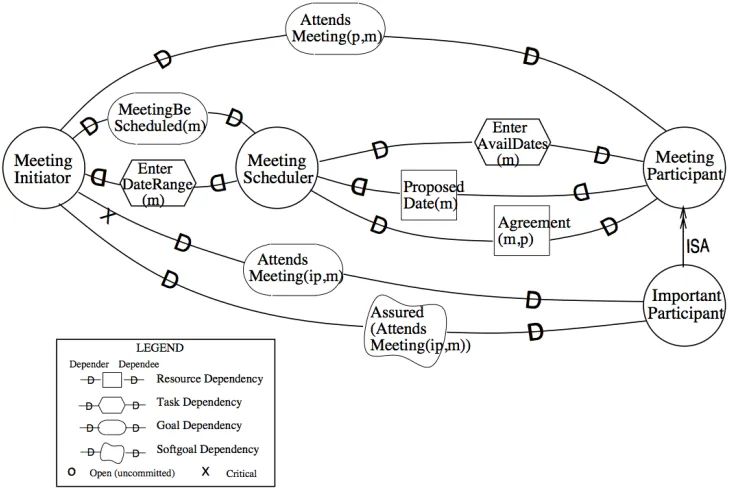
dependencies as abstractions to decompose situations into constituent parts. In this paradigm the structure of a situation is represented as a set of ‘intentional’ actors that depend on other actors to achieve a set of explicit goals and soft-goals. The term ‘intentional’ is used to claim that the actors being modelled have motivations, intentions and rationales that shape their actions (E. Yu et al., 2011). The agent goal decomposition approach as used in I* is primarily a form of structural modelling - although it enables the creation of more sophisticated models that relate behavioural and structural views. Simple I* models comprise actors interacting via four causal dependencies.
[image:30.595.124.490.288.537.2]The four causal dependencies consist of resource dependencies, task dependencies, goal dependencies and soft goal dependencies.
Figure 2.1 - Strategic Dependency model for a meeting (E. S. K. Yu, 1997) A resource dependency illustrates that an actor’s behaviour is causally dependent on another to provide a physical/informational entity (e.g. a desk, a worksheet). For instance in Figure 2.1 we can see that the meeting scheduler is dependent upon the information resource of an agreement on the meeting date, and that the meeting participants are dependent on the meeting scheduler proposing dates for the meeting.
initiator’s goal of scheduling the meeting is dependent upon the meeting scheduler.
A soft goal dependency is where an actor’s behaviour is causally dependent on another to perform some task that meets a soft goal. A soft goal requires context sensitive conditions to be met for the goal to be attained. For example the goal of “attending to patients needs promptly” is a soft goal since the manner in which the activity needs to be performed to meet the criteria is context specific as it may depend on the number of patients vs. staff, the seriousness of patients conditions, the experience of the staff and so on, such that it cannot be specified in a prescriptive manner. In Figure 2.1 we can see that the meeting initiator’s softgoal of being assured that an important participant attends the meeting is dependent upon the important participant.
[image:31.595.103.490.329.653.2]Agent goal decomposition has also been used to help reason about situations via the use of strategic rationale models. These models may be used to represent actors’ reasoning about a situation using logical relations.
Figure 2.2 - A Strategic Rationale model for Youth Counselling Organisation (Horkoff & Yu, 2009)
configurations of activity. This provides a means of analysing the ability of different configurations’ to satisfy the agents’ goals. Granular representations of situations may be constructed using decomposition links (logical relations), which enable a task to be decomposed into components such as sub goals, subtasks, resources for tasks and soft goals for tasks.
Even further granularity may be introduced by introducing concepts that distinguish between agents, roles and positions. In the language of I*, an agent is an actor with a physical manifestation such as a human being. A role is an abstract characterisation of a social actor within a specific context or domain e.g. Counsellor. A position is a set of roles typically played by one agent e.g. a person can simultaneously hold the roles of counsellor, tutor and doctoral student.
Agent goal decomposition provides an interesting candidate approach for representing and analysing SoS. It is a practical approach as it has been used to identify risks / threats. It has also been used to identify system configurations that meet actors’ goal specifications. Within the domain of socio-technical systems, the I* framework has been shown to enable the identification of dependability threats and requirements for air traffic management (ATM) and enterprise systems (Maiden & Jones, 2004; Maiden, Kamdar, & Bush, 2006; Mayer, Dubois, & Rifaut, 2007). In the context of ATM this was achieved by means of exploring the consequences of agents fulfilling two or more roles and whether this affects the system’s overall goal attainment (Maiden & Jones, 2004; Maiden et al., 2006). In the context of enterprise systems, I* has been used to identify threats to security goals by modelling and discovering business assets, constraints and security requirements (Mayer et al., 2007). In these studies, human beings were treated as mere input-output conversion mechanisms and so human needs with respect job satisfaction and group level interactions such as politics were assumed to have no significant influence on the system. These assumptions limit these studies’ relevance to the study of SoS as we may not assume that politics and worker satisfaction has no influence on the SoS.
2010) enables analysts to infer whether a configuration meets actors’ goals, identify configurations that do meet the actors’ goals, and identify aspects of a configuration that result in the failure of goals. This characteristic of the agent goal approach is particularly promising for the analysis of SoS.
Agent goal decomposition has been used to analyse dependencies between actors to ensure the dependence is bidirectional and is thus ‘sustainable’ (Guizzardi, Perini, & Dignum, 2011). Agent goal decomposition has also been used to elicit and explain the dynamics of trust, confidentiality and distrust (Gans, Jarke, Kethers, Lakemeyer, & Schmitz, 2011).
However few studies have analysed the fit between human beings needs for job satisfaction and group level interests such as politics. One notable exception is the work of (Sutcliffe, 2011) that has extended agent goal modelling using complex adaptive systems theory to enable the analysis of power and motivation of actors in a situation. Despite this effort it is unclear whether this approach is scalable as the models produced require a subject matter expert to interpret and apply heuristics. It is also unclear to what extent the predictions of these models correlate with the observed behaviour of individuals or organisations.
More fundamentally it is unclear whether representing situations as interdependent goal-seeking actors is appropriate. The notion of a goal is a modelling construct rather than a notion that people commonly use to describe their working lives. Goals seem to be asocial constructs in that they merely represent states of affairs that an actor intends/desires to achieve, avoid or maintain. They provide little information about the organisational, social or cultural environment that may shape an actors behaviour, not what incentivises some behaviours over others. Perhaps it is unnecessary to capture and represent actor goals. Perhaps what is necessary is an understanding of constructs that shape the kinds of goals that actors pursue so that one may bound the kinds of behaviour actors will pursue without the cost of having to keep up-to-date models of what their goals are. This leads us to discuss agent responsibility decomposition.
2.4.2.2 Agent Responsibility Decomposition
norms captures the fact that responsibilities must be discharged in accordance with legal and domain standards.
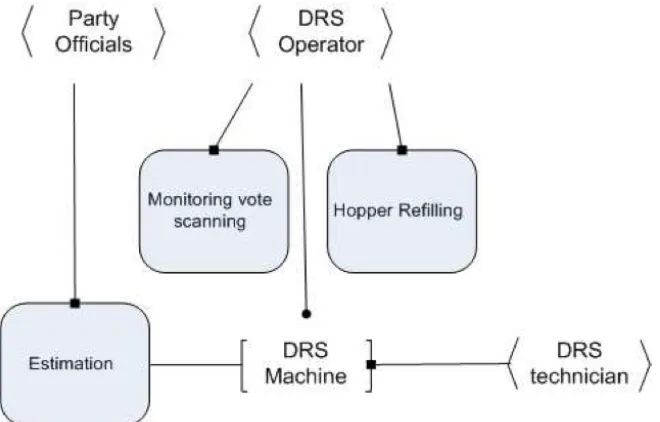
Agent responsibility decomposition is both a structural and behavioural modelling approach. Responsibilities represent units of behaviour that an agent has a duty to perform. Resources represent information or equipment that an agent requires to fulfil a responsibility. Hence a responsibility model is a description of the behaviours that agents have a duty to perform and the resources they require to perform these behaviours.
[image:34.595.134.464.289.500.2]In its simplest form the relationships between agents, resources and responsibilities comprise the ‘responsible for’ relation that denotes that an agent is responsible for the performance of a duty, the ‘has’ relation that denotes the allocation of a resource to an agent or to a responsibility – see Figure 2.3 below.
Figure 2.3 - Responsibility Model of e-Counting System in Scottish Elections (Lock, 2009)
Figure 2.4 - Responsibility Model of Responsibilities during a Civil Emergency (Sommerville, 2009)
The agent responsibility paradigm can be seen as an alternative to the agent goal paradigm as it takes the stance that situations can be understood by understanding factors that provide a social / legal bound on the behaviour of agents, such as obligations and liabilities, rather than framing the agents’ behaviours in terms of explicit goals or soft goals.
The agent responsibility approach has been successfully used by (Lock et al., 2009; Sommerville, Storer, & Lock, 2009) to analyse the failure of an E-counting system in the Scottish elections and to analyse UK civil emergency plans. In the E-counting case, agent responsibility decomposition was used to represent the dependencies between human/organisational agents and resources that were required for the socio-technical e-counting system to operate successfully. The identification and analysis of failures was achieved through the use of a HAZOPS style approach. This comprised considering the implications of hazard keywords on each dependence and identify threats that could emerge should agents renege on their responsibilities, resources fail, or become available too early, too late or in insufficient number (Lock et al., 2009). When used to analyse civil emergency plans a similar HAZOPS approach was used along with a rich set of structural relations to describe the complicated relationships between agents and the assignment of responsibilities.
where responsibilities have not been assigned to agents (Lock et al., 2009; Sommerville et al., 2009).
A drawback of agent responsibility decomposition is that its socio-technical analysis is weak. The agent responsibility approach treats human beings as mere mechanisms for fulfilling responsibilities. It does not consider the fit between assigned responsibilities and the human or organisational agent, or whether an agent would find a responsibility satisfying or otherwise. Equally the approach does not take into account politics, group processes and other factors that can arise when responsibilities are assigned and distributed amongst differing groups. More research is required in this area to determine how these ‘social factors’ could be incorporated into responsibility modelling.
Another drawback of agent responsibility decomposition is that, to date, analyses have assumed that interactions between system parts will not exhibit non-linear properties for instance triggering cascades or forming feedback loops. This limitation is significant as in reality threats can trigger a sequence of events that ripple through a system. More research is required so that the analysis of non-linear behaviour may be incorporated to agent responsibility decomposition approaches. Further research may also be required in exploring how logics or other analytical techniques could be used to improve support for computer-aided analysis of these models.
2.4.3 Information Systems
Insights from the discipline of ‘Information Systems’ (IS) may be relevant to the socio-technical analysis of system-of-systems this is because an ‘information system’ is “the system that emerges from the mutually transformational interactions between the information technology and the organization” (Lee, 2004, p. 11). This means that the discipline of information systems is interested in understanding the relationship between people and information technology at the organisational scale. This suggests that theories and approaches to understanding information systems may be applicable to the modelling and socio-technical analysis of system-of-systems. This section will cover two interesting approaches to the analysis of information systems – cultural-historical activity theory and actor-network theory.
2.4.3.1 Cultural-Historical Activity Theory
or an organisation’s, needs rather than analysing how a human may contribute or hinder the conversion of inputs into outputs. This flipping of the orientation of analysis provides a human-centred analysis of systems.
Central to activity theory is the notion of activity. Activity is the purposeful interaction of a subject (an intentional agent such as a person or an organisation) with the world. Purposeful interaction is defined as a process by which mutual transformations occur between the ‘subject’ and ‘object’ – the ‘object’ of an activity is some prospective outcome that the human or organisation needs or desires.
According to CHAT, activities have hierarchical structures that are composed of three layers.
• Motives - The top most layer is the motive of an activity. A motive is a need or desire that motivates an activity.
• Goals - At the next layer, the action layer, a subject’s goals are the object of analysis. Goals are conscious such that a subject is aware of their existence and that they structure their actions. This is in contrast to motives, which are subconscious unless actively elicited by an individual. For instance, in the mornings I am acutely aware that my goal is to get to a bus stop on time so I can get to work by 9:30am. Because of my awareness of this goal, I structure my actions such that the route I walk to the bus stop and the type of breakfast I prepare in the morning is compatible with attaining this goal.
• Operations - The next layer comprises the operations layer. This is where analysis is directed towards the conditions under which a subject is trying to attain a goal. Operations are routine processes (that require almost no conscious thought) that provide an adjustment to an action due to the ongoing circumstances. A common example of an operation is the avoidance of people whilst walking along a crowded high street. This requires little thought and occurs in the background whilst a person typically focuses on their goals, such as getting to their bus stop on time or posting their mother’s birthday card. In CHAT, a socio-technical system is cast as a mediator of the subject-object relationship. This means the socio-technical system is regarded as something that may facilitate, inhibit, or alter the subject’s abilities to satisfy their various needs. This facilitation, inhibition or alteration is achieved by means of influencing a subject’s operations, goals and motives. For instance the system may provide a means of achieving what was previously unachievable or may prevent previously achievable goals. The system may also have the ability to alter a subject’s operations, goals or motives through a process termed development. Development is the idea that subjects alter their behaviours in response to their experiences. According to CHAT development is a socio-cultural process and therefore to understand the behaviour of subjects it requires an understanding of cultural practices that may influence their development.
unsatisfied. CHAT may be used to analyse whether a subject’s work activity and environment enables them to satisfy their motives.
When an organisation is the subject of study it is treated as socially distributed human activity and so the role of specialisation and the division of labour is given much attention. This is because socially distributed work activity results in actions that are motivated by one object (say the need for food and shelter) but are directed at another (say the goal of writing an excellent textbook).
In modern organisations and society, there can be complex relationships between objects of motivation and objects of action sometimes resulting in disconnections between motivating objects and objects of action, thus resulting in dysfunctional organisational behaviour. These situations can become further complicated by incompatibilities between the motives and goals of the organisation and those of the individuals whom are members of the organisation. Symptoms of this include bureaucracy reigning over common sense and local optimisations at the expense of the organization as a whole. CHAT enables the analysis of these inconsistencies within socio-technical systems.
Figure 2.5 – The structure of human activity systems (Engestrom, 2001) Figure 2.5 provides a schematic of the interactions that occur when a subject performs purposeful activity. It shows that the subject-object relationship is influenced by the tools and signs available in the situation, the formal/informal rules of the situation, the norms/expectations of the community that the subject is a part of, and the way work is divided up in the situation. It also shows that the subject-object relationship mediates the activity that is performed and the interpretation of the outcome of the activity. The diagram is considered to be useful as it highlights aspects of a situation an analyst may want to investigate to identify mediators that encourage behaviour that is inconsistent with a desirable outcome.
Engeström’s framework has been used to analyse a variety of problematic socio-technical systems. For instance it has been used to support the study and organisational redesign of a children’s hospital outpatient clinic (Engestrom, 2000, 2001), understand conflicting goals of judging in legal cases (Engestrom, 1996), studying the problematic nature of inter-organisational partnerships in the construction industry (Hartmann & Bresnen, 2011), and studying the use of technology in a higher education context to support learning (Isssroff & Scanlon, 2002).
managers and patients’ needs. These socio-technical factors are only treated implicitly when hospital staff are brought together to negotiate new ways of working that minimise disturbances / incompatibilities.
In later work (Engestrom, 2001) pluralist views of systems were adopted. The notion of a ‘boundary crossing laboratory’ was developed so that the differing views, for instance of patients, health centre practitioners and hospital practitioners could be aired and discussed. This enabled the attending participants to generate a shared understanding of the interactions between their activity systems and their consequences for patient care. This particular approach is interesting as it uses the conflicting needs and views of participant to drive a resolution that satisfies or at least improves upon the current system.
The drawbacks of this approach are with respect to its scalability. The approach does not appear to be scalable to large situations since representatives from each viewpoint to be considered must be present and attend the boundary crossing laboratory meeting. Another drawback of the approach is that it relies on the participants identifying incompatibilities on the fly during the meeting. This can be troublesome in some situations as expertise and judgement is required to spot subtle incompatibilities between objects. Another limitation arises from the fact that incompatibilities are identified through discussion. This lack of more formal representation of interactions makes systematic analysis more challenging as it is difficult to track the effect of multiple interactions.