Master Thesis
Performance implications of Multiple Team Membership
and the influence of the intuitive cognitive style
Margaretha Beate Maria Gerhard
s2151588
September 20, 2019
Study:
Track:
Master of Science in Business Administration
Double Degree Program together with the TU Berlin
Entrepreneurship, Innovation & Strategy
First supervisor:
Second supervisor:
Supervisor from
the TU Berlin:
Dr. Matthias de Visser
Dr. Michel L. Ehrenhard
Acknowledgments
Abstract
Multiple Team Membership (MTM) describes a situation in which individuals are simultaneously
part of multiple teams. MTM is widely used in the business world and has attracted attention in
theory. Yet, empirical evidence on performance implications of MTM is lacking. Therefore, the aim of this thesis was to examine the relationship between MTM and performance on the team level. In
addition, it was investigated whether this relationship is influenced by cognitive styles. Research on MTM indicated that low to moderate levels of MTM produce positive effects for teams and increase
their performance. High levels of MTM, however, create more negative than positive effects which
leads to a decrease of team performance. Hypothesis 1 thus assumed that MTM and performance have an inverted-U shaped relationship. The theory on cognitive styles led to the assumption that the
intuitive cognitive style enables teams to better cope with some of the challenges that arise from MTM. Hypothesis 2 therefore expected that the inverted U-shaped relationship between MTM and
performance is positively influenced by a team’s preference for the intuitive cognitive style. The hypotheses were tested by hierarchical regression analyses. The dataset used for the quantitative
analysis included 94 new product development teams from Dutch companies operating in
technology-intensive manufacturing industries. In support for Hypothesis 1, the results revealed that the relationship between MTM and performance follows an inverted U-shape. The results further
showed that this inverse U shape only applies to less intuitive teams. Contrary to Hypothesis 2, no significant relationship between MTM and performance for more intuitive teams could be observed.
Research on MTM is enriched by proving that MTM and performance are related in an inverted-U way and that this relationship only applies to less intuitive teams. Based on these findings,
implications for practice are given. Firms are advised, for instance, to monitor their team’s MTM and intervene when the level of MTM no longer matches the team’s capabilities. One way to
determine a team’s tolerance for MTM could be to test its preference for the intuitive cognitive style.
Key words: Multiple Team Membership, teams, cognitive styles, team performance, new product
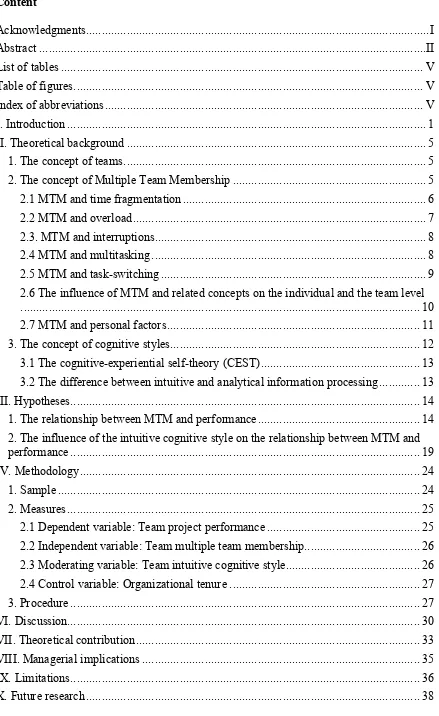
Content
[image:4.595.90.529.76.792.2]Acknowledgments ... I
Abstract ... II
List of tables ... V
Table of figures ... V
Index of abbreviations ... V
I. Introduction ... 1
II. Theoretical background ... 5
1. The concept of teams ... 5
2. The concept of Multiple Team Membership ... 5
2.1 MTM and time fragmentation ... 6
2.2 MTM and overload ... 7
2.3. MTM and interruptions ... 8
2.4 MTM and multitasking ... 8
2.5 MTM and task-switching ... 9
2.6 The influence of MTM and related concepts on the individual and the team level
... 10
2.7 MTM and personal factors ... 11
3. The concept of cognitive styles ... 12
3.1 The cognitive-experiential self-theory (CEST) ... 13
3.2 The difference between intuitive and analytical information processing ... 13
III. Hypotheses ... 14
1. The relationship between MTM and performance ... 14
2. The influence of the intuitive cognitive style on the relationship between MTM and
performance ... 19
IV. Methodology ... 24
1. Sample ... 24
2. Measures ... 25
2.1 Dependent variable: Team project performance ... 25
2.2 Independent variable: Team multiple team membership ... 26
2.3 Moderating variable: Team intuitive cognitive style ... 26
2.4 Control variable: Organizational tenure ... 27
3. Procedure ... 27
VI. Discussion ... 30
VII. Theoretical contribution ... 33
VIII. Managerial implications ... 35
IX. Limitations ... 36
List of tables
Table 1: Descriptive statistics and correlations (whole sample) Fehler! Textmarke nicht definiert. Table 2: Results of hierarchical regression analysis of H1 (Based on Model Summary and ANOVA tables) ... Fehler! Textmarke nicht definiert. Table 3: Results of hierarchical regression analysis of H1 (Based on coefficients table) ... Fehler! Textmarke nicht definiert.
Table 4: Descriptive statistics and correlations (Group 1) ... Fehler! Textmarke nicht definiert. Table 5: Descriptive statistics and correlations (Group 2) ... Fehler! Textmarke nicht definiert. Table 6: Results of hierarchical regression analysis of H2: Group 1 (Based on Model Summary and ANOVA tables) ... Fehler! Textmarke nicht definiert. Table 7: Results of hierarchical regression analysis of H2: Group 1 (Based on coefficients table) ... Fehler! Textmarke nicht definiert. Table 8: Results of hierarchical regression analysis of H2: Group 2 (Based on Model Summary and ANOVA tables) ... Fehler! Textmarke nicht definiert. Table 9: Results of hierarchical regression analysis of H2: Group 2 (Based on coefficients table) ... Fehler! Textmarke nicht definiert.
Table of figures
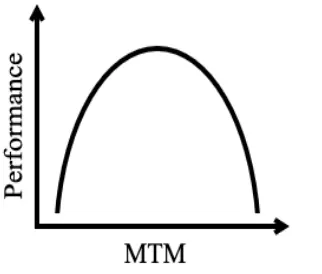
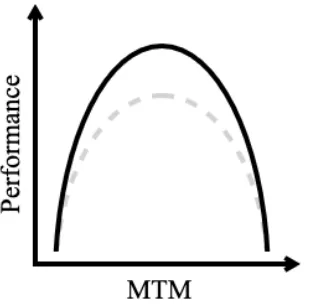
Figure 1: The inverted U-shaped relationship between team MTM and team performances ... 19 Figure 2: The inverted U-shaped relationship between team MTM and team performance with (black slope) and without (grey slope) a strong team preference for the intuitive cognitive style ... 23
Index of abbreviations
MTM NPD SPSS i.e. e.g.
Multiple Team Membership New Product Development
Statistical Package for the Social Sciences id est
exempli gratia
R&D Research & Development H1 Hypothesis 1
I. Introduction
Teams are an essential part of companies and central to their learning and effectiveness (Senge, 1990,
p. 236; Wilson, Goodman, & Cronin, 2007, p. 1041). They are interdepending, socially interacting units that perform organizationally relevant tasks (Kozlowski & Bell, 2003, p. 334; Maynard,
Mathieu, Rapp, & Gilson, 2012, p. 342). Organizations rely on teams because they allow them to
distribute high workload and, most importantly, to accomplish complex and difficult tasks that require a diverse set of experts working together (Paulus & Kohn, 2012, pp. 334; Mathieu, Heffner,
Goodwin, Salas, & Cannon-Boewers, 2000, p. 273; Wilson et al., 2007, p. 1051; Salas, Cooke, & Rosen, 2008, p. 540). Members of a team are equipped with different knowledge, skills and
information (Van der Vengt & Bunderson, 2005, p. 532). By retrieving and linking their various
information and different types of knowledge, teams can develop better or even new approaches to solve problems or to perform their tasks (Liang, Moreland & Argote, 1995, p. 385; Gilson & Shalley,
2004, p. 454). Aside from this, members have different perspectives and ideas, and through both interaction and cross-fertilization of their ideas, even innovations can emerge (Van der Vengt &
Bunderson, 2005, p. 534; Van der Vengt & Bunderson, 2005, p. 543; Paulus & Kohn, 2012, p. 328).
For this reason, teamwork plays an important role particularly for knowledge intensive industries where it accounts for up to 80% of an employee’s work (Lansmann & Klein, 2018, p. 14).
All of these described characteristics of teams make them important organizational assets, especially
in the fast-paced and increasingly complex business world in which companies operate nowadays (Salas et al., 2008, p. 540). The technical progress as well as globalization have been changing
business requirements for all industries and pressure firms to react quickly and remain flexible
(Tannenbaum, Mathieu, Salas, & Cohen, 2012, p. 3; Wageman, Gardner, & Mortensen, 2012, p. 301; Edmondson & Nembhard, 2009, p. 124). To deal with changes and trends, the team approach is
chosen by many companies (Mathieu et al., 2000, p. 273; Paulus & Kohn, 2012, pp. 334). Temporary teams, for example, allow firms to remain agile, and new product development (NPD) teams enable
firms to develop products in an interdisciplinary and faster manner (Tannenbaum et al., 2012, p. 3;
Edmondson & Nembhard, 2009, pp. 124).
Just like the business environment, the nature of collaboration and the original perception of teams have been changing (Wageman et al., 2012, p. 301; Tannenbaum et al., 2012, p. 3; Maynard et al.,
2012, p. 342). Teams do not necessarily have strict boundaries anymore and new technological communication means allow group members to collaborate geographically dispersed (Cummings &
organize their work and to keep up with the dynamism and complexity of today’s business
environment (Cummings & Haas, 2012, p. 316; O’Leary, Woolley, & Mortensen, 2011, p. 461; Berger, 2018, para 6; Maynard et al., 2012, p. 343; Chan, 2014, p. 76). Already in 2007, Mortensen,
Woolley and O’Leary found that 65% of the 401 professionals they surveyed worked in more than
one team at a time (p. 218). Given the increasing technical complexity and developments since 2007, it is very likely that this percentage is much higher today.
Taken together, the importance of teams for companies has increased as a result of the more dynamic
and challenging business environment. Teams are influenced by the environment they operate in, and when the environment changes, so does their interaction (Wilson et al., 2007, p. 1055). MTM is
used as a method by companies to assert themselves in this ever changing environment (Maynard et
al., 2012, p. 343; Chan, 2014, p. 76). However, it is conceivable that MTM itself additionally influences the environment by creating new challenges and more ambiguities, and consequently
influences team processes and outcomes. Gaining an understanding of the phenomenon is important for scholars and practitioners to deduce how to handle MTM correctly in order to avoid any negative
effects (Pluut, Curseu, & Flestea, 2014, p. 333; O’Leary et al., 2011, p. 474). In particular, companies
need to understand how MTM impacts the performance of their teams. This knowledge will enable them to achieve the desired beneficial effects of MTM as well as to develop tactics of how to overcome potential negative effects of MTM.
Research on teams has already collected many insights into team performance, as for example how
it is measured and promoted (Salas et al., 2008, p. 540). Despite its increasing prevalence at work, MTM however has not gained enough attention by research since most of it focused on members who are part of only one group at a time (Higgins, Weiner, & Young, 2012, p. 384; Mortensen,
Woolley, & O’Leary, 2007, p. 215). The discrepancy between developments in practice, in which
MTM is adopted by many companies, and the theory has been stressed by many scientists in the past (e.g. Pluut et al., 2014, p. 343, Wageman et al., 2012, p. 301). A few scientists responded to the call
and investigated the effects of MTM on individuals and teams. Bertolotti, Mattarelli, Vignoli and Maria Macri (2015), for example, studied the impact of MTM on team performance and found that,
depending on its level, MTM can have both positive and negative effects (p. 918). Other authors,
such as O'Leary et al. (2011), examined the impact of MTM on performance only in theory without providing empirical evidence for their propositions (p. 468). Overall, there is still too little knowledge
and not enough empirical evidence on implications of MTM in general, and implications of MTM on performance in particular (Yao & Robert, 2017, p. 8; Mathieu, Maynard, Rapp, & Gilson, 2008,
caused by assigning individuals to many teams may be offset by resulting negative effects, cannot
be adequately answered (Mathieu et al., 2008, p. 442; Wageman et al., 2012, p. 309).
Another understudied domain is the influence of personality on the relationship between MTM and
performance. Some authors already expressed the need for future research on the relation between individual factors and concepts that are closely related to MTM. Bertolotti and colleagues (2015),
for example, find that the impact of individual differences in time management on the MTM-performance relationship should be investigated (p. 922). The concept of time management is
important for the understanding of MTM and the same is true for multitasking. Therefore, Altschuller and Benbunan-Fich (2017), who put MTM and multitasking into an integrated perspective, call
future scientists to examine what cognitive decisions individuals make when it comes to situations
that require multitasking (p. 11). Next to them, Akinci and Sadler-Smith (2013) express their interest in an investigation of cognitive styles on the ability to multitask (p. 219). Besides, O’Leary et al.
(2011) suggest research on employee skills that could benefit MTM (p. 471).
Research has proven that personality affects team outcomes. Bradley and Hebert (1997), for example,
found that team composition of personality types explains variances in team performance (p. 350). An analysis by Barrick, Stewart, Neubert and Mount (1998) shows that conscientious teams and high cognitive-ability teams have a higher performance than teams that are less conscientious and lower
in cognitive ability (p. 387). Several studies (e.g. Barrick & Mount, 1991; Reilley, Lynn, & Aronson,
2002; Peeters, Van Tuijl, Rutte, & Reymen, 2006) investigated performance implications of
personality in terms of the big five (i.e. five personality traits including openness, stability, agreeableness, conscientiousness, and extraversion-introversion) (Reilley et al., 2002, p. 41). Some other researchers gathered insights about the impact of the cognitive style, which represents another
personality construct (Witkin, Moore, Goodenough, & Cox, 1977, p. 15; Sadler-Smith, 2004, p. 165).
De Visser, Faems, Visscher and De Weerd-Nederhof (2014) were among the first to study how cognitive styles affect team performance of NPD teams and they demonstrate that a preference for
the analytical cognitive style positively relates to project performance of both incremental and radical NPD projects (p. 1174). Findings from Sadler-Smith (2004) reveal that the intuitive cognitive style
has a positive association with performance (p. 174) and Fuller and Kaplan (2004) found that the
performance of specific tasks can be enhanced by the cognitive style - analytical people, for instance, perform analytical tasks better than intuitive people do (p. 141).
Hence, the cognitive style impacts team outcomes but it has not been studied whether it also has an
effect on the relationship between MTM and performance. People who differ in their cognitive style also seem to differ in how they deal with their external environment (Witkin et al., 1977, p. 4; Priola,
which people find themselves. Thus, it is conceivable that cognitive styles influence the way people
handle their simultaneous team memberships, and that this in turn affects the outcomes of their teams. Yet, there are no studies with any evidence to prove this assumption. To conclude, there is a clear
lack of research on the effects of cognitive style on the relationship between MTM and performance.
Following the repeated calls for further research on the impact of MTM on performance and the
obvious research gap of how personality factors affect the relationship between MTM and performance, the aim of this thesis is to investigate the relationship between MTM on performance
and whether this relationship is influenced by cognitive styles. Specifically, it is hypothesized that team MTM has an inverted U-shaped relationship with team performance1. Hence, MTM is
suspected to have a positive relationship with performance but only until a certain point after which
a further increase in MTM impacts performance negatively as the benefits derived by MTM are outweighed by its disadvantages. Furthermore, this thesis focuses on the intuitive cognitive style. It
is suggested that the intuitive cognitive style positively influences the inverted-U relationship between MTM and performance on the team level. That is, under the event of MTM, teams with a
higher preference for the intuitive cognitive style perform slightly better than those who have a lower
preference for the intuitive cognitive style. Accordingly, this thesis is guided by the following research question: How are team MTM and team performance related and how does the intuitive cognitive style influence this relationship?
In order to study the impact of MTM on performance as well as to study the influence of the intuitive
cognitive style, this research analyses survey data from 295 individual team members of 94 teams gathered from Dutch companies. The results reveal that MTM and performance are in an inverted U-shaped relationship. A comparison between less intuitive and more intuitive teams however shows
that the inverted U-shaped relationship between MTM and performance holds true only for less
intuitive teams while the performance of more intuitive teams is not significantly affected by MTM.
By answering the research question, insights about the relationship between MTM and performance are given, and the growing body of research that aims to understand how psychological factors
influence work outcomes is enriched by including cognitive style in the analysis of the relationship
between MTM and performance. The results also allow practitioners to draw concrete conclusions about how to deal with MTM, as well as to tailor the management of MTM to the cognitive style of
their employees and teams, ultimately increasing the performance of their teams.
The thesis is structured as follows: First, the theoretical background of MTM and cognitive styles is
given. Based on the theoretical background and valuable findings from studies in this area, which are presented briefly, two hypotheses are developed. Thereafter, the methodology part is provided
containing a description of the sample used to test the hypotheses, an overview of the measures and
the results of the statistical analyses. The results are followed by the discussion section, in which the findings are analysed and interpreted on the basis of the hypotheses. Against this background,
theoretical contribution and managerial implications are derived. The thesis ends with possible limitations of the study, recommendations for future research and a conclusion.
II. Theoretical background
1. The concept of teams
A team is "a distinguishable set of two or more people who interact dynamically, interdependently,
and adaptively towards a common and valued goal/objective/mission, who have each been assigned specific roles or functions to perform, and who have a limited life-span of membership" (Salas,
Dickinson, Converse, & Tannenbaum, 1992, p. 4). Teams may differ regarding their composition, size and structure but are usually embedded in an organizational context in which they engage in
exchange relationships with other units (Paulus & Kohn, 2012, p. 328; Kozlowski & Bell, 2003, p. 334). A collection of individuals with particular roles, interdependent relations with another, and
whose identity can be recognized by the external environment, can be referred to as a “group”
(Alderfer, 1977, p. 320). Since the definitions of the two terms, ‘team’ and ‘group’, are quite similar, research using the term ‘group’ was considered in the literature review as well.
In many definitions of either groups or teams, boundaries are mentioned. Clear boundaries ensure
that members and non-members can be distinguished by both insiders and outsiders of the team.
Hence, they provide clarity about who is on the team, and therefore allow for accountability (Hackman & Katz, 2010, p.4; Hackman, 2012, p. 437; Mortensen & Haas, 2018, p. 342). In contrast to that, Wageman et al. (2012) recognize that clear and stable bounded memberships are increasingly
rare in teams. Therefore, they question whether boundaries are still one of the defining characteristics
for teams (p. 305).
2. The concept of Multiple Team Membership
As outlined above, teams, perceptions of teams and their use have been changing and companies
which describes the situation where an individual is part of more than one team at a time (O’Leary
et al., 2011, p. 461; Berger, 2018, para 6; Chan, 2014, p. 76).
2.1 MTM and time fragmentation
“MTM work environments by definition involve people splitting their time across multiple teams”
(Mortensen et al., 2007, p. 216). A person who is a member of multiple teams at the same time cannot invest the same amount of time in a team like someone who has only one team membership
(Espinosa, Cummings, Wilson, & Pearce, 2003, p.179). Thus, he or she has to allocate his or her limited working time among those teams. Specifically, this means that an increase in time spent in
one team goes along with the reduction of time spent in another team (O’Leary et al., 2011, p. 464). The way time is shared between teams varies from person to person. For example, some may spend
70% of their time in one team and 10% in each of the other three teams, while others may prefer an
even time distribution between their teams (Tannenbaum et al., 2012, p. 8). It was found that fragmentation of time across teams positively affects job strain by increasing teamwork related job
demands (Pluut et al., 2014, p. 342). In addition, fractional team assignment influences the degree to which people feel connected to their teams (Shore & Warden, 2007, p. 39). Espinosa et al. (2003)
note that time spent in a team matters for how strong one identifies with it and that members who
always only spend part of their time in a team have difficulties in defining their many identities (p. 176; p. 179). Therefore, allocating time is demanding for individuals with MTM. The demands are even higher when appointments in different teams overlap (Altschuller & Benbunan-Fich, 2017, pp.
3). Besides, the way people with MTM distribute their time depends on their fellow team members,
whom they have to arrange with and possibly adjust their actions to (Pluut et al., 2014, p. 337).
In addition to the individual level, members’ time allocation shows effects on the team level. How much time, and thus attention, individuals give to their teams impacts the teams’ processes,
functioning and effectiveness (Tannenbaum et al., 2012, p. 8; Maynard et al., 2012, p. 347). Time
influences cognitive processes such as the development of team mental models. A mental model is defined as a "mechanism whereby humans generate descriptions of system purpose and form,
explanations of system functioning and observed system states, and predictions of future system states" (Rouse & Morris, 1986, p. 360). In a team context, members should develop a shared mental
model, so they can effectively adapt to the team. A team member model contains information about
each member (such as their abilities and preferences) so that each member’s behaviour can be better predicted, and others can align their actions to it (Mathieu et al., 2000, p. 274). Thereby, chances to
experience process losses (i.e. a situation in which people do not direct their resources towards the fulfilment of the group task) can be reduced (Zaccaro & Lowe 1988, p. 548; Mathieu et al., 2000, p.
p. 878; Mathieu et al., 2000, pp. 279). In order to align team members’ mental models within the
team and finally develop a common team membership model, teams have to coordinate their action and dedicate time (Mortensen, 2014, p. 915; Mohammed et al., 2010, p. 878). For a person with
many team memberships, however, opportunities to engage in the process of aligning mental models
are limited (Mortensen, 2014, p. 916).
Furthermore, time plays a decisive role for trust, because it takes time to develop trust in a team (Chung & Jackson, 2013, p. 441). Trust is “the willingness of a party to be vulnerable to the actions
of another party based on the expectation that the other will perform a particular action important to the trust, irrespective of the ability to monitor or control that other party” (Mayer, Davis, &
Schoorman, 1995, p. 712) and it was found that the degree of internal trust relationship strength in
internal networks of teams (i.e. networking relationships among people within a team (Chung & Jackson, 2013, p. 443)) has an inverse-U relationship with team performance (Chung & Jackson,
2013, p. 457).
Generally, teams whose members are part of several other teams have more difficulties at aligning
members’ blocks of time (O’Leary et al., 2011, p. 468). Because of this coordination challenge, teamwork processes become more effortful and a team’s productivity can suffer (Pluut et al., 2014, p. 337; Mortensen et al., 2007, p. 219; O’Leary et al., 2011, p. 465). Some researchers assume that
the total work effort caused by the necessity to coordinate is higher when individuals have multiple
team memberships instead of just having one (Crawford, Reeves, Stewart, & Astrove, 2019, p. 345).
A study by Cummings and Haas (2012) also proves that time allocation has an impact on performance. The authors found a positive relationship between time allocation and performance (Cummings & Haas, 2012, p. 331). Hence, spending more time on a team benefits a team’s
performance, but the percentage of time members spend on the team task was found to be negatively
affected by their MTM (Mortensen, 2014, p. 923).
2.2 MTM and overload
In addition to time fragmentation, MTM can lead to overload and thereby affect both individuals and their teams. Many memberships and associated time pressure create a lack of opportunities to calm
down and to reflect on certain matters (Zika-Viktorsson, Sundström, & Engwall, 2006, pp. 390).
High work demands stemming from MTM combined with little slack time impact individuals negatively (Crawford et al., 2019, p. 344). A lack of recuperation opportunities not only reduces the
possibility for reflection which is essential for learning but also leads to project overload, and project overload impacts performance negatively (Pluut et al., 2014, p. 335; Zika-Viktorsson et al., 2006, p.
worst-case scenario, even burnout. As a consequence, an individual’s contribution to and
effectiveness for the team is impacted (Pluut et al., 2014, p. 339; Tannenbaum et al., 2012, p. 10; Wageman et al., 2012, p. 309).
2.3. MTM and interruptions
Due to the coordination challenges caused by MTM which are mentioned above, teams have to make plans in accordance to their members’ time allocation decisions. However, spontaneous events can
occur which lead to interruptions and disturb teams’ schedules (Perlow, 1999, p. 65). Generally, MTM increases the risk for interruptions (Cummings & Haas, 2012, p. 322) which are defined as
“(…) temporary suspension(s) of a person’s goal-directed action” (Brixey, Robinson, Johnson, Johnson, Turley, & Zhang, 2007, p. E30). When someone actively decides to take a break from the
current task, for example, one refers to it as an internal interruption. In contrast to that, an external
interruption is not self-initiated (Kirchberg, Roe, & Van Eerde, 2015, p. 116).
Individuals who face frequent interruptions because they engage in multiple tasks (as in the case of MTM) may benefit from information gains, but they also experience time losses. Owing to these
time losses, individuals have fewer opportunities to recover from their high workload that result from
these multiple tasks (Baethge, Rigotti, & Roe, 2015, p. 317). Periods of recovery, however, are necessary to prevent persons who engage in multiple activities from overstrain and depletion of their resources (Baethge et al., 2015, p. 314; Baethge et al., 2015, p. 317). Baethge et al. (2015) propose
that being exposed to interruptions for a long time can have negative effects on performance (p. 317).
In fact, the authors assume that cumulative interruptions (i.e. an increasing number of interruptions
in a certain time period) lead to an inverted U-development of performance (Baethge et al., 2015, p. 317). Likewise, Adler, Adepu, Bestha and Gutstein (2015) state that individual performance can be reduced by an increasing number of interruptions and tasks (p. 5461). In any case, interruptions lead
to task-switching, hence, multitasking (Jeuris & Bardram, 2016, p. 407; Benbunan-Fich, Adler, &
Mavlanova, 2011, p. 2).
2.4 MTM and multitasking
Multitasking represents “the act of switching between multiple tasks or doing them simultaneously” (Altschuller & Benbunan-Fich, 2017, p. 11). Accordingly, multitasking encompasses both
simultaneous activities, where two or more tasks are performed at the same time, and interleaved
strategies, where one task is put aside in order to pursue another one (Adler & Benbunan-Fich, 2012, p. 157; Kirchberg et al., 2015, p. 113). In an extreme form of the latter strategy, the sequential mode,
People who are involved in multiple teams at the same time have to manage a high number of
project-related activities (Altschuller & Benbunan-Fich, 2017, p. 12). They constantly switch between teams; sometimes even daily, thus, they need to multitask (Altschuller & Benbunan-Fich, 2017, p. 6;
Mortensen et al., 2007, p. 219). In a situation in which an individual with MTM faces tight deadlines
in several of his or her teams, the level of multitasking even increases because he or she has to respond to several urgent requirements at the same time (Altschuller & Benbunan-Fich, 2017, p. 11).
Furthermore, the amount of switching is higher, the more teams a person belongs to (Bertolotti, Mortensen, Mattarelli, & O’Leary, 2013, p. 4). It is less likely that people with MTM can attend a
team’s task from the very beginning until the very end but more likely that they constantly leave unfinished tasks in one team for performing tasks in another team. Hence, they switch among tasks.
Task-switching is considered as a multitasking paradigm representing the middle between
simultaneous multitasking and the sequential mode (Altschuller & Benbunan-Fich, 2017, p. 4; Benbunan-Fich et al., 2011, p. 3; Payne, Duggan, & Neth, 2007, pp. 373). Therefore, even if
multitasking and MTM are separate concepts, they have several overlaps and many of the implications of multitasking are applicable to MTM as well (Altschuller & Benbunan-Fich, 2017, p.
6; Pluut et al., 2014, p. 335). This thesis follows the considerable number of authors who studied
MTM and included multitasking or task-switching in their considerations and hypothesis development (e.g. Bertolotti et al., 2013; Chan, 2014; O’Leary et al., 2011).
2.5 MTM and task-switching
Task-switching means shifting attention from one to another task. This process represents a challenge
itself and it is more severe in a case of MTM where one switches between projects, thus, a high
number of tasks (McDonald, DeChurch, Asencio, Carter, Mesmer-Magnus, & Contractor, 2015, pp. 1157). Multitasking requires multiple goal orientation (Benbunan-Fich et al., 2011, p. 6). Projects have unique characteristics and goals and because of that switching requires refocusing which in turn
costs time (Adler & Benbunan-Fich, 2012, p. 165; Patanakul & Milosevic, 2008, pp. 225). The fact
that switching becomes more difficult when working on multiple heterogeneous projects is also reported by an informant in a study by Bertolotti et al. (2015) who notes “(…) It’s impossible to
manage well so many projects of different kinds! Some projects need concentration; the others need availability!” (p. 919). Besides time costs, individuals who have to constantly re-engage with new
tasks pay a cognitive price. Frequent switching can, for instance, consume members’ attention and
lead to a lack of focus as well as to a reduction of cognitive resources available for task performance (Payne et al., 2007, p. 371; Waller, 2007, p. 244; Zika-Viktorsson et al., 2006, p. 388; Yao & Robert,
2017 p. 5). Switching costs increase when tasks are complex and diverse and are said to impact individual performance negatively (Bertolotti et al., 2013, p. 6). Besides, it was found that switching
residue which “reflects the persistence of cognitive activity about a Task A even though one stopped
working on Task A and currently performs a Task B.“ (p. 169). Her study’s results reveal that individuals who leave a task unfinished experience more attention residue and lower subsequent task
performance compared to those who are able to complete the first task before transitioning to the
next (Leroy, 2009, p. 178).
The concept of multitasking (including task switching) and its consequences, particularly for performance, have attracted attention in science. Mainly negative consequences of multitasking are
reported by the majority of researchers. Richter and Yeung (2012), for instance, found that task switching harms current performance, because it reduces memory for task-relevant items while
improving memory for task-irrelevant ones (pp. 1261). The study of Kirchberg et al. (2015), in which
93 employees rated their performance and well-being over a period of five consecutive workdays, reports negative relationships between daily multitasking and daily performance and between
day-level multitasking and well-being in the evening (p. 121; p. 130). The findings from the study of Goes, Ilk, Lin and Zhao (2018), which investigated the customer service, demonstrate that even
though multitasking led to an increase of productivity because employees were able to process more
customer inquiries in the same time, quality suffered. The authors suspect that due to the bad quality even more customer demands might be created in the long run (Goes et al., 2018, pp. 3052). In their paper from 2012, Adler and Benbunan-Fich found that an increase of multitasking benefits
performance but only until a certain point after which any more multitasking negatively affects
performance (p. 157). Therefore, productivity is best at medium levels of multitasking activity (Adler
& Benbunan-Fich, 2012, p. 166). According to the authors, multitasking leads to higher levels of arousal, which means that time is better utilized, individuals are more involved in their task and additional cognitive resources are mobilized. Thereby, better productivity can be reached. However,
too much multitasking can result in a situation of cognitive overloading, in which one’s memory is
negatively affected by the amount of task switching and interfering (Adler & Benbunan-Fich, 2012, p. 159; Adler & Benbunan-Fich, 2012, pp. 165; Adler & Benbunan-Fich, 2012, p. 167). Next to these
predictions, the authors could further show that any increase of multitasking only has negative effects for accuracy, hence, performance effectiveness (Adler & Benbunan-Fich, 2012, pp. 166).
2.6 The influence of MTM and related concepts on the individual and the team level
In summary, MTM is a concept that can be linked to some other concepts such as multitasking or team mental models. By linking these concepts, effects of MTM become more obvious. First, more
memberships lead to a decrease of time available, which has an impact on the individual and the team level. At the individual level, this time fragmentation, among other things, influences
2007, p. 216; O’Leary et al., 2011, p. 464; Altschuller & Benbunan-Fich, 2007, pp. 3). At the team
level, time fragmentation forces teams to coordinate and plan more as they have to align their members’ schedules. This process is effortful and can harm a team’s performance (O’Leary et al.,
2011, p. 468; Pluut et al., 2014, p. 337; Mortensen et al., 2007, p. 219; O’Leary et al., 2011, p. 465).
Besides, members who spend less time together find it more difficult to develop both trust and team mental models (Chung & Jackson, 2013, p. 441). Moreover, MTM leads to overload since it
eventually decreases both cognitive resources and opportunities available to reflect and to recover (Pluut et al., 2014, pp. 334; Zika-Viktorsson et al., 2006, pp. 390). Individuals and teams with MTM
also experience more interruptions, and MTM forces them to multitask as they have to switch tasks and teams often (Cummings & Haas, 2012, p. 322; Jeuris & Bardram, 2016, p. 407; Benbunan-Fich
et al., 2011, p. 2). Findings suggest that some level of MTM is beneficial (e.g. by leading to higher
levels of arousal), but too much MTM negatively impacts performance (e.g. by creating cognitive overload) (Payne et al., 2007, p. 371; Waller, 2007, p .244; Zika-Viktorsson et al., 2006, p. 388; Yao
& Robert, 2017 p. 5). The insights gained in this theoretical part on the influence of MTM on performance and performance-influencing factors are used for the development of the hypotheses in
chapter III.
2.7 MTM and personal factors
In many cases where scientists investigated the effects of MTM or the effects of concepts related to MTM, it has been suggested that personal factors might also play a role. Van de Brake, Walter, Rink,
Essens and Van der Vegt (2016), for instance, suggests that personality traits might help employees
with an increasing MTM to overcome resulting challenges as well as to use possibly resulting
opportunities (p. 1229). Besides, qualitative research about MTM and multitasking which was conducted and interpreted by Altschuller and Benbunan-Fich (2017), leads the authors to the assumption that “perhaps the choice of how multitasking occurs is a cognitive decision that, along
with individual skills, determines the impact of the multitasking on outcomes” (p. 11). Next to them,
Adler and Benbunan-Fich (2012), who studied the impact of multitasking on performance, find that an inclusion of personality or cognitive styles would be a logical expansion to their framework (p.
167). There is a widespread belief that some individuals have a higher preference for multitasking than others. Waller (2007), for example, assume that polychronicity which describes a “preference
for doing more than one thing at a time” (Francis-Smythe & Robertson; 2003, p. 308) positively
impacts the ability to multitasking (Waller, 2007, p. 244). On top of that, Bertolotti et al. (2013) find that preferences for and abilities in multitasking are meaningful moderators when studying
To conclude, literature suggests that personality may impact the way multiple simultaneous
commitments are handled and call for more research in that regard (e.g. Adler & Benbunan-Fich, 2012, p. 167; Baethge et al., 2015, p. 320; Altschuller & Benbunan-Fich, 2017, p. 11). Because of
these signals from literature, this thesis includes individual differences in personality when analysing
performance implications of MTM. Specifically, it is investigated how cognitive styles, which are considered a personality dimension (Witkin et al., 1977, p. 15; Sadler-Smith, 2004, p. 165), impact
the relationship between MTM and performance. For this reason, theories and findings on literature about cognitive styles are introduced below.
3. The concept of cognitive styles
“Cognitive styles are concerned with the form rather than the content of cognitive activity” (Witkin et al., 1977, p. 5) and are considered as features of personalities which might be possible to alter, but
are generally stable over time (Witkin et al., 1977, p. 15; Miller, 1991, p. 231; Messick, 1976, p. 5;
Sadler-Smith, 2004, p. 165). Due to their different perceptual and intellectual activities, individuals approach situations and their external environments differently (Witkin et al., 1977, p. 4; Priola et
al., 2004, p. 568). Cognitive styles represent individual preferences in how experience and information are organized and processed, including how information is acquired, stored and
transformed (Ho & Rodgers, 1993, p. 103). The different cognitive styles matter for example when individuals perform tasks and for the problem-solving process, in which context they are therefore
often mentioned (e.g. Priola et al., 2004, p. 569; Fuller & Kaplan, 2004, pp. 131; Sadler-Smith, 2004, p. 155). The influence of cognitive styles “extends to almost all human activities that implicate
cognition, including social and interpersonal functioning” (Messick, 1976, p. 5). Accordingly,
cognitive styles are also concerned with the way people relate to others and they likely affect individuals’ behaviour in teams (Witkin et al., 1977, p. 15; Armstrong & Priola, 2001, p. 290). The
concept of cognitive style has been studied from different perspectives and the dual processing theory posits that there are at least two processing styles (Priola et al., 2004, p. 568; Salas, Rosen, &
DiazGranados, 2010, p. 946). Even though the taxonomies of the two modes of processing vary in
literature, they have in common that both present systems of information processing. System 1, the intuitive system, works rather fast, holistic and unconscious and System 2, which is the conscious
deliberative system, works slower, more cognitively effortful and conscious (Akinci & Sadler-Smith, 2013, p. 212; Sales et al., 2010, p. 944). Humans use both systems for decision-making, but it has
been found that they have a tendency to either rely on the analytical or the intuitive system (Sales et al., 2010, p. 949; Dane & Pratt, 2007, p. 48; Sales et al., 2010, p. 946). Evans (2003) summarizes
dual-process theories as “two minds in one brain” (p. 454). Indeed, many researchers suggest that
differences in cognitive styles are caused by differences between the left/ right hemispheric specialization of the brain (e.g. Riding & Pearson, 1994; Allinson & Hayes, 1996; Doktor, 1978;
1989), whereby logical thought mainly results from the left hemisphere and simultaneous integration
of inputs and synthesis from the right hemisphere (Allinson, Armstrong, & Hayes, 2001, p. 203). It is assumed that, depending on the environmental context, one of the cognitive styles is more
appropriate than the other (Sadler-Smith, 2004, p. 157). Olson (1985), for example, examined
entrepreneurial activities in terms of the two thinking modes (p. 25). The author proposes that right-hemispheric processing matters in the beginning of the entrepreneurial process where individuals
engage in creative activities and idea-thinking (Olson, 1985, p. 28). Beyond the status quo, ideas have to be assessed rationally and plans have to be developed, and for that, the left-hemispheric
processing is important (Olson, 1985, p. 29).
3.1 The cognitive-experiential self-theory (CEST)
One of the theories belonging to dual-processing theories is CEST, the cognitive-experiential
self-theory, which is a “global theory of personality” (Epstein, 1994, p. 710). CEST differentiates between two modes of information processing: the experiential and the rational system, which are
independent from another rather than distributed along a bipolar continuum (Epstein, Pacini, Denes-Raj, & Heier, 1996, p. 401; Hayes, Allinson, Hudson, & Keasey, 2004, p. 270). The experiential
system, which results in intuitive thinking, is preconscious, rapid, holistic and associative (Epstein,
2012, p. 95; Armstrong, Cools, & Sadler-Smith, 2012, p. 252) and “a source of intuitive wisdom and creativity” (Epstein, 1994, p. 715). In contrast to that, the rational system is conscious, relatively slow, intentional and affect-free (Epstein, 2012, p. 95; Armstrong et al., 2012, p. 252) and leads to
analytical thinking which is “capable of very high levels of abstraction” but “a very inefficient system
for responding to everyday events” (Epstein, 1994, p. 715). The two systems operate by different
rules – the former by abstract, general ones guided by analysis and logic and the latter by context-specific, heuristic rules, but both influence the individual’s behaviour (Epstein et al., 1996, p. 401). This work focuses on CEST and, in line with authors like De Visser et al. (2014), examines cognitive
styles in terms of ‘intuitive and analytical information processing’ (p. 1169). Nonetheless, articles
using other terminologies like ‘field dependent’ and ‘field independent’ (e.g. Witkin et al., 1977; Armstrong et al., 2012) or ‘intuitive synthesis’ and ‘rational analysis’ (Khatri & Ng, 2000) are also
considered for the literature review as long as they are related to dual-processing theories and the descriptions are similar to those of ‘intuitive information processing’ and ‘analytical information
processing’ respectively.
3.2 The difference between intuitive and analytical information processing
As previously outlined, individuals tend to either engage more in intuitive or analytical information
processing2
Intuitive individuals are said to be optimistic, but also naïve, impulsive and tend to engage in unrealistic, irrational thinking (Epstein et al., 1996, p. 395; Epstein et al., 1996, p. 402; Evans, 2008,
p. 257). They do not conform to prevailing ideas easily and their positive mindsets make them think
beyond boundaries (Armstrong & Priola, 2001, pp. 287). Persons with this cognitive style feel most comfortable in less structured environments (Armstrong & Priola, 2001, p. 304). Work settings can
benefit from them, because they often develop unique products. By contrast, products created by people with a high analytical tendency are well-crafted, logical and useful (Puccio, Treffinger, &
Talbot, 1995, p. 157). In general, analytical individuals are characterized by a pronounced logical, reflective and rational way of thinking and a preference for structure, rules and step-by-step
procedures (Armstrong & Priola, 2001, p. 304; Priola et al., 2004, p. 589). In comparison to intuitive
individuals, they might be less emotionally expressive and approachable but they are constructive and effectively push realistic actions forward (Armstrong & Priola, 2001, p. 290; Epstein et al.,1996,
pp. 395).
Increasingly, studies investigate cognitive styles at the team-level rather than at the individual-level
(e.g. Kearney, Gebert, & Voelpel, 2009; Leonard, Beauvais, & Scholl, 2005; Post, 2012; De Visser et al., 2014). These studies suggest that teams have a certain preference for information processing because of their membership structure. That is, a team of predominantly members who tend to engage
in analytical information processing strengthens the preference for analytic information processing
of the team. Likewise, a team with more intuitive individuals has a preference for intuitive
information processing (De Visser et al., 2014, p. 1169).
III. Hypotheses
1. The relationship between MTM and performance
In the following paragraph, studies with explicit findings of the relationship between MTM and performance are presented. Subsequently, the most important insights of MTM and associated
concepts (such as multitasking) from the theoretical part are linked and interpreted. Based on this,
the first hypothesis is developed.
MTM has an inverted-U shaped relationship with productivity
O’Leary et al. (2011) significantly set the basis for further research on MTM by providing a theoretical model of MTM and its effects on learning and productivity. Productivity is considered a
performance dimension (Adler & Benbunan-Fich, 2012, p. 161). Learning, however, should be
observed. For example, it may be that something has been learned, but it cannot be used to improve
performance (Wilson et al., 2007, p. 1043). Therefore, only O’Leary et al.’s results on productivity are taken into consideration for the purpose of this thesis. In terms of productivity, the authors
examined turnaround and utilization. Turnaround includes the actual time needed to complete the
task as well as the amount of time before the work on the task can be started. Utilization means the percentage of a person’s time that is actively used for team projects (O’Leary et al., 2011, p. 466).
The number of MTM seems to have curvilinear effects on productivity at both the individual and the team level. This means that positive effects created by MTM increase until a certain point. After that
point, productivity gains turn negative. As people with MTM have to manage multiple tasks at once, they have to focus on the most important ones and manage their work most efficiently. The so-called
“focusing effect on individual attention” (O’Leary et al., 2011, p. 462), which means concentrating
on the most important tasks and fully utilizing time schedules, improves productivity by positively impacting utilization and turnaround, respectively (O’Leary et al., 2011, p. 462; O’Leary et al., 2011,
pp. 466). But if someone has to finish too many tasks at once, turnaround will take longer and thereby reduce productivity (O’Leary et al., 2011, p. 468). Such negative effects show up after the saturation
point that was mentioned above.
MTM has an inverted U-shaped relationship with team performance
Bertolotti et al. (2015) provide evidence for the theoretical model proposed by O’Leary et al. (2011). Instead of examining productivity, the authors tested the relationship between MTM and team
performance (Bertolotti et al., 2015, p. 920). In order to do so, an R&D unit with 83 members of a
worldwide leading firm in the alternative energy sector was examined (Bertolotti et al., 2015, pp.
916). The study is particularly interesting for this thesis since it investigates the team-level and the measures for both performance and team MTM are similar to those used in the preceding analysis of this thesis: Performance was assessed by the individuals, and team MTM was formed by the average
number of concurrent team memberships of the individual members of the central team (Bertolotti
et al., 2015, pp. 916; Bertolotti et al., 2015, p. 918). Bertolotti et al. (2015) expected that a team’s performance is enhanced when there is an intermediate level of MTM in the team. The expectation
of an inverted U-shaped relationship between MTM and team performance is verified in their study (Bertolotti et al., 2015, p. 918). The authors believe that MTM's advantages outweigh its
disadvantages at medium levels of MTM in contrast to extreme (very high or very low) levels of
MTM. On the one hand, the team benefits from the members' knowledge and best practices acquired from other teams. At medium levels of MTM, individuals have enough time to reflect on the
knowledge gained in one team and to modify it as to utilize it in the focal team. On the other hand, these members allocate enough time to the focal team and do not have to switch too often. Because
organizing the teamwork as in the case of extremely high levels of MTM (Bertolotti et al., 2015, p.
912; Bertolotti et al., 2015, pp. 914).
MTM has a positive relationship with team performance and an inverted U-shaped relationship with
individual performance
Chan (2014) assumed that the relation between MTM and team performance has an inverse U-shape. The argumentation leading to this hypothesis is similar to the one of Bertolotti and his colleagues: A
focal team can benefit from diverse knowledge gathered by its members who are part of multiple other teams, but if the team is confronted with too much MTM, it can experience coordination and
organizational problems (Chan, 2014, p. 78). The variety of ideas individuals develop through their MTM can inspire them to innovate. Yet, if they have too many team memberships, the individuals
have less time capacity to think creatively and engage in innovative behaviour with their fellow team
members (Chan, 2014, p. 76). In contrast to their suggestion, the study’s results reveal a positive relationship between the number of MTM that a focal team’s members have concurrently and team
performance. On the individual level, however, their argumentation proved correctly: A curvilinear relationship between MTM and individual innovative performance is demonstrated, meaning that
there is a certain point after which a further increase in MTM does not influence one’s individual
performance positively but negatively (Chan, 2014, p. 84).
MTM leads to performance gains in the long run
The paper by Van de Brake et al. (2016) investigates MTM on the individual-level and adds
within-person perspectives to the discussion about MTM and performance. In order to derive conclusions
about the relationship between changes in employees’ MTM and job performance over time, the
authors used data from 1,875 knowledge workers of a Dutch organization of applied research (Van de Brake et al., 2016, p. 1220; Van de Brake et al., 2016, p. 1223). Regarding the within-person perspective, a negative relation between changes in MTM and subsequent job performance was
found. Additionally, the study gains insights from a between-person perspective. It shows that the
level of MTM is positively associated with job performance changes (Van de Brake et al., 2016, p. 1227). These results led the authors to the presumption that MTM might create negative performance
detriments initially but that those are outweighed by performance gains that are produced by MTM in the long run (Van de Brake et al., 2016, p. 1229).
MTM impacts team performance positively
Cummings and Haas (2012) conducted a multi-level study in 285 knowledge-intensive teams in a large global corporation (p. 317). The authors suspected that the time a team member spends in a
(Cummings & Haas, 2012, p. 318; Cummings & Haas, 2012, p. 321). Unexpectedly, the results show
that MTM has a positive impact on team performance. The authors suggest that this could stem from the possibility to acquire knowledge from other teams that is useful for the focal team (Cummings &
Haas, 2012, p. 336). Furthermore, if the members’ “work on other teams is complementary, yet
distinct, then these team members may be able to more readily import valuable insights and learning from those other teams to the focal team” (Cummings & Haas, 2012, p. 336).
Intermediate summary of the key studies
All studies presented are concerned with the impact of MTM on performance. Some authors
examined the influence of MTM on job performance (e.g. Van de Brake et al., 2016), others the influence on team performance (e.g. Cummings & Haas, 2012, Chan, 2014). The studies were carried
out at different levels: Van de Brake et al. (2016), for example, investigated MTM at the individual
level while Bertolotti et al. (2015) did so at the team level. Besides, multi-level analyses were done, for example by Cummings and Haas (2012) and O'Leary et al. (2011). Apart from these subtle
differences, the researchers have in common that most of them propose an inverse U-shape relation between MTM and performance. In many cases, the reasoning for this relationship is similar as well.
Reviewing the studies has helped to understand how MTM can influence outcomes of individuals
and teams. This understanding is further strengthened by bringing together the most important findings on MTM and MTM-related concepts from the theoretical part with regard to performance implications.
The relevance of the level of MTM on its performance implications
The findings from literature that are presented in the following lead to the assumption that the overall
effect that MTM might have on performance, whether positive or negative, could depend on the level of MTM.
Individuals and teams with MTM experience positive effects which they, most probably, would not
experience this way without MTM. First of all, individuals with MTM are required to manage their time and work most efficiently. As a consequence, their time schedules are fully utilized, and they
concentrate on the most important tasks which in turn has a focusing effect on their attention (O’Leary et al., 2011, p. 462; pp. 466). On top of that, MTM leads to multitasking, and lower levels
of multitasking result in higher levels of arousal and efficiency gains (Altschuller & Benbunan-Fich,
2017, p.6; Mortensen et al., 2007, p. 219; Adler & Benbunan-Fich, 2012, p. 165). In addition to having more effective, efficient and focused members, teams benefit from knowledge, best practices,
ideas and even inspirations for innovation that their members can acquire by being part of several teams (Chan, 2014, p. 78; Bertolotti et al., 2015, p. 912; Bertolotti et al., 2015, pp. 914; Cummings
Up to this point, it could be concluded that the relationship between MTM and performance is linear and positive. However, such a conclusion would ignore any negative impacts MTM can have on
performance. The reasons outlined below, gathered from the theoretical background of MTM, show
that high levels of MTM affect team performance negatively.
For one, a further raise in memberships leads to a further decrease in time available for each team (O’Leary et al., 2011, p. 464). Finding times where members of a team can work together becomes more difficult for the team and thus more time has to be spent for planning activities (O’Leary et al., 2011, p. 468; Crawford et al., 2019, p. 345). Owing to the challenge of aligning member’s blocks of
time and coordinating their work, team work processes can become more effortful and consequently,
team performance suffers (Bertolotti et al., 2015, p. 912; Bertolotti et al., 2015, pp. 914; Pluut et al., 2014, p. 337; Mortensen et al., 2007, p. 219; O’Leary et al., 2011, p. 465; Cummings & Haas, 2012, p. 331). On top of that, team performance is impacted by the effects that high levels of MTM create
on the individual level. As the same amount of time has to be split between even more teams, members have less time available for each team (O’Leary et al., 2011, p. 464; Mortensen et al., 2007,
p. 216). Hence, teams have less common time and, as pointed out above, a higher proportion of time must be spent on planning (O’Leary et al., 2011, p. 468; Crawford et al., 2019, p. 345). As a result,
team members can spend only little time together which means trust between team members takes
longer to establish and teams experience greater difficulties at developing shared mental models
which, however, would benefit teams’ processes (Chung & Jackson, 2013, p. 341; Espinosa et al., 2003, p. 176; Espinosa et al., 2003, p. 179; Mortensen, 2014, pp. 915; Mathieu et al., 2000, p. 275;
Mohammed et al., 2010, p. 878). In addition, teams have to deal with members who perform less because of their many team memberships. Individuals who become part of even more teams have to
work on even more tasks, face more interruptions and have to switch more often (Adler et al., 2015,
p. 5461; Baethge et al., 2015, p. 317). The constant need to switch and refocus takes time, energy and results in a faster depletion of resources (Adler & Benbunan-Fich, 2012, p. 165; Patanakul &
Milosevic, 2008, pp. 225; Pluut et al., 2014, pp. 334). Additionally, opportunities for reflection and recovery are lacking (Mortensen et al., 2007, p. 216; Zika-Viktorsson et al., 2006, pp. 390).
Therefore, individuals have a higher risk of experiencing performance detriments caused by cognitive or project overload (Pluut et al., 2014, pp. 334; Zika-Viktorsson et al 2006, p. 388; Pluut
et al., 2014, p. 339; Tannenbaum et al., 2012, p. 10; Wageman et al., 2012, p. 309; Adler &
Benbunan-Fich, 2012, pp. 165; Adler & Benbunan-Fich, 2012, p. 167). Furthermore, individuals lack time for creative thinking and innovative behaviour (Baethge et al., 2015, p. 314; Baethge et al.,
Overall, it seems that low to medium levels of MTM lead to an increase of team performance as,
among others, individuals make better use of their time, are more focused and are able to acquire knowledge and information that can be translated to the respective team in order to improve
performance. If, however, MTM reaches very high levels, individuals have fewer opportunities to
really gather such insights, reflect upon them and, finally, make use of them in order to enhance team performance. In addition, coordinating and planning becomes increasingly tedious and more time
has to be invested for it, ultimately negatively affecting team processes (like the development of mental models) and performance. To summarize, the relationship between performance and MTM
seems to follow an inverted U-shape where performance is best at medium levels of MTM. Several researchers suggest such an inverse U-shape between MTM and performance (e.g. O’Leary et al.,
2011, p. 468) and some even found evidence for this relationship (e.g. Bertolotti et al., 2015, p. 918).
Moreover, inverse U-shaped relationships between concepts related to MTM (as multitasking, interruptions and strength of trust) and performance are suggested and empirically proven (e.g.
Baethge et al., 2015, p. 317; Chung & Jackson, 2013, p. 457).
Following both implications of MTM and findings provided by researchers, it is hypothesized that a
team’s level of MTM is in an inverted U-shaped relationship with team performance. The relationship is best explained using a graph (see Figure 1): An increase of MTM positively influences performance but only until a certain point after which a further increase of MTM negatively
influences performance. Hence, the first hypothesis is as follows:
[image:25.595.91.252.485.622.2]H1: Team MTM has an inverted U-shaped relationship with team performance.
Figure 1: The inverted U-shaped relationship between team MTM and team performances
2. The influence of the intuitive cognitive style on the relationship between MTM and
performance
As indicated above, this study examines the influence of cognitive styles on the relationship between MTM and performance. Therefore, the characteristics of the intuitive and analytical cognitive style
The relevance of social skills for performance implications of MTM
As previously described, MTM leads to a fragmentation of time across teams. The study of Pluut et al. (2014) discusses the demanding and resourceful aspects of MTM (p. 336). The authors propose
that team processes as coordinating actions and communicating are more demanding for a person
with MTM (Pluut et al., 2014, p. 337). Besides, they assume that chances for interpersonal demands like conflicts between members are higher when member’s time is highly fragmented for example
because of member’s different goal preferences and priorities (pp. 337). Their assumptions proved correct: Both a positive association between fragmentation of time across teams and individual
demands related to team processes and between fragmentation of time across teams and conflicts experienced with members is determined (Pluut et al., 2014, p. 342). Hence, being on multiple teams
simultaneously calls for a higher engagement in communication and coordination as well as in
conflict management activities (Pluut et al., 2014, p. 337). MTM also requires switching between teams. Each team is made up of different personalities, so each switch not only means a change in
content but also a change in the social environment the switching individual has to adapt to (McDonald et al., 2015, p. 1158). Therefore, it could be assumed that individuals who can quickly
adapt to the team environment, and who do not have difficulties in contacting fellow team members
(e.g. for coordinating actions), find switching between teams probably easier than those who do not have these abilities. Mortensen et al. (2007), who interviewed employees with MTM, state that MTM can be better handled when team members have established relationships and trust (p. 223). Trust, in
turn, leads to a reduction of switching costs i.e. negative effects stemming from switching
(Mortensen et al., 2007, p. 224). In that regard, it seems also conceivable that a member’s MTM
impacts his or her focal team performance less negatively if he or she possesses social skills helping them to communicate, resolve actions and establish relationships with fellow members. For the same reasons, it is conceivable that an intuitive team (i.e. one that consists predominantly of members who
have a preference for the intuitive style) can handle any level of MTM better than a less intuitive
team (i.e. one that consists of only few members who have a preference for the intuitive style).
All these findings demonstrate that social activities matter in teams; especially in those facing MTM. In the next section, the influences of a preference for the intuitive or analytical cognitive style on
social behaviour are examined.
The influence of cognitive styles on social behaviour
Intuitive persons are said to be highly empathetic and agreeable (Epstein, 2012, p. 110). These characteristics, paired with their open-mindedness and sensitivity to social cues, allow them to
develop satisfying interpersonal relationships (Epstein, 2012, pp. 109; Witkin, et al., 1977, p. 7). Striking evidence for the perception that persons who primarily process information intuitively have
100 final-year undergraduate students, organized in 11 teams, to examine the effect of cognitive
styles on group behaviour (Armstrong & Priola, 2001, p. 292). The authors find that intuitive individuals and homogeneous intuitive teams initiate more social-emotional oriented behaviours than
analytical individuals and homogeneous analytical teams do (Armstrong & Priola, 2001, p. 304).
People with a more intuitive mindset are “seized by emotions” (Epstein, 2012, p. 95) and are more emotionally involved in an outcome (Epstein, 2012, p. 104). However, they are equipped with the
skill to get along with others very well (Witkin et al., 1977, p. 8). This skill may be particularly helpful in a situation where one is part of multiple teams at the same time. For one, the person
probably establishes favourable relationships with fellow team members which means that he or she knows whom to reach out to for information like status updates about what has happened when this
person was busy in another team or for help. Additionally, the overall group climate likely benefits
from an intuitive person as he or she engages in social-emotional activities in the group, thereby potentially impacting a team’s performance positively. In this sense, team performance is even more
positively influenced the more intuitive people a team has i.e. the higher the team preference for the intuitive style is.
By contrast, analytical individuals are often perceived as insensitive and impersonal (Epstein, 1996, p. 395; Armstrong & Priola, 2001, p. 290). Instead of putting energy towards establishing relationships with others, they focus on their tasks (Armstrong & Priola, 2001, p. 290). People with
this cognitive style have a higher awareness for their own needs and feelings than for those of others.
When they are in social contact, they tend to rely on their internal frames which mainly consist of
their own feelings and thoughts (Witkin et al., 1977, p. 11). Such behaviour patterns could explain why their relationship style is also referred to as “dismissive” (Epstein, 2012, p. 110). Given the above rationale, it can be argued that in the same way as social skills stemming from an intuitive
cognitive style could facilitate dealing with MTM, a mindset that is not intuitive could impede
dealing with MTM and thereby negatively impact a team performance.
The relevance of cognitive styles for ambiguity and resulting performance implications
In addition to frequent switching between different content and people, MTM may lead to greater planning uncertainty. Teams are often confronted with spontaneous occurrences that force them to
react quickly and immediately (Perlow, 1999, p. 65). This is especially true for NPD teams, which
are statistically analysed in the following, who often deal with unpredictable environments that cause new conditions and challenges teams have to respond to (Dayan & Elbanna, 2011, p. 160). Such
occurrences could mean, for instance, that emergency meetings have to be set up while regular meetings have to be postponed. For someone who is a member of several teams in parallel, a change