Original citation:
Saginbekov, Sain and Jhumka, Arshad. (2014) Efficient code dissemination in wireless
sensor networks. Future Generation Computer Systems, Volume 39 . pp. 111-119.
Permanent WRAP url:
http://wrap.warwick.ac.uk/64378
Copyright and reuse:
The Warwick Research Archive Portal (WRAP) makes this work of researchers of the
University of Warwick available open access under the following conditions. Copyright ©
and all moral rights to the version of the paper presented here belong to the individual
author(s) and/or other copyright owners. To the extent reasonable and practicable the
material made available in WRAP has been checked for eligibility before being made
available.
Copies of full items can be used for personal research or study, educational, or
not-for-profit purposes without prior permission or charge. Provided that the authors, title and
full bibliographic details are credited, a hyperlink and/or URL is given for the original
metadata page and the content is not changed in any way.
Publisher statement:
“NOTICE: this is the author’s version of a work that was accepted for publication in
Future Generation Computer Systems. Changes resulting from the publishing process,
such as peer review, editing, corrections, structural formatting, and other quality control
mechanisms may not be reflected in this document. Changes may have been made to
this work since it was submitted for publication. A definitive version was subsequently
published in Saginbekov, Sain and Jhumka, Arshad. (2014) Efficient code dissemination
in wireless sensor networks. Future Generation Computer Systems, Volume 39 . pp.
111-119.
http://dx.doi.org/10.1016/j.future.2013.12.008
A note on versions:
The version presented here may differ from the published version or, version of record, if
you wish to cite this item you are advised to consult the publisher’s version. Please see
the ‘permanent WRAP url’ above for details on accessing the published version and note
that access may require a subscription.
Efficient Code Dissemination in Wireless Sensor Networks
ISain Saginbekova,1,∗, Arshad Jhumkaa
aDepartment of Computer Science
University of Warwick Coventry CV4 7AL, UK
IThis is an extended version of a paper [? ] that was published in the Proceedings of the International Conference on Ubiquitous Computing and Communications (IUCC) 2012.
∗Corresponding author
Abstract
Given the dynamic nature of the mission of a wireless sensor network (WSN), and of the environment in which it is usually
deployed, network reprogramming is an important activity that enables the WSN to adapt to the mission and/or environment.
One important component of a reprogramming protocol is code dissemination and maintenance, during which new code is
propagated to relevant WSN nodes. Several dissemination protocols have been proposed, each with a specific objective in
mind. Protocols such as Trickle minimise dissemination latency by periodically broadcasting advertisement messages at the
expense of energy consumption, while protocols, e.g., Varuna, reduce energy usage by broadcasting advertisement only when
needed. In certain type of WSNs, such asevent-based WSNs, Varuna has high code dissemination latency, while the energy
consumption of Trickle does not improve in such WSNs. Further, the efficiency of Varuna drops drastically in the presence
of asymmetric links. In this paper, we propose a new code dissemination protocol, calledTriva, for event-based WSNs, by
leveraging the properties of Trickle and Varuna. Our simulation and experimental results show that, for event-based WSNs,
Triva outperforms Trickle and Varuna in terms of energy consumption and code dissemination latency respectively. Triva also
outperforms Trickle and Varuna when there are unidirectional links in the network. We also show that Triva provides excellent
results during bursty traffic in event-based WSNs. Triva is the first information dissemination protocol for event-based WSNs
and that tolerates asymmetric links.
1. Introduction
Awireless sensor network(WSN) consists of a set of resource-constrained devices, callednodesormotes, that
commu-nicate wirelessly with each other. These networks have enabled novel applications such as monitoring and tracking. These
devices are battery-operated, and have limited computational power (e.g., small memory). Given that these networks are
generally deployed unattended for long periods, e.g., buried in bird burrows [11] or collared on roving herds of zebras for
years possibly, they have to adapt either to their environment or to any change in the WSN mission. To achieve this adaptivity,
network reprogrammingis an important activity during which new code or parameters2 are uploaded onto the nodes
over-the-air. One important component of network reprogramming iscode dissemination, during which the new code is wirelessly
propagated to all the target nodes in the network. Several code dissemination protocols exist (e.g., Trickle [9], MNP [7],
Varuna [14]), each focusing on specific dissemination aspects.
Any code dissemination protocol needs to satisfy some important properties: (i)energy efficiency: wireless communication
has a high energy cost, and primarily defines the system lifetime. Where laptops or mobile phones can be recharged, sensor
networks die due to energy exhaustion. Thus, an effective code dissemination protocol for reprogramming must send as few
packets as possible, while ensuring that all target nodes receive the code update. (ii)dissemination latency: while the new
code is being propagated, the network may be in an erroneous, useless state, since interacting nodes may have different code
versions running, possibly running different missions. In this case, transition time is wasted time, leading to a waste in energy.
Therefore, an effective code dissemination protocol must also propagate new code quickly. The code dissemination protocol
typically consists of two components, namely (i) a code maintenance part and (ii) a code download part. The code maintenance
enables nodes to determine if they need to download new code or not, whereas the code download part enables relevant nodes
to download the code.
To achieve the first goal, viz. energy efficiency, protocols control energy expenditure in various ways, especially during
code maintenance. For example, energy efficiency is achieved by either reducing the number of messages being sent [9] (using
some form of “polite gossip”) or using some well-defined duty-cycling [7] or by integrating the version inconsistency detection
during payload communication, thereby avoiding special packet transmission [14]. On the other hand, one way of reducing
the code dissemination latency is to periodically perform a “polite gossip”, i.e., periodically perform a code maintenance (to
determine whether any node needs code updating). However, there seems to be a tradeoff between dissemination latency
and energy efficiency: specifically, to reduce latency, version inconsistency needs to be detected fast, requiring periodic
transmission of code information. On the other hand, to reduce energy consumption, inconsistencies need only be detected
“when needed”, i.e., when nodes communicate. Trickle [9] is an algorithm that achieves low dissemination latency through
periodic advertisement of the new code. However, there is a steady expenditure of energy, even when the network is in a
steady state (i.e., when no node needs updating). This is due to the proactive step to detect inconsistencies. On the other hand,
in Varuna [14], inconsistencies are detected during application message communication. In this case, no additional energy is
spent in the steady state.
WSN applications can be classified according to their data delivery model as either continuous (periodic), event-driven,
observer-initiated or hybrid [18]. For event-based WSNs, messages are sent only when a given event is detected, over a time
period [1, 22]. In applications like forest fire detection and flood detection, when a node detects a fire or a flood, it must
A B
C
D
E Ne Nd Nc Nb Na
(a) Multihop network divided into regions ac-cording to hop distance from the sink.
A B
C
D
E
[image:5.612.128.272.54.166.2](b) Network after communications of nodes in regionBwith the nodes in regionA.
Figure 1: Varuna in action.
immediately send an alarm to the sink for a certain time. However, if events of interest are far between, i.e., the occurrences of
the events are rare, then any code dissemination protocol that are based on regular data communication, e.g., Varuna, can suffer
from high dissemination latency. If data packets are sent rarely, like in such event-based sensor networks, nodes further away
from the sink will update their code very late, depending on how frequently data packet is sent. Moreover, in Varuna, most
of the application data will be discarded by intermediate nodes, during convergecast, due to code incompatibilities, thereby
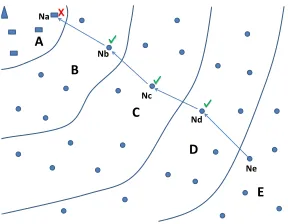
reducing the yield of the network. Figure 1(a) illustrates these drawbacks of Varuna. For the sake of simplicity, consider a
multihop network in which nodes located in the same region labeled withX have the same number of hops away from the
sink. The nodes in neighbouring regions have one hop distance. Assume that triangular node located in the corner is sink, the
rectangular nodes in regionAare updated nodes and circular nodes in other regions are not updated. According to Varuna
protocol, nodes in regionsB, C, DandEcommunicate and accept each others data because they have the same version codes.
However, since nodes in regionAhave bigger version numbers than the nodes in other regions, the nodes in regionAshould
not communicate with other nodes. They will not forward messages received from nodes inB and will discard them. They
detect inconsistency and let the nodes in regionB update their code. For example, assume that a nodeNein regionEhas
detected a fire and wants to send an alarm message to thesinkimmediately. It sends to a nodeNdinD, which accepts and
forwards it further to a nodeNcinC.Ncforwards to nodeNb. When data is forwarded fromNbto a nodeNain regionA,
Na will cancel it because nodeNbhas lower version thanNa. In other words, the data originated atNewill be waste after
flowing through the entire network. Similarly, many packets originated at regionsB,C,DandEwill be discarded since the
time when new code is injected. Therefore, when events are rare, leading to bursts of data packets, Varuna not only waste
resources such as energy and bandwidth, but also increases dissemination latency and delivery latency. Figure 1(b) shows the
network after communication of nodes in regionBwith the nodes in regionA.
Further, in WSNs, link quality can fluctuate[2], causing asymmetric links to exist in the network, and this can be due
to several reasons. For example, the network can transmit low-power signals, thus creating links that are often asymmetric.
The link quality depends strongly on hardware inaccuracy and environmental factors [2]. Hardware inaccuracy may create
asymmetric links between nodes [2]. In [10], the authors observed that transceiver frequency mismatch can also be a reason
for asymmetric links. Further, the duration of these asymmetric links may be very small (i.e., transient) or very long (i.e.,
permanent) [12]. Protocols that assume bidirectional links may not work or may not be efficient in networks with asymmetric
links. Specifically, Varuna will not work efficiently if asymmetric links exist in the network since the protocol is based on
Trickle spends a lot of energy, even in steady state, for code maintenance, while Varuna, which addresses the shortcomings of
Trickle, does not perform well in presence of asymmetric links or if the network application is event-based.
Thus, there is a need for a code dissemination protocol performs well in event-based WSNs and that tolerates asymmetric
links. Such a protocols needs to have the following properties: (i) low dissemination latency as Trickle, and (ii) does not incur
steady energy expenditure during steady state, as Varuna. To achieve this, we propose a new protocol, calledTriva, which is
an adaptive code dissemination protocol that leverages the properties of Trickle and Varuna. Specifically, when dissemination
is needed, Triva behaves like Trickle, but when dissemination is not needed (maintenance is needed), it behaves like Varuna.
Our results show that Triva outperforms both protocols in general. Further, Triva outperforms both Trickle and Varuna in
presence of asymmetric links. We also show that Triva handles bursty traffic much better than Varuna.
Our paper is structured as follows: We present an overview of related work in Section 2. We present our network model
in Section 3. We propose Triva, an adaptive algorithm for event-based WSNs in Section 4. We explain our simulation and
experimental setup in Section 5, and discuss our results in Section 6. Finally, we conclude the paper in Section 7.
2. Related Work
2.1. Overview of Related Work
There exist several dissemination protocols for updating codes. While some of the protocols deliver complete binary image
of the code like [3], [16], [5], [7], some deliver only the difference between the new code and the old code [6, 15]. Also there
exist protocols which deliver tasks[4], network parameters[20], and queries[23].
In XNP[3], the base station broadcasts the code image to the nodes which are in the coverage range of it. The nodes
which are not in the range cannot receive the code image. The protocol proposed in MOAP[16] is a multi-hop dissemination
protocol, which can deliver code images to nodes that are several hops away from the base station. Each node forwards the
code image further after receiving the complete code image. Deluge[5] allows large data transmission by fragmenting the
data into fixed-size pages. It also supports pipelined page transmission to make dissemination faster. Unlike MOAP, nodes in
Deluge should not wait for the complete code image before forwarding it. The authors of MNP[7] proposes another protocol
which, like Deluge, fragments the code image and uses a pipelining mechanism. However, unlike Deluge, MNP selects the
sender of the code such that there is at most one sender at any time in a neighbourhood, i.e., a sender with the highest coverage
will be chosen to avoid message collisions. A sender selection mechanism reduces collisions and avoids the hidden terminal
problem. Also, in MNP, some of the nodes can go to the sleep mode to save energy whenever there is no data to receive or
transmit.
Because of the features of wireless sensor networks, e.g., transient link failures and node mobility, not all nodes will update
their code to the newest one during the dissemination phase. Some of the nodes may not receive any message at all during the
dissemination period because of transient link failures or node rejoins. To ensure the delivery of the updated code to all nodes
in a network, any updated node should continuously check the consistency of its neighbours, by broadcastingadvertisement
messages. Blindly broadcasting advertisement messages causes the so-called “broadcast storm problem” [13]. There are two
algorithms which address this problem. The first one is Trickle [9], which addresses this problem by using a “polite gossip”
policy. In Trickle, a node suppresses its advertisement message transmissions when it hears a number of messages identical
maintenance. Varuna consumes constant energy in steady phase when the network is in a steady state, i.e., when all nodes
have the same code.
Since our proposed algorithm Triva leverages the properties of Trickle and Varuna, we will discuss both of these algorithms
in more details in the subsequent sections.
2.2. Trickle
In Trickle, every node broadcasts advertisement messages that contain a metadata that includes the version number of the
code, at most once per period given between [τ/2,τ]. If a node hears more thankidentical metadata before it transmits its
advertisement, it suppresses its broadcast and doubles the value ofτ up toτh, which is an upper bound forτ. If it hears a
different metadata,τ is set toτl, which is a lower bound forτ. By increasing the broadcast interval, τ, Trickle sends less
number of advertisement messages, thus saving energy. By decreasingτ ,Trickle can update nodes more quickly. So, there
is a trade-off between dissemination latency and energy to be achieved when selectingτ. As noted in [14], in addition to the
dissemination latency, increasing the value ofτto large values causes some other problems such as message communication
between two nodes, which have different code versions. In Trickle, the number of advertisement messages increases linearly
as a function of time, as the dissemination is irrespective of the mission of the WSN application.
2.3. Varuna
Varuna[14] is another protocol which supports code update maintenance. Varuna saves energy in the network steady phase,
a phase where no dissemination is being done as all the nodes have the same code version. Unlike Trickle, where there is a
linear increase of energy consumption, energy consumption in Varuna is constant in the steady phase. To achieve this constant
energy consumption in the steady phase, nodes, in Varuna, send advertisement messages only when there is a change in their
neighbourhood topology or metadata since their last advertisement transmissions. To learn about this change, each node
stores its neighbour IDs in itsneighbourhood table. A node stores only the IDs of neighbours which are consistent with it, i.e.,
neighbours that have the same code as it. For example, if a nodeN1sends a message to a nodeN2,N2checks the existence ofN1’s ID. If it exists in the table, it is assumed to be consistent with theN2, and thenN2does not send an advertisement message. Otherwise,N2 checks the consistency of its code with the nodeN1by sending an advertisement message. If the version numbers are equal,N2stores the ID ofN1in its table. If they are different, the node which has bigger version number sends an advertisement message to let other nodes request and download the code with the bigger version. After receiving the
new code, the node resets its table (as it has to detect new consistent nodes). When all nodes receive the newest code, every
node’s table will contain the IDs of all neighbouring nodes. This state stops sending advertisement messages, which makes
energy drain constant in steady phase after some time. In Varuna, a node detects inconsistency only if it receives a message
from a node which has smaller version number. It means that, a node will not update its code unless it communicates with
a node with new version number. This makes theupdate latency, the time from the injection of new code to the time when
all nodes receive the new code, dependent to a communication rate of a node. Therefore, update latency in Varuna increases
linearly with data communication rate or with the event time if the application is event based.
2.4. Asymmetric links
In wireless networks, especially in networks which transmit low-power signals, links are often asymmetric. The link
inaccu-racy may also create asymmetric links between nodes [2]. In their experiments[10], they observed that transceiver frequency
mismatch can also be a reason for asymmetric links. And these asymmetric links may be transient or permanent[12].
Many proposed protocols for WSNs in the literature assume symmetric or bidirectional links, i.e, two nodes can receive
each others messages. However, as mentioned above, the links can be asymmetric or unidirectional. Therefore, they may not
function properly, may be inefficient in terms of different metrics such as energy and delay as intended, or they may not work
at all.
There are also protocols which deal with asymmetric links. In[17], authors propose two WSN MAC protocols that increase
reliability, connectivity and network lifetime by utilizing unidirectional links. In[21], authors propose a framework which
allows routing protocols designed for bidirectional links to function in the presence of unidirectional links. Another energy
efficient reliable transport protocol for WSNs which overcomes the negative impact of asymmetric links is presented in[10].
One of the most important performance criteria when designing WSNs protocols, may it be a routing protocol, MAC
protocol or other layer protocol, is energy conservation. And one of the reasons of energy waste is retransmission of packets
due to reasons such as collisions and asymmetric links as in Varuna. Recall that, in Varuna, a node sendsADV packets until
it receives a response for that. The node may never receive the response, if the link beetween them is unidirectional, in other
words, if there exists only downlink.
3. Network Model
We define a wireless sensor node as a computing device equipped with a wireless interface and associated with a unique
identifier. The node has limited computational resources, such as limited memory and power. A wireless sensor network
is a collection of wireless sensor nodes that communicate via the wireless interfaces, and is modelled as a directed graph
G= (V, A)whereV is a set ofN wireless sensor nodes (i.e.,|V|=N) andAis a set of arcs, representing the direction of
message travel. Each directed link(m, n)represents a pair of distinct nodes, and a directed edge exists between two nodes
(m, n)only if noden can receive a message from nodem. A noden is said to be a 1-hop neighbour (or neighbour) of
mif (m, n) ∈ A. We denote by M the set ofm’s neighbours. We say that two nodesm andncan collide at nodepif
(m, p)∈ A∧(n, p)∈ A3. Our model allows the network to have asymmetric links. In such a case, any signal with a low
signal-to-noise ratio (SiNR) such that the signal is not correctly received at an intended receiver can be omitted from the graph.
However, we also assume that the network remains connected in that every node has at least one arc incident on it and at least
one outgoing link, i.e.,∀m∈V∃p, q·(m, p)∈A∧(q, m)∈A.
We assume that there are two special types of messages: (i) An advertisementmessage, which is broadcast by a node
to inform its neighbourhood about the version numberof the code it has, as is the case with existing code dissemination
protocols, and (ii) arequestmessage that is used by a node to request new code from one of its neighbours.
4. Triva: Efficient Algorithm for Code Dissemination in Event-Based WSNs
In this section, we explain our proposed protocol,Triva, and subsequently give a formal description of its working.
Trivais a code maintenance protocol, as part of a code dissemination protocol intended specifically for event-based
wire-less sensor networks. It works in such a way so as to enable nodes to update their code quickly, very much like Trickle.
Varuna’
Trickle’
Update completed
count(th) > q
Trickle
+ Neighbourhood table + count(
t
h)MOODy (2’) HELP
Quiescent
[image:9.612.181.427.58.245.2]Disseminate
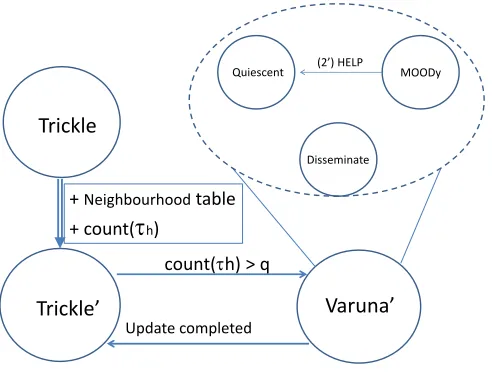
Figure 2: The state machine for Triva, which is a combination of Trickle’ and Varuna, where Trickle’ is obtained by adding aNeighbourhoodtable and variablecount(τh)to Trickle.
However, unlike Trickle, it does not consume much energy in steady state. Specifically, it consumes little energy, like Varuna,
when there is no new code in the network. Further, when there unidirectional links exist in the network, Varuna’s energy
efficiencydrops drasticallyas redundant message transmissions are necessary. Trivatries to address the unidirectional link
problem by making use of other neighbours, circumventing the problem when a relevant neighbour cannot be reached.
Informally, our protocol leverages the working of both Trickle and Varuna to achieve efficient dissemination and works in
the following way: When a nodeN1updates its code, it tries to quickly disseminate the code to its neighbours.N1broadcasts advertisement messages at a random time in given period, as in Trickle. If, during these transmissions, a neighbouring node
N2requests the new code,N1sends the new code toN2. However, unlike in Trickle, ifN1receives an advertisement message with the same version number from N2, it saves N2’s ID in its neighbourhood table. After broadcasting advertisement messages for some time, the node stops broadcasting and acts like in Varuna in the steady phase to save energy. InTriva, there
is no concern with selecting an upper bound valueτh(see Section 2.2) as, inTriva, a node sends advertisement message, as in
Trickle, only for a short period after the node has updated its code.
Specifically, we extend Trickle with some Varuna-like variables, such as neighbourhood table to reduce the broadcasting
of advertisement messages. Then, in steady state, Triva behaves as Varuna, while in the dissemination phase, it behaves like
Trickle. Further, in the MOODy state of Varuna’, we extend the working of Varuna to handle asymmetric links, through HELP
messages (see Figure 2).
4.1. Formal protocol description
Figure 2 illustrates the state machine of our protocol, which we now detail.
• Trickle’ state:
When a nodeN1enters this state, it setscounter, which is a Trickle variable, to 0, and setsτtoτl. In this state,N1 sends an advertisement message periodically at a random time between [τ/2,τ], if it has not heardkadvertisement
messages about the same version number, i.e., ifcounter< k, otherwise, it doublesτup toτh.
N1 N2
N3 ADV
N4 N5
N6
N2 N7 …
N7
N1 N4 …
N8 N4 …
N8
[image:10.612.216.401.64.201.2]Packet
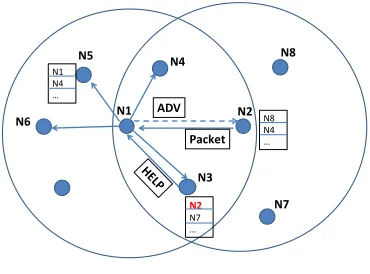
Figure 3:N3is addressing the asymmetric link betweenN1andN2. There exists only one link betweenN1andN2: the link fromN2toN1
– If a nodeN1receives an advertisement message from a nodeN2,N1compares the received version number with its own. If the version number ofN2is bigger, thenN1requests the code after a randomly chosen time between
[0, R]seconds, then downloads the code, and updates fromN2. If the version number ofN2is smaller, thenN1 broadcasts advertisement messages. If the version numbers are equal and ifN2does not exist in its neighbourhood table,N1addsN2in its table, then doublesτup toτh0 and incrementscounterby one.
– If a nodeN1receives a request message fromN2,N1sends the new code toN2.
– If a nodeN1updates its code fromN2, it first clears its neighbourhood table and then addsN2in its table. It sets counterto 0, setsqto 0 and setsτtoτl.
– If, duringτtime,N1does not send any advertisement message, it doublesτup toτh. Ifτis already equal toτh,
it incrementscountQby one and setscounterto 0.
– Ifcount(τh)> q,N1setscounterto 0,count(τh)to 0 and goes toVaruna’ state.
• Varuna’:
– If a nodeN1updates its code from a nodeN2, it clears its neighbourhood table and addsN2in its table, and then it goes toTrickle’ state.
– If a nodeN3receives an advertisement message destined toN2from a nodeN1, and ifN2is in the neighborhood table of N3 and ifN1’s version number is equal to N3’s version number, thenN3 sends a HELP packet (see Figure 2), which includes the ID ofN2, toN1with a propabilityP after random time between [0,1] second.
– If a nodeN1receives aHELPpacket that is destined to itself, thenN1extracts the node IDN2from the packet and adds it into its neighborhood table ifN2does not exist in the table (see Figure 3).
– Otherwise, Varuna’ behaves as Varuna.
• Download state:
– After sending a new code, a node returns to the previous state.
4.2. Fast dissemination
In Triva, every node tries to quickly disseminate its code, whenever it receives a new code. It does so by broadcasting
advertisement packet periodically between [τ/2,τ]. Since a node broadcasts only a limited number of advertisement packets,τ
can be a small number. Therefore, the amount of energy spent sending advertisement messages is bounded, unlike in Trickle.
4.3. Constant energy consumption
In Triva, a node eventually fills its neighborhood table with the IDs of all of its neighbours, which means that all its
neighbouring nodes have received the new code. Therefore, like in Varuna, in this steady phase, there is no advertisement
message transmission, thereby limiting the energy expenditure due to advertisement broadcasts.
4.4. Addressing asymmetric/unidirectional links
InTriva, a node tries to help two of its neighbouring nodes that may have an asymmetric link between them. It does so by
informing them about their code consistency if the node’s code is consistent with those two nodes. Figure 3 depicts the Triva
process of addressing the unidirectional links betweenN1andN2: NodeN1, after receiving any packet fromN2, checks if
N2exists in its neighbourhood table. If not, thenN1sends an advertisement message toN2. However,N2will not respond as it cannot hear packets fromN1(due to asymmetric link). IfN3andN4can overhear messages between the nodes, then they can helpN1receive information aboutN2’s version number, as long as their codes are consistent with bothN1’s andN2’s code. They do it by sending aHELPpacket, which contains the ID ofN2, toN1. However, since there may be several nodes that can hear bothN1andN2, they send theHELPpacket with a probabilityP.
In addressing the asymmetric link problem, we assume that the two nodes which have asymmetric links between them
share a common neighbour. If there is no such a node, then Triva will not be executed, thereby making no message overhead.
Trickle will not be affected by the presence of asymmetric links as, in Trickle, nodes independently send advertisement
packets periodically. In the case of Varuna, using the above example,N1will send advertisement packetsitimes periodically until it gets a response fromN2. N1does this every time it receives any data packet fromN2. Therefore, in Varuna, a node transmitsiADVpackets periodically, whenever it gets a data packet and there is no uplink. Thus, if the nodes in the network
send packets periodically everyTtime, then each node transmitsO(A∗i∗T)advertisements packets even when there is no
new version in the network. Here,Ais the number of unidirectional links (downlinks) between a node and its neighbors.
5. Simulation Setup
q 15 τh0 20 sec TM OODY 60 sec DIS RAND 2 sec
τl 1 sec k 2 τv 8 sec ADV RAND 2 sec
[image:11.612.142.473.570.611.2]τh 60 sec b 1, 30, 60 R 1 sec P 0.5
Table 1: Parameters for the simulation
We perform TOSSIM[8] simulations on a 20x20 grid network to evaluateTriva. We used a network topology generator
tool given on tinyos.net to construct the network. We set the distance between neighboring nodes to 10 feet. By appropriately
choosing the power decay value for the reference distance, we constructed the network such that a node has a communication
taken in the Casino Lab of Colorado School of Mines. The file itself can be found in Tossim/noise folder. The parameter
values used in our simulation are given in Table 1, while all other parameter values used are the same as in Trickle and Varuna.
The value of τ0
h can be set to the value ofτh. However, sinceTrivaruns Trickle for a short period, we keep the value
ofτh0 small. The value ofqcan be set according to how fast a node’s neighborhood table can be filled with its neighboring
nodes’IDs. Simulations show that almost all (≥90%) neighboring nodes’IDscan be saved whenqis between 15 to 20. The
parameterτv isτ used in Varuna. The probabilityP of sending aHELPpacket can be set according to the density of the
network. If the network is dense, thePcan be set to a small value. If the network is sparse, thenPcan be set to larger values.
In our simulations, we setPto 0.5.
In our simulations, we ran three protocols: (i) Triva, (ii) Trickle and (iii) Varuna, to assess (i) the number of advertisement
packets transmitted, (ii) the total number of discarded data packets (relevant for Varuna) from the time when the new version
is injected and (iii) thecompletion timeor dissemination latency, the time from the point when a new version is injected to the
point when the last node receives the update. We simulated three scenarios:
1. Periodic traffic: Each node periodically sends data packet, with the period randomly selected between [0. . .1] minute.
2. Event-based traffic: Each node sends only one packet at a randomly selected time between[λ, λ+ 1]minute, whereλ
is the time the event occurred. Events occur everyλminutes.
3. Event-based bursty traffic[24] : Each node sendsb packets, one packet per second, after a randomly selected time
between[λ, λ+ 1]minute, whereλis the time the event occurred. Events occur everyλminutes.
To evaluate the performance of the three protocols on networks with different link symmetry, we simulated them on a
network (i) with symmetric links and (ii) with asymmetric links.
In all our simulations, all nodes boot randomly in the first minute and a packet with a new version is injected into the
top-left node (the sink) after 2 minutes. We also assume that the network starts in a “Varuna” state.
6. Results
We assume that Triva is in the Varuna’ state (see Figure 2) at the beginning of execution of the simulations. We show the
simulation results of Triva, Varuna and Trickle.
6.1. Metrics
In our simulations, we used the following metrics: (i) the number of advertisement packets transmitted, as the number
of transmissions is directly related to energy consumption, (ii) the number of discarded application, packets as this metric
captures the amount of resources wasted as bandwidth and energy, and (iii) completion time (dissemination latency), which is
another important criteria in network reprogramming, to enable the network to work efficiently.
6.2. Number of Advertisement Packets
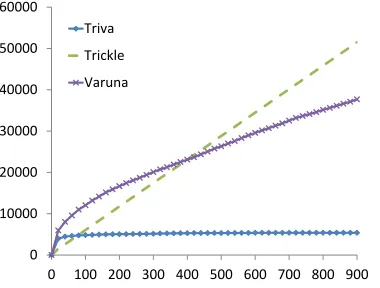
Figure 4 shows the number of advertisement packets transmitted for completely disseminating the code update in the
network. Figure 4(a) shows the number of advertisement packets where a node periodically sends one data packet, with the
period randomly chosen between [0. . .1] minute in the network with symmetric links. As can be observed, the number of
advertisement packets Trickle sends increases linearly with time, even when there is no new code in the network, while the
0 10000 20000 30000 40000 50000 60000
0 100 200 300 400 500 600 700 800 900 Triva
Trickle
Varuna
(a) Scenario 1 -Periodic Traffic, Symmetric Links: Data packets generated randomly every0. . .1minute for periodic traffic 0 10000 20000 30000 40000 50000 60000
0 100 200 300 400 500 600 700 800 900 Triva
Trickle
Varuna
[image:13.612.79.271.55.203.2](b) Scenario 2 -Periodic Traffic, Asymmetric Links: Data packets generated randomly every0. . .1minute for periodic traffic.
Figure 4: The number of advertisement packets during dissemination.
Triva, the transmission of advertisement andHELPpackets stop after some time and never transmitted again, as long as there
is no new code in the network. In the network with symmetric links, Triva sends advertisement andHELPpackets 10 times
less than Trickle and 3 times less than Varuna.
Figure 4(b) shows the number of advertisement packets transmitted in the network with high asymmetric links. Here, we
can also see that Triva transmits advertisement packets 10 times less than Trickle and 7 times less than Varuna.
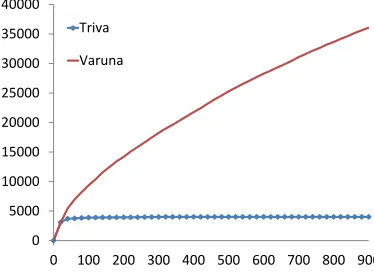
In Figure 6, Triva, and Varuna are compared in terms of the number of advertisement packets sent, when each node in the
network sends 30 packets back-to-back at 1 packet/second, withλ= 5minutes. In this figure, Triva again stops transmitting
advertisement packets after some time.
6.3. Number of Discarded Application Packets
Figure 5 shows the number of discarded application data packets after the time when a packet with a new version is
injected, i.e., after 2 minutes. Figure 5(a) shows the values obtained from the network in which a node periodically sends
only one, i.e,b=1, data packet at randomly selected time between [λ, λ+ 1] minutes. In bothTrivaand Varuna, values are
relatively high whenλ=0, as the randomly selected time by a node could be very small such as150ms, which forces nodes to
send more data packets in a small amount of time. This is shown in Figure 5(a).
In Figure 5(b), a node sendsb=60 packets back-to-back every 1 second. The number of data packets discarded by Varuna
remains constant, with increasing idle time. On the other hand, the number of dropped packets inTrivais very low, due to the
fact that the nodes quickly obtain the updated code.
Overall, when the number of discarded data packets is low, it captures the fact that the all nodes have the same code
version, i.e., code dissemination has completed quickly.
6.4. Code Dissemination Latency
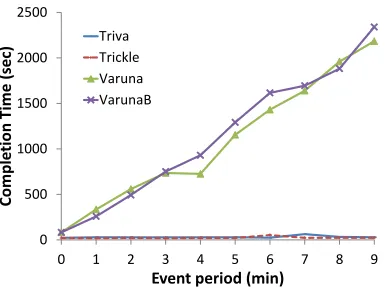
Figure 7 shows the time taken from the point when a packet with new version is injected to the point when the last node
in a network receives that packet, i.e., the code dissemination latency. We investigated the latency under two scenarios: (i)
periodic traffic, and bursty traffic.Trivaand Trickle have very low dissemination latency (for both scenarios), whereas Varuna
[image:13.612.344.534.56.200.2]0 200 400 600 800 1000 1200 1400
0 1 2 3 4 5 6 7 8 9
Num. o f disca rded da ta pack ets
Event period (min)
Varuna
Triva
(a) Scenario 3 -Event-Based Traffic: (λ,λ+1) minutes,λ
represents x-axis, Data packets: One data packet is sent for every event. 0 500 1000 1500 2000 2500 3000 3500
0 1 2 3 4 5 6 7 8 9
Num. of disc ar ded da ta pack ets
Event period (min)
Varuna
Triva
[image:14.612.339.536.56.204.2](b) Scenario 4: Event-Based Bursty Traffic: (λ,λ+1) min-utes,λrepresents x-axis, Data packets:60packets are sent at 1 packet/second.
Figure 5: Number of discarded data packets after injecting new code.
0 5000 10000 15000 20000 25000 30000 35000 40000
0 100 200 300 400 500 600 700 800 900 Triva
Varuna
Figure 6: Scenario 5 -Bursty Traffic:30packets are sent at 1 packet/second,λ= 5minutes for bursty traffic.
6.5. Experimental Results
We have implemented Triva and Varuna on TelosB platform based nodes. Our implementation of Triva takes 989 bytes
in memory, which includes two tables, each of size 20 entries of 2 bytes, and other algorithm related variables. To have an
asymmetric link between nodes, we set the power levels of all nodes to 31 except one which is set to 2. In our experiment, we
used 11 nodes and we measured the number of advertisement packets. Table 6.5 shows the results of our experiment. Triva,
after around 100 minutes, stopped sending advertisement packets at 104. On the other hand, Varuna, about every minute,
sends 11 advertisement packets.
Triva 104
[image:14.612.83.271.58.201.2]Varuna 661
Table 2: The number of transmitted advertisement packets.
7. Conclusion
In this paper, we proposed a new code dissemination protocol called Triva that leverages the properties of two well-known
code dissemination protocols, namely Trickle and Varuna. It adapts both Trickle and Varuna to achieve energy efficiency and
[image:14.612.209.396.275.411.2]0 500 1000 1500 2000 2500
0 1 2 3 4 5 6 7 8 9
Comple
tio
n
Time (
sec)
Event period (min)
[image:15.612.212.406.58.203.2]Triva Trickle Varuna VarunaB
Figure 7: Scenarios 6 and 7: Completion time as a function ofλ, the event period. Scenario 1: Data packets generated every (0. . .1) minute, Scenario 3: 30 packets per event at 1 packet/second.
outperforms both Trickle and Varuna (i) in periodic traffic, (ii) event-based traffic, (iii) bursty traffic, and (iv) in networks with
asymmetric links.
References
[1] A. Arora and et al. A line in the sand: A wireless sensor network for target detection, classification, tracking.Computer
Networks (Elsevier), 46(5), 2004.
[2] Nouha Baccour, Anis Koubaa, Luca Mottola, Marco Zuniga, Habib Youssef, Carlo Boano, and Mario Alves. Radio Link
Quality Estimation in Wireless Sensor Networks: a Survey.ACM Transactions on Sensor Networks, 2011.
[3] Inc. Crossbow Technology. Mote in-network programming user reference, www.tinyos.net/tinyos-1.x/doc/xnp.pdf.
2003.
[4] O. Gnawali, K. Jang, J. Paek, M. Vieira, R. Govindan, B.Greenstein, A.Joki, D.Estrin, and E. Kohler. The tenet
archi-tecture for tiered sensor networks. InSenSys, pages 153–166, 2006.
[5] Jonathan W. Hui and David Culler. The dynamic behavior of a data dissemination protocol for network programming at
scale. InProceedings of the 2nd international conference on Embedded networked sensor systems, SenSys ’04, pages
81–94, 2004.
[6] Jaein Jeong and David Culler. Incremental network programming for wireless sensors. InIEEE Sensor and Ad Hoc
Communications and Networks (SECON, pages 25–33, 2004.
[7] Sandeep S. Kulkarni and Limin Wang. Mnp: Multihop network reprogramming service for sensor networks. InIn
Proceedings of the 25th International Conference on Distributed Computing Systems (ICDCS, pages 7–16, 2005.
[8] Philip Levis, Nelson Lee, Matt Welsh, and David Culler. Tossim: accurate and scalable simulation of entire tinyos
applications. InProceedings of the 1st international conference on Embedded networked sensor systems, SenSys ’03,
[9] Philip Levis, Neil Patel, David Culler, and Scott Shenker. Trickle: a self-regulating algorithm for code propagation and
maintenance in wireless sensor networks. InProceedings of the 1st conference on Symposium on Networked Systems
Design and Implementation - Volume 1, pages 2–2, 2004.
[10] Ren Ping Liu, Zvi Rosberg, Iain B. Collings, Carol Wilson, Alex Y. Dong, and Sanjay Jha. Overcoming radio link
asymmetry in wireless sensor networks. InProceedings of the IEEE 19th International Symposium on Personal, Indoor
and Mobile Radio Communications, PIMRC 2008, 15-18 September 2008, Cannes, French Riviera, France, pages 1–5.
IEEE, 2008.
[11] A. Mainwarig and et al. Wireless sensor networks for habitat monitoring. InProceedings WSNA, pages 88–97, 2002.
[12] Luca Mottola, Gian Pietro Picco, Matteo Ceriotti, S¸tefan Gunˇa, and Amy L. Murphy. Not all wireless sensor networks
are created equal: A comparative study on tunnels. ACM Trans. Sen. Netw., 7(2):15:1–15:33, September 2010.
[13] Sze-Yao Ni, Yu-Chee Tseng, Yuh-Shyan Chen, and Jang-Ping Sheu. The broadcast storm problem in a mobile ad hoc
network. InProceedings of the 5th annual ACM/IEEE international conference on Mobile computing and networking,
MobiCom ’99, pages 151–162, 1999.
[14] Rajesh Krishna Panta, Madalina Vintila, and Saurabh Bagchi. Fixed cost maintenance for information dissemination in
wireless sensor networks. InProc. SRDS, pages 54–63, 2010.
[15] N. Reijers and K. Langendoen. Efficient code distribution in wireless sensor networks. InProc. of the2ndInt. Conf. on
Wireless Sensor Networks and Applications (WSNA), 2003.
[16] Thanos Stathopoulos, John Heidemann, and Deborah Estrin. A remote code update mechanism for wireless sensor
networks. Technical Report CENS-TR-30, UCLA, Center for Embedded Networked Computing, 2003.
[17] Jorg Nolte Stephan Mank, Reinhardt Karnapke. Mac protocols for wireless sensor networks: Tackling the problem of
unidirectional links.International Journal on Advances in Networks and Services, 2(4):218–229, 2009.
[18] S. Tilak, N. Abu-Ghazaleh, and W. Heinzelman. A taxonomy of wireless micro-sensor network models. ACM Mobile
Computing and Communication Review, 6(2), 2002.
[19] T.Masuzawa and S.Tixeuil. Stabilizing locally maximizable tasks in unidirectional networks is hard. InProceedings of
International Conference on Distributed Computing Systems, 2010.
[20] Gilman Tolle and David E. Culler. Design of an application-cooperative management system for wireless sensor
net-works. InEWSN, pages 121–132, 2005.
[21] R. Chandra V. Ramasubramanian and D. Mosse. Providing a bidirectional abstraction for unidirectional ad-hoc networks.
InIn Proceedings of the IEEE Infocom, 2002.
[22] Geoff Werner-Allen, Konrad Lorincz, Jeff Johnson, Jonathan Lees, and Matt Welsh. Fidelity and yield in a volcano
monitoring sensor network. InProceedings of the 7th symposium on Operating systems design and implementation,
[23] Kamin Whitehouse, Gilman Tolle, Jay Taneja, Cory Sharp, Sukun Kim, Jaein Jeong, Jonathan Hui, Prabal Dutta, and
David Culler. Marionette: using rpc for interactive development and debugging of wireless embedded networks. InProc.
IPSN, 2006.
[24] H. Zhang, A. Arora, Y. Choi, and M. Gouda. Reliable bursty convergecast in wireless sensor networks. Computer