warwick.ac.uk/lib-publications
Original citation:
Santos, Cláudio, Abubakar, Sharbanom, Barros, Ana Cristina and Godsell, Janet (2016) The role of organizational networks in the development of technological capabilities. In: EUROMA 2016, Trondheim, Norway, 17-22 Jun 2016
Permanent WRAP URL:
http://wrap.warwick.ac.uk/78874
Copyright and reuse:
The Warwick Research Archive Portal (WRAP) makes this work by researchers of the University of Warwick available open access under the following conditions. Copyright © and all moral rights to the version of the paper presented here belong to the individual author(s) and/or other copyright owners. To the extent reasonable and practicable the material made available in WRAP has been checked for eligibility before being made available.
Copies of full items can be used for personal research or study, educational, or not-for-profit purposes without prior permission or charge. Provided that the authors, title and full
bibliographic details are credited, a hyperlink and/or URL is given for the original metadata page and the content is not changed in any way.
A note on versions:
The version presented here may differ from the published version or, version of record, if you wish to cite this item you are advised to consult the publisher’s version. Please see the ‘permanent WRAP URL’ above for details on accessing the published version and note that access may require a subscription.
1
The role of organizational networks in the
development of technological capabilities
Cláudio Santos ([email protected]) INESC TEC, Portugal
Sharbanom Abubakar ([email protected]) WMG, University of Warwick, United Kingdom
Ana Cristina Barros ([email protected]) INESC TEC, Portugal
Janet Godsell ([email protected]) WMG, University of Warwick, United Kingdom
Abstract
The development of technological capabilities in a region is achieved through coordinated efforts from networks of organizations, including government agencies, research institutions, industrial associations and companies. The objective of this study is to identify the initiatives promoted by organizational networks to support the development of technological capabilities for the aeronautic industry, a sector experiencing fast growth. Semi-structured interviews conducted among organizational networks of two countries developing strategies to increase local aeronautic activity indicate commonalities of initiatives.
Keywords: Organizational networks, Technological capabilities, Aeronautic industry
Introduction
Continuous technological development is a crucial element for a company to sustain competitive advantage (Chiesa, 2001). Indeed, companies with demonstrated capabilities in a number of technologies that meet demand requirements are in a better position to ensure the sustainability of their business (Burgelman et al., 2001). Networks play a role in the development of technological capabilities of companies through knowledge sharing (Mentzas et al., 2006; Trkman and Desouza, 2012) and the promotion of collaborative working (Hagedoorn et al. 2006). Collaborations between industry, government agencies and academia have been considered as vital for technology development in regions (Hendry et al., 2000; Johnson, 2008).
2
The organizational networks considered in this study are formed by companies, industry associations, research institutions, and government agencies, since these have been considered the critical stakeholders for the development of technological capabilities in a region (Bales et al., 2004). In order to study the phenomenon of technological development of a region, we selected two regions where this phenomenon recently occurred, namely the development of technological capabilities for the production of aero-structures in Portugal and the development of technological capabilities for the design & engineering services, build-to-print aero structures in Malaysia. The aircraft industry is an adequate context to study the development of technological capabilities in regions because worldwide aircraft demand is increasing at approximately 2% a year till 2033 (Deloitte, 2015) and therefore, several regions in the World are trying to enter the industry. Within this context we formulate our research as follows: “How do organizational networks influence the development of technological capabilities in a region to supply the aeronautic industry?”
Literature Review
The literature review is divided in two sub sections: the first discusses the literature of technological capabilities development in organizational networks, the second, analyses a number of studies about the role of organizational networks in different regional aeronautic sectors.
Technological capabilities development in organizational networks
Organizational networks have been defined as a group of organizations whose relationships are primarily non-hierarchical and trust-based, and often formally established and governed for the purpose of achieving a common goal (Provan et al., 2007). Depending on the nature of these goals, networks have been classified in numerous types, including innovation networks (Rycroft and Kash, 2004; Salavisa et al. 2012), collaborative networks (Camarinha-Matos et al., 2009) and knowledge networks (Anderson and Parker, 2013).
Literature has focused in the role of networks in the diffusion of technological innovations and, at this level of analysis, studies have addressed the formation of partnerships for R&D (Hagedoorn et al., 2006), outsourcing of innovations (Baloh et al., 2008), among others. Under this research stream, organizations may decide on the adoption of a technology by: (1) imitating the practices and behaviour of organizations perceived to be successful (a mimetic process), (2) being pressured by other organization(s) to adopt a technology (a coercive process), and (3) following professional associations that establish norms and rules to force pertaining organizations to adopt a technology so to be seen as legitimate (a normative process) (Robertson et al., 1996).
3
Steensma (1996) suggested that there is a close relationship between the attributes of a technology, which includes its technical complexity and the systemic shift for the organization, the collaboration method and the organizational learning capabilities. The heterogeneity and complementarity of actors in networks in terms of capabilities and competences contribute to innovation success (Corsaro and Cantù, 2015).
In his study about clusters, Porter (1998) emphasized that not only companies, but also government agencies, universities and research institutions have a role in the competitiveness of regions, namely in providing specialized training, technical and market information, R&D services and technical support. Kerr and Newell (2003) suggested, based on their study on the US petroleum industry in the early 2000s that economic policy instruments can provide more efficient incentives for technology adoption than conventional regulations, implying that instruments can affect the direction of technological change significantly.
Although the importance of organizational networks has been considerably discussed, the influence of the initiatives available to organizational networks to promote technological capabilities development in specific industrial sectors has been less explored. The case of the aeronautic sector is discussed in the next section.
Technological capabilities development in the aeronautic industry
The global aeronautic industry has some distinctive characteristics, which in turn have serious implications to policy making towards the development of technological capabilities. First, the aeronautic industry is heavily regulated with high entry barriers for newcomers (Braddorn and Hartley, 2007). In this sense, the aeronautic sector is commonly analysed in a broader perspective, which spans not only buyer-supplier relationships but also other network entities, namely government agencies, industry associations, research partners and others. Second, the geographical distribution of the technological capabilities of the global aeronautic industry has been dominated by the most industrialized economies. Few countries or regions have developed indigenous technological capabilities, especially concerning systems design and integration. According to Eriksson (2010), for a country or region to develop aerospace technological capabilities - through the stages of assimilation, implementation and improvement - they need to stay in close contact with international scientific communities, to monitor the progress of technology development, and with major industry players and government bodies, to delineate strategies for offset agreements which are known to leverage technology transfer to developing regions. These issues highlight the role of organizational networks in this process.
For example, Prencipe (2001) in his study about the aerospace industry argues that in multi-technology industries, organizations need to develop capabilities that are not self-contained but rather multi-faceted as they require the integration and coordination of multiple technological streams. In this sense, Prencipe identified four types of technological capabilities: absorptive, the ability to monitor, identify and assess new technologies, integrative, the capabilities related to specification of requirements, materials, systems, components and their integration into products’ architecture, coordinative, the capabilities to coordinate (with internal and external entities) the development of technological innovations and generative, related to the capabilities to develop technological innovations.
4
aeronautic still remain under-developed. Despite the “deverticalization process of production” observed in the global aeronautic industry, where OEM delegate non-core competencies and require direct suppliers (mostly Tier 1) to actively participate in the design and development of aircrafts’ systems and components (Figueiredo et al., 2008), formal suppliers development programs were found to have marginally contributed to develop technological capabilities in aeronautic suppliers (Reed and Walsh, 2002). In another study about anchor tenants in aeronautics – organizations heavily engaged, including firms, universities and laboratories– Niosi and Zhegu (2010) argues that effective knowledge and technology transfer takes place only when favourable regional and market conditions are present in the long term.
The technological challenge is first and foremost, fundamental to the aircraft design requirement, since only proven technologies that comply with international regulations and standards should be considered for inclusion from the conceptual design level (Beaugency, et. al., 2015). The technological challenge is also closely related to the need for substantial continuous funding in the aircraft development projects, especially when the development timeframe typically spans over ten to fifteen years (Pritchard and MacPherson, 2007; Rose-Anderssen et al., 2011). Therefore, aircraft development programmes depend on government influence and funding support in order to succeed.
Despite the recognized role of organizational networks in the development of the aeronautic sector in different regions, their influence in the development of technological capabilities of their members has been poorly explored in the literature. This paper presents a preliminary study about the initiatives put in place by organizational networks towards the development of technological capabilities in the aeronautic industry.
Research methods
Given the exploratory nature of the research, case research is an appropriate method for this study (Voss et al., 2002; Yin, 2003; Ketokivi and Choi, 2014). Two countries with strategic aspirations in developing technological capabilities in the aeronautic sector were chosen for analysis, namely Portugal and Malaysia. As an industry extremely regulated and with high entry barriers, the role of organizational networks formed by a mix of private and public institutions is of great relevance in the global aeronautic industry. Furthermore, the need for the development of technology capabilities in the aeronautic industry is clear from the fact that its end product is classed as high value manufacturing, the technologies involved are those of advanced manufacturing, and it has some of the most demanding quality standards of any industry.
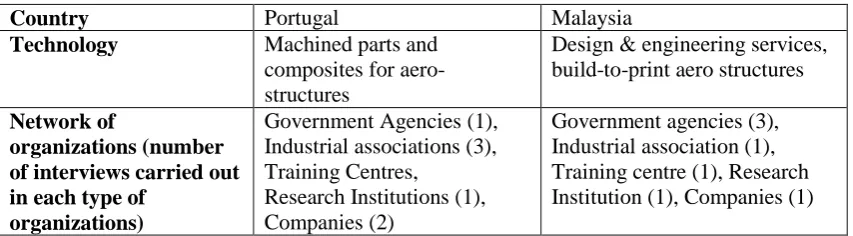
[image:5.595.86.513.634.752.2]Table 1 presents the case evidence collected by means of semi-structured interviews carried out in each country. The unit of analysis is the network of organizations involved in the development of the technological capabilities in each country.
Table 1. Case data
Country Portugal Malaysia
Technology Machined parts and composites for aero-structures
Design & engineering services, build-to-print aero structures
Network of
organizations (number of interviews carried out in each type of
organizations)
Government Agencies (1), Industrial associations (3), Training Centres,
Research Institutions (1), Companies (2)
5 Portugal
Portugal entrance to the aeronautic industry occurred through the creation of a Maintenance, Repair and Overhaul (MRO) company in 1918. After a period of strong growth during the 1960s, driven by the Defence, the sector witnessed a sharp decrease in business volume with the end of the Colonial Wars. It was only in the 1980s, with the renewal of the military fleet, and the cooperation agreement signed with the European Space Agency (ESA) in 1996, that the sector has experienced some resurgence. Currently, MRO remains the most important segment, in terms of business volume, in the Portuguese aeronautic sector (INE, 2015).
Manufacturing activity of aircraft parts is dispersed in a fragmented value network composed of several small and medium enterprises (SMEs) in lower Tiers of the supply chain delivering typically low value high volume parts. Still, since 2012 this activity has been extended by the installation of production facilities of an anchor company in the country. However, the low volumes characteristic of this sector presents some challenges for most Portuguese firms, which are used to more volume intensive industrial sectors such as the automotive. Furthermore, qualified human resources for the production of aircraft structure parts did not exist in Portugal before the installation of the anchor company and therefore the creation of these technological capabilities in the country has been promoted by a network of public and private organizations. Therefore, this research reached out to these organization in order to identify the initiatives needed to create technological capabilities for the aeronautic industry in Portugal.
Malaysia
Malaysia’s First Industrial Master Plan (IMP1), encompassing the period from 1986 to 1995, focused on the manufacturing sector to lead as a growth sector. The government saw increased investments in high technology and capital-intensive projects, together with an increased demand for skilled workers during this period, signalling a shift towards high technology adoption. Malaysia’s interest in the aerospace manufacturing sector during that decade was represented by the focus on “transport equipment”.
According to Szirmai (2012), industrialisation as a strategy for economic growth and development has propelled manufacturing as a major activity in many developing countries, creating the race for technological leadership. The government ministry official cited tremendous progress in technology and heightened business competition, both regionally and globally, as key challenges to the successful implementation of the industrial master plans. She recalled instances of urgent policy adjustments for the electronics industry, for instance, and expects a similar challenge as aerospace OEMs began to address growing demands for aircrafts from the Asia Pacific region. In order to address the mounting competition from within the Association of South-East Asian Nations (ASEAN), the government ministry had had to establish a national-level coordinating agency to ensure real-time alignment of aerospace industry development activities.
6
Findings
The empirical data collected from the organizational networks analysed in the two countries enabled the identification of a number of initiatives being taken to promote the development of technological capabilities in the aeronautic sector. These are described below:
Industry-academia collaboration through R&D projects: partnerships driven by collaborative projects are important mechanisms for knowledge exchange. While in Portugal aeronautic R&D activity is dispersed in a handful of research institutions, in Malaysia, an innovation centre was set by the Government in 2010 to coordinate collaborative research and technology projects between aeronautic industry and academia. Collaborations for knowledge sharing, as stated by one of the interviewees of a Portuguese research institution, even the preparation of applications allows members of an organizational network to have knowledge about the technological capabilities of each other, a mutual learning process on the potentialities of each partner. This process also supports the identification of knowledge gaps within the network and thus helps narrowing the scope of projects and the positioning of the network in terms of technological capabilities. As relationships deepen through time, organizational networks tend to be formatted to certain type(s) of aeronautic project(s), and may motivate members to begin establishing relationships with other partners to widen the scope of projects. Particularly important for “latecomers” such as the two regions analysed, the participation in international R&D projects with major OEMs may be an opportunity to enter the global aeronautic value chain, since there is a natural tendency for aeronautic manufacturers to continue with the partners with proven technical expertise when they decide to move forward with the industrialization and formation of the local supply chain, as stated by one of the interviewees.
Shared services centres: equipment necessary for testing, diagnostics, metrology and others can be an onerous cost to manufacturers, which is aggravated by their punctual utilization. Some associations of the countries analysed formed shared service centres where, by paying an annual fee or at reduced prices, manufacturers have access to testing services. In addition to freeing manufacturers from the burden of having to manage costly testing facilities, thus enabling them to focus on high value added technological capabilities, the shared services centres constitute an important knowledge repository about materials’ behaviour in simulated conditions in aircrafts. Support in the implementation of aeronautic certification: the certification of
manufacturing technologies is a lengthy process in the aeronautic sector, which may span a number of years. This is often observed as an obstacle for manufacturers, especially smaller ones, to introduce technological innovations in the aeronautic sector. Organizational networks from the two regions analysed provide support for companies to obtain necessary aeronautic certifications, for example, the AS9100. In Portugal, an industrial association has offered specific training for professionals leading the process of aeronautic certification implementation. In the case of Malaysia, government agencies have launched a series of initiatives to provide subsidized funding for product and process certification required by OEMs and industry regulators.
7
learning to improve the specialization level of their workforce. There, two training centres dedicated to the manufacturing of aircraft structure parts have been created through coordinated efforts of companies, government agencies and industrial associations. Initially, since the country faced a considerable gap in terms of aeronautic technological capabilities, there was no qualified training personal for the training centres and they were trained by collaborators from the companies, which was only made possible with the support of the network of organizations. The need to improve technical expertise of the human resources to leverage the local aeronautic sector was also observed as a serious issue by the Malaysian government, which supported the opening of industry skills training for aircraft maintenance technicians and the opening of graduate aerospace engineer programs at five leading Malaysian research universities.
Coordinated participation in aeronautic international events: fairs and exhibitions are a relevant showcases for the visibility of aeronautic industry from different regions. This visibility can draw the attention of global manufacturers and thus attract foreign investments for the development of local technological capabilities. Organizational networks from both countries organize and coordinate the participation in several aeronautic conventions and fairs, for example in the Singapore, Farnborough, Paris, and Dubai airshows. Both countries also brought international events to their countries, as for example the ASD Annual Convention that was held in Lisbon in 2012 (the largest edition of the convention so far) and the International Aerospace Business Convention in Kuala Lumpur in 2016.
Conclusions
This study reinforces the importance of organizational networks for the development of technology capabilities in regions and identifies the initiatives these networks may carry out towards achieving this goal. Case research in two countries developing strategies to increase local aeronautic activity, namely Portugal and Malaysia, has shown that the initiatives carried out by organizational networks in these two countries are quite similar in nature. The main difference observed was that in Portugal organizational networks have organized themselves to respond to the needs of foreign companies or Portuguese companies entering the aeronautic sector, whereas in Malaysia the organizational networks are moved by the government defined formal strategy for the aeronautic sector. Future research may study the design and impact of the initiatives identified in this study towards the effective development of technological capabilities in regions. From a practitioner point of view, our results may help the development of lines of action of companies, governmental agencies or industry associations for enhanced collaboration in the development of technological capabilities.
Acknowledgements
This work is financed by the FCT – Fundação para a Ciência e a Tecnologia (Portuguese Foundation for Science and Technology) within project CMUP-ERI/TPE/0011/2013 of the CMU Portugal Program.
References
Anderson, E.G. and Parker, G.G. (2013) “Integration of global knowledge networks”. Production and
Operations Management, Vol. 22, No. 6, pp.1446–1463.
Bales, R.R., Maull, R.S. and Radnor, Z., (2004), “The development of supply chain management within the aerospace manufacturing sector”, Supply Chain Management: An International Journal, Vol. 9, No. 3, pp.250–255.
8
outsourcing”, Strategic Outsourcing: An International Journal, Vol. 1, No. 2, pp.100–121.
Beaugency, A., Sakinç, M. E., and Talbot, D. (2015), “Outsourcing of strategic resources and capabilities: opposing choices in the commercial aircraft manufacturing”, Journal of Knowledge Management, Vol. 19, No. 5, pp. 912–931.
Beeby, M. and Booth, C., (2000), “Networks and inter-orgaizational learning : a critical Review”. The
Learning Organization, Vol. 7, No. 2, pp.75–88.
Bell, M. and Pavitt, K. (1995), The development of technological capabilities, in ul Haque, I. (Ed.), Trade,
technology, and international competitiveness, World Bank, Washington D.C., pp.69–101.
Bolívar-Ramos, M.T., García-Morales, V.J. and García-Sánchez, E. (2012), “Technological distinctive competencies and organizational learning: Effects on organizational innovation to improve firm performance”, Journal of Engineering and Technology Management - JET-M, Vol. 29, No. 3, pp.331– 337.
Braddorn, D. and Hartley, K. (2007), “The competitiveness of the UK aerospace industry”, Applied
Economics, Vol. 3, No. 6, pp.715–726.
Burgelman, R.A., Christensen, C.M. and Wheelwright, S.C. (2001), Strategic Management of Technology
and Innovation,McGraw-Hill Education, New York.
Camarinha-Matos, L.M. et al. (2009), “Collaborative networked organizations - Concepts and practice in manufacturing enterprises”, Computers and Industrial Engineering, Vol. 57, No. 1, pp.46–60.
Chiesa, V. (2001), R&D strategy and organization: managing technical change in dynamic environments,
Imperial College Press, London.
Corsaro, D. and Cantù, C. (2015), “Actors’ heterogeneity and the context of interaction in affecting innovation networks”, Journal of Business & Industrial Marketing, Vol. 30, No. 3/4, pp.246–258. Deloitte (2015), “Global aerospace and defense industry outlook”, available at:
https://www2.deloitte.com/content/dam/Deloitte/global/Documents/Manufacturing/gx-mnfg-2015-global-a-and-d-outlook.pdf. Access date: 2015-11-12.
Eriksson, S. (2010), “China’s aircraft industry: collaboration and technology transfer - the case of Airbus”,
International Journal of Technology Transfer & Commercialisation, Vol. 9, No. 4, pp.306-325
Ernst, D. and Kim, L. (2002), “Global production networks, knowledge diffusion, and local capability formation”, Research Policy, Vol. 31, No. 8-9, pp.1417–1429.
Figueiredo, P., Silveira, G. and Sbragia, R. (2008), “Risk sharing partnerships with suppliers: the case of Embraer”, Journal of Technology Management & Innovation, Vol. 3, No. 1, pp.27–37.
Hagedoorn, J., Roijakkers, N. and Van Kranenburg, H. (2006), “Inter-firm R&D networks: The importance of strategic network capabilities for high-tech partnership formation”, British Journal of Management, Vol. 17, No. 1, pp.39–53.
Hendry, C., Brown, J. and Defillippi, R. (2000), “Regional clustering of high technology-based firms: Optoelectronics in three countries”, Regional Studies, Vol. 34, No. 2, pp.129–144.
INE (2015)” Produtos vendidos (€) da indústria por Tipo de produto (Por CAE Rev. 3); Anual - INE, Inquérito Anual à Produção Industrial”, Indústria e Energia, available at: https://www.ine.pt/. Access date: 2015-11-12.
Johnson, W.H.A. (2008), “Roles, resources and benefits of intermediate organizations supporting triple helix collaborative R&D: The case of Precarn”, Technovation, Vol. 28, No. 8, pp.495–505.
Keeble, D. and Wilkinson, F. (1999), “Collective Learning and Knowledge Development in the Evolution of Regional Clusters of High Technology SMEs in Europe”, Regional Studies, Vol. 33, No. 4, pp.295– 303.
Kerr, S. and Newell, R.G. (2003), “Policy-Induced Technology Adoption: Evidence from the U.S. Lead Phasedown”, The Journal of Industrial Economics, Vol. 51, No. 3, pp.317–343.
Ketokivi, M. and Choi, T. (2014), “Renaissance of case research as a scientific method”, Journal of
Operations Management, Vol. 32, No. 5, pp.232–240.
Liu, J., Qian, J. and Chen, J. (2006), “Technological learning and firm-level technological capability building: analytical framework and evidence from Chinese manufacturing firms”, International Journal
of Technology Management, Vol. 36, No. 1/2/3, pp.190–208.
Mentzas, G. et al. (2006), “Inter-organizational networks for knowledge sharing and trading”, Information
Technology and Management, Vol. 7, No. 4, pp.259–276.
MITI Malaysia (2006), “3rd Industrial Masterplan. MITI Malaysia”, available at: http://www.miti.gov.my/index.php/pages/view/1690. Access date: 2015-10-09.
Niosi, J. and Zhegu, M. (2010), “Anchor tenants and regional innovation systems: the aircraft industry”,
International Journal of Technology Management, Vol. 50, No. 3/4, pp. 263-284.
Pilbeam, C., Alvarez, G. and Wilson, H. (2012) “The governance of supply networks: a systematic literature review”, Supply Chain Management: An International Journal, Vol. 17, No. 4, pp.358–376.
9 November-December, pp.77–90.
Prencipe, A. (2001), “Expoliting and nurturing in-house technological capabilities: Lessons from the Aerospace industry”, International Journal of Innovation Management, Vol. 5, No. 3, pp.299–321. Pritchard, D. J., and MacPherson, A. (2007), “Strategic destruction of the Western commercial aircraft
sector: implications of systems integration and international risk-sharing business models”,
Aeronautical Journal, Vol. 111, No. 1119, pp. 327–334.
Provan, K.G., Fish, a. and Sydow, J. (2007), “Interorganizational Networks at the Network Level: A Review of the Empirical Literature on Whole Networks”, Journal of Management, Vol. 33, No. 3, pp.479–516.
Rebolledo, C. and Nollet, J. (2011), “Learning from suppliers in the aerospace industry”, International
Journal of Production Economics, Vol. 129, No. 2, pp.328–337.
Reed, F.M. and Walsh, K. (2002), “Enhancing technological capability through supplier development: A study of the U.K. aerospace industry”, IEEE Transactions on Engineering Management, Vol. 49, No. 3, pp.231–242.
Robertson, M., Swan, J. and Nkwell, S.U.E. (1996), “The role of networks in the diffusion of technological innovation”, Journal of Management Studies, Vol. 33, No. 3, pp.333–360.
Rose-Anderssen, C., Baldwin, J. S., and Ridgway, K. (2011), “Commercial aerospace supply chains”,
Journal of Manufacturing Technology Management, Vol. 22, No. 1, pp. 66–89.
Rycroft, R.W. and Kash, D.E. (2004), “Self-organizing innovation networks: Implications for globalization”, Technovation, Vol. 24, No. 3, pp.187–197.
Salavisa, I., Sousa, C. and Fontes, M. (2012), “Topologies of innovation networks in knowledge-intensive sectors: Sectoral differences in the access to knowledge and complementary assets through formal and informal ties”, Technovation, Vol. 32, No. 6, pp.380–399.
Steensma, H.K. (1996), “Acquiring technological competencies through inter-organizational collaboration: An organizational learning perspective”, Journal of Engineering and Technology Management - JET-M, Vol. 12, No. 4, pp.267–286.
Szirmai, A. (2012), “Industrialisation as an engine of growth in developing countries, 1950-2005”,
Structural Change and Economic Dynamics, Vol. 23, No. 4, pp. 406–420.
Teece, D. (2007), “Explicating dynamic capabilities: the nature and microfoundations of (sustainable) enterprise performance”, Strategic Management Journal, Vol. 28, No. 13, pp.1319–1350.
Trkman, P. and Desouza, K.C. (2012), “Knowledge risks in organizational networks: An exploratory framework” Journal of Strategic Information Systems, Vol. 21, No. 1, pp.1–17.
Voss, C., Tsikriktsis, N. and Frohlich, M. (2002), “Case research in operations management”, International
Journal of Operations & Production Management, Vol. 22, No. 2, pp.195–219.