University of Warwick institutional repository:
http://go.warwick.ac.uk/wrap
A Thesis Submitted for the Degree of PhD at the University of Warwick
http://go.warwick.ac.uk/wrap/58890
This thesis is made available online and is protected by original copyright.
Please scroll down to view the document itself.
Library Declaration and Deposit Agreement
1. STUDENT DETAILS Please complete the following:
Full name: ………. University ID number: ………
2. THESIS DEPOSIT
2.1 I understand that under my registration at the University, I am required to deposit my thesis with the University in BOTH hard copy and in digital format. The digital version should normally be saved as a single pdf file.
2.2 The hard copy will be housed in the University Library. The digital version will be deposited in the University’s Institutional Repository (WRAP). Unless otherwise indicated (see 2.3 below) this will be made openly accessible on the Internet and will be supplied to the British Library to be made available online via its Electronic Theses Online Service (EThOS) service.
[At present, theses submitted for a Master’s degree by Research (MA, MSc, LLM, MS or MMedSci) are not being deposited in WRAP and not being made available via EthOS. This may change in future.]
2.3 In exceptional circumstances, the Chair of the Board of Graduate Studies may grant permission for an embargo to be placed on public access to the hard copy thesis for a limited period. It is also possible to apply separately for an embargo on the digital version. (Further information is available in the Guide to Examinations for Higher Degrees by Research.)
2.4 If you are depositing a thesis for a Master’s degree by Research, please complete section (a) below. For all other research degrees, please complete both sections (a) and (b) below:
(a) Hard Copy
I hereby deposit a hard copy of my thesis in the University Library to be made publicly available to readers (please delete as appropriate) EITHER immediately OR after an embargo period of ………... months/years as agreed by the Chair of the Board of Graduate Studies.
I agree that my thesis may be photocopied. YES / NO (Please delete as appropriate)
(b) Digital Copy
I hereby deposit a digital copy of my thesis to be held in WRAP and made available via EThOS.
Please choose one of the following options:
EITHER My thesis can be made publicly available online. YES / NO(Please delete as appropriate)
OR My thesis can be made publicly available only after…..[date] (Please give date)
YES / NO(Please delete as appropriate)
OR My full thesis cannot be made publicly available online but I am submitting a separately identified additional, abridged version that can be made available online.
YES / NO (Please delete as appropriate)
Whether I deposit my Work personally or through an assistant or other agent, I agree to the following:
Rights granted to the University of Warwick and the British Library and the user of the thesis through this agreement are non-exclusive. I retain all rights in the thesis in its present version or future versions. I agree that the institutional repository administrators and the British Library or their agents may, without changing content, digitise and migrate the thesis to any medium or format for the purpose of future preservation and accessibility.
4. DECLARATIONS (a) I DECLARE THAT:
I am the author and owner of the copyright in the thesis and/or I have the authority of the authors and owners of the copyright in the thesis to make this agreement. Reproduction of any part of this thesis for teaching or in academic or other forms of publication is subject to the normal limitations on the use of copyrighted materials and to the proper and full acknowledgement of its source.
The digital version of the thesis I am supplying is the same version as the final, hard-bound copy submitted in completion of my degree, once any minor corrections have been completed.
I have exercised reasonable care to ensure that the thesis is original, and does not to the best of my knowledge break any UK law or other Intellectual Property Right, or contain any confidential material.
I understand that, through the medium of the Internet, files will be available to automated agents, and may be searched and copied by, for example, text mining and plagiarism detection software.
(b) IF I HAVE AGREED (in Section 2 above) TO MAKE MY THESIS PUBLICLY AVAILABLE DIGITALLY, I ALSO DECLARE THAT:
I grant the University of Warwick and the British Library a licence to make available on the Internet the thesis in digitised format through the Institutional Repository and through the British Library via the EThOS service.
If my thesis does include any substantial subsidiary material owned by third-party copyright holders, I have sought and obtained permission to include it in any version of my thesis available in digital format and that this permission encompasses the rights that I have granted to the University of Warwick and to the British Library.
5. LEGAL INFRINGEMENTS
I understand that neither the University of Warwick nor the British Library have any obligation to take legal action on behalf of myself, or other rights holders, in the event of infringement of intellectual property rights, breach of contract or of any other right, in the thesis.
Please sign this agreement and return it to the Graduate School Office when you submit your thesis.
by
Jawad A. El-Omari
Supervised by Professor Juergen Branke
A thesis submitted in the partial fulfilment of the requirements
for the degree of Doctor of Philosophy in
Operational Research and Management Sciences
Acknowledgement vii
List of figures viii
List of tables xiv
Declaration xix
Abstract xx
List of abbreviations xxi
Chapter 1: Introduction
1.1. Motivation and problem statement………. 1
1.2. Solution approaches………. 2
1.3. Contributions………. 6
1.3.1. Meta-Optimization with a Flexible Budget………... 6
1.3.2. Racing with a self-adaptive significance level………. 8
1.3.3. One-way Racing with an intelligent budget allocation……… 9
1.4. Organization of the thesis………... 10
Chapter 2: Literture Review 2.1 Introduction……….. 11
2.2 Classification……… 11
2.3 Online control……….. 14
2.3.1 Single step look-ahead………. 14
2.3.2 Multi-step look-ahead……….. 19
2.4 Offline tuning……….. 23
2.4.1 Model-free methods……….. 23
2.4.1.1 Meta-optimization………. 23
2.4.1.2 Computational budget allocators………... 28
2.4.2 Model Based Methods……….. 35
2.5 Online or offline?... 39
2.6 Prospect research………... 41
3.1 Introduction……….. 44
3.2 Meta-optimization……… 44
3.2.1 Meta-optimization with a fixed budget……….. 45
3.2.2 Meta-optimization with a flexible budget (first contribution)…… 46
3.3 Budget allocators………. 50
3.3.1 OCBA maximizing the probability of correct selection………….. 51
3.3.2 CBA………. 53
3.4 Racing algorithms……… 55
3.4.1 Parametric Racing………. 56
3.4.1.1 A background on normal-model based ANOVA………... 57
3.4.1.2 Violating normal-model based ANOVA assumptions……….. 63
3.4.1.3 Applicability of ANOVA models to Racing algorithms…….. 66
3.4.2 Non-parametric Racing………. 67
3.4.2.1 F-Race………. 67
3.4.2.2 KW-Race………. 70
3.5 Racing with reset (second contribution)……….. 73
3.6 One-way Racing with intelligent budget allocation (third contribution) 76 3.7 Conclusion……… 77
Chapter 4: Experiments, Results, and Analysis Meta-Optimization with a Flexible Budget 4.1 Introduction………. 78
4.2 Experimental setup………. 78
4.2.1 Competing algorithms and performance measures………. 78
4.2.2 Training and testing sets……… 81
4.3 Results………. 82
4.3.1 Results for Set-1……….. 82
4.3.2 Results for Set-2……….. 87
4.3.3 Results for Set-3……….. 94
4.3.4 Time savings……… 100
4.3.5 Summary……….. 100
4.4 Conclusion……….. 101
Chapter 5: Experiments, Results, and Analysis Computational Budget Allocators 5.1 Introduction……… 103
5.2 Experimental setup……… 103
5.3.1.1 Case 1: Monotonically increasing means with
equal variances....……….……… 108 5.3.1.2 Case 2: Monotonically increasing means with
exponentially decreasing variances……… 117 5.3.1.3 Case 3: Monotonically increasing means with
exponentially increasing variances………. 124 5.3.1.4 Case 4: Means and variances are randomly selected……… 130
5.3.1.5 Summary……….. 137
5.3.2 Results for Set-2……….. 138
5.3.2.1 Case 1 and Case 4: Monotonically increasing means with equal variances, and means and variances are randomly
selected……… 140
5.3.2.2 Case 2 and Case 3: Monotonically increasing means with
increasing or decreasing variance……….. 142
5.3.2.3 Summary……….. 145
5.3.3 Results for Set-3……….. 146
5.3.3.1Case 1: Monotonically increasing means with
equal variances……….………. 147 5.3.3.2 Case 2: Monotonically increasing means with
linearly decreasing variances……….. 154 5.3.3.3 Case 3: Monotonically increasing means with
linearly increasing variances……….…. 159 5.3.3.4 Case 4: Means and variances are randomly selected…………. 166
5.3.2.4 Summary……… 172
5.4 Conclusion……….. 173
Chapter 6: Conclusion
6.1. Summary of contributions………. 175
6.1.1.Meta-Optimization with a Flexible Budget……… 175 6.1.2. Racing with a self-adaptive significance level and
one-way Racing with an intelligent budget allocation………… 177 6.2. Limitations, extensions, and future research……….. 180
References
Reference list………..………. 182
Appendix
A1. CBA vs. OCBA……… 198
A2. A-Race_2Way setting the budget………. 201
Chapter 1: Introduction
No. Description Page
1.1 Effect of different parameter settings on an algorithm’s performance on aminimization problem 1
1.2 For a minimization problem, a greedy parameter is suitable for small budgets,Different parameter settings are suitable for different budgets. but not larger ones
3
1.3 Configuring parameters with a higher level algorithm 4
1.4 The performance of an algorithm, minimization problem, under three different parameter settings, each is suitable for a different computational budget.
7
Chapter 2: Literature Review
No. Description Page
2.1 The proposed categorization of algorithm configurators 13
2.2 Meta-optimization framework 24
2.3
An example of allocating a budget between five parameter settings withn0= 5. The numbers indicate the iteration in which the runs were made. For instance,
parameter settings 1 and 3 were run in the second iteration with parameter setting 1 being tested on instances 6-9, while parameter settings 3 was run on
instance 6
29
Chapter 3: Theory and Methodology
No. Description Page
3.1 A sample meta-EA 45
3.2 Convergence curves of an algorithm, applied to a minimization problem, under
two different parameter settings 46
3.3 Ranking parameter settings using the Flexible Budget method. Assume a
minimization problem 48
3.4 Area Under the Curve as a secondary criterion for the Flexible-Budget method.
Assume a minimization problem 48
3.5 Area Lost as a secondary criterion for the Flexible-Budget method.
Assume a minimization problem 49
3.8
An example of allocating a budget between five parameter settings/systems withn0= 5. The numbers indicate the iteration in which a sample is taken. For
instance, systems 1 and 3 were sampled in the second iteration with system 1 being tested on instances 6-9, while system 3 was run on instance 6
51
3.9 A pseudo-code of the OCBA algorithm 53
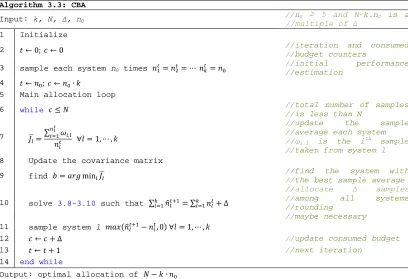
3.10 A pseudo-code of the CBA algorithm 55
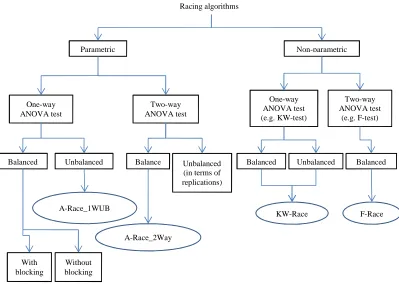
3.11 Classification of the Racing algorithms used in this thesis 56
3.12 A pseudo code of a Racing algorithm 72
3.13 A pseudo code of a Racing algorithm with a reset 74
3.14 An example of Racing with reset 75
Chapter 4: Experiments, Results, and Analysis Meta-Optimization with a Flexible Budget
No. Description Page
4.1
Comparison of the Fixed and Flexible Budget methods at different computational budgets. In this example, the Flexible Budget, using L, AUC,
or AL, was able to find a better (lower) solution quality at each of the four selected budgets less than 3000 (nmax)
79
4.2 Example instances of the hump function in 2D.Set-2 81
4.3 Example instances of the quadratic function in 2D.Set-3 82
Chapter 5: Experiments, Results, and Analysis Computational Budget Allocators
No. Description Page
5.1 Comparison of different algorithms based onPICSunder 0.0
(above) and 0.9 (below) correlation.~ࣨ (݅, 6ଶ)∀݅= 0, … ,݇ −1 109
5.2 Overall allocation of different algorithms at 0.0 and 0.9 correlation.
~ࣨ (݅, 6ଶ)∀݅= 0, … ,݇ −1. The numbers are averaged over all replications 111
5.3 Estimated mean of the best two systems under 0.0 correlation at selected
points throughout the run.~ࣨ(݅, 6ଶ)∀݅= 0, … ,݇ −1 114
5.4 Cumulative budget allocated to each system throughout the run, averaged over all replications.~ࣨ (݅, 6ଶ)∀݅= 0, … ,݇ −1. Correlation = 0.0 115
5.5 Cumulative budget allocated to each system throughout the run, averaged over
~ࣨ (݅, (݇ − ݅) )∀݅= 0, … ,݇ −1
5.7
Overall allocation of different algorithms at 0.0 and 0.9 correlation. ~ࣨ (݅, (݇ − ݅)ଷ)∀݅= 0, … ,݇ −1. The numbers are averaged over all
replications
118
5.8 Cumulative budget allocated to each system throughout the run, averaged over all replications.~ࣨ(݅, (݇ − ݅)ଷ)∀݅= 0, … ,݇ −1. Correlation = 0.0
120
5.9 Cumulative budget allocated to each system throughout the run, averaged over all replications.~ࣨ(݅, (݇ − ݅)ଷ)∀݅= 0, … ,݇ −1. Correlation = 0.9 122
5.10
Cumulative budget allocated to each system throughout the run, averaged over all replications.~ࣨ(݅, (݇ − ݅)ଷ)∀݅= 0, … ,݇ −1. Correlation = 0.9.
Only the systems getting less thann0are displayed
123
5.11 Comparison of different algorithms based onPICSunder 0.0
(above) and 0.9 (below) correlation.~ࣨ (݅, (݅+ 1)ସ)∀݅= 0, … ,݇ −1 125
5.12
Overall allocation of different algorithms at 0.0 and 0.9 correlation. ~ࣨ(݅, (݅+ 1)ସ)∀݅= 0, … ,݇ −1. The numbers are averaged over all
replications
125
5.13 Cumulative budget allocated to each system throughout the run, averaged over all replications.~ࣨ(݅, (݅+ 1)ସ)∀݅= 0, … ,݇ −1. Correlation = 0.0
127
5.14 Cumulative budget allocated to each system throughout the run, averaged over all replications.~ࣨ(݅, (݅+ 1)ସ)∀݅= 0, … ,݇ −1. Correlation = 0.9 128
5.15 Cumulative allocations (a) byKW-RaceRR and convergence curves (b) based onPICSfor ~ࣨ(݅, (݅+ 1)ସ)∀݅= 0, … ,݇ −1. Correlation = 0.9 129
5.16 Comparison of different algorithms based onPICSunder 0.0 and 0.9 correlation (above) and (below).~ࣨ ൫ܷ(0,݇),ܷ(10,24)൯Set-A
131
5.17 Overall allocation of different algorithms at 0.0 and 0.9 correlation. ~ࣨ ൫ܷ(0,݇),ܷ(10,24)൯Set-A. The numbers are averaged over all replications
132
5.18 Cumulative budget allocated to each system throughout the run, averaged over all replications.~ࣨ ൫ܷ(0,݇),ܷ(10,24)൯Set-A. Correlation = 0.0
134
5.19 Cumulative budget allocated to each system throughout the run, averaged over all replications.~ࣨ ൫ܷ(0,݇),ܷ(10,24)൯Set-A. Correlation = 0.9
135
5.20 Box plots of the budget consumed byKW-Race at variousαvalues, and different correlation levels. The connecting line is that of the means
139
5.21 ECs based onfrat 0.0 (above) and 0.9 (below) correlation levels. Data are drawn from~ࣨ (݅, 6ଶ)∀݅= 0, … ,݇ −1
141
5.22 ECs based onfrat 0.0 (above) and 0.9 (below) correlation levels. Data are
~ࣨ(݅, (݅+ 1) )∀݅= 0, … ,݇ −1
5.24 Weibull (left) and Gamma (right) distributions used inSet-3 experiments 146
5.25 Comparison of different algorithms based onPICSunder 0.0 (above) and 0.9 (below) correlation.~ࣞ(݅, 6ଶ)∀݅= 0, … ,݇ −1
149
5.26 Overall allocation of different algorithms at 0.0 (a) and 0.9 (b) correlation.
~ࣞ(݅, 6ଶ)∀݅= 0, … ,݇ −1. The numbers are averaged over all replications 150
5.27 Cumulative budget allocated to each system throughout the run.~࣡(݅, 6ଶ)∀݅= 0, … ,݇ −1. Correlation = 0.0 (above) 0.9 (below) 151
5.28 Cumulative budget allocated to each system throughout the run.
~ࣱ (݅, 6ଶ)∀݅= 0, … ,݇ −1. Correlation = 0.0 (above) 0.9 (below) 152
5.29 Cumulative budget allocated to each system byKW-RaceRR throughout the
run. Correlation = 0.9. 153
5.30 Comparison of different algorithms based onPICSunder 0.0 (above) and 0.9
(below) correlation.~ࣞ൫݅, 3(݇ − ݅)൯∀݅= 0, … ,݇ −1 155
5.31 Cumulative budget allocated to each system throughout the run. ~ࣨ ൫݅, 3(݇ − ݅)൯∀݅= 0, … ,݇ −1. Correlation 0.0 (above) 0.9 (below)
156
5.32 Cumulative budget allocated to each system throughout the run.
~࣡൫݅, 3(݇ − ݅)൯∀݅= 0, … ,݇ −1. Correlation 0.0 (above) 0.9 (below) 157
5.33 Cumulative budget allocated to each system throughout the run.
~ࣱ ൫݅, 3(݇ − ݅)൯∀݅= 0, … ,݇ −1. Correlation 0.0 (above) 0.9 (below) 158
5.34 Comparison of different algorithms based onPICSunder 0.0 (above) and 0.9
(below) correlation.~ࣞ൫݅, 4(݅+ 1)൯∀݅= 0, … ,݇ −1 161
5.35
Overall allocation of different algorithms at 0.0 (a) and 0.9 (b) correlation. ~ࣞ൫݅, 4(݅+ 1)൯∀݅= 0, … ,݇ −1.
The numbers are averaged over all replications
162
5.36 Cumulative budget allocated to each system throughout the run. ~ࣨ ൫݅, 4(݅+ 1)൯∀݅= 0, … ,݇ −1. Correlation 0.0 (above) 0.9 (below)
163
5.37 Cumulative budget allocated to each system throughout the run. ~࣡൫݅, 4(݅+ 1)൯∀݅= 0, … ,݇ −1. Correlation 0.0 (above) 0.9 (below)
164
5.38 Cumulative budget allocated to each system throughout the run.
~ࣱ ൫݅, 4(݅+ 1)൯∀݅= 0, … ,݇ −1. Correlation 0.0 (above) 0.9 (below) 165
5.39 Comparison of different algorithms based onPICSunder 0.0 (above) and 0.9 (below) correlation.~ࣞ൫ܷ(0,15),ܷ(20,40)൯
~ࣨ ൫ܷ(0,15),ܷ(20,40)൯
5.41 Cumulative budget allocated to each system throughout the run.
~࣡൫ܷ(0,15),ܷ(20,40)൯. Correlation 0.0 (above) 0.9 (below) 169
5.42 Cumulative budget allocated to each system throughout the run.
~ࣱ ൫ܷ(0,15),ܷ(20,40)൯. Correlation 0.0 (above) 0.9 (below) 170
5.43 Estimated mean of the best four systems under 0.0 correlation at selected points throughout the run.~ࣨ ൫ܷ(0,15),ܷ(20,40)൯ 171
5.44 Validation of CBA against published results based onPICS.
~ࣨ (݅, 6ଶ)∀݅= 1, … ,݇. 176
5.45 Estimation of the covariance between system 0 and all other systems.
Estimation is made by CBA aftern0at 0.0 (a) and 0.9 (b) correlation 177
5.46 Box plots of the budget consumed byA-Race_2W at variousαvalues, and
different correlation levels. The connecting line is that of the means 180
5.47 ECs based onfrat 0.0 (above) and 0.9 (below) correlation levels. Data are
drawn from~ࣨ (݅, 6ଶ)∀݅= 0, … ,݇ −1. 181
5.48 ECs based onfrat 0.0 (above) and 0.9 (below) correlation levels. Data are
drawn from ~ࣨ (݅, (݇ − ݅)ଷ)∀݅= 0, … ,݇ −1 182
5.49 ECs based onfrat 0.0 (above) and 0.9 (below) correlation levels. Data are
drawn from ~ࣨ(݅, (݅+ 1)ସ)∀݅= 0, … ,݇ −1 183
5.50 ECs based onfrat 0.0 (above) and 0.9 (below) correlation levels. Data are
drawn from~ࣨ ൫ܷ(0,݇),ܷ(10,24)൯Set-A 184
5.51 ECs based onfrat 0.0 (above) and 0.9 (below) correlation levels. Data are
drawn from~ࣨ ൫ܷ(0,݇),ܷ(10,24)൯Set-B 185
5.52 E[OC]for 0.0 (above) and 0.9 (below) correlation. Case 1 186
5.53 E[OC]for 0.0 (above) and 0.9 (below) correlation. Case 2 187
5.54 E[OC]for 0.0 (above) and 0.9 (below) correlation. Case 3 188
5.55 E[OC]for 0.0 (above) and 0.9 (below) correlation. Case 4,Set-A 189
5.56 Comparison of different algorithms based onb) and 0.9 (c and d) correlation. ~N(U(0,k),U(10,24))PICSandE[OC]under 0.0 (a andSet-B 190
5.57 ~N(U(0,k),U(10,24))Overall allocation of different algorithms at 0.0 and 0.9 correlation.Set-B. The numbers are averaged over all replications 191
5.60 E[OC]at 0.0 (left) and 0.9 (right) correlation for Case 1 194
5.61 E[OC]at 0.0 (left) and 0.9 (right) correlation for Case 4Set-A. 194
5.62 ECs based onfrand E[OC] at 0.0 (a and b) and 0.9 (c and d) correlation levels
for Case 4Set-B 194
5.63 E[OC]at 0.0 (left) and 0.9 (right) correlation for Case 3 195
degree of Doctor of Philosophy in Operational Research and Management Sciences. It has
been composed by myself and has not been submitted in any previous application for any
degree at any other university. All the work presented here, including the data and analysis,
was carried out by the author.
Parts of this thesis have been published:
1. Branke, J. and Elomari, J. A., 2012. Meta-optimization for parameter tuning with a
flexible computing budget. In:Soule, T. ed.Genetic and Evolutionary Computation
Conference.Philadelphia, 7-11 July. New York: ACM.
2. Branke, J. and Elomari, J., 2013. Racing with a fixed budget and a self-adaptive
significance level. In: Pardalos, P. and Nicosia, G. eds. Learning and Intelligent
Chapter 2: Literature Review
No. Description Page
2.1 A sample comparison of the number of hyper-parameters required by some online controllers and the corresponding number of parameters to control 42
Chapter 3: Theory and Methodology
No. Description Page
3.1 Data arrangement for a two-way ANOVA model 57
3.2 Data arrangement for a one-way ANOVA model 58
3.3 Data arrangement for a one-way ANOVA model with blocking 58 3.4 Test statistic calculations of a fixed effects two-way ANOVA model 61 3.5 Test statistic calculations of a fixed effects one-way ANOVA model
without blocking 62
3.6 Test statistic calculations of a fixed effects one-way ANOVA modelwith blocking 62 3.7 Test statistic calculations of a mixed effects two-way ANOVA model 62 3.8 Effect of correlation on the actualNominalαα= 0.05values of a one-way ANOVA 63
3.9
Effect of heterogeneous variances on the actualαvalues of a one-way ANOVA model with various sample sizes
Nominalα= 0.05
64
3.10 Effect of heterogeneous variances on the actual α values of a one-way ANOVA 64
3.11 Effect of heterogeneous variances on the actual α values of a one-way ANOVA model with equal sample sizes (n1=n2= 10)
64
3.12 Effect of non-normality on the actualαvalues for a one-way ANOVA,
with different number of treatments and sample sizes 65 3.13 Effect of non-normality on the actualwith different number of treatments and sample sizesβvalues for a one-way ANOVA, 65
3.14 Effect of binomial data on the actualαvalues for a one-way ANOVA,
with various numbers of treatments and equal sample sizes 65 3.15 Effect of binomial data on the actualwith different sample sizes and a constant number of treatmentsβvalues for a one-way ANOVA, 66
3.16 Data arrangement for theF-test 68
No. Description Page 4.1 nmaxandbifor which parameters of CMA-ES are to be tuned 80
4.2
Comparison of the solution quality obtained by the Fixed and the Flexible Budget methods at various computational budgets, with α = 0.05
Results are forSet-1 functions
83
4.3 methods forThe best parameter settings proposed by the Fixed and Flexible BudgetSet-1. The numbers are averaged over all 30 replications of the meta-EA
84
4.4
Comparison of the solution quality obtained by the Fixed and Flexible Budget methods at various computational budgets, with α = 0.05.
Results are for thehumpfunction in5Dwhere training and testing instances are different
87
4.5
Comparison of the solution quality obtained by the Fixed the Flexible Budget methods at various computational budgets, with α = 0.05.
Results are for thehumpfunction in10Dwhere training and testing instances are different
88
4.6
Comparison of the solution quality obtained by the Fixed the Flexible Budget methods at various computational budgets, with α = 0.05.
Results are for thehumpfunction in15Dwhere training and testing instances are different
89
4.7
Best parameter settings suggested by the Fixed and Flexible Budget methods. Highlighted cells indicate lowerµ/λratios proposed by the Flexible Budget.
Results are for thehumpfamily of functions in5D
91
4.8
Best parameter settings suggested by the Fixed and Flexible Budget methods. Highlighted cells indicate lowerµ/λratios proposed by the Flexible Budget.
Results are for thehumpfamily of functions in10D
92
4.9
Best parameter settings suggested by the Fixed and Flexible Budget methods. Highlighted cells indicate lowerµ/λratios proposed by the Flexible Budget.
Results are for thehumpfamily of functions in15D
92
4.10 dimensions forComparison of the best parameters proposed by each method acrossSet-2. Results are limited to the 3000 budget case as it is the only common case between all dimensions
93
4.11 Comparison of the solution quality obtained by the Fixed Budget method andthe Flexible Budget method at various computational budgets, withα= 0.05. Results are for the quadratic function in5D
94
4.12 Comparison of the solution quality obtained by the Fixed Budget method andthe Flexible Budget method at various computational budgets, withα= 0.05. Results are for the quadratic function in10D
95
4.13 Comparison of the solution quality obtained by the Fixed Budget method andthe Flexible Budget method at various computational budgets, withα= 0.05. Results are for the quadratic function in15D
Results are for thequadraticfamily of functions in5D
4.15
Best parameter settings suggested by the Fixed and Flexible Budget methods for various computational budgets.
Results are for thequadraticfamily of functions in10D
97
4.16
Best parameter settings suggested by the Fixed and Flexible Budget methods for various computational budgets.
Results are for thequadraticfamily of functions in15D
98
4.17 Comparison of the best parameters proposed by each method across
dimensions forSet-3. Results are for the 400 function evaluations budget 98
4.18 Comparison of the best parameters proposed by each method across
dimensions forSet-3. Results are for the 600 function evaluations budget 99
4.19 Comparison of the best parameters proposed by each method across
dimensions forSet-3. Results are for the 800 function evaluations budget 99
4.20 Comparison of the best parameters proposed by each method across
dimensions forSet-3. Results are for the 1000 function evaluations budget 99
4.21 Computational effort savings gained by the Flexible Budget method over the
Fixed Budget method 100
4.22 better than (+), significantly worse than (-), or no significant difference thanPercentage of times the Flexible Budget method performed significantly (≈) the Fixed Budget method at α = 0.05
101
4.23 Computational effort savings gained by the Flexible Budget method over the Fixed Budget method
101
Chapter 5: Experiments, Results, and Analysis Computational budget allocators
No. Description Page
5.1 Competing algorithms forSet-1 experiments 104
5.2 EitherKW-Race orCompeting algorithms forA-Race_2Way set the budget for OCBA, CBA, and EBASet-2 experiments. 104
5.3 LowestPICSand E[OC] achieved in Case 1 at 2000 samples for various
correlation levels 108
5.4
An example of why thePICSandE[OC]are at minimum near the end of an iteration. The best mean after each sample is shown inbold.
The data are drawn from~ࣨ (݅, 6ଶ)∀݅= 0, … ,݇ −1with 0.9 correlation 110
5.5 Variability in the average ranks assigned to each system byRaceRR, averaged over all replications. TheNAindicates that no ranks wereF-RaceR andKW -assigned to that system beyondn0
5.7 The numbers based on all replications and are reported at the end of the runDeviation of the estimated means from their nominal values. for~ࣨ(݅, (݇ − ݅)ଷ)∀݅= 0, … ,݇ −1with 0.0 correlation
117
5.8
Averages and variances of the ranks assigned to all systems byF-RaceR and KW-RaceRR. The numbers are based on all replications for ~ࣨ (݅, (݇ − ݅)ଷ)∀݅= 0, … ,݇ −1with 0.0 correlation. The numbers inboldrepresent the
location of the largest gap in rank averages
119
5.9 Estimated mean of each system if it is sampled less, or more, than ܰ ௫⁄݇ 119
5.10 LowestPICSand E[OC] achieved in Case 3 at 2000 samples for various
correlation levels 124
5.11 The exact means and variances drawn from~ࣨ ൫ܷ(0,݇),ܷ(10,24)൯ 130
5.12 LowestPICSand E[OC] achieved in Case 4,Set-A, at 2000 samples for
various correlation levels 131
5.13 0.9 correlation. The numbers are reported at the end of the run, and are basedDeviation of the estimated means from their nominal values, under 0.0 and on all replications.~ࣨ ൫ܷ(0,݇),ܷ(10,24)൯.Set-A
133
5.14 LowestPICSand E[OC] achieved in Case 4,Set-B, at 2000 samples for
various correlation levels 136
5.15 0.9 correlation. The numbers are reported at the end of the run, and are basedDeviation of the estimated means from their nominal values, under 0.0 and on all replications.~ࣨ ൫ܷ(0,݇),ܷ(10,24)൯.Set-B
136
5.16 A summary of the best performing algorithms (based onPICS) inSet-1
experiments 137
5.17 A summary of thefrachieved by the competing algorithms at selectedα
points of an EC. Data are drawn from~ࣨ(݅, 6ଶ)∀݅= 0, … ,݇ −1 140
5.18 A summary of thefrachieved by the competing algorithms at selectedα
points of an EC. Data are drawn from~ࣨ ൫ܷ(0,݇),ܷ(10,24)൯. Set-A 141
5.19 A summary of thefrachieved by the competing algorithms at selectedα
points of an EC. Data are drawn from~ࣨ ൫ܷ(0,݇),ܷ(10,24)൯. Set-B 141
5.20 A summary of thefrachieved by the competing algorithms at selectedα
points of an EC. Data are drawn from~ࣨ(݅, (݇ − ݅)ଷ)∀݅= 0, … ,݇ −1 142
5.21 A summary of thefrachieved by the competing algorithms at selectedα
points of an EC. Data are drawn from~ࣨ (݅, (݅+ 1)ସ)∀݅= 0, … ,݇ −1 142
5.24 Deviation of the estimated means, of systems 0-2, from their nominal values.The numbers are based onKW-RaceRR allocations by the end of the run under 0.9 correlation
147
5.25 Percentage of the budget allocated to each system by OCBA at the end of the
run. Data~ࣞ(݅, (݅+ 1)ସ)∀݅= 0, … ,݇ −1 159
5.26 A summary of the best performing algorithms (based onPICS) inSet-3
experiments 172
5.27 Validation of CBA against published results based onPICS.~ࣨ(݅, 6ଶ)∀݅=
1, … ,݇ 176
5.28 Validation of CBA against published results based onPICS.
~ࣨ ൫ܷ(1,݇),ܷ(10,24)൯ 176
5.29 A summary of thefrachieved by the competing algorithms at selectedα
points of an EC. Data are drawn from~ࣨ(݅, 6ଶ)∀݅= 0, … ,݇ −1 178
5.30 A summary of thefrachieved by the competing algorithms at selectedα
points of an EC. Data are drawn from~ࣨ (݅, (݇ − ݅)ଷ)∀݅= 0, … ,݇ −1
178
5.31 A summary of thefrachieved by the competing algorithms at selectedα
points of an EC. Data are drawn from~ࣨ (݅, (݅+ 1)ସ)∀݅= 0, … ,݇ −1 178
5.32 A summary of thefrachieved by the competing algorithms at selectedα
points of an EC. Data are drawn from~ࣨ ൫ܷ(0,݇),ܷ(10,24)൯.Set-A
179
5.33 A summary of thefrachieved by the competing algorithms at selectedα
points of an EC. Data are drawn from~ࣨ ൫ܷ(0,݇),ܷ(10,24)൯.Set-B
179
Chapter 6: Conclusion
No. Description Page
6.1 A summary of the best performing algorithms (based on PICS) inSet-1
experiments 200
6.2 A summary of the best performing algorithms (based on PICS) inSet-2
experiments 201
6.3 A summary of the best performing algorithms (based on PICS) inSet-3
Abbreviation Description Page of definition
ACO Ant Colony Optimization 1
AL Area Lost 48
ANN Artificial Neural Networks 25
ANOVA Analysis of Variance 8
AOS Adaptive Operator Selection 13
AOTA Adaptive Online Time Allocator 35
AP Adaptive Pursuit algorithm 14
A-Race
A Racing algorithm based on a normal-model ANOVA
test
31
A-Race_1WUB A Racing algorithm based on a normal-model 1-way
unbalanced ANOVA test
66
A-Race_2Way A Racing algorithm based on a normal-model 2-way
ANOVA test
66
A-RaceR_2Way Normal model-based 2-way ANOVA Race with Reset 75
A-RaceRR_1WUB Normal model-based 1-way ANOVA Race with Reset
and Resample (unbalanced)
75
ARIMA Autoregressive Integrated Moving Average 24
ARMA Autoregressive Moving Average 24
AUC Area Under the Curve 47
avBSF best-so-far average utility 47
BasicILS Basic ILS (a version of the ParamILS algorithm) 31
BP Back Propagation 25
CA Credit Assignment 13
CL-PSO Comprehensive Learning Particle Swarm Optimization 15
CMA-ES derandomized Evolution Strategy with Covariance
Matrix Adaptation
78
DbV Difference based Velocity update strategy 15
DE Differential Evolution 25
DMAB Dynamic Multi Armed Bandit 17
DP Dynamic Programming 18
E[OC] Expected Opportunity Cost 101
EA Evolutionary Algorithm 1
EBA Equal Budget Allocation 74
EbV Estimation based Velocity update strategy 15
ES Evolutionary Strategy 20
FocusedILS Focused ILS (a version of the ParamILS algorithm) 31
fr Failure rate 101
F-Race A Racing algorithm based on Freidman’s test 29
F-RaceR Non-parametric 2-way Freidman ANOVA Race with
Reset (balanced)
75
GA Genetic Algorithm 22
GE Grammatical Evolution 25
GP Genetic Programming 25
HRTS Hamming Reactive Tabu Search 20
I\F-Race IteratedF-Race 30
ILS Iterated Local Search 18
KW Kruskal-Wallis test 8
KW-Race A Racing algorithm based on Kruskal-Wallis test 70
KW-RaceRR Non-parametric 1-way Kruskal-Wallis ANOVA Race
with Reset and Resample (unbalanced)
L Length 47
LL Lower Level algorithm 44
LSPI Least Squares Policy Iteration 19
LUS Local Unimodal Sampling 25
MAB Multi Armed Bandit 15
MCHH Markov Chain Hyper-heuristic 20
MMAS Max-Min Ant System 26
OCBA Optimal Computing Budget Allocation 33, 8
OPSO Optimized Particle Swarm Optimization 24
OS Operator Selection 13
ParamILS Parameter Iterated Local Search 31
PCS Probability of Correct Selection 51
PD Pareto Dominance 15
PICS Probability of Incorrect Selection 101
PM Probability Matching 14
PM-AdapSS-DE Probability Matching Differential Evolution with
Adaptive Strategy Selection algorithm
13
Pmin/Pmax Minimum/maximum selection probability 14
PR Pareto Rank 15
PS Parameter Setting 74
PSO Particle Swarm Optimization 15
QAP Quadratic Assignment Problem 26
REVAC Relevance Estimation and Value Calibration 37
RL Reinforcement Learning 19
RTS Reactive Tabu Search 19
SAT Boolean satisfiability problem 15
SD Steepest Descent 18
SMAC Sequential Model-based Algorithm Configuration 37
SMBO Sequential Model Based Optimization 35
SPO Sequential Parameter Optimization 36
STGP Strongly Typed Genetic Programming 26
TB-SPO Time Bounded Sequential Parameter Optimization 36
TS Tabu Search 1
TSP Traveling Salesman Problem 23
UCB1 Upper Confidence Bound algorithm 17
CHAPTER 1 Introduction
1.1. Motivation and problem statement
This thesis focuses on the algorithm configuration problem. Many search
algorithms, and metaheuristics in particular, have several parameters that affect their
performance in terms of solution quality and running time. Population size in Evolutionary
Algorithms (EA), tabu list length in Tabu Search (TS), and evaporation rate in Ant Colony
Optimization (ACO) are examples of numerical parameters, while parent and survival
selection types in EAs are examples of categorical parameters. Incorrectly setting these
parameters can, in extreme cases, cause the algorithm to behave greedily, converging early
to a local optimum. Or, it may behave similar to a random walk, where it does not converge
to any solution in the allowed time limit. In either case, computational effort is wasted on
poor quality solutions (De Jong, 2007). Ideally, the algorithm should explore as much as
possible before converging to high quality solution(s). See Figure1.1.
Figure 1.1. Effect of different parameter settings on an algorithm’s performance applied to a minimization problem.
120 170 220 270 320 370 420
S
o
lu
ti
o
n
q
u
a
li
ty
Iteratioin
Informally, the algorithm configuration problem is defined as: finding parameter
values which enable the algorithm to reach its best possible performance within the available
computational budget. Specifying what is “best” depends on the application, it could be, for
instance, the solution quality obtained within a time limit (or computational budget), the
running time needed to reach a target solution quality, or the percentage of how often a
stochastic algorithm reaches a target solution quality under a budget constraint.
Hutter (2009, pp. 9-12) formally defines the problem as a 6-tuple〈,߆, Π,ߢ ௫,ߧ,߬〉
where: Αis a stochastic algorithm,Θ is the parameter space which includes the solution to
the algorithm configuration problem,Πis the set of problem instances, often generated from
a distribution D, κmax is the maximum cap time an algorithm is allowed to run, ο is the
observed performance of the algorithm, and τis a statistical measure (e.g. mean or median)
of the observed performance that is to be optimized.
1.2. Solution approaches
Setting the parameters of an algorithm is not trivial. There are many challenges that
require innovative methods to address them. This section first presents the major challenges,
and then moves to a broad description of the solution approaches.
First, an algorithm can have categorical and/or numerical parameters (continuous
and/or discrete), some of which can be conditional (i.e. they exist only if others do). For
example, crossover rate and tournament size are only relevant for an EA if a crossover
operator and a tournament selection are used, respectively. The parameter space is made up
of all possible combinations of parameter values, and its landscape (defined later) is likely to
be discontinuous and highly multi-modal, such that exhaustive search may not be feasible
(Eiben and Smit, 2011).
Second, evaluating a parameter’s quality, utility hereafter, on stochastic algorithms
may require several replications, which raises the question of how many replications are
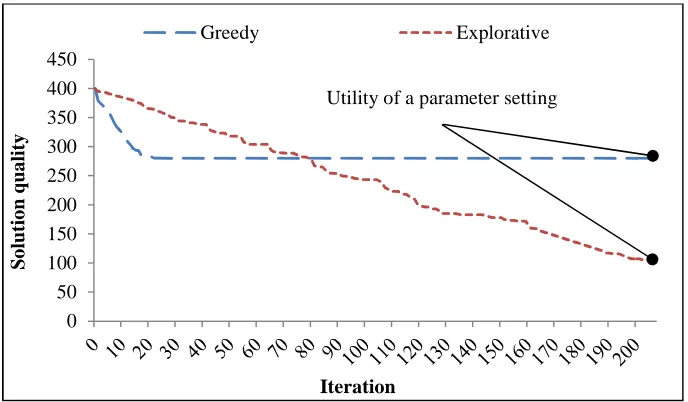
depend on the budget available for assessment. A greedy parameter setting can seem
superior under a small budget compared to an explorative one. The situation may be
reversed if more time is allowed for the latter, see Figure1.2. This presents the challenge of
specifying the budget needed to evaluate a parameter setting.
Figure 1.2. Different parameter settings are suitable for different budgets.
For a minimization problem, a greedy parameter is suitable for small budgets, but not larger ones.
Third, parameter settings which work well on one problem domain, routing for
example, may not work for another, like cutting stock. The same issue extends across
instances of the same domain if they differ greatly, or even within the same instance
depending on its landscape. A problem domain encloses all instances (realizations of the
problem) that share common similarities. Measuring similarities depends on the problem
itself. For example, in a vehicle routing problem the number of nodes, their distribution
(scattered, clustered, or random), and the number of vehicles can be used to distinguish
between various instances. Smith-Miles and Lopes (2011) present several measures to
characterize many real-world optimization problems, and assess their difficulty.
If the problem is to be solved only once, it is desirable to find a parameter setting
which works best for that specific problem. Conversely, if similar problems, or instances, are
to be solved repeatedly, a parameter setting which performs well overall might be preferred. 0
50 100 150 200 250 300 350 400 450
0 20 40 60 80 100 120 140 160 180 200
S
o
lu
ti
o
n
q
u
a
li
ty
Iteration
also point out that finding a good generalist is by itself a multi-objective optimization
problem, with each problem, or instance, being one objective.
Solving the algorithm configuration problem requires another algorithm, working at
a higher level, and capable of searching the parameter space. EAs are an example. To
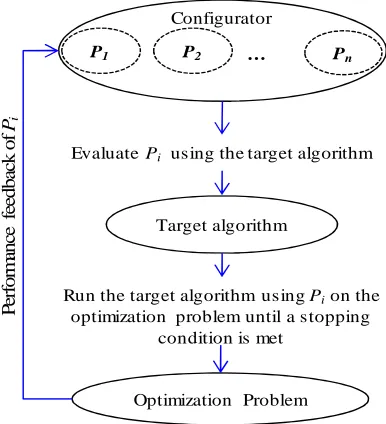
distinguish between both, the higher level algorithm will be referred to as the configurator
and the lower level algorithm as the target algorithm, see Figure 1.3 .The solutions of the
configurator are parameter settings suitable for the target algorithm. Some configurators
generate/modify parameter settings (e.g. through evolution as in EAs), while others only
select the best out of a given set. Note that the configurator is likely to be stochastic as well,
[image:29.595.223.416.345.557.2]indicating that it, too, may require multiple replications.
Figure 1.3. Configuring parameters with a higher level algorithm.
Assessing a parameter’s utility requires running the target algorithm on the
optimization problem until a stopping condition, for that parameter, is met. A stopping
condition for a parameter can be, for example, a pre-specified number of iterations, the
continued application until no improvement is observed, or the continued application until
the target algorithm terminates. A performance measure is then fed back to the configurator
and used to determine the utility. Note that more than one performance measure can be
reported and combined in calculating a utility (e.g. running time and/or solution quality). Target algorithm
Optimization Problem
P1 P2 … Pn
EvaluatePi using the target algorithm
Run the target algorithm usingPion the
optimization problem until a stopping condition is met
P
er
fo
rm
an
ce
fe
ed
b
ac
k
o
f
Pi
The stopping condition for a parameter determines the frequency of feedback to the
configurator. One extreme is to report the performance only after the target algorithm
terminates, in which case multiple assessments require multiple complete runs of the target
algorithm on different instances of the optimization problem. The other extreme is to report
performance after one or more applications of a parameter (an operator) before the target
algorithm terminates, in which case the configurator gets feedback while the optimization
problem is being solved.
The former case will be referred to as offline tuningas parameter settings are learnt
after the problem is solved across many instances, and remain fixed. It is suitable for finding
a generalist based on a training set of instances that is assumed to be large enough and
representative, such that the best parameter setting found during training will also perform
best on other, unseen, test instances. The latter case will be referred to as online controlas
parameter settings are learnt, and hence change, while solving the problem. It is suitable for
finding a specialist.
Using online or offline rests on the application; does the problem require a specialist
or a generalist? It remains unclear, however, if a generalist can perform just as well as a
specialist, or if there is much to gain from online control over offline tuning. This issue will
be further addressed in Chapter 2, where a comprehensive overview of the state-of-the-art
configurators is presented, alongside a unique classification.
Finally, the termHyper-heuristicswas introduced just over a decade ago to refer to
high-level methods specializing in generating or selecting lower-level heuristics, or heuristic
components. The heuristics can be simple crossover or local search operators for example.
They can also be parameter settings for algorithms. Hyper-heuristics have little or no
problem domain knowledge, only information about the heuristics themselves; thus,
heuristic that is potentially able to solve a number of problem instances. Selective
hyper-heuristics, however, select and apply a heuristic to the current solution in order to improve it.
Comprehensive surveys on the topic are found in Burke et al. (2013) and in Chakhlevitch
and Cowling (2008).
Almost any configurator can be viewed as a hyper-heuristic. In this work, though,
the terms configurator, parameter setting/operator, and target algorithm will be used to
describe a framework for the algorithm configuration problem.
1.3. Contributions
The contributions are methodological. In specific, new efficient configurators are
introduced to tune algorithm parameters. This Section briefly describes each contribution,
the motivation behind it, and a summary of its experimental assessment results.
1.3.1. Meta-Optimization with a Flexible Budget
The first contribution concerns offline tuning, where the configurator modifies its
solutions to reach better ones. Such configurators are also known as meta-optimization
methods. Meta-optimizers are computationally intensive as evaluating a single parameter
setting requires a complete run of the target algorithm on the optimization problem. Also,
several replications, for both levels, may be required for stochastic algorithms. Matters
become worse if the computational budget for the target algorithm varies, because this will
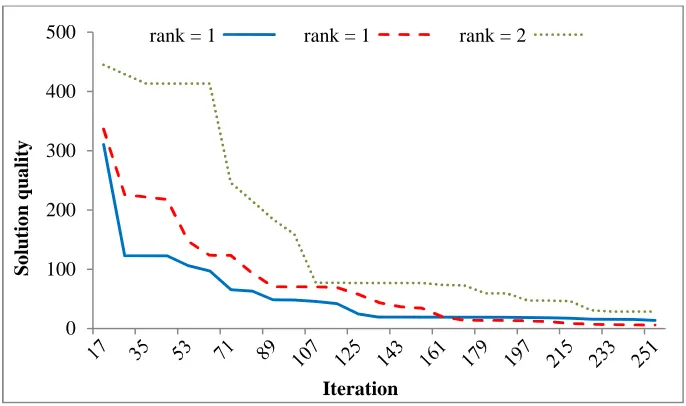
require a re-run of the whole meta-optimizer for each potential new budget. Figure 1.4
displays the performance of an algorithm, applied to a minimization problem, under three
different parameter settings. It is clear that the best parameter setting depends on the length
Figure 1.4. The performance of an algorithm, applied to a minimization problem, under three different parameter settings, each is suitable for a different computational budget.
This work proposes a new meta-optimizer capable of finding the best parameter
settings for any computational budget less than a specified maximum in a single run, thus
saving a lot of time. The algorithm is called Meta-Optimization with a Flexible Budget, or
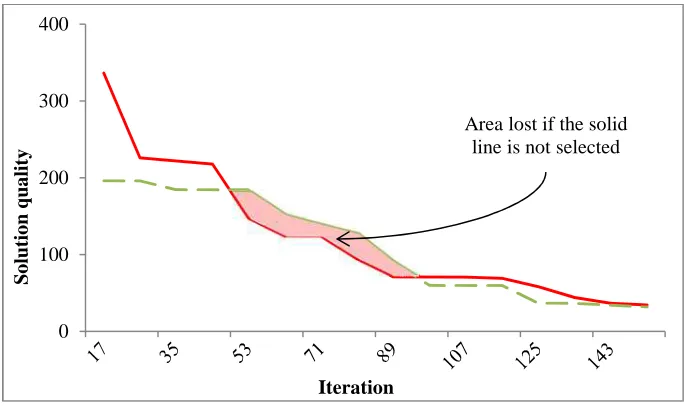
Flexible Budget for short. It makes use of the entire convergence curve of a parameter
setting to calculate a rank-based utility.
It will be shown later that, for the experiments conducted here, the Flexible Budget
method always finds the best parameter settings for any computational budget less than a
specified maximum, while saving about 60%-70% of the computational effort required by
the repeated application of the Fixed Budget method, without compromising solution
quality. However, some experiments with a small budget using the quad function (defined
later), showed minor solution quality degradation. Further details are in Chapter 4. Initial
results of this method were presented in Branke and Elomari (2012).
A real-world application of the Flexible Budget is found in shipping. For next-day
parcel deliveries, the daily work load varies, which, in turn, affects the time needed to
prepare the parcels (e.g. inspection, weighing, sorting.). Such variability disturbs the running
time available to a routing algorithm dispatching vehicles on the next day. Obviously, with
only one to two hours at hand, the algorithm may perform better with a greedy parameter 0
50 100 150 200 250 300 350 400 450
0 20 40 60 80 100 120 140 160 180 200
S
o
lu
ti
o
n
q
u
a
li
ty
Iteration
1.3.2. Racing with a self-adaptive significance level
The second contribution also falls under offline tuning where the configurator
selects the best out of a set of parameter settings. There are a number of algorithms that
specialize in efficiently allocating a computational budget (e.g. a training set) among several
competing systems, the characteristics of which are unknown beforehand, such that the true
best is selected when the budget is consumed. These algorithms guarantee a correct selection
in the limit (i.e. if the budget is infinite), and converge to it at varying rates.
The term “system” is originally used in the Simulation Optimization literature to
refer to the performance of a simulated system (e.g. a production plant), which is usually
modeled with a probability distribution. Here, the term will be used to speak of the
performance of an algorithm, or a parameter setting over various problem instances.
Racing is one such algorithm. It works by discarding inferior systems, or parameter
settings, as soon as there is enough statistical evidence that they are significantly worse than
the current best. In every iteration, the surviving systems are sampled once and the tests are
run again. This continues until one system remains, or if the entire budget is consumed, in
which case the system with the best performance measure is chosen as the winner. The
algorithm’s performance (e.g. the probability of selecting the best) is affected by the
significance level α set by the user. A very high α results in less conservative tests and
increases the probability of discarding the true best as the systems are dropped off more
quickly. A very low α means more conservative tests, where the systems are hardly
discarded and the algorithm samples all systems almost equally.
Note that Racing may terminate before the entire budget is consumed. In situations
where there is a fixed budget constraint, such that there is no advantage of terminating the
algorithm beforehand, a new Racing algorithm, Racing with reset, is introduced. Its basic
idea is as follows: whenever a winner is identified and the budget is not entirely consumed,
significance level, and runs the tests on all systems. Consequently, if the best system was
incorrectly discarded before, it now has another chance to survive in the race. The process is
repeated as many times as needed until the budget is consumed. Racing with reset is thus
able to consume any given budget and at the same time automatically adaptα.
It will be shown later that Racing with reset, at a relatively highα(say 0.3), always
reaches a lower probability of incorrect selection (defined later), than its standard version
with the best fixed α set by the user. Moreover, if the variances of the parameter settings’
performance distribution are quite close, or they are highly correlated, its probability of
incorrect selection converges to zero faster than one of the best budget allocators from the
Simulation Optimization literature, namely the Optimal Computing Budget Allocation
(OCBA) algorithm, which addresses a problem similar to the focus of this thesis. See Chen
and Lee (2010). There are, of course, situations where Racing with reset is inferior (e.g. if
the variances are exponentially increasing), such situations will be detailed in Chapter 5.
Initial results of Racing with reset were presented in Branke and Elomari (2013).
1.3.3. One-way Racing with an intelligent budget allocation
All Racing algorithms currently used in the literature rely on a two-way Analysis of
Variance (ANOVA) test, so as to account for the effect of the parameter setting (first factor),
the effect of the problem instance (second factor), and their interaction. This, in turn, dictates
having an equal number of samples for each of the competing systems whenever the tests are
run, More importantly, every time a system is discarded, the remaining systems mustall be
sampled the same number of times (once is the default). This has two disadvantages, first, it
does not allow for a more intelligent way of allocating the budget in each iteration. Second,
it does not allow Racing with reset to use all previously collected data if the algorithm
terminates before the budget is consumed.
called KW-RaceR and can handle unequal sample sizes. To better allocate the budget in
every iteration, instead of sampling all surviving systems equally, OCBA is run to determine
the distribution of that iteration’s budget, utilizing all previous knowledge. This combination
allows for a different exploration vs. exploitation balance, compared to that obtained with
equal allocation (the default). It will be shown that such a combination causes KW-RaceR to
perform very similarly to OCBA.
1.4. Organization of the thesis
This thesis consists of six main chapters. Every chapter begins with an introduction
section stating its objectives and expectations, and finishes with a conclusion section
summarizing the main issues and findings. It is possible to grasp the main ideas of this thesis
just by reading these two sections of each chapter.
The most relevant work to the developed methods are reviewed in Chapter 2, with
the main objectives of positioning the before mentioned contributions within the literature,
and highlighting some areas that received little or no attention, and are believed to represent
future research topics. The theory and methodology of each contribution are detailed in
Chapter 3. Chapter 4 empirically validates the first contribution by comparing it to the
current methods in the literature and over a variety of scenarios. Chapter5does the same for
the second and third contributions. Finally, Chapter 6 summarizes what was presented and
CHAPTER 2 Literature Review
2.1 Introduction
The algorithm configuration problem has been recently advanced by different
research communities, and now there exists a wealth of literature describing various solution
approaches. Many of these approaches can be seen as extensions, or variations, of a few
ideas, and can hence be grouped under a common umbrella. This chapter identifies two such
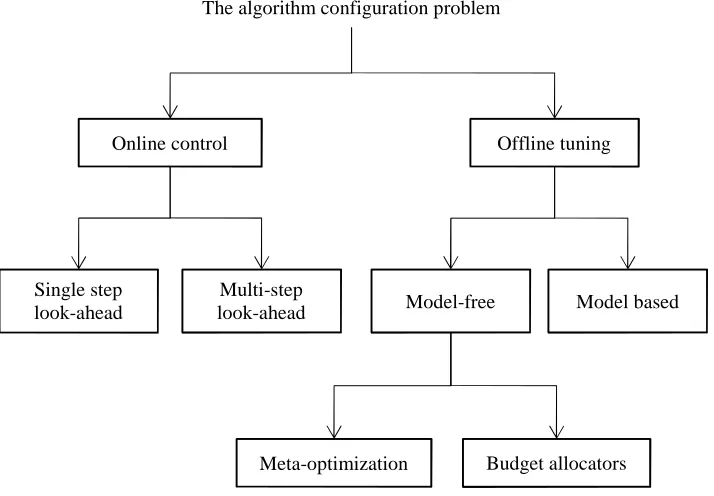
key ideas, online control and offline tuning. It then organizes the current literature
accordingly, along with a constructive critique when possible. This classification will assist
in understanding how the current state-of-the-art methods have developed, and it helps
position the work presented in this thesis.
The chapter is organized as follows: Section 2.2 describes the basis for the
classification and the applications of each class. Section 2.3reviews the literature on online
control. Section 2.4 reviews the literature on offline tuning. Section 2.5 presents a few
experimental studies comparing both classes. Section 2.6 points to some research areas
which received little, or no, attention so far. Finally, Section2.7concludes this chapter.
2.2 Classification
Broadly speaking, algorithm configurators can be seen as online controllers, or
offline tuners. The difference being whether parameters change while the target algorithm is
solving the optimization problem, according to feedback from the search, or they remain
fixed. In both cases these parameter settings have to be learnt; online methods do it
on-the-fly, which makes them more likely to find specialized parameter settings for specific
makes them more likely to find generalized parameter settings suitable for instances similar
to the training set.
Eiben et al. (1999) distinguished between three types of online control:
deterministic, self-adaptive, and adaptive. Deterministic methods first learn a schedule of
parameter-changes based on a training set, and then apply these changes while the target
algorithm is running; hence, there is no feedback from the specific instance being solved.
Still, they can be considered as online controllers as the parameters change. Self-adaptive
methods are best seen in an EA context, where the parameter settings are encoded with the
solutions and evolve to better values. Whitacre et al.(2006) pointed out that such methods
increase the size of the search space, making the problem even harder to solve. Finally,
adaptive methods use performance feedback gathered during the search to determine which
operator to apply next.
A different sub-division of online control is proposed in this thesis, that is: single
step look-ahead methods, where the operator which is best for the next immediate move is
preferred, or multi-step look-ahead methods, where the operator which is bestn-steps ahead
is preferred. The latter assumes that while the immediate rewards of a chosen operator may
be less than those of the others, the gain expected n-steps ahead outweighs such smaller
losses.
Offline methods are sub-divided according to whether, or not, a model is built to
guide the search for the best parameter setting. The model represents a relationship between
the performance of an algorithm and a particular parameter setting. Model-free offline tuners
are further sub-grouped into meta-optimizers, or computational budget allocators that
efficiently distribute a training budget among the competing parameters. Figure 2.1 shows
The application determines whether to use online or offline. If one is
interested in solving a single instance, a dynamic instance, or instances that are quite
different from one another, then online control is expected to discover a specialist for
that particular instance, without the need for the expensive training overhead
required by offline tuning, which may not be feasible to begin with. On the other
hand, if one is interested in solving many, similar, instances, then it may be
meaningful to invest once in offline tuning and find a generalist that works well on
many instances. In addition, offline tuning has the advantage of synthesizing
algorithm components, or even entire algorithms through Genetic Programming or
Grammatical Evolution.
Online control Offline tuning
The algorithm configuration problem
Single step look-ahead
Multi-step
look-ahead Model-free Model based
[image:38.595.141.498.78.326.2]Meta-optimization Budget allocators
2.3 Online control
2.3.1 Single step look-ahead
Adaptive Operator Selection (AOS) methods are composed of two stages: Credit
Assignment (CA) and Operator Selection (OS). AOS applies an operator, from a set of
operators, to the target algorithm, observes its effect, assigns a reward to that operator based
on its performance, and finally selects an operator for the next iteration. The underlying
assumption is that the credit assigned to an operator, up until the current iteration, is
indicative of its future performance. Different CA and OS methods are available, and any
combination can be used.
The most basic CA method is based on solution quality observed during the last
iteration. A slightly advanced version considers the average quality, or a weighted average,
over the lastn iterations. Whitacreet al.(2006) were among the first to introduce the idea
that operators which produce rare, but large, improvements could be more beneficial than
those performing well on average. They setup an experiment to select the best out of ten EA
operators using five CA methods based on average performance, and two based on extreme
values. Results showed that the two extreme-value methods were significantly better than
the rest. However, they pointed out that if extreme improvements are very rare, it might be
better to focus on operators with steady improvements, especially towards the end of the run.
Extreme values were not always beneficial, for example Gonget al.(2010) applied
four CA methods to a Probability Matching Differential Evolution with Adaptive Strategy
Selection algorithm (PM-AdapSS-DE), they were: absolute reward, average normalized
reward, extreme absolute reward, and extreme normalized reward. PM-AdapSS-DE was
compared to a uniform selection DE and the Self-adaptive Differential Evolution algorithm
(SaDE) of Qinet al.(2009). PM-AdapSS-DE was able to outperform the others in terms of
solution quality and convergence speed when using average rewards instead of extreme