ISSN Print: 2161-718X
DOI: 10.4236/ojs.2019.93025 Jun. 30, 2019 361 Open Journal of Statistics
A Statistical Comparison of the Implementation
of Concurrent Engineering
in Jordanian Industry
Mohammad D. Al-Tahat
1, Ala’a M. Al-Habashneh
1, Issam S. Jalham
21Industrial Engineering Department, the University of Jordan, Amman, Jordan 2School of Engineering, the University of Jordan, Amman, Jordan
Abstract
In this paper, a statistical comparative investigation of the implementation of Concurrent Engineering (CE) in Jordanian Industry is introduced, practices of CE are reviewed, then mapped into six statistical latent. A Structural Equa-tion Model (SEM) is developed for the implementaEqua-tion of CE, then the model is applied to the following Jordanian industrial sectors: chemical and cosmet-ics industries, engineering and electrical industries and information technol-ogy, wood and furniture industries, and construction industry. The imple-mentation level for the six CE practices among the selected sectors is investi-gated; a statistical comparative analysis between the considered industrial sectors is conducted. Thereafter, a system dynamics model is developed to understand the true CE trade-offs, which is used as a validity measure to in-sure that the proposed statistical model and hypotheses are valid.
Keywords
Concurrent Engineering, Structural Equation Model, SEM, System Dynamics, Jordan, Social Statistics
1. Introduction
Authors continuously applying different methodologies searching for solutions improve the performance of operations and systems from multiple aspects. AL-Tahat M. D. considered the Japanese Kanban methodology to formulate a production line as a queuing network model [1]. A study was conducted by Al-Momani K. R. et al. [2] in order to assess the needs of performance im-provement of maintenance effectiveness measures imim-provement of the health
How to cite this paper: Al-Tahat, M.D., Al-Habashneh, A.M. and Jalham, I.S. (2019) A Statistical Comparison of the Implementa-tion of Concurrent Engineering in Jordanian Industry. Open Journal of Statistics, 9, 361-372.
https://doi.org/10.4236/ojs.2019.93025
Received: May 26, 2019 Accepted: June 27, 2019 Published: June 30, 2019
Copyright © 2019 by author(s) and Scientific Research Publishing Inc. This work is licensed under the Creative Commons Attribution International License (CC BY 4.0).
http://creativecommons.org/licenses/by/4.0/
DOI: 10.4236/ojs.2019.93025 362 Open Journal of Statistics
care services; for in King Abdullah University Hospital (KAUH). Al-Refaie A. et al.[3] examined the factors that affect firm performance using structural equa-tion modeling; they developed a structural model that includes several latent, in-cluding knowledge management, organization learning, customer relationship management, employee performance, innovation and business performance. AL-Tahat M. D. etal.[4] presented an Activity-Based Cost Estimation Model for better estimation of the cost of producing steel castings in a foundry system. A model to estimate the weights of mutually dependent criteria, based on cause-effect assessments of a group of professionals, is developed by Dalalah D.
etal.[5] for problem of multiple criteria decision making (MCDM). For phar-maceutical industry, Al-Tahat M. D. et al.[6] used an Ordinal Logistic Regres-sion Modeling (OLRM) to predict and to investigate the relationship(s) between the different types of failures encountered in tablet production and the relevant tablet- and punch attributes. Mohammad D., Al-Tahat et al. [7] presented a model of a multi-phase multi-product manufacturing system considering a con-stant work-in-process (CONWIP) control mechanism using continuous-time Markov chain modelling approach; the analyses explain a foundation needed for analyzing the steady state behavior of manufacturing systems. For microsystem technologies, Aljanaideh O. etal.[8] suggested a new hysteresis model that can describe rate and bias effects of the harmonic magnetic fields on hysteresis non-linearities of a magnetostrictive actuator. The model characterized the asymme-tric hysteresis effects under different levels of input magnetic bias. Unlike the aforementioned methodologies, authors in this paper presented another metho-dology for performance improvements, Concurrent Engineering (CE) is intro-duced, and then a Structural Equation Model (SEM) is developed for the imple-mentation of CE in some Jordanian industrial sectors.
DOI: 10.4236/ojs.2019.93025 363 Open Journal of Statistics
concurrency, 3) people, 4) process, 5) instruments and technology.
This paper aims to: 1) provide a statistical comparative investigation of the implementation of CE in Jordanian Industry, 2) provide a dynamics model for better understanding of the effects of CE on industry.
2. Statistical Latent of the Proposed Model
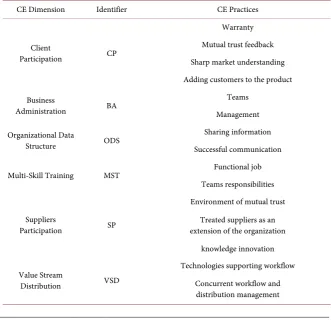
[image:3.595.207.539.420.742.2]Concurrent Engineering is supposed to involve six-construct latent listed in
Table 1. These are Client Participation, Business Administration, Organizational Data Structure, Suppliers Participation, Value Stream Distribution, and Mul-ti-Skill Training. The following sub-section describes briefly each of these latent.
2.1. Client Participation (CP)
Firms depend on acquiring markets; with products, that customer needs [13]. Firms have found a number of techniques to capture customer requirements, sharp market understanding, and feedback from buyers, warranty and adding clients to the product development team, and ensure a sustainable process inno-vation are essential to gain more customs attentions [14].
2.2. Business Administration (BA)
Business Administration (BA) is a common management style for modern small businesses. Administration allows managers to break down the entire operations
Table 1. Mapping of CE practices into six-construct latent.
CE Dimension Identifier CE Practices
Client
Participation CP
Warranty Mutual trust feedback Sharp market understanding Adding customers to the product
Business
Administration BA
Teams Management
Organizational Data
Structure ODS
Sharing information Successful communication
Multi-Skill Training MST Functional job Teams responsibilities
Suppliers
Participation SP
Environment of mutual trust Treated suppliers as an extension of the organization
knowledge innovation
Value Stream
Distribution VSD
DOI: 10.4236/ojs.2019.93025 364 Open Journal of Statistics
of a department into several phases. Dividing operational functions into sections allows management to obtain a clear picture of what the goals of a department are and how to implement the goals most effectively. Administration also allows managers to respond rapidly to factors that affect the internal or external expec-tations of company.
2.3. Organizational Data Structure (ODS)
When the Organizational Data Structure (ODS) is not balanced, the process of collaboration can break down, and the development teams can lose their effec-tiveness. According to Willaert etal.[15], an unwell integrated ODS environment means that communication problems between departments will cause lengthy de-lays in development time and increased costs. A team cannot exist without com-munication, to make the team concept work; therefore, technical information had to be more accessible to all parties involved in the organization [13].
2.4. Multi-Skill Training (MST)
A good team has the foresight to identify, address, and resolve issues through the entire product life cycle. Multi-Skill Training (MST) performance is important for the success of any CE initiative. Teams with team leaders whose functional jobs and team responsibilities have a high degree of overlap tend to be the most successful [16]. A key step in the successful use of teams is training. Training can help speed team effectiveness [17].
2.5. Business Administration (BA)
A successful supplier relationship management model implies; few suppliers, suppliers’ involvements, an environment of mutual trust, and treated suppliers as an extension of the organization [18].
2.6. Value Stream Distribution (VSD)
Value stream distribution (VSD) provides optimum value to customers through a complete value creation process with minimum waste. Supporting technologies for VSD include; work process modeling, performance analyzing, engineering, re-design of processes, and tasks monitoring. For the successful application of workflow, it is essential that there be a good fit between work practice and the models/mechanisms used by the VSD system.
3. Structural Equation Model (SEM) and Statistical
Hypotheses
DOI: 10.4236/ojs.2019.93025 365 Open Journal of Statistics
review. A pretest pilot study conducted on sample size of 20 to test the question-naire clarity, comprehensiveness, wording of questions, and level of sophistication of language and appropriateness of the content [19]. The questionnaire consists of five-point Likert-scale, anchored at 1) “poor”, 2) “fair”, 3) “good”, 4) “very good”, and 5) “excellent”. A sample with a proper size is selected; the sample covers the following industries: therapeutic industries and medical supplies, plastic and rub-ber industries, chemical and cosmetics industries, engineering and electrical in-dustries and information technology, wood and furniture inin-dustries, construction industry, packaging and paper industries, food and agricultural industries.
4. Data Collection and Analysis
Jordanian companies were screened according to whether they have a potential of implementing CE tools or not, the developed questionnaire was distributed to the industrial sectors concerned to apply CE more than others, these sectors are: 1) construction industry, 2) engineering and electrical industries and informa-tion technology, 3) chemical and cosmetics industries, and 4) wood and furni-ture industries. The sample size of those sectors is 492. Feedback of 310 respon-dents is collected; statistical analysis has been carried out using IBM SPSS ver-sion 22. For the developed Structural Equation Model (SEM), ANOVA, Validity, Multicollinearity, internal consistency, and relationships between CE elements and tools are tested, thereafter; the causal relationships of CE elements and their impact on the performance of industrial enterprises are investigated.
4.1. Validity and Reliability
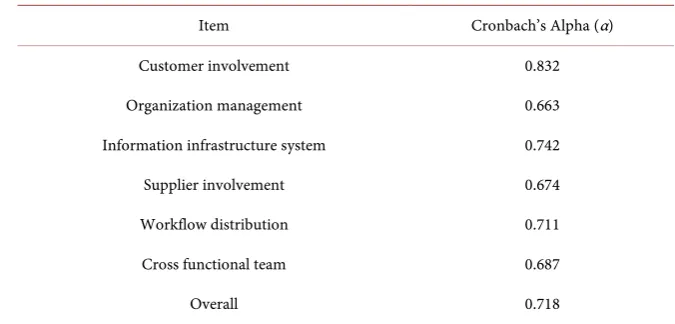
[image:5.595.241.506.515.704.2]The Cronbach’s alpha coefficient [20] is used to evaluate the internal reliability of the developed SEM. It measures the internal consistency of the items of the questionnaire [21], the higher this coefficient, the better the measuring instru-ment. As shown in Table 2, Cronbach’s alpha value of the whole CE practices is equal to 0.718.
DOI: 10.4236/ojs.2019.93025 366 Open Journal of Statistics Table 2. Cronbach’s alpha for each latent.
Item Cronbach’s Alpha (α)
Customer involvement 0.832
Organization management 0.663
Information infrastructure system 0.742
Supplier involvement 0.674
Workflow distribution 0.711
Cross functional team 0.687
Overall 0.718
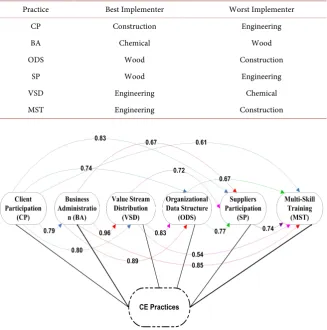
It is observed that the implementation level for the six CE practices among the selected sectors is ranged between 60.37% and 60.70%. Best and worst imple-menter among the ten sectors is illuminated in Table 3.
For CP practice, Construction sector has achieved the best implementation index because construction sector considers the premise that the customers know what they want and what they need, during the definition phase, there is a customer’s self-understanding about the project’s objectives, and confront the customer’s desires by exploring alternatives that were not previously considered
[22]. However, engineering industries exhibits the worst implementation index because practices such as sharp market understanding, and feedback from buy-ers are rarely used in this sector, also gathering relevant customer knowledge in the front end of new product development to enable solid strategies therefore remains a challenge.
On the other hand, for BA practice, wood sector has accomplished low in-dex because of the lack of slack resources, a goal of lean centralized organiza-tional designs, and an inward communication climate. In contrary, chemical sector is classified as the best implementer for BA because in the case of con-struction the lack of fit between the type of infrastructure available and the needs of society [23].
For ODS wood sector has earned the best implementation index, while con-struction sector is the worst. For SP wood sector has earned the best implemen-tation index, while engineering sector is the worst. VSD engineering sector has earned the best implementation index, while chemical sector is the worst.
Finally, engineering sector is the best implementer for MST, because training started at the beginning of implementation stage and there is a flexible training option. However, construction sector has achieved the worst implementation level.
4.2. Comparative Investigation of Model Relations
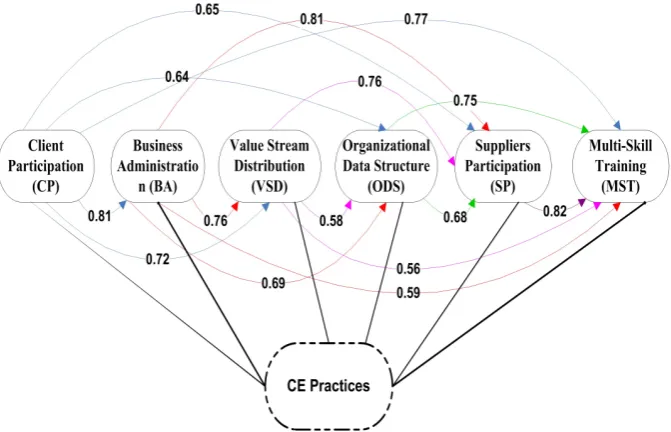
cos-DOI: 10.4236/ojs.2019.93025 367 Open Journal of Statistics
[image:7.595.211.539.133.464.2]metics industries sector, engineering and technology, construction as well as wood and furniture are shown in Figures 2-5 respectively.
Table 3. Best and worst CE implementer.
Practice Best Implementer Worst Implementer
CP Construction Engineering
BA Chemical Wood
ODS Wood Construction
SP Wood Engineering
VSD Engineering Chemical
[image:7.595.211.536.497.694.2]MST Engineering Construction
Figure 2. Estimates of relations for chemical and cosmetics industries sector.
DOI: 10.4236/ojs.2019.93025 368 Open Journal of Statistics Figure 4. Estimates of relations for construction industry.
Figure 5. Estimates of the relations for the wood and furniture sectors.
5. System Dynamics and Validation
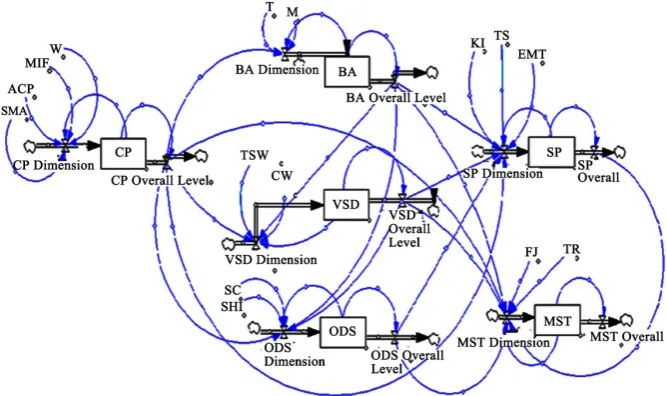
System dynamics (SD) models are diagrams that consisting of symbols and equ-ations. The objective of SD modeling is to validate if the system is stable or not, and to evaluate if the system output increases, decreases or constant over time. One proven policy to compete and win in the dynamic automotive market is the one due to Toyota, which is widely discussed by Morgan and Liker [24]. This section provided a system dynamic model of the proposed conceptual model of CE practices and research hypotheses of this research as shown in Figure 6.
[image:8.595.201.537.317.533.2]DOI: 10.4236/ojs.2019.93025 369 Open Journal of Statistics Figure 6. System dynamic model to CE practices.
( )
(
)
(
)
(
)
Dimension Overall
Dimension
CP CP CP CP
CP CP, SMA, ACP, W, MTF
t t dt dt
f
= − + −
=
A causal relation y = f(x) means that the input variable (I) has some causal in-fluence on the output variable (y). The equations used in the SFD for the second stock “BA” are:
( )
(
)
(
)
(
)
Dimension Overall
Dimension Dimension
BA BA BA BA
BA BA, T, M,
t t dt dt
f CP
= − + −
=
The equations used in the SFD for the third stock “VSD” are:
( )
(
)
(
)
(
Dimension Overall)
Dimension Overall Overall
VSD VSD VSD VSD
VSD VSD, CP , BA , TSW, CW
t t dt dt
f
= − + −
=
The equations used in the SFD for the fourth stock “ODS” are:
( )
(
)
(
)
(
)
Dimension Overall
Dimension Overall Overall Overall
OSD OSD OSD OSD
OSD OSD, CP , VSD , BA , SHI, SC
t t dt dt
f
= − + −
=
The equations used in the SFD for the fifth stock “SP” are:
( )
(
)
(
)
(
Dimension Overall)
Dimension Overall Overall Overall Overall
SP SP SP SP
SP SP, CP , VSD , BA , OSD , EMT, KI, TS
t t dt dt
f
= − + −
=
The equations used in the SFD for the last stock “MST” are:
( )
(
)
(
)
(
)
Dimension Overall
Dimension Overall Overall Overall Overall Overall
MST MST MST MST
MST MST, CP , VSD , BA , OSD , SP , FJ, TR
t t dt dt
f
= − + −
=
DOI: 10.4236/ojs.2019.93025 370 Open Journal of Statistics Figure 7. Graphical Outputs of the Model after Changing its Values.
6. Conclusion
The paper provided a statistical comparative investigation of the implementation of CE in Jordanian Industry that simplifies the implementation of CE in indus-try. A successful statistical comparative investigation of the implementation of CE in Jordanian Industry is provided; a system dynamic model validates results. This paper will contribute significantly to the literature in the field; the presented methodology is expected to enhance investigation related to the implementation of CE. That is expected to bridge the gap between academia and the applications of lean practice and CE. Moreover, the approach presented in this paper can fa-cilitate to understand the implementation of CE practices in industries and assist in managing the challenges opposed to that.
Acknowledgements
Work presented in this paper is extracted from a master’s thesis prepared by Ala’a AL-Habashneh under the supervision of Prof. Dr. Mohammad D. AL-Tahat; The University of Jordan approves the thesis in August 2016.
Conflicts of Interest
The authors declare no conflicts of interest regarding the publication of this pa-per.
References
[1] AL-Tahat, M.D. (2005) Optimizing of Work In Progress (WIP) in Kanban Con-trolled Production Lines. Dirasat: EngineeringSciences, 32, 123-132.
DOI: 10.4236/ojs.2019.93025 371 Open Journal of Statistics for Improvement of Maintenance Effectiveness: A Case Study in King Abdullah University Hospital (KAUH). Proceedingofthe InternationalConferenceon Ser-viceSystemsandServiceManagement, Troyes, October 25-27 2006, 632-637.
https://doi.org/10.1109/ICSSSM.2006.320535
[3] Al-Refaie, A. and AL-Tahat, M.D. (2014) Effects of Knowledge Management and Organization Learning on Firms’ Performance. TheJournalofNatureScienceand SustainableTechnology (JNSST), 8, 369-390.
[4] AL-Tahat, M.D. and Al-Refaie, A. (2012) Activity-Based Cost Estimation Model for Foundry Systems Producing Steel Castings. Jordan JournalofMechanicaland In-dustrialEngineering (JJMIE), 6, 75-86.
[5] Dalalah, D., AL-Tahat, M.D. and Bataineh, K. (2012) Mutually Dependent Mul-ti-criteria Decision Making. FuzzyInformationandEngineering, 4, 195-216.
https://doi.org/10.1007/s12543-012-0111-3
[6] Al-Tahat, M.D., Abdul Jawwad, A.K.M. and Abu Nahleh, Y.L. (2013) Ordinal Lo-gistic Regression Model of Failure Mode and Effects Analysis (FMEA) in Pharma-ceutical Tabletting Tools. EngineeringFailureAnalysis, 27, 322-332.
https://doi.org/10.1016/j.engfailanal.2012.08.017
[7] Al-Tahat, M.D. and Rawabdeh, I.A. (2008) Stochastic Analysis and Design of CONWIP Controlled Production Systems. Journal of Manufacturing Technology Management, 19, 253-273. https://doi.org/10.1108/17410380810847945
[8] Aljanaideh, O., AL-Tahat, M.D. and Al Janaideh, M. (2016) Rate-Bias-Dependent Hysteresis Modeling of a Magnetostrictive Transducer. Microsystem Technologies. 22, 883-892. https://doi.org/10.1007/s00542-015-2566-8
[9] Chouet, S.-Y., Trappey, A., Pokojski, J. and Smith, S. (2009) Global Perspective for Competitive Enterprise, Economy and Ecology. Proceedings of the 16th ISPE In-ternational Conference on Concurrent Engineering. In: Rajkumar, R. Ed., Advanced ConcurrentEngineering, Springer, Switzerland, 267-279.
https://doi.org/10.1007/978-1-84882-762-2
[10] Herder, P.M. and Weijnen, M.P.C. (2000) A Concurrent Engineering Approach to Chemical Process Design. International Journal of Production Economics, 64, 311-318.https://doi.org/10.1016/S0925-5273(99)00068-7
[11] Yassine, A. and Braha, D. (2003) Complex Concurrent Engineering and the Design Structure Matrix Method. ConcurrentEngineering, 11, 165-176.
https://doi.org/10.1177/106329303034503
[12] Moges, A. (2007) Concurrent Engineering and Implementation a Case Study IN Addis Engineering Center. Doctoral Dissertation, Addis Ababa University, Ethi-opia.
[13] Anderson, J.C. and Gerbing, D.W. (1988) Structural Equation Modeling in Practice: A Review and Recommended Two-Step Approach. Psychological Bulletin, 103, 411-423.https://doi.org/10.1037//0033-2909.103.3.411
[14] Wang, J.H., Chang, Y.C. and Chiu, W.H. (2013) Customer Involvement in the Process Innovation: Benchmarking.InternationalJournal, 17, 180-194.
[15] Willaert, S.S., De Graf, R. and Minderhoud, S. (1998) Collaborative Engineering: A Case Study of Concurrent Engineering in a Wider Context. JournalofEngineering andTechnologyManagement, 15, 87-109.
https://doi.org/10.1016/S0923-4748(97)00026-X
DOI: 10.4236/ojs.2019.93025 372 Open Journal of Statistics [17] Skalak, S. (2002) Implementing Concurrent Engineering in Small Companies. CRC
Press,Boca Raton, FL.
[18] Handfield, R.B. (1993) The Role of Materials Management in Developing Time Based Competition. International Journal of Purchasing and Materials Manage-ment, 29, 2-10.https://doi.org/10.1111/j.1745-493X.1993.tb00255.x
[19] Rea, L.M. and Parker, R.A. (2005) Designing and Constructing Survey Research. Jossey-Bass, San Francisco, CA.
[20] Cronbach, L. (1951) Coefficient Alpha and the Internal Structure of Tests. Psycho-metrica, 16, 297-334.https://doi.org/10.1007/BF02310555
[21] Chadha, S.K. and Kapoor, D. (2009) Effect of Switching Cost, Service Quality and Customer Satisfaction on Customer Loyalty of Cellular Service Providers in Indian Market. IUPJournalofMarketingManagement, 8, 23.
[22] Tillman, P., Ballard, G., Tzortzopolous, P. and Formosa, C. (2012) How Integrated Governance Contributes to Value Generation—Insights from an IPD Case Study.
Proceedings ofthe 20th Annual Conferenceof theInternational GroupforLean Construction. San Diego, CA, 18-20 July 2012.
[23] Luger, L., Butler, J. and Winchm G. (2013) Infrastructure and Manufacturing: Their Evolving Relationship. Manchester Business School, Manchester.