ISSN Print: 2332-5968
DOI: 10.4236/cc.2019.73005 Jul. 4, 2019 59 Computational Chemistry
Quantum Mechanical Studies on the Mode of
Hydrogen Bonding, Stability and Molecular
Conformations of Phenol-Water Complexes
Mrinal Jyoti Bezbaruah, Shruti Sharma, Benzir Ahmed, Bipul Bezbaruah
*Department of Applied Sciences, Gauhati University, Guwahati, India
Abstract
It is experimentally well established that the phenolic systems such as phenol and diphenols undergo strong hydrogen bonding interaction with water mo-lecule. But, the possible mode hydrogen bonding in phenol-water systems may be of different types. Although, the experimental methods are not always well enough to give the proper hydrogen bonding conformations in the phe-nol-water complexes. The hydrogen bonding ability in phephe-nol-water systems can directly be influenced by changing the interacting sites in the given mo-lecular systems, which could be investigated by theoretical studies. Generally, in phenol-water system, the hydrogen bonding is taking place through −OH group of phenol with water molecule, and this kind of interactions between phenol-water and diphenol-water complexes have been extensively investi-gated in electronic ground state by Quantum Mechanical MP4 calculations. It is also very important to study the stability of different phenol-water com-plexes and to find out the proper phenol-water comcom-plexes with minimized interaction energy. This study will also be helpful for understanding the effect of hydrogen bonding interaction in a better way on other aromatic systems.
Keywords
Phenol, Diphenol, MP4 Method, Hydrogen Bonding
1. Introduction
Non-covalent and hydrogen bonding interactions are very important and essen-tial for modern chemistry, material sciences, molecular biology, etc. These inte-ractions are quite common in aromatic-pi systems and these kinds of forces can exist as pi-pi stacking, pi-cations, pi-anions, etc. Among these non-covalent
in-How to cite this paper: Bezbaruah, M.J., Sharma, S., Ahmed, B. and Bezbaruah, B. (2019) Quantum Mechanical Studies on the Mode of Hydrogen Bonding, Stability and Molecular Conformations of Phenol-Water Complexes. Computational Chemistry, 7, 59-71.
https://doi.org/10.4236/cc.2019.73005
Received: March 18, 2019 Accepted: July 1, 2019 Published: July 4, 2019
Copyright © 2019 by author(s) and Scientific Research Publishing Inc. This work is licensed under the Creative Commons Attribution International License (CC BY 4.0).
http://creativecommons.org/licenses/by/4.0/
DOI: 10.4236/cc.2019.73005 60 Computational Chemistry
teractions, the hydrogen bonding interactions are the most important in different molecular system as they play a very crucial role in the formation of fundamen-tal units of bulky molecules [1] [2] [3] [4]. It is very common that phenol and diphenol molecule shows hydrogen bonding with water molecule through its functional group (−OH). But, interestingly the mode of hydrogen bonding be-tween these systems is also a very important factor. Therefore, the formation of intermolecular hydrogen bonding with other chemical species or solvent mole-cules plays a crucial role in its molecular properties such as bond lengths, bond angles and electron density on atoms which further influence on the chemical reactivity of phenolic systems [5] [6]. The determination and quantification of such types of hydrogen bonding or non-covalent interaction are highly desirable in order to predict and understand the probable molecular interactions or
con-cerned reaction mechanism of molecular association [7]. Moreover, the
non-covalent interactions are often low in energy (1 - 5 kcal/mol) as compare to the covalent interactions (80 - 110 kcal/mol) [8].
Nowadays, people have been investigating to identify the hydrogen bond mo-tifs, one of the main aims is to expand the available list of hydrogen bond donor and acceptor in the periodic table for a wider range of application [9] [10] [11] [12] [13]. A number of molecular complexes have extensively been studied by
scientists exhibiting D-H---A interactions, where D-H is the “H-bond” Donor
and A is the Acceptor both experimentally and computationally [14] [15] [16] [17]. Computational calculations also show that there exists a significant interac-tion between a hydrogen bond donor and the centre of an aromatic ring, which acts as a hydrogen bond acceptor. This interaction is as strong as a normal hy-drogen bond, which contributes approximately 3 kcal/mol (1 cal = 4.184 J) of stabilizing energy and it plays a significant role in molecular associations [18]. Studies on hydrogen bonding interaction with common aromatic systems are well known, for example, H-bonding between electron donor and aromatic ring acceptor was studied by Ray L. Brinkley et al. [19]. The interaction energy of in-termolecular phenol-water complex is in the range of about 15 - 28 kcal/mol, which is about three times higher compared to its analogue i.e. O-H---Se [20]. Even
O-H---S hydrogen bond interaction energy in phenol-SH2 complex is higher
than that of O-H---Se in Phenol-SeH2 complex. The stabilization energy of
O-H---O hydrogen bond was estimated to be similar to its analogue i.e.
O-H---Se and O-H---S [21]. It is well known for classical Hydrogen bond inte-raction that the introduction of a positive charge into the proton donor or nega-tive charge on the acceptor enhanced the stabilization energy [22]. Luminol sys-tem was also well studied for their extended hydrogen bonding network in water solution [23]. In some cases, it has been observed that the hydrogen bonding in-teraction can also affected by infrared spectra at high pressure and temperature,
e.g. π-hydrogen bonding interaction between water and aromatic hydrocarbons
confor-DOI: 10.4236/cc.2019.73005 61 Computational Chemistry
mations and also study the stability of such conformers by using computational method. We also try to study more detailed investigation of this mentioned phe-nomenon where we could investigate on the minute details like different path of interaction, orientation of the molecules by calculating single point energy, Mul-likan charge and Gibbs free energy by MPn methods.
2. Methodology
In our investigations all the models were constructed by using Gaussian 5.0. We have studied the hydrogen bonding interactions between simple phenolic system and water molecules by computational methods. Several phenol-water complexes were constructed in such a way that they have different orientation with respect to each other and optimized these complexes in gas phase at room temperature. The molecular structures were optimized by using Møller-Plesset perturbation methodology i.e. MP2 level of theory and double zeta basis set 6-311G/++(d,p) at 298 K and 1atmospheric pressure. After optimization it gives a constant in-termolecular hydrogen bond distances and then interaction energies were calcu-lated by changing the intermolecular hydrogen bond distances for every phe-nol-water complexes. We have calculated the single point energy by MP4 level of theories with basis set 6-311++G(d,p). For our studies we also calculated Gibbs free energy, Mullikan charges etc. for each phenol-water complexes [25].
The interaction energies (EIE) are calculated by the following equation;
EIE = EPhenol-water − EPhenol − E water
Here, EPhenol-water = Energy for phenol-water complex, EPhenol = Energy of
Phe-nol, E water = Energy of water.
3. Result and Discussions
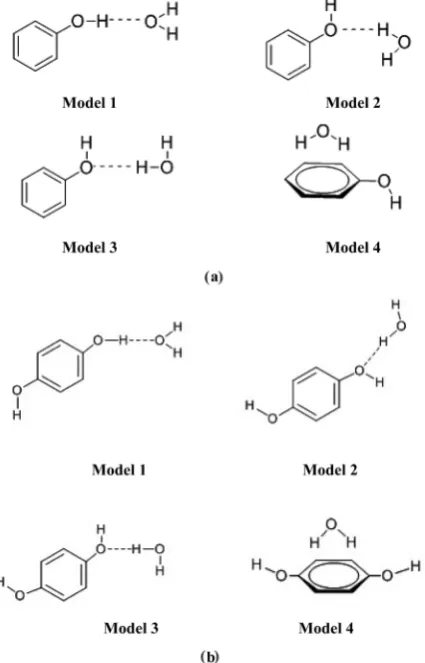
In this current study, we have prepared different phenol-water models to analyze the actual hydrogen bonding interactions, stability and effect in phenol-water complexes. Phenol can directly interact with water in many ways, but we have taken only the most prominent and chemically favoured interactions between the water and phenol molecules. As we know, phenol undergoes strong hydro-gen bonding interactions with its neighbouring water molecule when it is in aqueous medium and this is already experimentally established. Phenol interacts with water molecule through the −OH group of phenol, depending on the elec-tron denoting and accepting abilities −OH group of phenol can interact with water either through H atom (donor) or through O atom (acceptor). It can also show weak π-dipole interaction i.e., π-electrons of phenol interacts with dipoles of water and many other mode of interactions. To observe the proper
phe-nol-H2O complexes, we have constructed four different chemically favoured
phenol-H2O complexes (Figure 1(a) & Figure 1(b)). These proposed
con-structed phenol-H2O complexes are universally accepted and shows better
interac-tion between phenol and water molecule. Our investigainterac-tion is based on these four
DOI: 10.4236/cc.2019.73005 62 Computational Chemistry
Figure 1. (a) Proposed models for phenol-water complexes; (b) Proposed models for phenol-water complexes.
appropriate phenol-H2O hydrogen bonding and dipole-π interactions. We also
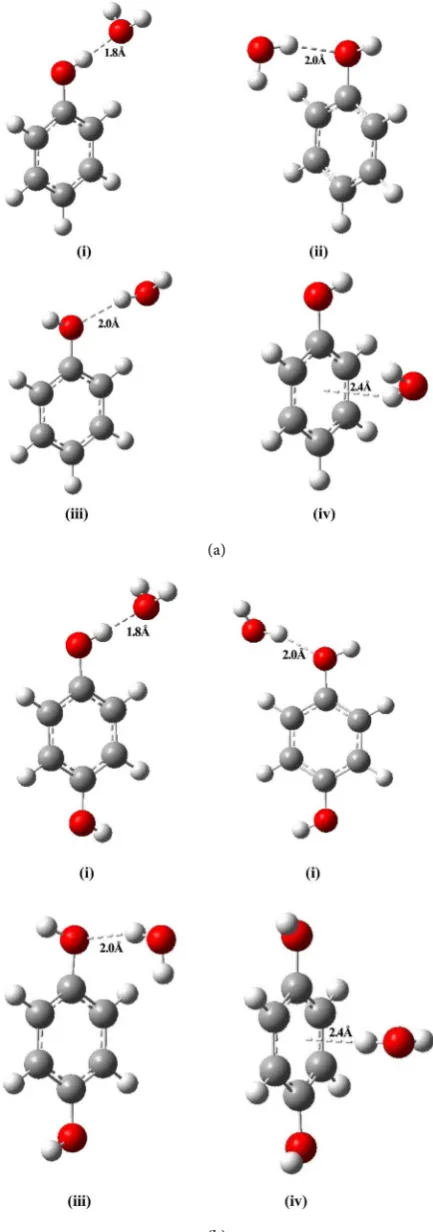
carried out computational calculations to determine the stability of these phe-nol-H2O complexes. For all four proposed phenol-H2O complexes, the optimised
geometry of model-1, 2 and 3 shows strong hydrogen bonding and gives a
con-stant hydrogen bond distance between phenol and water molecule (Figures
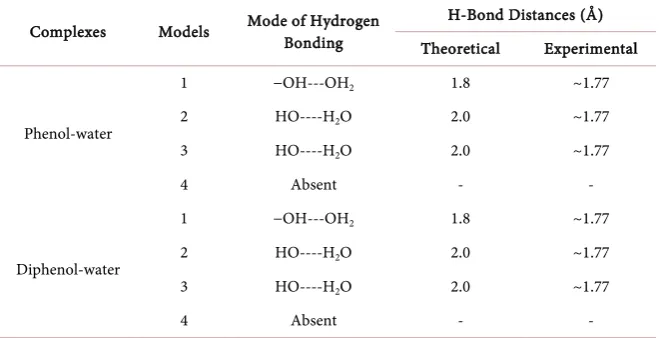
2(a)(i)-(iii)). On the other hand, only model-4 shows dipole-π interaction, which is a very weak force of interaction (Figure 2(b)(iv)). It has been observed that the calculated hydrogen bond distances between the four proposed models of phenol-water complexes are found to be 1.8 and 2.0 Å respectively (Table 1). However, the crystal structure of phenol-water complexes reveal that the actual phenol-water hydrogen bond distance for any linear model is found to be ~1.77 Å [26], whereas for our proposed models the optimum hydrogen bond distance for model 1, 2 and 3, lies within a range from 1.8 - 2.0 Å (Table 1). Again, we are
trying to change the hydrogen bond distances of four proposed phenol-H2O
DOI: 10.4236/cc.2019.73005 63 Computational Chemistry (a)
[image:5.595.264.481.71.688.2](b)
DOI: 10.4236/cc.2019.73005 64 Computational Chemistry
Table 1. Computed hydrogen bond distances for minimized models of phenol/diphenol-water complexes (MP4 method).
Complexes Models Mode of Hydrogen Bonding H-Bond Distances (Å) Theoretical Experimental
Phenol-water
1 −OH---OH2 1.8 ~1.77
2 HO----H2O 2.0 ~1.77
3 HO----H2O 2.0 ~1.77
4 Absent - -
Diphenol-water
1 −OH---OH2 1.8 ~1.77
2 HO----H2O 2.0 ~1.77
3 HO----H2O 2.0 ~1.77
4 Absent - -
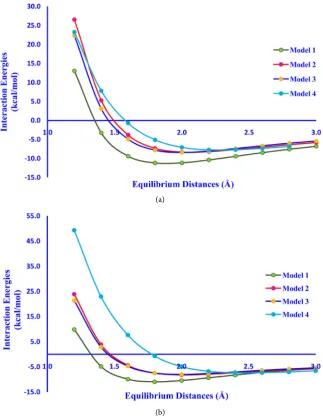
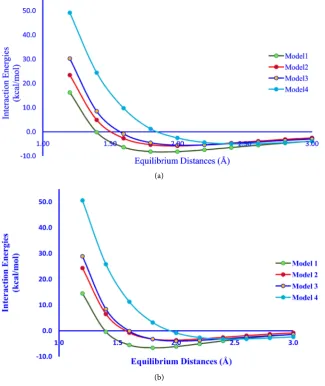
each model with respect to the change in hydrogen bond distances then we can get an exponentially decreasing curve. The minimum of the curve results the more negative interaction energy value which gives the most favoured point with a stable phenol-water complex (Figure 3(a)). During the process of increasing and decreasing in hydrogen bond lengths for each model, it has been observed that on increasing the hydrogen bond length the interaction energy becomes steady and they behave as two individual molecules rather than a phenol-water complex. Moreover, on decreasing the hydrogen bond distances at a certain point the interaction between phenol-water complexes become stronger, which gives the more negative interaction energy value and it may also form covalent bond if they get closer than the minimum intermolecular distances i.e. 1.2 Å. Since, we have to determine the minimized interaction energy between phe-nol-water complexes; therefore we must take only one minimized point with more negative interaction energy value. All the minimized structures of
pro-posed phenol-water complexes are shown in the Figures 2(a)(i)-(iv). To check
the effect of solvation on the selected phenol-water complexes, we put the model in aqueous medium and we also calculated the interaction energy values of phe-nol-H2O complexes, and also compare it with gas phase (Figure 3(b)). Here, we
can easily distinguish the change in interaction in gas phase and solvent phase
i.e. in aqueous phase. The minimized interaction energies for phenol-water
DOI: 10.4236/cc.2019.73005 65 Computational Chemistry (a)
[image:7.595.212.536.70.491.2](b)
Figure 3. (a) Interaction energy plot for phenol-water complexes in gas phase; (b) Inte-raction energy plot for Phenol-water complexes in aqueous phase.
Table 2. Computed interaction energies for minimized models of Phenol-water complexes (MP4 method).
Models Equilibrium Distances (Å) Interaction Energies (kcal/mol) Gas Phase Aqueous Phase
1 1.8 −11.1783 −10.9398
2 2.0 −8.3149 −8.1831
3 2.0 −8.4201 −7.9944
4 2.4 −7.7345 −7.3569
Model-1, where the hydrogen bond occurs through −OH group of phenol with water molecule (−OH---OH2), gives the most negative interaction energy
[image:7.595.209.540.565.668.2]DOI: 10.4236/cc.2019.73005 66 Computational Chemistry
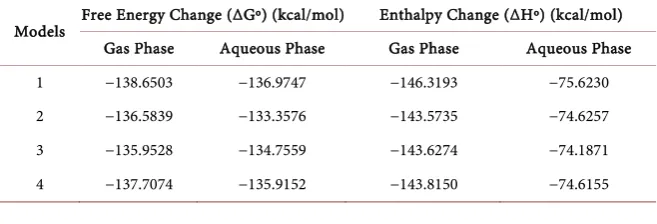
stable and stronger hydrogen bond, where the hydrogen bonds distance is found as 1.8 Å. The calculated ΔGº for the minimized geometry for all four models re-veals that the model-1 gives the more negative value, i.e. −138.6503 kcal/mol (Table 3). Therefore, model-1 is the most stable and favoured conformation
among the other phenol-H2O complexes. On the other hand, the study of
phe-nol-water complexes for model-2 and 3 are also very important, as they show
similar kind of hydrogen bonding interaction (HO---H2O), with hydrogen
bond distance ~2.0 Å, but they have different conformations with respect to the water molecule as shown in Figure 2(a)(ii) & Figure 2(a)(iii). Phenol-water complexes for model-2 and 3 gives almost similar hydrogen bonding interaction energies for the minimized models in gas phase, which are found as −8.3149 and −8.4207 kcal/mol respectively (Table 2). Irrespective of the above studies, in phenol-H2O model-4, there exists very weak dipole-π interaction at a separation
of 2.4Å, as the water molecule is placed just above the centre of π-electrons of phenol ring as shown in Figure 2(a)(iv), the minimized interaction energy is found as −7.7345 kcal/mol. Although, it may also form hydrogen bond but that
will be very weak as the −OH group of phenol and H2O placed far apart from
each other. For all the phenol-water complexes, the hydrogen bonding interac-tion also shows similar trend in both gas and solvent phase. Again, the chemical behaviour of all the phenol-water complexes show negative ΔHº values, there-fore all the systems are exothermic in nature.
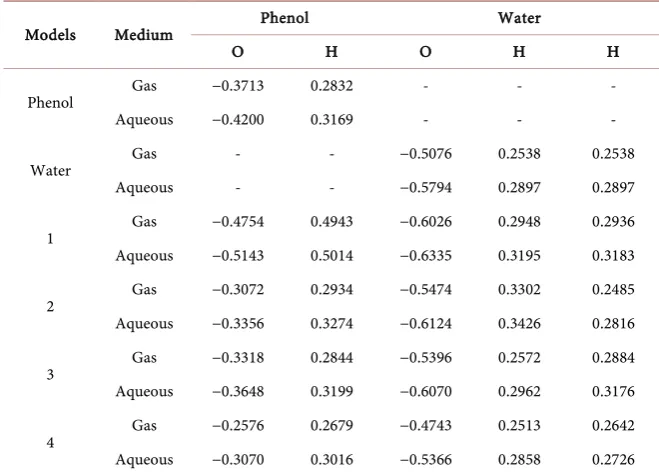
Mulliken charge density calculation is also a very important tool to investigate the change in individual charge densities of the molecule before and after raction. Greater is the change in charge densities (Mulliken charges) of the inte-racting individual atoms which are responsible for hydrogen bonding in phe-nol-water complexes, more will be the interaction in between phenol and water in that complex. The actual change in the electron charge densities of the mini-mized phenol-water complexes were obtained by calculating the Mulliken charges of the complex which shows whether there exist strong or weak interac-tions between phenol and water molecule (Table 4). In our calculations, we have obtained that the model-1 shows great change in the mulliken charge density value for −OH group of phenol and H2O interacting sites than that of the
[image:8.595.210.539.623.735.2]indi-vidual molecules. On the other hand model-2 and 3 shows weak hydrogen bonding interaction as there observed a small change in the mulliken charge
Table 3. Computed free energy change (ΔGº) and enthalpy change (ΔHº) for minimized models of phenol-water complexes (MP2 method).
Models Free Energy Change (ΔGº) (kcal/mol) Enthalpy Change (ΔHº) (kcal/mol) Gas Phase Aqueous Phase Gas Phase Aqueous Phase
1 −138.6503 −136.9747 −146.3193 −75.6230
2 −136.5839 −133.3576 −143.5735 −74.6257
3 −135.9528 −134.7559 −143.6274 −74.1871
DOI: 10.4236/cc.2019.73005 67 Computational Chemistry
Table 4. Mulliken charge calculation for phenol-water complexes (MP4 method).
Models Medium Phenol Water
O H O H H
Phenol Gas −0.3713 0.2832 - - -
Aqueous −0.4200 0.3169 - - -
Water Gas - - −0.5076 0.2538 0.2538
Aqueous - - −0.5794 0.2897 0.2897
1 Gas −0.4754 0.4943 −0.6026 0.2948 0.2936
Aqueous −0.5143 0.5014 −0.6335 0.3195 0.3183
2 Gas −0.3072 0.2934 −0.5474 0.3302 0.2485
Aqueous −0.3356 0.3274 −0.6124 0.3426 0.2816
3 Gas −0.3318 0.2844 −0.5396 0.2572 0.2884
Aqueous −0.3648 0.3199 −0.6070 0.2962 0.3176
4 Gas −0.2576 0.2679 −0.4743 0.2513 0.2642
Aqueous −0.3070 0.3016 −0.5366 0.2858 0.2726
density values for the same interacting sites i.e. −OH group of phenol and H2O
molecule (Figure 2(a)(ii) & Figure 2(a)(iii)). In case of model-4, which shows a minute change in the Mulliken charge densities as it does not show any
hydro-gen bonding interaction but the existing interaction shows due to the dipole-π
interaction (Table 4).
We also carried out similar types of investigation for diphenol-H2O
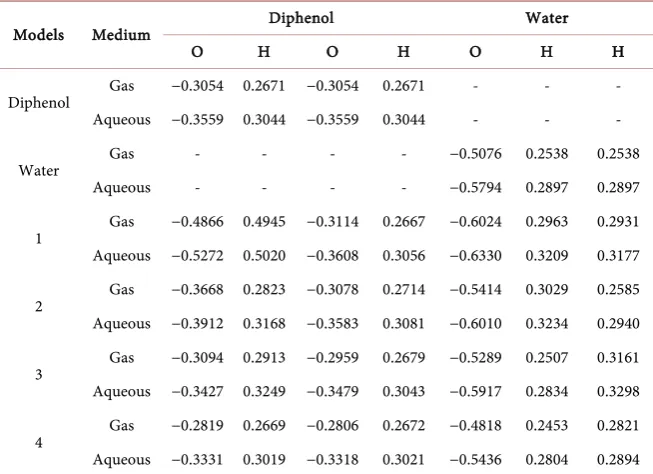
complex-es, prepared the four models for diphenol-water complexes as constructed for phenol-H2O, and also calculated the interaction energy values (Figure 1(b) and Table 5). Interestingly, the change the interaction energies and Mulliken change densities for phenol-H2O system and diphenol-H2O systems give almost similar
trend (Table 5 & Table 6). The minimized models for diphenol-water complex-es are shown in Figure 2(b). The minima of the interaction energy plots for all four diphenol-water systems, both in gas and aqueous phase shows almost simi-lar types of interactions as it has shown in phenol-water systems (Figure 4(a) &
Figure 4(b)). But, these kinds of interactions might be changed on changing the substituent on phenolic systems.
4. Conclusion
From the above calculations, we can conclude that in model-1 hydrogen bond-ing is takbond-ing place through −OH---OH2, and it shows the strongest interactions
in phenol-water system with hydrogen bond distance 1.8 Å, in both gas and wa-ter phase. It also shows the most negative inwa-teraction energy values i.e. −11.1783 kcal/mol, which reveals the most stable and favoured conformation. Model 2 and 3 also show almost similar types of hydrogen bonding but the hydrogen
DOI: 10.4236/cc.2019.73005 68 Computational Chemistry (a)
[image:10.595.213.539.74.461.2](b)
Figure 4. (a) Interaction energy plot for diphenol-water complexes in gas phase; (b) In-teraction energy plot for diphenol-water complexes in aqueous phase.
Table 5. Interaction energies for minimized models of diphenol-water complexes (MP4
method).
Models Equilibrium Distances (Å) Interaction Energies (kcal/mol)
Gas Phase Aqueous Phase
1 1.8 −8.1873 −6.5889
2 2.0 −5.8227 −3.6419
3 2.0 −5.5271 −3.9699
4 2.4 −4.9716 −3.2049
[image:10.595.210.539.536.634.2]DOI: 10.4236/cc.2019.73005 69 Computational Chemistry
Table 6. Mulliken charge calculation for diphenol-water complexes (MP4 method).
Models Medium Diphenol Water
O H O H O H H
Diphenol Gas −0.3054 0.2671 −0.3054 0.2671 - - - Aqueous −0.3559 0.3044 −0.3559 0.3044 - - -
Water Gas - - - - −0.5076 0.2538 0.2538
Aqueous - - - - −0.5794 0.2897 0.2897
1 Gas −0.4866 0.4945 −0.3114 0.2667 −0.6024 0.2963 0.2931 Aqueous −0.5272 0.5020 −0.3608 0.3056 −0.6330 0.3209 0.3177
2 Gas −0.3668 0.2823 −0.3078 0.2714 −0.5414 0.3029 0.2585 Aqueous −0.3912 0.3168 −0.3583 0.3081 −0.6010 0.3234 0.2940
3 Gas −0.3094 0.2913 −0.2959 0.2679 −0.5289 0.2507 0.3161 Aqueous −0.3427 0.3249 −0.3479 0.3043 −0.5917 0.2834 0.3298
4 Gas −0.2819 0.2669 −0.2806 0.2672 −0.4818 0.2453 0.2821 Aqueous −0.3331 0.3019 −0.3318 0.3021 −0.5436 0.2804 0.2894
constant for both the phases, but the solvent phase models show more stability and negative interaction energy values, because of the polarity of the water mo-lecule. It is also found that the diphenol-water systems show the same trends as it has shown by phenol-water system.
Acknowledgements
Authors are highly grateful to the AICTE-TEQIP-3 fund and Ministry of Human Resource Development (MHRD), New Delhi, for providing research assistance.
Conflicts of Interest
The authors declare no conflicts of interest regarding the publication of this pa-per.
References
[1] Salonen, L.M., Ellermann, M. and Diederich, F. (2011) Aromatic Rings in Chemical and Biological Recognition: Energetics and Structures. Angewandte Chemie Inter-national Edition, 50, 4808-4842.https://doi.org/10.1002/anie.201007560
[2] Schottel, B.L., Chifotides, H.T. and Dunbar, K.R. (2008) Anion-pi Interactions.
Chemical Society Review, 37, 68-83.https://doi.org/10.1039/B614208G
[3] Ma, J.C. and Dougherty, D.A. (1997) The Cation-pi Interaction. Chemical Review, 97, 1303-1324.https://doi.org/10.1021/cr9603744
[4] Hunter, C.A., Lawson, K.R., Perkin, J. and Urch, C.J. (2001) Aromatic Interactions.
Journal of the American Chemical Society, Perkin Transactions, 2, 651-669. https://doi.org/10.1039/b008495f
DOI: 10.4236/cc.2019.73005 70 Computational Chemistry [6] Kone, M., Illien, B., Laurence, C. and Graton, J. (2011) Can Quantum-Mechanical Calculations Yield Reasonable Estimates of Hydrogen Bonding Acceptor Strength? The Case of Hydrogen-Bonded Complexes of Methanol. Journal of Physical Che-mistry A, 115, 13975-13985.https://doi.org/10.1021/jp209200w
[7] Albrecht, L. and Boyd, R.J. (2012) Visualizing Internal Stabilization in Weakly Bound Systems Using Atomic Energies: Hydrogen Bonding in Small Water Clus-ters. Journal of Physical Chemistry A, 116, 3946-3951.
https://doi.org/10.1021/jp301006g
[8] Lodish, H., Berk, A., Zipursky, S.L., Matsudaira, P., Baltimore, D. and Darnel, J. (2000) Molecular Cell Biology. 4th Edition, W. H. Freeman, New York.
[9] Biswal, H.S., Chakraborty, S. and Wategaonkar, S. (2008) Experimental Evidence of O-H-S Hydrogen Bonding in Supersonic Jet. Journal of Chemical Physics, 129, Ar-ticle ID: 184311.https://doi.org/10.1063/1.3012569
[10] Biswal, H.S., Shirhatti, P.R. and Wategaonkar, S. (2010) O-H···O versus O-H···S Hydrogen Bonding. 2. Alcohols and Thiols as Hydrogen Bond Acceptors. Journal of Physical Chemistry A, 114, 6944-6955.https://doi.org/10.1021/jp102346n
[11] Xu, L.H., Liu, Q., Suenram, R.D., Lovas, F.J., Walker, A.R.H., Jensen, J.O. and Sa-muels, A.C. (2004) Rotational Spectra, Conformational Structures, and Dipole Mo-ments of Thiodiglycol by Jet-Cooled FTMW and Ab Initio Calculations. Journal of Moleculer Spectroscopy, 228, 243-250.https://doi.org/10.1016/j.jms.2004.04.004 [12] Pal, D. and Chakrabarti, P. (1998) Different Types of Interactions Involving
Cyste-ine Sulfhydryl Group in Proteins. Journal of Biomolecular Structure and Dynamics, 15, 1059-1072.https://doi.org/10.1080/07391102.1998.10509001
[13] Zauhar, R.J., Colbert, C.L., Morgan, R.S. and Welsh, W.J. (2000) Evidence for a Strong Sulfur-Aromatic Interaction Derived from Crystallographic Data. Biopoly-mers, 53, 233-248.
https://doi.org/10.1002/(SICI)1097-0282(200003)53:3<233::AID-BIP3>3.0.CO;2-4 [14] Krepps, M.K., Parkin, S. and Atwood, D.A. (2001) Hydrogen Bonding with Sulfur.
Crystal Growth Design, 1, 291-297.https://doi.org/10.1021/cg015505v
[15] Francuski, B.M., Novakovic, S.B. and Bogdanovic, G.A. (2011) Electronic Features and Hydrogen Bonding Capacity of the Sulfur Acceptor in Thioureido-Based Compounds. Experimental Charge Density Study of 4-methyl-3-thiosemicarbazide.
CrystEngComm, 13, 3580-3591.https://doi.org/10.1039/c0ce00760a
[16] Howard, D.L. and Kjaergaard, H.G. (2008) Hydrogen Bonding to Divalent Sulphur.
Physical Chemistry Chemical Physics, 10, 4113-4118. https://doi.org/10.1039/b806165c
[17] Novakovic, S.B., Fraisse, B., Bogdanovic, G.A. and Spasojevic-De Bire, A. (2007) Experimental Charge Density Evidence for the Existence of High Polarizability of the Electron Density of the Free Electron Pairs on the Sulfur Atom of the Thiourei-do Group, NH-C(S)-NH2, Induced by N-H···S and C-H···S Interactions. Crystal Growth Design, 7, 191-195. https://doi.org/10.1021/cg060497+
[18] Levitt, M. and Perutz, M.F. (1988) Aromatic Rings Act as Hydrogen Bond Accep-tors. Journal of Molecular Biology, 201, 751-754.
https://doi.org/10.1016/0022-2836(88)90471-8
[19] Brinkley, R.L. and Gupta, R.B (2004) Hydrogen Bonding with Aromatic Ring.
American Institute of Chemical Engineers, 47, 948-953. https://doi.org/10.1002/aic.690470417
Com-DOI: 10.4236/cc.2019.73005 71 Computational Chemistry plexes. Chemical Physics Letters, 622, 28-33.
https://doi.org/10.1016/j.cplett.2015.01.012
[21] Harada, T., Yoshida, H., Ohno, K., Matsuura, H., Zhang, J., Iwaoka, M. and Tomod, S. (2001) Implications of Intramolecular OH···Se Hydrogen Bonding and CH···O Interaction in the Conformational Stabilization of 2-(Methylseleno)ethanol Studied by Vibrational Spectroscopy and Density Functional Theory. Journal of Physical Chemistry A, 105, 4517-4523.https://doi.org/10.1021/jp003990j
[22] Nepal, B. and Scheiner, S. (2014) Effect of Ionic Charge on the CH···π Hydrogen Bond. Journal of Physical Chemistry A, 118, 9575-9587.
https://doi.org/10.1021/jp5070598
[23] Xue, B., et al. (2014) Luminol: Extended Hydrogen Bond Network in Water Solu-tion. Computational and Theoretical Chemistry, 1028, 81-86.
https://doi.org/10.1016/j.comptc.2013.11.022
[24] Furutaka, S. and Ikawa, S. (1998) Hydrogen Bonding of Water with Aromatic Hy-drocarbons at High Temperature and Pressure. TheJournal of Chemical Physics, 108, 5159-5160.https://doi.org/10.1063/1.475953
[25] Frisch, M.J., Trucks, G.W., Schlegel, H.B., Gill, P.M.W., Johnson, B.G., Robb, M.A., Cheeseman, J.R., Keith, T., Petersson, G.A., Montgomery, J.A., Raghavachari, K., Al-Laham, M.A., Zakrzewaki, V.G., Ortiz, J.V., Foresmann, J.B., Ciolowski, J., Ste-fanov, B.B., Namayakkara, A., Challacombe, M., Peng, C.Y., Ayala, P.Y., Chen, W., Wong, M.W., Andres, J.L., Replogle, E.S., Gomperts, R., Martin, R.L., Fox, D.J., Binkley, J.S., Defrees, D.J., Baker, J., Stewart, J.P., Head-Gordon, M., Gonzalez, C. and Pople, J.A. (2009) Gaussian 09. Gaussian Inc., Pittsburgh.
[26] Josefin, E.U., Mikael, K., Dick, S. and Björn, Å. (2006) Water as a Hydrogen Bond-ing Bridge between a Phenol and Imidazole. A Simple Model for Water BindBond-ing in Enzymes. Biochimica et Biophysica Acta, 1757, 1592-1596.