EXPLOSION OF RAPE CASES IN INDIA: A STUDY OF LAST ONE DECADE
1,*
Ramu Rawat and
1
Affiliation-International
2
Department of Geography, Sri Krishnadevaraya University Anantapur, Andhra Pradesh, India
ARTICLE INFO ABSTRACT
Objectives:
one decade by age and region.
Methods:
2004-2013. Data on crimes in India are published annually by the NCRB. These are compiled from records of police stations all over the country and refer to reported and registered crimes. The causative factors or reasons of incidents of crimes are not being captured by the Bureau. NCRB, only police recorded crime cases are being captured.
Result:
are divided into two parts one is incest rape (rape committed by the blood relative) and other rape (rape committed by other than blood relative). Other rape cases rem
period where, Incest rape is slightly increased in India. Age group 18
venerable group as compare to other age group in this study. More than 70 % states have above national average level of rape cases.
Discussion:
incidents of women.
Copyright © 2015 Ramu Rawat and Tadapatri Masthanaiah
permits unrestricted use, distribution, and reproduction in any medium, provided the original work is properly cited.
INTRODUCTION
During the ancient time Indian women held a high place of respect in the society as mentioned in Rig
scriptures. But later on, because of social, political and economic changes, women lost their status and were relegated to the background (Crime against women, 2013
statistics showed a declining sex-ratio, health status, literacy rate, work participation rate and political participation among women. While on the other hand the spread of social evils like dowry deaths, child marriage, domestic violence, rape, sexual harassment, exploitation of women workers are rampant in different parts of India. Humiliation, rape, kidnapping, molestation, dowry death, torture, wife-beating etc. have grown up over the years (Singh and Choudhury, 2012
“crime” is a very common word that comes across in day to day life. “The Semantic meaning of ‘crime against women’ is direct or indirect physical or mental cruelty to Girls and women’s. Crimes which are directed specifically against women and in which only women are victims are characterized as “Crime against Women”.
*Corresponding author: Ramu Rawat,
Affiliation-International Institute for Population Sciences, Mumbai.
ISSN: 0975-833X
Article History:
Received 17th April, 2015
Received in revised form 19h May, 2015
Accepted 22ed June, 2015
Published online 28th July, 2015
Key words:
Incest rape, Other rape, Women, Age group, State and Country
Citation: Ramu Rawat and Tadapatri Masthanaiah
Journal of Current Research, 7, (7), 17976-17984
RESEARCH ARTICLE
EXPLOSION OF RAPE CASES IN INDIA: A STUDY OF LAST ONE DECADE
Ramu Rawat and
2Tadapatri Masthanaiah
International Institute for Population Sciences, Mumbai
Sri Krishnadevaraya University Anantapur, Andhra Pradesh, India
ABSTRACT
Objectives: In this study we examine the rape trends and situation In India and its states during last one decade by age and region.
Methods: Present study used National Crimes Records Bureau (NCRB) India data for the year of 2013. Data on crimes in India are published annually by the NCRB. These are compiled from ords of police stations all over the country and refer to reported and registered crimes. The causative factors or reasons of incidents of crimes are not being captured by the Bureau. NCRB, only police recorded crime cases are being captured.
Result: During study period rape cases significantly increased in all states. Furthermore, rape cases are divided into two parts one is incest rape (rape committed by the blood relative) and other rape (rape committed by other than blood relative). Other rape cases rem
period where, Incest rape is slightly increased in India. Age group 18
venerable group as compare to other age group in this study. More than 70 % states have above national average level of rape cases.
Discussion: Rape is the fastest growing crime in the country today compared to other than crime incidents of women.
Ramu Rawat and Tadapatri Masthanaiah. This is an open access article distributed under the Creative Commons Att use, distribution, and reproduction in any medium, provided the original work is properly cited.
During the ancient time Indian women held a high place of respect in the society as mentioned in Rig-Veda and other scriptures. But later on, because of social, political and economic changes, women lost their status and were relegated Crime against women, 2013). The official ratio, health status, literacy work participation rate and political participation among women. While on the other hand the spread of social evils like dowry deaths, child marriage, domestic violence, rape, sexual harassment, exploitation of women workers are rampant in of India. Humiliation, rape, kidnapping, beating etc. have grown Singh and Choudhury, 2012). The word “crime” is a very common word that comes across in day to crime against women’ is direct or indirect physical or mental cruelty to Girls and women’s. Crimes which are directed specifically against women and in which only women are victims are characterized
International Institute for Population Sciences, Mumbai.
It is equally important to clarify the concept of ‘Violence against women’. Violence is also known as abuse and includes any sort of physical aggression or misbehaves
violence against women requires challenging the way that gender roles and power relations are articulated towards women will take a long time sometime it happens one generation to next generation. According to one study about 30 percent children are suffered from various type sexual abuse such as making a child rub private parts, making a child revelation private parts being photographed in the nude etc (Derby, 2013). In India crime against women’s day by day increased. From year 2005 to 2010 dowry death i
to 8391. Furthermore, rape cases also significantly mounting from 18359 to 22172 during 2005
was also created against the accused in cases of custodial rape, if the woman alleged that the act was without her consent. spite of these amendment cases of rape is showing their upward trend (Khandelwal, 2015). The number of rape cases increase due to effect of mass media exposure. Sometimes after watching movies and getting idea people get involve in sexual violence, depiction of crime and brutality, fighting scenes, foul language and romance Films becomes hit because of no holds barred rape and gang rape scenes in all the details.
International Journal of Current Research
Vol. 7, Issue, 07, pp.17976-17984, July 2015
INTERNATIONAL
Tadapatri Masthanaiah, 2015. “Explosion of rape cases in India: A study of last one 17984.
EXPLOSION OF RAPE CASES IN INDIA: A STUDY OF LAST ONE DECADE
Institute for Population Sciences, Mumbai
Sri Krishnadevaraya University Anantapur, Andhra Pradesh, India
In this study we examine the rape trends and situation In India and its states during last
Present study used National Crimes Records Bureau (NCRB) India data for the year of 2013. Data on crimes in India are published annually by the NCRB. These are compiled from ords of police stations all over the country and refer to reported and registered crimes. The causative factors or reasons of incidents of crimes are not being captured by the Bureau. NCRB, only
g study period rape cases significantly increased in all states. Furthermore, rape cases are divided into two parts one is incest rape (rape committed by the blood relative) and other rape (rape committed by other than blood relative). Other rape cases remarkable increased over time period where, Incest rape is slightly increased in India. Age group 18-30 have been found more venerable group as compare to other age group in this study. More than 70 % states have above
Rape is the fastest growing crime in the country today compared to other than crime
is an open access article distributed under the Creative Commons Attribution License, which
It is equally important to clarify the concept of ‘Violence against women’. Violence is also known as abuse and includes any sort of physical aggression or misbehaves1. Combating violence against women requires challenging the way that gender roles and power relations are articulated towards women will take a long time sometime it happens one generation to next generation. According to one study about 30 red from various type sexual abuse such as making a child rub private parts, making a child revelation private parts being photographed in the nude etc In India crime against women’s day by day increased. From year 2005 to 2010 dowry death increased 6787 to 8391. Furthermore, rape cases also significantly mounting from 18359 to 22172 during 2005-2010. A legal presumption was also created against the accused in cases of custodial rape, if the woman alleged that the act was without her consent. In-spite of these amendment cases of rape is showing their upward
. The number of rape cases increase due to effect of mass media exposure. Sometimes after watching movies and getting idea people get involve in sexual iction of crime and brutality, fighting scenes, foul language and romance Films becomes hit because of no holds- barred rape and gang rape scenes in all the details.
INTERNATIONAL JOURNAL OF CURRENT RESEARCH
That type films a number of visuals and dialogues depict women in ignoble servility to man and such servility is shown as a praiseworthy quality. In Indian society, sexual abuse and un-wanted sex by an intimate partner is not considered a crime. If women are married in many societies do not consider forced sex as rape. According to United Nations definition for violence against women: The Declaration on the Elimination of Violence against Women, adopted by the United Nations General Assembly in 1993, defines violence against women as per; Article-1, the term violence against women means “any act of gender-based violence that results in, or is likely to result in, physical, sexual or psychological harm or suffering to women, including threats of such acts, coercion or arbitrary deprivation of liberty, whether occurring in public or in private life”.
Article-2,(b) the term violence against women means “Physical, sexual and psychological violence occurring within the general community, including rape, sexual abuse, sexual harassment and intimidation at work, in educational institutions and elsewhere, trafficking in women and forced prostitution”. Crime is the most neglected in the field of development research and thus, need more exploration with empirical evidence (Guruappa, 2011; Dreze and Khera, 2000).
Review of Literature
The word ‘crime against women’ has become a “silent epidemic”, with more and more cases of rape, molestation and sexual assault being reported from college campuses, while travailing and workplaces. “It’s a very complex issue, involving legal, cultural and psychological aspects (Rufus, 2014). Women in urban areas are twice as likely as men to experience violence, particularly in developing countries (Vanderschueren, 2000). According United Kingdom’s daughter documentary-2015, UK is the 5th place at the world’s rape list, in every day 250 women of UK are getting rape, the studies shows that men who committing rape comes from every economic, ethnic and social group (http://indianexpress.com/ article/india/india-others/united-kingdoms-daughters-an-indian-mans-response-to-bbcs-documentary- on-delhi-gangrape/).
Across the world women’s are facing major crime of ‘rape and sexual harassment etc, Johnson have described about rape cases in USA i.e. no other major category of crime not murder, assault or robbery has generated a more serious challenge of the credibility of national crime statistics than rape (Taylor et al., 2007). Globally, rape is very rarely reported by girls and women’s due to the acute social, religion and caste stigma or the fear of reject by their family members or subjected to violence and where premarital sex are illegal, or premarital sex can face prosecution under the laws (Harter, 2011). Rape is an infamously under-reported crime in India. Because victims of rape can face prosecution under the existing laws, according to these laws they have to face lengthy prosecution and investigation. If there is no sufficient evidence to prove a rape in the court they can’t get justice, even after the stepped the court. During investigation victims may show that they were a not virgin which is not allowed to get marriage in the society. The woman’s or girls who has been raped often encounters painful and humiliating procedures when she reports her sexual assault. Police sent victims to the hospital emergency room
where she may wait a long time for a medical examination and the collection of evidence that is needed to convict a suspect that why victim don’t want to report cases. A new UN report has highlighted around 120 million girls around the world, close to one in 10, have been raped or sexually assaulted by the time they turn 20 years (UNICEF, 2014). United Nations statistical report has been shows about 65 countries compiled data from government sources (registered cases only) that annually more than 250000 cases of rape or attempted rape were recorded by policey (UNODC, 2005)
According to Indian express dated on 15thDec 2013, National Crime Records Bureau of India reveals that there has been an eight-fold increase in the number of rapes in the last four decades. The rise in the number of rape cases is the most rapid compared to other serious crimes such as murder, robbery and kidnapping (Sardar, 2013). For every one hour, 2.84 cases of rape were reported in country in which, on an average, 3.55 persons were arrested during the year 2012 (NCRB, 2012). JAGORI and UN Women report 2010 have found that, In New Delhi about 66 percent of women’s reported experiencing sexual harassment between two to five times during the past year (JAGORI and Women, 2010). Rape cases day by day increase in major cities India. Generally people believe that the primary cause of rape is an aggressive desire to dominate the victim rather than an attempt to achieve sexual fulfillment (JAGORI and Women, 2010). The one rape and murdered case were happened in Delhi (16 Dec. 2012) Capital of India with 23 years old girl. The girl was travelling in bus with her male friend, and another six person also travelling in the same bus. In moving bus, suddenly all six person have get aggressive and beaten her male friend and doing raped with her including bus driver. After reaped of girl they have through her side of road. The girl was died from her virginal injuries after thirteen days undergoing emergency treatment in Singapore.
society as its respect figure members (http://ncrb. gov.in/index.htm) Although, women being a victims of any of the general crimes such as rape, kidnapping and abduction for different purposes, torture-both mental and physical, molestation and sexual harassment. As crime against women various new legislation have been enacted and amendments have been made in existing laws with a view to handle these crimes effectively.
As the present study is confined only to the crime of rape, the crime of rape is identified under the Sec 376 Indian Penal Code. Furthermore, the rape cases have been categorized as Incest Rape (rape done by the blood relative) and other rape cases (rape done by other than the blood relative). Rape is one of the most terrible crimes. It is the most reprehensible violent incident committed against a woman. Rape causes not only physical torture to the body of the women victims her mental psychological, emotional and which a women tends to suffer from a sense of shame for no fault hers has to bear the fear of being ostracized by society as well as her relatives, throughout her life.
MATERIALS AND METHODS
Data on crimes in India are published annually by the National Crimes Records Bureau (NCRB). These are compiled from records of police stations all over the country and refer to reported and registered crimes. However, it is a fact that reporting of crime tends to be incomplete, particularly the crimes against child and women, for obvious reasons. The causative factors or reasons of incidents of crimes are not being captured by the Bureau. NCRB, only police recorded crime cases are being captured. However, NCRB to make the statistical analysis more meaningful, they have calculated Crime Rate on the basis of population of that segment only i.e. the crime rate of crime against women has been calculated using only female population. Although, crime rate in respect of Scheduled Castes, Scheduled Tribes and Children has been calculated and presented were using population of the concerned segment. Hence, there may be variation in respect of crime rate calculated and presented in previous reports in respect of these segments of population. To understanding the trends and dynamics of rape cases by age group in India during last one decade (2004-13) we have used NCRB data from 2004 to 2013 (data online available at http://ncrb.gov.in/index.htm).
Calculation rate of rape
Rate of rape = (Registered rape cases / population of women) x1, 00,000
Note- Incidence of rape per one lakh female population has been calculated
RESULTS
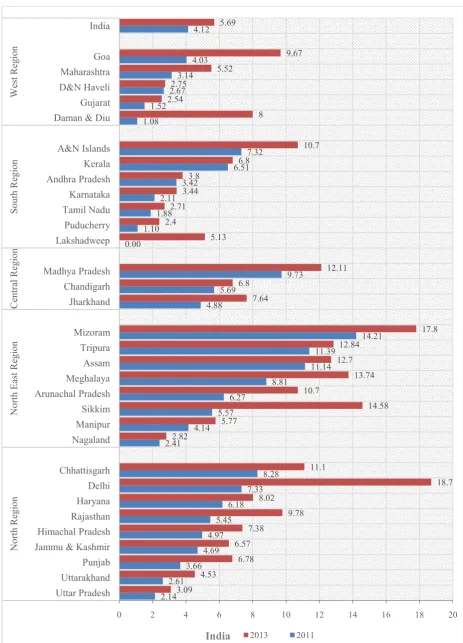
Figure 1 presents total rape of rate cases for 2011-2013 in India (rape case registered per one lakh women in 2011 and 2013).
The result depicts that the rate of rape cases in India increased from 4.1 to 5.6 % during 2011-13. The nation capital Delhi
state has explosion in rape cases; it has increased from 7.3 to 18.7 % even after made some legal improvements (Nirbhaya act) and where the unprecedented public protest and forced the political systems that to be made powerful act for rape. Rest of states in the north region rape cases significantly increased in Rajasthan from 5.4% in 2011 to 9.7% in 2013. The second highest rape cases was registered in Chhattisgarh during 2011, 8.2% to 11.1 % in 2013. The highest proportion of rape of rate cases has been found in North East Region compared to other selected region in India during the study period. The highest rape rate has increased from 5.5% to 14.5 % during 2011 to 2013 in Sikkim. The same results also have been found in Meghalaya and Mizoram states. In South region A and N Island, Pondicherry and Lakshadweep states have higher significant increased rate of rape cases from 7.3%, 1.1%, 0.0% to 10.7%, 2.4%, and 5.13% as compared to their counterpart. Madhya Pradesh and Jharkhand states have higher contributed to increased rate of rape cases from 9.7%, 4.9 % to 12.1% 7.6% during 2011-13.
In West region, rape cases are increased about two folders in Goa (4.1% to 9.7%) and about eight folders, increased in Daman and Diu from 1.08% to 8.0 % during 2011-13. In these states, rape cases are mounting very high during last three years as compared other states in West region. Among the union territories (Goa, Damanand Diu, A and N Islands, Lakshadweep, Delhi) percentage of rate of rape cases significantly increased during 2011-2013 as compared to national average. The results also highlighted that the all states have rape cases more than the national average except Nagaland, Uttarakhand and Uttar Pradesh in North East region and North Region has found in Figure 1. Figure 2 shows the trends of other Rape cases (rape committed by other than the blood relative) in India during the last one decade (2004-13). Other rape cases in India consistently increased during the study period. Furthermore, after 2009 it was significantly incised from 2013. Although, there is no any clue to other reduce rape cases in India. The Indian penal codes do not have special laws for incest rape cases, it’s define based on offender’s abuse.
Note- A and N, Andaman and Nicobar.
Figure 1. Levels of rate of rape cases by region in India, 2011-13
2.14 2.61
3.66 4.69
4.97 5.45
6.18 7.33
8.28 2.41
4.14 5.57
6.27
8.81
11.14 11.39
14.21 4.88
5.69
9.73 0.00
1.10 1.88
2.11 3.42
6.51 7.32 1.08
1.52 2.67
3.14 4.03
4.12
3.09 4.53
6.78 6.57
7.38
9.78 8.02
18.7 11.1
2.82
5.77
14.58 10.7
13.74 12.7
12.84
17.8 7.64
6.8
12.11 5.13
2.4 2.71
3.44 3.8
6.8
10.7 8
2.54 2.75
5.52
9.67 5.69
0 2 4 6 8 10 12 14 16 18 20
Uttar Pradesh Uttarakhand Punjab Jammu & Kashmir Himachal Pradesh Rajasthan Haryana Delhi Chhattisgarh Nagaland Manipur Sikkim Arunachal Pradesh Meghalaya Assam Tripura Mizoram Jharkhand Chandigarh Madhya Pradesh Lakshadweep Puducherry Tamil Nadu Karnataka Andhra Pradesh Kerala A&N Islands Daman & Diu Gujarat D&N Haveli Maharashtra Goa India
No
rth
Reg
ion
No
rth
East
Reg
ion
Cen
tral
Reg
ion
South
Regi
on
W
est
Reg
ion
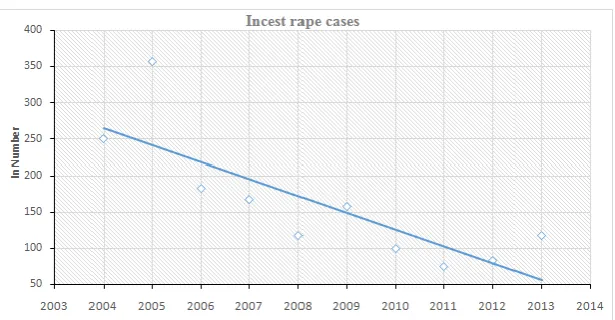
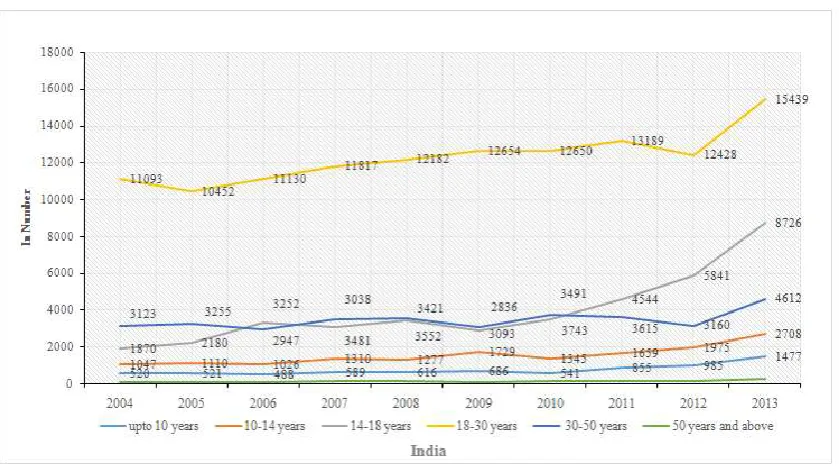
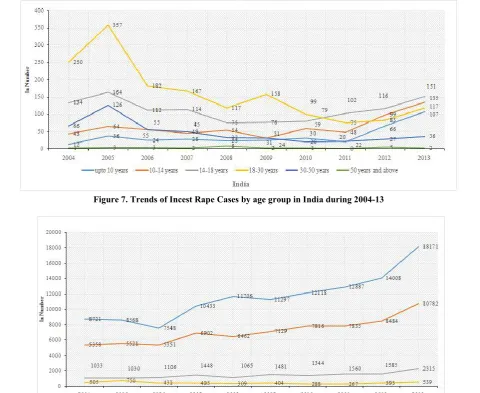
Overall result shows that the trends of other rape cases are increased in all age group except age group 50 years and above during study period (Figure 6). Incest rape cases by age group during 2004-2013 have shown in Figure 7. The trends of Incest rape cases in age group 18-30 years have significantly higher in year 2005, but through 2006-2013 the trends of incest rape cases are uniformly decreased.
[image:5.595.139.464.54.225.2]The trends of incest rape cases were consistently going up and down during study period in age group 14-18 years. Incidentally, the maximum numbers of victims are aged between 14-18 years of age with the member increasing from 116 in 2012 to 151 in 2013. The result also explains after 2011 incest rape cases are increased among age group up to 10 years.
[image:5.595.143.458.253.452.2]Figure 2. Trends of other rape cases in India during 2004-13
Figure 3. Trends of incest rape cases in India during 2004-13
[image:5.595.148.456.486.646.2]Victims between 10-14 years came second which has also shown a sharp increase from 99 in 2012 to 135 in 2013, The high proportion of incest rape victims are found in innocent/adolescent girls which age group is between <10, 10-14, 14-18 years compared else age group (Figure 7) (Hilberman, 1978).
The article published on November 19, 2014 in Hindustan time New Delhi edition which is submitted by police to the Delhi high court according to that 1704 rape cases registered in the capital in the duration of first ten months of 2014, among those cases 215 were subjected to incest rape cases. The offenders of incest rapes was respectively 43cases of fathers involved , 36 from uncle or cousins, 27 cases by brother, in 23 cases by stepfathers and in 86 cases involved others relatives21. Trends in offender’s relation and proximity to rape victims in India during 2004-2013 shown in Figure 8.
The result shows trend of rape cases significantly increase during last one decade in India. However, other known persons have considerable contribute to increased rape cases as compared to their counterpart during 2004-13. Furthermore, the neighbors in India have found the same trends during study period. Trends in rape cases (incest rape) done by relatives and parents or close family members have no significant change during study time (Figure 8) (Singh, 2014).
[image:6.595.124.475.63.255.2]Discussion: The study reveals that the trend of rape incidents (both other/incest rape) consistently increased from the study period. The study clearly depict that the incident of rape reporting and raping rate also increased between 2012-2013, even after the criminal amendment, Act, 2013, which was an Indian legislation passed the bill related to sexual offences (Nirbhaya act-2013).
Figure 5. Scatter diagramed of other rape cases of age group 18-30 years in India
[image:6.595.88.508.286.519.2]Another ‘evil scenario’ has been found in this study the high prevalence of rape victims are belongs to 18-30 years younger and working age group, who always need to nation, who are the part of economic growth, who moves outside of the home for the purpose of education, job opportunity etc. The relation/proximity between offenders to rape victims, the prevalence by respectively known persons and neighbors (Singh, 2014). During last one decade impact of the criminal justice system on victims of rape and many others sexual assault offence has been received significant attention. Attention have been showed individual and organization those working for women welfare. Rape is the ultimate violence for women. It is a humiliating event in a women’s life. Which leads to fear for existence and a sense of powerless (http://ncrb.gov.in/index.htm; Koss et al., 1994). The victim needs empathy and safety and a sense of re-assurance. The rape victims have undergone certain tribulation. These begin with their treatment by the police and continue through male dominated criminal justice system.
Many literature highlighted uniformly indicate that community about rape have considerable impact on the responses that rape survivors receive from others upon disclosure of their assaults. Many literatures found negative social reaction in general to be related to more psychological symptom and poorer self-reported recovery. Research also shows stigmatization and blame of rape victims to be widespread in many societies, culture affecting the victim’s mental and physical health. Victim’s needs sympathy; claim assistance, temporary relief from other role responsibilities, legal recourse and many other advantages, cannot be exercised if survivors do not identify their experience such as rape (Hilberman, 1978).
[image:7.595.58.539.64.457.2]Every day in print and electronic media we can found that girls/women’s are sexually harassed or raped and also caused to death. New statistical records say that there are records of women raped and sexually assaulted in the recent past years. Rape is the fastest growing crime in the country today compared to other than crime incidents of women.
[image:7.595.91.510.253.489.2]Figure 7. Trends of Incest Rape Cases by age group in India during 2004-13
National capital Delhi has become the most unsafe place for girls where one rape happens almost every day. Hence the empowerments which are being given by the elegance of democracy or so called constitutional aspect are in danger. In this context the present paper is explained about trends and dynamics of rape cases and increasing incidents of rapes, incest and other rape, rape on minors and women like rape cases by age group in India during last one decade (2004-13) and also its deals with regional rape scenario for 2011-2013 which rapes are becoming very frequent these days. The present study is based on the data from National crime records bureau of India from 2004-2013. Data on crimes in India are published annually by the National Crimes Records Bureau (NCRB). These are compiled from records of police stations all over the country and refer to reported and registered crimes. (http://ncrb.gov.in/index.htm).
Conclusion
In order to stop crime against women the study have suggested some policy makers to the government, NGO’s, and social communities, Generally Women have lack of awareness of which is happing of crimes against them, due to this women have underreporting their sexual abuse, and they wish to keep silence, which that heinous crime embarrassed their filmily social status and many of sexual abuse victims may felt even after the knocked the court, there will be long legal battle will be there. Our constitution will provide large number protective laws to prevent and control the crimes against women. Therefore mass media should be play important role to create legal, social awareness amongst the young men and women’s by catchy programmes.
In Indian community generally women have underreporting their abuse i.e. domestic abuse, rape because they feel embarrassed, guilty and family social status because they wish to protect their perpetrators with whom they may have in relationship. Victims also have been feared such responses as terror incredulity and outright rejection. For controlling such kind of abuse on women in the society; there is one major problem in the society is imbalance of sex ration. To create awareness about girls child protection and also have equal right as boy have. Provide equal opportunity for male and female in the society and respect girls/women. Free and compulsory education program for girl and boy at local level with help of local leader and non- profit organization.
REFERENCES
Crime against women 2013. Loke Sabha Secretariat, Parliament library and reference research documentation and information services, reference no. 2/RN/Ref./2013. Derby, J. 2013. On rape, from silence to justice. The Hindu, 15
June 2013.
http://www.thehindu.com/todays-paper/tp-opinion/on-rape-from-silence-to-justice/article4815995.ece. Dreze, J. and Khera, R. 2000. Crime, gender, and society in India: Insights from homicide data. Population and
Development Review, 26(2), 335-352.
Guruappa, N. 2011. Violence against Women in India. Serials
Publications, New Delhi, p. 23.
Harter, P. 2011. Libya rape victims face honor killings. BBC News Libya rape victims 'face honor killings. http://www.bbc.com/news/world-africa-13760895.
Hilberman, E. 1978. The impact of rape. In The woman
patient (pp. 303-322). Springer US.
JAGORI and Women, U.N. 2010. Report on the Baseline
Survey.http://jagori.org/wp- content/uploads/2011/03/Baseline-Survey_layout_for-Print_06_04_2015.pdf.
Khandelwal, S. K. 2015. A Socio legal Study of Crimes Against Women A Critical Review of Protective Laws. Koss, M. P., Goodman, L. A., Browne, A., Fitzgerald, L. F.,
Keita, G. P. and Russo, N. F. 1994. No safe haven: Male violence against women at home, at work, and in the
community. American Psychological Association.
National Crime Record Bureau Statistics Ministry of Home affaire. http://ncrb.gov.in/index.htm.
NCRB 2012. Snapshots: general crime statistics NCRB. http://ncrb.nic.in/CD-CII2012/cii-2012/Snapshots.pdf. Perceived government inaction over rape and murder of two
teenage girls sparks public anger". India'sNews.Net. https://www.google.co.in/search?q=1.+Perceived+governm ent+inaction+over+rape+and+murder+of+two+teenage+gir ls+sparks+public+anger%22.+India%27s+News.Net.+Retri eved+31+May+2014.andoq=1.+Perceived+government+in action+over+rape+and+murder+of+two+teenage+girls+spa rks+public+anger%22.+India%27s+News.Net.+Retrieved+ 31+May+2014.andaqs=chrome..69i57.1714j0j4andsourcei d=chromeandes_sm=93andie=UTF-8#q=Perceived+ government+inaction+over+rape+and+murder+of+two+tee nage+girls+sparks+public+anger%22.+India%27s+News.N et.+Retrieved+31+May+2014.
Rufus, D. 2014. Victims of sexual harassment at the workplace a comparative study in the organized and unorganized sectors of Tirunelveli district.
Sardar, K. 2013. A year after Nirbhaya, rapid rise in number of rape complaints. The new Indian express.
http://www.newindianexpress.com/thesundaystandard/A- Year-After-Nirbhaya-Rapid-Rise-in-Number-of-Rape-Complaints/2013/12/15/article1946075.ece
Singh, A.K. and Choudhury, A. 2012. Violence against Women and Children-Issues and Concerns. Serials
Publications, New Delhi.
Singh, S. R. 2014. Incest rapes in Delhi up, fathers among offenders. Hindustan Times 19, Nov, 2014. New Delhi. http://www.hindustantimes.com/newdelhi/capital-shame-
incest-rapes-on-rise-in-delhi-fathers-among-offenders/article1-1287696.aspx.
Taylor Jr, S., Johnson, K. C. and Johnson, R. D. 2007. Until proven innocent: Political correctness and the shameful
injustices of the Duke lacrosse rape case. Macmillan.
The Economic Times 2012. Delhi gang rape: Protests go viral nationwide, unstoppable public outpouring as gang rape victim dies, New Delhi, 30, December.
The Telegraph 2012. (2012-12-19). Video: Protests grow over gang rape of Indian woman. 19, Dec 2012, London. UNICEF (2014). Hidden In Plain Sight: A statistical analysis
of violence against children. Data and Analytics Section
Division of Data, Research and Policy. http://www.
United Kingdom’s Daughters, an Indian man’s response to BBC’s documentary on Delhi gang rape. http://indianexpress.com/article/india/india-others/united- kingdoms-daughters-an-indian-mans-response-to-bbcs-documentary-on-delhi-gangrape/.
UNODC, 2005. The Eighth United Nations Survey on Crime Trends and the Operations of Criminal Justice Systems (2001 - 2002). http://www.unodc.org/unodc/en/data-and- analysis/Eighth-United-Nations-Survey-on-Crime-Trends-and-the-Operations-of-Criminal-Justice-Systems.html.
Vanderschueren, F. 2000. The Prevention of Urban Crime, Paper presented at the Africities 2000 Summit, Windhoek, Namibia. Cited in UN-HABITAT, 2006, State of the
World’s Cities 2006/2007, p. 144, Nairobi. http://www.
unwomen.org/en/what-we-do/ending-violence-against-women/facts-and-figures#sthash.ibA8dhJB.dpuf.