ISSN Online: 2151-4771 ISSN Print: 2151-4755
DOI: 10.4236/ce.2018.915193 Nov. 21, 2018 2546 Creative Education
Characterization of Rational Numbers Using
Kronecker’s Orbit: A Didactic Approach
Petros-Stylianos Marsellos
Greek Ministry of Education, Athens, Greece
Abstract
For every real number x, we define as integer part the biggest integer k so that k ≤ x and is expressed [x]. The difference of the number from its integral part is defined as decimal part of x and expressed with
( )
x ∈[
0,1)
. Consequently, for every x, the Kronecker’s orbit is defined, namely the set{
( )
nx n∈}
. Through Kronecker’s orbit, rational numbers are characterized as the num-bers whose orbit is a bounded set, while irrational numnum-bers are characterized as the numbers whose orbit is a dense set. Using this fundamental theoretical result and utilizing a computer, a didactic approach was established, initially referring to the definition of rational numbers as fraction equivalence classes and basically to the segregation of rational and irrational numbers. This di-dactic approach also incorporates elements of ancient Greek mathematics history. The proposition was applied to students and was evaluated.Keywords
Kronecker’s Orbit, Rational Numbers’ Characterization, Mathematical Education, Geogebra, Decimal Part
1. Introduction
In 1881, Leopold Kronecker defined what is called the “rationality domain”, which is indeed a body of polynomials in modern terms. In 1893, Heinrich M. Weber gave the first clear definition of the abstract body. In 1910, Ernst Steinitz published a very important article on the Algebraische Theorie der Korper. In this article, he studied the properties of the domains and defined very important theoretical concepts, such as the prime field, perfect field and the field’s degree of transcendence. Emil Artin developed the relationship between the groups and the fields with great precision from 1928 to 1942 (Cohen, 2013).
How to cite this paper: Marsellos, P.-S. (2018). Characterization of Rational Num-bers Using Kronecker’s Orbit: A Didactic Approach. Creative Education, 9, 2546-2560. https://doi.org/10.4236/ce.2018.915193
Received: October 8, 2018 Accepted: November 18, 2018 Published: November 21, 2018
Copyright © 2018 by author and Scientific Research Publishing Inc. This work is licensed under the Creative Commons Attribution International License (CC BY 4.0).
DOI: 10.4236/ce.2018.915193 2547 Creative Education
With regard to Kronecker, whose theory is the basic idea and the basic con-tent of this article, he begins his study with the word “Jugendtraum” as his guide, which is the German translation of the phrase “youthful dream”. Indeed, in his letter to Dedekind, Kronecker described as his youthful dream the finding of functions whose specific values could produce abelian extensions of random al-gebraic fields of numbers. More specifically, he said: “It is the most coveted dream of my youth, namely to prove that abelian equations with explicit square roots date back to transformations of elliptic functions with particular moduli, just as in the case of reduction of integer abelian equations in cyclotomic equa-tions” (Vlăduț, 1991).
The Jugendtraum of Kronecker refers to achieving the construction of all ab-elian extensions of a squared complex algebraic field of numbers, attaching spe-cific values of certain transcendental functions on any algebraic fields of num-bers (Cassels, 1992). When the chosen field is Q, the answer to this problem is the Kronecker and Weber theorem. This informs us that any abelian extension of Q is contained in a cyclotomic field. In other words, each abelian extension of Q is contained in a field resulting from attachment to Q of a specific value of the exponential function.
The Jugendtraum is the generalization of the Kronecker and Weber theorem in the case where the algebraic field chosen is not Q, but a random squared complex number field. The effort to solve this problem has led to the develop-ment of mathematical disciplines, such as complex multiplication theory and the class field theory (Charollois & Sczech, 2016).
From the above, it becomes clear that the study of the Jugendtraum requires knowledge and manipulation of sophisticated mathematical concepts and gener-ally theories. For this reason, the choice of analysis of concepts and the presenta-tion of theory to students is not only aimed at achieving the goal of solving the Jugendtraum in the case of squared number fields but also in acquaintance with several attractive mathematics. This article is a reference to the characterization of rational numbers through the use of Kronecker’s theorem. The present article has a teaching aim and trend and through the sections that will follow this will not be the only to be explained, but also a thorough analysis of its dynamics at the teaching level will be made.
Kro-DOI: 10.4236/ce.2018.915193 2548 Creative Education
necker will be explained, but also a complete picture of the teaching process that should be followed to understand this and its applications in mathematical science will be provided.
2. Literature Review Regarding the Difficulties in
Understanding the Difference between Rational-Irrational
Numbers and Usage of Technology in Education
Students experience obstacles in understanding real numbers and rational num-bers in particular (Smith et al., 2005). These problems still remain among stu-dents of schools of mathematics (Hart &Sinkinson, 1988; Fischbein, Jehiam, & Cohen, 1995) but also among mathematic teachers. Students do not comprehend the concept of rational numbers and believe that they have nothing to do with real numbers (Moseley, 2005).
• The problem of understanding rational numbers
Rational numbers, as a creation of human thought is a difficult notion (Pitkethly & Hunting, 1996). Students, having created an impression on num-bers (being taught the natural numnum-bers), find it hard to understand rational numbers (Ni & Zhou, 2005).
Rational and natural numbers present similarities which are only superficial. As a result, students believe that natural numbers’ properties are also applied on rational numbers (Kollias et al., 2004; Voskoglou & Kosyvas, 2012). This student difficulty is reinforced by the fact that they come into contact for the first time with new mathematical symbolisms, which they must understand but also learn to use (Ni & Zhou, 2005).
Fractions trouble particularly students, who cannot understand that a fraction is a mathematical entity and not two different numbers, they are being taught fractions as part of the whole, and therefore, in the course of their mathematical knowledge, cannot comprehend their further meanings.
Multiple representations of real numbers have a negative effect on their com-prehension and students fail to understand that different representations may represent the same number. However, school books do not emphasize on this matter (Voskoglou & Kosyvas, 2012).
recogni-DOI: 10.4236/ce.2018.915193 2549 Creative Education
tion of real, rational and irrational numbers (Giannakoulias, Souyoul, & Zacha-riades, 2007; Voskoglou & Kosyvas, 2012). Moreover, it was ascertained that age, along with the depth of mathematical knowledge affect comprehension of these difficult concepts (Giannakoulias, Souyoul, & Zachariades, 2007).
• How to tackle the problem
Several opinions have been expressed about the ways through which this dif-ficult matter of number comprehension, and particularly rational numbers, can be dealt with. These opinions are based on observed problems but also on the way in which the human mind faces these mathematical concepts. In order to introduce students to these new notions, a radical change of the “number con-cept” is required (Carpenter et al., 1999). This can be achieved through the con-tribution of the professor, who, among others, must take into consideration that they are addressing children and not adults, and must therefore follow a corres-ponding teaching and pedagogical approach. Professors must have full know-ledge of real numbers and their subsets, and be equipped with perseverance and patience, emphasizing on solving the students’ problems. Also, positive impact could be observed when approaching these concepts with “tangible”, representing examples, which are connected with real life.
According to Keiren (1976), when rational numbers are represented on the numbers’ line, then it is easier to understand that rational numbers are a subca-tegory of the real numbers. Furthermore, students are in a position to under-stand more easily rational numbers, if they learn and become familiar with mul-tiple representations (Kieren, 1980, 1993). For this reason, the teacher can focus on multiple representations using many examples and exercises, exercises which will be done during class by students, working in groups, but also exercises which will be given to students to be solved, so that they also practice at indi-vidual level, realising themselves their difficulties and questions. Professors must encourage open discussion to track students’ problems and adjust their teaching according to the needs of their class concerned (Voskoglou, 2009).
Finally, we should refer to the opinions according to which rational numbers must be taught at a younger age, even before students form an idea on what a number actually is. When an opinion has been completed, it is very difficult to change the attempt in the future (Voskoglou & Kosyvas, 2012).
“Question: Why did you answer that 5
2
− is a rational number?
Answer: Because it is a fraction.
In this case we have a classical misinterpretation of the definition of rational numbers. The student focused her attention on the symbol of fraction without realizing that, in order to be rational number, its terms must be integers, with non-zero denominators.
Question: Why did you answer that − 4 is an irrational number?
Answer: Because it has the root.
Dis-DOI: 10.4236/ce.2018.915193 2550 Creative Education
tinction among several types of numbers remains muddy in general, each time depending on their semiotic representations” (Voskoglou & Kosyvas, 2012).
This represents a very usual student opinion: fractions are rational numbers and roots are irrational numbers.
• Conclusions
Many researches and studies on students’ difficulty in understanding rational numbers have been carried out. Incomplete knowledge of real numbers and their subsets was ascertained from those studies. Also, weakness is observed in recog-nizing rational-irrational numbers and in using multiple representations. School books are responsible for this, too, as they do not delve into these concepts and therefore, the professor’s contribution is crucial for dealing with these difficul-ties, by him insisting on these problems and “listening” to their students, pro-moting discussion in class.
• The proof
Teaching proofs is a difficult part of mathematics. Students cannot compre-hend proofs and believe that there is no substantial reason for their obligatory teaching.
• The contribution of technology
Technology can help students change their attitude regarding these problems, particularly by re-defining their opinions on geometry and geometrical proof. Since 1980, software of Dynamic Geometry, known as DGS, has been created, aiming to understand Geometry and geometry proofs. These programs may help students comprehend the above and make them realize the importance of proofs, and also be used as an alternative proposition to their approach.
DGS are programs of geometrical visualisation (Cabri, Sketchpad, EukliDraw, a.o.). Through this software, students become active members of knowledge, understand geometry better, are leaded to conclusions, express questions and conjectures.
Studies have shown that DGS can help students understand the need for proofs and intervene to their transition from the intuitive to the theoretical level (Jones, 2000). Of course, there are critics against these programs, who believe that there is a possibility that the teacher’s role is lost due to DGS.
There are many students who present difficulties in using rulers and com-passes, and DGS solve this problem, as the user can easily construct geometric shapes and confirm their correct or wrong construction.
DOI: 10.4236/ce.2018.915193 2551 Creative Education
Students create, change and observe, cease being passive knowledge receivers, become active members and knowledge producers. Calculation and dragging possibilities provide analyses and also properties’ discoveries. Students can for-mulate and revise conjectures through DGS, based on image and numeric data changes; they can revise relations but also work on constructions which copy real-life problems (Kordaki & Mastrogiannis, 2006).
• Conclusions
DGS use when teaching Geometry and geometric proofs may contribute posi-tively in changing the students’ attitude across those matters and also help them express conjectures. The professors who will include DGS in their lesson can create a research laboratory environment, integrating students in groups, acting as their partner, exciting in this way their students’ interest. They will guide the students and will provide the scientific verification of their results.
3. The Role of Technology in Teaching and Understanding
Mathematical Concepts
There are numerous advantages in using technological means both for students and for teachers.
Students:
• Gain access in various sources, information, knowledge from all over the world.
• Are more easily led to create conjectures and they participate actively in the lesson’s course.
• Can evaluate themselves.
• Do not feel that they are being judged because the computer is impersonal, and therefore they take initiatives and control their knowledge.
• Can seek distance help. Teachers:
• Can present images and material with great accuracy in shapes or simulate experiments.
• Can easily have access in a variety of pre-written exercises, e.g. http://digitalschool.minedu.gov.gr/.
Finally, the computer environment is more attractive and easy-to-use for both groups than the traditional paper and pencil.
However, there are also disadvantages. The most important is that students tend to consider the computer’s answer as proof. Also, their high acquisition cost is the main cause for the lack of equipment and software in schools. Lastly, the intensification of the alienation due to lack of human contact is also a disad-vantage.
proce-DOI: 10.4236/ce.2018.915193 2552 Creative Education
dures. The creation of conjectures and the development of intuition are useful tools when trying to find the solution to a problem. Often, if students get the answer-solution through the computer, they can also more easily find the strict proof. The phrase of Professor P. Spyrou in his class is characteristic: “the visua-lization of the solution (shape) is like the plane’s auxiliary wheels; while they are not doing anything during flight, they are necessary for take-off”. There comes the moment when the teacher must point out that mathematics are based on deductive inference and are built only by strict proofs, because intuition can be misled many times.
4. Characterization of Rational-Irrational Numbers Using
Kronecker’s Orbit
Definition: Consider x∈. The set Ox =
{
( )
nx n∈}
where( )
x = −x[ ]
xwe symbolize the number’s fraction part. Proposition 1
Consider x∈. Then x∈ ⇔ Ox is a finite subset of [0, 1) Proof
Consider x k,k ,l , ,
( )
k l 1 l= ∈ ∈ = . Then
( ) ( )
kx = 0 =0, therefore( ) ( )
{
0, ,}
x
O = x kx is finite.
Vice versa, if Ox is finite, then ∃m n, ∈,m n mx< :
( ) ( )
= nx . So,nx mx k− = ∈ therefore x k n m
= ∈
−
Proposition 2
Consider x∈. Then x irrational⇔Ox is a dense subset of [0, 1) Proof
If Ox is a dense subset of [0, 1) then it is infinite, so from the previous proposition x irrational.
Vice versa, consider irrational. I will show that for any y of [0, 1) there is an element of Ox which is close to y. That is, for
[
0,1 ,0)
1( )
( )
2y x
y∈ < <e − ∃ ∈ν with nx ∈O so that nx − <y e. I choose
1 1
e Μ = + ∈
. I divide [0, 1) in M equal intervals and I take the first M + 1 elements of Ox from 0, namely 0,
( )
x , ,… Μ( )
x . Using the pigeonhole prin-ciple since I have M + 1 elements and M intervals, this means that at least two elements (kx), (lx) with 0 < k < l < M belong to the same interval and therefore their distance is less than 1 :( ) ( )
kx − lx < 1Μ Μ . Since x is irrational, then
( ) ( )
kx ≠ lx and I put 0< = − ≤ ≤ Μr l k l and j=[ ] [ ]
lx − kx . We have( ) ( )
1 , rx j− = kx − lx < <e j∈Μ . So,
[ ]
rx = j or rx[ ]
− = −j andDOI: 10.4236/ce.2018.915193 2553 Creative Education
5. Scenario Presentation
Our goal is to create an alternative scenario which will offer a new perspective in the topic of rational numbers using the computer, based on the history and the problems we mentioned above in the literature review. The scenario consists of four papers which are given to the students consecutively, ages: 14 - 16.
Activity Analysis
Part one: reminders-additions Prerequisites:
Firstly, we will discuss about the fraction part. Here we will remember the Euclidean division and we will define the integer and decimal or fraction part relating it with mixed numbers which students learnt in primary school. Using specific examples, students practice alone in finding numbers’ fraction parts. In this activity each one will work in their notebook for about 15 minutes.
After that, a Discussion about representing numbers in the line will be done. They have been already taught this topic, but we will give them some examples to make sure that there will be no mistakes due to this in the questions of page 2. Completion will be done in pairs under the teacher’s supervision. We do not ex-pect students to face particular difficulties.
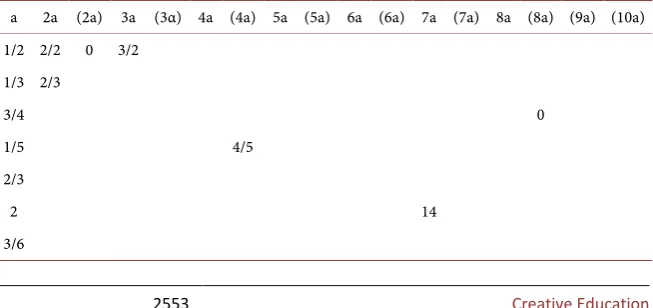
Afterwards, the students will complete the first page (Table 1). The first col-umn has the numbers “a”, in the second one “2a” we write number a’s double and in the third one “(2a)” we write 2a’s fraction part as already completed as an example.
Completing Table 1
Part two: The orbit’s concept
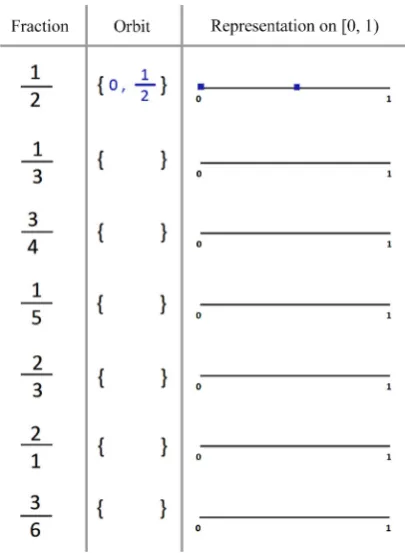
[image:8.595.212.539.595.749.2]Having completed the table, we ask students to circle fraction parts on the page. “Is there any pattern they are following? How do you believe it would con-tinue if we wrote more multiples?” Here we expect them to find out that fraction parts are repeated. There we will give the name “orbit”. We will remind them, if necessary, that in a set we only write once each element. “Which is the orbit for every number of the table?” This question leads us to the second page (Figure 1). Here the orbit is represented in the rectilinear part after being defined as a set.
Table 1. First page of the scenario. Finding the fraction part.
a 2a (2a) 3a (3α) 4a (4a) 5a (5a) 6a (6a) 7a (7a) 8a (8a) (9a) (10a) 1/2 2/2 0 3/2
1/3 2/3
3/4 0
1/5 4/5
2/3
2 14
DOI: 10.4236/ce.2018.915193 2554 Creative Education
Figure 1. Second page of the scenario. Finding Kronecker’s orbit.
DOI: 10.4236/ce.2018.915193 2555 Creative Education
we do not spoil the lesson’s course now. For the time being, accept it because I say to you that I have proved it”. The proof is not difficult but in my opinion requires a familiarisation with the concepts we’ve just learnt and could cause agitation if mentioned altogether. Mentioning that there is a proof is necessary.
Afterwards, the graphical representation of the table’s elements follows, in the page’s third column. There, the [0, 1) can be done with separation in as many equal parts as many elements the set has, or with the traditional representation.
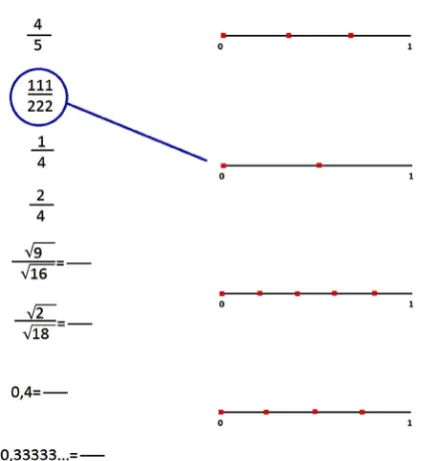
We proceed to Page 3 (Figure 2) which is matching. The definition of rational numbers is: “the numbers which can be written as fractions of integers”. This “can” is page 3’s main goal.
This is obvious from the choice of forms that are not fractions of integers and the fraction line is next to them. It requests to be completed with the appropriate form which will allow them to apply the proposition they discovered. Of course, through this page I also want to ensure that they can apply correctly the proposi-tion (e.g. in equivalent fracproposi-tions) and find out the matches without making op-erations with the fraction parts (Always in pairs).
Part three: the PC
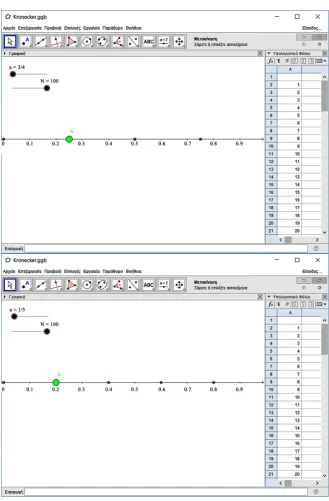
I now explain that through a program we can see orbits for all numbers (I present images) (Figure 3).
“We now turn on the PC. Let’s see what you have done … Firstly, we will con-firm some of your results”. After we ascertain the correspondence of their results with those of the program, we proceed to the next step.
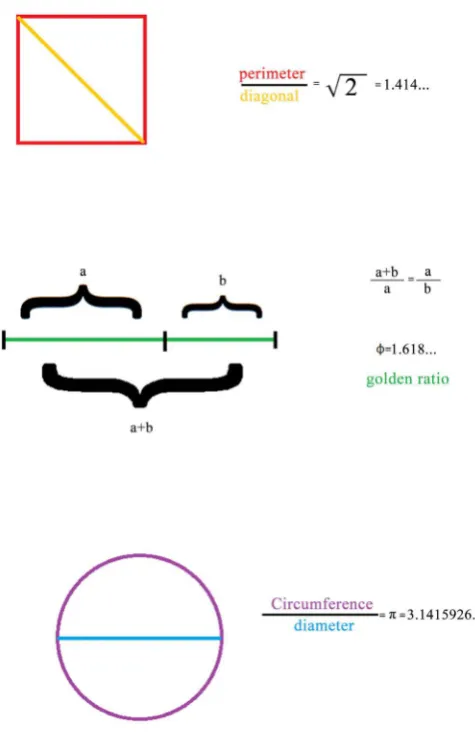
[image:10.595.274.486.471.702.2]Now we give them the final page (Figure 4) where the geometrical construc-tion of numbers is presented, and we will check their orbits. Here, we will come to infinite orbits for the numbers we described before as irrational, − 2,
DOI: 10.4236/ce.2018.915193 2556 Creative Education
Figure 3. Examples of Kronecker’s orbits for rational numbers using Geogebra.
1 5
2
±
, the golden ratio, the ratio of the circumference to the diameter and of the side to the diagonal of a square. “We have learnt in Junior high School that the ratio of the circumference to the diameter gives us?” π = 3.14159 … «The Pythagorean Theorem states that the ratio of a diagonal to a square’s side equals to 1.414 …” and with a trinomial like that of the school book of the third grade of Junior High School we know that the golden ratio is the ratio 1.618 …
DOI: 10.4236/ce.2018.915193 2557 Creative Education
1) in the orbit of those numbers. Let’s see”.
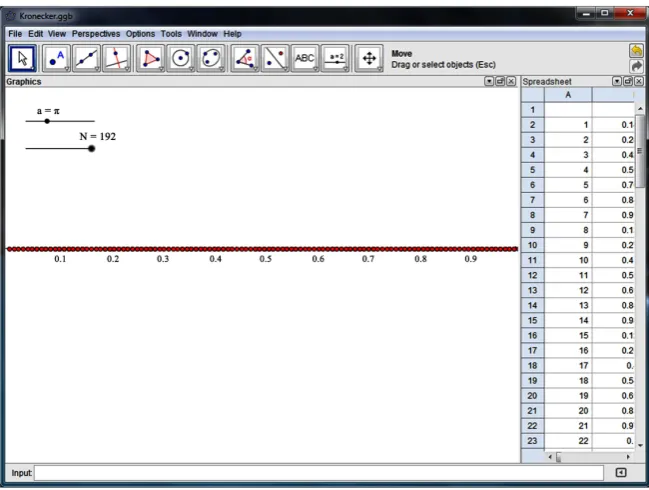
I indicatively present the image for pi (Figure 5).
I zero the cursor and start raising multiples up to 200 which are more than enough in all three cases to complete with dense dots [0, 1).
Part four: irrational numbers
“How many elements does the orbit have here?” ∞ infinite.
“Let’s remember the proposition we found before. Find it there where we wrote it to see it”. If we have a fraction in its lowest terms k/l, then the orbit con-sists of l elements and vice versa, if the number’s orbit concon-sists of l elements then the number is written as a fraction in its lowest terms with denominator l. And here lies the big question:
[image:12.595.252.490.331.698.2]“Could they be written as a fraction and, if yes, with which denominator?” I expect through conversation with the whole team to conclude finally that no, they couldn’t. Students may try to make operations using infinity as if it were a real number. This appears to be another delicate point which must be clarified to students. Finally, create the definition and an extra characterization of rational numbers.
DOI: 10.4236/ce.2018.915193 2558 Creative Education
Figure 5. Example of Kronecker’s orbit for irrational numbers using Geogebra (Dense).
The typical proof follows. Definition
Consider x∈. The set 0x=
{
( )
nx n∈}
where (x) = x – [x] we represent the number’s fraction part, it is called Kronecker’s orbit.Proposition (characterization of rational numbers)
Consider x∈. Then x∈ ⇔ 0x is an finite subset of [0, 1) Proof
Consider x k,k ,l , ,
( )
k l 1 l= ∈ ∈ = . Then
( ) ( )
lx = 0 =0 , therefore( ) ( )
{
0, ,}
x
O = x … kx is finite.
In reverse, if Ox is finite, then ∃m n, ∈,m n mx< :
( ) ( )
= nx . Therefore,nx mx k− = ∈ so x k n m
= ∈
− .
6. Continuation
It is very important that students understand through ancient problems the concept of asymmetry qualitatively, that is, the non-existence of a common measure and not simply through definitions. In Euclid’s Elements, the rational numbers were characterized with a method called anthyferesis and there was proof that the square roots of 2, 3 … 17 were irrational.
7. Discussion
DOI: 10.4236/ce.2018.915193 2559 Creative Education
important for students to make assumptions, which is the first step when learn-ing a new concept.
Conflicts of Interest
The author declares no conflicts of interest regarding the publication of this pa-per.
References
Carpenter, T., Fennema, E., Fuson, K., Hiebert, J., Human, P., Murray, H. et al. (1999). Learning Basic Number Concepts and Skills as Problem Solving. Mathematics
Class-rooms that Promote Understanding, 45-61.
Cassels, J. W. S. (1992). Kronecker’s Jugendtraum and Modular Functions. Bulletin of the
London Mathematical Society, 24, 613-614. https://doi.org/10.1112/blms/24.6.613
Charollois, P., & Sczech, R. (2016). Elliptic Functions according to Eisenstein and Kro-necker: An Update. EMS Newsletter, 9, 8-14. https://doi.org/10.4171/NEWS/101/4 Cohen, H. (2013). A Course in Computational Algebraic Number Theory. New York:
Springer Science & Business Media, Springer-Verlag Berlin Heidelberg GmbH. Fischbein, E., Jehiam, R., & Cohen, D. (1995). The Concept of Irrational Numbers in
High-School Students and Prospective Teachers. Educational Studies in Mathematics, 29, 29-44. https://doi.org/10.1007/BF01273899
Giannakoulias, E., Souyoul, A., & Zachariades, T. (2007). Students’ Thinking about Fun-damental Real Numbers Properties. In Proceedings of the Fifth Congress of the
Euro-pean Society for Research in Mathematics Education (pp. 416-425). Cyprus: ERME,
Department of Education, University of Cyprus.
Hart, K., & Sinkinson, A. (1988). Forging the Link between Practical and Formal Mathe-matics. In Proceedings of the 12th International Conference for the Psychology of
Ma-thematics Education (Vol. 2, pp. 380-384).
Kieren, T. E. (1980). Five Faces of Mathematical Knowledge Building. Department of Secondary Education, University of Alberta.
Kieren, T. E. (1983). Partitioning, Equivalence and the Construction of Rational Number Ideas. In Proceedings of the Fourth International Congress on Mathematical Education
(pp. 506-508). Boston: Birkhauser.
Kollias, B., Mamalougos, N., Mol, A., Vamvakousi, X., Stathopoulou, X., & Vosniadou, S. (2004). Significant Turns of Teachers’ Professional Knowledge who Implement Com-puter Supported Collaborative Learning Environments. In Proceedings of 4th
Confe-rence Technologies of Information and Communication in Education (pp. 45-62).
Kordaki, M., & Mastrogiannis, A. (2006). The Potential of Multiple-Solution Tasks in E-Learning Environments: Exploiting the Tools of Cabri Geometry II. In E-Learn: World Conference on E-Learning in Corporate, Government, Healthcare, and Higher
Education (pp. 97-104). Association for the Advancement of Computing in Education
(AACE).
Laborde, C., Kynigos, C., Hollebrands, K., & Strässer, R. (2006).Teaching and Learning Geometry with Technology. Handbook of Research on the Psychology of Mathematics
Education: Past, Present and Future, 275-304.
DOI: 10.4236/ce.2018.915193 2560 Creative Education
https://doi.org/10.1007/s10649-005-5031-2
Ni, Y., & Zhou, Y. D. (2005). Teaching and Learning Fraction and Rational Numbers: The Origins and Implications of Whole Number Bias. Educational Psychologist, 40, 27-52.
https://doi.org/10.1207/s15326985ep4001_3
Pitkethly, A., & Hunting, R. (1996). A Review of Recent Research in the Area of Initial Fraction Concepts. Educational Studies in Mathematics, 30, 5-38.
https://doi.org/10.1007/BF00163751
Smith, C. L., Solomon, G. E., & Carey, S. (2005). Never Getting to Zero: Elementary School Students’ Understanding of the Infinite Divisibility of Number and Matter.
Cognitive Psychology, 51, 101-140. https://doi.org/10.1016/j.cogpsych.2005.03.001
Vlăduț, S. G. (1991). Kronecker’s Jugendtraum and Modular Functions 2. Luxembourg: Cordon and Breach Publishers, CRC Press.
Voskoglou, M. G. (2009). Fuzzy Sets in Case-Based Reasoning. In 2009 Sixth
Internation-al Conference on Fuzzy Systems and Knowledge Discovery (pp. 252-256).
https://doi.org/10.1109/FSKD.2009.667
Voskoglou, M., & Kosyvas, G. D. (2012). Analyzing Students’ Difficulties in Understand-ing Real Numbers. Journal of Research in Mathematics Education, 1, 301-336.