RELATIVE PERFORMANCE AND COMBINING ABILITY FOR YIELD AND YIELD COMPONENT
IN MAIZE BY USING A FULL DIALLEL CROSS
Department of Field Crops
ARTICLE INFO ABSTRACT
Maize (Zea mays
country is generally low due to limitation of high yielding improved maize hybrid varieties. Knowledge of combining ability and gene action is essential to identify good c
and high yielding potential hybrids. The objectives were to evaluate combining ability of the elite maize inbred lines with respect to yield and yield related traits. Six inbred lines were mated
dialle fashion to obtain of a hybrids in the year 201 station
yield and other related traits and subjected for analysis of variance.
estimate the general and specific combining ability effects for yield and yield related traits. Analysis of variance revelation significa
Combining ability analysis, mean squares due to
traits except number of rows per ear and number of kernels per row for RCA. indicating the importance of additive and Non
lines L2, L3 and L4 showed good general GCA for most of the characters studied. Among the crosses L3×L4 (192.2 gm.p
L3 × L1 (177.54 gm.p
grain yield and yield related traits studied. It can be concluded that good general comb
good yield can be potential varieties for commercial production. However, further evaluation of these breeding materials atmore locations and year, is advisable to confirm th
in the present study.
Copyright©2016, Omar Hazim Al-Rawi. This is an open access article distributed under the Creative Commons Att use, distribution, and reproduction in any medium, provided the original work is properly cited.
INTRODUCTION
The scientific basis of plant breeding started in the 1900s rediscovery of Mendelian genetic and the development of the statistical concepts of randomization and replication had considerable impact on plant breeding methods. Maize is an economically important crop for feed, fiber, fuel, and food. Maize is grown twice in a year, i.e., spring and autumn. The production per hectare is low in spring season because of high temperature that affects the pollination and seed setting in maize. Modern maize breeding methods are primarily a 20th century phenomenon. Applied maize breeding has been effective in developing improved hybrids during the past 100 year. The inbred–hybrid concept was developed in the public
*Corresponding author: Omar Hazim Al-Rawi, Department of Field Crops-Agriculture College-Al
ISSN: 0975-833X
Article History: Received 14th June, 2016
Received in revised form 09th July, 2016
Accepted 02nd August, 2016
Published online 20th September,2016
Key words:
Maize, Full diallel, Combining ability.
Citation: Omar Hazim Al-Rawi, 2016. “Relative performance and combining ability for yield and yield component in maize by using a full Diallel cross
International Journal of Current Research, 8, (09), 37721
RESEARCH ARTICLE
RELATIVE PERFORMANCE AND COMBINING ABILITY FOR YIELD AND YIELD COMPONENT
IN MAIZE BY USING A FULL DIALLEL CROSS
*Omar Hazim Al-Rawi
Field Crops-Agriculture College-Al-Anbar University
ABSTRACT
Maize (Zea mays L.) is an important food crop but its productivity in farmers’ field throughout the country is generally low due to limitation of high yielding improved maize hybrid varieties. Knowledge of combining ability and gene action is essential to identify good c
and high yielding potential hybrids. The objectives were to evaluate combining ability of the elite maize inbred lines with respect to yield and yield related traits. Six inbred lines were mated
fashion to obtain of all possible crosses including their reciprocals hybrids in the year 2014. The hybrids and parent line along were evaluated in station-General authority for agricultural researches in Abu-Ghriab
yield and other related traits and subjected for analysis of variance.
estimate the general and specific combining ability effects for yield and yield related traits. Analysis of variance revelation significant variation at (p<0.01) for most of studied traits. Regarding Combining ability analysis, mean squares due to GCA, SCA and RCA were significant for most of the traits except number of rows per ear and number of kernels per row for RCA. indicating the rtance of additive and Non-additive gene action in controlling the expression of traits. Among lines L2, L3 and L4 showed good general GCA for most of the characters studied. Among the crosses L3×L4 (192.2 gm.p-1), L1×L3 (181.85 gm.p-1) and L2×L4 (175.66
L3 × L1 (177.54 gm.p-1), L4× L2 (170.13 gm.p-1)and L4×L3 (170.96 gm.p grain yield and yield related traits studied. It can be concluded that
good general combining ability can be desirable parents for hybrids, Besides the hybrids that gave good yield can be potential varieties for commercial production. However, further evaluation of these breeding materials atmore locations and year, is advisable to confirm th
in the present study.
is an open access article distributed under the Creative Commons Attribution License, which use, distribution, and reproduction in any medium, provided the original work is properly cited.
t breeding started in the 1900s. The genetic and the development of the statistical concepts of randomization and replication had considerable impact on plant breeding methods. Maize is an economically important crop for feed, fiber, fuel, and food. ng and autumn. The season because of high temperature that affects the pollination and seed setting in Modern maize breeding methods are primarily a 20th century phenomenon. Applied maize breeding has been ybrids during the past 100 hybrid concept was developed in the public
Al-Anbar University
sector and is still considered one
in crop breeding. Richey and Mayer (1925) who established relationships between yielding ability of inbred lines and their hybrid off springs. The common understanding then was that the standard inbred lines were homogeneous for their traits, biologically pure and genetically stable. In order to develop satisfactory hybrid, the maize breeder must make and test a large number of crosses among his outstanding inbred line. The value of inbred lines for breeding is characterized by the traits like high uniformity, drop out of the lethal combinations and good combining ability. Maize breeders have diverse opinion on assessing the genetical constitution of inbred line. The yield of maize hybridis higher tha
varieties. But the farmers in most countries do not use hybrid seed du high cost of hybrid seed.
character is influenced by a number of yield contributing characters controlled by polygenes and also influenced by International Journal of Current Research
Vol. 8, Issue, 09, pp.37721-37728, September, 2016
INTERNATIONAL
Relative performance and combining ability for yield and yield component in maize by using a full Diallel cross 37721-37728.
RELATIVE PERFORMANCE AND COMBINING ABILITY FOR YIELD AND YIELD COMPONENT
University
L.) is an important food crop but its productivity in farmers’ field throughout the country is generally low due to limitation of high yielding improved maize hybrid varieties. Knowledge of combining ability and gene action is essential to identify good combiner inbred lines and high yielding potential hybrids. The objectives were to evaluate combining ability of the elite maize inbred lines with respect to yield and yield related traits. Six inbred lines were mated in a full ll possible crosses including their reciprocals to develop 30 single cross along were evaluated in Maize researches Ghriab. Data were recorded for grain yield and other related traits and subjected for analysis of variance. Full dialle analysis was used to estimate the general and specific combining ability effects for yield and yield related traits. Analysis nt variation at (p<0.01) for most of studied traits. Regarding , SCA and RCA were significant for most of the traits except number of rows per ear and number of kernels per row for RCA. indicating the additive gene action in controlling the expression of traits. Among lines L2, L3 and L4 showed good general GCA for most of the characters studied. Among the crosses ) and L2×L4 (175.66 gm.p-1), for reciprocals crosses
and L4×L3 (170.96 gm.p-1) performed better for grain yield and yield related traits studied. It can be concluded that the parental lines which manifested ining ability can be desirable parents for hybrids, Besides the hybrids that gave good yield can be potential varieties for commercial production. However, further evaluation of these breeding materials atmore locations and year, is advisable to confirm the promising results observed
ribution License, which permits unrestricted
and is still considered one of the greatest achievements in crop breeding. Richey and Mayer (1925) who established relationships between yielding ability of inbred lines and their springs. The common understanding then was that red lines were homogeneous for their traits, biologically pure and genetically stable. In order to develop satisfactory hybrid, the maize breeder must make and test a large number of crosses among his outstanding inbred line. breeding is characterized by the traits like high uniformity, drop out of the lethal combinations and good combining ability. Maize breeders have diverse opinion on assessing the genetical constitution of inbred line. higher than the open pollinated varieties. But the farmers in most countries do not use hybrid seed du high cost of hybrid seed. Yield being a complex character is influenced by a number of yield contributing characters controlled by polygenes and also influenced by
INTERNATIONAL JOURNAL OF CURRENT RESEARCH
environment. So, the observed variability in the collections for these characters is the sum total of heredity effects of concerned genes plus the influence of the environment. To produce hybrids it is needed to collect information about germplasm diversity, combining ability and heterotic pattern that is essential in maximizing the effectiveness of the breeding programs. Studies on combining ability are useful for evaluating the genetic worth of parental lines available in a breeding programmers. Sprague and Tatum (1942) first recognized the importance of General Combining Ability (GCA) and (General Combining Ability) SCA. They defined GCA as the average performance of a line in hybrid combinations and SCA as those cases where a certain combination does relatively better or worse than would be expected on the basis of GCA of their parents. Parents showing high general combining ability (GCA) effects are used more frequently in hybrid breeding programmers while, crosses showing high specific combining ability (SCA) effects can be used directly for production. Combining ability in maize has been helpful in choice of parental in breds and productive hybrids. It has also served as a basis of grouping inbred lines into heterotic groups. Fisher (1918) first demonstrated that the hereditary variance in a random mating population can be partitioned into three parts: (1) an additive portion associated with average effects of genes, (2) a dominance portion due to allelic interactions (3) a portion due to non-allelic interactions or epistatic effects. Diallel mating models developed by Griffing (1956) and Gardner and Eberhart (1966), are the major models used in combining ability analyses.
MATERIALS AND METHODS
The studies was carried out during the two seasons of 2014 in Maize researches station-General authority for agricultural researches in Abu-Ghriab. The experimental material comprised of six inbred lines of maize (L1=DAQ, L2= ART-B263 L3=HNG9, L4=UMGW4, L5=ART-B374 and L6=ART-B34). The lines were crossed during spring, 2014 in a full diallefashion to obtain of all possible crosses including their reciprocals. The F1 seeds along with their parentalinbred lines were sown in a triplicated randomized complete block design during autumn 2014, Each plot consisted of two 6.0 m rows, spaced 0.9 m apart, and plants were spaced 0.25 m apart. The grain was dibbled at the rate of three grains per hill and later thinned to one seedling per hill at 4-5 leaf stage. Uniform agronomic practices were applied to all the entries. Ten guarded plants were selected from three replications of each entry to record the data for the following characters. Data pertaining to 50%days taken to tasseling (DT), 50% days taken to silking(DS), plant height
PH(cm), first ear mean height (cm) EH, leaf area LA(cm2),
number of kernel rows per ear (NRE), number of kernels per row (NKR), 100-kernelweight HKW (g) and grain yield per plant GY (g).
Analysis of variance
The mean values of the genotypes were subjected to analysis of variance
Combining ability analysis
The variation among the hybrids was further partitioned into genetic components attributed to general combining ability
(gca) variances ad specific combining ability (sca)and (rca) variances and effects were analyzed by adopting Model-I, Method-1 of Griffing’s (1956), since the present study includes parents and F1s with reciprocals. The statistical procedure assumes the following mathematical model.
Yij= µ+gi+gj+sij+rij+1/bc∑∑eijkl
RESULTS AND DISCUSSION
Analysis of variance: The analysis of variance for ordinary analysis and combining ability based On combined data 50% days to tasseling (DT), 50% days to Silking (DS), Plant height (PH), ear height (EH) , leaf area (LE), number of rows per ear (NRE), number of kernels per row (NKR), hundred kernel weight (HKW) and grain yield per plant (GY) are presented in Table 1. Mean squares were highly significant for all the studied traits. This indicated the existence of variability among the materials in the field trials, which could be exploited for the improvement of the respective traits for further maize breeding. In Table 1. showed that both general (GCA) specific combining ability (SCA) and reciprocal(RCA) mean squares were highly significant for all studied traits excepted NRE and NKR for reciprocal combining ability. These results indicated that both additive and non additive types of gene effects were involved in the inheritance of these traits. Similarly, in earlier studies (Glover et al., 2005, Akbar et al., 2009, Pavan et al., 2011) were recorded significant mean square of GCA and SCA effects of yield components in corn.
Mean performance of traits
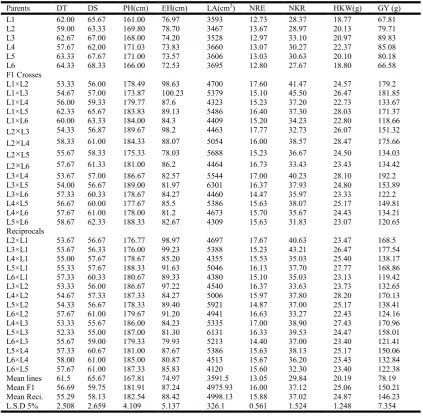
The differences between genetic compositions attributed to differing genetic factors carried by individual vulnerability to environmental conditions and genetically identical or different. The data shown in the table 2 the inbred line6 gave the highest
average of Leaf area 3695 cm2, while giving the inbred line2
less than the average of leaf area reached 3467 cm
2
.Superiority the inbred line2 into giving the highest average number of rows per ear13.67 row followed by inbred line4 as it was gave 13.07 rows, while the inbred line1 was gave less than the average rows number 12.73 row. For number of kernels per row (NKR) where the attribute values ranged from 33.10 grain in the inbred line3 and the lowest 27.67 grain in the inbred line6. Assures Chapman and Edmeades (1999) a high positive correlation r = 0.9 between the number of grains to plant and grain yield, it also showed that the greatest influence on grain yield is through a number of grains to plant. Achieved the inbred line4 a higher average of the weight of 100 grain 22.37 g, conversely showed the inbred line1 the lowest average of the weight of 100 grain reached 18.77 g. For grain yield per plant was the ranged of values between the top 89.83 g in inbred line3 was followed by the inbred line4, while the minimum values66.58 g. in inbred line6.
Single crosses Hybrids
The Results Showed from the Table 2 averages of the single crosses Hybrids not reciprocal values resulting from full diallel. For the number of days from planting to 50% days to tassiling was in the hybrid L1×L2 As early as the Hybrids where took the lowest number of days to tassiling reached 53.33 day followed by hybrid L3×L4 it took 53.67 days while the hybrid L1×L5 Thehighest value was recorded where it took 62.33 days to tassiling. For the number of days from planting to 50% days to silking it was a valuable ranged between the highest 65.67 day in hybrid L1×L5 and the lowest 56.00 in the hybrid L1×L2, this confirms that the Hybrids had headed towards to the early flowering compared with their parents, which lasted the longest flowering period. For plant height ranged values between 189.67 cm in the hybrid L2×L3 and lowest 173.87 in the hybrid L1×L3. For ear height averages values indicate that the overall average resultant was higher than the average of the inbred line in the table 2. The highest average of the ear height in the desired direction 100.23 Cm. in the hybrid L1×L3 and the minimum 78.03 cm in hybrid L2×L5 .The leaf area is the important field trait which the plant breeders which seeks to increase it or increase their activity, the results showed that the average varied
between 6301 cm2 in hybrid L3×L5 and the lowest value
4309 cm 2 in the hybrid L5×L6. For number of rows per ear
(NRE) the results showed that the overall average of inbred line13.05was less than the individual hybrids average 16.00, the highest increase value showed in the number of rows of ear17.77 in hybrid L2×L3, followed by hybrid L1×L2 it was give it17.60 and the lowest of 14.47 In the hybrid L3×L6 . The number of the grain one of the major grain yield components, therefore it has a highly influences on the product and the yield of corn. The results show differentiated the hybrids L1×L3 and L1×L2 with the highest number of kernels per row45.5 and 41.47 respectively while the hybrid L5×L6 give the lowest number of the kernels per row was 31.83. The display shows the highest increase in weight of 100 grain was 28.47 and 28.1 g. appeared in the hybrids L2×L4 and L3×L4
respectively, which did not differ in A significant, the effect reflected giving him the highest yield of the plant reached 192.2 g/plant while the lowest weight of 100 grain 22.73 g find in hybrid L1xL4. The result showed the highest increase in grain yield 192.2 g was in hybrid L3xL4, the is Due to the synthesis gave the highest mean of the weight of 100 grain 28.1 this influence was reflected by increasing the grain yield of the genotype, followed by the L1×L3 which gave 181.85 g it was superiority by giving the highest number of kernels per row 45.5 while it was appeared the minimum increase in yield of plant 118.66 g in hybrid L1 × L6.
Reciprocal cross
The result Showed from the Table 2 the values of Reciprocalcross resulting from full diallel cross, in number of days from planting to 50% days to tassiling and silking, the hybrid L5×L3 It was the earliest hybrids as it took fewer days52.33 to tassiling and 55.00 day to silking, followed L4×L3 while the hybrid L6×L4 was more days in flowering took 58.00 day to tassiling and 61.00 day to silking. For plant height ranged between 188.33 cm. in hybrid L5×L1 and lowest 176.00 in hybrid L3×L1.For the ear height averages values indicate that the highest average of ear height99.23 cm, was in the hybrid L3×L1 and the lower 79.93 cm in hybrid L6×L3. For the leaf area, the results showed that the average value
varied between 6131 cm2 in hybrid L5×L3 and 4120 cm2 in a
lower average in the hybrid L6×L5 . For the number of rows per ear the results showed the highest increase 17.67 appeared in hybridL2×L1 followed by hybrid L4×L3it was gave 17.00 while the lowest value 14.40 in hybrid L6×L3 . The Results showed the crossL3×L1 and hybrid L2×L1 gave a higher number of kernels per row reached to 43.21 and 40.63 respectively and it is the same that excelled in the hybrid cross, while theL6×L5 gave the fewest number of kernels per row ear reached 32.30. The highest value of hundred kernels weight 28.20 appeared in the crossL4×L2 followed by cross L5xL1 and L4xL3 which gave 27.77and 27.43 g. respectively, Which did not show a significant different, it was the influence was reflected by giving the highest grain yield of the plant reached 170.96 g/plant in the crossL4xL3 and 168.86 g/plant in the cross L5xL1. The lowest mean showed in weight of 100 grain 22.43 g. in the hybrid L6×L2. Note that the highest increase appeared in grain yield 177.54 g was in hybrid L3×L1, this is attributed that this genotype gave the highest average of number of kernels per row 43.21 it was reflected on increasing the yield, followed by genotype L4×L3 which gave 170.96 g and it was superiority by gave the highest weigh of 100 grain 27.43. But the minimum increase appeared in the grain yield 119.42 g in the hybrid L6xL1.
Estimation of Combining Ability
Estimates of General combining Ability Effects
Based on the GCA effects Table 3, L2, L3, and L4 inbred lines had negative GCA effects for traits of 50% days to tasseling and silking indicated contributed towards earliness in their respective crosses as compared their parents. This result is in agreement with Gudeta N. (2007) who reported significant positive and negative GCA effect and great contribution of additive gene action for a number of days to tasseling and silking. In maize breeding, shorter plant height and medium ear placement is desirable for lodging resistance and mechanized agriculture over the longer ones because of their suitability for machine harvesting. So, regarding these traits, L3, L4, and L5 showed positively GCA effects, indicating their poor combiners while L1, L2 and L6 manifested negative GCA effects for PH and EH, indicating that these lines contributed to reduce plant stature or enhancing shortness in their crosses. On other hand, Ali et al. (2012) showed greater ear height is undesirable because the ear placement at a greater height from theground level exerts pressure on plant during grain filling and physiological maturity and causes lodging, which could ultimately affect the final yield. Leaf area the analyses indicated that L5(327.72) and L3 (229.72) were by far the best general combiner for LA, indicating that it might be a goodentry for the formation of a composite variety or as a source germplasm for the maize improvement programmer. For number of rows per ear (NRE), L2 showed significant and positive GCA effect, where as L1, L5 and L6 showed negative GCA effect (Table 3). The positive GCA effect is desired for number of rows per ear as it is the most important yield component that directly contributes to increased grain yield. Hence, inbred lines with high GCA effect for this trait could be suitable parents for hybrid formation as well as for inclusion in future breeding programs. Such parents contribute favorable alleles in the process of synthesis of new varieties. Hussain
et al. (2003) also observed the similar phenomenon. For
number of kernels per row (NKR), Inbred lines L3 and L1 had positive and significant GCA effects for number of kernels per row while L2, L5 and L6 had negative GCA effects. The positive and significant GCA effects for number of kernels per row indicates prolifically which is desirable in increasing maize productivity while negative and significant GCA effects for the same trait indicates non-prolifically which is undesirable. Hence, inbred lines with positive and significant GCA effect could be selected for further use in the breeding program. Hundred kernels weight is considered as one of the yield contributing components in maize, hence positive effects of GCA and SCA are desirable. Mean square values for GCA and SCA were highly significant. Four of the inbred lines showed positive GCA effects out of which L3 and L4 had significant GCA effect for an increase of hundred kernels weight. While L1 and L6 manifested poor GCA effects for 100-kernels weight. As report of Bernardo (2002) showed, parents with high GCA or additive gene effects for hundred kernels weight trait would theoretically respond favorably to selection. Improvement of a variety can start with those having high GCA estimates. In grain yield (GY) trait, mean squares of GCA and SCA effects were significant. Regarding GCA effect, four of the inbred lines L1, L2, L3 and L4 showed positive GCA effect in desired direction while the remaining L5 and L6 expressed negative GCA effects. GCA estimates showed that line L3 was the best general combiner for GY with a highly
significant and positive GCA effect of 8.590 followed by L4 with GCA effect of 7.153. Inbred lines, L3 showed significant and positive GCA effects of 0.512 for hundred kernels weight (HKW), 1.704 Number of kernels per row (NKR) -1.268 days to tasseling (DT) and -1.405 days to Silking (DS).L4 also had positive effect of GCA for trait of hundred kernels weight (HKW). Whereas L6 exhibited the lowest GCA effect of-21.26, indicating the existence of poorest general combiners in the group of inbred lines studied. Similar results have also been reported by Sofi and Rather (2006). General combining ability for six parental line indicated that the parental inbred line L3 was a good combiner for grain yield, number of kernels per row (NKR), leaf area(LE) , days to tasseling (DT) and days to Silking (DS). The parental inbred line L4 was good combiner for hundred kernel weight (HKW) and grain yield per plant(GY). The parental inbred line L2 was good combiner for number of rows per ear, (NRE) ear height (EH), days to 50% tasseling (DT) and days to 50% Silking. In plant breeding, increasing yield component traits is suitable for grain yield improvement program.
Estimates of SCA effects of single crosses
Table 1. Analysis of variance for ordinary analysis and combining ability for studied traits
S.O.V D.F DT DS PH EH LE NRE NKR HKW GY
Block 2 1.62 6.37 14.30 12.95 77080 0.0545 0.929 0.705 12.79 Genotypes 35 29.25** 38.83** 149.32** 176.49** 1698816** 5.60** 49.41** 19.32** 3401.2** GCA 5 17.36** 21.13** 31.33** 123.72** 731582** 1.178** 26.785** 10.03** 1438.6** SCA 15 14.24** 19.75** 101.20** 87.86** 1037890** 3.886** 28.868** 11.114** 2132.5** Reciprocal 15 2.721** 3.41** 4.49* 8.166** 39551** 0.077 ns 0.629 ns 0.571 ** 33.38** Error 70 2.373 2.67 6.37 9.951 40098 0.1184 0.876 0.587 20.39
[image:5.595.87.511.213.630.2]* and ** significant at 0.05 , 0.01 levels of probability respectively, DT= days to50% tasseling, DS= days to50% Silking, PH=Plant Height, EH= Ear Height, LE= leaf area, NRE= Number of rows per ear, NKR=Number of kernels per row, HKW=hundred kernel weight and GY= grain yield per plant
Table 2. Mean performance of maize genotypes for the traits studied in growing season
GY (g) HKW(g)
NKR NRE
LA(cm2)
EH(cm) PH(cm) DS DT Parents 67.81 18.77 28.37 12.73 3593 76.97 161.00 65.67 62.00 L1 79.71 20.13 28.97 13.67 3467 78.70 169.80 63.33 59.00 L2 89.83 20.97 33.10 12.97 3528 74.20 168.00 67.00 62.67 L3 85.08 22.37 30.27 13.07 3660 73.83 171.03 62.00 57.67 L4 80.18 20.10 30.63 13.03 3606 73.57 171.00 67.67 63.33 L5 66.58 18.80 27.67 12.80 3695 72.53 166.00 68.33 64.33 L6 F1 Crosses 179.2 24.57 41.47 17.60 4700 98.63 178.49 56.00 53.33 L1×L2 181.85 26.47 45.50 15.10 5379 100.23 173.87 57.00 54.67 L1×L3 133.67 22.73 37.20 15.23 4323 87.6 179.77 59.33 56.00 L1×L4 171.37 28.03 37.30 16.40 5486 89.13 183.83 65.67 62.33 L1×L5 118.66 22.80 34.23 15.20 4409 84.3 184.00 63.33 60.00 L1×L6 151.32 26.07 32.73 17.77 4463 98.2 189.67 56.87 54.33 L2×L3
175.66 28.47 38.57 16.00 5054 88.07 184.33 61.00 58.33 L2×L4
134.03 24.50 36.67 15.23 5688 78.03 175.33 58.33 55.67 L2×L5
134.42 23.43 33.43 16.73 4464 86.2 181.00 61.33 57.67 L2×L6
192.2 28.10 40.23 17.00 5544 82.57 186.67 57.00 53.67 L3×L4 153.89 24.80 37.93 16.37 6301 81.97 189.00 56.67 54.00 L3×L5 122.2 23.33 35.97 14.47 4460 84.27 178.67 60.33 57.33 L3×L6 149.81 25.17 38.07 15.63 5386 85.5 177.67 60.00 56.67 L4×L5 134.21 24.43 35.67 15.70 4673 81.2 178.00 61.00 57.67 L4×L6 120.65 23.07 31.83 15.63 4309 82.67 188.33 62.33 58.67 L5×L6 Reciprocals 168.5 23.47 40.63 17.67 4697 98.97 176.77 56.67 53.67 L2×L1 177.54 26.47 43.21 15.23 5388 99.23 176.00 56.33 53.67 L3×L1 138.17 25.40 35.03 15.53 4355 85.20 178.67 57.67 55.00 L4×L1 168.86 27.77 37.70 16.13 5046 91.63 188.33 57.67 55.33 L5×L1 119.42 23.13 35.03 15.10 4380 89.33 180.67 60.33 57.33 L6×L1 132.65 23.73 33.63 16.37 4540 97.22 186.67 56.00 53.33 L3×L2 170.13 28.20 37.80 15.97 5006 84.27 187.33 57.33 54.67 L4×L2 138.41 25.17 37.00 14.87 5921 89.40 178.33 56.67 54.33 L5×L2 124.16 22.43 33.27 16.63 4941 91.20 179.67 61.00 57.67 L6×L2 170.96 27.43 38.90 17.00 5335 84.23 186.00 55.67 53.33 L4×L3 158.01 24.47 39.53 16.33 6131 81.30 187.00 55.00 52.33 L5×L3 121.41 23.40 37.00 14.40 5213 79.93 179.33 59.00 55.67 L6×L3 150.06 25.17 38.13 15.63 5386 87.67 181.00 60.67 57.33 L5×L4 132.84 23.43 36.20 15.67 4513 80.87 185.00 61.00 58.00 L6×L4 122.38 23.40 32.30 15.60 4120 85.83 187.33 61.00 57.67 L6×L5 78.19 20.19 29.84 13.05 3591.5 74.97 167.81 65.67 61.5 Mean lines 150.21 25.06 37.12 16.00 4975.93 87.24 181.91 59.75 56.69 Mean F1 146.23 24.87 37.02 15.88 4998.13 88.42 182.54 58.13 55.29 Mean Reci. 7.354 1.248 1.524 0.561 326.1 5.137 4.109 2.659 2.508 L.S.D 5%
Table 3. Estimates of G.C.A. effects of six parents maize genotypes for the traits studied in growing season
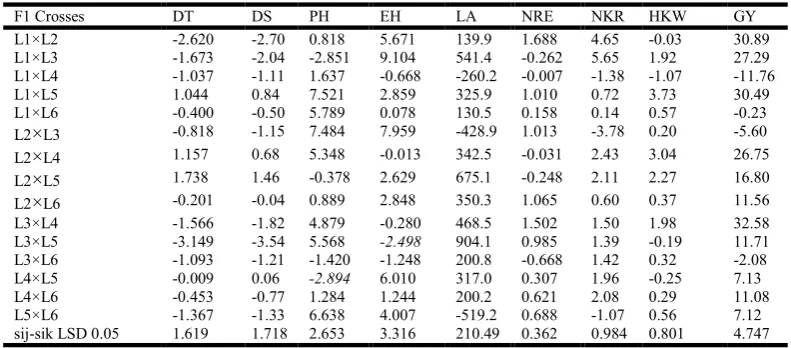
[image:5.595.63.533.662.743.2]For 100 kernel weight, 11 crosses showed positive estimates of SCA effect. Good specific combination positive and significant was observed for L1×L5, while the poorest was L1×L4. Crosses with positive and significant SCA effects for this trait are desirable as this trait directly contributes to grain yield of maize. Deitos et al. (2006) reported that good general combining parent does not always show high SCA effects in their hybrid combinations. In grain yield, more than 70% of the crosses found to combine well in positive direction out of which three crosses namely L3 × T4, L1 ×T2 and L1 ×T5 exhibited highest and desirable significant SCA effect, signifying that these crosses had increased grain yield than the expected mean performance of its parents and showed genetic diversity. On the other hand four crosses expressed negative SCA effect for this trait in undesired direction and contained poor specific combiner for grain yield trait, especially cross L1 ×L4 gave the highest negative value (−11.76) for grain yield, indicating that this hybrid reduced grain yield than the expected mean performance of its parent.
Estimates of reciprocal effects of single crosses maize
In diallel cross analyses, the presence of these effects will cause biases in the estimates of genetically components of the variation. The estimates of reciprocal combining ability effects RCA of the 15 Fcrosses for the studied traits are given in Table5.For days to %50 tasseling and Silking, The hybrid
L5×L4 (-0.33) and (-0.34) respectively recorded the highest
negative and significant RCA effects followed by L2×L1 (-0.17) and (-0.33) respectively. Whereas, L5×L1 (3.5) and
[image:6.595.98.494.75.249.2](4.0) exhibited highest positive RCA effect. For plant height (PH) 15 hybrids evaluated eight hybrids recorded positive RCA effects, while the remainder hybrids exhibited negative RCA effects. Two crosses showing high positive RCA effects for plant height were L6×L1 and L3×L2.In hybrid development, crosses with low positive RCA effects for plant height are more desirable than those with high positive RCA effects to avoid plant lodging from increased heights. For ear height (EH) seven hybrids recorded positive RCA effects, while the remainder hybrids exhibited negative RCA effects. Two crosses showing high positive RCA effects for ear height were L6×L3 and L4×L2. All other crosses had small positive RCA values. In hybrid development, crosses with low positive RCA effects for ear height are more desirable than those with high positive RCA effects. For Leaf area, both negative and positive estimates of RCA effects were observed among the crosses Table 5. Cross L5 ×L1 and L4 × L3 were good specific combiners, whereas, crosses L6 ×L3 and L6 ×L2 were poor specific combiners. In number of kernels per row the two crosses namely L3 ×L1 and L4 ×L1 exhibited highest and desirable significant RCA effect, signifying that these crosses had increased grain yield. On the other hand nine crosses expressed negative RCA effect for this trait in undesired direction especially cross L5× L3 gave the highest negative Table 4. Estimatesof S.C.A. effects of 15 single crosses maize genotypes for the traits studied in growing season
GY HKW NKR NRE LA EH PH DS DT F1 Crosses 30.89 -0.03 4.65 1.688 139.9 5.671 0.818 -2.70 -2.620 L1×L2 27.29 1.92 5.65 -0.262 541.4 9.104 -2.851 -2.04 -1.673 L1×L3 -11.76 -1.07 -1.38 -0.007 -260.2 -0.668 1.637 -1.11 -1.037 L1×L4 30.49 3.73 0.72 1.010 325.9 2.859 7.521 0.84 1.044 L1×L5 -0.23 0.57 0.14 0.158 130.5 0.078 5.789 -0.50 -0.400 L1×L6 -5.60 0.20 -3.78 1.013 -428.9 7.959 7.484 -1.15 -0.818
L2×L3
26.75 3.04 2.43 -0.031 342.5 -0.013 5.348 0.68 1.157
L2×L4
16.80 2.27 2.11 -0.248 675.1 2.629 -0.378 1.46 1.738 L2×L5
11.56 0.37 0.60 1.065 350.3 2.848 0.889 -0.04 -0.201
L2×L6
32.58 1.98 1.50 1.502 468.5 -0.280 4.879 -1.82 -1.566 L3×L4 11.71 -0.19 1.39 0.985 904.1 -2.498 5.568 -3.54 -3.149 L3×L5 -2.08 0.32 1.42 -0.668 200.8 -1.248 -1.420 -1.21 -1.093 L3×L6 7.13 -0.25 1.96 0.307 317.0 6.010 -2.894 0.06 -0.009 L4×L5 11.08 0.29 2.08 0.621 200.2 1.244 1.284 -0.77 -0.453 L4×L6 7.12 0.56 -1.07 0.688 -519.2 4.007 6.638 -1.33 -1.367 L5×L6 4.747 0.801 0.984 0.362 210.49 3.316 2.653 1.718 1.619
[image:6.595.100.490.281.444.2]sij-sik LSD 0.05
Table 5. Estimates of reciprocal effects of 15 single crosses maize genotypes for the traits studied in growing season
value (−0.80). The cross combination L3×L2 was the best specific combiner RCA and significant for number of rows per ear (0.70), 100 kernel weight(1.167) and grain yield per plant (9.335). The superiority of crosses as parents could be explained on the basis of interaction between positive alleles from good combiners and negative alleles for the poor combiners as parents.
For 100 kernel weight, 10 crosses showed positive estimates of RCA effect. Good specific combination positive and significant was observed for L3 × L2, while the poorest was L4 ×L1. Crosses with positive and significant RCA effects for this trait are desirable as this trait directly contributes to grain yield of
maize. In grain yield per plant the two crosses namely L3×L2
and L4 ×L3 exhibited highest and desirable significant RCA effect. On the other hand six crosses expressed negative RCA effect for this trait in undesired direction especially cross L4 × L1 gave the highest negative value (-2.250).
Conclusion
A comparison of the combining ability effects of the parents and their corresponding crosses indicated that the GCA effects of the parents were not reflected in the SCA effects of the crosses for most of the traits studied. Thus, in most cases, crossing the two good general combiners may not necessarily result into a good specific combination and the same was true for certain poor combinations which involved one good combiner, while in very few cases, both good combiners could produce superior combinations. In some cases, when two poor combiners were crossed, best combinations were observed to be produced. This indicated wide diversity in nicking ability of the inbreds to produce hybrid vigor. In general, no generalized order of nicking among the parents to produce desirable combinations was observed. Any sort of combination among the parents could give hybrid vigour over the parents which might be due to favorable dominant genes, over-dominance or epistatic action of genes.
Based on the present results, it could be concluded that the production of hybrids based on the parental performance was not practically true. Such types of results were also reported by Kumar (2003). The cross combinations observed as good specific combiners can be utilized as such under heterosis breeding or in obtaining desirable recombinants/segregants in subsequent generations for such traits.
REFERENCES
Akbar, M., M. Saleem, M.Y. Ashraf, A. Husain, F.M. Azhar and R. Ahmad, 2009. Combining ability studies for physiological and grain yield traits in maize at two temperature regimes. Pak. J. Bot., 41: 1817-1829. Ali F., I. A. Shah, H. Rahman, M. Noor, Durrishahwar, M.Y.
Khan, I.Ullah and J.B Yan. 2012. Heterosis for yield and agronomic attributes in diverse maize germplasm. Aust. J.
Crop Sci., 6: 1283-1289.
Bernardo R.2002. Breeding for quantitative Traits in Plants. Stemma Press, Woodbury, MN. pp91.
Bruce, A. B., 1910, The Mendelian theory of heredity and the augmentation of vigour. Science, 32: 627-628.
Burton, G. W. and Devane, E. M., 1952, Estimating heritability in fall the sane (Festuca circnclinaceae) from replicated clonel – material. Agron. J., 45: 478-481. Chapman, S.C. and G.O. Edmeades. 1999. Selection improves
drought tolerance in tropical maize populationII. Direct and correlated responses among secondary trait. Crop Sci., 39:1315-1324.
Choudhary, L. B. and Prasad, B., 1968, Genetic variation and heritability of quantitative characters in Indian mustard (Brassica Juncea). Ind. J. Agric. Sci., 38: 820-825.
Deitos, A., E. Arnhold, and G.V. Miranda. 2006. Yield and combining ability of maize cultivars under different eco
geographic conditions. CropBreeding and Applied
Biotechnology, 6:222-227.
Fisher, R. A. 1918. The correlation between relatives on the supposition of Mendelian inheritance. Trans. Roy. Soc.
Edinburgh, 52:399–433.
Gardner, C.O. and S.A. Eberhart, 1966. Analysis and interpretation of the variety cross diallel and related populations. Biometrics, 22: 439-452.
Glover M, D. Willmot, L. Darrah, B. Hibbard and X. Zhu, 2005. Diallel analysis of agronomic traits using Chinese and U.S. maize germplasm. Crop Sci., 45(3): 1096-1102. Griffing, B., 1956, Concept of general combining ability and
specific combining ability in relation to diallel crossing system. Aust. J. Biol. Sci., 9: 463-493.
Gudeta, N., 2007. Heterosis and combining abilities in QPM varieties of early generation high land maize (Zea mays L.) inbred lines. M.Sc. Thesis. Haramaya University of agriculture, school of graduate studies. Haramaya, Ethiopia.185p.
Hanson, G. H., Robinsion, H. F., and Comstock, R. E., 1956, Biometrical studies of yield in segregating populations of Korean Lespedeza. Agron. J., 48: 267-282.
Hayes, H. K., F. R. Immer and D. C. Smith. 1955. Methods of Plant Breeding. Mc. Grow Hill Book. Co., Inc., New York Hussain, S. A., M. Amiruzzaman and Z. Hossain. 2003.
Combining ability estimates in maize. Bangladesh J. Agri.
Res., 28(3):435-440.
Johnson, H. W., H. F. Robinson and R. E. Comstock,. 1955. Estimates of genetic and environmental variability in soyabean. Agron. J., 47: 314-318.
Keeble, F. and, E. Pellow, 1910, The mode of inheritance of stature and time of flowering in peas. Genet., 1:47-56. Kempthorne, O. 1957. An Introduction to Genetic Statistics.
Wiley, New York, : Johan Wiley and Sons, Inc. London : Chapman and Hall, Ltd.
Kumar, P., and S. C. Gupta. 2003. Genetic analysis in maize (Zea mays L.). J.Res.Birsa.Agric.University 15(1):107-110. Lush, J. L., 1940, Intersize correlationb regression of offsping on dary as a method of estimating heritability of characters.
Prov. Amer. Soc. Animal Production, 33: 293-301.
Pavan, R., G. Prakash and N.M. Mallikarjuna, 2011. General and specific combining ability studies in single cross of hybrids of maize. Curr. Bioet., 5: 196-208.
Richey, F. D., and L. S. Mayer. 1925. The productiveness of successive generations of self-fertilized lines of corn and of crosses between them. USDA Bull., 1354.
Robinson, H. F., R. E. Comstock and P. H. Harvey.1949, Estimates of heritability and degree of dominance in corn.
Shull, G. H., 1908. The composition of a field maize. American Breeders Association Republic, 4:296-301. Sofi, P. and A. G.Rather. 2006. Genetic analysis ofyield trails
in local and CIMMYT inbred line crosses using Line x tester analysis in maize (Zea mays L.). Asian J. Plant Sci., 5 (6): 1039-1042.
Sprague, G. F., and L. A. Tatum. 1942. General vs. specific combining ability in single crosses of corn. J. Amer. Soc.
Agron., 34:923–932.