ENTRY-LEVEL DOCTOR OF PHYSIOTHERAPY IN NIGERIA: PROGRAM READINESS
*1
Joseph A. Balogun,
1
Distinguished University Professor
2
Professor in the Department of Medical Rehabilitation, University of Maiduguri, Nigeria
3Adjunct Professor of Occupational Therapy at Brown Mackie College, Merryville, Indiana
ARTICLE INFO ABSTRACT
This exploratory study was designed to ascertain whether the existing physiotherapy progra Nigeria have the infrastructures and institutional support needed to initiate an entry
Physiotherapy (DPT) program. A secondary objective was to evaluate whether the level of readiness to implement the program is influenced by the
debut of the existing baccalaureate degree programs. The Heads of Department of Physiotherapy programs that have produced physiotherapists (N=7) completed a questionnaire that sought information on (1) progr
instrumentation, library subscriptions and institutional support available; and (2) contents currently taught in the undergraduate
indicated that they have an adequate number of qualified clinicians (not lecturers) to supervise students in the hospital/
respondents indicated that their programs have adequa current subscription to physiotherapy journals,
respondents felt they are currently adequately funded to operate their program effectively. The respondents a
taught in the
women’s health, EKG interpretation, autism, nutrition and differential physi currently taught in the undergraduate program. In addition, only 29% of the laser biostimula
are currently taught. The vast majority (71%) of the programs surveyed indicated interest in starting a DPT program within 1 to 5 years.
two top institutions
the least prepared institution. The result of the Shapiro demographic and readiness outcome data monitored in this
The Levene's test also confirmed the population variances to be equal. The independent student t revealed that the location of the academic programs (Northern vs Southern
debut of the bac impact the
Copyright©2017, Joseph A. Balogun et al. This is an open access article distributed under the Creative Commons Att use, distribution, and reproduction in any medium, provided the original work is properly cited.
INTRODUCTION
In response to knowledge explosion in science and technology, physiotherapy profession in the last decade has witnessed several dynamic shifts in its education and practice. In Nigeria, the first generation university-based physiotherapy program was established at the Universities of Ibadan, Lagos, and Ile Ife between 1966 and 1977 (Balogun et al., 2017).
*Corresponding author: Joseph A. Balogun
Department of Health Studies, College of Health Sciences, Chicago State University, U.S.A.
ISSN: 0975-833X
Article History:
Received 22nd April, 2017 Received in revised form 14th May, 2017
Accepted 29th June, 2017
Published online 31st July, 2017
Citation: Joseph A. Balogun, Adetoyeje Oyeyemi and Adetutu O. Balogun
evaluation”, International Journal of Current Research
Key words:
Entry-level Doctor of Physiotherapy (DPT) program, Resources Capacity, Curriculum Evaluation,
Program Needs Assessment, Professionalism,
True Professional Status.
RESEARCH ARTICLE
LEVEL DOCTOR OF PHYSIOTHERAPY IN NIGERIA: PROGRAM READINESS
EVALUATION
Joseph A. Balogun,
2Adetoyeje Y. Oyeyemi and
3Adetutu O. Balogun
istinguished University Professor, College of Health Sciences, Chicago State University, U.S.A
Professor in the Department of Medical Rehabilitation, University of Maiduguri, Nigeria
Adjunct Professor of Occupational Therapy at Brown Mackie College, Merryville, Indiana
ABSTRACT
This exploratory study was designed to ascertain whether the existing physiotherapy progra Nigeria have the infrastructures and institutional support needed to initiate an entry
Physiotherapy (DPT) program. A secondary objective was to evaluate whether the level of readiness to implement the program is influenced by the regional location of the university and the year of debut of the existing baccalaureate degree programs. The Heads of Department of Physiotherapy programs that have produced physiotherapists (N=7) completed a questionnaire that sought information on (1) program demographic characteristics, human/
instrumentation, library subscriptions and institutional support available; and (2) contents currently taught in the undergraduate curriculum. The
indicated that they have an adequate number of qualified clinicians (not lecturers) to supervise students in the hospital/private clinic and community settings. On the other hand, only 29% of the respondents indicated that their programs have adequate state of the art physiotherapy equipment, a current subscription to physiotherapy journals, and adequate research laboratories
respondents felt they are currently adequately funded to operate their program effectively. The respondents also unanimously indicated that 56% of the “gold” standard DPT curriculum contents are taught in the baccalaureate degree program. Paradoxically, only 14% of the
women’s health, EKG interpretation, autism, nutrition and differential physi currently taught in the undergraduate program. In addition, only 29% of the laser biostimulation therapy, private practice and home health, direct access and
currently taught. The vast majority (71%) of the programs surveyed indicated interest in starting a DPT program within 1 to 5 years. Nnamdi Azikiwe University and the University of Lagos two top institutions primed to implement the DPT program. The University of Nigeria at Nsukka is the least prepared institution. The result of the Shapiro-Wilk test revealed that the program demographic and readiness outcome data monitored in this study were neither skewed nor kurtotic. The Levene's test also confirmed the population variances to be equal. The independent student t revealed that the location of the academic programs (Northern vs Southern
debut of the baccalaureate program (First and Second generations) did not significantly (p>.05) impact the entry-level DPT readiness outcomes.
is an open access article distributed under the Creative Commons Attribution License, which use, distribution, and reproduction in any medium, provided the original work is properly cited.
In response to knowledge explosion in science and technology, physiotherapy profession in the last decade has witnessed several dynamic shifts in its education and practice. In Nigeria, based physiotherapy program ished at the Universities of Ibadan, Lagos, and
Ile-., 2017).
epartment of Health Studies, College of Health Sciences, Chicago
The first generation physiotherapy programs are all located in the Southwest region of the country. The Northern States did not have a university-based physiotherapy program until 1990 when Bayero University was established. Much later in 2003, the second physiotherapy program in the Northern States was initiated at the University of Maiduguri. Today, entry Bachelor of Science (BS) and professional Bachelor of Physiotherapy (BPT) programs are offered in only 12 (8.5%) out of the 141 universities in N
and Doctor of Philosophy (Ph.D.) degrees in physiotherapy are offered in 7 (58%) of the 12 universities with physiotherapy
International Journal of Current Research
Vol. 9, Issue, 07, pp.54884-54891, July, 2017
Joseph A. Balogun, Adetoyeje Oyeyemi and Adetutu O. Balogun. 2017. “Entry-level doctor of physiotherapy in Nigeria: program readiness
International Journal of Current Research, 9, (07), 54884-54891.
LEVEL DOCTOR OF PHYSIOTHERAPY IN NIGERIA: PROGRAM READINESS
Adetutu O. Balogun
Chicago State University, U.S.A
Professor in the Department of Medical Rehabilitation, University of Maiduguri, Nigeria
Adjunct Professor of Occupational Therapy at Brown Mackie College, Merryville, Indiana, USA
This exploratory study was designed to ascertain whether the existing physiotherapy programs in Nigeria have the infrastructures and institutional support needed to initiate an entry-level Doctor of Physiotherapy (DPT) program. A secondary objective was to evaluate whether the level of readiness location of the university and the year of debut of the existing baccalaureate degree programs. The Heads of Department of Physiotherapy programs that have produced physiotherapists (N=7) completed a questionnaire that sought raphic characteristics, human/physical/financial resources, instrumentation, library subscriptions and institutional support available; and (2) thirty specific The respondents unanimously (100%) indicated that they have an adequate number of qualified clinicians (not lecturers) to supervise and community settings. On the other hand, only 29% of the te state of the art physiotherapy equipment, a and adequate research laboratories; only 43% of the respondents felt they are currently adequately funded to operate their program effectively. The lso unanimously indicated that 56% of the “gold” standard DPT curriculum contents are . Paradoxically, only 14% of the respondents indicated that women’s health, EKG interpretation, autism, nutrition and differential physiotherapy diagnosis are currently taught in the undergraduate program. In addition, only 29% of the respondents indicated that home health, direct access and independent practice currently taught. The vast majority (71%) of the programs surveyed indicated interest in starting a Nnamdi Azikiwe University and the University of Lagos are the to implement the DPT program. The University of Nigeria at Nsukka is Wilk test revealed that the program study were neither skewed nor kurtotic. The Levene's test also confirmed the population variances to be equal. The independent student t-test revealed that the location of the academic programs (Northern vs Southern States) and the year of calaureate program (First and Second generations) did not significantly (p>.05)
ribution License, which permits unrestricted
The first generation physiotherapy programs are all located in the Southwest region of the country. The Northern States did based physiotherapy program until 1990 when Bayero University was established. Much later in 2003, physiotherapy program in the Northern States was initiated at the University of Maiduguri. Today, entry-level Bachelor of Science (BS) and professional Bachelor of Physiotherapy (BPT) programs are offered in only 12 (8.5%) out of the 141 universities in Nigeria. Master of Science (MS) and Doctor of Philosophy (Ph.D.) degrees in physiotherapy are offered in 7 (58%) of the 12 universities with physiotherapy INTERNATIONAL JOURNAL
OF CURRENT RESEARCH
program (Balogun et al., 2016 a & b). Although the academic programs are accredited by the National Universities Commission (NUC) and the Medical Rehabilitation Therapists (Registration) Board (MRTB), the curriculum, human/ financial/physical resources, instrumentation, library subscriptions and institutional support available in each university varied widely. Entry-level doctoral education and post-professional clinical specialization training are currently the two front burner issues among Nigerian physiotherapists (John 2016). In 2015, the Nigeria Society of Physiotherapy (NSP) and the MRTB jointly submitted a proposal to the NUC to upgrade the entry-level bachelor of physiotherapy curriculum to an entry-level Doctor of Physiotherapy (DPT) degree program. Furthermore, the NSP has sponsored a Bill that is awaiting ratification by the National Assembly to establish the National Postgraduate Physiotherapy College of Nigeria (NPPCN). One of the primary goals of the NPPCN is to produce adequate number of clinical specialists in physiotherapy to stem the tide of medical tourism for specialist physiotherapy services abroad. Despite the above development, there is currently no empirically based study to justify the implementation of an entry-level DPT program in the country. This exploratory study was designed to ascertain whether the existing physiotherapy programs in Nigeria have the infrastructures and institutional support needed to initiate a DPT program. A secondary objective was to evaluate whether the level of readiness to implement the DPT program is influenced by the location of the university (Northern or Southern States) and year of the debut of the existing BS/BPT programs (First or Second generations).
MATERIALS AND METHODS
Study Setting and Research Design
Nigeria’s population is 174,507,573, and doubles the population of the next two most populous African countries - Ethiopia and Egypt - and has a land mass of 910,768 sq. km (West Africa, 2016). The protocol for this cross-sectional descriptive study was approved by the University of Maiduguri Teaching Hospital Ethical Research Committee (Approval number UMTH/REC/17/0080). The study participants were recruited purposively from the list of physiotherapy education programs in Nigeria. The Heads of Department or designee in the 12 universities offering physiotherapy program was identified and requested to participate in a program evaluation survey. After receiving their consent, the research questionnaire was emailed to them. Follow-up emails and phone calls were made to the study participants to ensure a 100% response rate.
Research Questionnaire
The questionnaire used for data collection in this study was developed by the investigators. It consists of 50
open-and-closed ended questions divided into three parts. Part I of the research questionnaire sought information on when they plan to start a DPT program, on the year of debut of the entry-level BS/BPT program (from which program age and program generation classification - first generation vs others were deduced), total number of students enrolled in the BS/BPT program, location of the university (North vs South States), number of full-time (core) Lecturers employed and number of Lecturers in the program with Ph.D. degree. Part II of the questionnaire consists of 15 “Yes" or "No" type questions pertaining to human/physical/financial resources, instrumentation, library subscriptions and institutional support available to educate physiotherapist students. The respondents were instructed to judge the adequacy of each item within their institution. Part III of the research questionnaire consists of 30 “Yes" or "No" type questions pertaining to a standard DPT curriculum.
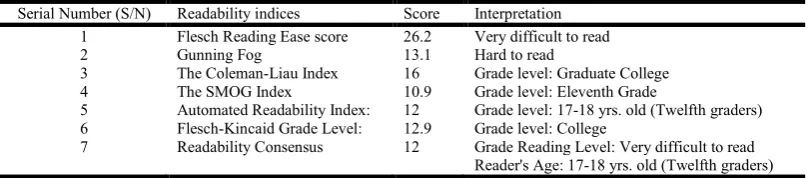
The respondents were asked to confirm whether each of the thirty DPT contents is currently taught in their BS/BPT curriculum. In developing the thirty content questions, five physical therapy programs in the USA were randomly selected from the list of programs approved by the Commission on Accreditation in Physical Therapy Education (CAPTE, 2015). The entry-level DPT curriculum in each of the institution was obtained from their website and meticulously reviewed to identify thirty major contents common to the five curricula. The thirty common content topics were compiled and considered the “gold standard” DPT curriculum against which the deficiencies in the BS/BPT curriculum were identified. We selected curricula from the USA as the “gold standard” to compare the BS/BPT curriculum because the USA was the first nation in the world to develop the post-professional (transitional) and entry-level DPT programs in 1992 and 1993, respectively (Plack 2015, John & Bartlett Publishers 2015). Furthermore, USA attained the major professional milestones in physical therapy education and clinical practice before any other country in the world (Moffat 2015). To establish the face and content validity of the research questionnaire, three physical therapy faculty from the USA with over 10 years experience as program director/chair (Head of Department) reviewed the initial draft of the questionnaire. Based on their feedback, several items were rewritten to improve content and comprehension. Subsequently, the readability of the research questionnaire was investigated using standard procedures (https://readability-score.com/premium/). The result is presented in Table 1. The findings revealed a Flesch-Kincaid and Flesch-Kincaid Reading Ease scores of 12.9 and 26.2, respectively. The Flesch-Kincaid and the Flesch Reading Ease scores are a measure of the research questionnaire literacy difficulty level.
[image:2.595.99.503.656.745.2]A Flesch-Kincaid score of 12.9 indicates that the respondents would need a College level reading ability to fully comprehend the contents of the survey. The minimum and maximum Flesch Reading Ease score range from 0 to 100, respectively. A low
Table 1. The readability indices of the research questionnaire
Serial Number (S/N) Readability indices Score Interpretation
1 Flesch Reading Ease score 26.2 Very difficult to read
2 Gunning Fog 13.1 Hard to read
3 The Coleman-Liau Index 16 Grade level: Graduate College
4 The SMOG Index 10.9 Grade level: Eleventh Grade
5 Automated Readability Index: 12 Grade level: 17-18 yrs. old (Twelfth graders)
6 Flesch-Kincaid Grade Level: 12.9 Grade level: College
7 Readability Consensus 12 Grade Reading Level: Very difficult to read
Flesch Reading Ease score indicates the content of the questionnaire is difficult to read. A Flesch Reading Ease score of 26.2; indicates that the test is “very difficult” to comprehend. The conclusions from the Flesch-Kincaid and Flesch-Kincaid Reading Ease scores are also supported by the readability indices from the Gunning Fog, The Coleman-Liau Index, The SMOG Index, Automated Readability Index, and the Readability Consensus. Given the technical nature of many of the terms contained in the questionnaire, it is not surprising that a College level education will be needed to fully comprehend the research questionnaire. All the Heads of Department or designee who participated in this study had a Ph.D. qualification with a good command of the English language to comprehend the contents of the research questionnaire.
Procedures
After identifying the Head of Department or a designee at each university, the research questionnaire was sent to them via emailed to complete. The questionnaire provides detail instructions on the objectives of the study and appropriate instructions for completing the survey. The study participants were informed in the questionnaire that their responses will be kept strictly confidential and participation is voluntary and they have the right to withdraw from the study at any time. They were also instructed to answer the questions as honestly and as accurately as possible. No time limit was imposed for the completion of the questionnaire and no stipends or incentive was offered for participating in the study. Following data collection, the institutional resources score (IRS) was computed from Part II of the questionnaire by adding up the number of “Yes” responses from the fifteen items and the number was expressed as a percentage. The minimum and maximum possible IRS score are 0 and 100%, respectively. A high IRS indicates that the program has adequate human/physical/ financial resources, instrumentation, library subscriptions and institutional support to implement a DPT program. The program curriculum score (PCS) was also computed from Part III of the questionnaire by adding up the number of “Yes” responses from the thirty items and the number was expressed as a percentage. The minimum and maximum possible PCS score are 0 and 100%, respectively. A high PCS indicates that the program BS/BPT curriculum is relatively expansive with only limited deficits short of a DPT curriculum. Finally, we computed the average of the IRS and PCS as a proxy for the overall readiness score (ORS) to implement a DPT program. The minimum and maximum possible ORS score are 0 and 100%, respectively. A high ORS indicates that the program is primed to implement a DPT program.
Statistical analysis
The independent variables in this investigation are the location of the university (North vs South States) and year of the debut of the BS/BPT program (First vs Second generation classification). The dependent variables monitored are the program demographic data (year ready to start a DPT program, program age, the number of students enrolled in the BS/BPT program, the number of Lecturers, the number of Lecturers with Ph.D.) and the readiness outcome (IRS, PCS, and ORS) data. The dependent and independent variables were coded appropriately into the computer using the Statistical Package for Social Scientists version 16 data analysis software (SPSS,
Chicago, IL, USA). Both descriptive (measures of central tendency and percentage) and inferential statistics were computed. A p-value ≤.05 was chosen as being statistically significant for all hypothesis testing. Given the small sample size (N=7) of the study, it was deemed necessary to test the normality of the dependent (outcome) data. Shapiro-Wilk test was used to assess the normality (Skewness and Kurtosis) of the dependent variables. The null hypothesis for the Shapiro-Wilk test is that the population is normally distributed. Therefore, if the p-value is less than the stipulated 0.05 alpha level, then the null hypothesis is rejected and will conclude that the program demographic and readiness outcome data are not from a normally distributed population; that is, the data are not normal. Levene's test was also used to assess the equality of variances (homogeneity of variance or homoscedasticity) for each dependent variable calculated for the two independent groups. Levene's statistical procedure tests the null hypothesis that the population variances are equal. Independent student t- test was employed to evaluate plausible differences in the dependent variables between the location of the university (North vs South States) and year of program debut (First vs Second generation programs). Of the twelve survey responses received from the Heads of Department, five of the programs are yet to graduate any student and their data was eliminated due to incomplete data. The findings from the remaining seven programs were analyzed and the findings are presented below.
RESULTS
Program demographic profile
The demographic characteristics of the participating programs are presented in Table 2. The physiotherapy programs are at different stages of development and implementation. Of the twelve existing programs, seven (58%) have awarded BS/BPT degrees; three (25%) of the programs have enrolled students but are yet to produce their first cohort of physiotherapists, and the remaining two (17%) are yet to admit students into the professional phase of the program, but still in the planning stages. The physiotherapy programs are unevenly distributed across the country. Only two (17%) of the twelve programs are from the Northern States while the remaining ten (83%) programs are from the Southern States. Based on the programs debut dates, only three (25%) of the twelve are first generation programs, four (33%) are the second generation. The third generation cohorts (42%) are the newly established programs that are yet to produce any graduate.
Institutional resources available to implement the DPT program
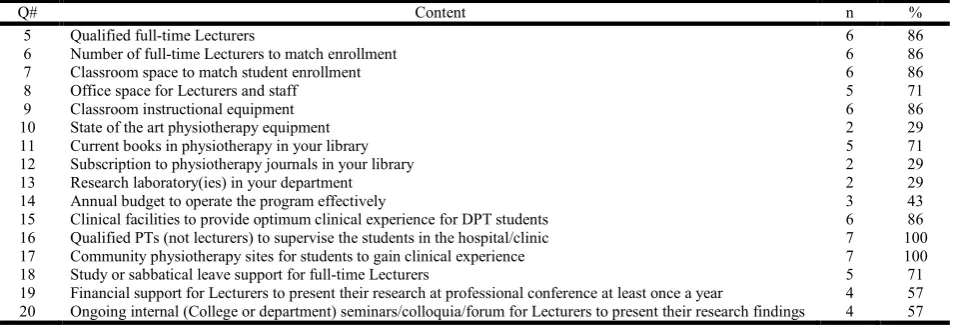
at a professional conference at least once a year and there is an adequate number of ongoing internal seminars/colloquia/forum for lecturers to present their research findings. Only 29% of the respondents indicated that their programs have adequate state of the art physiotherapy equipment, a current subscription to physiotherapy journals, and adequate research laboratory. Funding is another issue of concern to the Heads of Department who participated in the study; only 43% of them felt they are currently adequately funded to operate their program effectively.
Curriculum content strengths and deficiencies in the BS/BPT program
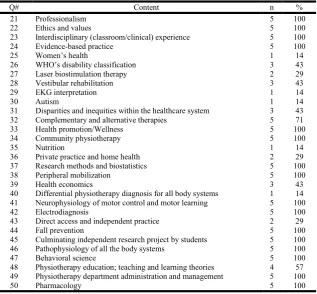
All (100%) the Heads of Department who participated in the study indicated that sixteen of the thirty (56%) curriculum contents that they were requested to evaluate are presently taught in their BS/BPT program (Table 4). The contents that the respondents unanimously felt are included in the BS/BPT curriculum are professionalism, ethics and values, interdisciplinary (classroom/clinical) experience, evidence-based practice, health promotion/wellness, community physiotherapy, research methods and biostatistics, peripheral
mobilization, neurophysiology of motor control and motor learning, electro-diagnosis, fall prevention, culminating independent research experience, pathophysiology of all the body systems, behavioral science, administration and management and pharmacology. The majority of the respondents indicated that complementary (alternative) therapies (71%) and physiotherapy education (57%) are taught in the BS/BPT curriculum. On the other hand, only 14% of the respondents indicated that women’s health, EKG interpretation, autism, nutrition and differential physiotherapy
[image:4.595.61.540.194.347.2]diagnosis are currently taught in the BS/BPT curriculum. Only 29% of the respondents indicated that laser biostimulation therapy, private practice and home health, direct access and independent practice are currently taught in the BS/BPT curriculum. Similarly, only 43% of the respondents indicated that the World Health Organization’s Disability classification schema, vestibular rehabilitation, disparities and inequities within the healthcare system and health economics are taught in the BS/BPT curriculum. Five of the seven (71%) programs surveyed indicated interest in starting a DPT program. The projected start date ranges from one to five years; mean = 3.2 years (Table 5).
Table 2. Program demographic profile (N = 12)
S/N University Program
debut age (yrs)
BS/BPT enrollment
Location of university
(region)
Number of core Lecturers
Number of Lecturer with Ph.D.
Program generation
category
1 University of Ibadan 51 74 Southwest 15 11 First
2 University of Lagos 46 210 Southwest 13 10 First
3 Obafemi Awolowo University 40 412 Southwest 9 8 First
4 University of Nigeria, Nsukka 32 530 Southeast 8 5 Second
5 Audu Bayero University, Kano 27 344 Northwest 23 7 Second
6 University of Maiduguri 14 172 Northeast 19 7 Second
7 Nnamdi Azikiwe University 13 243 Southeast 8 5 Second
8 University of Benin1 3 33 Southwest 5 3 Third
9 Bowen University2 2 20 Southwest 8 6 Third
10 University of Ilorin3 2 0 Southwest 6 4 Third
11 Federal University, Dutse4 2 0 Northwest 2 1 Third
12 Ondo State Univ. of Medical Sciences5 1 0 Southwest 1 1 Third
Total 2,038 117 68
Comments from the Heads of Department of the Programs yet to produce physiotherapists
1
We are a new program; our highest class is at the 200 levels, this may be the reason where many of the courses listed above are not yet being taught.
2Our program presently has students in 200 levels. So we do not currently teach the courses above, virtually all of them are going to be
taught at the 400 and 500 levels.
3
Our University is yet to admit students. As such, we do not teach any of the courses and we do not currently have equipment in the labs. The teaching hospital has most equipment except laser machine and even the teaching hospital department may not be described as having state-of-the-art equipment.
4
The program did not take off due to the change in University administration. It, therefore, remains on hold for now.
5We are currently in Part one. Physiotherapy courses are yet to commence.
Table 3. Percentage of the Heads of Department (N=7) who indicated adequate resources to implement a DPT program
Q# Content n %
5 Qualified full-time Lecturers 6 86
6 Number of full-time Lecturers to match enrollment 6 86
7 Classroom space to match student enrollment 6 86
8 Office space for Lecturers and staff 5 71
9 Classroom instructional equipment 6 86
10 State of the art physiotherapy equipment 2 29
11 Current books in physiotherapy in your library 5 71
12 Subscription to physiotherapy journals in your library 2 29
13 Research laboratory(ies) in your department 2 29
14 Annual budget to operate the program effectively 3 43
15 Clinical facilities to provide optimum clinical experience for DPT students 6 86
16 Qualified PTs (not lecturers) to supervise the students in the hospital/clinic 7 100
17 Community physiotherapy sites for students to gain clinical experience 7 100
18 Study or sabbatical leave support for full-time Lecturers 5 71
19 Financial support for Lecturers to present their research at professional conference at least once a year 4 57
[image:4.595.64.541.490.655.2]Based on the overall readiness score, Nnamdi Azikiwe University followed by the University of Lagos are the two top universities primed to implement the DPT program. The University of Nigeria at Nsukka is the least prepared institution to implement the DPT program (Table 5).
Normality and homoscedasticity properties of the dependent variables
The null hypothesis for the Shapiro-Wilk test is that the population is normally distributed.
[image:5.595.142.460.82.376.2]The p-values presented in Table 6 is greater than the 0.05 alpha level stipulated, therefore the null hypothesis is accepted. It is therefore inferred that the program demographic and the readiness outcome data were normally distributed; they were neither skewed nor kurtotic (Table 6). Based on the findings from the Shapiro-Wilk test, we proceeded to use the independent t-test to evaluate plausible regional and generational differences in the readiness outcomes monitored in the study (Table 7).
Table 4. Curriculum contents not currently taught in the BS/BPT program as identified by the Heads of Department (N=7)
Q# Content n %
21 Professionalism 5 100
22 Ethics and values 5 100
23 Interdisciplinary (classroom/clinical) experience 5 100
24 Evidence-based practice 5 100
25 Women’s health 1 14
26 WHO’s disability classification 3 43
27 Laser biostimulation therapy 2 29
28 Vestibular rehabilitation 3 43
29 EKG interpretation 1 14
30 Autism 1 14
31 Disparities and inequities within the healthcare system 3 43
32 Complementary and alternative therapies 5 71
33 Health promotion/Wellness 5 100
34 Community physiotherapy 5 100
35 Nutrition 1 14
36 Private practice and home health 2 29
37 Research methods and biostatistics 5 100
38 Peripheral mobilization 5 100
39 Health economics 3 43
40 Differential physiotherapy diagnosis for all body systems 1 14
41 Neurophysiology of motor control and motor learning 5 100
42 Electrodiagnosis 5 100
43 Direct access and independent practice 2 29
44 Fall prevention 5 100
45 Culminating independent research project by students 5 100
46 Pathophysiology of all the body systems 5 100
47 Behavioral science 5 100
48 Physiotherapy education; teaching and learning theories 4 57
49 Physiotherapy department administration and management 5 100
[image:5.595.67.535.405.514.2]50 Pharmacology 5 100
Table 5. The DPT readiness scores and ranking at each university
S/N University Institutional
resources score (IRS)
Program curriculum score (PCS)
Overall readiness score (ORS)
Ready to start DPT?
Projected start date
Readiness performance
ranking
1 University of Ibadan 69 87 78 No NA Fifth
2 University of Lagos 82 84 83 Yes 1 Second
3 Obafemi Awolowo University 63 94 79 Yes 5 Fourth
4 University of Nigeria, Nsukka 13 90 52 No NA Seventh
5 Audu Bayero University, Kano 94 67 81 Yes 2 Third
6 University of Maiduguri 69 83 76 Yes 3 Sixth
7 Nnamdi Azikiwe University 94 90 92 Yes 5 First
Mean (SD) 69.1 (27.7) 85.0 (8.8) 77.3 (12.3)
NA = Not applicable
Table 6. Evaluation of the normality of the program demographic and readiness outcome data by Shapiro-Wilk test (N = 7)
S/N Program demographic data
and readiness outcomes
Descriptive statistics
Min. Max. Mean (SD)
Shapiro-Wilk test measures
Statistic DF Sig. Demographic data
1 Program debut age (yrs) 13 51 31.9 14.9 .932 7 .564
2 Number of students enrolled 74 530 283.6 155.1 .979 7 .952
3 Number of core Lecturers 8 23 13.6 5.8 .898 7 .320
4 Number of Lecturers with PhD 5 11 7.6 2.3 .918 7 .452
Readiness outcomes 5 Institutional resources score (IRS) 13 94 69.1 27.7 .829 7 .079
6 Program curriculum score (PCS) 67 94 85.0 8.8 .844 7 .109
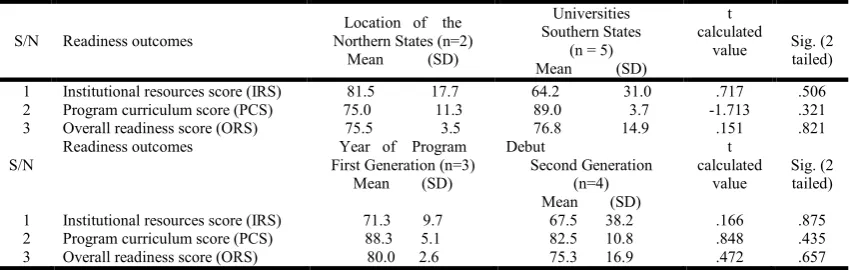
[image:5.595.107.493.554.669.2]The Levene's test for equality of variances (homogeneity of variance or homoscedasticity) in each readiness outcomes calculated for the two independent groups (location of the university and first and second generation programs) accepted the null hypothesis that the population variances are equal. The result of the independent student t-test revealed no statistically significant (p>.05) difference in the readiness outcomes between the programs located in the Northern and Southern States of the country. Similarly, no statistically significant (p>.05) difference was found in the readiness outcomes between the first and second generation programs.
DISCUSSION
The World Confederation of Physical Therapy (WCPT) has for decades argued for graduate-level training for physical therapists. However, only a few recent studies exist on graduate programs for physiotherapists in Africa (Agho, John 2017; Belay, Wamisho, Gebre 2017, Footer et al., 2017, Balogun et al., 2016 a & b). This study was designed to obtain relevant information on the readiness of the existing physiotherapy education programs in Nigeria to offer the DPT degree program. The study is the first empirical-based nationwide investigation of the resources and curriculum assessments in developing a DPT program in Nigeria. The findings provided useful baseline information on human/physical/financial resources, research and instructional equipment, library journal subscriptions and institutional support available in each university. On a positive note, the Heads of Department unanimously indicated that they have an adequate number of qualified clinicians (not lecturers) to supervise students in the hospital/private clinic and community settings. Paradoxically, only 29% of the Heads of Department indicated that their programs have adequate state of the art physiotherapy equipment, a current subscription to physiotherapy journals, and adequate research laboratories; only 43% of the Heads of Department felt they are currently adequately funded to operate their program effectively. Several of the challenges found in this study concur with the findings in a previous study from Ethiopia (Belay, Wamisho, Gebre 2017). As was the case in Nigeria, Ethiopia also experienced shortage of Lecturers and instructional equipment while developing their DPT program (Belay, Wamisho, Gebre 2017). Doctoral education in physiotherapy is costly to develop and sustain at a high level of performance. The physiotherapy profession in Nigeria cannot afford to produce “half-baked” DPT graduates who cannot practice as “first line contact” clinicians. incapable of functioning as “first line contact” clinicians.
prevent this from happening, the NUC must adequately fund the
To prevent this from happening, the NUC must adequately support the universities offering physiotherapy programs. Funds are desperately needed to develop research and instructional laboratories, recruit competent physiotherapist educators and to purchase state-of-the-art tools that are needed to accomplish meaningful clinical research. Another positive finding in this study is the fact that the Heads of Department also unanimously indicated that 56% of the “gold” standard DPT curriculum contents are presently taught in the BS/BPT program. The later finding portends some concerns. For example, only 14% of the Heads of Department indicated that women’s health, EKG interpretation, autism, nutrition and differential physiotherapy diagnosis are currently taught in the undergraduate program. Also, only 29% of the Heads of Department indicated that laser biostimulation therapy, private practice and home health, direct access and independent practice are currently taught. Nnamdi Azikiwe University and the University of Lagos are the two top institutions primed to implement the DPT program. The University of Nigeria at Nsukka is the least prepared institution. When the DPT program is approved by the NUC, Nigeria can adopt some of the nontraditional teaching strategies (e-learning, data-based educational systems, clinical practice, and peer-education methods) that Ethiopia utilized in the implementation of its DPT program (Footer et al., 2017). The findings in this study can be used as a guide in formulating a standard DPT curriculum in each university. The curriculum template in this study can be used by each program to identify the area of content deficiency in their curriculum. The MRTB must provide the oversight needed to ensure that the curriculum that each university develops must meet international standard. However, MRTB must allow for some diversity in developing innovative elective courses; it should not be a “one size fits all” prescriptive DPT curriculum.
[image:6.595.85.510.93.228.2]The DPT curriculum approved by MRTB must include contents in the following topics that are currently not taught in the majority of the programs in Nigeria: women’s health, EKG interpretation, autism, nutrition and differential physiotherapy diagnosis, laser biostimulation therapy, private practice and home health, direct access and independent practice, WHO’s disability classification, vestibular rehabilitation, disparities and inequities within the healthcare system and health economics. The above contents are essential because of the expanded role of the physiotherapists in health care as a “first line contact” practitioner. Contrary to our hypothesis, we found that the location of the academic programs and the year of the debut of the BS/BPT program did not significantly (p>.05) affect the readiness outcomes. The lack of statistically
Table 7. Independent student t- test to evaluate the impact of university location and year of program debut on the university readiness to implement the DPT program (N= 7)
S/N Readiness outcomes
Location of the Northern States (n=2)
Mean (SD)
Universities Southern States
(n = 5) Mean (SD)
t calculated
value Sig. (2 tailed)
1 Institutional resources score (IRS) 81.5 17.7 64.2 31.0 .717 .506
2 Program curriculum score (PCS) 75.0 11.3 89.0 3.7 -1.713 .321
3 Overall readiness score (ORS) 75.5 3.5 76.8 14.9 .151 .821
S/N
Readiness outcomes Year of Program
First Generation (n=3) Mean (SD)
Debut
Second Generation (n=4) Mean (SD)
t calculated
value
Sig. (2 tailed)
1 Institutional resources score (IRS) 71.3 9.7 67.5 38.2 .166 .875
2 Program curriculum score (PCS) 88.3 5.1 82.5 10.8 .848 .435
significant difference in readiness outcomes between universities located in the Northern and Southern States of the country and between first and second generation physiotherapy programs may be attributed, in part, to the fact that the seven universities in the study are all owned by the federal government and they received their funding from the NUC. In the health professions, entry-level doctoral education is sacrosanct and a sine qua non in the long and tortuous journey to true professional status (Dutton et al., 2015). Entry-level doctoral education is one of the barriers that the profession of physiotherapy in Nigeria must overcome in its evolutionary path from an occupation to true professional status. To join the league of progressive nations with high-quality physiotherapy education, it is imperative that Nigeria must upgrade its existing entry-level BS/BPT education to a DPT curriculum. Besides the entry-level DPT program, the physiotherapist educators in each university must develop a fast track curriculum ladder for physiotherapists with BS/BPT and MS degrees to earn the Transitional Doctor of Physiotherapy degree (t-DPT) degree. Transitional (t-DPT) and entry-level DPT degrees were first developed in the USA at the University of Southern California and Creighton University, respectively (Moffat 2015). As of January 2015, all the accredited and developing educational programs in the USA now offer the entry-level DPT degree that enables program graduates to take the professional licensing examination in all the 50 states, including the District of Columbia (CAPTE, 2016).
In recent years, there is a trend in several countries around the world to transition their entry-level education to a Master’s of Physical Therapy (MPT) or a clinical Doctor of Physiotherapy (DPT) degree (Plack, 2015). In Canada, MPT is the entry-level education for physiotherapists with a few universities offering the DPT degree program. In the UK, BS is still the entry-level education but 35 universities currently offer the entry-level Master of Science (MS) degree in physiotherapy and the University of Sussex offers a t-DPT; this is a 5-year research-based program. Furthermore, three universities now offer a generic physiotherapy professional doctorate (ProfD.) degree in health science; the title of the degree is consistent with degree awarded by other professions in the UK such as veterinary medicine and pharmacy. In Australia, MPT is the entry-level education while six of their universities offer the DPT degree (Bentley, Dunstan, 2015). In Africa, only Ethiopia and Egypt now offers the entry-level DPT (Belay, Wamisho, Gebre 2017). In the Middle East, Iran, Turkey, Japan, Taiwan and India their entry-level physiotherapy education is still at the baccalaureate level but a few universities offer the MPT and DPT degrees. In 2008, Pakistan was the third country in the world to offer the DPT degree program.
A 2011 survey of 93 countries that are members of the WCPT revealed that direct access (first contact practice) to physiotherapy services is allowed in 59% of WCPT member nations and physiotherapists are educated for independent practice in 63% of the countries. Bachelor of Science (BS) or professional Bachelor of Physiotherapy (BPT) degree is still the most common entry-level education for physiotherapists globally; more than 50% of WCPT member nations offer entry-level BS degree (WCPT, 2012). In developing countries, the desire to establish entry-level DPT education is constrained by economic realities. To make DPT education available and affordable to physiotherapists in developing countries, international collaborations and partnerships with institutions
in developed countries are being explored to assist in establishing new programs or strengthen the existing curricula (John et al., 2012, Footer et al., 2017). In Africa, most countries still offer entry-level BS degree; but Egypt, South Africa, and Nigeria have also developed MS and Ph.D. degrees in physiotherapy (Agho, John 2017).
While the consultation among the NUC, MRTB, and NSP has been ongoing for three years now, a whopping 40% of the physiotherapists in Nigeria perceived the BS degree to be adequate for independent practice (Johnson et al., 2012). This perception is a cause for alarm and demonstrates the urgent need to educate the NSP members of the imperative to upgrade the existing entry-level BS/BPT education to a clinical doctoral curriculum. When the entry-level DPT proposal submitted to the NUC is approved, the NSP leadership must ensure that the implementation of the program takes place concurrently in all the universities. The profession must never repeat the mistake of the past when in the 1970s there were multiple entry-level education pathways (certificate, diploma, and degree) within the profession. This situation was a source of confusion to the bureaucrats in federal and state civil services; it was also a public relations’ disaster in marketing and branding physiotherapy profession.
Limitations of the study
The limitation of this exploratory study should be recognized. Being a survey study, it is plausible that some of the Heads of Department may be less than 100% honest in their responses. The Heads of Department may want to appear better than their peers in order to build their program self-worth. The Heads of Department may also have given socially desirable answers that can influence the outcome of the study in favor of their program. The external validity of the findings in this study is limited because the research design is cross-sectional in nature with no manipulation of any independent variable and no random assignment of the study participants. Therefore, no cause-and-effect inference can be drawn from the findings in this study.
Conclusion
REFERENCES
Agho AO, John EB 2017. Occupational therapy and physiotherapy education and workforce in Anglophone Sub-Saharan Africa countries. Human Resources for Health 15(1), June 2017. DOI: 10.1186/s12960-017-0212-5 Available from URL: https://human-resources- health.biomedcentral.com/articles/10.1186/s12960-017-0212-5
Balogun JA, Mbada CE, Balogun AO, Okafor UAC. Profile of physiotherapist educators from Anglophone West African countries: A cross-sectional study. International Journal of Medical and Health Sciences 3(9): 99 -109, 2016.
Balogun JA, Mbada CE, Balogun AO, Okafor UAC. The spectrum of student enrollment-related outcomes in physiotherapy education programs in West Africa.
International Journal of Physiotherapy, 3(6), 603-612,
2016.
Balogun JA, Balogun AO, Obajuluwa V. A phenomenological investigation of the first two decades of university-based physiotherapy education in Nigeria. Cogent Medicine 4: 1301183, 2017.
Belay MM, Wamisho BL, Gebre SA. Doctor of physiotherapy program in Ethiopia. Asian Journal of Science and
Technology, 08 (1); 4154-4160, 2017.
Bentley P, Dunstan D. The Path to Professionalism: Physiotherapy in Australia to the 1980s. 2015. Available from: URL: https://books.google.com/books?id=PVZ2Ug-6SpAC&pg=PT237&lpg=PT237&dq=history+of+physioth erapy+education+in+Australia&source=bl&ots=oxYThA6 MM&sig=IoO13TCpqdk7vAp9JTUiaAiwXHs&hl=en&sa =X&ved=0CCYQ6AEwAmoVChMIyLnR1OXyyAIViug mCh2x2wOJ#v=onepage&q&f=false
Commission on Accreditation in Physical Therapy Education (CAPTE). Aggregate Program Data. 2015. Available from: URL: http://www.capteonline.org/uploadedFiles/CAPTE org/About_CAPTE/Resources/Aggregate_Program_Data/A ggregateProgramData_PTPrograms.pdf
http://www.africaranking.com/west-african-countries/
http://www2.paeaonline.org/index.php?ht=a/GetDocumentActi on/i/69169SimilarYou
Dutton LL, Hyland M, Lake D, Maihafer G, Thompson A, Wilson CM. Professionalism in physical therapy: history, practice, development. Copyright © 2005, Elsevier Inc Footer CB, Tsegaye HS, Yitnagashaw TA, Mekonnen W,
Shiferaw TD, Abera E, Davis A. Empowering the physiotherapy profession in Ethiopia through leadership development within the doctoring process. Front Public Health. 2017; 5: 51.
John EB, Pfalzer LA, Fry D, Glickman L, Masaaki S, Sabus C, Okafor UAC, Al-Jarrah M. Establishing and upgrading physical therapist education in developing countries: Four case examples of service by Japan and United States physical therapist programs to Nigeria, Suriname, Mongolia, and Jordan. Journal of Physical Therapy
Education. 26, 29-39, 2012.
John P (2016). National Postgraduate Physiotherapy College of Nigeria: Before creating more problems in the health
sector. Available from: URL: http://www.
medicalworldnigeria.com/2016/05/national-postgraduate- physiotherapy-college-of-nigeria-before-creating-more-problems-in-the-health-sector/#.V0piaDUrJdg
Johnson, O.E, Ayorinde, C.B, Adedoyin, RA Ativie, RN. Opinion of Nigerian physiotherapists on the introduction of the doctor of physical therapy degree programme in Nigeria. Journal of the Nigeria Society of Physiotherapy, 20: 47-51, 2012.
Jones & Bartlett Publisher. The evolution of physical therapy in the USA. 2015; Chapter 1:1-37. Available from: URL: http://www.jblearning.com
Moffat, M. 2015. The history of physical therapy practice in the United States. Available from: URL: https://www. questia.com
Plack MM. The evolution of the doctorate of physical therapy: Moving beyond the controversy, 2015. Available from: URL: http://www2.paeaonline.org
West Africa. The 16 West African countries, 2016. Available from: URL:
World Confederation for Physical Therapy (WCPT). 2016; Available from: URL: http://www.wcpt.org/education/ Entry-level-physical-therapy-education-programmes