Differential Fault Analysis on AES with 192 and 256-Bit Keys
Junko Takahashi and Toshinori Fukunaga
NTT Information Sharing Platform Laboratories
Nippon Telegraph and Telephone Corporation
3-9-1 Midori-cho, Musashino-shi, Tokyo, 180-8585, JAPAN
{
takahashi.junko, fukunaga.toshinori
}
@lab.ntt.co.jp
Abstract
This paper describes a differential fault analysis (DFA) on AES with 192 and 256-bit keys. We show a new attack in which both 192 and 256-bit keys are retrieved within a feasible computational time. In order to verify the proposed attack and estimate the calculation time, we implement the proposed attack using C code on a PC. As a result, we suc-cessfully recover the original 192-bit key using 3 pairs of correct and faulty ciphertexts within 5 minutes, and 256-bit key using 2 pairs of correct and faulty ciphertexts and 2 pairs of correct and faulty plaintexts within 10 minutes.1
1
Introduction
A side-channel attack is considered to be serious because the secret keys embedded in a secure computing device such as a smart card and RFID tag can be recovered within a feasible computational time. Fault analysis is one type of side-channel attack that deduces the secret key by deliber-ately inducing faults into the secure device during its cryp-tographic computation. Differential fault analysis (DFA) proposed by Biham et al. [1] is the most well known in fault analysis. In their attack, the secret key of DES can be recov-ered by comparing the correct and faulty output results after injecting faults into the secure device. Until now, DFA at-tacks against some symmetrical ciphers have been proposed and have had success in recovering secret keys [1, 2, 3].
There are many papers that propose a DFA attack against AES where the secret keys are recovered by inducing faults into the data part [4, 5, 6, 7, 8] or key expansion part [9, 10, 11]. They improve the attack conditions such as the fault model and requiring pairs of correct and faulty cipher-texts needed to recover the secret key. However, all previous attacks can only be applied to AES with a 128-bit key and
1This paper is the English version of the publication in the Japanese
domestic symposium, Symposium on Cryptography and Information Se-curity, SCIS 2010, which will be held on Jan. 19-22, 2010.
in15
in11
in7
in3
in14
in10
in6
in2
in13 in9 in5 in1
in12
in8
in4
in0
s3,0 s3,1 s3,2 s3,3
s2,0 s2,1 s2,2 s2,3
s1,0 s1,1 s1,2 s1,3 s0,0 s0,1 s0,2 s0,3
input bytes State array
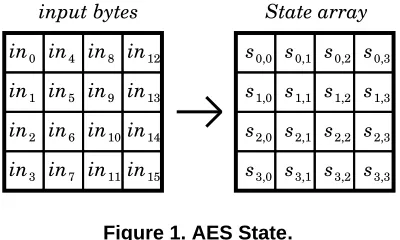
Figure 1. AES State.
the attack against 192 or 256-bit key has not been proposed in the published paper.
In this paper, we propose the attack against AES with 192 and 256-bit key. Our attack uses the characteristic structure of the key expansion routines for 192 and 256-bit keys and we can retrieve the original key within a practical time. In order to verify the proposed attack and evaluate the total calculation time needed to obtain the original key, we implement the proposed attack using C code on a PC. The simulation results show that we can retrieve the 192-bit key using 3 pairs of correct and faulty ciphertexts within 5 minutes, and we can retrieve the 256-bit key using 2 pairs of correct and faulty ciphertexts and 2 pairs of correct and faulty plaintexts within 10 minutes.
The reminder of this paper is organized as follows. No-tations are defined in Section 2. In Section 3, we describe the previous work. We describe the idea of the proposed attack in Section 4. We describe the attack assumptions in Sections 5 and the attack procedures in Section 6 and 7. The simulation results are shown in Section 8. Finally, we conclude the paper in Section 9.
2
Notations
two-dimensional array of bytes called the State in Fig.1(See [12] for more details). At the start of the Cipher and Inverse Cipher, the input – the array of bytesin0, in1, . . . in15– is copied into the State array as illustrated in Fig.1.The Cipher or Inverse Cipher operations are then conducted on the State array.
We use the parameters as follows.
a(n): ndenotes the bit length ofa a⊕b: Bitwise exclusive-OR operation
a·b: Finite field multiplication
Kn: n-th round key that consists of 16 bytes,
4 by 4 matrix Kn
i,j: (i, j)byte ofKn(i, j= 0. . .3),
whereiandjare the row and column numbers
3
Previous Work
In this section, we briefly introduce well-known previous attacks against AES with a 128-bit key [6, 7] and we show the difficulty in applying these attacks to 192 and 256-bit keys.
The previous works use the fact that the state difference between the states calculated from correct and faulty cipher-texts is related to another state difference in the same col-umn because one byte fault injected into the state is propa-gated to four bytes due to the MixCoumns transformation. We obtain the last round keyK10by solving the simulta-neous equations related to the state differences by 4 bytes using correct and faulty ciphertexts2. Once we obtainK10, we also obtain the original 128-bit key.
We verify we can extend the above attack method to the case of 192/256-bit key. In order to obtain the 192-bit key (256-bit key), we need to obtain the last round keyKrand the right half ofKr−1(wholeKr−1). We obtainKras the attack for 128-bit key. We can not obtain Kr−1 by sim-ply apsim-plying the above attack, because we have to deduce Kr−1by 16 bytes (not 4 bytes) due to the influence of the MixColumns transformation of ther−1round. Therefore, the simultaneous equations related toKr−1are more com-plicated, and we can not solve these equations in a practical time.
4
Idea of Proposed Attack
In this section, we describe the idea of the proposed at-tack.
2In fact, we obtainK10by 4 bytes using three kinds of simultaneous equations.
In the case of 192-bit key We find that a part of the 10th
round output difference between correct and faulty calcu-lations are known because we obtain the left-half ofK11 usingK12by the characteristics of the key expansion rou-tine. Further, we find that the known output difference has a relation to the output difference calculated from the un-known right-half of K11. Therefore, we can solve the si-multaneous equations of the 10th round output difference by 4 bytes, and we can obtain the right-half ofK11within a practical time. Therefore, we obtain the original 192-bit key using the right-half ofK11andK12.
In the case of 256-bit key In the case of 256-bit key, we
can not obtain even 1 byte ofK13usingK14by its struc-ture of the key expansion routine. Then, we have to solve the simultaneous equations by 16 bytes, and it is difficult to deduce the original key within a practical time. Here, we find that the first round keyK0can be uniquely determined when we assume the value of one column (4 bytes) ofK13. by the characteristics of the key expansion routine. We ver-ify whether the assumed one column (4 bytes) of K13 is correct or not by determiningK0using the fault injections into the decryption. Using this method, we reduce the key candidate space ofK13. Therefore, we obtain the original 256-bit key usingK13andK14.
In the next section, we propose the attack using the above idea.
5
Attack Assumptions
In this section, the attack assumptions are described.
• Correct and faulty ciphertexts calculated from the same plaintext are known.
• One pair of correct plaintext and ciphertext is known.
• Any one column (total 4 bytes) of therth round output is randomly corrupted.
– In the case of 192-bit key:r= 9,10
– In the case of 256-bit key: r = 12 (encryption
and decryption)
To satisfy the above conditions, fault injection area can be chosen as follows.
– Any 1 byte of the (r−1)th round output.
– Any one column (total 4 bytes) of therth round
output.
6
Attack Procedure for 192-Bit Key
In this section, we describe the attack procedure for 192-bit key. In order to obtain the original 192-192-bit key, we need to deduce the right-half of K11, (K11
0,i, K111,i, K211,i, K311,i)
(i= 2,3)andK12. Using the proposed attack, we reduce the key candidate space of these values to28. Finally we obtain the original 192-bit key by the exhaustive search.
6.1
Deduce
K12We obtainK12using the method described in [13]. In order to obtainK12, we obtain two kinds of faulty ci-phertexts by injecting the faults into 1 byte of the 9th round output. The left figure of Fig.2 shows the fault propagation when 1 byte fault is injected into the 9th round outputs0,0.
We can deduceK12by solving the simultaneous equations ofK12within 1 minute using 2 pairs of correct and faulty ciphertexts on a PC.
6.2
Obtain faulty ciphertext
We obtain the faulty ciphertext by fault injection into 1 byte of the 8th round output (or one column (total 4 bytes) of the 9th round output). As an example, we explain the case when the fault is injected into 1 byte of the 8th round outputs0,0in the following paper.
6.3
Deduce the left-half of
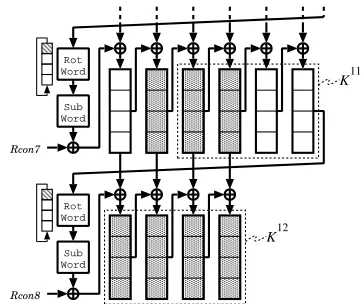
K11As we knowK12, we can deduce 8 bytes of the left-half ofK11,(K11
0,i,K111,i,K211,i,K311,i) (i = 0,1)by the
charac-teristics of the key expansion routine (Fig. 3).
6.4
Deduce the right-half of
K11We deduce 8 bytes of the right-half ofK11,(K011,i,K111,i, K11
2,i,K311,i) (i = 2,3). Figure 4 shows the last part of the
encryption for 192-bit key. The bytes shown in gray color are known values because we calculate them fromK12 de-duced in Section 6.1, the left-half ofK11deduced in Sec-tion 6.3, and the known ciphertext. Using these values, we deduce the 10th round output differences between correct and faulty encryption shown in gray color in Fig.4.
Moreover, the 10th round output differences between correct and faulty encryption shown in the box with the hatched line can be uniquely determined when we assume the 4 byte values ofK11,(K11
0,3,K111,3,K211,3,K311,3)shown in the box with the hatched line in Fig.4.
Here, due to the linearity of the MixColumns transforma-tion, the input and output differences of the MixColumns transformation are held. Then, the differences of the byte
SubBytes
ShiftRows SubBytes
ShiftRows
MixColumns SubBytes
ShiftRows
MixColumns
K12
K11
K10
SubBytes
ShiftRows SubBytes
ShiftRows
MixColumns SubBytes
ShiftRows
MixColumns
K10
K9
SubBytes
ShiftRows
MixColumns
K9
SubBytes
ShiftRows MixColumns
K12
K11
11R
12R 10R 9R 8R
Sub Word
Rcon8 Rot Word
Sub Word
Rcon7
Rot Word
K12
K11
Figure 3. Last part of the key schedule for 192-bit key
between correct and faulty encryption have a relation to an-other byte in the same column, because the one byte fault is propagated to four bytes due to the influence of the Mix-Columns transformation. As an example, the most left col-umn of the 10th round output satisfy the following equa-tions.
M0,0⊕Mf0,0={02} ·F (1)
M1,0⊕Mf1,0=F (2)
M3,0⊕Mf3,0={03} ·F (3)
In the above,Fis the fault value. The notationMi,j(Mfi,j)
is the correct (faulty) 10th round output. Further, the fol-lowing simultaneous equations are satisfied.
M0,0⊕Mf0,0={02} ·(M1,0⊕Mf1,0) (4)
M3,0⊕Mf3,0={03} ·(M1,0⊕Mf1,0) (5)
Here,M1,0can be calculated from the above equations be-cause the left parts of eq.(4) and (5) are known values. The byteM1,0is calculated from the guessed values of(K011,3, K11
1,3,K211,3,K311,3). Then, we can reduce the space of the key candidates of(K11
0,3,K111,3,K211,3,K311,3)by eliminating the guessed values which does not satisfy eq.(4) and (5). The above method can be applied from the second column to fourth column of 10th round output. Then, the stateM2,1,
M3,2,M0,3are also calculated from the above guessed val-ues(K011,3,K111,3,K211,3,K311,3). We also reduce the space of the key candidates by eliminating the key candidates which does not satisfy the equations ofM2,1,M3,2,M0,3.
In the same way, we reduce the space of the key candi-dates(K11
0,2,K111,2,K211,2,K311,2). Therefore, we deduce the key candidates of the right-half ofK11using 1 pair of cor-rect and faulty ciphertext.
SubBytes
ShiftRows
SubBytes
ShiftRows MixColumns
K12 K11
1:2
3:1
2:1
3:1
11R
12R 10R
Figure 4. Data part for 192-bit key
6.5
Deduce the original 192-bit key
UsingK12deduced in Section 6.1 and the key candidates K11deduced in Section 6.4, we calculate the key candidates of the original 192-bit key k(192) by applying the inverse calculation of the key expansion routine. If the candidates of the ciphertext calculated fromk(192) is equal to the cor-rect ciphertext, the key candidates of the original 192-bit key is correct and equal to the original keyK(192).
7
Attack procedure for 256-bit key
In this section, we describe the attack procedure for 256-bit key. In order to obtain the original 256-256-bit key, we need to deduceK13andK14. Using our attack, we reduce the key candidate space of these values to213. Finally, we ob-tain the original 256-bit key by the exhaustive search.
7.1
Deduce
K147.2
Deduce
K0In order to obtain K0, we obtain two kinds of faulty plaintexts by injecting the faults into 1 byte of the 11th round output. As Section 6.1, the first round key K0 is uniquely determined using 2 pairs of correct and faulty plaintexts.
7.3
Deduce
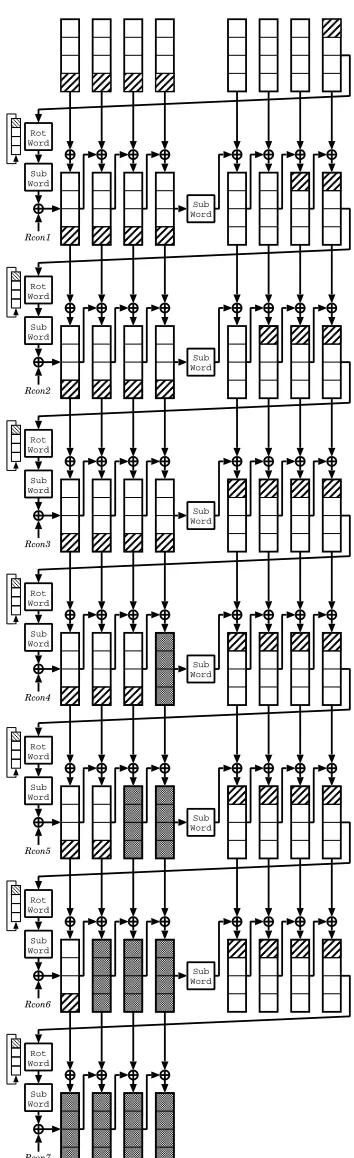
K13As we knowK14, we also know bytes indicated by the gray color in Fig.5 by calculating the inverse of the key ex-pansion routine.
Here, we guess 4 bytes of(K13
0,0, K013,1, K013,2, K013,3) in-dicated by the box with the hatched line in Fig.5. Then, we can determine 4 bytes of(K0
3,0, K30,1, K30,2 K30,3), ofK0 by calculating the inverse of the key expansion routine. If the guessed 4 bytes are equal to 4 bytes ofK0 deduced in Section 7.2, we store the guessed values(K13
0,0, K013,1, K013,2, K13
0,3). Therefore, we can reduce the space of the key candi-dates of(K13
0,0, K013,1, K013,2, K013,3), by calculating232times the inverse of the key expansion routine.
In the same way, we reduce the the space of the key can-didates of(Ki,130, Ki,131, Ki,132, Ki,133) (i= 1. . .3).
7.4
Deduce the original 256-bit key
UsingK14deduced in Section 7.1 and the key candidates K13deduced in Section 7.3, we calculate the key candidates of the original 256-bit key k(256) by applying the inverse calculation of the key expansion routine. If the candidates of the ciphertext calculated fromk(256)is equal to the cor-rect ciphertext, the key candidates of the original 256-bit key is correct and equal to the original keyK(256).
8
Simulation Result
In order to verify the proposed attack and estimate the calculation time, we implement the attacks for 192-bit and 256-bit keys using the C code and execute it on a Xeon 3.0 GHz PC3.
In the case of 192-bit key Using proposed attack method,
the key candidate space of the right-half ofK11is reduced to 28 from 264. Therefore, an amount of calculation T needed to obtain the original key is calculated as follows.
T = 2×0.5×232×(1R inverse calc.) + 28×(encryption) = 232×(1R inverse calc.) + 28×(encryption)
∼232×(1R inverse calc.) (6)
3This simulation was done with a single thread processing. Therefore,
one core of the multi-core CPU is only used.
The notation R indicates the round. In the above calcula-tion, the coefficient2of the first term means two kinds of calculation which is correct and faulty calculations. The co-efficient0.5means that we calculate the half-state (8 bytes) by applying the 1 round inverse function.
In the result, we can obtain the original 192-bit key within 5 minutes.
In the case of 256-bit key Using proposed attack method,
the space of the key candidates of(K013,0, K013,1, K013,2, K013,3)
is reduced to24 from232. Moreover, the space of the key candidates of(Ki,130, Ki,131, Ki,132, Ki,133) (i = 1. . .3)is re-duced to23. Therefore, we need213(= 24×23×23×23) times encryption to determine the original 256-bit key.
Therefore, an amount of calculationT needed to obtain the original key is calculated as follows.
T = 232×(key expansion) + 213×(encryption) ∼232×(key expansion) (7)
In the result, we can obtain the original 256-bit key within 10 minutes.
9
Conclusions
We propose the differential fault analysis on AES with 192 and 256-bit keys. In the proposed attack, we can obtain 192-bit key using 3 pairs of correct and faulty ciphertexts within 5 minutes. We can obtain 256-bit key using 2 pairs of correct and faulty ciphertexts and 2 pairs of correct and faulty plaintexts within 10 minutes. Both 192 and 256-bit keys are retrieved within a practical time.
References
[1] E. Biham and A. Shamir, “Differential Fault Analysis of Se-cret Key Cryptosystems,” Technion - Computer Science De-partment - Technical Report CS0901.revised - 1997.
[2] H. Chen, W. Wu, and D. Feng, “Differential Fault Analy-sis on CLEFIA,” In S. Qing, H. Imai, and G, Wang, edi-tor, Information and Communications Security, vol.4861 of Lecture Notes in Computer Science, pp.284-295, Springer-Verlag, 2008.
[3] “An Improved Method of Differential Fault Analysis on the SMS4 Cryptosystem,” In proceedings of the First Interna-tional Symposium on Data, Privacy, and E-Commerce 2007, IEEE-CS, pp.175-180.
[5] P. Dusart, G. Letourneux and O. Vivolo, “Differential Fault Analysis on A.E.S.,” Cryptology eprint Archive Report 2003/010. Available at http://www.iacr.org/
[6] G. Piret and J. J. Quisquater, “A Differential Fault Attack Technique against SPN Structures, with Application to the AES and KHAZAD,” In C. D. Walter et. al. , editor, Cryp-tographic Hardware and Embedded Systems – CHES 2003, vol.2779 of Lecture Notes in Computer Science, pp.77-88, 2003.
[7] C. Giraud, “DFA on AES,” In H. Dobbertin, V. Rijmen and A. Sowa, editors, Advanced Encryption Standard (AES): 4th International Conference, AES 2004, vol.3373 of Lec-ture Notes in Computer Science, pp. 27-41, Springer-Verlag, 2005.
[8] A. Moradi, M. T. M. Shalmani and M. Salmasizadeh, “A Generalized Method of Differential Fault Attack Against AES Cryptosystem,” In L. Goubin and M. Matsui, ed-itor, Cryptographic Hardware and Embedded Systems – CHES 2006, vol.4249 of Lecture Notes in Computer Sci-ence, pp.91-100, 2006.
[9] C.-N. Chen and S.-M. Yen, “Differential Fault Analysis on AES Key Schedule and Some Countermeasures,” Aus-tralasian Conference on Information Security and Privacy 2003 (ACISP 2003), vol.2727 of Lecture Notes in Computer Science, pp.118-129, 2003.
[10] D. Peacham and B. Thomas, “A DFA at-tack against the AES key schedule,” SiVenture White Paper 001, 26 October 2006. Available at http://www.siventure.com/pdfs/AES KeySchedule
DFA whitepaper.pdf
[11] J. Takahashi, T. Fukunaga and K. Yamakoshi, “DFA Mech-anism on the AES Key Schedule,” Fault Diagnosis and Tol-erance in Cryptography, FDTC2007, IEEE-CS, pp.62–72.
[12] National Institute of Standards and Technology, Advanced Encryption Standard, NIST FIPS PUB 197, 2001.
[13] D. Mukhopadhyay, “An Improved Fault Based Attack of the Advanced Encryption Standard,” Africacrypt 2009, vol.5580 of LNCS, pp.421-434, 2009.
Rot Word
Sub Word
Rcon7
Sub Word Rot
Word
Sub Word
Rcon3
Sub Word Rot
Word
Sub Word
Rcon2
Sub Word Rot
Word
Sub Word
Rcon1
Sub Word Rot
Word
Sub Word
Rcon6
Sub Word Rot
Word
Sub Word
Rcon5
Sub Word Rot
Word
Sub Word
Rcon4