University of Warwick institutional repository: http://go.warwick.ac.uk/wrap
A Thesis Submitted for the Degree of PhD at the University of Warwick
http://go.warwick.ac.uk/wrap/4526
This thesis is made available online and is protected by original copyright.
Please scroll down to view the document itself.
M A
E
G NS
I T A T MOLEM
U N
IV ER
SITAS WARWICEN
SIS
Strategy Iteration Algorithms for Games and
Markov Decision Processes
by
John Fearnley
Thesis
Submitted to the University of Warwick
in partial fulfilment of the requirements
for the degree of
Doctor of Philosophy
Department of Computer Science
Contents
List of Figures v
List of Tables vi
Acknowledgments vii
Declarations viii
Abstract ix
Chapter 1 Introduction 1
1.1 Markov Decision Processes . . . 1
1.2 Two Player Games . . . 4
1.3 Model Checking And Parity Games . . . 6
1.4 Strategy Improvement . . . 7
1.5 The Linear Complementarity Problem . . . 9
1.6 Contribution . . . 10
Chapter 2 Problem Statements 13 2.1 Infinite Games . . . 13
2.1.1 Parity Games . . . 14
2.1.2 Mean-Payoff Games . . . 17
2.2 Markov Decision Processes . . . 23
2.3 The Linear Complementarity Problem . . . 27
2.4 Optimality Equations . . . 29
2.4.1 Optimality Equations For Markov Decision Processes . . . . 30
2.4.2 Optimality Equations For Games . . . 32
2.5 Reductions . . . 35
2.5.1 Reductions Between Games . . . 35
2.5.2 Reducing Discounted Games To LCPs . . . 37
Chapter 3 Algorithms 42 3.1 A Survey Of Known Algorithms . . . 42
3.2 Strategy Improvement . . . 47
3.2.1 Strategy Improvement For Markov Decision Processes . . . . 50
3.2.2 Strategy Improvement For Discounted Games . . . 51
3.2.3 Strategy Improvement For Mean-Payoff Games . . . 53
3.2.4 Switching Policies . . . 57
3.3 Algorithms for LCPs . . . 61
3.3.1 Lemke’s Algorithm . . . 61
3.3.2 The Cottle-Dantzig Algorithm . . . 66
Chapter 4 Linear Complementarity Algorithms For Infinite Games 69 4.1 Algorithms . . . 70
4.1.1 Lemke’s Algorithm For Discounted Games . . . 70
4.1.2 The Cottle-Dantzig Algorithm For Discounted Games . . . . 83
4.1.3 Degeneracy . . . 88
4.2 The Link With LCPs . . . 89
4.2.1 Correctness Of The Modified Games . . . 90
4.2.2 Lemke’s Algorithm . . . 94
4.3.1 Lemke’s Algorithm . . . 98
4.3.2 The Cottle-Dantzig Algorithm . . . 107
4.4 Concluding Remarks . . . 114
Chapter 5 Greedy Strategy Improvement For Markov Decision Pro-cesses 116 5.1 The Strategy Improvement Algorithm . . . 117
5.2 The Family of Examples . . . 118
5.2.1 The Bit Gadget . . . 119
5.2.2 The Deceleration Lane . . . 121
5.2.3 Reset Structure . . . 123
5.3 The Flip Phase . . . 126
5.3.1 Breaking The Example Down . . . 128
5.3.2 The Deceleration Lane . . . 131
5.3.3 Zero Bits . . . 134
5.3.4 One Bits . . . 138
5.3.5 The Reset Structure . . . 141
5.4 The Reset Phase . . . 146
5.4.1 The First Reset Strategy . . . 148
5.4.2 The Second Reset Strategy . . . 150
5.4.3 The Third Reset Strategy . . . 153
5.4.4 The Final Reset Strategy . . . 165
5.5 Exponential Lower Bounds For The Average Reward Criterion . . . 171
5.6 Concluding Remarks . . . 171
Chapter 6 Non-oblivious Strategy Improvement 173 6.1 Classifying Profitable Edges . . . 174
6.1.1 Strategy Trees . . . 175
6.2 Remembering Previous Iterations . . . 186
6.2.1 Snares . . . 187
6.2.2 Using Snares To Guide Strategy Improvement . . . 190
6.2.3 Switching Policies For Snare Based Strategy Improvement . . 192
6.3 Evaluation . . . 195
6.3.1 Performance on Super Polynomial Time Examples . . . 196
6.3.2 Experimental Results . . . 198
6.4 Concluding Remarks . . . 202
Chapter 7 Conclusion 205
List of Figures
2.1 An example of a parity game. . . 14
2.2 An example of a mean-payoff game. . . 20
2.3 An example of a Markov decision process. . . 24
2.4 The result of reducing a parity game to a mean-payoff game. . . 36
4.1 A running example for the demonstration of Lemke’s algorithm. . . 71
4.2 The modified game produced by Lemke’s algorithm. . . 72
4.3 The balance of each vertex in the first step of Lemke’s algorithm. . . 73
4.4 The balance of each vertex in the second step of Lemke’s algorithm. 76 4.5 An example upon which the LCP algorithms take exponential time. 97 4.6 The first strategy considered in a major iteration. . . 108
5.1 The gadget that will represent the state of a bit. . . 119
5.2 The deceleration lane. . . 121
5.3 The outgoing actions from each bit gadget. . . 121
5.4 The structure that is associated with each bit gadget. . . 123
5.5 The full example with two bit gadgets. . . 125
6.1 A strategy tree. . . 178
List of Tables
5.1 The deterministic actions in the gameGn. . . 124
6.1 Experimental results for Friedmann’s examples. . . 199
6.2 Experimental results for the examples of Friedmann, Hansen, and
Zwick. . . 200
Acknowledgments
First, and foremost, I am indebted to my supervisor, Marcin Jurdzi´nski. His
insis-tence on mathematical rigour and clear thinking have been an inspiration to me,
and the progress that I have made as a researcher can be attributed entirely to him.
I do not think that any of the work in this thesis could have been completed without
his influence.
I am also indebted to Ranko Lazi´c for acting as my advisor during my studies.
He has never failed to provide sound advice and guidance during my time here. I
would also like to thank Ranko and Kousha Etessami for acting as my examiners,
and for their helpful comments that have greatly improved the final version of this
thesis.
I am thankful to the Department of Computer Science at Warwick for hosting
my six year journey from leaving high-school student to the submission of this
thesis. In particular, I would like to thank the members of the DIMAP centre,
the algorithms group, and the formal methods group, for providing a stimulating
environment in which to do research.
Finally, I would like to thank my colleagues and friends: Haris Aziz, Peter
Krusche, Micha l Rutkowski, and Ashutosh Trivedi. My time at Warwick would have
Declarations
The research presented in Chapter 4 is a joint work with Marcin Jurdzi´nski and
Rahul Savani. My co-authors contributed in the high-level ideas behind the
algo-rithms, but the technical details, along with the lower bounds are my own work. All
other work presented in this thesis has been produced by myself unless explicitly
stated otherwise in the text.
None of the work presented in this thesis has been submitted for a previous
degree, or a degree at another university. All of the work has been conducted
during my period of study at Warwick. Preliminary versions of the work presented
in this thesis have been published, or have been accepted for publication: Chapter 4
has been published in SOFSEM 2010 [FJS10], Chapter 5 has been published in
ICALP 2010 [Fea10b], and Chapter 6 has been accepted for publication at
Abstract
In this thesis, we consider the problem of solving two player infinite games, such as parity games, mean-payoff games, and discounted games, the problem of solving Markov decision processes. We study a specific type of algorithm for solving these problems that we call strategy iteration algorithms. Strategy improvement algorithms are an example of a type of algorithm that falls under this classification. We also study Lemke’s algorithm and the Cottle-Dantzig algorithm, which are classical pivoting algorithms for solving the linear complementarity problem. The reduction of Jurdzi´nski and Savani from discounted games to LCPs allows these algorithms to be applied to infinite games [JS08]. We show that, when they are applied to games, these algorithms can be viewed as strategy iteration algorithms. We also resolve the question of their running time on these games by providing a family of examples upon which these algorithm take exponential time.
Greedy strategy improvement is a natural variation of strategy improvement, and Friedmann has recently shown an exponential lower bound for this algorithm when it is applied to infinite games [Fri09]. However, these lower bounds do not apply for Markov decision processes. We extend Friedmann’s work in order to prove an exponential lower bound for greedy strategy improvement in the MDP setting.
Chapter 1
Introduction
In this thesis, we study the problem of solving Markov decision processes and two
player infinite games played on finite graphs. In particular, we study parity,
mean-payoff, and discounted games. We are interested in strategy iteration algorithms,
which are a specific type of algorithm that can be used to solve these problems. In
this chapter, we give an overview of the problems that we are considering, and the
results that will be obtained in this thesis. A formal description of these problems
will be given in Chapter 2, and a formal description of the algorithms that we study
will be given in Chapter 3.
1.1
Markov Decision Processes
Markov decision processes were originally formulated in order to solve inventory
management problems. In keeping with this tradition, we will illustrate this model
with a simple inventory management problem. The following example is largely
taken from the exposition of Puterman [Put05].
A manager owns a store that sells exactly one good. At the start of each
month the manager must order stock, which arrives the following day. During
day of the month. Naturally, the manager cannot know how many orders will arrive
during a given month, but the manager can use prior experience to give a probability
distribution for this. The manager’s problem is to decide how much stock should
be ordered. Since storing goods is expensive, if too much stock is ordered then the
profits on the goods that are sold may be wiped out. On the other hand, if not
enough stock is ordered, then the store may not make as much profit as it could
have done.
This problem can naturally be modelled as a Markov decision process. At
the start of each month the inventory has some state, which is the number of goods
that are currently in stock. The manager then takes an action, by deciding how
many goods should be ordered. The inventory then moves to a new state, which
is decided by a combination of the amount of goods that have been ordered, and
the amount of orders that arrive during the month. Since the number of orders is
modelled by a probability distribution, the state that the inventory will move to in
the next month will be determined by this probability distribution. Each action has
a reward, which is the expected profit from the goods that are sold minus the cost
of storing the current inventory. If this reward is positive, then a profit is made
during that month, and if it is negative, then a loss is made.
A strategy (also known as a policy in the Markov decision process literature)
is a rule that the manager can follow to determine how much stock should be ordered.
This strategy will obviously depend on the current state of the inventory: if the
inventory is almost empty then the manager will want to make a larger order than
if the inventory has plenty of stock.
The problem that must be solved is to find an optimal strategy. This is a
strategy that maximizes the amount of profit that the store makes. The optimality
criterion that is used depends on the setting. If the store is only going to be open
for a fixed number of months, then we are looking for an optimal strategy in the
that is made while the store is open. On the other hand, if the store will remain
open indefinitely, then we are looking for an optimal strategy in the average-reward
criterion. This is a strategy that maximizes the long-term average profit that is
made by the store. For example, the strategy may make a loss for the first few
months in order to move the inventory into a state where a better long-term average
profit can be obtained. Finally, there is the discounted-reward criterion, in which
immediate rewards are worth more than future rewards. In our example, this could
be interpreted as the price of the good slowly falling over time. This means that
the profit in the first month will be larger than the profits in subsequent months.
The study of Markov decision processes began in the 1950s. The first work on
this subject was by Shapley, who studied two player stochastic games [Sha53], and
Markov decision processes can be seen as a stochastic game with only one player.
The model was then developed in its own right by the works of Bellman [Bel57],
Howard [How60], and others. Puterman’s book provides a comprehensive modern
exposition of the basic results for Markov decision processes [Put05].
Markov decision processes have since been applied in a wide variety of areas.
They have become a standard tool for modelling stochastic processes in operations
research and engineering. They have also found applications in computer science.
For example, they are a fundamental tool used in reinforcement learning, which is
a sub-area of artificial intelligence research [SB98].
These applications often produce Markov decision processes that have very
large state spaces, and so finding fast algorithms that solve Markov decision
pro-cesses is an important problem. It has long been known that the problem can be
formulated as a linear program [d’E63, Man60], and therefore it can be solved in
polynomial time [Kha80, Kar84]. However, this gives only a weakly polynomial
time algorithm, which means that its running time is polynomial in the bit length
of the numbers occurring in its inputs. There is no known strongly polynomial time
1.2
Two Player Games
The defining text on game theory was written by von Neumann and Morgenstern in
1944 [vM44]. Part of this work was the study of two player zero-sum games, which
are games where the goals of the two players are directly opposed. The zero-sum
property means that if one player wins some amount, then the opposing player loses
that amount. A classical example of this would be a poker game, where if one player
wins some amount of money in a round, then his opponents lose that amount of
money. These are the type of game that will be studied in this thesis.
Game theory can be applied to to produce a different type of model than
those models that arise from Markov decision processes. In many systems it is
known that there can be more than one outcome after taking some action, but there
may not be a known probability distribution that models this uncertainty about
the environment. Game theory can be used to model this, by assuming that the
decisions taken by the environment are controlled by an adversary whose goal is to
minimize our objective function.
For example, let us return to our inventory control problem. To model this
as a Markov decision process, we required a probability distribution that specified
the number of orders that will be placed by customers in each month. Now suppose
that we do not have such a probability distribution. Instead, we are looking for
a strategy for inventory control which maximizes the profit no matter how many
orders arrive during each month. To do this, we can assume that the number of
orders that are placed is controlled by an adversary, whose objective is to minimize
the amount of profit that we make. If we can devise a strategy that ensures a certain
amount of profit when playing against the adversary, then this strategy guarantees
that we will make at least this amount of profit when exposed to real customers.
From this, we can see that playing a game against the adversary allows us to devise
We will study two player infinite games that are played on finite graphs.
In particular, we will study mean-payoff games and discounted games. These are
similar to Markov decision processes with the average-reward and discounted-reward
optimality criteria, but where the randomness used in the Markov decision process
model is replaced with an opposing player. The objective in these games is again
to compute an optimal strategy, but in this case an optimal strategy is one that
guarantees a certain payoff no matter how the opponent plays against that strategy.
These games have applications in, for example, online scheduling and online string
comparison problems [ZP96].
Whereas the problem of solving a Markov decision process can be solved in
polynomial time, there is no known algorithm that solves mean-payoff or discounted
games in polynomial time. However, it is known that these games lie in the
com-plexity class NP∩co-NP [KL93]. This implies that the problems are highly unlikely
to be NP-complete or co-NP-complete, since a proof of either of these properties
would imply that NP is equal to co-NP.
In fact, it is known that these three problems lie in a more restricted class
of problems. A common formulation for the complexity class NP is that it contains
decision problems for which, if the answer is yes, then then there is a witness of
this fact that can be verified in polynomial time. The complexity class UP contains
decision problems for which, if the answer is yes, then there is a unique witness of
this fact that can be verified in polynomial time. The complexity class co-UP is
defined analogously. Jurdzi´nski has shown that the problem of solving these games
lies in UP∩co-UP [Jur98].
The complexity status of these games is rather unusual, because they are
one of the few natural combinatorial problems that lie in UP ∩ co-UP for which
no polynomial time algorithm is known. This complexity class is also inhabited by
various number theoretic problems such as deciding whether an integer has a factor
there are few combinatorial problems that share this complexity.
Membership of NP∩ co-NP does not imply that a problem is hard. There
have been problems in this class for which polynomial time algorithms have been
devised. For example, the problem of primality testing was known to lie in NP∩
co-NP, and was considered to be a hard problem. Nevertheless, Agrawal, Kayal, and
Saxena discovered a polynomial time algorithm that solves this problem [AKS04].
Another example is linear programming, which was shown to be solvable in
polyno-mial time by Khachiyan [Kha80]. Finding a polynopolyno-mial time algorithm that solves
a mean-payoff game or a discounted game is a major open problem.
1.3
Model Checking And Parity Games
The field of formal verification studies methods that can be used to check whether a
computer program is correct. The applications of this are obvious, because real world
programs often contain bugs that can cause the system to behave in unpredictable
ways. On the other hand, software is often entrusted with safety critical tasks, such
as flying an aeroplane or controlling a nuclear power plant. The goal of verification
is to provide tools that can be used to validate that these systems are correct, and
that they do not contain bugs.
Model checking is one technique that can be used to verify systems [CGP99].
The problem takes two inputs. The first is a representation of a computer program,
usually in the form of a Kripke structure. This structure represents the states that
the program can be in, and the transitions between these states that the program
can make. The second input is a formula, which is written in some kind of logic.
The model checking problem is to decide whether the system satisfies the formula.
This problem can be rephrased as a problem about a zero-sum game between
two players. This game is played on a graph, which is constructed from the system
described by the formula, and the other player is trying to prove the opposite.
Therefore, a model checking problem can be solved by deciding which player wins
the corresponding game.
The type of game that is played depends on the logic that is used to
spec-ify the formula. The modal µ-calculus is a logic that subsumes other commonly
used temporal logics, such as LTL and CTL* [Koz82]. When the input formula
is written in this logic, the corresponding model checking game will be a parity
game [EJS93, Sti95]. Therefore, fast algorithms for solving parity games lead to
faster model checkers for the modal µ-calculus. Parity games also have other
ap-plications in, for example, checking non-emptiness of non-deterministic parity tree
automata [GTW02].
Parity games are strongly related to mean-payoff games and discounted
games. There is a polynomial time reduction from parity games to mean-payoff
games, and there is a polynomial time reduction from mean-payoff games to
dis-counted games. Parity games are also known to be contained in UP∩ co-UP, and
no polynomial time algorithm is known that solves parity games. Finding a
poly-nomial time algorithm that solves parity games is a major open problem, and this
also further motivates the study of mean-payoff and discounted games.
1.4
Strategy Improvement
Strategy improvement is a technique that can be applied to solve Markov decision
processes and infinite games. Strategy improvement algorithms have been devised
for all three optimality criteria in MDPs [Put05], and for all of the games that we
have introduced [Pur95, BV07, VJ00]. Strategy improvement algorithms fall under
the umbrella of strategy iteration algorithms, because they solve a game or MDP by
iteratively trying to improve a strategy. We will introduce the ideas behind strategy
The problem of solving a linear program can naturally be seen as the problem
of finding a vertex of a convex polytope that maximizes an objective function. The
simplex method, given by Dantzig [WD49, Dan49], takes the following approach to
finding this vertex. Each vertex of the polytope has a set of neighbours, and since
the polytope is convex, we know that a vertex optimizes the objective function if and
only if it has no neighbour with a higher value. Therefore, every vertex that is not
optimal has at least one neighbour with a higher value. The simplex method begins
by considering an arbitrary vertex of the polytope. In each iteration, it chooses some
neighbouring vertex with a higher value, and moves to that vertex. This process
continues until an optimal vertex is found.
Since there can be multiple neighbours which offer an improvement in the
objective function, the simplex method must use a pivot rule to decide which
neigh-bour should be chosen in each iteration. Dantzig’s original pivot rule was shown to
require exponential time in the worst case by a result of Klee and Minty [KM70]. It is
now known that many other pivot rules have exponential running times in the worst
case, and there is no pivot rule that has a proof of polynomial time termination. On
the other hand, the simplex method has been found to work very well in practice
because it almost always terminates in polynomial time on real world examples. For
this reason, the simplex method is still frequently used to solve practical problems.
Strategy improvement uses similar techniques to those of the simplex
algo-rithm in order to solve MDPs and games. For each strategy, the set of neighbouring
strategies that secure a better value can be computed in polynomial time, and it can
be shown that a strategy is optimal if and only if this set is empty. Therefore,
strat-egy improvement algorithms begin with an arbitrary stratstrat-egy, and in each iteration
the algorithm picks some neighbouring strategy that secures a better value.
Strategy improvement algorithms also need a pivot rule to decide which
neighbouring strategy should be chosen. In the context of strategy improvement
it has been shown that using an unsophisticated switching policy can cause the
algorithm to take exponential time [MC94]. However, no exponential lower bounds
were known for more sophisticated switching policies. In particular, the greedy
policy is a natural switching policy for strategy improvement, and it was considered
to be a strong candidate for polynomial time termination for quite some time. This
was because, as in the case of linear programming, the greedy switching policy was
found to work very well in practice. However, these hopes were dashed by a recent
result of Friedmann [Fri09], in which he constructed a family of parity games upon
which the strategy improvement algorithm of V¨oge and Jurdzi´nski equipped with
the greedy switching policy takes exponential time. These results have been adapted
to show exponential lower bounds for greedy strategy improvement algorithms for
mean-payoff and discounted games [And09].
1.5
The Linear Complementarity Problem
The linear complementarity problem is a fundamental problem in mathematical
programming [CPS92], which naturally captures the complementary slackness
con-ditions in linear programming and the Karush-Kuhn-Tucker concon-ditions of quadratic
programs. The linear complementarity problem takes a matrix as an input. In
general, the problem of finding a solution to a linear complementarity problem is
NP-complete [Chu89]. However, when the input matrix is a P-matrix, the problem
is known to belong to the more restrictive class PPAD [Pap94]. This class is known
to have complete problems, such as the problem of finding a Nash equilibrium in
a bimatrix game [DGP06, CDT09], but it is not known whether the P-matrix
lin-ear complementarity problem is PPAD-complete. On the other hand, there is no
known polynomial time algorithm that solves P-matrix LCPs, and finding such an
algorithm is a major open problem.
algo-rithm, because it uses pivotal algebra to move from one vertex of the polytope to
the next. Pivoting algorithms have also been developed to solve the linear
com-plementarity problem. Prominent examples of this are Lemke’s algorithm [Lem65],
and the Cottle-Dantzig algorithm [DC67]. Although these algorithms may fail to
solve an arbitrary LCP, both of these algorithms are guaranteed to terminate with
a solution when they are applied to a P-matrix LCP.
Recently, the infinite games that we are studying have been linked to the
linear complementarity problem. Polynomial time reductions from simple stochastic
games [Con93] to the linear complementarity problem have been proposed [GR05,
SV07]. Simple stochastic games are a type of game that also incorporate random
moves, and it has been shown that the problem of solving a discounted game can
be reduced to the problem of solving a simple stochastic game [ZP96]. Also, a
direct polynomial time reduction from discounted games to the P-matrix linear
complementarity problem has been devised by Jurdzi´nski and Savani [JS08]. These
reductions mean that the classical pivoting algorithm from the LCP literature can
now be applied to solve parity, mean-payoff, and discounted games.
1.6
Contribution
In Chapter 4, we study how the pivoting algorithms for the linear complementarity
problem behave when they are applied to the LCPs that arise from the reduction
of Jurdzi´nski and Savani. We show that Lemke’s algorithm and the Cottle-Dantzig
algorithm can be viewed as strategy iteration algorithms, and we present versions of
these algorithms that work directly on discounted games, rather than on the LCP
reductions of these games. This allows researchers who do not have a background in
mathematical optimization, but who are interested in solving games, to understand
how these algorithms work.
are applied to P-matrix LCPs [Mur78, Fat79], it was not known whether these
bounds hold for the LCPs that arise from games. It is possible that the class of
LCPs generated by games may form a subclass of P-matrix LCPs that is easier to
solve. We show that this is not the case, by providing a family of parity games upon
which both Lemke’s algorithm and the Cottle-Dantzig algorithm take exponential
time. Since parity games lie at the top of the chain of reductions from games to the
linear complementarity problem, this lower bound also holds for mean-payoff and
discounted games. The work in this chapter is joint work with Marcin Jurdzi´nski
and Rahul Savani, and it is a revised and extended version of a paper that was
published in the proceedings of SOFSEM 2010 [FJS10].
In Chapter 5, we study strategy improvement algorithms for Markov decision
processes. The greedy switching policy was a promising candidate for polynomial
time termination in both game and MDP settings. For parity games, the result of
Friedmann [Fri09] proved that this was not the case. However, while Friedmann’s
examples have been adapted to cover mean-payoff and discounted games, no
expo-nential lower bounds have been found for greedy strategy improvement for Markov
decision processes. We resolve this situation by adapting Friedmann’s examples to
provide a family of Markov decision processes upon which greedy strategy
improve-ment takes an exponential number of steps. This lower bound holds for the
average-reward criterion. The work presented in this chapter is a revised and extended
version of a paper that was published in the proceedings of ICALP 2010 [Fea10a].
In Chapter 6, we study strategy improvement algorithms for parity games
and mean-payoff games. With the recent result of Friedmann, doubts have been cast
about whether strategy improvement equipped with any switching policy could
ter-minate in polynomial time. This view is reinforced by a recent result of Friedmann,
Hansen, and Zwick [FHZ10], who showed that random facet, another prominent
switching policy, is not polynomial.
im-provement follow simple rules, and do not take into account the structure of the
game that they are solving. In this chapter, we show that switching policies can
use the structure of the game to make better decisions. We show that certain
struc-tures in parity and mean-payoff games are strongly related with the behaviour of
strategy improvement algorithms. Moreover, we show that switching policies can
exploit this link to make better decisions. We propose an augmentation scheme,
which allows traditional switching policies, such as the greedy policy, to take
advan-tage of this knowledge. Finally, we show that these ideas are also exploited by the
recent super-polynomial lower bounds, by showing that the augmented version of
the greedy policy is polynomial on Friedmann’s examples, and that the augmented
version of random facet is polynomial on the examples of Friedmann, Hansen, and
Zwick. The work in this chapter is a revised and extended version of a paper that
Chapter 2
Problem Statements
In this section we introduce and formally define the problems that will be studied
in this thesis. There are three types of problem that we will introduce: two player
infinite games, Markov decision processes, and the linear complementarity
prob-lem. We will then see how these problems are related to each other, by the know
polynomial time reductions between them.
2.1
Infinite Games
In this section we will introduce three different types of infinite game: parity games,
mean-payoff games, and discounted games. All of these games are played on finite
graphs, in which the set of vertices has been partitioned between two players. The
game is played by placing a token on a starting vertex. In each step of the game, the
player that owns the vertex upon which the token is placed must move the token
along one of the outgoing edges from that vertex. In this fashion, the two players
construct an infinite path, and the winner of the game can be determined from the
properties of this path.
Parity games are an example of aqualitative game, where one player wins and
Figure 2.1: An example of a parity game.
winning condition means that one player wins the game if infinite path satisfies
some property, while the other player wins if the infinite path does not satisfy that
property.
Mean-payoff and discounted games are examples of quantitative games. In
these games, every infinite path is assigned a payoff, which is a real number. The
two players are usually referred to as Max and Min, and Min pays the payoff of the
infinite path to Max. Therefore, the two players have opposite goals: it is in the
interest of Max to maximize the payoff of the infinite path, and it is in the interest
of Min to minimize the payoff of the infinite path.
2.1.1 Parity Games
A parity game is played by two players, called Even and Odd, on a finite graph.
Each vertex in the graph is assigned a natural number, which is called the priority
of the vertex. Formally, a parity game is defined by a tuple (V, VEven, VOdd, E,pri),
where V is a set of vertices and E is a set of edges, which together form a finite
graph. We assume that every vertex in the graph has at least one outgoing edge.
The sets VEven and VOdd partition V into vertices belonging to player Even and
vertices belonging to player Odd, respectively. The function pri :V → Nassigns a
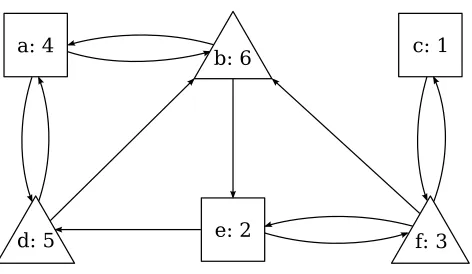
Figure 2.1 gives an example of a parity game. Whenever we draw a parity
game, we will represent the vertices belonging to player Even as boxes, and the
vertices belonging to player Odd as triangles. Each vertex is labeled by a name
followed by the priority that is assigned to the vertex.
The game begins by a token being placed on a starting vertex v0. In each
step, the player that owns the vertex upon which the token is placed must choose
one outgoing edge from that vertex and move the token along it. In this fashion,
the two players form an infinite path π = hv0, v1, v2, . . .i, where (vi, vi+1) ∈ E for
everyi∈N. To determine the winner of the game, we consider the set of priorities
that occurinfinitely often along the path. This is defined to be:
Inf(π) ={d∈N : For all j∈Nthere is ani > j such that pri(vi) =d}.
Player Even wins the game if the largest priority occurring infinitely often is even,
and player Odd wins the game if the largest priority occurring infinitely often is
odd. In other words, player Even wins the game if and only if max(Inf(π)) is even.
In Figure 2.1, the players could construct the pathha, b, eifollowed byhf, ciω.
The set of priorities that occur infinitely often along this path is{1,3}. Since 3 is
odd, we know that player Odd would win the game if the two players constructed
this path.
A strategy is a function that a player uses to make decisions while playing
a parity game. Suppose that the token has just arrived at a vertex v ∈ VEven.
Player Even would use his strategy to decide which outgoing edge the token should
be moved along. Player Even’s strategy could make its decisions using the entire
history of the token, which is the path between the starting vertex and v that the
players have formed so far. The strategy could also use randomization to assign a
probability distribution over which outgoing edge should be picked. However, we
history of the token, and they do make probabilistic decisions.
A positional strategy for Even is a function that chooses one outgoing edge
for every vertex inVEven. A strategy is denoted byσ :VEven→V, with the condition
that (v, σ(v)) is inE, for every Even vertex v. Positional strategies for player Odd
are defined analogously. The sets of positional strategies for Even and Odd are
denoted by ΠEven and ΠOdd, respectively. Given two positional strategies σ and τ,
for Even and Odd respectively, and a starting vertex v0, there is a unique path
hv0, v1, v2. . .i, where vi+1 =σ(vi) if vi is owned by Even and vi+1 =τ(vi) if vi is
owned by Odd. This path is known as the play induced by the two strategies σ
andτ, and will be denoted by Play(v0, σ, τ).
An Even strategy is called a winning strategy from a given starting vertex
if player Even can use the strategy to ensure a win when the game is started at
that vertex, no matter how player Odd plays in response. We define PathsEven :
V×ΠEven→2V
ω
to be a function that gives every path that starts at a given vertex
and is consistent with some Even strategy. If σ is a positional strategy for Even,
andv0 is a starting vertex then:
PathsEven(v0, σ) ={hv0, v1, . . .i ∈Vω : for all i∈N, ifvi ∈VEven
thenvi+1 =σ(vi), and ifvi∈VOdd then (vi, vi+1)∈E)}.
A strategy σ is a winning strategy for player Even from the starting vertex v0 if
max(Inf(π)) is even for every path π ∈ PathsEven(v0, σ). The strategy σ is said to
be winning for a set of vertices W ⊆ V if it is winning for every vertex v ∈ W.
Winning strategies for player Odd are defined analogously.
A game is said to be determined if one of the two players has a winning
strategy. We now give a fundamental theorem, which states that parity games are
determined with positional strategies.
be partitioned into two sets (WEven, WOdd), where Even has a positional winning
strategy for WEven, and Odd has a positional winning strategy for WOdd.
There are two problems that we are interested in solving for parity games.
Firstly, there is the problem of computing the winning sets (WEven, WOdd) whose
existence is implied by Theorem 2.1. Secondly, there is the more difficult problem of
computing the partition into winning sets, and to provide a strategy for Even that
is winning forWEven, and a strategy for Odd that is winning for WOdd.
In the example shown in Figure 2.1, the Even strategy{a7→b, e7→d, c7→f}
is a winning strategy for the set of vertices {a, b, d, e}. This is because player Odd
cannot avoid seeing the priority 6 infinitely often when Even plays this strategy. On
the other hand, the strategy {d7→ a, b7→ a, f 7→ c} is a winning strategy for Odd
for the set of vertices{c, f}. Therefore, the partition into winning sets for this game
is ({a, b, d, e},{c, f}).
2.1.2 Mean-Payoff Games
A mean-payoff game is similar in structure to a parity game. The game is played
by player Max and player Min, who move a token around a finite graph. Instead
of priorities, each vertex in this graph is assigned an integer reward. Formally, a
mean-payoff game is defined by a tuple (V, VMax, VMin, E,r) where V and E form
a finite graph. Once again, we assume that every vertex must have at least one
outgoing edge. The setsVMaxandVMinpartitionV into vertices belonging to player
Max and vertices belonging to player Min, respectively. The function r : V → Z
assigns an integer reward to every vertex.
Once again, the game begins at a starting vertex v0, and the two players
construct an infinite path hv0, v1, v2, . . .i. The payoff of this infinite path is the
average reward that is achieved in each step. To capture this, we defineM(π) =
lim infn→∞(1/n)Pni=0r(vi). The objective of player Max is to maximize the value
The definitions of positional strategies and plays carry over directly from the
definitions that were given for parity games. The functions PathsMax and PathsMin
can be defined in a similar way to the function PathsEven that was used for parity
games. We now define two important concepts, which are known as thelower and
the upper values. These will be denoted as Value∗ and Value∗, respectively. For
every vertexv we define:
Value∗(v) = max
σ∈ΠMax
min π∈PathsMax(v,σ)
M(π),
Value∗(v) = min
τ∈ΠMin
max π∈PathsMin(v,τ)
M(π).
The lower value of a vertex v is the largest payoff that Max can obtain with a
positional strategy when the game is started at v, and the upper value of v gives
the smallest payoff that Min can obtain with a positional strategy when the game
is started at v. It is not difficult to prove that, for every vertex v, the inequality
Value∗(v)≤Value∗(v) always holds. However, for mean-payoff games we have that
the two quantities are equal, which implies that the games are determined.
Theorem 2.2([LL69]). For every starting vertex v in every mean-payoff game we
haveValue∗(v) = Value∗(v).
This theorem implies that if a player can secure a certain payoff from a given
vertex, then that player can also secure that payoff using a positional strategy. Once
again, this implies that we only need to consider positional strategies when working
with mean-payoff games.
We denote thevalue of the game starting at the vertexvas Value(v), and we
define it to be equal to both Value∗(v) and Value∗(v). A Max strategy σ isoptimal
for a vertex v if, when that strategy is used for a game starting at v, it ensures a
payoff that is at least the value of the game at v. In other words, as strategy σ
is optimal for a vertex v if minπ∈PathsMin(v,σ)M(π) = Value(v). A Max strategy σ
strategies for Min are defined analogously.
There are several problems that we are interested in for mean-payoff games.
Firstly, we have the problem of computing the value of the game for every vertex.
Another problem is to compute an optimal strategy for the game for both players.
We can also solve mean-payoff games qualitatively. In this setting, Max wins if and
only if the payoff of the infinite path is strictly greater than 0. In this setting, a
Max strategyσis winning from a vertexvif minπ∈PathsMin(v,σ)M(π)>0, and a Min
strategyτ is winning from the vertexv if maxπ∈PathsMax(v,τ)M(π)≤0. A strategy
is said to be a winning strategy for a set of vertices W if it is a winning strategy for
every vertexv∈W.
The computational problem associated with the qualitative version of
mean-payoff games is sometimes called thezero-mean partition problem. To solve this we
must compute the partition (WMax, WMin) of the set V, where Max has a winning
strategy for WMax, and where Min has a winning strategy for WMin. An efficient
algorithm for the zero-mean partition problem can be used to solve the quantitative
version of the mean-payoff game efficiently: Bj¨orklund and Vorobyov have shown
that only a polynomial number of calls to an algorithm for finding the zero-mean
partition are needed to find the value for every vertex in a mean-payoff game [BV07].
Figure 2.2 shows an example of a mean-payoff game. Every time that we
draw a mean-payoff game, we represent the vertices belonging to player Max as
boxes, and the vertices belonging to player Min as triangles. One possible play in
this game would be ha, b, c, diω, and the payoff of this play is −6.25. An optimal
strategy for player Max is{a7→b, c7→e, e7→c}, and an optimal strategy for player
Min is{b7→a, d7→a}. The value of the game for the vertices in the set {a, b, d} is
the average weight on the cycle formed byaand b, which is−3.5, and the value of
the game for the vertices in the set{c, e}is the average weight on the cycle formed
by c and e, which is 0.5. The zero-mean partition for this mean-payoff game is
Figure 2.2: An example of a mean-payoff game.
2.1.3 Discounted Games
Discounted games are very similar to mean-payoff games, but with a different
def-inition of the payoff of an infinite path. Formally, a discounted game is defined by
a tuple (V, VMax, VMin, E,r, β), where the first five components are exactly the same
as the definitions given for mean-payoff games. In addition to these, there is also a
discount factor β, which is a rational number chosen so that 0≤β <1.
As usual, the game begins at a starting vertex v0, and the two players
con-struct an infinite pathhv0, v1, v2, . . .i. In a discounted game, the payoff of an infinite
path is the sum of the rewards on that path. However, for each step that the path
takes, the rewards in the game are discounted by a factor ofβ. Formally, the payoff
of an infinite path is defined to be D(π) = P∞i=0βir(vi). For example, if we took
the game shown in Figure 2.2 to be a discounted game with discount factor 0.5,
then the payoff of the pathhe, ciω would be:
With this definition in hand, we can again define the lower and upper values:
Value∗(v) = max
σ∈ΠMax
min π∈PathsMax(v,σ)
D(π),
Value∗(v) = min
τ∈ΠMin
max π∈PathsMin(v,τ)
D(π).
The analogue of Theorem 2.2 was shown by Shapely.
Theorem 2.3([Sha53]). For every starting vertex v in every discounted game we
haveValue∗(v) = Value∗(v).
Therefore, we define Value(v) to be equal to both Value∗(v) and Value∗(v),
and the definitions of optimal strategies carry over from those that were given for
mean-payoff games.
Some results in the literature, such as the reduction from discounted games
to the linear complementarity problem presented in Section 2.5.2, require a
differ-ent definition of a discounted game. In particular, the reduction considers binary
discounted games that have rewards placed on edges. A binary discounted game is
a discounted game in which every vertex has exactly two outgoing edges.
We introduce notation for these games. A binary discounted game with
rewards placed on edges is a tuple G = (V, VMax, VMin, λ, ρ, rλ, rρ, β), where the
set V is the set of vertices, and VMax and VMin partition V into the set of vertices
of player Max and the set of vertices of player Min, respectively. Each vertex has
exactly two outgoing edges which are given by the left and right successor functions
λ, ρ : V → V. Each edge has a reward associated with it, which is given by the
functionsrλ, rρ:V →Z. Finally, the discount factorβ is such that 0≤β <1.
All of the concepts that we have described for games with rewards assigned
to vertices carry over for games with rewards assigned to edges. The only difference
that must be accounted for is the definition of the payoff function. When the rewards
are placed on edges, the two players construct an infinite pathπ =hv0, v1, v2, . . .i
rewardshr0, r1, r2, . . .i, whereri =rλ(vi) ifλ(vi) =vi+1, andri=rρ(vi) otherwise.
The payoff of the infinite path is then D(π) =P∞i=0βiri.
At first sight, it is not clear how the two models relate to each other. Allowing
rewards to be placed on edges seems to be less restrictive that placing them on
vertices, but forcing each vertex to have exactly two outgoing edges seems more
restrictive. We will resolve this by showing how a traditional discounted game can
be reduced to a binary discounted game with rewards placed on edges.
We will first show that every discounted game can be reduced to a discounted
game in which every vertex has exactly two outgoing edges. This will be
accom-plished by replacing each vertex with a binary tree. Letkbe the largest out degree
for a vertex in the discounted game. Every vertex in the game will be replaced with
a full binary tree of depth⌈log2k⌉ −1, where each vertex in the tree is owned by
the player that ownsv, and each leaf of the tree has two outgoing edges. The root
of the tree is assigned the reward r(v), and every other vertex in the tree is assigned
reward 0.
For each incoming edge (u, v) in the original game, we add an edge fromuto
the root of the binary tree in the reduced game. For each outgoing edge (v, u) in the
original game, we set the successor of some leaf to beu. If, after this procedure, there
is a leafwthat has less than two outgoing edges, then we select some edge (v, u) from
the original game, and setuas the destination for the remaining outgoing edges ofw.
It is not a problem ifwhas two outgoing edges touafter this procedure, because we
use left and right successor functions in our definition of a binary discounted game,
rather than an edge relation. We then set the discount factor for the binary game
to be√lβ, wherel=⌈log
2k⌉.
We now argue that this construction is correct. Clearly, a player can move
from a vertex v to a vertex u in the discounted game if and only if that player can
move from v to u in our binary version of that game. Therefore, the players can
construct an infinite pathhv0, v0,1, v0,2, . . . , v0,⌈log2k⌉−1, v1, . . .iin the binary version
of that game, where each vertexvi is the root of a binary tree, and each vertexvi,j
is an internal vertex in the binary tree. To see that the construction is correct, it
suffices to notice that these two paths have the same payoff. The payoff of the first
path is r(v0) +β·r(v1) +. . ., and the payoff of the second path is:
r(v0) + l
p
β·r(v0,1) +· · ·+ (l
p
β)⌈log2k⌉−1·v
0,⌈log2k⌉−1·r(v0,2) + ( l p
β)lr(v1) +. . .
Since r(v0,i) = 0 for alli, and (√lβ)l=β, the two paths must have the same payoff.
From this, it follows that the two games must have the same value, and therefore
solving the binary game gives a solution for the original game.
We now argue that a discounted game with rewards placed on vertices can
be transformed into an equivalent game in which the rewards are placed on edges.
The reduction in this case is simple: if a vertexvhas rewardr in the original game,
then we set the reward of every outgoing edge ofvto ber in the transformed game.
This reduction obviously gives an equivalent game, because in both games you must
see a reward ofr if you pass throughv.
In summary, an efficient algorithm that solves binary discounted games with
rewards placed on edges can also be used to efficiently solve discounted games
spec-ified with the standard formulation. We will use this formulation when we describe
the reduction from discounted games to the linear complementarity problem in
Sec-tion 2.5.2, and in the work based on this reducSec-tion presented in Chapter 4.
2.2
Markov Decision Processes
Markov decision processes are similar to two player games, but with two important
differences. Firstly, a Markov decision process does not have two players. This could
be thought of as a game in which there is only one player. The second difference is
Figure 2.3: An example of a Markov decision process.
In the game setting, the vertices are connected by edges, and when the token is at
some vertex, then the owner of that vertex can choose one of the edges and move
the token along that edge. In the Markov decision process setting, the vertices are
connected by actions, and when the token is at some vertex, an action must be
chosen. The outcome of picking an action is not deterministic. Instead, each action
has a probability distribution over the vertices in the game. The vertex that the
token is moved to is determined by this probability distribution.
Formally, a Markov decision process consists of a set of vertices V, where
each vertexv∈V has an associated set of actionsAv. For a given vertexv∈V and
action a∈Av the function r(v, a) gives an integer reward for when the action ain
chosen at the vertexv. Given two verticesv andv′, and an actiona∈Av, p(v′|v, a)
is the probability of moving to vertexv′ when the actionais chosen in vertexv. This
is a probability distribution, soPv′∈V p(v′|v, a) = 1 for all v∈V and all a∈Av.
The MDPs that we will study actually contain a large number ofdeterministic
actions. An action a ∈ Av is deterministic if there is some vertex v′ such that
p(v′|v, a) = 1. For the sake of convenience, we introduce notation that makes
working with these actions easier. We will denote a deterministic action from the
vertexv to the vertex v′ as (v, v′), and the function r(v, v′) gives the reward of this
action.
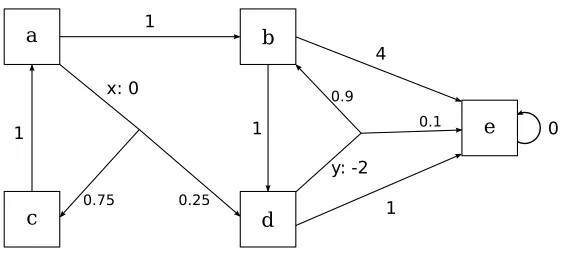
a Markov decision process, the vertices will be drawn as boxes, and the name of a
vertex will be displayed on that vertex. Actions are drawn as arrows: deterministic
actions are drawn as an arrow between vertices, and probabilistic actions are drawn
as arrows that split, and end at multiple vertices. Each deterministic action is
labelled with its reward. For probabilistic actions, the probability distribution is
marked after the arrow has split, and both the name of the action and the reward
of the action are marked before the arrow has split.
Strategies and runs for MDPs are defined in the same way as they are for
games. A deterministic memoryless strategy σ :V →As is a function that selects
one action at each vertex. If an action a is a deterministic action (v, u), then we
adopt the notation σ(v) =u for when σ chooses the action a. For a given starting
vertexv0, a run that is consistent with a strategyσis an infinite sequence of vertices
hv0, v1, v2, . . .i such thatp(vi+1|vi, σ(vi))>0 for all i.
There could be uncountably many runs that are consistent with a given
strategy. We must define a probability space over these runs. The set Ωχv0 contains
every run that starts at the vertex v0 and that is consistent with the strategy χ.
In order to define a probability space over this set, we must provide a σ-algebra of
measurable events. We define the cylinder set of a finite path to be the set that
contains every infinite path which has the finite path as a prefix. Standard results
from measure theory imply that there is a unique smallest σ-algebra Fvχ0 over Ω
χ
v0
that contains every cylinder set. Furthermore, if we define the probability of the
cylinder set for a finite path hv0, v1, v2, . . . vki to be Qki=0−1p(vi+1|vi, σ(vi)), then
this uniquely defines a probability measure Pχv0 over the σ-algebra Fvχ0 [ADD00].
Therefore, our probability space will be (Ωχv0,F
χ
v0,P
χ
v0). Given a measurable function
that assigns a value to each consistent run f : Ω→ R, we defineEχv0{f} to be the
expectation of this function in the probability space.
A reward criterion assigns a payoff to each run. In the total-reward criterion,
criterion, the payoff of a run is the average reward that is obtained in each step
along the infinite run. Thevalue of a vertex under some strategy is the expectation
of the payoff over the runs that are consistent with that strategy. Formally, the
value of a vertex v in the strategy σ under the total-reward criterion is defined to
be:
Valueσ(v) =Eσv{ ∞ X
i=0
r(vi, vi+1)}.
Under the average-reward criterion the value of each vertex is defined to be:
ValueσA(v) =Eσv{lim inf
N→∞
1 N
N
X
i=0
r(vi, vi+1)}.
Finally, for the discounted reward criterion a discount factor β is chosen so that
0≤β <1, and the value of each vertex is defined to be:
ValueσD(s) =Eσs{ ∞ X
i=0
βi·r(si, si+1)}.
For a given MDP, the computational objective is to find an optimal
strat-egyσ∗, which is the strategy that maximizes the optimality criterion for every
start-ing vertex: an optimal strategy will satisfy Valueσ(v)≤Valueσ∗(v) for every vertexv
and every strategyσ. We define the value of a vertex to be the value that is obtained
by an optimal strategy from that vertex. That is, we define Value(v) = Valueσ∗(v),
we define ValueA(v) = ValueσA∗(v), and we define ValueD(v) = ValueσD∗(v), for every
vertexv.
In the example shown in Figure 2.3 the strategy {a7→ x, b7→ e, c7→ a, d7→
y, e7→e} is an optimal strategy under the total reward criterion. The value of the
vertexaunder this strategy is 4.6. Under the average reward criterion, every vertex
will have value 0, no matter what strategy is used. This is because we cannot avoid
reaching the sink vertexe, and therefore the long term average-reward will always
2.3
The Linear Complementarity Problem
The linear complementarity problem is a fundamental problem in mathematical
optimisation. Given an n×n matrix M and an n-dimensional vector q, the linear
complementarity problem (LCP) is to find two n-dimensional vectors wand z that
satisfy the following:
w=M z+q, (2.1)
w, z ≥0, (2.2)
zi·wi = 0 fori= 1,2, . . . , n. (2.3)
We will denote this problem as LCP(M, q). The condition given by (2.3) is called
thecomplementarity condition, and it insists that for alli, either thei-th component
ofwis equal to 0 or thei-th component ofzis equal to 0. It is for this reason that we
refer towi and zi as being complements of each other. From the complementarity
condition combined with the non-negativity constraint given by (2.2) it is clear that
every solution to the LCP contains exactlyn non-negative variables and exactly n
variables whose value is forced to be 0. In LCP terminology, the non-negative
variables are called basic variables and the complements of the basic variables are
callednon-basic.
Before continuing, it must be noted that the system given by (2.1)-(2.3) may
not have a solution or it may have many solutions. However, we are interested
in a special case of the linear complementarity problem, where the matrix M is a
P-matrix. For every set α ⊆ {1,2, . . . n} the principal sub-matrix of M associated
withα is obtained by removing every column and every row whose index is not in
α. A principal minor ofM is the determinant of a principal sub-matrix of M.
Definition 2.4(P-matrix). A matrixM is a P-matrix if and only if every principal
In our work, we will always consider LCPs in which the matrix M is a
P-matrix. LCPs of this form have been shown to have the following special property.
Theorem 2.5 ([CPS92]). If the matrix M is a P-matrix then, for everyn
dimen-sional vector q, we have that LCP(M, q) has a unique solution.
A fundamental operation that can be applied to an LCP is apivotoperation.
This operation takes two variables wi and zj and produces an equivalent LCP in
which the roles of these two variables are swapped. In this new LCP, the variablezj
will be thei-th variable in the vectorw, and the variablewi will be thej-th variable
in the vectorz. To perform a pivot step, we construct a tableauxA= [I, M, q], that
is, a matrix whose first n columns are the columns of the n-dimensional identity
matrix, whose followingn columns are the columns of M, and whose final column
isq. Now, suppose that the variable wi is to be swapped with zj. The variable wi
is associated with the i-th column of A, and the variable zj is associated with
the (n+j)-th column of A. To perform this operation we swap the columns that
are associated with wi and zj. We then perform Gauss-Jordan elimination on the
tableaux A, which transforms the first ncolumns of A into an identity matrix and
the remaining columns into annby nmatrixM′ and anndimensional vector q′.
A matrix Mα and a vector qα, where α ⊆ {1,2, . . . , n}, are called a
prin-cipal pivot transform of M and q, if they are obtained by performing |α| pivot
operations, which exchange the variables wi and zi, for every i∈ α. Each solution
of LCP(Mα, qα) corresponds to a solution of LCP(M, q). If there is a solution of
LCP(Mα, qα) in which the variableswi = 0 for everyi∈β, and the variables zi= 0
for every i /∈β, then there is a solution to LCP(M, q) with wi = 0 for every i∈γ
andzi = 0 for everyi /∈γ, whereγ = (α\β)∪(β\α). Once we know which variables
should be set to 0, the system given by (2.1)-(2.3) becomes a system ofn
simulta-neous equations over n variables, which can easily be solved to obtain the precise
values of w and z. Therefore, to solve an LCP it is sufficient to find a solution to
This fact is useful, because some LCPs are easier to solve than others. For
example, a problem LCP(M, q) has atrivial solution if q≥0. Indeed, if this is the
case then we can setz= 0, and the system given by (2.1)-(2.3) becomes:
w=q,
w, z≥0,
zi·wi= 0 fori= 1, 2 . . . n.
Since q≥0 and z= 0, this can obviously be satisfied by setting w=q. This gives
us a naive algorithm for solving the problem LCP(M, q), which checks, for eachα⊆
{1,2, . . . , n}, whether LCP(Mα, qα) has a trivial solution. In our setting, whereM
is a P-matrix, there is guaranteed to be exactly one principal pivot transform ofM
andq for which there is a trivial solution.
2.4
Optimality Equations
Optimality equations are a fundamental tool that is used to study Markov decision
processes and infinite games. The idea is that the value of each vertex can be
characterised as the solution of a system of optimality equations. Therefore, to find
the value for each vertex, it is sufficient to compute a solution to the optimality
equations. Optimality equations will play an important role in this thesis, because
each of the algorithms that we study can be seen as a process that attempts to find
a solution of these equations.
In this section we introduce optimality equations for the average-reward
cri-terion in MDPs, and for mean-payoff and discounted games. We also show, for each
of these models, how the optimality equations can be used to decide if a strategy
is optimal. The key concept that we introduce is whether an action or edge is
switchable for a given strategy. A strategy is optimal if and only if it has no
studied in this thesis.
2.4.1 Optimality Equations For Markov Decision Processes
We will begin by describing the optimality equations for the average-reward criterion
in MDPs. In the literature, there are two models of average-reward MDP that are
commonly considered. In theuni-chainsetting, the structure of the MDP guarantees
that every vertex has the same value. This allows a simplified optimality equation
to be used. However, the MDPs that will be considered in this thesis do not satisfy
these structural properties. Therefore, we will introduce themulti-chain optimality
equations, which account for the fact that vertices may have different values. In the
multi-chain setting, we have two types of optimality equation, which must be solved
simultaneously. The first of these are called the gain equations. For each vertex v
there is a gain equation, which is defined as follows:
G(v) = max
a∈Av
X
v′∈V
p(v′|v, a)·G(v′). (2.4)
Secondly we have the bias equations. We defineMv to be the set of actions that
achieve the maximum in the gain equation at the vertexv:
Mv={a∈Av : G(v) =
X
v′∈V
p(v′|v, a)·G(v′)}.
Then, for every vertex v, we have a bias equation that is defined as follows:
B(v) = max
a∈Mv
r(v, a)−G(v) + X
v′∈V
p(v′|v, a)·B(v′)
!
. (2.5)
For this system of optimality equations, the solution is not necessarily unique. In
every solution the gain will be the same, but the bias may vary. It has been shown
that the gain of each vertex in a solution is in fact the expected average reward from
Theorem 2.6([Put05, Theorem 9.1.3]). For every solution to the optimality
equa-tions we have ValueA(v) =G(v), for every vertex v.
We will now describe how these optimality equations can be used to check
whether a strategyσ is optimal. This is achieved by computing the gain and bias of
the strategyσ, which can be obtained by solving the following system of equations.
Gσ(v) = X
v′∈V
p(v′|v, σ(v))·Gσ(v′) (2.6)
Bσ(v) = r(v, σ(v))−Gσ(v) + X
v′∈V
p(v′|v, σ(v))·Bσ(v′) (2.7)
It is clear that a strategy σ is optimal in the average-reward criterion if and only if
Gσ and Bσ are a solution to the optimality equations.
It should be noted that the system of equations given in (2.6)-(2.7) may not
have a unique solution, and this will cause problems in our subsequent definitions.
As with the optimality equations, for each strategy σ and each vertexv, there will
be a unique valueg such that Gσ(v) =g for every solution to these equations, but
Bσ(v) may vary between solutions. To ensure that there is a unique solution, we
add the following constraint, for every vertexv∈V:
Wσ(v) = X
v′∈V
p(v′|v, σ(v))·Wσ(v′)−Bσ(v). (2.8)
Adding Equation 2.8 to the system of equations ensures that the solutions of the gain
and bias equations will be unique [Put05, Corollary 8.2.9]. In other words, for every
vertexv there is a constant g such that every solution of Equations (2.6)-(2.8) has
Gσ(v) =g, and there is a constantbsuch that every solution of Equations (2.6)-(2.8)
hasBσ(v) =b. The solution of Equation (2.8) itself may not be unique.
Now suppose that the strategyσ is not optimal. We will define theappeal of
an actionaunder a strategyσ. To do this, we find the unique solution of the system
Gσ(v′), and we define the bias ofato beBσ(a) = r(v, a)−G(v) +P
v′∈V p(v′|v, a)·
B(v′). We then define the appeal of the actionato be Appealσ(a) = (Gσ(a), Bσ(a)).
We can now define the concept of a switchable action. To decide if an action
is switchable, the appeal of the action is compared lexicographically with the gain
and bias of the vertex from which it originates. This means that an action a∈Av
is switchable in a strategy σ if either Gσ(a) > Gσ(v), or if Gσ(a) = Gσ(v) and
Bσ(a)> Bσ(v).
Clearly, if σ has a switchable action then Gσ and Bσ do not satisfy the
optimality equations, which implies that σ is not an optimal strategy. Conversely,
if σ does not have a switchable action then Gσ and Bσ must be a solution to the
optimality equations. Therefore, we have the following corollary of Theorem 2.6.
Corollary 2.7. A strategy σ is optimal if and only if it has no switchable actions.
2.4.2 Optimality Equations For Games
We now introduce the optimality equations for two player games. We begin by
describing a system of optimality equations for discounted games. For each vertexv,
the optimality equation forv is defined to be:
V(v) = min
(v,u)∈E(r(v) +β·V(u)) if v∈VMin,
V(v) = max
(v,u)∈E(r(v) +β·V(u)) if v∈VMax.
Shapley has shown the following theorem.
Theorem 2.8 ([Sha53]). The optimality equations have a unique solution, and for
every vertexv, we have Value(v) =V(v).
If σ is a strategy for Max and τ is a strategy for Min, then we define
Valueσ,τ(v) =D(Play(v, σ, τ)) to be the payoff that is obtained when Max plays σ