EHR Requirements
David LLOYD and Dipak KALRA
CHIME – Centre for Health Informatics and Multiprofessional Education, University College London N19 5LW, by email: [email protected].
Abstract. Published requirements for the EHR are available principally via ISO 18308. They are statements defining the generic features necessary in any
Electronic Health Record for it to be communicable and complete, retain integrity across systems, countries and time, and be a useful and effective ethico-legal record of care. Examples of requirements are provided in four themes: •EHR functional requirements; Ethical, legal, and security requirements; Clinical requirements; Technical requirements. The main logical building blocks of an EHR are described using the terminology of CEN TC251 ENV13606. Examples are given of the placement of attributes to satisfy contextual and other requirements at the level of specific building blocks. A worked example of the use of the building blocks is given for the request-report cycle for an imaging investigation.
1. Introduction
This paper provides an introduction and overview of published requirements for the Electronic Health Record (EHR). It is not meant to be exhaustive, but presents the major requirements affecting the architecture of an EHR, organised by themes. Any Reference model of the EHR must place attributes and other architectural features at appropriate levels of the model in order to satisfy the requirements. This process is illustrated by a number of examples of how this might be done, including a worked example.
2. Definition
EHR Requirements referred to in this paper are statements defining the generic features necessary in any Electronic Health Record for it to be communicable and complete, retain integrity across systems, countries and time, and be a useful and effective ethico-legal record of care. Their goal is the specification of a conceptual model of the information in any Electronic Health Record. These requirements do not dictate what specific health-related information must be contained in a record. Nor do they dictate how any Electronic Health Record system is implemented. (Adapted from EHCR-SupA [1] )
3. Sources
Collated and classified sets of requirements have been published through the EHCR-SupA project [1] and by ISO 18308 [2], and a classification of requirements and a set of Design Principles by openEHR [3].
Formal methodologies exist for specifying requirements. For example the IEEE Standard 830 [4] asserts that requirements statements should be verifiable; traceable; unambiguous; correct; and relevant.
4.EHR functional requirements
Many of the detailed requirements for an EHR build on a fundamental functional understanding of what an EHR is intended to achieve, whether implemented as a
middleware service or as a sub-component of a healthcare information system. The EHR must enable the communication of healthcare information to support shared patient care, improved quality of care and effective resource utilisation. This includes the support of evidence-based care, and the rich ability to navigate and analyse EHRs for a wide range of purposes. Users must be able to access health record information from whichever system and in whatever format it is originally stored
5. Ethical, legal, and security requirements themes
The following list of provides an overview of the ethical, legal and security themes for which formal requirements statements have been defined.
• Subject access rights
• Confidentiality and access control
• Emergency over-ride • Audit trails
• Unambiguous identification of patients
• User Authentication
• Fulfilling the role of the record • Faithful reflection of clinical practice • Authorship of health record entries
• Identifying third parties, students
• Identifying healthcare and patient locations
• Dates and times of health care, and of recording EHR entries
• The amendment of health record entries
5.1 Example – Emergency override
o The EHR service must accommodate the over-riding of normal access rights in a medical emergency situation
o Emergency over-ride exceptions must be explicitly documented within the EHR service itself (for example, specifically labelled within the audit trail) to support subsequent investigation
o It must be possible for an authorised user to create or update a record entry, but impossible to alter an original entry
o Each version of an entry must document the amending responsible healthcare professional and an amendment date and time
o Data subjects (patients) must be able to make or to authorise amendments to their health record to correct errors, including amendments to the disclosure policy for entries
6. Clinical requirements themes
Similarly, there are many published requirements specifying features of an EHR that are required to support the clinical care process and its documentation. Very many of these, particularly those found in journal papers and conference proceedings, are specific to a the particular domain or specialty which was the focus of the authoring project or team. Those involved in defining generic EHR requirements have needed to distil these domain-specific requirements into generic statements. The following list indicates the areas in which such work has been done.
The information in a health record is inherently hierarchical.
• Clinical observations, reasoning and intentions can have a simple or a more
complex structure
• They are generally organised under headings, and contained in “documents” such as consultation notes, letters and reports
• These documents are usually filed in folders
• A patient may have more than one folder within a healthcare enterprise (e.g. medical , nursing, obstetric)
The Electronic Health Record needs to reflect this hierarchical structure and organisation. Other areas of context pertaining to single or to sets of clinical statements that need to be represented include information about the clinical reasoning process, links within and between patient records and references to externally-held medical knowledge (including guidelines that have informed the care process). The data values of clinical observations, inferences or intentions might need to represented in any of several different kinds of data type, including:
o narrative text
o coded terms
o quantities and numeric data
o reference ranges
o time and other sequences
o graphical and multimedia data
6.1 Example – Textual Entries
o Term set entries must always be retained with their original codes, and any mapping to other term sets must always be from this original
6.2 Example – Entry Structure and Support for Evidence-based Care
o The EHR must preserve the original organisation of compound clinical concepts, headings and any other hierarchies, and any defined relationships between record entries such as process status
o Authors must be able to record the rationale for clinical decisions, including references to protocols, knowledge databases, bibliographic references or decision support systems used for patient care decisions
7. Technical requirements for EHR services, systems, messages – themes
The technical requirements often included within requirements publications are difficult to generalise to any potential EHR implementation as they are often expressed in terms of the technology envisaged by the authoring project or team. However, there are a small number of themes that are probably generalisable to any kind of implementation, and are mentioned here for completeness. A specification for the information model of an EHR would
probably not explicitly demonstrate conformance in these areas.
• Information models for messages
• Conformance to international standards
• Record server and persistence, Interfaces and services • Performance and Concurrent use
• Version control
• Exceptions and Errors
8. EHR Context Requirements
The EHR
The electronic health record for one personFolders
High-level organisation of the EHRe.g. per episode, per clinical specialityCompositions
Set of entries committed at one date/timee.g. progress note, report, letter, test resultHeaded Sections
Clinical headings reflecting the workflowand consultation/reasoning processClusters
Compound entriese.g. blood pressure, full blood count
Items
Element entriese.g. reason for encounter, body weight
Data values
e.g. Coded terms from term sets, measurements with unitsThe EHR
The electronic health record for one personFolders
High-level organisation of the EHRe.g. per episode, per clinical specialityCompositions
Set of entries committed at one date/timee.g. progress note, report, letter, test resultHeaded Sections
Clinical headings reflecting the workflowand consultation/reasoning processClusters
Compound entriese.g. blood pressure, full blood count
Items
Element entriese.g. reason for encounter, body weight
Data values
e.g. Coded terms from term sets, measurements with unitsThe EHR
The electronic health record for one personThe EHR
The electronic health record for one personFolders
High-level organisation of the EHRe.g. per episode, per clinical specialityFolders
High-level organisation of the EHRe.g. per episode, per clinical specialityCompositions
Set of entries committed at one date/timee.g. progress note, report, letter, test resultCompositions
Set of entries committed at one date/timee.g. progress note, report, letter, test resultHeaded Sections
Clinical headings reflecting the workflowand consultation/reasoning processHeaded Sections
Clinical headings reflecting the workflowand consultation/reasoning processClusters
Compound entriese.g. blood pressure, full blood count
Clusters
Compound entriese.g. blood pressure, full blood count
Items
Element entriese.g. reason for encounter, body weight
Items
Element entriese.g. reason for encounter, body weight
Data values
e.g. Coded terms from term sets, measurements with unitsData values
e.g. Coded terms from term sets, measurements with unitsFigure 1 Logical Building Blocks of the EHR
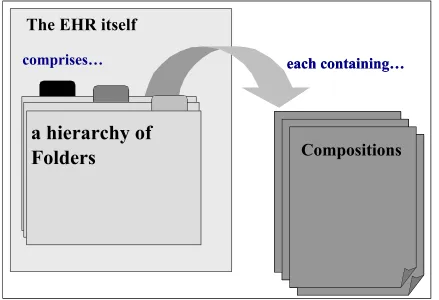
The EHR itself
comprises…
a hierarchy of
Folders
each containing…
Compositions
The EHR itself
comprises…
a hierarchy of
Folders
each containing…
Compositions
The EHR itself
The EHR itself
comprises…
a hierarchy of
Folders
each containing…
Compositions
8.1 Context Attributes for Any Component in the EHR
• Component identification
o UID/OID
• Component clinical meaning
o –Name used by user/application/feeder
o –Archetype ID (or archetype fragment)
• Access Control
o –Sensitivity level for any component
o –Need to support role-based access
8.2 Context Attributes at the EHR level
• Identity of the subject of care (the patient) • ID of this electronic record
• ID of the owning organisation (the data controller)
8.3 Context at the Folder Level
The Folder provides an high-level organisation of Compositions within an EHR
• Folders may contain other Folders
• Many to many containment of Compositions by reference permits Compositions to
be referenced by more than one Folder, although every Composition has its original context in just one Folder.
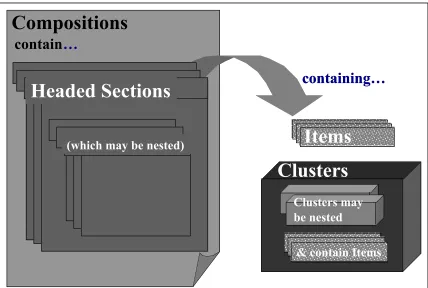
Clusters
Compositions
containing…
Headed Sections
(which may be nested)
Items
contain
…
Clusters may be nested
& contain Items
Clusters
Compositions
containing…
Headed Sections
(which may be nested)
Headed Sections
Headed Sections
(which may be nested)
(which may be nested)
Items
contain
…
Clusters may be nested
& contain Items
8.4 Context Attributes at the Composition Level
The Composition provides the medico-legal unit of committal in the EHR
• When committed, where, by whom
It also provides the clinical session context
• When the care activity took place
• Which care facility, as part of what service and at which location • Which clinician was in charge of the care
Attestation takes place at the Composition level:
• attested by whom, and when
• optionally include or reference the "signed proof" of attestation • optional additional co-attesters
• e.g. for legal documents
Attestation status may be required, or not required for some Compositions The Composition is the unit of revision in an EHR. Each version states
• revision status (original, correction, for attestation, etc.) • why revised
• ID of preceding versionIf the Composition is acquired from another clinical or EHR system:
• the original version's committal information • identity of the originating EHR system
• details about its acceptance into the receiving record system o when, by whom etc.
8.5 The “Contribution”
A Contribution to the EHR comprises all the Compositions created or amended at one record interaction session. It references all changes and updates made in that EHR during that session
• e.g. addition of a “new consultation” Composition
o and an update to a repeat medication list Composition elsewhere in the EHR
8.6 Context at the Headed Section level
The Headed Section provides an optional hierarchy of informal containment within the Composition.
8.7 The Entry Concept
Information in an entry may be about someone other than the patient (e.g. relative) Information in an entry may have been provided by someone else
Information in an entry may have originated at a date/time different from the care activity
or its recording9.8 The Entry for representing the clinical reasoning process
The Entry, being any combination of (simple) Items and (more complex) Clusters, is the level at which the reasoning process behind the inclusion of a ‘clinical statement’ may be captured. Foe example:
• if an observation or conclusion is uncertain
• if an observation or conclusion is unusual, abnormal or unexpected • –if an observation or conclusion is not the actual state of the patient
o e.g. at risk of, goal, prognosis, negated, excluded
• –Act/process status
o e.g. requested, performed, reported, cancelled
• explanation of reasoning/actions • guideline reference
• reference to published knowledge
9. Structured Data – the Cluster
• Complex entries may, for example, be measurements, test results or treatment
instructions.
o These may need to be represented as a list, table, a tree or a time series.
o Time series might be absolute times or relative to an origin the data at each time point might themselves be complex
o Some time series might have regular intervals, or be intermittent 'bursts"
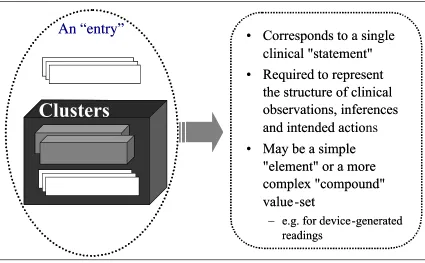
Figure 4 The Entry
• Corresponds to a single
clinical "statement"
• Required to represent
the structure of clinical
observations, inferences
and intended actions
• May be a simple
"element" or a more
complex "compound"
value-set
– e.g. for device-generated readings
• Corresponds to a single
clinical "statement"
• Required to represent
the structure of clinical
observations, inferences
and intended actio
• May be a simple
"element" or a more
complex "compound"
value-set
– e.g. for device-generated readings
Clusters
Items
An “entry”
Clusters
Clusters
Items
Items
• The Cluster structure can contain other Clusters and/or Items (which cn only take a
single value)
10. Links between Components
Links may be required between any two record components
• e.g. to indicate cause and effect
• e.g. to track the evolution of orders from request to completion
These might need to form linkage networks
• e.g. for clinical problems
• e.g. for clinical or service episodes
11. Data Types
The Item is the leaf node containing a single data value, which may be:
• –text • –numeric
• –date/time
• –person/software/agent ID • –graphical
• –other MIME type
o •e.g. image, signal
Each of these data types has its own context model. For example: Text Data Values
• Narrative; Coded terms, and the original rubric as seen by the author; Qualifiers;
Term sets, versions, registering agencies; Narrative text with "marked up" codes, hyperlinks.
Numeric Data Values
• Quantities, ranges and ratios; Accuracy and precision; Units; Reference ranges
Date / Time Data Values
• Dates; Times; Dates and Times • Date and time intervals
o including imprecisely specified dates and times _ e.g. May 1963
_ not the AI equivalent of “fuzzy dates”; e.g. a Tuesday in May; e.g. three months after the baby is born
_ (these can be represented by free text expressions
12. A Clinical Example - requesting and reporting a CT scan
Stage 1:
A GP sees a patient, John Jones, examines him, and makes a plan including a request for a CT scan of the chest.
The GP opens John Jones’ EHR and composes a ‘contact’ Composition. This will include an entry recording the details of the request for a CT scan, maybe contained in a Headed Section. He may also compose other entries under separate Headed Sections to capture other aspects of the Consultation.
Having chosen a suitable Folder (maybe his Practice folder) for the Composition, he commits it to the EHR.
The Workflow activities of the GP and Hospital now come into play, and John Jones eventually arrives at the Radiology department.
Stage 2:
The Radiologist considers the request for the CT scan and decided that he needs more clinical information. He opens John Jones’ EHR and uses a query tool to find, say, current medication, and any allergies that John Jones may have. He decides the parameters of the test and instructs the Radiographer to carry it out. The Radiographer stores the raw images from the investigation in the PACS.
Stage 3:
The Radiologist uses his sophisticated imaging workstation to view and manipulate the raw images. He composes a report for the GP and produces an illustrative image (which may be just part of one of the raw images) to accompany. He puts all this data into a ‘results’ Composition in, say, the ‘Imaging Results’ folder of John Jones’ EHR. He adds a link to associate the request with the result, and may also insert a URL reference to where the full set of images for the current investigation are stored on the PACS. Having finished composing the Composition, he commits it in his name to John Jones’ EHR.
Depending on the workflow arrangements in place, the Radiologist might send a message (external to the EHR) to the GP informing him of the availability of the results.
13. Conclusions
• Comprehensive, clearly expressed requirements are essential:
o As a starting point for the modelling of EHRs
o As a reference against which to check: Reference models of the EHR Implementations of EHR systems.
• EHR requirements are becoming agreed internationally through ISO 18308.
14. References
1. EHCR-SupA Deliverable 1.4: Consolidated List of Requirements
http://www.chime.ucl.ac.uk/work-areas/ehrs/EHCR-SupA/del1-4v1_3.PDF 2. ISO 18308 "Requirements for an Electronic Health Record Reference Architecture"
http://www.openehr.org/standards_iso.htm 3. Design Principles for the EHR
http://www.openehr.org/Doc_html/Model/Principles/design_principles.htm