http://wrap.warwick.ac.uk/
Original citation:Liu, Shuangyan, Joy, Mike and Griffiths, Nathan (2008) Incorporating learning styles in a computer-supported collaborative learning model. In: International Workshop on
Cognitive Aspects in Intelligent and Adaptive Web-based Education Systems (CIAWES 2008), Taipei, Taiwan, 27-31 Oct 2008 pp. 3-10.
Permanent WRAP url:
http://wrap.warwick.ac.uk/60724
Copyright and reuse:
The Warwick Research Archive Portal (WRAP) makes this work by researchers of the University of Warwick available open access under the following conditions. Copyright © and all moral rights to the version of the paper presented here belong to the individual author(s) and/or other copyright owners. To the extent reasonable and practicable the material made available in WRAP has been checked for eligibility before being made available.
Copies of full items can be used for personal research or study, educational, or not-for-profit purposes without prior permission or charge. Provided that the authors, title and full bibliographic details are credited, a hyperlink and/or URL is given for the original metadata page and the content is not changed in any way.
A note on versions:
The version presented in WRAP is the published version or, version of record, and may be cited as it appears here.For more information, please contact the WRAP Team at:
Incorporating Learning Styles in a
Computer-Supported Collaborative Learning
Model
Shuangyan Liua, Mike Joya, Nathan Griffithsa
a
Department of Computer Science, University of Warwick, UK
Abstract: Collaborative learning enables individual learners to combine their own expertise, experience and ability to accomplish a mutual learning goal. The grouping of learners, and learning from social interactions with peer-learners, are two basic characteristics of collaborative learning. For individual learners to benefit from collaborative learning, individual learners with different characteristics must be grouped together. In this paper, we propose a computer-supported collaborative learning model which incorporates learning styles for improving collaborative learning. The proposed model is novel since it can provide overall support for collaborative learning. In addition, the way we have incorporated learning styles in the model is a new approach to constituting heterogeneous groups containing learners with dissimilar learning styles and detect learning styles through monitoring collaborative interactions.
Keywords: Collaborative learning, group formation, monitoring collaborative interaction, learning styles, computer-supported collaborative learning model
Introduction
Collaborative learning contrasts with the traditional ‘direct transmission’ model of learning in which learners are passive, isolated receivers of knowledge delivered by instructors [1]. The term collaborative learning is used in various contexts supported by different theoretical approaches, leading to different understandings of the phrase. Norton and Wiburg emphasize the grouping in collaborative learning [2], and regard the goal of collaborative learning as being either for learners to combine expertise to accomplish a mutual goal or for more expert learners to teach others. More experienced and skilled learners are able to demonstrate to less experienced and skilled learners how they think and learn. Roschelle and Teasley focus more on the nature of interaction in collaborative learning, and define collaboration as a coordinated, synchronous activity in which learners attempt to construct and maintain a shared conception of a problem [3]. Lipponen, on the other hand, summarizes the definitions of collaborative learning as being an interaction which emphasizes the co-construction of knowledge and mutual engagement of learners [4]. Although there are different opinions about what collaborative learning is, these views reveal that grouping learners, and the process of learning from interactions with peer-learners, are the basic characteristics of collaborative learning as an instructional approach.
their instructional design. Groups can be formed for different purposes. Student project groups for computer science courses are an example of task groups, which are formed to solve a specific problem. Student reading groups for language learning courses are an example of learning groups, which are formed mainly to enable learners to practice for a particular course assignment with no specific problem to solve (e.g. improving the speaking ability in English in front of other learners). Groups can either be homogeneous or heterogeneous. Many advocates of collaborative learning strive for heterogeneous groups. One of the most important reasons is that heterogeneity naturally produces controversy more frequently [16]. This is consistent with literature on constructive controversy [29].
In traditional class mode educational settings, instructors usually let learners self-select their partners or randomly assign the groups. However, there are still many problems with these approaches. Self-selected groups are usually formed based on friendship rather than for educational reasons [5]. This can raise group tensions (if friendships impact on how much work is done by various group members) and heterogeneous groups are often avoided. Randomly assigned groups can increase the likelihood of heterogeneous groupings, but it does not ensure that learners are grouped according to their individual needs. Constraints such as large class size and time limitation prohibit the instructors from forming effective groups. More recently, intelligent educational systems provide various solutions for the group formation process [6,7,8,9].
In recent years, increasing numbers of researchers have incorporated learners’ characteristics such as learning styles and cognitive traits into their adaptive learning systems [17,18], and among those learner characteristics, learning styles are considered as providing valuable information [19,20]. Learning styles have been identified as an important learner characteristic which can be used to improve adaptive collaborative activities, e.g. in TANGOW [21] and CITS [9]. These studies revealed that learning styles can be a valuable tool for grouping learners for collaborative learning activities.
Another important issue in successful collaboration work is how to enable learners to gain educational benefits from the social interactions between them. Resta and Laferriere [10] noted that social interaction is an important source of cognitive advancement in collaborative learning. Not only can individual learners build up self-esteem from their learning interactions [11], but they can also compare, clarify and justify their own ideas by interacting with their peers [12]. Analysis of social interaction yields additional information, such as patterns of peer interaction and communication, and various indications of the success of the collaborative learning processes can be obtained from a social interaction analysis. For example, Suh et al.’s study [13] about the impact of a learner’s prior knowledge and personal intelligences on their learning outcomes in collaborative learning provides important indications for further development of collaborative learning tools.
How to incorporate learning styles in computer-supported collaborative learning is still a research question. One of the contributions of our research is proposing a new model to support collaborative learning, and incorporating learning styles for forming collaborative learning groups in the model. The proposed model has the advantage of providing overall support for collaborative learning. The conceptual basis for the model and the mechanism for automatically grouping individual learners based on their learning styles are emphasized. The method of incorporating learning styles for forming collaborative learning groups is currently being evaluated.
1.1 Background
Our model for supporting collaborative learning is based on an investigation of recent work in Computer Supported Collaborative Learning (CSCL) relating to support for learners’ cognitive advancement in collaborative learning [14]. The investigation focused on three areas in CSCL. First, we compared and analyzed representative theories, software tools and techniques for scaffolding social interaction. Current software systems are not able to provide support for structuring the collaborative learning process, and we identified that social interaction theory could provide us with the educational and sociological fundamentals for structuring social interactions in the collaborative learning process. Second, we considered building collaborative knowledge. Three important aspects in the use of technology to enhance collaborative knowledge were identified: individual reflection, quality group interaction, and contextual resources. These aspects were incorporated in the design of the ‘supporting collaborative learning activity’ component in the proposed model. Third, we investigated two aspects of assessing collaborative learning – the assessment of learning outcomes and the assessment of collaborative process. Various educational approaches and tools to assess learning outcomes, and different techniques to analyze collaborative process were investigated for our study. Methods and techniques for assessment of collaborative learning are incorporated in our model, which enables it to combine both the learning and assessment processes for supporting collaborative learning.
The investigation indicated several problems that our model should address, including: 1) how to describe learners in a way that is meaningful to the collaborative learning activities; 2) how to structure the collaborative learning process for individual learning groups; 3) how to monitor the interactions between learners.
Our model thus aims to specify the fundamental components of a collaborative learning tool which can provide overall support for describing learners, structuring the learning process and monitoring collaborative interactions. It also aims to address different elements for the design of CSCL tools and their functions to support the fundamental components of the proposed collaborative learning tool. The concrete implementation of the model and its advantages over other existing models are discussed in [14].
1.2 Components of the Model
We define collaborative learning to be a group of learners collaborating together to accomplish a learning activity. The learning activity consists of either problem-solving based tasks or general learning tasks to improve a certain skill of the learners. In such a learning activity, learners may be reluctant to share their experiences and knowledge, and the social interactions between the learners mainly support the collaborative process.
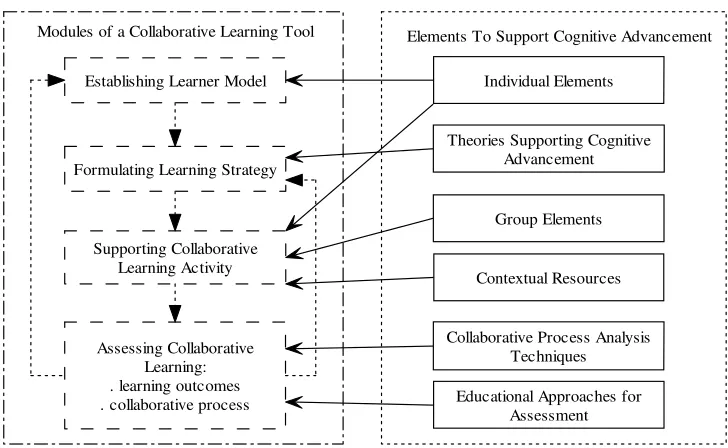
Our model (Figure 1) comprises two components: the fundamental modules that a collaborative learning tool consists of, and the various elements to support cognitive advancement which the investigation has identified [14].
Establishing Learner Model
Formulating Learning Strategy
Supporting Collaborative Learning Activity
Modules of a Collaborative Learning Tool
Assessing Collaborative Learning: . learning outcomes . collaborative process
Individual Elements
Group Elements Theories Supporting Cognitive
Advancement
Contextual Resources
Educational Approaches for Assessment Collaborative Process Analysis
Techniques
[image:5.595.115.479.69.293.2]Elements To Support Cognitive Advancement
Fig 1. A Model to Support Collaborative Learning
The established learner model is adopted as a reference for generating the learning strategy for an individual learning group; the formulated learning strategy provides guidance for the group to carry out the collaborative learning activities; the learners’ actions in the group interactions are used as evidence for assessing the collaborative process; the results of the assessment are used to fine-tune the learner model.
In Figure 1, there are six groups of design elements which support the functioning of the modules of the proposed collaborative learning tool. Individual elements are personal characteristics or behaviors of a learner which are the ways that the learners interact with the system, and group elements are group members’ interaction patterns of learning processes (e.g. communicative functions of conversational messages such as informative, elaborative and argumentative). Contextual resources are beliefs or assumptions about the topic for a given task and group members’ previous discourses, and educational approaches for assessment are different types of methods for assessing the learning effects. Collaborative process analysis techniques include contents analysis, social network analysis, the analysis of computer-generated quantitative log files, and theories supporting cognitive advancement include social interaction theory for collaborative learning.
The six groups of design elements operate on different modules in the proposed collaborative learning tool and they are indirectly connected in the sense that these function modules interact.
Our model to support collaborative learning is extensible in the sense that new design elements can be added to the model and new functional modules can also be added to the proposed tool.
1.3 Incorporating Learning Style in the Model
• In the first stage, mechanism is determined with regard to the learning styles of individual learners. Default rules are provided, and the course designer can specify rules with different criteria for an individual collaborative learning activity.
• In the second stage, the mechanism for grouping learners is extended to incorporate the social relations between learners as a primary criterion. During this stage, learners’ trust and reputation based on previous collaboration experiences are considered.
In this paper, we address the first stage, i.e. the mechanism for grouping with regard to the learning styles of individual learners. From the perspective of the proposed model, we will cover parts of the second and the fourth modules in the following sections, i.e. the forming of optimal collaborative learning groups for individual learners based on their learning styles and the detecting of learning styles through monitoring collaborative interactions. The modules for establishing learner model and supporting collaborative learning activity are beyond the scope of this paper.
2. Forming Collaborative Learning Groups based on Learning Styles
2.1 The Mechanism for Grouping
Our mechanism for the system to automatically group individual learners for a particular collaborative learning activity is based on learning style modeling, and the grouping rules specify the criteria and algorithms for dividing a set of learners into groups. The users of our system are learners involving in a particular course, and the course designer has specified one or more collaborative learning activities. Learners’ learning styles are incorporated in the system through learning style modeling, and the results of the modeling, i.e. representations of the learners’ learning styles, are combined with the grouping rules for assigning the learners into groups. Default rules are provided, which the course designer can alter. The modeling of learning styles and grouping rules are introduced in the following sections.
The assumption that guides the design of our mechanism for grouping individual learners based on their learning styles is that heterogeneous groups (in which learners are with dissimilar learning styles) can outperform homogeneous groups, as stated in the case studies Alfonseca et al. [15] and Sao Jose de Faria et al. [16]. Alfonseca et al. stated that the mean score of the mixed pairs is the highest among pairs in the active-reflective dimension of learning styles for the collaborative work assigned. Sao Jose de Faria et al. provide evidence [16] that heterogeneous groups (containing students with dissimilar programming styles) can have a higher increase of scores both for students with an initial high score and for students with a low initial score than homogeneous groups. As a consequence, the default grouping rule is based on combining learners with different learning styles.
2.2 Learning Style Modeling
We adopt the Felder and Silverman model, which categorizes a learner’s learning styles on five dimensions: active-reflective, sensing-intuitive, sequential-global, inductive-deductive, and visual-verbal [22]. The main reason we choose this model is that it has been successfully applied for adaptive individual learning [18,19,23]. Moreover, this model provides a sliding scale for classifying learners’ learning styles which is more flexible than other bipolar models [27, 28].
inductive-deductive dimension is not incorporated in the questionnaire for pedagogic reasons, and therefore the results of the questionnaire are four scores (odd numbers between -11 and 11), one for each of the remaining four dimensions.
For classifying the learners, the score for each dimension is divided into three categories, according to [15]: positive (P) — the score is higher or equal to 5 indicating the learner belongs to one of the dimensions respectively: active, sensing, sequential and visual;
medium(M) — the score is between -3 and 3 indicating the learner is either centered or has a mild tendency towards one of the sides; and negative (N) — the score is lower than or equal to -5 indicating the learner belongs to one of the dimensions correspondingly: reflective, intuitive, global and verbal.
Therefore, the learning styles of an individual learner can be described as (P/M/N, P/M/N, P/M/N, P/M/N) on the four dimensions of Felder and Silverman model (active-reflective, sensing-intuitive, sequential-global, visual-verbal).
2.3 Grouping Rules
A grouping rule consists of the criteria for grouping and the algorithm for assigning learners with different learning styles into groups. The criteria include the number of learners per one group, the dimension(s) of the Felder and Silverman model adopted for grouping, and the percentages of the three categories of scores (i.e. positive, medium, negative) for composing an individual group. These criteria are combined in our algorithm for assigning individual learners. The default criteria are defined as follows.
• The number of learners for each group is set to three. Wessner and Pfister [6] suggest that three to five learners is an appropriate size for group activity, and the course designer can change this value to four or five for a specific collaborative learning activity.
• The active-reflective dimension is selected to be incorporated in the grouping algorithm. The active-reflective dimension is more relevant than others with respect to the outcome of the collaborative task as addressed in Alfonseca’s study [15] – mixed groups in the active-reflective dimension get better scores than mixed groups in other dimensions. The course designer can also choose another dimension for a specific learning activity. • The sum of the group scores on the active-reflective dimension should be close to the
median value of the group members in order to keep a balance of active learners and reflective learners in an individual group. The course designer can also adjust the percentages of the three categories of scores for a particular learning activity.
Suppose L is the set of learners. The algorithm combining the default criteria for assigning learners with different learning styles according to the active-reflective dimension:
1. Initialize: create a set of n empty groups G; the value of n is determined by the total number of learners and the number of learners per group (i.e. Three); If there is a remainder m (m may be one or two), randomly pick m learners from L and forward to Step 4.
2. Order all the learners from positive score to negative score (e.g. P, P, M, M, M, N, N, N, N); randomize learners with the same type of scores; divide them into three segments from positive side to negative side (P, P, M; M, M, N; N, N, N).
3. For each group g in G,
1. randomly assign a learner from the first segment; 2. randomly assign a learner from the second segment; 3. randomly assign a learner from the third segment.
3. Detecting Learning Styles Through Monitoring Collaborative Interaction
We define the detection of learning styles as the procedure to fine-tune the learning styles through monitoring collaborative interactions between learners in the learning process. In our proposed model to support collaborative learning, the learners’ learning styles are initially acquired through the ILS questionnaire. However, these results are not fully reliable as it is reported that about 75% to 90% of the time people come out with three or four type preferences [26]. There may be discrepancy between the questionnaire results and the real values. Moreover, learners’ learning styles may change [30]. The fine-tuning of learning styles can ensure the evaluated values are accurate.
Our method for detecting learning styles is based on the information obtained from monitoring the collaborative interactions between learners after a collaborative learning activity is complete. Our collaborative learning tool adopts content analysis techniques [25] to infer various interaction patterns from chat transcripts (which are web pages in our system). Certain patterns are applied for re-evaluating each dimension of the learning style model. For example, interaction patterns such as the number and the types of messages sent by individual learners in chats are used for identifying learners’ preferences on the active-reflective dimension.
Due to the active-reflective dimension being selected as the default criterion in our grouping algorithm, our approach for re-evaluating the learning styles from the identified interaction patterns is specific to the active-reflective dimension. However, the approach may prove to be valid for other dimensions. The basic concept of this approach is to calculate the learning style using a similar method to the ILS questionnaire and represent the learning style on a 3-point scale of positive / medium / negative.
The detected learning styles are then compared with the learning styles stored in the learner model. If they do not match the learning styles stored in the learner model, our collaborative learning tool will update the values of the learning styles in the learner model.
4. Conclusion
In this paper, we have described a novel model to support collaborative learning, which incorporates learning styles. Learning styles are taken into account by automatically forming heterogeneous collaborative learning groups and monitoring collaborative interactions. In addition to the implementation of the proposed model, future work includes evaluating the method of incorporating learning styles for group formation.
References
[1] De Corte, E. (1996). Instructional psychology: overview. In De Corte, E. & Weinert, F.E. (Eds.)
Encyclopedia of Developmental and Instructional Psychology. London, Pergamon.
[2] Norton, P. & Wiburg, K.M. (2003). Teaching with Technology – Designing Opportunities to Learn, (2nd ed.). Belmont, Calif., IN: Thompson/Wadsworth.
[3] Roschelle, J. & Teasley, S.D. (1995). The construction of shared knowledge in collaborative problem solving. Proceedings of Computer-Supported Collaborative Learning (pp. 69-97). Berlin: Springer-Verlag.
[4] Lipponen, L. (2002). Exploring foundations for computer-supported collaborative learning. Proceedings
of CSCL’02, University of Colorado, Boulder, CO, USA.
[5] Redmond, M. A. (2001). A computer program to aid assignment of student project groups. Proceedings
of SIGCSE’01 (pp. 134-138). Charlotte, NC, USA: ACM Press.
[6] Wessner, M. & Pfister, H. R. (2001). Group formation in computer-supported collaborative learning.
[7] Inaba, A. & Supnithi, T. & Ikeda, M. & Mizoguchi, R. & Toyoda, J. (2000). How can we form effective collaborative learning groups? Proceedings of Fifth International Conference on Intelligent Tutoring
Systems (pp. 282-291). Gauthier, G., Frasson, C. and VanLehn, K. (Eds.). Lecture Notes In Computer
Science, vol. 1839. Springer-Verlag, London.
[8] Soh, L.K. (2006). A computer-supported cooperative learning system with multiagent intelligence.
Proceedings of the Fifth International Joint Conference on Autonomous Agents and Multiagent Systems
(AAMAS'06) (pp. 1556-1563). Hakodate, Japan, ACM Press.
[9] Razek, M.A. & Frasson, C. & Kaltenbach, M. (2002). Toward more cooperative intelligent distance learning environments. Proceedings of Software Agents Cooperation Human Activity Workshop at ITS2002.
[10] Resta, P. & Laferriere, T. (2007). Technology in support of collaborative learning. Educational Psychology Review, 19, 65–83.
[11] Webb, N. M. (1982). Group composition, group interaction, and achievement in small groups. Journal of Educational Psychology, 74(4), 475–484.
[12] Peterson, P. & Swing, S. (1985). Students cognitions as mediators of the effectiveness of small-group learning. Journal of Educational Psychology, 77(3), 299–312.
[13] Suh, H. & Kang, M. & Moon, K. & Jang, H. (2005). Identifying peer interaction patterns and related variables in community-based learning. Proceedings of CSCL’05.
[14] Liu, S. & Joy, M. & Griffiths, N. (2008). An exploration of correlative elements to support cognitive advancement in the design of collaborative learning tools.Research Report (CS-RR-438), August 2008, University of Warwick, UK. Available on Internet at http://www.dcs.warwick.ac.uk/reports/438.html. [15] Alfonseca, E. & Carro, R. M. & Martín, E. & Ortigosa, A. & Paredes, P. (2006). The impact of learning
styles on student grouping for collaborative learning: a case study. User Modeling and User-Adapted Interaction, 16(3-4), 377-401.
[16] Sao Jose de Faria, E. & Adan-Coello, J.M. & Keiji Yamanaka. (2006). Forming groups for collaborative learning in introductory computer programming courses based on students' programming styles: An Empirical Study. Proc. of 36th Annual Conf. on Frontiers in Education (pp.6-11), San Diego, CA, USA. [17] Kinshuk & Graf, S. (2007). Considering cognitive traits and learning styles to open web-based learning to a larger student community. Proceedings of ICTA’07 (pp. 21-26), April 12-14, Hammamet, Tunisia. [18] Sun S. & Joy, M. & Griffiths, N. (2005). To support adaptivity in agent-based learning systems- the use
of learning objects and learning style. Proceedings of ICALT’05, Kaohsiung, Taiwan.
[19] Brown, E.J. & Brailsford, T. (2004). Integration of learning style theory in an adaptive educational hypermedia (AEH) system. Proceedings of ALT-C’04. Exeter, UK.
[20] De Bra, P. & Calvi, L. (2003). AHA! The adaptive hypermedia architecture. Proceedings of the
Fourteenth ACM Conference on Hypertext and Hypermedia (HT’03) (pp. 81-84). Nottingham, UK.
[21] Carro, R.M. & Onigosa, A. & Martín, E. & Schlichter, J. (2003). Dynamic generation of adaptive web-based collaborative courses. Groupware: Design, Implementation and Use. Vol. 2806, pp. 191–198. Berlin, Heidelberg: LNCS.
[22] Felder, R.M. & Silverman, L.K. (1988). Learning styles and teaching styles in engineering education.
Eng. Edu 78(7), 674–681.
[23] Hong, H. & Kinshuk, D. (2004). Adaptation to student learning styles in web based educational systems.
Proceedings of World Conference on Educational Multimedia, Hypermedia and Telecommunications
(pp. 491–496), Lugano, Switzerland.
[24] Felder, R.M. & Soloman, B.A. (2004). Index of Learning Styles. http://www.ncsu.edu/felderpublic/ILS- page.html. Accessed on 21 August 2008.
[25] De Wever, B. & Schellens, T. & Valcke, M. & Van Keer, H. (2006). Content analysis schemes to analyze transcripts of online asynchronous discussion groups: A review. Computers & Education 46(1), 6–28. [26] The Myers & Briggs Foundation. Reliability and validity of the Myers-Briggs type indicator instrument.
http://www.myersbriggs.org/my-mbti-personality-type/mbti-basics/reliability-and-validity.asp. Accessed on 21 August 2008.
[27] Briggs, K.C. & Myers, I.B. (1977). Myers-Briggs Type Indicator. Palo Alto, CA, IN: Consulting Psychologist Press, Inc.
[28] Grashna, A. (1972). Observations on relating teaching goals to student response style and classroom methods. American Psychologist, 27, 144-147.
[29] Ellis Aleksander P. J. & Porter Christopher O.L.H. & Hollenbeck J. R. & Ilgen D.R. & West B. J. & Moon H. (2003). Team learning: collectively connecting the dots. Journal of Applied Psychology, 88(5),
821-835.