Statistical Comparison of Eight Alternative Methods for
the Analysis of Paired Sample Data with Applications
Godday Uwawunkonye Ebuh*, Ikewelugo Cyprian Anaene Oyeka Department of Statistics, Faculty of Physical Sciences, Nnamdi Azikiwe University,
Awka, Nigeria Email: *[email protected]
Received March 8,2012; revised June 10, 2012; accepted June 24,2012
ABSTRACT
This paper presents and statistically compares eight alternative methods that could possibly be used in the analysis of matched or paired sample data, including situations in which the data being analyzed satisfy the usual assumptions of normality and continuity necessary for the use of parametric tests as well as when the data are numeric and non-numeric measurements on as low as the ordinal scale. It is shown that only the modified sign tests based on only the raw obser-vations or their assigned ranks may be used with non numeric measurement on the ordinal scale. If the ordinary sign test, the Wilcoxon signed rank sum test and the modified sign tests can be equally used in data analysis, then it is shown that the modified sign tests are more efficient and hence more powerful than the ordinary sign tests because the two test sta-tistics are intrinsically and structurally modified for the possible presence of tied observations between the sampled populations for both using raw and simulated data. Of all the non-parametric methods presented, the modified Wil-coxon’s signed rank sum test when applicable is the most efficient and powerful, followed in this order by the modified sign test by ranks and the modified sign test based on only raw scores for raw data while using simulation, modified sign test by ranks is the most efficient and powerful, followed in this order by modified Wilcoxon’s signed rank sum test and modified sign test. Each of the non-parametric methods presented can be easily modified and re-specified for use with one sample data by simply re-designating the observations from one of the sampled populations to correspond with a hypothesized value of some measure of central tendency. The methods are illustrated with some raw data as well as simulated data and their relative performances compared.
Keywords: Normality; Continuity; Paired Sample; Parametric Test; Nonparametric; Numeric; Relative Performance; Tied Observation
1. Introduction
A clinician, medical researcher or research scientist may expose a random sample of subjects to some treatment or drug at two points in time or space, or expose two ran-dom samples of subjects matched on several characteris-tics, one to an active or new drug or treatment, and the other to a diluent, inactive placebo or control treatment and research interest is in comparing the responses after the exposure. A dietician may be interested in studying a random sample of subjects, treated with a regimen of diet or exercises and in measuring their responses in terms of the differences between body weights before and after the experiences. A panel of judges or examiners may be interested in comparing the performances of candidates in two tests or examinations taken at two points in time or space. A psychologist or psychiatrist may wish to compare the performance of two matched samples of
subjects exposed to two experimental conditions. A beautician, marketing consultant or advertising agent, product promoter or investor may wish to compare the performance of a line of products in terms of their ac-ceptability or sales, at two different points in time or space, etc.
In each of these and similar situations, the researcher may wish to select a statistical method often used in the analysis of matched or paired samples that is relatively efficient and powerful in terms of being able to more readily reject a false null hypothesis and accept a true one and hence be able to reach more reliable conclusions.
This paper presents, discusses and compares eight al-ternative statistical methods that may be used for this purpose.
2. The Proposed Methods
Let (xi1, xi2) be the ith pair randomly drawn from
popula-tions X1 and X2, for i = 1,2, ···, n. Populations X1 and X2
may or may not be measurements that are continuous; normally distributed; numeric data; independent; but they should be measurements on at least the ordinal scale. Interest is in statistically comparing the following eight methods for analyzing paired samples. They include paired sample t test, ordinary sign test for two samples, exact binomial test, normal approximation to the ordi-nary two sample sign test, unmodified Wilcoxon signed rank sum test for paired samples, modified sign test, modified sign test by ranks, and modified Wilcoxon signed rank sum test for paired samples.
All modifications or adjustments of test statistics are aimed at adjusting and making provisions for the possi-bility of any ties, that is tied observations between sam-pled populations and hence obviate the need to require the sampled populations to be continuous or even nu-meric.
2.1. Paired Sample T Test
Required Assumptions
Populations continuous and normally distributed; or sam- ple size sufficiently large [1]. This method can only be used for data that satisfy the required assumptions and are measurements on at least the interval scale.
Let
1 2 i i i
d x x (1.1)
for i = 1, 2, ···, n.
Let 1
n
i
di d
n
be the mean value of the differences and2 1
1 n i
di n i
n
2 2
1 n d
i
s d
(1.2) Be the variance of the differences.Let:
Sd Se dn
(1.3) be the standard deviation of the mean difference d
1 0
s : d
. We want to test the null hypothesis
0: d 0v
H d H d (1.4)
where d0 is any real number including zero. The test
sta-tistic is [1].
0
d
d d t
S n
(1.5)
which has a t distribution with n – 1 degrees of
free-dom .We reject H0 at the level of significance if
1 / 2; n 1
t t
1 2 i i i
d x x
(1.6) Otherwise H0 is accepted.
2.2. Ordinary Sign Test for Two Samples Required Assumptions
Populations continuous and numeric measurements. The test statistic is based on the signs (+ sign, or – sign) of the differences between members of the paired sample observations.
Thus let
1
1, if 0
0, if 0
i i
i d u
d
d
(2.1) for i = 1, 2, ···, n.
Let
(2.2) for i = 1, 2, ···, n.
Note that Equation (2.1) assumes that there are no ties that is i cannot be 0 and hence does not make any
provisions for this possibility. Let
i 1
p u
1
n i i
W u
(2.3) Let
(2.4) It is easily shown [2] that
. ; 1
E W n Var W n
0: 0 0.50 vs 1: 0 0.50
H H
(2.5) The test statistics for the null hypothesis of equal population medians
(H0: M1 = M2 = M0), that is of the null hypothesis,
(2.6) In general
2 2
0 0
2
0 1 0
w n w n
Var w n
2 2 1 :1
(2.7) which has the chi-square distribution with 1 degree of freedom for sufficiently large n.
H0 is rejected at the level of significance if
(2.8) Otherwise H0 is accepted.
Note that in particular under the null hypothesis usu-ally tested in the sign test (H0: = 0 = 0.50) Equation
2 0.5 0.25 w n n 1 2 1 2 1 2 if if if i i i i i i 2 (2.9) which has the chi-square distribution with 1 degree of freedom, if n is sufficiently large.
2.3. Exact Binomial Test Assumption: Data is discrete
As in 2 above, let
1 or 0, 1 or i x x x x d x x
1 or
0 (3.1) for i = 1, 2, ···, n
Under the null hypothesis of equal population medians, we would expect that 1’s or +’s are as likely to occur as –1’s or –’s. In other words we would expect that
1 or
p p
0 1 0 n k k
in general (3.2) Therefore too many of 1’s (or + signs) or –1’s (or – signs) will lead to a rejection of the null hypothesis.
If we let X be the number of plus signs (or minus signs, depending for simplicity on which one is smaller). Then the probability of obtaining at most X = x plus signs is –
[3] calculated from the binomial equation
0 x k
n p X x
k
(3.3) where n is the effective sample size (number of + signsplus number of minus signs, excluding all zero). In par-ticular under the null hypothesis usually tested in paired sample tests (H0: = 0 = 0.50), the null hypothesis of
equal population medians is rejected at the level of significance if
0 x k n p X xk 0.5 2
n
0.5n n k(3.4) where is the specified level of significance.
If the alternative hypothesis suggests a one-sided test, then H0 is rejected at the level of significance if
0 x k
p X x
0: 0 0.50 vs 1: 0 0.50
H H
(3.5) otherwise H0 is accepted.
Note that the exact binomial test leads to essentially the same conclusion as the ordinary sign test presented in Section 2.2 above.
2.4. Normal Approximation to the Ordinary Two Sample Sign Test
Assumption: Data is discreet.
The binomial test is usually used in the ordinary sign test to calculate the exact probability that is sufficiently satisfactory for most sample sizes encountered in prac-tice.
In general where as in the usual sign test, the null hy-pothesis is
(4.1) Then using the notations of Section 2.2 the test statis-tic becomes
2 2 0 2 0 00.5 0.5 0.5
1 0.25
w n w n
n n
(4.2)
where
0.5, if 2
0.5
0.5, if 2
w w n
w
w w n
(4.3)
which has approximately the chi-square distribution with 1 degree of freedom.
However, for sufficiently large n the normal approxi-mation can be used which then becomes
0 0 00.5 0.5 0.5
1 0.5
w n w n
z n n
(4.4)
H0 is rejected at the level of significance if
1 / 2
z z (4.5)
Otherwise H0 is accepted.
2.5. Unmodified Wilcoxon Signed Rank Sum Test for Paired Samples
This test is similar to the ordinary sign test except that it is based on the ranks of the absolute differences, /di/, of
the differences, di between paired observations instead of
only on the signs of the difference between the ith pair of sample observations, for i = 1, 2, …, n
Let
1 n i i iT r d u
(5.1) where “r”
di is the rank assigned to i , the abso-lute value of the differences di = xi1−xi2 without loss of
generality we may assume that r
d
di
= i, so that1
n i i
T i u
(5.2) It is easily shown that
1 ; 2
1 2 1 1 6
n n T
n n n
Var T
(5.3)
The unmodified Wilcoxon’s sign rank sum test statis-tic for the general null hypothesis of constant difference between population medians (H0: = 0) is [4]
2 0 0 1 1 0 2 1 2 1 2 6 u n n Tn n n
(5.4)
which under H0 has approximately the chi-square
distri-bution with 1 degree of freedom for sufficiently large n.
H0 is rejected at the level of significance if Equation
(2.8) is satisfied, otherwise H0 is accepted.
In particular, under the null hypothesis usually tested in the Wilcoxon’s signed rank sum test (H0: = 0 =
0.50), Equation (5.4) becomes
2 1 4 1 2 1
24 n n n 2 or s equal to e or
i x
;P ui 1 π
0
ππ π1
1 n i i w u
2
π π
0
π,π π
2 u T n n
(5.5) which has approximately a chi-square distribution with 1 degree of freedom for sufficiently large n.
2.6. Modified Sign Test
The ordinary sign test is modified for the possibility of tied observations between the two matched or paired observations and to also provide for the possibility that the ordinal scale data being analyzed may be non-nu- meric; we re-specify ui as follows;
Let 1 2 1 1 2
1, if is a higher or larger score observation than
0, if is the same score as, that i 1, if is a lower or smaller scor
observation than i i i i i i x x u x x x
for i = 1, 2, ···, n.
Let
1
π ;
0
π0i i
P u P u (6.2)
where
(6.3) Let
(6.4) It is easily shown that [2]
π π ;
π π
E w n Var w n
(6.5)
It can also be easily shown that the sample estimates of and are respectively.
0 0
ˆ ˆ ˆ
π f ;π f ;π f
n n n
πˆ πˆ
w f f n
(6.6) where f+, f0 and f− are respectively the number of 1’s, 0’s
and −1’s in the frequency distribution of the n values of these numbers in ui, for i = 1, 2, ···, n.
Also
0
(6.7) The test statistic for the null hypothesis that the popu-lation medians differ by some constant
0 0
1 0 0
2 2
0 0
2
2
: π π
Vs
: π π 0 1
is
ˆ ˆ ˆ ˆ
π π (π π
m H
H
w n w n
Var w n
(6.8)
which under H0 has approximately the chi-square
distri-bution with 1 degree of freedom for sufficiently large n. H0 is rejected at the level of significance if Equation
(2.8) is satisfied otherwise H0 is accepted. In particular
the test statistic for the null hypothesis usually tested for paired samples H0:
ππ00
is 2 2 2ˆ ˆ ˆ ˆ
π π (π π
w n
(6.9)
under which H0 has approximately the chi-square
distri-bution with 1 degree of freedom for sufficiently large n. As noted above this method may also be used with ordi-nal scale data that are non-numeric measurements.
2.7. Modified Paired Sample Test by Ranks
A rather noval and relatively more efficient and hence more powerful alternative method also exists. This meth- od is however similar to the one discussed in six above and yields similar but often more powerful results be-cause the paired raw scores or observations are first changed into ranks before use. Thus, let xi1 be assigned
the rank ri1 = k + 1, k or k− 1 if xi1 is a higher or larger
score or observation, the same or equal score, lower or smaller score than xi2. Similarly, let xi2 be assigned the
rank ri2 = k + 1, k, or k− 1, if xi2 is a larger or higher, the
same or equal, or lower or smaller score than xi1, for i = 1,
2, ···, n where (xi1, xi2) is the ith pair of sample
observa-tions and k is any real number.
1 2 i i i r r r
if 0 if 0 1, if 0
i i i i r u r r
i 1
P u
0
ππ π1
(7.1) Also let 1, 0, (7.2)
for i = 1,2, ···, n.
Let
0
π P ui 1 ;π P ui 0 ;π
(7.3)
where (7.4) Define 1 n i i i
w r u
.1 .2 (7.5) That is –W R R
R R
(7.6) where .1 and .2 are respectively the sums of the ranks assigned to sample observations from populations
X1 and X2.
2 2 2 2 1 π π π t
4
t n t
2
r r2
001
2 2 .1 .2
π π π
4 π π
Var w r r n k
n t (7.7)
which is independent of “k” since it is easily shown that
2 2 2.1 .2 2 1
r r n k (7.8)
where t is the number of tied observations between
populations X1 and X2 and .1 and .2 are respectively
the sums of squares of the ranks assigned to sample ob-servations from populations X1 and X2.
To test the general null hypothesis that the medians of the two sampled populations differ by some constant, that is the null hypothesis that the difference between the proportions of, or the probability that observations drawn from population X1 are on the average higher (greater)
than observations drawn from population X2 and the
probability that they are on the average lower (smaller) is some constant or notationally
0 0
1 0
: π π
vs
: π π H H (7.9) is
2 .1 .2 0 22 .1 .2 0
2
2 2 2
.1 .2
2 .1 .2 0
2
2 1 π π π π
4 π π π π
w R R
Var w
w R R
r r n k t
w R R
n t
0: π π 0
H
(7.10) which has approximately the chi-square distribution with 1 degree of freedom for sufficiently large “n”.
The null hypothesis H0 is rejected at the level of
sig-nificance if Equation (2.8) is satisfied otherwise H0 is
accepted.
In particular, under the null hypothesis usually tested in paired sample problems
, Equation (7.10) reduces to
2 2
2 2 2 2
.1 .2
2
2
ˆ ˆ ˆ ˆ
2 1 π π π π
ˆ ˆ ˆ ˆ
4 π π π π
w
r r n k t
w n t
(7.11) These results are unaffected by any chosen real valued “k”. However although the results obtained remainun-changed, it is often computationally easier and quicker if “k” is an integer.
The methods of Sections for 2.6 and 2.7 could be used alternatively to analyze the same types of data, although method 7 because it is based on ranks, is often more powerful than method 6 based on raw scores.
The two methods are nevertheless each more powerful than the unmodified Wilcoxon’s signed rank sum test, because unlike the later, the former test statistics intrin-sically adjust or make provisions for the possible pres-ence of ties in the data. To show this, we note that the relative efficiency of W to T+ is
2
0
1 2 1 24 ;
π π π π
1 2 1 24 1 π
Var T n n n
RE W T
Var w n
n n
2π π 0 and
ππ
1 π0Since
W T; 1
RE (7.12)
for all n≥ 3 and 0 0 < 1 showing that W is more
efficient and hence more powerful than T+ except for the
very rare cases in which we have only one or two paired samples.
2.8. Modified Wilcoxon Signed Rank Sum Test for Paired Samples
This method is designed to correct for the shortfalls of the regular Wilcoxon Signed Rank Sum test T+ that does
not intrinsically provide for the possibility of ties be-tween the sampled populations. To do this, assuming di is
as defined in Section 2.5, we let
1, 0, 1, u if 0 if 0 if 0 i i i i d d d
i 1
P u
0
ππ π1
(8.1) Let
0
π P ui 1 ;π P ui 0 ;π
(8.2)
where (8.3) Define
1 n i i iT r d u
(8.4) where r d
i i as defined in Section 2.5, the rankassigned to the absolute difference, di
TTT
. Note that (8.5) where T+ and T− are respectively the sums of the ranks of
absolute differences with positive and negative signs. It is easily shown [5] that
2
π π
0
π π
1
π π ,
2
1 2 1
π π
6 n n E T
n n n
Var T (8.6)
The sample estimates of π, and are re-spectively 0 ˆ ;π 0 ˆ ˆ
π f ;π f f
n n n
π π
(8.7)
where f+, f0, and f- are respectively the number of 1’s 0’s
and −1’s in the frequency distribution of the n values of these numbers in ui, i = 1 ,2, ···, n.
The corresponding test statistic for the general null hypothesis.
H0: 0 vs H0: ππ0
say (0 0 1)
2 0 2 2 0 2 1 2 1 2 1 2 1ˆ ˆ ˆ ˆ
π π π π
6 m n T n X Var T n T n
n n n
0:π π 0 0
H
(8.8)which under H0 has approximately the chi-square
distri-bution with 1 degree of freedom for sufficiently large n. H0 is rejected at the level of significance if Equation
(2.8) is satisfied otherwise H0 is accepted.
In particular, the test statistic for the null hypothesis usually tested in paired sample problems
reduces Equation (8.8) to simply
2 2
2
1 2 1
π π π π
6
m
T X
n n n
(8.9)
Note that the test statistic of Equation (5.4) could equivalently be expressed as
2
2 3 4 1
2 1 2 1
u
T n n X
n n n
(8.10) while Equation (8.7) could equivalently be expressed as2 0 2
2
3 2 1
2 1 2 1 π π π π
m
T n n X
n n n
(8.11)The relative efficiency of the test statistic given in Equation (8.11) for the modified Wilcoxon test statistic to Equation (8.10) for its unmodified counterpart may therefore be determined by comparing the variances of 4T+ and 2T.
As
|
4 4
2 ; 4
2
Var T Var T
RE T T
Var T Var T
(8.12) That is
2 2 2 2 0 4 ;1 2 1
1 2 1 π π π
1 1
π π
π π 1 π
m u
Var T RE X X
Var T
n n n
n n n
2π π 0 and ππ 1 π0.
2; 2
1m u X X 0
0π 1
0 π 1
ods are generally more efficient and hence more power-ful than the unmodified methods. Their specifications also enable the researcher, policy maker or implementer determine or estimate the proportions of, or the prob-abilities that a randomly selected subject performs better, as well as, or worse at a given point in time or space than at another given point in time or space or under one con-dition compared with another concon-dition, which are addi-tional advantage that provides further useful information that may guide the introduction of any desired interven-tionist remedial measures.
Hence
RE (8.13)
For all .
Showing that the modified Wilcoxon test is more pow-erful than the unmodified test for all that is whenever there are tied observations between the sam-pled populations.
Finally, as an anecdote and for completeness it is nec-essary and instructive to add that correlation models may also be used to study the degree of association between paired or matched samples.
These include the Pearson’s moment correlation coef-ficient used when the data being analysed are continuous and normally distributed and the Spearman’s ranked cor-relation coefficient used when the data being analysed are measurements on at least the ordinal scale.
3. Application
We here illustrate the application of these eight alterna-tive methods for the analysis of paired (matched) sample data with two data sets as well as using simulation. The first are ordinal non-numeric score and the second are numeric scores as follows:
The corresponding test statistics which are fairly fa-miliar are also available for use.
Again each of the proposed methods may be appropri-ately modified and used to analyse one sample data sim-ply by setting values or scores from one of the sampled populations equal to a hypothesized value of some meas-ure of central tendency.
1) A health insurance company every year assesses the vital signs of its clients for the purpose of determining the annual insurance premium payable. In this process the company scores its clients from A+ (excellent health)
through C (fair health) down to F (poorest health-fail), persons with excellent health pay the lowest annual health premium while clients with very poor score pay the highest annual premium. A sample of the scores earned by a random sample of 15 of the clients of this health insurance company during the past two consecu-tive years are as follows:
An important advantage of the modified methods over the unmodified ones is that each of them intrinsically and structurally makes provisions for the possibility of tied observations in the sampled populations and hence makes it unnecessary to require the populations to be continuous. By making use of the information on all the observations instead of only on the non-zero ones, the modified meth-
Client No 1 2 3 4 5 6 7 8 9 10 11 12 13 14 15
Year 1 Score A− A+ D B− A− B F A− A− C+ A+ E F B+ A+
Year 2 score F A− F E B C+ F B+ C A B− D E B+ C+
2) A random sample of members of each of 15 newly married couples (husband and wife) are asked to state
their preferred family size (desired number of children) with the following results.
Couple No 1 2 3 4 5 6 7 8 9 10 11 12 13 14 15
Husband 4 1 6 1 7 1 4 2 8 5 4 4 5 5 4
Wife 5 5 5 6 5 9 4 6 8 5 4 5 6 6 4
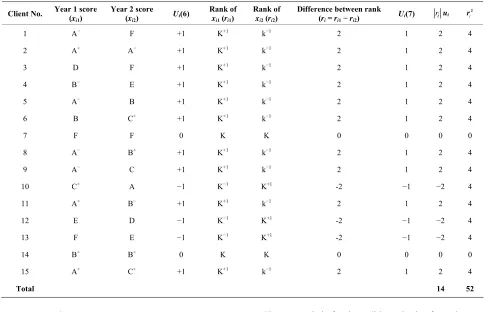
As noted above the data of example (1) being ordinal non-numeric data may only be analysed using modified sign test, using either raw scores (method 6) or ranks (method 7) as shown in Table 1.
Interest is to determine whether the median scores by clients are the same for the two years, that is if clients are likely to pay equal insurance premium for each of the two years. To do this using method 6 we have from col-umn 4 of Table 1 (ui(6)) that f+ = 10, f0 = 2; f− = 3 and w
= 10 – 3 = 7. Also
0
10 0.667; πˆ 2 0.133; 3 0.20
ˆ ˆ
π π
15 15 15
2
15 (0.667 0.20 0.667 0.20 15 0.667 0.218 15 0.649 9.735
Var w
Table 1. Analysis of health Insurance data (ordinal non-numeric data) using methods 6 and 7.
Client No. Year 1 score (
xi1)
Year 2 score
(xi2) Ui(6)
Rank of
xi1 (ri1)
Rank of
xi2 (ri2)
Difference between rank
(ri = ri1−ri2) Ui(7) i
r i
2 r ui
1 A− F +1 K+1 k−1 2 1 2 4
2 A+ A− +1 K+1 k−1 2 1 2 4
3 D F +1 K+1 k−1 2 1 2 4
4 B− E +1 K+1 k−1 2 1 2 4
5 A− B +1 K+1 k−1 2 1 2 4
6 B C+ +1 K+1 k−1 2 1 2 4
7 F F 0 K K 0 0 0 0
8 A− B+ +1 K+1 k−1 2 1 2 4
9 A− C +1 K+1 k−1 2 1 2 4
10 C+ A −1 K−1 K+1 -2 −1 −2 4
11 A+ B− +1 K+1 k−1 2 1 2 4
12 E D −1 K−1 K+1 -2 −1 −2 4
13 F E −1 K−1 K+1 -2 −1 −2 4
14 B+ B+ 0 K K 0 0 0 0
15 A+ C+ +1 K+1 k−1 2 1 2 4
Total 14 52
249 5.033 9.735
2
.667 0.20
2 7
9.735
(P-value = 0.0249)
which with 1 degree of freedom is highly statistically significant.
Now using the modified sign test by ranks we have from column 9 of Table 1 that W = 20 – 6 = 14; Also
from column 10 we have that
52 0.667 0.20 0 52 0.649 33.748
Var w
Hence the corresponding test statistic is
2196 5.808 33.748
2 14 33.748
(P-value = 0.0160)
which is statistically significant and infact more powerful than the modified sign test of Section 2.6 that depends only on raw scores but not on the ranks of these scores. To illustrate the application of each of the seven methods to numeric data we use example 2 first.
From Table 2 we have that
The test statistic for the null hypothesis of equal popu- lation medians (H0: d0 = 0) is
22 130
9.286 14
ar d
1.47; 15
9.286 0.619 15
0.619 0.787
d V
Var d Se d
0 0.7871.47d t
Se d
= −1.868 (P-value = 0.0828) which with 14 degrees of freedom is not statistically sig-nificant; showing that husbands and wives tend to prefer the same family sizes, that is, desire the same family sizes or number of children.
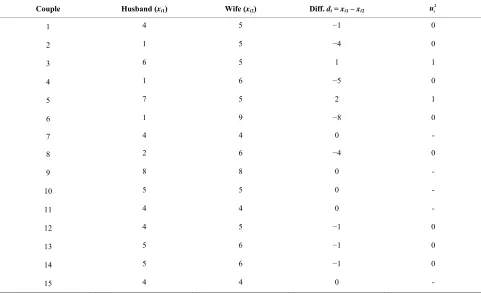
Analysis using the ordinary sign test, exact binomial test and its normal approximation are presented in Table 3.
Now note that the number of ties (0) is 5. Hence the effective sample size is 15 – 5 = 10. Also the number of 1s(+) is f+ = w = 2. Also Var(w) = n0(1 −0) Hence
un-der H0 (H0: = 0 = 0.5) we have
10 0.5 0.5
2.5Var w
2 2
2 0.5 2 5 9 3.6
2.5 2.5
W n
Var w
(P-value = 0.0578)
which with 1 degree of freedom is not statistically sig-nificant.
3.1. Exact Binomial Test
Table 2. Paired sample “t” test for the analysis of family size differences by a random sample of husbands and wife couples.
Couple Husband (xi1) Wife (xi2) Diff. di = xi1 – xi2 D2i
1 4 5 −1 1
2 1 5 −4 16
3 6 5 1 1
4 1 6 −5 25
5 7 5 2 4
6 1 9 −8 64
7 4 4 0 0
8 2 6 −4 16
9 8 8 0 0
10 5 5 0 0
11 4 4 0 0
12 4 5 −1 1
13 5 6 −1 1
14 5 6 −1 1
15 4 4 0 0
Total 3 – 25 = −22 130
Table 3. Application of the ordinary sign test and other two to the data on family size preferences by husbands and wives.
Couple Husband (xi1) Wife (xi2) Diff. di = xi1 – xi2 ui2
1 4 5 −1 0
2 1 5 −4 0
3 6 5 1 1
4 1 6 −5 0
5 7 5 2 1
6 1 9 −8 0
7 4 4 0 -
8 2 6 −4 0
9 8 8 0 -
10 5 5 0 -
11 4 4 0 -
12 4 5 −1 0
13 5 6 −1 0
14 5 6 −1 0
15 4 4 0 -
[image:9.595.57.538.440.733.2]data is the exact binomial test with x = 2, n = 10, and =
0 = 0.5. Hence
2
10 0
10
2 0.5 1 10 45
= 56 0.000977 0.0547
k P X
k
0.000977
Since P = 0.0547 > 0.05, we do not reject the null
hy-pothesis of equal population medians. That is with the exact method we may still conclude that newly married husbands and wives do not differ in their preferred or desired family sizes.
3.2. Normal Approximation
The normal approximation to the exact binomial test for the present data again with x = 2; n = 10 and = 0 = 0.5
is, with correction for continuity
2
2 2 0.5 10 0.5 2.5
10 0.5 0.5
2
5
2.50 2.5
Or in terms of the normal z-score we have
2.5 5 1. 0.5 10
z 2.5 1.581
581
(P-value = 0.1139) which is also not statistically significant.
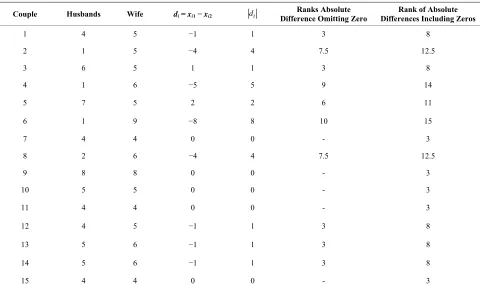
Analysis of example 2 using Wilcoxons signed rank sum test is presented in Table 4.
3.3. Unmodified Wilcoxons Signed Rank Sum Test
The sum of the ranks of absolute differences with posi-tive signs ignoring zero differences is
3 + 6 = 9 = T+
10 10 1 110 27.5
4 4
E T
and
10 11 21 2310 96.25
24 24
Var T
Therefore (P-value = 0.0625)
With 1 degree of freedom which is not statistically sig-nificant, leading to an acceptance of the null hypothesis of equal family size desires by newly married husbands and wives.
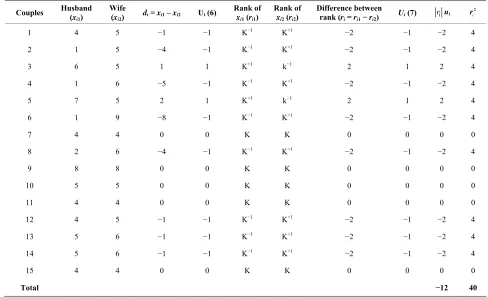
Now from column 5 of Table 5 (ui6) we have that f+ =
2, f0 = 5; f− = 8 and w = f+−f− = 2 – 8 = −6. Also
0
2 0.133; πˆ 5 0.333; 8 0.533
ˆ ˆ
π π
15 15 15
2
15 (0.133 0.533 0.133 0.533 15 0.666 0.160 15 0.506 7.59
Var w
[image:10.595.57.537.446.735.2]Therefore
Table 4. Analysis of data on family size, preferences by couples using Walloons signed rank sum test.
i
d
Couple Husbands Wife di= xi1−xi2 Difference Omitting Zero Ranks Absolute Differences Including ZerosRank of Absolute
1 4 5 −1 1 3 8
2 1 5 −4 4 7.5 12.5
3 6 5 1 1 3 8
4 1 6 −5 5 9 14
5 7 5 2 2 6 11
6 1 9 −8 8 10 15
7 4 4 0 0 - 3
8 2 6 −4 4 7.5 12.5
9 8 8 0 0 - 3
10 5 5 0 0 - 3
11 4 4 0 0 - 3
12 4 5 −1 1 3 8
13 5 6 −1 1 3 8
14 5 6 −1 1 3 8
Table 5. Analysis of family size preferences by couples using modified sign test.
Couples Husband (
xi1)
Wife
(xi2) di = xi1 – xi2 Ui (6)
Rank of
xi1 (ri1)
Rank of
xi2 (ri2)
Difference between
rank (ri = ri1−ri2) Ui(7) ri i 2 r ui
1 4 5 −1 −1 K−1 K+1 −2 −1 −2 4
2 1 5 −4 −1 K−1 K+1 −2 −1 −2 4
3 6 5 1 1 K+1 k−1 2 1 2 4
4 1 6 −5 −1 K−1 K+1 −2 −1 −2 4
5 7 5 2 1 K+1 k−1 2 1 2 4
6 1 9 −8 −1 K−1 K+1 −2 −1 −2 4
7 4 4 0 0 K K 0 0 0 0
8 2 6 −4 −1 K−1 K+1 −2 −1 −2 4
9 8 8 0 0 K K 0 0 0 0
10 5 5 0 0 K K 0 0 0 0
11 4 4 0 0 K K 0 0 0 0
12 4 5 −1 −1 K−1 K+1 −2 −1 −2 4
13 5 6 −1 −1 K−1 K+1 −2 −1 −2 4
14 5 6 −1 −1 K−1 K+1 −2 −1 −2 4
15 4 4 0 0 K K 0 0 0 0
Total −12 40
Therefore
236 4.743 7.59
2
.133 0.5332 6
7.59
(P-value = 0.0294) or which with 1 degree of freedom is highly statistically significant now indicating that newly married husbands and wives do differ in their preferred or desired family sizes.
Now to apply the modified sign test by ranks to same data we have from column 10 of Table 5 that W = 4 – 16
= –12; Also from column 11 of the table we have that
40 0.133 0.533 0 40 0.506 20.240
Var w
Hence the corresponding test statistic is
2144 7.115 20.240
2 12 20.240
(P-value = 0.0076)
which is highly significant.
Note that from the P-values and the associated chi- square values that the ordinary sign tests and the un-modified Wilcoxons sign rank sum test are likely to ac-cept a false null hypothesis (Type II error) more fre-quently than the two type of modified signed tests (methods 6 and 7). The relative efficiency of the modi-fied signed test w to the unmodimodi-fied Wilcoxons signed
rank sum test T+ for the present data is 96.25
: 12.681
7.59
RE W T ,
showing that at least for the present data the modified sign tests are much more powerful than the unmodified Wilcoxon signed rank sum test.
The problem with the ordinary sign test and the un-modified Wilcoxon signed rank sum test is that non of the two adjusts or modifies the test statistics for the pos-sible presence of tied observations between sampled populations, and simply ignores these ties if they occur, a procedure that because it uses less information tends to compromise the associated power of the test.
Now reanalyzing the data of example 2 using the modified Wilcoxon signed rank sum test of Section 2.8, we have from column 7 of Table 4 that T = 19 – 86 =
–67. Also f+ = 2, f0 = 5; f– = 8
0
2 0.133; πˆ 5 0.333; 8 0.533
ˆ ˆ
π π
15 15 15
And
2 15 16 31
0.133 0.533 0.133 0.533 6
1240 0.666 0.160 1240 0.506 627.44
Var T
dians 0 π π 0 0 , the test statistic for the mo-
H :
dified Wilcoxon signed rank sum test for the data be-comes
22 67 627.44 62
4489 7.154
7.44 (P-value = 0.0075)
which with 1 degree of freedom is highly statistically significant now indicating that newly married husbands and wives differ significantly in their desired family size preferences.
Thus the modified Wilcoxon signed rank sum test is here shown at least for the present data to be the most powerful of the six non parametric statistical methods presented here for the analysis of paired or matched sample data. This is because this method uses all avail-able information on the data being analyzed including direction and magnitude and also adjusts, that is makes provision, for the presence of any possible tied observa-tions between the sampled populaobserva-tions.
Using simulation, the result is as shownin Table 6. From Table 6 we have that
33
2.20; 15
11.50 0.767 15
0.767 0.876
d V
Var d Se d
161 11.50 14
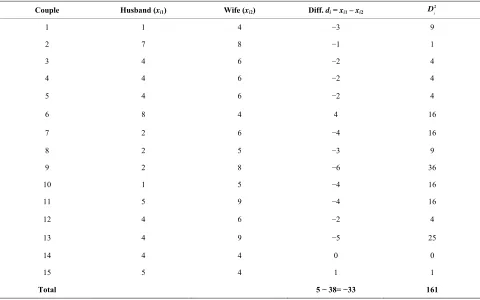
ar d
The test statistic for the null hypothesis of equal popu-lation medians (H0: d0 = 0) is
0 2
( )
d t
Se d
.20 2.511 0.876
(P-value = 0.0249) which with 14 degrees of freedom is statistically signifi-cant; showing that wife and husband differ in their choices.
Analysis using the ordinary sign test, exact binomial test and its normal approximation are presented in Table 7.
Now note that the number of ties (0) is 1. Hence the effective sample size is 15 – 1 = 14. Also the number of 1s(+) is f+ = w = 2. Also Var(w) = n0(1 − 0). Hence
under H0 (H0: = 0 = 0.5) we have
14 0.5
0.5 3.50Var w
2 2
2 0.5 2 7
3.50
W n
Var w
25 7.1429
3.50
2
14 0
14
2 0.5 1 14 91 0.000061
106 0.000061 0.0065
k P X
k
(P-value = 0.0075) which with 1 degree of freedom is highly statistically significant.
3.4. Exact Binomial Test
An equivalent approach to the ordinary sign test for these
data is the exact binomial test with x = 2, n = 14, and =
0 = 0.5. Hence
Since P = 0.0065 < 0.05, we therefore reject the null
hypothesis of equal population medians. That is with the exact method we may still conclude that husbands and wives differ in their preferences.
3.5. Normal Approximation
The normal approximation to the exact binomial test for the present data again with x = 2; n = 14 and = 0 = 0.5
is, with correction for continuity
2 2
2 2 0.5 14 0.5 2.5 7.0 5.786
14 0.5 0.5 3.5
Or in terms of the normal z-score we have 2.5 7.0 4.5 2.405
1.871 0.5 14
z
(P-value = 0.0143) which is also statistically significant.
Analysis of simulated data using Wilcoxons signed rank sum test is presented in Table 8.
3.6. Unmodified Wilcoxons Signed Rank Sum Test
The sum of the ranks of absolute differences with posi-tive signs ignoring zero differences is
10.5 + 1.5 = 12 = T+
14 14 1 210 52.5
4 4
E T
and
14 15 29 6090 253.75
24 24
Var T
22 40.5 1640.25 6.464
253.75 253.75
Therefore (P-value = 0.0110)
With 1 degree of freedom which is statistically sig-nificant, leading to a rejection of the null hypothesis of equal preferences by husbands and wives.
Now from column 5 of Table 9 (ui6) we have that f+ =
2, f0 = 1; f− = 12 and w = f+−f− = 2 –12 = −10. Also
0
2 0.133; πˆ 1 0.667; 12 0.800
ˆ ˆ
π π
15 15 15
2
i
D
Table 6. Paired sample “t” test for the analysis of family size differences by a simulated random sample of husbands and wife couples.
Couple Husband (xi1) Wife (xi2) Diff. di = xi1 – xi2
1 1 4 −3 9
2 7 8 −1 1
3 4 6 −2 4
4 4 6 −2 4
5 4 6 −2 4
6 8 4 4 16
7 2 6 −4 16
8 2 5 −3 9
9 2 8 −6 36
10 1 5 −4 16
11 5 9 −4 16
12 4 6 −2 4
13 4 9 −5 25
14 4 4 0 0
15 5 4 1 1
[image:13.595.58.538.112.412.2]Total 5 − 38= −33 161
Table 7. Application of the ordinary sign test and other two to the simulated data on family size preferences by husbands and wives.
Couple Husband (xi1) Wife (xi2) Diff. di = xi1 – xi2 ui2
1 1 4 −3 0
2 7 8 −1 0
3 4 6 −2 0
4 4 6 −2 0
5 4 6 −2 0
6 8 4 4 1
7 2 6 −4 0
8 2 5 −3 0
9 2 8 −6 0
10 1 5 −4 0
11 5 9 −4 0
12 4 6 −2 0
13 4 9 −5 0
14 4 4 0 -
Table 8. Analysis of simulated data on family size, preferences by couples using Walloons signed rank sum test.
i
d
Couple Husbands Wife di = xi1−xi2 Difference Omitting Zero Ranks Absolute Differences including ZerosRank of Absolute
1 1 4 −3 3 7.5 8.5
2 7 8 −1 1 1.5 2.5
3 4 6 −2 2 4.5 5.5
4 4 6 −2 2 4.5 5.5
5 4 6 −2 2 4.5 5.5
6 8 4 4 4 10.5 11.5
7 2 6 −4 4 10.5 11.5
8 2 5 −3 3 7.5 8.5
9 2 8 −6 6 14 15
10 1 5 −4 4 10.5 11.5
11 5 9 −4 4 10.5 11.5
12 4 6 −2 2 4.5 5.5
13 4 9 −5 5 13 14
14 4 4 0 0 - 1
15 5 4 1 1 1.5 2.5
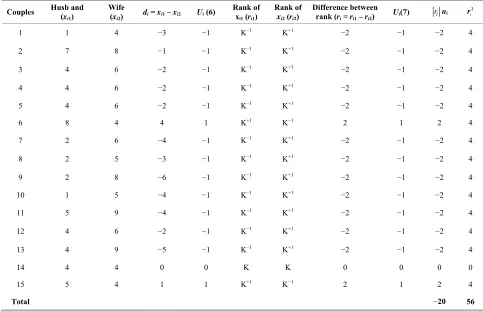
Table 9. Analysis of simulated family size preferences by couples using modified sign test.
Couples Husb and (
xi1)
Wife
(xi2) di = xi1 – xi2 Ui (6)
Rank of xi1 (ri1)
Rank of
xi2 (ri2)
Difference between
rank (ri = ri1 – ri2) Ui(7) i
r i
2 r ui
1 1 4 −3 −1 K−1 K+1 −2 −1 −2 4
2 7 8 −1 −1 K−1 K+1 −2 −1 −2 4
3 4 6 −2 −1 K−1 K+1 −2 −1 −2 4
4 4 6 −2 −1 K−1 K+1 −2 −1 −2 4
5 4 6 −2 −1 K−1 K+1 −2 −1 −2 4
6 8 4 4 1 K+1 K−1 2 1 2 4
7 2 6 −4 −1 K−1 K+1 −2 −1 −2 4
8 2 5 −3 −1 K−1 K+1 −2 −1 −2 4
9 2 8 −6 −1 K−1 K+1 −2 −1 −2 4
10 1 5 −4 −1 K−1 K+1 −2 −1 −2 4
11 5 9 −4 −1 K−1 K+1 −2 −1 −2 4
12 4 6 −2 −1 K−1 K+1 −2 −1 −2 4
13 4 9 −5 −1 K−1 K+1 −2 −1 −2 4
14 4 4 0 0 K K 0 0 0 0
15 5 4 1 1 K+1 K−1 2 1 2 4
Total −20 56
[image:14.595.55.538.422.733.2]
2
800
81 7.3215
Now under the null hypothesis of equal population me-
15 (0.133 0.800 0.133 0. 15 0.933 0.4449 15 0.48
Var w
Therefore
22 10 10
7.95 7.321
0 13.6584
5
2
0.800
1 27.334
(P-value = 0.00020) or which with 1 degree of freedom is statistically signifi-cant now indicating that husbands and wives preferences differs.
Now to apply the modified sign test by ranks to same data we have from column 10 of Table 9 that W = 4 – 24
= –20; Also from column 11 of the table we have that
56 (0.133 0.800 0.133 56 0.933 0.4449 56 0.488
Var w
Hence the corresponding test statistic is
22 20
27.334 27.33
400 14.634
4 (P-value = 0.00010) which is highly statistically significant.
Note that from the P-values and the associated chi- square values that the ordinary sign test and unmodified wilcoxon sign rank sum test have lower P-values than the two type of modified signed tests (methods 6 and 7). The relative efficiency of the modified signed test w to the unmodified Wilcoxons signed rank sum test T+ for the
simulated data is
25: =
27
RE W T 3.75 9.283
.334 ,
showing that also for the simulated data the modified sign tests are much more powerful than the unmodified Wilcoxon signed rank sum test.
The problem with the ordinary sign test and the un-modified Wilcoxon signed rank sum test is that non of the two adjusts or modifies the test statistics for the pos-sible presence of tied observations between sampled populations, and simply ignores these ties if they occur, a procedure that because it uses less information tends to compromise the associated power of the test.
Now reanalyzing the simulated data using the modi-fied Wilcoxon signed rank sum test of Section 2.8, we have from column 7 of Table 8 that T = 14 –105 = –91.
Also f+ = 2, f0 = 1; f− = 12
0
2 ˆ 1
0.133; π 0.667;
ˆ ˆ
π
15 15
12 0.800
π
15
and
2
3 0.800 881
0:π π 0 0
H
15 16 31
0.133 0.800 0.13 6
1240 0.933 0.4449 1240 0.4 605.244
Var T
dians
, the test statistic for the mo- dified Wilcoxon signed rank sum test for the data be-comes
2
2 91 8281 13.682
605.244 605.244
(P-value = 0.00019)
which with 1 degree of freedom is highly statistically significant now indicating that couples differ signifi-cantly in their preferences.
Thus the modified Wilcoxon signed rank sum test is here shown again to be the second best using the simu-lated data being the second most powerful of the six non parametric statistical methods presented here for the analysis of paired or matched sample data. This is be-cause this method uses all available information on the data being analyzed including direction and magnitude and also adjusts, that is makes provision, for the presence of any possible tied observations between the sampled populations.
4. Summary and Conclusion
We have in this paper presented and discussed eight al-ternative methods for the analysis of paired or matched sample data. If the sampled populations satisfy the nec-essary assumptions of continuity and normality, then the paired sample parametric “t” test becomes the method of choice and should be preferred since it is generally more powerful than most alternative non parametric methods. If however the data being analyzed are not continuous or are ordinal non-numeric measurements, then the modi-fied sign tests using either the raw scores themselves (method 6) or their ranks (method 7) are the only avail-able methods of analysis under the circumstance. If the data are numeric measurements on at least the ordinal scale but not appropriate for analysis using the paramet-ric “t” test, then the modified Wilcoxon signed rank sum test, the modified sign tests by ranks, the modified sign test, the exact binomial or ordinary sign test and its nor-mal approximation should be preferred and used in this order because of their relatively decreasing power, as shown by at least the illustrative examples used here and when reanalyzed using simulation, the modified sign test by ranks, modified Wilcoxon signed rank sum test, the modified sign test, the exact binomial or its ordinary sign test should be preferred and used in this order because of their relative decreasing power which is almost the same with the raw example except that modified sign tests by rank came first using simulation while second using raw data.
simply by setting values or scores from one of the sam-pled populations equal to some hypothesized value of a measure of central tendency.
REFERENCES
[1] I. C. A. Oyeka, “An Introduction to Applied Statistical Methods,” 8th Edition, Nobern Avocation Publishing Company, Enugu, 2009.
[2] S. Siegel, “Non-Parametric Statistics for the Behavioral Sciences,” McGraw-Hill Series in Psychology, New York,
1956.
[3] J D. Gibbons, “Non-Parametric Statistical Inference,” McGraw Hill, New York, 1971.
[4] I. C. A. Oyeka, C. E. Utazi, C. R. Nwosu, P. A. Ikpegbu, G. U. Ebuh, H. O. Ilouno and C. C. Nwankwo, “Method of Analysing Paired Data Intrinsically Adjusted for Ties,”
Global Journal of Mathematics, Vol. 1, No. 1, 2009, pp.
1-6.
[5] I. C. A. Oyeka and G. U. Ebuh, “Modified Wilcoxon Signed Rank Sum Test,” Open Journal of Statistics, Vol.
Appendix 1: A Summary of Eight Alternative Test Statistics for the Analysis of
Paired Samples
S/N Method Statistic (under Variance
H0)
Test Statistic
(under H0) Assumption Comments
1 Parametric Test sample d (mean of difference)
2 d
s t d d0
n s n
Populations continuous and normally distributed; measurements on the ratio scale
Most powerful if necessary assumptions are satisfied.
2 Ordinary Sign Test Wor −1’s) (=No. of 1’s n0(1 − 0) 2
2 0
0 1 0
w n n Population continuous numeric measurements on at least the ordinary scale
Usually ignores tied observations uses effective sample size (total number of non-zero differences).
3 Exact Binomial Test W (=No. = X’ = x
of 1’s or −1’s)
2
0 k
P x 2 01 0
n k k
n
k
Population numeric and discrete 4 Normal Approximation to the Sign TestW(=No. of 1’s
or −1’s) n010
0
0 0 0.5 1 w n n t
Population discrete “n” sufficiently large Incorporates continuity correction. 5 Unmodified Wilcoxon Signed Rank Sum Test
T+ = (sum of
the ranks of absolute differences with positives sign). 1 2 6 1 n n 1 n 2 0 0 0 1 1 1 6 n 2 2 1 2 u n n T n n Population continuous numeric measurement on at least the ordinal scale
Ignores zero absolute differences; does not provide for tied observations between samples.
6 Modified Sign Test
W = (difference between total number of 1s and −1s
2
ˆ ˆ ˆ ˆ π π π π
n
2 2 2 ˆ ˆ π πˆ ˆ ˆ ˆ
π π π π
w n n Population may be non numeric measurement on at least the ordinal scale
May be used with both numeric and non numeric measurements on at least the ordinal scale. Intrinsically adjusted for any possible tied observations between sampled population more powerful than the unmodified Wilcoxon signed rank sum test.
7 Modified Sign Test by Ranks W = R.1 – R.2
2 2 1
n k t
.1 .2 2 2ˆ ˆ ˆ ˆ π π π π =4
ˆ ˆ ˆ ˆ π π π π
n t
2 2r r
2
2
2
2 2 2
.1 .2
2
2
ˆ ˆ ˆ ˆ
2 1 π π π π
=
ˆ ˆ ˆ ˆ
4 π π π π
w
r r n k t
w n t Population may be non numeric measurement on at least the ordinal scale