Electromagnetic nature of nuclear forces and the
toroid structure of the helion and the alpha particle
Kiril Kolikov
Plovdiv University “P. Hilendarski”, Plovdiv, Bulgaria; [email protected] Received 20 May 2012; revised 18 June 2012; accepted 2 July 2012
ABSTRACT
In the present paper, we consider the nucleons in the helium-3 and helium-4 nuclei as tori. These tori rotate with constant angular velocity around an axis, which is perpendicular to the rotation plane and passes through the centre of mass of the nuclei. Based on exact analytical expressions for the electrostatic interaction be- tween two spheres with arbitrary radii and charges derived by us recently, we find that the well-known potential binding energy for the helion and for the alpha particle is of electro- magnetic character. Using the above mentioned formulae, we find the interaction force in the nuclei under consideration. Our toroid model recovers the basic experimental results not only for the binding energy, but also for the stability, radii, spins and the magnetic moments of the helion and the alpha particle.
Keywords:Helion; Alpha Particle; Strong Interaction; Potential Binding Energy; Electrostatic Interaction
1. INTRODUCTION
There are two basic models in the theory of elemen- tary particles: the standard model [1-3] and the helicon model [4-7].
In [8] and [9] the toroid model of nucleons has been
proposed, which is in certain contradiction with the stan- dard model, however in perfect agreement with the heli- con model.
Every nucleon is modelled with an imaginary torus, which rotates with constant angular velocity around an
axis z passing through its mass centre (the geometric
centre) O and perpendicular to the rotation plane of its
central circle. From quantum mechanical point of view, the nucleon is not a localized object in configuration space. Therefore, our model is valid in a formal heuristic sense a la Niels Bohr similar to his model for the electron
in the hydrogen atom, with which he obtained good re- sults for its spectrum within the framework of the old quantum mechanics.
Additional reasoning to consider the nucleons as spa- tially extended objects is the fact that they are located close to each other in the atomic nuclei. Thus, we assume that they are tori and their electric charge can be redis- tributed. Essentially, this idea does not contradict to the quark substructure model of nucleons, and it enables us to determine the electrostatic interaction between them. Based on the exact analytical expressions for the electro- static interaction between two charged conducting spheres with arbitrary radii and charges derived for the first time in [10], we conclude in [8] that strong interactions are electromagnetic in nature.
In [9], we ascertain that the experimentally determined potential binding energy between nucleons in the deu- teron and triton can be obtained taking into account the electrostatic interaction only. To do that, the values of the experimentally known radii, and masses of the nucleons and the corresponding nuclei have been utilized. In [9], the volume and the mass density of nucleons, as well as their interaction force in the deuteron and the triton have been calculated—important results in nuclear physics pre- sented for the first time.
Applying the method developed in [8,9], we calculate in the present paper the potential energy and the interac- tion force between the nucleons in the helium-3 and he-
lium-4 nuclei. Basic experimentally measured character- istics such as stability, spin, radius and magnetic moment
of the helion and the alpha particle are also explained. According to R. Feynman’s conjecture at distances less than 10−15 m either Coulomb’s law is not valid, or
electrons and protons cannot be considered as point-like particles [11]. In accordance with this conjecture, we as- sume that the distance within the corresponding proton- neutron pairs is less 10−15 m.
2. TOROID MODEL OF NUCLEONS
around an axis z passing through their mass (geometric)
centre O and perpendicular to the rotation plane of their
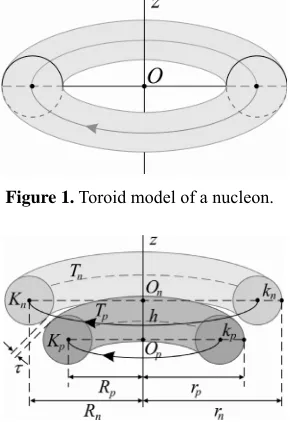
central circle (Figure 1).
Next, we study the system consisting of a proton and a neutron and determine the electrostatic interaction be- tween them.
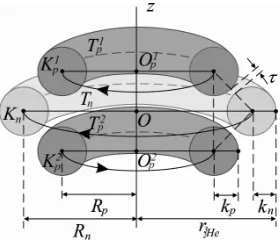
The tori corresponding to the proton and the neutron are denoted by Tp and Tn, while their centres are de-
noted by Op and On, respectively. We assume that the
central circles of Tp and n lie in parallel or merging
planes and rotate in the same or opposite direction with
the same angular velocity around the line z, which
passes through
T
ω
p
O and being perpendicular to the
rotation plane. Then, if n
O
p n
O O h, it follows that
(Figure 2).
0
h
Let Kp and Kn be the centres of the forming cir-
cles of the tori Tp and Tn, respectively, and
p p , n n n be the radii of the central cir-
cles of p
R O K R OK
p
T and Tn. We assume that the distance be-
tween Tp and Tn is m.
According to the available experimental data the pro- ton radius
15
10
0
p
r is not greater than the neutron radius .
That is why we must have n
r
p n R R .
Let kp and kn be the radii of the forming circles p
K and Kn, respectively. It is clear that kpRp and
. Moreover,
n
k Rn
p p p
R k r and Rnknrn, (1)
where rp and n are the radii of the proton and the
neutron in the configuration shown in Figure 2. It is worthwhile to note that in some nuclei
r
p
r , kp, Rp
and n, , may take different values.
Since , simple geometric consideration yields
r n
O O
k n
h
R
[image:2.595.307.541.75.279.2]p n
Figure 1. Toroid model of a nucleon.
Figure 2. Cross section of the system containing a proton and a neutron.
2
2
n p n p
h k k R R 2. (2)
Obviously, 0 h kp kn .
We assume that the mass and number densities of the proton and the neutron are equal, that is pn. If mp
and mn are the masses of Tp and Tn, then
p p
p
m V
and n
n n
m V
. (3)
According to [12], the volumes of the tori Tp and
n are
T Vp2π2 2kpRp and V Rn, respectively.
Therefore, from
2 2
2π
n kn p n
and from Eq.3 it follows that
n p
n p
p n
m R k k
m R
. (4)
Eqs.3 and 4 contain the proton and the neutron mass whose values are experimentally known and can be read- ily substituted.
Let be the radius of the of the empty part of
the circle with radius equal to that of the proton 0
q
p r .
Then
2
p p
q r k . (5)
In order to apply the results from [10] derived for the case of spheres, we remodel the tori as in [8,9].
Due to the spherical symmetry of the proton charge [13], we can assume that all its charge is concen- trated in the geometric centre
p
p
O of the torus Tp.
We remodel the proton with a sphere Sp having the
same centre Op lying on the axis , such that its area
is equal to that of the torus
z
p
T . Moreover, the charge
of the sphere is spherically symmetric and it can be re- distributed.
p
According to [12] the area Lp of the torus Tp is
2
4π
p p p
L k R . (6)
Since the areas of the torus Tp and the sphere Sp
are equal, from Eq.6 it follows that the radius rP of Sp
is
π
P p p
r k R . (7)
Next, we remodel the neutron Tn whose torus TN
has equivalent area and the same centre . The dis-
tance between its surface and that of SpO is the same n
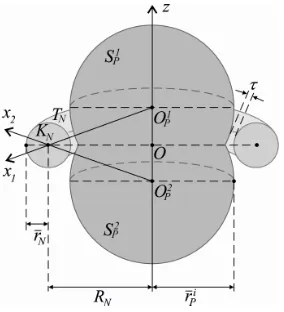
as the distance between Tn and Tp (Figure 3).
Let SN be the sphere, whose central circle is forming
the torus TN. We denote the centre of SN with KN so
that O Kn N RN, and let rN be the radius of SN. If
p N
O K R , then R rP rN and O Op nh im-
plies 2 2 2
N
R R h , that is
2 2N P N
[image:2.595.100.245.495.710.2]Figure 3. Cross section of the reduced model of the proton-neutron system.
Clearly, maxRN rp rN and minRN rN.
The equality of the areas LN and Ln of the tori TN
and Tn, together with Eq.6 yields
n N n
N R r k
R
. (9)
For the number of the spheres l SN whose total
area is equal to that of the torus TN, the following rela-
tion .4π 2 4π2
N RN N
l r r holds. Therefore
π N N R l
r
. (10)
Let us assume that the centre Op is fixed with re-
spect to some inertial reference frame J. Next, we in-
troduce a rigid inertial coordinate system , which ro- tates with the constant angular velocity ωG of the torus
N
T rotation with respect to J. The point Op is the
centre of the coordinate system , which is firmly
fixed with G and the spheres SO xyzPp and SN are at rest
one against the other (Figure 3).
Thus, taking into account the experimentally found value for k n (rk is the radius of the considering
nucleus), assigning different values for and varying m and 0
r r
15
0 q
0 1 h kpkn , from Eqs.1-5
we can find Rn, kn and Rp, kp, rp. Combining with
Eq.7 we determine the radius rP πk Rp p of the sphere
P
S with equivalent area. From Eqs.8 and 9 we deter- mine the radius rN of the forming sphere SN.
From R rP rN and taking into account ([10],
Eqs.10 and 11 therein), we can determine the interaction force F S
P,SN
and the binding energy W S
P,SN
,
.
According to Eq.10 the binding energy W T Tp n and
the interaction force F T T
p, n
between the proton andthe neutron become
, π ,
and
, π , .
N
p n P
N
N
p n P N
N
R
W T T W S S r
R
Eq.11 hold because the forming spheres of the torus
N
T are located symmetrically with respect to the centre
of the sphere SP.
3. VOLUME MASS DENSITY OF
NUCLEONS
Let us consider the proton in a free state as the torus
0. p
T According to [14] its radius is rp00.84184 10 15
m. Let 0
p
K is the centre of forming circle of the torus
0 p
T and let k0p is the radius of this circle. Moreover,
0 0
p p
Utilizing expressions (1) and (5) for different values of the radius of the empty part of the circle with radius
R OK .
q
p
r , we have calculated in [9] the quantities k0p, 0 p
R
2 0
N
F T T F S S r
(11)
and the volume of the proton torus 0 2π2
0p p p
V k R
27
[12]. The mass of the proton in a free state is
0 1.672621638 10
p
m
0 kg [15]. This can be used to
calculate p.
These results are depicted in Table 1 for various val- ues of q.
Since, the mass of the neutron
0 1.674927212 10
n
m 27
0 n
V
0 0
kg [15] is also known, its vol-
ume in a free state can be determined, where
p n
has been taken into account as already men-
tioned in Section 2.
Due to the mass defect in the atomic nuclei, the vol- umes of the nucleons change. We conjecture however, that the mass densities of the proton and the neutron in
all nuclei do not change . Based on
the values presented in Table 1, we ascertain the poten- tial binding energy and calculate the interaction force in the deuteron and the triton in [9].
0 0 const
p n
We model the deuteron as two immersed concentric
tori. The inner one Tp corresponds to the proton, while
the outer n corresponds to the neutron, such that the
distance between
T
p
T and Tn is of the order of 15
0 0 1
ω
m. In addition, we assume that the two tori rotate in the same direction with constant angular veloc-
ity around a straight line passing through their
common centre and perpendicular to the rotation plane.
z
[image:3.595.311.536.620.735.2]We model the triton with three tori whose central circles
Table 1. Dimensions, volume and mass density of the proton.
q
m
0
p k
15 10
m
0
p R
15 10
m
0
p V
3 104
m 5
0
p
3 1
kg m 108
0.3rp 0.294644 0.547196 0.93771 1.78373
0.4rp 0.252552 0.589288 0.74192 2.25444
0.5rp 0.21046 0.63138 0.55203 3.02997
0.6rp 0.168368 0.673472 0.37685 4.43843
lie in three parallel planes. The tori and repre- senting the neutrons are located symmetrically on both sides of the torus
1 n
T Tn2
p
T representing the proton. The dis-
tance between the neutron tori , and the proton
one
1 n
T Tn2
p
T is the same and of the order of 0 1015 m.
The tori Tp and rotate around an axis ,
which passes through their centres and is perpendicular to the rotation plane. The tori
i n
T
i1, 2
zp
T and rotate with
constant angular velocity in the same direction
(clockwise, for example), while T rotates with the
same angular velocity in the opposite direction.
1 n
T
ω
2 n
In the subsequent exposition we will model the he- lium-3 and the helium-4 nuclei. The nucleon disposition must comply with the principle of the minimum of po- tential energy. Taking into account the mass defect in atomic nuclei, the potential energy of interaction can be calculated according to the following formula [16]
2K p p n n K
W N m N m m c . (12)
Here Np is the number of protons, is the num-
ber of neutrons, while n
N
638 27
1.672621 10
p
m
27
kg are the proton and the neu- kg and tron mass, respectively [15],
1. 27212 10
n
m 6749
K
m
8
458 10 is the mass of the nu-
cleus and ms−1 is the speed of light
in vacuum [15]. 2.99792
c
Based on the values for mass densities in Table 1, we calculate the corresponding values of WK for the helion
and the alpha particle, we follow the procedure described in Section 2. Finally, our results will be compared with the values obtained by virtue of Eq.12.
4. MODEL OF THE HELION
The helion is a mirror nucleus of the triton and there-
fore its structure is analogous to that of the latter [9]. It consists of one neutron Tn and two protons Tp1 and
2 p
T . Since the proton tori Tp1 and Tp2 repel due to the
electrostatic interaction between them, their central cir- cles will lie in two parallel planes symmetrically located on both sides of the plane in which the central circle of the neutron torus n is located. In addition, the distance
between the surfaces of
T
1 p
T , Tp2 and that of will be
the same m(Figure 4).
n
T
15
1 0 0
This configuration ensures symmetry with respect to the mass centre (the geometric centre) of the helion. This
also implies the helion stability 3 .
2 T
He
The centres 1, 2
p p
O O and On of the tori Tp1, Tp2
and n, respectively lie on one axis perpendicular to
their plane of rotation with being the mass cen-
tre of the helion. The tori
T z
n
O O
1 p
T and Tn rotate with con-
stant angular velocity ω in a certain direction, while
2 p
T rotates with the same angular velocity but in the
[image:4.595.355.495.84.210.2]opposite direction. From here it follows directly that the
Figure 4. Cross section of the helion model.
spin of the helion is 3 2He 1 2
s , which is an experimen-
tally established fact [16].
The proton rotating in an opposite direction decreases the centrifugal force, which is originated by the two nu-
cleons rotating in the same direction. That is why the
helion radius m [17] is smaller than
that of the deuteron m [15].
3 2
15
1.9506 10
He
r
2
1H 2.1402
r 1015
The magnetic moments due to the proton charges compensate each other. Thus, the magnetic moment of the helion is generated by the charge of the neutron only. As a consequence of the enlarged neutron radius as compared to that in a free state, the magnetic moment of the helion 3 JT−1 is greater in ab-
2
26
1.0746 10
He
solute value than the magnetic moment of the neutron
26
0.9662 10
n
JT−1, which is in agreement with
the experimental data [15].
Let Kn and Kip be the centres of the forming cir-
cles of Tn and
i p
T , respectively with radii kn and
i p p
k k
i1, 2
. We introduce the notations RnOKnand for i1, 2, Rp O Kip ip i
(Figure 4).
This means that hOOp. Since the neutron radius is
equal to the radius of the helion, it follows that 3 2 n He
r r
and 3
2 n He n R r k .
Due to the spherical symmetry of the proton charges, we can assume that their charges
19
1.602176487 10
p
i
C are concentrated in their geo-
metric centres Op
i1, 2
. On these grounds we canmodel the protons with spheres i
P
S having the same
centres i
p
O and radii i
P P
r r with areas equal
to the areas of
1, 2
i
i p
T . Moreover, the charge of each i
P
S is
, which is spherically symmetric and can be redistrib-uted.
p
With TN n
T
i
we denote the torus which is equivalent in
area to with the same centre . The distance be-
tween
O
P
S and TN is equal to the distance between
i p
T and Tn. Let us denote: with SN the sphere whose
N
K the center of the sphere and with rN the radius of
the sphere (Figure 5).
We assume that the points i
p
O are at rest with respect
to an inertial frame J. Let us also introduce two rigid
non inertial reference frames 1 and G2 rotating with
respect to
G
J with angular velocity equal to that of the
rotation of the torus TN.
The point i
p
O is the centre of the coordinate system
and is fixed firmly with the reference frame i
relative to which the spheres
i iz
1, 2
Ox y
iG
iP
S and SN are
at rest one against the other (Figure 5).
The torus TN is located symmetrically with respect to
the two spheres i
P
S . It suffices to analyse the electro-
static interaction between TN and any of the spheres.
Based on the calculations presented in [8], we assume that the electrostatic interaction between the spheres 1
P
S
and 2
P
S
W S
can be approximated with interaction between
point-like charges , concentrated in their centres,
i.e. p p and
p W
p
, p p,
1 2
S
F S
1p,S2p
F p
,p
.For the sake of simplicity, we assume that the distance
p
between the surfaces of the protons 1
p
T and Tp2 is
the same as the distance between i
p
T and Tn, i.e.
p
. Therefore, we must have
2
i
P p
O O h k ( Fig-ure 4).
Using Eqs.1-5 from Section 2, we calculate n, n
and
k R
p
k , Rp, rp for different values of the mass den-
sity taken from Table 1 of Section 3 and different
values of the distance . The mass defect of the two
protons and the neutron has been taken into account in Eqs.3 and 4 accordingly to the mass proportions of the nucleons. According to Eqs.7-9 we calculate rP, rN
and the distance R rP rN between the centers of
the spheres i P
S and SN.
The experimentally established mass of the helion is
3 2He
[image:5.595.102.244.553.709.2]m 5.00641192 10 27kg [15]. According to Eq.12 the binding energy of the helion is
Figure 5. Cross section of the reduced model of the triton.
3 2
13
12.352 10
He
W J. Using the corresponding Eq.
11, we confirm this value for
3
2 2 , ,
i p n He
W W T T W p p , where i1 or i2. By
virtue of the same Eq.11 we find the magnitude of the interaction force for the helion
3
2 2 , ,
i p n He
F F T T F p p , where i1 or i2.
In Table 2, kn and kp denote the radii of the form-
ing circles, while Rn and Rp are the radii of the cen-
tral circles of the neutron and the proton tori in the helion, respectively. In addition, 3
2He
F is the interaction force
between the nucleons in the helion.
It is important to note that in order to obtain the value
of 3
2He, we can vary as well for different values of
the distance
W h
, such that kp h kp kn holds. This
implies that the distance p between the surfaces of the
two protons will vary according to 0p2kn2.
5. MODEL OF THE ALPHA PARTICLE
Structurally, the alpha particle is obtained by adding
one neutron to the helion. We assume that the centres of
the protons 1
p
T , Tp2 and the neutrons , are
symmetrically located with respect to the mass centre of the nucleus. The central circles of the tori lie in parallel planes. The distance between the tori
1 n
T Tn2
i p
T , i ( n
T i1, 2)
is the same 0 1015 m, while the elongation be-
tween Tn1, is some small distance (Figure 6).
2 n
T
From this configuration it follows the stability of the alpha particle is 4
2He T
i
.
The centres Op and ( ) of the tori
i n
O i1, 2 Tpi
and lie on one axis perpendicular to the plane of rotation. The tori
i n
T z
1 p
T and rotate in the same direc-
tion around with constant angular velocity , while
1 n
T
z ω
2 p
T and Tn rotate with the same velocity in the oppo-
site direction. It follows that both the spin and the mag- netic moment of the alpha particle are zero, which is an
experimentally established fact [15,16].
2
Moreover, the decrease of the centrifugal force as
compared to the helion implies that the radius of the
[image:5.595.355.491.592.714.2]Table 2. Dimensions of nucleons and interaction force between them in the helion.
3 1
kg m 108
17
m 10
n k
15
m 10
n R
15
m 10
p k
15
m 10
p R
15
m 10
3 2He
F
N
1.78373 0.728856 0.16290 1.7877 0.17828 1.4905 −13415.87
2.25444 0.695851 0.14415 1.8065 0.15580 1.5441 −15321.68
3.02997 0.648141 0.12364 1.8270 0.13192 1.6025 −16853.54
4.43843 0.588400 0.10154 1.8491 0.10693 1.6650 −19439.99
[image:6.595.56.539.101.215.2]7.42639 0.508946 0.078006 1.8726 0.08107 1.7313 −23415.29
Table 3. Dimensions of nucleons and the interaction force in the alpha particle.
3 1
kg m 108
17
m 10
n
k 15
m 10
n
R 15
m 10
p
k 15
m 10
p
R 15
m 10
4 2He
F
N
1.78373 1.582281 0.17769 1.4953 0.20746 1.0954 –60565.5
2.25444 1.421146 0.15697 1.5160 0.17881 1.1667 –72347.6
3.02997 0.793140 0.13440 1.5386 0.14916 1.2475 –84474.6
4.43843 0.313777 0.11018 1.5628 0.11934 1.3303 –100313.4
7.42639 0.246313 0.08449 1.5885 0.089552 1.4121 –139022.6
alpha particle 4 m [17] is smaller 2
15
1.673 10
He
r
than the radius of the helion 3 m.
2He
Let
15
1.9506 10
r
i p
K and Kni be the centres of the forming cir-
cles of i
p
T and Tni with radii i p p
k k and kn kni
. For , we denote
i1,2
i1, 2 RpOipKpi and(Figure 6). i i
nK n
R O n
The radius of the neutron is equal to the radius of the
alpha particle, that is 4
2 n He r r
1 2
and 4 . From
2 n He n R r k
1
the isosceles trapezoid n n p p
2
K K K K it follows that the
distance between the surfaces of the tori 1
p
T and
is
2 n
T
2
22kn h Rn Rp kn k
p
. (13)We assume again that the proton charges are concen- trated in their geometric centres i
p O
i
. Similar to Section 4, we model the protons as spheres SP with centres
i p O
and radii i
P P
r r , whose areas are equal to
that of
1, 2
i
i p
T . Moreover, the charge of SPi is , which is
spherically symmetric and can be redistributed.
p
With i
N
T , we denote the tori, whose areas
are equal to the areas of with the same centres .
The distance between the objects
i1, 2
i n
T Oni
i P
S and TNj is the
same as the distance between i
p
T and Tnj
. Let us denote: with
i1, 2;j1, 2
SNi the spherewhose central circle is the forming circle of the torus i N
T ;
with i
N
K the center of the sphere and with rN rNi the
radius of the sphere (Figure 6). We further assume that the points i
p
O and Oni
i1, 2
are at rest with respect to an inertial reference frame J. In addition, four firm noninertial coordinatesystems j
i
G
i1, 2;j1, 2
ω
are introduced rotating at
constant angular velocity (or ) equal to the an-
gular velocity of rotation of the neutrons
ω
1 N
T and TN2
with respect to J. Every point i
p
O is a centre of two
coordinate systems j j j
i i
Ox y z fixed firmly
with the reference frames
1,
j 2
j i
G with respect to which the
spheres i
P
S and j
N
S are at rest.
1 N
T
Since the total charges of the tori and 2
N
T are
zero it can be assumed with good approximation that there is no electrostatic interaction between them.
Due to the symmetry, it suffices to find the interaction
between any of the spheres i
P P and the spheres
S S
j N
S
j1, 2
. We assume as we noted in Section 4 thatthe interaction between the spheres 1
P
S and SP2 is
taken as point charges p p, , i.e.
1p,S2p
p p,
and
W S W
1, 2
,
p p
F S S F p p . For the sake of calculative
simplicity it is assumed that the distance p between
the surfaces of the proton tori 1 p
T and Tp2, as well as
the distance n between the surfaces of the neutron tori
and , is the same as the one between
1 n
T Tn2
i p
T and
i n
T
i1,2
, i.e. pn1 2 2
p p p O O k
.
We have and n
1 2 n n
O O 2k . There-
fore, i i
p n h kp kn
O O . Taking into account the mass
density of the nucleons from Table 1 of Section 3 and using Eqs.1-5 from Section 2 for different values all parameters kn, Rn and kp, Rp, rp can be found.
[image:6.595.57.539.246.359.2]According to Eqs.7-9 we calculate rP, rN and the dis-
tances 1 1 1
1 P N P N
R O K r r and
1 2 2
2 P N P N
R O K r r between the centres of the
spheres 1
P
S , S1N and S1P, SN2, where is given by
Eq.13.
The experimentally established mass of the alpha par- ticle is 4
2He
m 6.64465620 10 27 kg [15]. According to
Eq.12 the binding energy for the alpha particle
J. Using the corresponding Eq.
11 we confirm this value for
here
4 2
13
10
He
W
4
2He T
32.92
W W
32
2 Tp, n
2
2 p, n
1 2 , 2
i i
p n
T
p n
T W
p,p
,, w
W
1 2 ,
i i
1
i or i . By virtue of the same Eq.11 we find the
magnitude of the interaction force for the alpha particle
4 2
2 He
F F T T F T T F p p , where i1
or i2.
The quantities kn and kp in Table 3 denote the ra-
dii of the forming circles of the tori, Rn and Rp are
the radii of the central circles of the neutron and proton tori, respectively and 4
2He
F is the interaction force be-
tween the nucleons in the alpha particle.
We would like to note that in order to obtain the value
of 4
2He
W , the quantity for different values of the dis-
tance
h
can be varied as well, such that
p n
0 h k k . It follows that the distance p be-
tween the proton surfaces will vary 0p4kn3.
According to Eq.13 the distance will vary, too.
6. DISCUSSION
Describing the nucleons as tori, we calculate in [8] the potential energy and the interaction force between the nucleon couples. This approach is based on recently de- rived for the first time analytical expressions describing the electrostatic interaction between two charged spheres in the most general case [10]. According to the above mentioned formulae one can determine the electrostatic interaction between spheres at distances much less than their radii.
Based on this method, we find that strong interactions in atomic nuclei are electromagnetic in origin. Additional finding is the fact that the electrostatic interactions be- tween the couples proton-neutron are short range (at- tracting forces), while the interactions between the cou- ples proton-proton are long range ones (repelling forces) [18].
In [9] the basic experimental results for the deuteron and the triton such as binding energy, radii, spins and magnetic moments have been explained.
In the present paper, we extend this investigation for the nuclei of helium-3 and helium-4 and confirm that our model is capable to explain all essential experimental results for the basic simple nuclei. We find new results—
the volumes and the mass densities of the nuclei, as well as the force of interaction in the considered nuclei.
7. CONCLUSIONS
The presented here model can be applied for the more complicated atomic nuclei. The electrostatic interaction between nucleons changes their electric structure. Thus, all nucleons enter to various extents in interactions, which compensate each other.
Let us also note that the electromagnetic forces be- tween nucleons depend on whether they rotate in the same or different directions that is they depend on the orientation of their spins.
Based on our research, we are confident that all avail- able experimental data about atomic nuclei can be ex- plained by the model proposed. Other new properties of atomic nuclei can also be found.
It is essential that we obtain the basic nuclear charac- teristic—the binding energy in all of the considered nu- clei, using only electromagnetic interactions. The most significant conclusion from our studies is that nuclear forces are electromagnetic in origin.
8. ACKNOWLEDGEMENTS
The author would like to thank Stefan Bozhkov, for performing the calculations in the present paper on Wolfram Mathematica 7.0.
The results of the present studies are published with the financial support from the Fund for Scientific Research at the Ministry of Educa- tion and Science of Bulgaria under contract DTC No. 02/35.
REFERENCES
[1] Standard model.http://en.wikipedia.org/wiki/Standard_Model. [2] University of Tennessee. Standard model.
http://electron6.phys.utk.edu/phys250/modules/module% 206/standard_model.htm
[3] Fehling, D. The standard model of particle physics: A lunchbox’s guide.
http://www.pha.jhu.edu/~dfehling/
[4] Bergman, D. (2000) The real proton. Foundations of Sci- ence, 3, 4.
[5] Toroidal ring model.
http://www.enotes.com/topic/Toroidal_ring_model [6] Toroidal ring model.
http://en.wikipedia.org/wiki/Toroidal_ring_model [7] Twain, M. (1995) The undiscovered physics.
http://groupkos.com/mtwain/TheProton.pdf.
[8] Kolikov, K., Ivanov, D. and Krustev, G. (2012) Electro- magnetic nature of the nuclear forces and a toroid model of nucleons in atomic nuclei. Natural Science, 4, 47-56. doi:10.4236/ns.2012.41008
of the deuteron and triton. Natural Science, 4, 123-130.
doi:10.4236/ns.2012.42018
[10] Kolikov, K., Ivanov, D., Krustev, G., Epitropov, Y. and Bozhkov, S. (2011) Electrostatic interaction between two conducting spheres. Journal of Electrostatics, 70, 91-96.
doi:10.1016/j.elstat.2011.10.008.
[11] Feynman, R. (1964) The Feynman lectures on physics: Exercises. Addison Wesley Publishing Co., Boston. [12] Gellert, W., Kästner, H. and Neuber, S. (1983) Mathe-
matical encyclopedic dictionary, science and art, Sofia. 585 (in Bulgarian).
[13] Sardin, G. (1999) Fundamentals of the orbital conception of elementary particles and of their application to the neutron and nuclear structure. Physics Essays, 12, 204-
220. doi:10.4006/1.3025378
[14] Sick, I. (2003) On the rms-radius of the proton. Physics Letters B, 576, 62-67.
doi:10.1016/j.physletb.2003.09.092
[15] Mohr, P., Taylor, B. and Newell, D. (2008) CODATA rec- ommended values of the fundamental physical constants: 2006. http://arxiv.org/abs/0801.0028
[16] Krane, K. (1999) Introductory nuclear physics. Wiley- VCH, Weinheim.
[17] Wang, L.B., Mueller, P., Bailey K., Drake G.W., Greene J.P., et al. (2004) Laser spectroscopic determination of
6He nuclear charge radius. Physical Review Letters, 93,
142501. doi:10.1103/PhysRevLett.93.142501