ISSN Print: 2327-4352
DOI: 10.4236/jamp.2018.66098 Jun. 11, 2018 1160 Journal of Applied Mathematics and Physics
Differential Integrals of Curves and Inversion of
Magnetic Source Morphology
Jiaxiong Cai
Department of Land and Resources, Hunan Province, Changsha, China
Abstract
In this paper, the problem of magnetic source shape determination is simpli-fied into iterative inversion after symbol recognition. Based on the theory of differentiating different forms of magnetic sources by integral magnetic ano-maly curves, a unified expression for calculating magnetic fields of different magnetic sources under undulating terrain conditions is given, and the trian-gular system plate interpretation method is used to identify the magnetic fields of different magnetic sources. The calculus parameter basis for the clas-sification of unknown magnetic source morphology and the method technol-ogy for determining the magnetic source spatial morpholtechnol-ogy are confirmed. The example shows that the application of the calculus triangulation method to the magnetic source morphological system inversion has a good prospect.
Keywords
Applied Mathematics, Magnetic Source Form, Inflection Vector, Symbol Recognition, Thickening Judgment, Spatial Form
1. Introduction
The study of magnetic source morphology is helpful to provide important basic data on geological background, mineral factors, genesis process, geological his-tory and so on. Magnetic anomalies are used to explain the occurrence size, space location, magnetic parameters of magnetic source, etc. There have been many literatures [1] [2] [3], but it is rare to identify the variation of the latent magnetic source thickness by the magnetic anomaly curve, and then to invert the spatial shape of the magnetic source [4].
It is not easy to study the shape of magnetic source by observing the magnetic field data when the magnetic source with thousands of morphological changes is buried underground in a concealed state. This paper starts with the application
How to cite this paper: Cai, J.X. (2018) Differential Integrals of Curves and Inver-sion of Magnetic Source Morphology. Journal of Applied Mathematics and Phys-ics, 6, 1160-1169.
https://doi.org/10.4236/jamp.2018.66098
Received: February 24, 2018 Accepted: June 8, 2018 Published: June 11, 2018
Copyright © 2018 by author and Scientific Research Publishing Inc. This work is licensed under the Creative Commons Attribution International License (CC BY 4.0).
DOI: 10.4236/jamp.2018.66098 1161 Journal of Applied Mathematics and Physics
of differential and integral curves of anomalous profile of single magnetic source. By identifying parameters to distinguish large magnetic source catego-ries, after gradual iteration and shape adjustment to determine the profile shape of magnetic source, combined with magnetic source plane abnormal fitting, the spatial shape of magnetic source is finally determined. The application of diffe-rential integral in magnetic source shape inversion plays a key role and has im-portant theoretical significance.
2. Theoretical Problems
2.1. Magnetic Source Classification
According to its downward variation, it can be roughly divided into three kinds of models: “plate type” (thick plate body, thin plate body) with no change in thickness; “lens” with thickening thickness (including lens body, garlic body, etc.); “tip vanishing class” with thickness change book (pinnacle); Saccular body, etc.
According to the principle of superposition of magnetic field, three kinds of magnetic source models can be used to add magnetic field parallel to the plate and change the extension of the subplate which is included in the accumulation, then the tip out body of the upper thick lower book, the lens body of the upper and lower layer thickness, the plate body of the upper and lower thickness can be obtained. The magnetic field expressions of different types of magnetic sources can be obtained by changing the direction length of the plate. In the expression, the depth of the top of the magnetic source below the calculated point is differ-ent from the topographic change, so this formula is applicable to the undulating terrain. The unified expression of magnetic field of different types of magnetic sources [2] [5]:
(
)
2 2 0 1
1 n 2 sin 1 cos cos , ,
xy i S i xy i i
i
T b J I AF h x y L l
n = β
∆ =
∑
− ± (1)(
, , ,) (
, , ,) (
, , ,)
i xy i i xy i i xy i i
F h x y L l± = f h x y L l+ − f h x y L l−
(
)
(
)
(
)
(
)
(
)
(
)
(
)
(
)
(
)
(
)
(
)
2 2 2 22 2 2 2 2 2
2 2 2
2 2
2 2 2 2
, ,
cos cos sin cos
cos sin
sin cos 1 1
cos cos cos cos 2 sin
1 1 2 cos xy xy z z xy z xy
z z z
z s
s
z z
f h x y L
x l h l
L
c L x l h l
L x h P P
B L c L D L
D L D
K L k i B
K i
c L D L
β ξ β ξ
β β
ξ ξ
ξ β ξ ξ β
β + − − + = + − + + − + − − − + + + + × − − + − − + − − + +
where: L Y Lz= + ; Lf = −Y L; P h= xysin
β
−xcosβ
; B x= sinβ
+hxycosβ
;2 2 2
xy
D =x h+ ; 2
(
cos)
2(
sin)
2 xyDOI: 10.4236/jamp.2018.66098 1162 Journal of Applied Mathematics and Physics
(
0)
arctg tg csc
s
i = I A ; hxy= +h H x y
( )
, ; b b b bi= 1, , , ,2 3 bn;1, , , ,2 3
i n
L =L L L L ; l l l li= 1 2 3, , , , ln; H x y
( )
, For height data with zeroori-gin; ξ=2is−β Magnetization characteristic angle; L Half length of the
di-rection of the magnetic source; l Magnetic source extension; b Half
thick-ness of magnetic source;
β
Magnetic source inclination; I0 Geomagneticin-clination; is In section magnetization characteristic dip; A Magnetic source
azimuth; Js Magnetization in the section.
2.2. Mathematical Basis
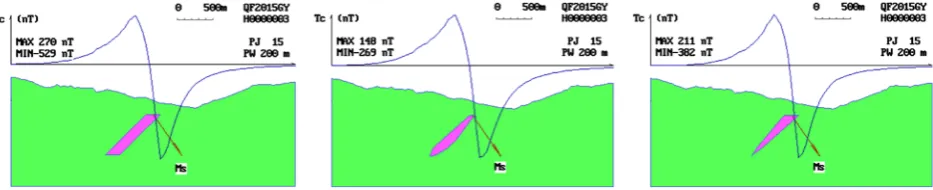
Under the premise of certain buried depth, the profile anomalies of different types of magnetic sources are calculated according to the formula. The characte-ristics of the profile curves of the anomalies are so similar that it is difficult to distinguish them. It seems to be a deadlock to solve the problem of magnetic source morphology from the characteristics of the profile anomaly curve itself
(Figure 1).
There are two ways to solve the problem: seeking for the two parameters to enhance the abnormal characteristics in Applied Mathematics, and using the accurate way to explain anomalies by using abnormal characteristics, we can find the “recognition parameter” that can distinguish the magnetic source morphol-ogy accurately.
Inflection point vector
The inflexion vector is a vector composed of the axial coordinates and the magnetic field intensity of the inflection point of the abnormal curve of the pro-file. The most essential characteristic of the abnormal curve of different magnet-ic sources is the inflection point vector of the curve. When the shape of the magnetic source is different, the research shows that the differential and integral curves of curves play a definite role in enhancing the difference of inflexion vec-tors. The change of inflexion vector of the profile curve of magnetic anomaly and the establishment of quadratic parameter with symbol discrimination by using vector change are the mathematical and physical basis for distinguishing the morphology of magnetic source with different morphology.
[image:3.595.67.534.586.681.2]The interpretation method of “triangle system” is to make use of the inflexion line of the curve of magnetic anomaly section, to construct triangle, to reveal the
DOI: 10.4236/jamp.2018.66098 1163 Journal of Applied Mathematics and Physics
trace change of inflexion vector, to obtain the related parameters of magnetic source in sections, and to explain the method system of magnetic anomaly. By changing the model parameters of Formula (1)) (l, L, h), the “triangle system” can give an explanation method of any form of magnetic anomaly.
2.3. Identification Parameter
It is a bottleneck problem to determine the spatial form of magnetic source by determining the shape of magnetic source with abnormal profile, and the identi-fication parameter is the watershed to distinguish the type of magnetic source and determine the variation of the thickness of magnetic source.
By applying the “triangle system” to reveal the trace variation of inflexion vector, and combining the effect of differential and integral in applied mathe-matics on the inflexion vector in abnormal curve, the identification parameters for identifying the unknown anomaly corresponding to the type of magnetic source can be given.
The identification parameters are specified in the, σ1d, σ2d, σ3, Ratio
pa-rameter combination generation σ1d For the first order differential curve of
unknown curve, the differential contrast value “one micro ratio” before and after the section is explained by the triangle system plate method. σ2d For the
second order differential curve of unknown curve, the second order differential contrast value “two micro ratio”, the second order differential identification pa-rameter (abbreviated as “two micro ratio”) before and after the interpretation of the second order differential contrast value before and after the triangle system method are used. σ3 For the integral curve of unknown curve, the “integral
ra-tio” is explained by the method of triangle plate [2]:
A micro ratio
(
)
1 1 1
1 1
0 0 0
1 1 1
1
0 0
d d
d
n n n
i i i i
Ti Oi
d n n
i i
Oi
T T O O S S
x x
O O S
x σ − − − + + − − + − − − − = = −
∑
∑
∑
∑
∑
(2)Two micro ratio
2 1 1 0 2 2 1 0 d d d n
Ti Ti Oi Oi
d n
Oi Oi
S S S S
x x S S x σ − + + − + − − − = −
∑
∑
(3)Integral ratio 0
(
)
3 0 d d n i i n i
T O x
O x
σ
−
=
∫
∫
(4)In the form: Ti For abnormal slabs ∆T; Oi Anomaly of magnetic source
with unknown shape ∆T; dx dot pitch.
The above formula is embedded in the “triangle system” interpretation me-thod. When the unknown anomaly is retrieved, the order of generation is auto-matically σ1d, σ2d, σ3. The three ratios are combined to form
DOI: 10.4236/jamp.2018.66098 1164 Journal of Applied Mathematics and Physics
“P”, “”, “N” show: “P” Expressed as >0.1 Positive value of “N” Expressed as <−0.1 Negative value of “” Expressed as being between (0.1 - −0.1) Value of “” It’s close “0” Interval value of, its setting helps to determine the shape of the magnetic source.
Under any terrain condition, the magnetic anomaly caused by the under-ground monomer magnetic source at any point can be verified by the book plate model, and the three types of model abnormality under the magnetic source under the magnetic source are abnormal, and the identification parameters of the three ratio symbol combinations occur. Therefore, the classification of the unknown abnormal magnetic source form can be determined by different iden-tification symbols.
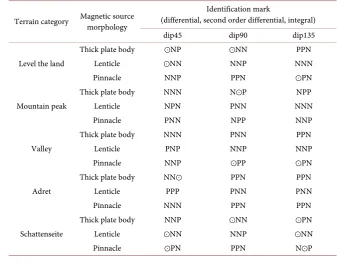
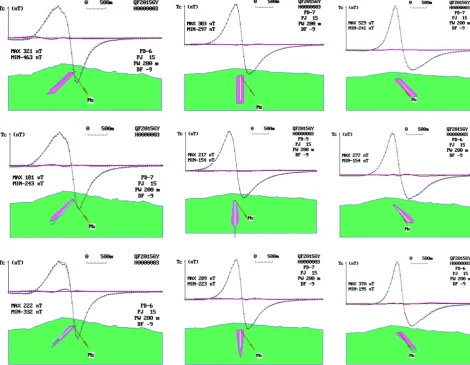
[image:5.595.201.539.469.735.2]After the classification of magnetic source is determined first, the prerequisite condition is obtained for further determining the profile shape of magnetic source, and the bottleneck problem is solved. In order to prove this precondi-tion, the common anomaly of three deviations (deflection angle, offset, deviation point) is given, and by means of differential, The integral function of the trian-gular plate interpretation method, to explain the angle of 15 degrees, deviation of 200 meters, deviation of 7 points of the magnetic profile, the design of the mag-netic source buried depth of 200 meters, the direction of 1600 meters long, down 800 meters, the change in the thickness of 0 - 200 meters (including the upper width of the book, Below the book thick, up and down equal thickness three kinds of shape, the inclination angle chooses 45 degrees/90 degrees/135 degrees, in the level. The results of the calculations under the conditions of topography, mountain, valley, sunny slope and overcast slope are as follows (Table 1).
Table 1. Symbol recognition table for shape differential integral curve of magnetic source profile.
Terrain category Magnetic source morphology
Identification mark
(differential, second order differential, integral) dip45 dip90 dip135
Level the land
Thick plate body NP NN PPN
Lenticle NN NNP NNN
Pinnacle NNP PPN PN
Mountain peak
Thick plate body NNN NP NPP
Lenticle NPN PNN NNN
Pinnacle PNN NPP NNP
Valley
Thick plate body NNN PNN PPN
Lenticle PNP NNP NNP
Pinnacle NNP PP PN
Adret
Thick plate body NN PPN PPN
Lenticle PPP PNN PNN
Pinnacle NNN PPN PPN
Schattenseite
Thick plate body NNP NN PN
Lenticle NN NNP NN
DOI: 10.4236/jamp.2018.66098 1165 Journal of Applied Mathematics and Physics
It can be seen that the three kinds of magnetic sources in the table have dif-ferent identification parameters at any point in any terrain (see Figure 2).
When the “triangle system” interpretation method inverts the anomaly of the same model as its own method, because the inflexion vector of the abnormal curve is the same, the discriminant parameter must be the formula of “”.
After the shape of the magnetic source is identified, the interpretation method in the triangle system is changed to the interpretation method of the shape type of the magnetic source. In the iterative process, the gradual increase in the thickness of the model and the refinement of the interpretation of the shape of the magnetic source are made. The changes of identification parameters and re-sidual anomalies are observed. When the identification parameters are changed to the symbol of “”, the shape of the section of the magnetic source can be determined.
2.4. Magnetic Source Spatial Morphology [6] [7] [8]
After the shape of the magnetic source profile is determined and combined with the plane anomalous characteristics of the unknown anomaly, the length of the
[image:6.595.62.533.340.705.2]
DOI: 10.4236/jamp.2018.66098 1166 Journal of Applied Mathematics and Physics
plate strike of the magnetic source is changed respectively, in order to explain the best fitting between the anomaly and the unknown anomaly, and finally de-termine the spatial shape of the magnetic source.
3. Method and Technology
3.1. Three Steps to Determine the Shape of an Unknown Magnetic
Source
1) The unknown anomaly was explained by the triangular plate interpretation method, and the identification parameters were obtained preliminarily. All the parameters except the thickness in the result were interpreted by the book board method, combined with the thickness of 3 to 5 times, the thick plate model and the pinnacle model were calculated. Three abnormal profile curves of lens mod-el. Three identification parameters are obtained by using the method of log plate. Comparing with the identification parameters of unknown anomalies, the types of magnetic source morphology of unknown anomalies can be identified.
2) The triangular system interpretation method corresponding to the magnet-ic source morphology model is used to gradually increase the thmagnet-ickness of the model to explain the anomalies. Each time, the identification parameters and the variation of the remaining anomalies are observed. Under normal conditions, the identification parameters will be gradually close to the direction of “”, and the remaining anomalies will be gradually close to the horizontal coordinate axis. When the model thickness is gradually iterated and the western details of the model are adjusted appropriately, the identification parameters will be con-sidered as “”. The magnetic source profile in the magnetic anomaly profile can be obtained.
3) Combined with the abnormal plan, the length of the model combination board is adjusted, and the spatial shape of the magnetic source which causes the unknown magnetic anomaly is determined.
3.2. Technical Processing in Inversion Process
1) In the process of adopting progressive iteration of model thickening, it is shown that the thickness of the model is excessive when the identification para-meters are found to be reversed. When it is found that the values of the identifi-cation parameters cannot trend to “” at the same time, and the local residual anomalies are obvious, It is shown that the model for interpretation needs to be revised, and the details of the model should be adjusted repeatedly, and the con-sistency of identification parameters towards “” and the change of residual anomalies should be observed in order to make the interpretation model close to the true magnetic source shape (Figure 3).
DOI: 10.4236/jamp.2018.66098 1167 Journal of Applied Mathematics and Physics Figure 3. Flow chart of shape determination of field source profile.
2) In order to determine the shape of magnetic source accurately, it is neces-sary to adopt the combination of first section, later plane, section and plane, step by step iteration and careful adjustment before it can be realized.
4. Application Examples
DOI: 10.4236/jamp.2018.66098 1168 Journal of Applied Mathematics and Physics
[image:9.595.62.537.65.229.2]
(a) (b) (c)
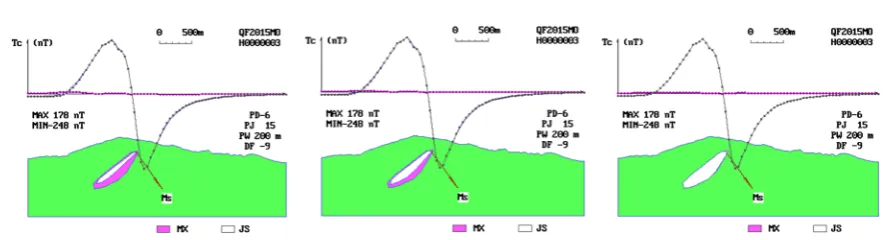
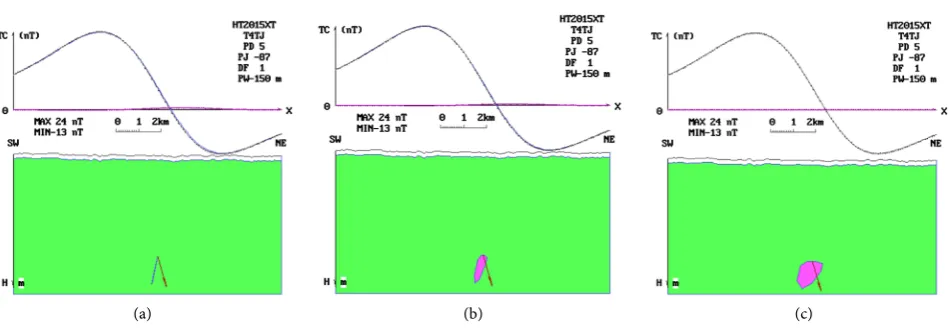
Figure 4. Morphological identification and determination of deep magnetic source bodies of Haitang aeromagnetic anomaly. (a) The “NNP” formula is obtained by using the inversion of the plate method, and the magnetic source is identified as a “pinnacle” magnetic source; (b) The “NNP” formula is still obtained by using the method of pinnacle interpretation, which indicates that the thickness of the pinnacle needs to be increased; (c) By adjusting the thickness and the detail of the pinnacle, the identification parameters are changed to the formula of “” and the shape is determined to be “kernel”.
5. Conclusions
The problem of magnetic source shape determination is simplified into iterative inversion of magnetic source thickening and detail adjustment after symbol rec-ognition.
The trigonometric interpretation method with the function of differential and integral not only gives the space position, occurrence, size, magnetic characteris-tics and intensity of the magnetic source, but also the identification parameters of unknown curves can be determined according to the calculus in applied ma-thematics. Under the premise that the magnetic source can be considered as homogeneous magnetization, the spatial shape of the magnetic source can be determined by the adjustment of the gradual thickness and the detail.
In this paper, a unified expression of multi-class magnetic sources combined with variable size and uniform multi-plate is given, which is an infinite number of interpretation methods corresponding to the variable model for the triangle system, which is helpful to the detailed study of the morphology of the hidden magnetic source.
References
[1] Cai, J.X. (1989) Magnetic Anomaly Triangle Interpretation System. Geological Pub-lishing House, 12-21.
[2] Cai, J.X., Li, Y. and Dai, Q.W. (2016) Research on the Source of Magnetic Anomaly Field. China Science and Technology Paper Online.
[3] Yan, Y.P., Dai, Q.W. and Cai, J.X. (2014) Theory and Method of Conjugate Inter-pretation of Magnetic Anomalies. Geological Publishing House, 89-91.
[4] Brain, D.A., Bagenal, F. and Acuña, M. (2000) Magnetic Morphology from MGS MAG. Bulletin of the American Astronomical Society, Summary.
DOI: 10.4236/jamp.2018.66098 1169 Journal of Applied Mathematics and Physics [6] Liu, X.Z. (1993) Principle and Application of spectral Analysis of Gravity and
Mag-netic Anomalies. Chongqing Publishing House, Chongqing, 132-167.
[7] Yan, Y.P., Dai, Q.W., Cai, J.X. and Lu, G.M. (2011) Magnetic Anomaly Conjugate Element Inverse Interpretation Method. Journal of Central South University, Natu-ral Science Edition, 731-737.