Performance Evaluation of AODV by Imposing Energy
and Load based Approach of Path Selection
Gourab Bhattacharya
Assistant ProfessorDept. of CSE TIT Narsinghar
ABSTRACT
A wireless Mobile Adhoc Network (MANET) is an infrastructure-less mobile network which is based on radio to radio multi-hoping and they have no centralized controller or a fixed router. In MANET all nodes are capable of movement and can be connected dynamically in an arbitrary manner. Due to the dynamic nature of network topology, frequent mobility, limited battery power, routing in MANETs is a challenging task. In addition to that, overloaded nodes may deplete their energy in forwarding others packets resulting in unstable network and performance degradation. The classical AODV routing protocol does not consider nodes energy or load while path selection procedure which declines its performance sharply in high load and fast moving velocity. This paper evaluates performance of AODV protocol when path selection is made considering the load and residual energy of the node. In this approach the nodes with low energy and high load is avoided by varying the delay time of broadcasting the RREQ packet. According to the simulation results using NS-2.35 the load and residual energy based path selection approach increases the stability & energy efficiency of the network significantly. Results show a non linear improvement of tthe network lifetime, packet delivery fraction, reduces the network routing load and number of dropped packets
Keywords
AODV, MANET, Energy efficient path selection
1.
INTRODUCTION
Ad Hoc wireless network can be formed as a self-initializing, self-configuring and self-maintaining network without fixed infrastructure. In Ad Hoc networks, wireless communication technology is used and here nodes communicate through intermediate nodes where every node performs as neighbor’s router within its communication range. The major problem in Ad Hoc Networks is that the nodes are equipped with finite battery charge and they have limited transmission range as well as limited wireless resources.
In MANETs, reactive on-demand routing protocols determine routes only when required. They incur less overhead and exhibit better performance compared to the class of proactive routing protocols. Irrespective of the requirement these protocols determine routes for every node pairs, [4][5]. In this treatise we restrict ourselves to on-demand routing protocols.[3]AODV is a popular on demand routing protocol as it consumes low memory and other resources and it is easy to implement .It exhibits better performances in case of lighter network load, but under heavier network load. its performance degrades quickly. [2]. In the routing process of AODV it selects minimum hop path between source and destination. This likely to cause some nodes in center of networks running out of energy too soon.[2].Over time the
network will eventually become partitioned if these nodes are not replaced or recharged. In a large network most of the nodes rely on other nodes to forward their packets and very few nodes actually communicates directly with destination. Some of the nodes may be especially critical for forwarding these packets because these nodes provide the only path between certain pairs of nodes. For every node that depletes its battery and stops operating, there may be a number of other nodes that can no longer communicate. This causes an unstable network and performance degradation of the network. For this reason, a number of researchers have focused on the design of communication protocols that preserve energy in order to prevent network failures for as long as possible to provide stability in the network [6]. For this reason power aware routing algorithms try to ensure equal distribution of transmission costs to all constituent nodes, so that loss of nodes due to the depletion of battery power can be avoided which in turns improves the total operational lifetime of the network.
In this paper in our proposed method of path selection current residual energy of node and load of the node is considered. The proposed method avoids relatively low energy and high load nodes at a particular time to choose the path so that relatively high energy and low nodes are selected in path for communication which interns improves network stability and energy efficiency.
The rest of the paper is organized as follows: In section 2, we provide a brief overview of AODV protocol and some related work on power aware and load aware routing. In section 3 we have described our proposed modification in path selection procedure. In section 4 we provided the simulation result and comparison of our proposed method with the original AODV. Section 5 gives the conclusion and summarizes the work.
2.
LITERATURE SURVEY
7 looping.. In this way, the RREQ packets are flooded to every
node in the connected part of the network.
If the intermediate node which receives the RREQ packet itself is the destination node then it sends RREP packet back to the source using the reverse route already created while broadcasting RREQ. If any non-destination node receives RREQ, and it has a fresh route to the destination then this node also can send RREP packet back to the source using reverse route constructed. As the RREP packet follows the path back to the source, the corresponding forward route is created at each intermediate node towards the destination. When the source receives the RREP packet, data traffic can now flow along this forward route. AODV maintains a sequence number on each node to prevent routing loops. Any routing information transmitted on routing packets or maintained on a node is tagged with the last known sequence number for the destination of the route. AODV protocol guarantees the invariability that the destination sequence numbers in the routing table entries on the nodes along a valid route are always monotonically increasing. This sequence number ensures loop free route. It also ensures freshness of routes and gives a choice of multiple routes, the one with a newer sequence number is always chosen. An important feature of AODV is maintaining of timer-based states in each node, regarding utilization of individual routes. A route is “expired” if not used recently. It also maintains a set of predecessor nodes for each routing table entry, indicating a set of adjacent nodes that use that entry to route data packets. These predecessor nodes are informed with route error (RERR) packets about the next hop link breaks. Each predecessor node, in turn, forwards the RERR to its own set of predecessors, therefore, effectively erasing all routes using the broken link. Then this RERR is propagated to each source routing traffic through the failed link, causing the route discovery process to be reinitiated if routes are still needed.[6][7].
As AODV protocol uses minimum hop path to establish route it makes network-centric nodes involved in too many routings, which in turn causes the networks to get into congestion state when a large number of data transmission. Too many data transferred by one node which exceed its buffer leads to data packet loss and node energy depletion.. This makes the network to be unstable and less energy efficient. The life time of node determines the service time of the network. A goal to optimize the AODV is to try to extend the service hours of the network, make the routes of network to be more stable and also energy efficient. This paper intends to establish a more reasonable route path.[2]
At present, many proposed schemes have showed up to control network congestion and make network more energy efficient. In CA-AODV [8] protocol, each node maintains a record of congestion status of neighbor nodes. Before forwarding RREQ, node looks up the congestion status of neighbors to avoid congested nodes to participate in. This method effectively solves the problem of network congestion, but it increases storage cost of congestion table and time cost of establishing bypass route. When there are too many congestion nodes Ad Hoc networks cannot bear such a large operational time. For avoiding the congestion ZHANG Hui-juan and WANG Ke-te proposed a method which avoids the use of the central node. They used GPS satellite positioning to calculate which nodes are in the network center [9]. Using GPS satellite positioning every node stores location information of other nodes in network. Location calculating is done while node gets a RREQ each time. In this proposed
method nodes broadcast location information periodically. This periodic broadcasting increases the network traffic. Here RREQ packet is added with parameters of average residual battery power of the nodes on the path and the number of hops that the RREQ packet has already traversed [10]. When an intermediate node receives the RREQ packet, it calculates the average residual battery power and increases the number of hops by one & the node rebroadcast RREQ after a delay-time which depends on the above calculation. This proposed method can postpone the nodes switch off time and increase network lifetime to some extent.
In Ad Hoc network, nodes are generally equipped with batteries to provide energy. The storage capacity of batteries has not improved to that great extent in recent years, so, optimize use of limited battery power to prolong the network lifetime has been the research focus. The popularly used energy research schemes are MTPR, MBCR [11] and MMBCR. MTPR scheme tries to find a rout consuming lowest energy from source to destination. This type of protocols don’t consider nodes load balance, their main focus is minimum total energy consumption. The nodes battery power is the main route selection criterion for MBCR. It uses battery power of node as a route indicator. The higher energy nodes are preferred more than the lower energy nodes for data forwarding. In MMBCR the main goal is to make the key nodes ‘energy consumption lowest. The above three solutions are based on the total routing energy consumption and they add extra field in RREQ packet which increases the network overhead and storage overhead. [2]
Jian Kuang, Xianqing Meng, Jiali Bian proposed a method which takes into account nodes remaining energy, load and moving speed to increase network lifetime and better energy consumption and stability in the network. They have defined normal, warning and dangerous three type of threshold values for these three parameters. If any of the two parameters in the dangerous range then node will drop RREQ packet .If any of the two parameters are in the warning range then node wait for a delay time then rebroadcast RREQ. This proposed method is able to longer the network lifetime to some extent.[2]
3.
LOAD AND RESIDUAL ENERGY
BASED PATH SELECTION
PROCESS
In the modification of the path selection process in AODV , when an intermediate node receives a RREQ packet and if it is not the destination node or it don’t have any fresh route to destination, then it calculates delay time to forward the packet using the following equation
D = ( K1( 1-NECurrent / NEInitial) + K2 (NQCurrent / NQMax) ) * Tc
where
D= Variable Delay to forward RREQ packet NECurrent= Current available energy of node NEInitial = Initial Energy of node.
NQCurrent = Current queue length of node NQMax = Maximum queue length of node. Tc = Delay Constant
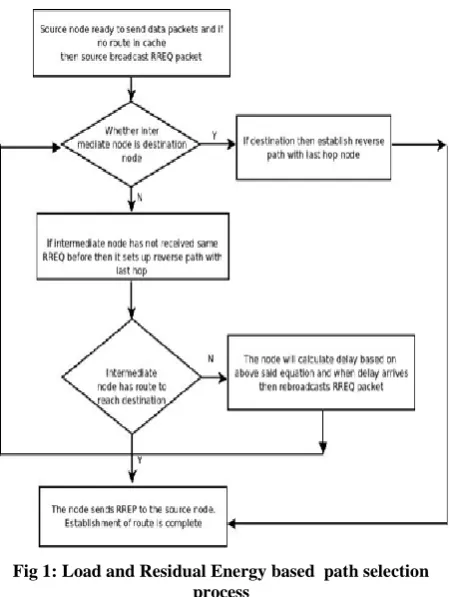
From the above equation it is clear that if the energy of node is low then delay will increase and if the queue length of node is high then delay will increase. So a node having relatively low energy and high load will broadcast the RREQ packet late then a High energy and low load node. Since by default the AODV replies to the RREQ packet it first receives , so with the modification in delay it will tend to choose relatively high energy and low load nodes in the path and in turns increasing the energy efficiency and stability of network. The detailed flow chart of the proposed method is given below:-.
Fig 1: Load and Residual Energy based path selection process
4.
SIMULATION RESULT & ANALYSIS
[image:3.595.316.534.267.636.2]The simulation carried out in NS 2.35 simulator. The simulation carried out in two scenarios. In the first scenario the all nodes initial energy is same. In the second scenario to make it more realistic we have taken all nodes initial energy different.
Table 1. Simulation Parameter
Parameter Set values
Number of mobile node 5,10,15,20 Simulation Scenario 670m x 670m
Communication Radius 250m
Maximum buffer queue 50 Packets
Pause Time 4ms
Maximum Speed of nodes 10 m/s
Rate of sending Data Packets 5 Packets / s Number of maximum
connections
10
Data Flow Cbr
Parameters used in paper K1=0.5,K2=0.5,Tc=0.01
Simulation Time 200s
Network life time can be measured either as the time when first node dies, or a certain number of nodes drops below a threshold energy level, or death of all the nodes. Here in this paper we have considered network lifetime as the time when first node dies or drops below 30% of their initial energy. In case of both the scenarios in simulation, the network lifetime, packet delivery fraction increases then the original AODV. The network routing load and number of dropped packets also reduces in the modified AODV. The significant improvement is observed in end to end delay parameter. The simulation result graphs are shown below for both the scenarios
5.
CONCLUSION
An early energy depletion of nodes can lead to an unstable network and performance degradation in ad hoc networks. Since the original AODV considers only the minimum hop count as its main criterion for path selection, under heavier loads its performance degrades sharply as some of the nodes in network center loses energy quickly. This paper proposes the method to solve this problem by considering the load and residual energy of node in path selection process. This new approach reduces the unstable routing and extends the network life time significantly. The simulation considers two scenarios, in one all the nodes initial energy is same and in other different nodes have different initial energy. In both the situations the simulation result shows that the network life time and packet delivery fraction improves in the modified AODV. The number of dropped packets and network routing load also reduces in case of modified AODV.
6.
REFERENCES
[1] Conti M, Giordano S. Multihop Ad hoc networking:the theory[J]. 2007 IEEE Communications Magazine, , 45(4):78-84.
[2] Kuang Jian, Meng Xianqing , Bian Jiali. An Imporved AODV protocol Based on Extension Lifetime of the Ad Hoc Networks Proceedings of IEEE CCIS,2012 1013-1016.
[3] Meghanathan. Natarajan, Milton. Leslie C. “A Simulation Based Performance Comparison Study of Stability-Based Routing, Power-Aware Routing and Load-Balancing On-Demand Routing Protocols for Mobile Ad hoc Networks”, IEEE, 2009, 978-1-4244-3375
[4] J. Broch, D. A. Maltz, D. B. Johnson, Y. C. Hu and J. Jetcheva, “A performance comparison of multi-hop wireless ad hoc network routing protocols,” Proceedings of the 4th Annual Conference on Mobile Computing and Networking, pp. 85-97, Oct. 1998.
[5] P. Johansson, T. Larsson, N. Hedman, B. Mielczarek and M. Degermark,“Scenario-based performance analysis of routing protocols for mobile ad hoc networks,” Proceedings of the 5th Annual ACM/IEEE International Conference on Mobile Computing and Networking, pp. 195 – 206, 1999.
[6] Asadi.M, Rahebi.S, Nourizadeh.S,” High Reliable Routing method for mobile ad hoc networks underlining Efficient Energy Consumption”, Australian Journal of Basic and Applied Sciences, INSInet Publication, 2010, 4(10): 4671-4681.
[7] Perkins.C.E, “AD HOC NETWORKING”, Pearson Publication, 2013, pp.173-219.
[8] JIANG Dao-xia, LIU Feng-yu. Congestion Adaptive Routing Protocol Based on AODV in Ad Hoc Network. Journal of Nanjing university of Science and Technology(Natural Science), 2009, 33(4).
[9] ZHANG Hui-juan, WANG Ke-te. Improved AODV Algorithm Based on Ad hoc Load Balance. Computer Engineering, 2010, 36(10).
[10] RANHIKA D.JOSHI, PRITI P.REGE. Distributed Energy Efficient Routing in Ad Hoc Networks. "Wireless Communication and Sensor Networks, 2008. WCSN 2008. Fourth International Conference on, vol., no., pp.16-21, 27-29 Dec. 2008.