Operator Equation and Application of Variation
Iterative Method
Ning Chen, Jiqian Chen
School of Science, Southwest University of Science and Technology, Mianyang, China Email: [email protected]
Received June 8,2012; revised July 8, 2012; accepted July 15, 2012
ABSTRACT
In this paper, we study some semi-closed 1-set-contractive operators A and investigate the boundary conditions under which the topological degrees of 1-set contractive fields, deg
I A, ,p
are equal to 1. Correspondingly, we canobtain some new fixed point theorems for 1-set-contractive operators which extend and improve many famous theorems such as the Leray-Schauder theorem, and operator equation, etc. Lemma 2.1 generalizes the famous theorem. The cal- culation of topological degrees and index are important things, which combine the existence of solution of for integra- tion and differential equation and or approximation by iteration technique. So, we apply the effective modification of He’s variation iteration method to solve some nonlinear and linear equations are proceed to examine some a class of integral-differential equations, to illustrate the effectiveness and convenience of this method.
Keywords: Topology Degrees and Index; 1-Set-Contract Operators; Modified Variation Iteration Method; Integral-Differential Equation
1. Introduction
In recent years, the fixed point theory and application has rapidly development.
That topological degree theory and fixed point index theory play an important role in the study of fixed points for various classes of nonlinear operators in Banach spaces (see [1-6]). We begin recall theorem A and lemma 1.1 [3]. Then, several new fixed point theorems are ob- tained in Section 2, and the common solutions of the sys- tem of operator equations in Section 3. We also extend some examples for search solution of integral equation and integral-differential equation in Section 4 and Sec-tion 5 by variaSec-tion iterative method. In last part, we com- pare some figures, by numerical test and note that simple case of Schrodinger equation. The main results are Theo-rem 2.2, TheoTheo-rem 3.4-3.5, Example 3, Example 6, etc.
2. Several Fixed Point Theorems
Let be a real Banach space, a bounded open subset of and
E
E the zero element of E.
If A: E is a completely continuous operator, we
have some well known theorems as follows (see [3,4]). First, we need following some definitions and conclu- sion (see [3]). For convenience, we first recall theorem A.
Theorem A (see Theorem 1.1 in [3]) Suppose that A
has no fixed point on and one of the following
conditions is satisfied,
,
1) (Leray-Schauder) ,Axx, for and 1; 2) (Rothe) Ax x , for all x;
3) (Petryshyn) Let , Ax Axx , for all ;
x
4) (Altman) Axx2 Ax2 x2, for all x.
then deg
I A, ,
1, and hence A has at least onefixed point in .
Lemma 2.1 (see Corollary 2.1 [3]) Let be a real Banach Space,
E
is a bounded open subset of E and .
IfA: Eis a semi-closed 1-set-contractive opera-
tor such that satisfies the L-S boundary condition ,
Axtx for all x and t1, (2.1)
then deg
I A, ,
1, and so A has a fixed pointin .
Remark This lemma 2.1 generalizes the famous L-S theorem to the case of semi-closed 1-set-contractive op- erators.
First, we state following some extend conclusion (see theorem [5]).
Theorem 2.2 Let , ,E A be the same as in lemma 2.1. Moreover, if there exists 1,0, 0 , - positive integer such that
n
( ) ( )
4 2 ,
for all .
n n n n
Ax x Ax x Ax x
(2.2)
Then deg
I A, ,
1 if A has no fixed pointson and so A has a fixed point in .
Proof.By lemma 2.1, we can prove theorem 2.2. Sup-pose that A has no fixed point on .
Then assume it is not true, there exists x0,01
such that Ax00 0x . It is easy to see that 01.
Now, consider the function defined by
( )
( )4 n 2n
f t t t 1,
1
, for any t1.
Since
( )
( ) 1
4
2 0
n
n
f t n n t
n n t
and by formal differential, f t
is a strictly increasingfunction in
1,
, and so f t
f
1 for . Thus1 t
( )
( )
4 2 1 2
for any 1.
n n n n
t t t
t 1, t
Consequently, noting that x0 0, 0 1, we have
( ) ( )
0 0 0 0 0
( ) ( )
0
( )
0 0 0 0
4 4 2 1 2 , n n n n
n n n
Ax x x x
x
Ax x Ax x
)
which contradicts (2.2), and so the condition (LS is
satisfied. Therefore, it follows from lemma 2.1 that the conclusions of theorem 2.2 hold.
Theorem 2.3 Let be the same as in lemma 2.1. Moreover, if there exists
, , E A
1, 0, 0
,
positive integer such that
,
m n
( )( )
1
, for all .
n n n
n
Ax m x Ax mx Ax
x x
(2.3)
Then deg
I A, ,
1, if A has no fixed pointson and so A has a fixed point in .
Proof.Similar proof of that theorem 2.2. Now, we consider the function defined by
( )
( )1n n 1
f t t m t m , for any t1, and f
t 0.So,
f t is a strictly increasing function in
1,
, and
1f t f for t1. We have
( ) ( ) 1 1 1, n n n nt m t m
t m t
for any t1.
Consequently, noting that x0 0, 01, we have
( )0 0 0 0
( )
0
1 n n n
n
Ax m x Ax mx Ax
x 0
which contradicts (2.3). Therefore, it follows from le- mma 2.1 that the conclusions of theorem 2.3 hold.
Corollary 2.4 If
( )1 n n ,
Ax m x Axmx Axn (2.4)
then (2.3) holds. By theorem 2.3, A has a fixed point in
.
We get easy theorem 2.5 in bellow. So, extend (vi) of theorem 2.6 in [3], omit the similar proof.
Theorem 2.5 Let E, , A be the same as in lemma
2.1. Moreover, if there exists 1,1 and - positive integer such that
,
m n
( )
,for all .
n n n
Ax Axmx x x (2.5) Then deg
I A, ,
1, if A has no fixed pointson and so A has at least one fixed point in .
(Let m1, that is theorem 2.4 in [5]).
3. Operator Equations
We will extend Lemma 2 and Theorem 2, adopt same notation and method in [7]in following form.
Let be a real Banach space, and -posi- tive integer.
E p1,m
Lemma 3.1 When t1,p1 the following holds:
1
1
mp 1 mp
1
mpm t t t .
Proof.Let
mp 1
1
1
mp
1
mpf t mt m t t , similar the proof of lemma 2 in [7], we easy get
0.f t In fact, by derivative of it, we have
1 1 1 1 1 1 1 1 1 ,1 1 1
mp mp
mp
mp mp
mp
f t m mp t m mp t
mp t
mp t m t t
. Since
1 1 1 1 1 1 1 1 1 1 1 11 1 1
1 1 1 1 1 1
1 1 1 1
2 0. 1 mp mp mp mp mp mp mp t t m t t t
m t t
m t m t
m
1
1 1 mp 1 mp
mp
t t m t1 1,
0 that is,
1
11 1 1 mp 1 mp
mp
mp t m t t .
Thus, f
t 0 Therefore, f t
0, is a strictly mo-
notone increasing function in
.When wehave and
1
t
1 ,f t f f
1 m 2mp0, that is.
f t 0Hence,
11 mp 1 1mp
mp
t t m t 1,
where We complete the proof of this lemma 3.1.
1, 1.
t p
Theorem 3.2 Let be a bounded open convex sub- set in and
D
;
D
,
E Suppose that A D: E is a
semi-closed 1-set-contradictive operator, and m, n -posi-tive integer such that
1
mp mp mp mpm Axx Axx Ax x ,
. for every
, 1
xD p (3.1)
Then the operator equation Axx has solution
in .
a
D
Proof. By (3.1), we know that Axx has no
solu-tion in D, that is xAx, for every xD. We shall
prove ,
xtAx for every t
0,1 , for every xD. (3.2)In fact, suppose that (3.2) is not true that is there exists a t0
0,1 ,and an x0D such that x0t Ax0 0, thatis 1
0 0 0
Ax tx .
By (3.1), we obtain
1 10 0 0 0 0
4 1
0 0 0
1
,
mp mp
mp
m t x x t x x
t x x
for every 0 This is because
, 1
x D p .
0 ;
x D hence x0 0, then we
have
1
1
0 0 0
1 1 1 mp mp
m t t t
1
1.
,
mp
Let 0 as we have
That is
then thisis a contradiction to Lemma 3.1. ,
tt t0
0,1 ,
1 1mp
m t
1. t
1
mpt
1 mp
t
Thus, ,
xtAx for every t
0,1 , for everyxD. (3.3) From (3.2) and (3.3), we know that xtAx. By Ref [6], we obtain that i A D E
, ,
1. Then this operator equation Axx has a solution in D.Theorem 3.4 Let be a bounded open convex sub- set in and
D ; D ,
E Suppose that , :A B DE are
semi-closed.
1-set-contradictive operator, and m, n-positive integer such that
1
, for every , 1.
mp mp mp
mp
m Ax x Ax x Ax
Ax Bx x D p
(3.4)
Then the operator equation Axx Bx, x has common solution in (omit the proof of this theorem).
a
D
Theorem 3.5 Let Same as assume theorem 3.1. Sup- pose that , , :A B C DE are semi-closed 1-set-contra- dictive operator, and m, n-positive integer, substitute (3.5) for inequality bellow
1
, , 1.
mp mp mp
mp
m Ax x Ax x Ax
Ax Bx Cx x D p
Then the operator equation Axx Bx Cx, x has common solution in (omit this proof).
a D
4. Solution of Integral Equation
Recently, the variational iteration method (VIM) has been favorably applied to some various kinds of nonlin- ear problems, for example, fractional differential equa- tions, nonlinear differential equations, nonlinear thermo- elasticity, nonlinear wave equations.
In this section, we apply the variation iteration method (simple writing VIM) to Integral equations bellow (see [8,9]). To illustrate the basic idea of the method, we con-sider:
.L u t N u t g t
The basic character of the method is to construct func-tional for the system, which reads:
1 0 d
x
n n n n
u x u x
s Lu Lu Nu g s sWhich can be identified optimally via variation theory, is the nth approximate solution, and
n
u un denotes a
restricted variation, i.e., un 0. There is a iterative
formula:
1 , d
b
n a n
u x f x
k x t u t t,d of this equation
b
,a
u x f x
k x t u t t (*) Theorem 4.1 (see theorem 3.1 [8]) Consider the itera- tion scheme u0
x f x
,and
1 , d
b
n a n
u x f x
k x t u t t.Now, for n0,1, 2, , to construct a sequence of successive iterations that for the for solution of integral equation (*).
n
In addition, we assume that
2 , d d 2 , b b
a ak x t x tB
and
2 then if , ,a b
f x L 1 ,B the above iteration
converges in the norm of to the solution of inte- gral equation (*).
2 ,
a b L
Corollary 4.2 If k x t
, k x t1
, k2
x t, , and
2 , d d 2 ,
b b
a ak x t x tB
then assume
2 if , ,a b
f x L 1 ,B the above iter-
ation converges in the norm of to the solution of integral equation (*).
2 ,
a b L
Example 1 Consider that integral equation
1
0 d
u x xx x
xt u t t (4.1)where u(0)0, and
0 0 1,0
u x xxx 1
n
From that
1
1
0 d .
n
u x xx x
xt u t tWe have 1 1
2 2
l
1 3
0
1
1 0 d
,
u x x x x xt u t t
x x x xl
1
2 0 d
1 .
3
u x x x x xt u t t
x x x lx
1From theorem 4.1 and simple computation, we obtain again that
2 1 1
2 20 0
1
d d d d ,
9
b b
a a xt x t xt x t B
and by theorem 4.1 if 3, then iterative
1
1 0 d
n
u x xx x
xt un t tis convergent.
Then inductively, we have
1
1 0
2
d
1
3 3 3
n
n
u x x x x xt u t t
x x x
lx
.
n
The solution of integral Equation (4.1) by calculating as follows.
1 1
1
lim
2 2 3 3 3
n n
u x u x x x x
x
.
Example 2 We consider that integral equation
4 1
0 d ,
u x xx
xtt u t t (4.2)
4
0 0 1
u x xx . From (*), we have that
4 1
1 0 d
n n
u x xx
xtt u t tIn fact,
1 1
2 2
0 0 2
( , ) d ( ) d d 1 1 1 7
9 3 3 9
b b
a ak x t Ex t xt t x t
B
and by Corollary 4.2, then if 3 7 , iterative se- quence is convergent the solution of Equation (4.2).
5. Some Effective Modification
In this section, we apply the effective modification method of He’s VIM to solve some integral-differential equa-tions.
In [10] by the variation iteration method (VIM) simu- late the system of this form
.LuRuNug x
To illustrate its basic idea of the method .we consider the following general nonlinear system
, LuRuNug xLu the highest derivative and is assumed easily in-vertible, is a linear differential operator of order less than represents the nonlinear terms, and
R
,
L N g is the
source term. Applying the inverse operator 1
x
L to both
sides of Equation (1), and we obtain
1 1 .
x x
u f L Ru L Nu
The variation iteration method (VIM) proposed by Ji-Huan He (see [5,10] has recently been intensively studied by scientists and engineers. the references cited therein) is one of the methods which have received much concern .It is based on the Lagrange multiplier and it merits of simplicity and easy execution. Unlike the tradi-tional numerical methods. Along the direction and tech-nique in [5], we may get more examples bellow.
Example 3 Consider the following integral-differential equation
1
(5)
0 4
d , 3
x
where In similar example1, we easy have it.
0 1, 0 2, 0 1, 0 1 u u u u .
According to the method, we divide f into two parts
defined by
0 0 0
6 6
1
, ,
4 1 .
3 6! 540
x x
f x x e u x f x x e
f x x x
Takingf x
x ex
1 540
x6, then we have
6 1
1
1 1 540 0 0 d
,
x
x x
u x x e x L xtf t t
x e
where and the
proc-esses:
1
0 0 0 0 0
( ) x x x x x( )d d d d d ,
x
L
t t t t t
6 1
1
1 1 540 0 d , 1.
x
n x n
u x x e x L
xtu t t nThus, 1
, x nu x x e then u x
x ex is theexact solution of (5.1) by only one iteration leads to a solution.
Example 4 (similar example 3 in [5]) Consider the following nonlinear Fredholm integral equation
1 1
2 2
0 0
1
2 0
9π 3 2
d
12 3 2
1
d .
3
1 ( ) 3
u x x t
u t u t
t
u t
(5.2)where from that arctan1π4, arctan 3π 3.
0 0 , 1 3π 4 , 0 ,
u x f x x f x f f f1
by iterative method:
1 1
1 0 2 0 2
1
2 0
9π 3 2
d
12 3 2
1
, 1. 3
1 3
n
n n
n
u x x t
u t u t
t
d x n
u t
Clearly, u(x)x is evident exact solution of (5.2).
6. Some Notes for Schrodinger Equations
The quantum mechanics theory and application in more field are widely important meaning.Along the direction and technique in [11] and [12], we may get more examples.
As we all know the solution of initial problem for Schrodinger equation bellow
2 , , , 0,
,0 , .
n t
n
u ia u f x t x R t
u x x x R
(6.1)
Assume that real part and imaginary part of
x ,f x t, , are real analytical function for n, xR then this solution of the problem may express in form:
2
0 0
,
, d !
k
t k
k k k
x k
u x t
ia
t x t f x
k .
(*)Now, the authors consider again one-dimension Sch- rodinger equation as application form:
0, ,xx x f x x x R
(6.3)
2m
f x E V
h
x . (6.4) where look in (6.3), that
x be the part in space forwave function
x t, E
, the in (6.4) be the poten-tial function h be arrange plank constant, be the practical mass, express energy.
V x
m
The Equation (6.3) for with extensive equation, by cal-culating and search the general solution that
x C1sin
x f x
C2cos
x f x
(6.5)
So, by (6.3) and with power of (6.4), we consider that two case:
1) (see [13,14]) The infinite deep power trap
2 2 ,
2 2π 2 2
2, 0,1, 2, . nV x x E h m n n
2) The shake Power
2 2 ,
0.5
, 0,1, 2, . nV x x E n h n
We take parameters m h 1,C1C21. Then
2 2 2 2 2 2 22 2
2 2 2
2 π π
2 1
2
π , 0,1, 2, .
2
m h x n x
f x n
m h
x
n n
2
Furthermore, from (6.5), we obtain analytic solution for
x and
x . So, we have that
2 2
2 2
sin π 0.5
cos π 0.5 , 0,1, .
x x n x
x n x n
(6.61)
2
2
sin 2 1
cos 2 1 , 0,1, 2, .
x x n x
x n x n
(6.62)
See Figures 1 and 2 below.
-2 -1.5 -1 -0.5 0 0.5 1 1.5 2 -2
[image:6.595.314.533.86.278.2]0 2 4 6 8 10
Fig 1, En=(n*phi)2,m=h=w=1,n=0,1,2,3,4.
X
Ph
i(
x
)
Phi0 Phi1 Phi2 Phi3 Phi4 V=x2/2
Figure 1.The φ(x) is the space form of wave function φ(x.t) for (6.3) under action of shake V(x) = 0.5x2, by φ
0, φ1, ···, φ4
express for 0-level, 1-level,···, 4-level wave function respec-tively.
-2 -1.5 -1 -0.5 0 0.5 1 1.5 2
-2 -1 0 1 2 3 4 5 6
Fig 2 En=(n+0.5),m=h=w=1,n=0,1,2,3,4.
X
Ph
i(
x)
,V
(x
)
V=x2/2 Phi0 Phi1 Phi2 Phi3 Phi4
Figure 2. The ϕ(x) is the space form of wave functionϕ(x,t) for (6.3) under action of shake power V(x) = 0.5x2, by φ
0,
φ1, ···, φ4 express for 0-level, 1-level,···, 4-level wave
func-tion respectively.
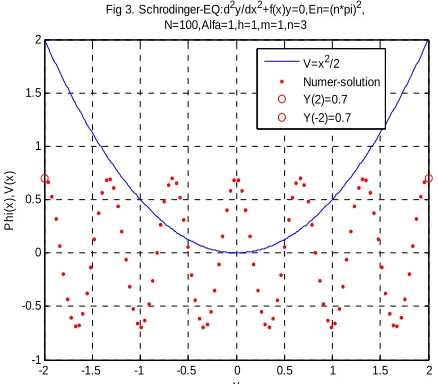
In fact, according to the finite difference principle, a one-dimensional Schrodinger equation can be converted into a set of nodal liner equations expressed in a matrix equation after the space is divided into a series of dis-crete nodes with an equal interval. The matrix left divi-sion command offered in the MATLAB software can be used to derive the function approximation of each un-known nodal function.
7. Concluding Remarks
In this Letter, we consider operator equations and apply
-2 -1.5 -1 -0.5 0 0.5 1 1.5 2
-1 -0.5 0 0.5 1 1.5 2
X
Ph
i(
x)
,V
(x)
Fig 3. Schrodinger-EQ:d2y/dx2+f(x)y=0,En=(n*pi)2, N=100,Alfa=1,h=1,m=1,n=3
V=x2/2 Numer-solution Y(2)=0.7 Y(-2)=0.7
Figure 3. The φ(x) is numerical solution by action of (6.3) under the shake power V(x) = 0.5x2 and in boundary value
condition φ(–2) = φ(2) = 0.7, the φ3(x) express 3-level (here
step length = 0.04, the energy En = ((nπ)2, n = 3).
-2 -1.5 -1 -0.5 0 0.5 1 1.5 2 -1
-0.5 0 0.5 1 1.5 2
X
Ph
i(
x
),
V(
x
[image:6.595.64.282.87.283.2])
Fig 4. Schrodinger-EQ:d2y/dx2+f(x)y=0,En=(n+0.5), N=100,Alfa=1,h=1,m=1,n=3
V=x2/2 Numer-solution Y(2)=0.7 Y(-2)=0.7
Figure 4. The φ(x) is numerical solution by action of (6.3) under the shake power V(x) = 0.5x2 and in boundary value
condition φ(–2) = φ(2) = 0.7, the φ3(x) express 3-level (here
step length=0.04, the energy En = ((nπ)2, n = 3).
the variation iteration method to integral-differential equ- ations, and extend some results in [3,8,10]. The obtained solution shows the method is also a very convenient and effective for various integral-differential equations, only one iteration leads to exact solutions. Recently, the im-pulsive differential delay equations is also a very inter-esting topic, and we may see [10]etc.
In our future work, we may try to do some research in this field and may be could obtain some better results.
8. Acknowledgements
[image:6.595.312.532.343.523.2] [image:6.595.64.282.348.534.2]Founda-tion (No. 11ZB192) of Sichuan EducaFounda-tion Bureau and the key program of Science and Technology Foundation (No. 11ZD1007) of Southwest University of Science and Technology.
The author thanks the Editor kindest suggestions, and thanks the referee for his comments.
REFERENCES
[1] D. Guo and V. Lashmikantham, “Nonlinear Problems in abstract Cones,” Academic Press, Inc., Boston, New York, 1988.
[2] Y. J. Cui, F. Wang and Y. M. Zou, “Computation for the Fixed Index and Its Applications,” Nonlinear Analysis,
Vol. 71, No. 1-2, 2009, pp. 219-226.
doi:10.1016/j.na.2008.10.041
[3] S. Y. Xu, “New Fixed Point Theorems for 1-Set-Con- tractive Operators in Banach Spaces,” Nonlinear Analysis,
Vol. 67, No. 3, 2007, pp. 938-944.
doi:10.1016/j.na.2006.06.051
[4] N. Van Luong and N. X. Thuan, “Coupled Fixed Points in Partial Ordered Metric Spaces and Application,”
Nonlinear Analysis, Vol. 74, No. 3, 2011, pp. 983-992. doi:10.1016/j.na.2010.09.055
[5] N. Chen, and J. Q. Chen, “New Fixed Point Theorems for 1-Set-Contractive Operators in Banach Spaces,” Nonlin-ear Analysis, Vol. 6, No. 3, 2011, pp. 147-162.
[6] G. Z. Li, “The Fixed Point Index and the Fixed Point Theorems of 1-Set-Contrac-Tive Mappings,” Proceedings of the American Mathematical Society, Vol. 104, No. 4,
1988, pp. 1163-1170.
doi:10.1090/S0002-9939-1988-0969052-9
[7] C. X. Zhu and Z. B. Xu, “Inequality and Solution of an Operator Equation,” Applied Mathematics Letters, Vol. 21, No. 6, 2008, pp. 607-611.
doi:10.1016/j.aml.2007.07.013
[8] R. Saadati, M. Dehghan, S. M. Vaezpour and M. Saravi, “The Convergence of He’s Variational Iteration for Solv-ing Integral Equations,” Computers & Mathematics with Applications, Vol. 58, No. 11-12, 2009, pp. 2167-2171. doi:10.1016/j.camwa.2009.03.008
[9] Y. F. Xu, “The Variational Iteration Method for Autono-mous Ordinary Differential Equations with Fractional Order,” Journal of Hubei University Nationalities (Nature Science Edition), Vol. 29, No. 3, 2011, pp. 245-249.
[10] G. B. Asghar and S. N. Jafar, “An Effective Modification of He’s Variational Iteration Method,” Nonlinear Analy-sis: Real World Application, Vol. 10, No. 5, 2009, pp.
2828-2833. doi:10.1016/j.nonrwa.2008.08.008
[11] J. H. He, “Variational Iteration Approach to Schrodinger Equation,” Acta Mathematica Scienca, Vol. 21A, 2001,
pp. 577-583.
[12] S .Q. Wang and J. H. He, “Variational Iterative Method for Solving Integro-Differential Equations,” Physics Let-ters A, Vol. 367, No. 3, 2007, pp. 188-191.
doi:10.1016/j.physleta.2007.02.049
[13] Z. Z. Zhang and S. R. Lu, “Numerical Solution of Sch- rodinger Equation,” Journal of Shanxi Daton Universeity, Vol. 26, No. 2, 2010, pp. 22-24.
[14] Y. F. Wang and L. B. Tang, “Direct Solution of One-Di- mensional Schrodinger Equation through Finite Differ-ence and MATLAB Matrix Computation,” INFRARED