Munich Personal RePEc Archive
Competitive equilibrium with indivisible
objects
Yang, Yi-You
Department of Economics, Aletheia University
2 July 2013
Competitive equilibrium with indivisible objects
∗
Yi-You Yang
†October 19, 2016
Abstract
We study exchange economies in which objects are heterogeneous and
indivisi-ble, and may not be substitutes for each other. We give new equilibrium existence
results with the p-substitutability condition, under which a certain degree of
com-plementarity among objects is permitted according to the parameter vector p.
Moreover, we introduce conditions under which the contributions of objects to the
social welfare are equilibrium prices.
Keywords: Indivisibility, competitive equilibrium, gross substitutability,
p-substitutability.
1
Introduction
We study the equilibrium existence problem for exchange markets with heterogeneous indivisible objects and preferences that are quasi-linear in money. The gross substi-tutability (GS) condition on agents’ preferences is a sufficient condition for the existence
∗Support by Ministry of Science and Technology, R.O.C., under grant MOST 104-2410-H-156-002 is
gratefully acknowledged.
†Department of Economics, Aletheia University, New Taipei City 251, Taiwan. E-mail address:
of a competitive equilibrium and has been extensively studied in the literature.1 Kelso
and Crawford [8] prove that when all agents view objects as substitutes in the sense that their preferences satisfy GS, a price adjustment procedure will end up at a competitive equilibrium. In this paper, we try to extend their analysis to incorporate markets in which objects may not be considered as substitutes by all agents with a weaker condi-tion calledp-substitutability, where a parameter vectorpis employed to permit a certain degree of complementarity among objects.
Suppose that some agentj promises to purchase any set of objects from other agents at price levelp= (pa), where pa is the minimal marginal value of object afor j. We say
that agent i’s preferences are p-substitutable if, taking into accountj’s promise, i would view objects as substitutes for each other. We prove that there exists a competitive equilibrium if each agent’s preferences arep-substitutable.
It should be noted that since the parameter vectorp is derived from the preferences of a certain agent j in the market, p-substitutability is an endogenous condition, and thus, in general, cannot guarantee the existence of an equilibrium for another market. Hence, our existence result does not contradict to the maximal domain theorem by Gul and Stacchetti [5], which shows that if any agent’s preferences fail GS, then all other agents having GS preferences does not guarantee an equilibrium to exist. Moreover, since agent j’s preferences satisfy GS whenever j has p-substitutable preferences, our result complements Gul and Stacchetti’s theorem in the sense that the a single agentj having GS preferences is helpful for sustaining an equilibrium by relaxing the GS restriction on other agents’ preferences.
Based on the foregoing observations, we try to further extend our analysis and give
1
an existence result that can be applied to markets in which no agent has GS prefer-ences. Suppose that the social welfare function of the market has decreasing marginal returns and let p = (pa) be the vector consisting of objects’ contributions to the social
welfare. We prove that if all agents’ preferences arep-substitutable, then (i) there exists a competitive equilibrium; and (ii) pa is the largest competitive price of object a. It is
well-known that the contribution of objectato the social welfare is greater than or equal to any competitive price of a.2 We prove that underp-substitutability, this bound itself
is a competitive price of a.
This paper is organized as follows. We present the model and some fundamental results in Section 2. In Section 3, we introduce the notion ofp-substitutability with an illustrative example and give an existence result. We then relate the existence problem to social welfare function and study equilibrium prices in Section 4, and conclude in Section 5.
2
Preliminaries
Consider an economy with a finite set N = {1, . . . , n} of agents and a finite set Ω =
{a1, . . . , am} of heterogeneous indivisible objects. Let p= (pa)∈R|Ω| be a price vector,
wherepa denotes the price of object a∈Ω. We assume that agents’ net utility functions
are quasilinear in prices: each agenti’s utility of consuming bundleA⊆Ω at price level
pis
ui(A, p)≡vi(A)−p(A),
wherevi : 2Ω →Ris a valuation function satisfyingvi(∅) = 0 andp(A) is a shorthand for
∑
a∈Apa. We also assume that agents are not subject to any budget constraints. Hence
2
such a trading economy can be simply represented byE =⟨Ω; (vi, i∈N)⟩.
A competitive equilibrium for economy E is a pair ⟨p;X⟩, where X = (X1, . . . , Xn)
is an allocation of objects among agents and p∈ R|Ω| is a price vector such that for all
agent i∈N,
Xi ∈Dvi(p)≡arg max
A⊆Ωui(A, p).
In Proposition 1, we recall the standard theorem of welfare economics and include a proof for completeness.
Proposition 1. Let ⟨p;X⟩ be a competitive equilibrium for E =⟨Ω; (vi, i∈N)⟩. Then
(a) X is efficient;3 and
(b) for any efficient allocation Y, ⟨p;Y⟩ is also a competitive equilibrium for E.
Proof. Let Y = (Y1, . . . , Yn) be an arbitrary allocation of objects among agents. Since
Xi ∈Dvi(p) for each i∈N, we have
n
∑
i=1
vi(Xi) = n
∑
i=1
[vi(Xi)−p(Xi)] +p(Ω)
≥
n
∑
i=1
[vi(Yi)−p(Yi)] +p(Ω) = n
∑
i=1
vi(Yi).
Hence X is efficient.
In caseY is efficient, the above inequality implies that for alli∈N,vi(Xi)−p(Xi) =
vi(Yi)−p(Yi) and henceYi ∈Dvi(p).
The gross substitutability introduced by Kelso and Crawford [8] is an essential con-dition for the analysis of equilibrium. A valuation function vi : 2Ω → R satisfies gross
3
substitutability (GS) if for any vector p∈R|Ω|, the following condition holds:
A ∈Dvi(p), p
′ ≥p⇒ ∃B ∈D
vi(p
′) such that {a∈A:p′
a =pa} ⊆B. (1)
It is well-known that each GS valuation function vi : 2Ω → R has decreasing marginal returns 4 i.e., for each objecta∈Ω,
A⊆B ⊆Ω\{a} ⇒vi(B∪ {a})−vi(B)≤vi(A∪ {a})−vi(A).
Theorem 2 of Kelso and Crawford [8] implies that a competitive equilibrium exists when-ever all agnets’ preferences satisfy GS. A natural question is how to extend their analysis to incorporate markets with non-GS preferences.
Gul and Stacchetti [5] address the issue and give a negative result: if any agent’s preferences violate GS, then GS preferences can be found for other agents such that no equilibrium exists. In contrast to Gul and Stacchetti’s approach, we focus on the question of whether the GS preferences of a single agent or a group of agents can help to sustain a competitive equilibrium. In what follows, we will first introduce the notion ofp -substitutability to generalize GS, and then study economies in which agents’ preferences may fail GS.
3
The
p
-substitutability condition
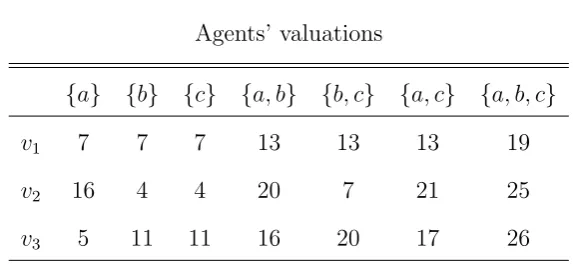
Our analysis begins with an illustrative example. Consider the three-agent economy
E with Ω = {a, b, c} given in Table I. Although only agent 1’s preferences satisfy GS, the efficient allocation X1 = ∅, X2 = {a}, X3 = {b, c} could be supported by prices
4
pa = 16, pb =pc = 9 as a competitive equilibrium. The reason for this is that agent 1’s
[image:7.595.153.440.211.343.2]preferences can complement other agents’ preferences such that objects are viewed as substitutes by all agents in a certain context.
Table I
Agents’ valuations
{a} {b} {c} {a, b} {b, c} {a, c} {a, b, c}
v1 7 7 7 13 13 13 19
v2 16 4 4 20 7 21 25
v3 5 11 11 16 20 17 26
Suppose that agent 1 promises to buy any set of objects from other agents at the price levelpv1 = (pv1
α)∈R|Ω|, where
pv1
α ≡v1(Ω)−v1(Ω\{α})
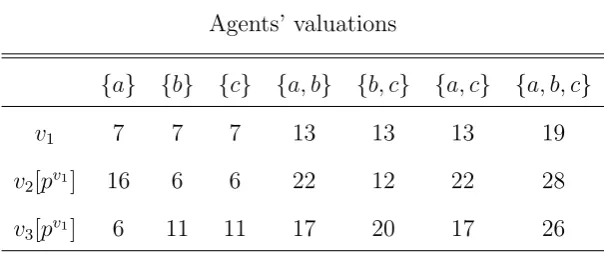
is the minimal marginal value of object α for agent 1.5 In this case, agent i (i = 2,3)
would act the same as an agent with the valuation functionvi[pv1] given by
vi[pv1](A) = max{vi(B) +pv1(A\B) :B ⊆A} for A⊆Ω,
5
Since v1 satisfies GS, it has decreasing marginal returns, and hencev1(Ω)−v1(Ω\{α})≤v1(A)−
and thus leading to the economy E′ =⟨Ω;v
[image:8.595.146.450.168.295.2]1, v2[pv1], v3[pv1]⟩ given in Table II.
Table II
Agents’ valuations
{a} {b} {c} {a, b} {b, c} {a, c} {a, b, c}
v1 7 7 7 13 13 13 19
v2[pv1] 16 6 6 22 12 22 28
v3[pv1] 6 11 11 17 20 17 26
We first note that all agents in enonomy E′ have GS preferences, it follows that
there exists a competitive equilibrium⟨p;X1, X2, X3⟩for E′. Then, by definition, we can
chooseYi ⊆Xi such thatvi[pv1](Xi) =vi(Yi) +pv1(Xi\Yi) and verify that Yi ∈Dvi(p) for
i= 2,3. It is not difficult to check X1∪(X2\Y2)∪(X3\Y3)∈Dv1(p). Hence, we obtain
that there is a competitive equilibrium⟨p;X1∪(X2\Y2)∪(X3\Y3), Y2, Y3⟩for E.
We now introduce the notion ofp-substitutability, and study its relation to GS. The
marginal vectorof a valuation function vi : 2Ω →R is the vector pvi = (pvai)∈R|
Ω| given
by
pvi
a =vi(Ω)−vi(Ω\{a}) fora ∈Ω.
For any vectorp∈R|Ω|, the valuation functionv
i is called p-substitutable if the function
vi[p] : 2Ω →R given by
vi[p](A) = max{vi(B) +p(A\B) :B ⊆A} for A⊆Ω
satisfies GS. By definition, it is clear that vi[pvi](A) =vi(A) for all A⊆ Ω. Hence, vi is
pvi-substitutable if and only if v
Proposition 2. Let p∈R|Ω| and let v
i : 2Ω →R be a valuation function.
(a) If vi satisfies GS, then vi is p-substitutable.
(b) Let p′ ∈ R|Ω| be a vector such that p′ ≥ p. If v
i is p-substitutable, then vi is also
p′-substitutable.
Proof. (a) Assume that vi satisfies GS. Let vj : 2Ω → R be the function given by
vj(A) = p(A) for A ⊆ Ω and let C = {i, j}. Suppose, to the contrary, that vi[p] fails
GS. Theorem 2 of Gul and Stacchetti [5] implies that there exists GS valuation functions
v2, . . . , vr such that the economy E =⟨Ω;vi[p], v2, . . . , vr⟩ has no equilibrium. However,
we are going to show that there exists an equilibrium forE, yielding a contradiction. Note that each agent’s preferences in the economy E′ = ⟨Ω;v
i, vj, v2, . . . , vr⟩ satisfy
GS. Hence there exist an allocation (Xi, Xj, X2, . . . , Xr) and an equilibrium price vector
q ∈R|Ω| such that X
i ∈Dvi(q), Xj ∈Dvj(q) and Xk ∈ Dvk(q) for k = 2, . . . , r. For any
Y ⊆Ω, there existsA⊆Y such that vi[p] =vi(A) +p(Y\A) and hence
vi[p](Xi ∪Xj)−q(Xi∪Xj) = [vi(Xi)−q(Xi)] + [vj(Xj)−q(Xj)]
≥[vi(A)−q(A)] + [vj(Y\A)−q(Y\A)]
=vi[p](Y)−q(Y).
This implies that⟨q;Xi∪Xj, X2, . . . , Xr⟩is a competitive equilibrium for E.
(b) Assume thatvi isp-substitutable. This implies thatvi[p] is GS, and so is (vi[p])[p′].
It suffices to prove that vi[p′] coincides with (vi[p])[p′]. Let A ⊆ Ω be an arbitrary
existsC′ ⊆B′ such that vi[p](B′) = vi(C′) +p(B′\C′). Sincep′ ≥p, we have
vi[p′](A) = vi(B) +p′(A\B)≤vi[p](B) +p′(A\B)≤(vi[p])[p′](A)
=vi[p](B′) +p′(A\B′) = vi(C′) +p(B′\C′) +p′(A\B′)
≤vi(C′) +p′(A\C′)≤vi[p′](A).
This impliesvi[p′](A) = (vi[p])[p′](A) and completes the proof.
The following result shows thatpv1
-substitutability is sufficient for the existence of a competitive equilibrium whenever v1 satisfies GS.
Theorem 1. Let E = ⟨Ω; (vi, i ∈ N)⟩ be an economy. Assume that v1 satisfies GS. If
each agent’s valuation function vi satisfies pv1-substitutability, then E has a competitive
equilibrium.
The proof of Theorem 1 requires the following lemma.
Lemma 1. Let E = ⟨Ω;v1, . . . , vn⟩ be an economy. Assume that v1 has decreasing
marginal returns and that there exists a competitive equilibrium ⟨p;X⟩ for the economy
E′ = ⟨Ω;v
1, v2[pv1], . . . , vn[pv1]⟩. Then there exists Yi ⊆ Xi for i = 2, . . . , n such that
Y1∪(
∪n
i=2(Xi\Yi))∈Dv1(p), and Yi ∈Dvi(p) for i= 2, . . . , n.
Proof. We first note thatpv1
a ≤pa for alla∈Ω\X1. In casepav1 > pa for somea∈Ω\X1,
since v1 has decreasing marginal returns, it follows that
v1(X1∪ {a})−p(X1∪ {a}) = [v1(X1∪ {a})−v1(X1)−pva1] + [p v1
a −pa]
contradicting to the fact X1 ∈Dv1(p).
Fori= 2, . . . , n, there exists Yi ⊆Xi such that vi[pv1](Xi) =vi(Yi) +pv1(Xi\Yi), and
hence
vi[pv1](Yi)−p(Yi)≤vi[pv1](Xi)−p(Xi)
≤[vi(Yi)−p(Yi)] + [pv1(Xi\Yi)−p(Xi\Yi)]
≤vi(Yi)−p(Yi)≤vi[pv1](Yi)−p(Yi).
This implies∑n
i=1[p
v1
(Xi\Yi)−p(Xi\Yi)] = 0 and vi(Yi)−p(Yi) =vi[pv1](Xi)−p(Xi)≥
vi[pv1](A)−p(A)≥vi(A)−p(A) for i= 2, . . . , n and for all A⊆Ω. Moreover, since
v1(Y1)−p(Y1)≥v1(Y1∪(
n
∪
i=2
(Xi\Yi)))−p(Y1∪(
n
∪
i=2
(Xi\Yi)))
≥v1(Y1)−p(Y1) +
n
∑
i=1
[pv1
(Xi\Yi)−p(Xi\Yi)]≥v1(Y1)−p(Y1),
we have Y1∪(∪ni=2(Xi\Yi))∈Dv1(p).
We are now ready to prove Theorem 1.
Proof of Theorem 1. Assume that vi satisfies pv1-substitutability for i = 1, . . . , n. This
implies each agent inE′ has GS valuation function, and hence there exists an equilibrium
forE′. Moreover, since each GS valuation function has decreasing marginal returns and
4
Markets with non-GS preferences
In this section, we will extend our analysis to study economies in which no agent has GS preferences with the notion of aggregate valuation function. For each coalition of agents
C⊆N, the corresponding aggregate valuation function vC : 2Ω→R is defined by
vC(A) = max
{
∑
i∈C
vi(Ai) :
∪
i∈C
Ai =A and Ai∩Aj =∅ for i̸=j
}
for A⊆Ω.
In particular, we call vN the social welfare function of the economyE =⟨Ω; (vi, i∈N)⟩.
The following result shows that when the aggregate valuation function of some coali-tion C has decreasing marginal returns, pvC-substitutability is sufficient for an
equilib-rium to exist.
Theorem 2. LetE =⟨Ω; (vi, i∈N)⟩be an economy. Assume that there exists a coalition
C⊆N such that vC has decreasing marginal returns. If each agent’s valuation function
vi satisfies pvC-substitutability, then
(a) there exists a competitive equilibrium; and
(b) the social welfare function vN satisfies GS.
To illustrate the impact of Theorem 2, we consider the three-agent economy given in Table III. Note that each agent’s preferences violate GS but satisfypvN-substitutability.
market has an equilibrium by Theorem 2.
Table III
Agents’ valuations
{a} {b} {c} {a, b} {b, c} {a, c} {a, b, c}
v1 7 3 3 8 7 8 13
v2 7 7 7 8 8 8 12
v3 3 3 7 7 8 8 13
vN 7 7 7 14 14 14 21
Letp∈ R|Ω| be the vector given by p
a =pb =pc = 4 and let X1 ={a}, X2 ={b}, X3 = {c}. It can be verified that ⟨p;X⟩ is a competitive equilibrium.
Proof of Theorem 2. Assume that vi satisfiespvC-substitutability for i= 1, . . . , n.
(a) Let E′ = ⟨Ω;v
0, v1, . . . , vn⟩ be the economy constructed from E by adding an
agent 0 with the valuation function v0 given by v0(A) = pvC(A) for A ⊆ Ω. Since v0
satisfies GS andpv0
=pvC, the result of Theorem 1 implies that there exists a competitive
equilibrium ⟨p;X0, X1, . . . , Xn⟩ for E′.
Note that in case X0 =∅, ⟨p;X1, . . . , Xn⟩ is a competitive equilibrium for E and we
have done. Suppose X0 ={a1, . . . , ar} ̸=∅. Let A0 =∪i∈CXi and let Aj =Aj−1 ∪ {aj}
forj = 1, . . . , r. SincevC has decreasing marginal returns, we have
vC(Aj)−vC(Aj−1)≥pvaCj for j = 1, . . . , r,
{Xi′}i∈C be a partition of Ar such that vC(Ar) =
∑
i∈Cvi(Xi′). It follows that n
∑
i=0
vi(Xi)≥ n
∑
i=0
vi(Xi′) =vC(Ar) +
∑
i∈N\C
vi(Xi)
≥v0(X0) +vC(A0) +
∑
i∈N\C
vi(Xi)≥ n
∑
i=0
vi(Xi).
This impliesX0′, X1′, . . . , Xn′⟩is an efficient allocation forE′, i.e.,∑n
i=0vi(Xi) =
∑n
i=0vi(Xi′).
By Proposition 1, ⟨p;X0′, X1′, . . . , Xn′⟩ is a competitive equilibrium for E′, and hence
⟨p;X1′, . . . , Xn′⟩ is a competitive equilibrium forE.
(b) Suppose, to the contrary, that vN violates gross substitutability. By Theorem
2 of Gul and Stacchetti (1999), there exists a GS valuation function vn+1, . . . , vn+r
such that there is the economy ⟨Ω;vN, vn+1, . . . , vn+r⟩ has no competitive equilibrium.
However, the result of (a) implies that there exists an equilibrium ⟨p;X1, . . . , Xn+r⟩ for
the economy ⟨Ω;v1, . . . , vn, vn+r⟩. Let XN = ∪i∈NXi. It is not difficult to check that
⟨p;XN, Xn+1, . . . , Xn+r⟩ is an equilibrium for ⟨Ω;vN, vn+1, . . . , vn+r⟩, yielding a
contra-diction.
It is well-known that in equilibrium, the competitive price of objecta∈Ω is less than or equal topvN
a ≡vN(Ω)−vN(Ω\{a}), i.e., the contribution of ato the social welfare. A
proof by Bevi´a et al. [3] is included for completeness.
Proposition 3 (See Bevi´a et al. [3]). Let ⟨p;X⟩ be a competitive equilibrium for E =
⟨Ω; (vi, i∈N)⟩. Then pvN ≥p.
vN(Ω\{a}). SinceX is efficient and Xi ∈Dvi(p) for i= 1, . . . , n, it follows that
vN(Ω)−p(Ω) = n
∑
i=1
[vi(Xi)−p(Xi)]
≥
n
∑
i=1
[vi(Yi)−p(Xi)] = vN(Ω\{a})−p(Ω\{a}).
This impliespvN
a =vN(Ω)−vN(Ω\{a})≥pa.
Following the above observation, Bevi´a et al. [3] and Gul and Stacchetti [5] study the question of under which conditions an efficient allocation can be supported by pvN
as an equilibrium. In the following result, we try to generalize their results with pvN
-substitutability.
Theorem 3. Let E = ⟨Ω; (vi, i ∈ N)⟩ be an economy. Assume that the social welfare function vN has decreasing marginal returns. If each agent’s valuation function vi
sat-isfies pvN-substitutability, then for any efficient allocation X, ⟨pvN;X⟩ is a competitive
equilibrium.
Proof. Consider the economy E′ = ⟨Ω;v
0, v1, . . . , vn⟩ where v0 is the valuation function
given by v0(A) = pvN(A) for A ⊆ Ω and let N′ ={0,1, . . . , n}. The result of Theorem
1 implies that there is a competitive equilibrium ⟨p;Y0, Y1, . . . , Yn⟩ for E′. Without
loss of generality, we may assume that Y0 = {a1, . . . , ar}. Let A0 = ∪ni=1Yi and let
Aj = Aj−1∪ {aj} for j = 1, . . . , r. Morover, since vN has decreasing marginal returns,
we have
vN(Ω)−vN(A0) =
r
∑
j=1
[vN(Aj)−vN(Aj−1)]
≥pvN(Y
This impliesvN(Ω)≥v0(Y0)+vN(A0)≥v0(Y0)+
∑n
i=1vi(Yi) = vN′(Ω) ≥v0(∅)+vN(Ω) =
vN(Ω), and we have vN(Ω) = vN′(Ω). Let (X1, . . . , Xn) be an arbitrary partition of
Ω such that ∑n
i=1vi(Xi) = vN(Ω) = vN′(Ω) and let X0 = ∅. By Proposition 1, we
have that⟨p;X0, X1, . . . , Xn⟩ is also a competitive equilibrium for E′. This implies that
⟨p;X1, . . . , XN⟩ is a competitive equilibrium forE and for eacha ∈Ω,
v0(∅)−p(∅) = 0≥v0({a})−pa=pvaN −pa.
Together with the factpvN
a ≥pa by Proposition 3, we obtain that pvN =p.
5
Concluding remarks
In contrast to our approach, Sun and Yang [13] and Teytelboym [14] extend the GS framework of Kelso and Crawford, and study the effect of complementarity on equilib-rium results under the assumption that objects can be partitioned into different groups and agents’ preferences arealikein the way that they all view objects in the same group as substitutes and objects across different groups as complements. In this paper, we in-troduce the notion ofp-substitutability to permit complex types of complementarity, and give equilibrium results which can be applied to markets with agents having divergent
preferences.
left for further work.
References
[1] E. Baldwin and P. Klemperer, Tropical geometry to analyse demand, mimeo, 2014.
[2] E. Baldwin and P. Klemperer, Understanding preferences: “demand types”, and the existence of equilibrium with indivisibilities, mimeo, 2015.
[3] C. Bevi´a, M. Quinzii, and J. A. Silva, Buying several indivisible goods, Math. Soc. Sci. 37 (1999), 1-23.
[4] S. Fujishige and Z. Yang, A note on Kelso and Crawford’s gross substitutes condition, Math. Oper. Res. 28 (2003), 463-469.
[5] F. Gul and E. Stacchetti, Walrasian equilibrium with gross substitutes, J. Econ. Theory 87 (1999), 95-124.
[6] J.W. Hatfield, S.D Kominers, A.Nichifor, M. Ostrovsky, and A. Westkamp, Stability and competitive equilibrium in trading networks, J. Polit. Economy 92 (2013), 966-1005.
[7] J.W. Hatfield, S.D Kominers, A.Nichifor, M. Ostrovsky, and A. Westkamp, Full Substitutability, mimeo, 2016.
[8] A. S. Kelso and V. P. Crawford, Job matching, coalition formation, and gross sub-stitutes, Econometrica 50 (1982), 1483-1504.
[10] P. Milgrom and B. Strulovici, Substitute goods, auctions, and equilibrium, J. Econ. Theory 144 (2009), 212-247.
[11] H. Reijnierse, A. van Gellekom, and J. A.M. Potters, Verifying gross substitutability, Econ. Theory 20 (2002), 767-76.
[12] A. Shioura and A. Tamura, Gross substitutes condition and discrete concavity for multi-unit valuations: a survey, J. Oper. Res. Soc. Japan 58 (2015), 61-103.
[13] N. Sun and Z. Yang, Equilibria and indivisibilities: Gross substitutes and comple-ments, Econometrica 74 (2006), 1385-1402.