ISSN Online: 2152-7393 ISSN Print: 2152-7385
Buffon’s Needle Algorithm to Estimate
π
Chi-Ok Hwang
1*, Yeongwon Kim
2, Cheolgi Im
1, Sunggeun Lee
31Division of Liberal Arts and Sciences, GIST College, Gwangju, Korea
2Concentration of Electrical Engineering and Computer Science, GIST College, Gwangju, Korea 3Concentration of Physics, GIST College, Gwangju, Korea
Abstract
Buffon’s needle experiment was originally devised to get the value of π. With the advent of computers, Buffon’s needle algorithm has been used pedagogi-cally as an example of Monte Carlo methods in introduction classes, and there are many Buffon’s needle algorithm implementations available on the inter-net. However, for the calculation of π, the exact value of π is used in the programs for Buffon’s needle angle sampling, and hence the example is not demonstrated correctly. This brief note presents a random angle sampling al-gorithm for the Buffon’s needle. We then compare the Buffon’s needle and Hit-and-Miss integration algorithms using Monte Carlo laboriousness com-parison, and find that the Hit-and-Miss algorithm is superior.
Keywords
Buffon’s Needle, Monte Carlo, Angle Sampling
1. Introduction
Buffon’s needle experiment [1] was originally used to provide π. Throwing a needle (see Figure 1) onto a flat plane with equally-spaced parallel lines, the probability that the needle touches the parallel line provides an estimate for π
is
0 2sin
2 l d P d π θ θ π
=
∫
(1)and so
2
= l
Pa
π
(2) where P is the probability, l the length of the needle and a the spacingwith l<a.
How to cite this paper: Hwang, C.-O., Kim, Y., Im, C. and Lee, S. (2017) Buffon’s Needle Algorithm to Estimate π. Applied Ma- thematics, 8, 275-279.
https://doi.org/10.4236/am.2017.83022
Received: December 13, 2016 Accepted: February 28, 2017 Published: March 3, 2017
Copyright © 2017 by authors and Scientific Research Publishing Inc. This work is licensed under the Creative Commons Attribution International License (CC BY 4.0).
http://creativecommons.org/licenses/by/4.0/
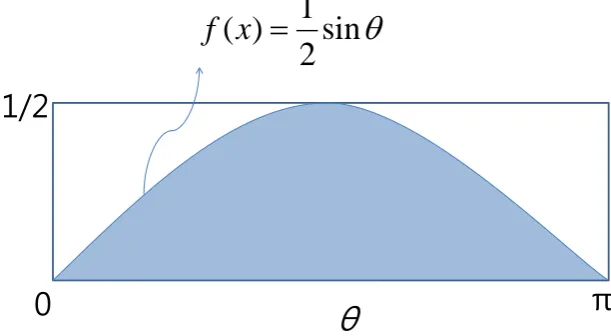
Here, we should note that the Buffon’s needle problem becomes an integra-tion problem (see Figure 2) so the probability is just the ratio of areas.
Many variants of the original Buffon’s needle experiment [2] [3] [4] [5] [6] [7]
have been developed. Kendall and Moran [2] and Diaconis [3] examined several aspects of the problem for a long needle (l>a) and Siniksaran [7] used
Ma-thematics to review various statistical aspects of the experiment.
With the advent of computers, Buffon’s needle has been pedagogically used as an example in Monte Carlo method introductory classes and many websites pro- vide Buffon’s needle algorithm implementations. However, in these programs, the value of π is used for the random sampling of the needle angular direction. Thus π is used to obtain the value of π itself.
[image:2.595.216.522.541.709.2]This note presents a sampling algorithm for the random direction of the needle that avoids using
π
within the algorithm. We then compare the Buf-fon’s needle and the Hit-and-Miss integration algorithms using the common Monte Carlo algorithm comparison method, the time consumption (laborious-ness) [8].Figure 1. Buffon’s needle algorithm with spacing a and needle length l.
Figure 2. Buffon’s needle problem can be converted to an integration problem.
l
a
0
π
1/2
θ
θ
2. Buffon’s Needle Algorithm
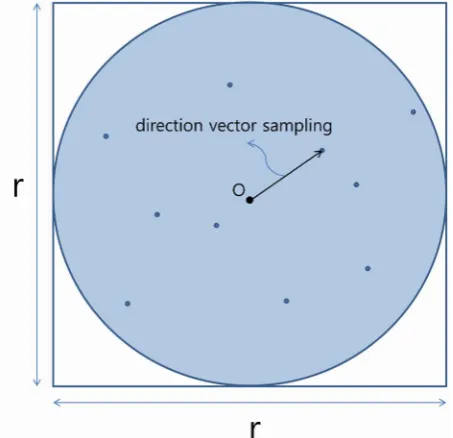
For random direction sampling of the needle, we use a square enclosing a tightly fitted circle (see Figure 3).
Since the directions of the random points inside the circle are uniform, we obtain uniform needle random directions.
3. Comparison with the Hit-and-Miss Algorithm
The Hit-and-Miss integration algorithm can also provide the value of π. Using one quadrant of the circle circumscribed by a square (see Figure 4), we can ob-tain π = 4h, where, h is the probability of hitting the shaded area, when we
generate a pair of random numbers to sample a random point inside of the square. We use the common Monte Carlo algorithm comparison, time consumption (laboriousness): [8] t Dξ where t is the CPU time expended in calculating a
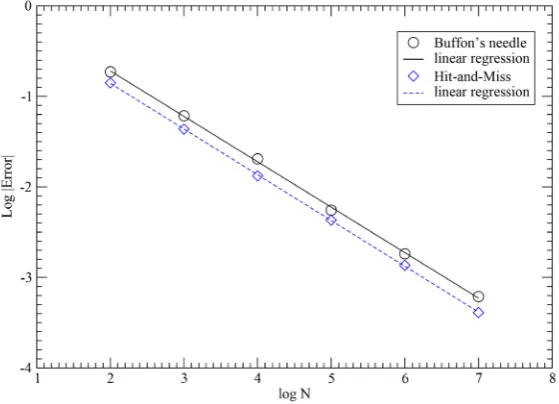
single estimate and Dξ estimate variance. Figure 5 shows the log-log plot of
the number of Monte Carlo steps v.s. the errors of the two algorithms, and Table 1 compare the two algorithms. The Hit-and-Miss algorithm is superior to the Buffon’s needle algorithm for calculation of π, which seems reasonable given the Buffon’s needle algorithm requires more numerical operations for a Monte Carlo step. Of course, we can improve Buffon’s algorithm performance using a tighter non-constant proposed probability distribution for the acceptance-rejec- tion sampling method. Using quasi-Monte Carlo random numbers [9] for the angle sampling will also improve the convergence.
4. Conclusion
[image:3.595.263.490.471.690.2]Buffon’s needle algorithm has been pedagogically used as an introduction to
Figure 4. Hit-and-Miss diagram. Using a pair of random num- bers, we obtain the probability of hitting inside of the marked quadrant.
Figure 5. Monte Carlo steps and estimation errors. The linear regression slopes for Buffon’s needle and Hit-and-Miss algorithms (solid and dotted lines res- pectively) are −0.502 and −0.505 with correlation coefficients −0.9994 and
0.9999
− respectively.
Table 1. Time consumption of Buffon’s needle and Hit-and-Miss algorithm. Variances were obtained from 100 independent runs and the number of random walks per run was
7
10 .
Method CPU time per run (s) Variance ( 7
10− ) Time consumption ( 6
10− )
Buffon’s needle 15.9 5.97 9.49
Hit-and-Miss 13.0 2.51 3.26
[image:4.595.208.540.678.730.2]Monte Carlo methods. However, π is used for needle angle sampling inside the original algorithm. This note presents a method for the needle angle sam-pling without using π and make the Buffon’s needle algorithm a Monte Carlo method to estimate π. We compared the Buffon’s needle and Hit-and-Miss in-tegration algorithms and found that the Buffon’s needle algorithm is not supe-rior to the Hit-and-Miss integration algorithm.
Acknowledgements
This research was supported by the Basic Science Research Program through the National Research Foundation of Korea (NRF) funded by the Ministry of Educa-tion, Science and Technology (2012R1A1A2003025). Also, later this work was supported by the GIST Research Institute (GRI) in 2017. In addition, this re-search was a collaborative rere-search project, supercomputing infrastructure ser-vice and application, supported by the Korea institute of science and technology information.
References
[1] Buffon, G. (1777) Essai da’rithme’tique morale. Histoire Naturelle, Générale, et Par-ticuliére, Supplément, 4, 685.
[2] Morton, R.A. (1966) The Expected Number and Angle of Intersections between Random Curves in a Plane. Journal of Applied Probability, 3, 559-562.
https://doi.org/10.1017/S0021900200114342
[3] Diaconis, P. (1976) Buffon’s Problem with a Long Needle. Journal of Applied Prob-ability, 13, 614-618.
[4] Periman, M.D. and Wichura, M.J. (1975) Sharpening Buffon’s Needle. Amer. Stat, 29, 157.
[5] Solomon, H.(1987) Geometric Probability. SIAM, Philadelphia.
[6] Wood, G.R. and Robertson, J.M. (1998) Information in Buffon Experiments. Jour-nal of Statistical Planning and Inferences, 66, 415-421.
[7] Siniksaran, E. (2008) Throwing Buffon’s Needle with Mathematica. The Mathemat-ical Journal, 11, 71.
[8] Sobol, I.M. (1994) A Primer for the Monte Carlo Method. CRC Press, Washington DC.
Submit or recommend next manuscript to SCIRP and we will provide best service for you:
Accepting pre-submission inquiries through Email, Facebook, LinkedIn, Twitter, etc. A wide selection of journals (inclusive of 9 subjects, more than 200 journals)
Providing 24-hour high-quality service User-friendly online submission system Fair and swift peer-review system
Efficient typesetting and proofreading procedure
Display of the result of downloads and visits, as well as the number of cited articles Maximum dissemination of your research work
Submit your manuscript at: http://papersubmission.scirp.org/