Munich Personal RePEc Archive
Ties matter: improving efficiency in
course allocation by introducing ties
Chen, Ning and Li, Mengling
Nanyang Technological University, Singapore
25 April 2013
Online at
https://mpra.ub.uni-muenchen.de/47031/
by Introducing Ties
By Ning Chen and Mengling Li∗
We study the course allocation system at Nanyang Technological University, where students submit strict preferences for courses and courses have implicit preferences for students. This formulates a many-to-many matching problem. We show the inefficiencies of the current mechanism and propose new competing mechanisms called Pareto-improving draft and dictatorship mechanisms, which introduce ties into students’ preferences. Our mechanisms gen-erate (group) stable and Pareto-efficient allocations, and the dic-tatorship mechanism can be implemented truthfully. Simulations on real data show that introducing ties into students’ preferences can significantly improve efficiency, and the draft mechanism out-performs the dictatorship mechanism despite that the former is non-strategyproof.
JEL: C78, D82, I23
Course allocation is a classic many-to-many matching problem in which a set
of courses are allocated to a set of students who have multiunit course demands.
Allocating courses equitably and efficiently has proven a challenging market
de-sign problem and there has been little in the literature to address it due to a
variety of difficulties. First, students do not have proprietary rights over courses;
therefore, buying or selling courses through money transfer is strictly prohibited.
Second, the use of an unauthorized computer program to gain unfair advantage
over other students in securing courses is unacceptable. Third, students may have
preferences not only for individual courses but also for combinations of courses,
and these preferences may include ties (i.e., indifferences); thus, they may exhibit
∗ Chen: Division of Mathematical Sciences, School of Physical and Mathematical Sciences, Nanyang
Technological University, Singapore (e-mail: [email protected]); Li: Division of Mathematical Sciences, School of Physical and Mathematical Sciences, Nanyang Technological University, Singapore (e-mail: [email protected]).
complicated strategic behavior. Finally, because most applications involve a large
number of students and courses under a strict deadline to produce a feasible
al-location, an efficient computation is critical. Consequently, the course allocation
problem and the more general many-to-many matching problems are substantially
more difficult to address than one-to-one and many-to-one allocation problems.1
In practice, there are two main types of course allocation mechanisms employed
in educational institutions.
• Preference-ranking mechanisms, e.g., the draft mechanism at Harvard Business
School (HBS), in which students submit ordinal preferences for courses.
Bud-ish and Cantillon (2012) showed that the draft mechanism is manipulable in
theory and manipulated in practice; but, interestingly, the mechanism
outper-forms the strategyproof alternative, which implies that strategyproofness has
both benefits and costs. The authors further proposed a proxy draft
mecha-nism that is shown to generate better efficiency. Later, Kominers et al. (2010)
proposed a new proxy mechanism that simplifies students’ strategic decision
by directly incorporating their manipulation strategy into the mechanism. The
mechanism is Pareto-efficient and resistant to strategic manipulations observed
in the extant data. However, other unobserved manipulations may still exist. • Bidding mechanisms, e.g., the mechanism at the Ross School of Business at
the University of Michigan (UMBS), in which students bid for courses. In the
UMBS mechanism, bids submitted by students play a dual role—to infer the
preferences of both students and courses. These two roles can easily conflict
and result in unnecessary efficiency loss. S¨onmez and ¨Unver (2010) proposed
an alternative Gale-Shapley Pareto-dominant mechanism that asks students
to submit their preferences for courses in addition to bids. The mechanism
is confirmed to have superior efficiency in both field and laboratory studies
by Krishna and ¨Unver (2008). However, the mechanism is not strategyproof,
which can prompt additional concerns about efficiency loss.
1The generalization to multiunit demand on both sides is nontrivial as the properties and structures
Note that while the common objectives of course allocation mechanisms are
effi-ciency and equity, the practice of using different mechanisms in different
educa-tional institutions indicates that the current mechanisms are neither well
under-stood nor satisfactory.
In this paper, we examine the course allocation system for around 13,000
un-dergraduate students at Nanyang Technology University (NTU) in Singapore and
explore its potential improvement. In NTU’s current mechanism, students submit
strict preferences for individual courses in different categories and courses have
predeterminedpreferences (with ties) for students, which are essentially the
pri-oritiesof each student. A centralized mechanism then determines allocations by
considering student-course pairs in an order based on the priorities of students and
their course preferences. This is a preference-ranking mechanism and is similar to
the Boston Student Assignment Mechanism (Abdulkadiro˘glu and S¨onmez 2003).
The details of the mechanism are deferred to the subsequent section.
The NTU’s mechanism does exhibit some nice properties. An allocation
gen-erated through this mechanism is bothpairwise stable (i.e., there is no
student-course blocking pair) and students-sided group stable (i.e., there is no group of
students such that each of them can strictly improve his/her assignment by
swap-ping courses among themselves). Note that the latter is a simple implication of
the strict preferences of students and a homogeneity property exhibited by the
students’ priorities. However, the mechanism is not strategyproof in theory and
is manipulated in practice.2 Furthermore, breaking ties arbitrarily at random
(as courses’ preferences for students have ties) may result in severe efficiency
loss. A similar issue was recently addressed for many-to-one matchings (Erdil
and Ergin 2006, Erdil and Ergin 2008, Abdulkadiro˘glu et al. 2009).
A critical ingredient in NTU’s mechanism is that students are enforced to
sub-mitstrictpreferences. Indeed, much of the literature on many-to-many matching
markets assumes strict preferences when studying solution concepts.3 In
prac-2As shown in a field survey of over 1,200 students at NTU (see Figure 1), 19 percent indicate that
they would manipulate their preferences.
3Roth (1984) showed that the set of pairwise stable matchings is nonempty with substitutable
tice, however, there are various matching markets in which agents are not able to
strictly rank their prospective partners for a variety of reasons (e.g., incomplete
information). Our survey data (see Figure 1) show that in the course allocation
at NTU, 76 percent of students prefer to have ties in their preference lists. This
motivates us to design a course allocation mechanism for many-to-many matching
markets that includestiesin both courses’ and students’ preferences, in the hope
of satisfying more students’ demand and increasing overall efficiency.
Before designing our mechanism, we examine which solutions are desired in
course allocation. On the one hand, we still hope to keep pairwise and
student-sided stability to capture fairness by taking students’ preferences and priorities
into account. On the other hand, we require that the allocation be
Pareto-efficient, which to some extent qualifies the overall efficiency of an allocation.
Pairwise stability and Pareto efficiency (together called Pareto stability as
sug-gested by Sotomayor (2011)), provide a natural solution benchmark for matching
markets in the presence of ties. Note that Pareto stability and one-sided group
stability generally cannot coexist (Claim 1). However, in our application, with the
homogeneity property of the students’ priorities, we show that Pareto stability
implies one-sided group stability (Proposition 2).
The question then becomes whether a Pareto-stable matching always exists, and
how to find one efficiently. Introducing ties into preferences results in dramatic
changes to the properties of stable matchings. In particular, stability no longer
guarantees Pareto efficiency.4 The question of finding a Pareto-stable matching
has recently been addressed by Erdil and Ergin (2006, 2008) for many-to-one
matchings. They presented a stability-preserving Pareto-improving algorithm
by eliminating augmenting paths/cycles. However, their algorithm fails to work
for many-to-many matchings, in which Pareto improvement does not necessarily
preserve stability (see Example 5).
We construct an efficient algorithm that computes a Pareto-stable
many-to-many matching. Our result immediately implies the existence of such a
match-in which the set of group stable matchmatch-ings is empty. Echenique and Oviedo (2006) later gave conditions under which the group stable matchings set is nonempty and can be approached through an algorithm.
4For example, there are two menm1, m2and two womenw1, w2, wherem1strictly prefersw1tow2,
but all others are indifferent amongst their possible partners. The matching (m1, w2),(m2, w1) is stable,
ing. Our algorithm works for general arbitrary preferences for individuals in the
presence of ties. The algorithm, from a high-level overview, builds on the idea
of Roth and Vande Vate (1990), who provided an alternative to the deferred
ac-ceptance algorithm that computes a stable (one-to-one) matching. The details of
the algorithm are presented in Section IV.
Our algorithm, like those of Erdil and Ergin (2006, 2008), is a Pareto-stable
matching mechanism, which is generally not strategyproof (see Example 2 of Erdil
and Ergin (2008)). In the course allocation applications, we construct two
addi-tional competing allocation mechanisms: thePareto-improving draft mechanism
and thePareto-improving serial dictatorship mechanism, based on the
homogene-ity of students’ priorities. Both mechanisms compute a Pareto-stable matching
and the latter can be implemented in a truthful manner, which makes it a
dom-inant strategy for students to report their true preferences. This significantly
simplifies the strategic consideration of students. The truthful mechanism is
based on the combination of the random serial dictatorship mechanism and
aug-menting paths/cycles elimination. While the dictatorship mechanism exhibits the
property of strategyproofness, it brings out some potential fairness issues by
giv-ing too much priority to the lucky students who get a high random order while
callously disregarding the preferences of those who belong to the same priority
group but receive a low random order. Therefore, with some simple welfare
mea-sures, including the average rank of assigned courses and the total number of
unassigned students, we compare the performance of the Pareto-improving draft
and dictatorship mechanisms using real course registration data.
To quantify efficiency improvement that allows ties in students’ preferences and
compare the two competing allocation mechanisms, simulations are performed
us-ing real course registration data from three academic years at NTU: 2010, 2011
and 2012 at NTU. A survey has revealed that a majority of students prefer to
have two or three levels of preference. Given the strict preferences submitted by
students, we therefore divide the students’ preferences into two or three levels
at random and assume that students are indifferent between courses at the same
level. We run simulations in different environments introducing ties and for
simulation results show that (1) the efficiency in terms of total number of
alloca-tions and total number of unassigned students can be significantly improved by
introducing ties into students’ preferences; (2) the draft mechanism outperforms
the dictatorship mechanism in terms of the total number of allocations, the
av-erage rank and the total number of unassigned students, even though it is not
strategyproof.
Organization. The remainder of this paper is organized as follows. Section I
describes NTU’s current course allocation system and mechanism. Section II
for-mally defines the many-to-many matching model with ties. Section III discusses
the solution concepts considered in this paper. The algorithm that computes a
Pareto-stable matching in general frameworks and two specific mechanisms for
the course allocation problem are described in Section IV. The simulation results
and discussions are presented in Section V. We conclude our work in Section VI.
I. NTU Course Allocation: Matching with Preferences
In course allocation, while it is natural to assume that students have preferences
for courses, educational institutes usually decide a priority ranking for individual
students for each course. For instance, a course may take prior considerations for
final year graduating students who need the course to fulfill graduation
require-ments, or those who failed the course in the preceding semesters and need to take
the course again in the current semester. The priority ranking can be considered
a course’s implicit preference for students.
The current course allocation system at NTU solicits preferences from both
students and courses to decide allocations. Specifically, in addition to the major
core courses required by each department, there are two types of general education
requirements that are open to students from all departments: Prescribed Electives
(PE) and Unrestricted Electives (UE).5 Students submit up to five courses under
a strict order as preferences for both PE and UE, respectively, to the system.
The implicit preferences of courses for individual students (i.e., their priorities)
are formed according to the following hierarchy (from highest to lowest):
1) • Students with only PE courses remaining to fulfill, if the course is a
PE type.
• Students with only UE courses remaining to fulfill, if the course is a UE type.
• Students with only PE or UE courses remaining to fulfill, if the course
is both a PE and UE type.
2) Final year students.
3) Students of special programs (e.g., accelerated bachelor degree).
4) Year 3 students.
5) Year 2 students.
Note that some of the students are at the same level on the priority lists; that is,
there are ties (i.e., indifferences) in the courses’ preference lists. In addition, it
can be seen that all of the courses have the same preferences for students (called
homogeneous). In particular, all of the courses (PE or UE) can list all those
students who have only PE or UE courses to fulfill in the first priority. (This is
because a student with only PE/UE courses to fulfill will not submit any UE/PE
courses, respectively. The individual rationality property of feasible assignments
allows us to unify the preferences of courses in such a way.)
PROPOSITION 1: The preferences of courses for students are homogeneous.6
Each course has a prespecified capacity constraint due to resource limitations,
e.g., the size of a classroom. In addition, every student has a capacity constraint
as well, which sets an upper bound on the number of registered courses allowed.
Specifically, except for final year graduating students, a student will be allocated,
at most, one course for PE and one course for UE. In addition, for all students
(including those in their final year), a maximum of 24 academic units (including
major core courses) can be registered within one semester, which corresponds to
about 7 courses.
Given the capacity constraints and preferences of both students and courses,
the system allocates the courses to the students using a mechanism, which runs
6Precisely, some courses may have special predetermined preferences for students (e.g., the course
for PE and UE courses separately and sequentially, first for PE, followed by UE.
(If a course is in both PE and UE, its capacity will be predivided for PE and UE,
respectively, by the administration.) The mechanism is described as follows.
NTU mechanism
Consider students priority by priority. For all students that are at the same
priority level, consider courses according to their preferences. That is, for
k= 1, . . . ,5,
• Consider all student-course pairs in which the student is at the considered
priority level and the course is as his/her k-th choice, and assign courses
to students amongst these pairs subject to the capacity constraints (with ties
broken randomly).
The mechanism is simple to implement and quite similar to the Boston Student
Assignment Mechanism as described by Abdulkadiro˘glu and S¨onmez (2003). The
main difference is that the Boston Student Assignment Mechanism runs
simul-taneously for all students instead of running separately for students in different
priority groups. A serious shortcoming of the Boston Student Assignment
Mech-anism is that students with high priorities at specific schools lose their priorities
unless they list these schools as their top choices. As a consequence, truth-telling
is not a dominant strategy and students can easily manipulate their preferences.
Indeed, in a recent field survey (see Figure 1) of NTU’s current course allocation
system, from a pool of over 1,200 participating students, 19 percent indicated that
they did not place course preferences truthfully. Manipulation is a key challenge
to the mechanism, and may result in severe efficiency loss.
A. Inefficiency of the Mechanism
While the NTU mechanism guarantees fairness to some extent by considering
the preferences of students and courses, there are a large number of students who
are not assigned any course due to competitiveness and the mechanism, which
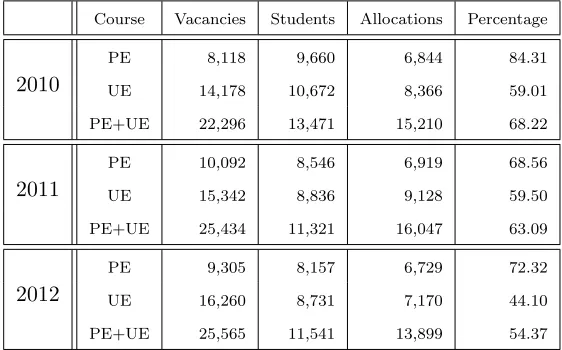
results in considerable efficiency loss (see Table 1 for the data summary of course
allocation statistics for the three academic years: 2010, 2011 and 2012). Note that
the allocation statistics were collected after certain manual adjustments, which
have already corrected some of the inefficiency issues in the results directly from
Table 1—Course Registration Statistics for Semester 1 of Academic Year 2010-2012.
Course Vacancies Students Allocations Percentage
PE 8,118 9,660 6,844 84.31
2010 UE 14,178 10,672 8,366 59.01
PE+UE 22,296 13,471 15,210 68.22
PE 10,092 8,546 6,919 68.56
2011 UE 15,342 8,836 9,128 59.50
PE+UE 25,434 11,321 16,047 63.09
PE 9,305 8,157 6,729 72.32
2012 UE 16,260 8,731 7,170 44.10
PE+UE 25,565 11,541 13,899 54.37
Percentage is measured as the total number of allocations over the total vacancies. For instance, for the 2010 data, the PEs and UEs have 8,118 and 14,178 vacancies while 9,660 and 10,672 students demand them, respectively. The data indicate that the current systems resulted in an allocation of 6,844 PEs and 8,366 UEs. About 29.15 percent and 21.61 percent of the students who requested PEs and UEs failed to get any allocation, respectively. Note that in the 2011 data, the number of UE allocations is larger than that of students, because a considerable amount of students get more than one UE registered in the process of manual adjustments after the implementation of the mechanism.
submitted by unsatisfied students, and can even cause the deferral of graduation
for final year students. Due to the inefficiency of the NTU mechanism, many
unsatisfied students and program coordinators spend a tremendous amount of
time and effort manually seeking better allocations. Despite this effort, some
students can still end up with an unfavorable outcome in which no course is
registered.
Our survey statistics (Figure 1) show that 65 percent of students find the current
system unsatisfactory. Another important phenomenon illustrated in the survey
is that 76 percent of the students think that they should be allowed to indicate
ties (i.e., indifferences) in their course preferences. In practice, while students
may have strict preferences for some courses, such strictness is not very sensitive
in the sense that most students are usually only concerned with whether one
of his/her desired courses is registered, but not exactly which one. In other
words, it is reasonable to assume that students’ preferences should have ties. As
with the objective of reducing the flaws in the current system and improving
overall efficiency for students.
1) Are you satisfied with the current course allocation system?
• Yes --- 35 percent • No --- 65 percent
2) Are you indifferent between two or more courses that you are interested in (i.e., among these courses, you do not strictly prefer one to another)?
• Yes --- 76 percent • No --- 24 percent
3) If your answer is "Yes" to the previous question, how many levels would like to have in your preference structure (assuming you are indifferent between the courses in the same level)?
• One level (all indifferent) --- 10 percent
• Two levels --- 35 percent
• Three levels --- 23 percent
• Four levels --- 8 percent
4) What is the number of courses you would like to put on your preference list?
• Five --- 75 percent
• Ten --- 13 percent
• Other --- 12 percent
5) Do you submit courses to the system according to your true preferences?
[image:11.612.118.493.139.394.2]• Yes --- 81 percent • No --- 19 percent
Figure 1. Survey Questions and Results for 1,200 students at NTU.
II. Model
Given the fact that both students and courses have capacities and incomplete
preferences with ties, we consider a two-sided many-to-many matching model with
a set of menM and a set of women W.7 Throughout this paper, we use m∈M
to denote a man, w ∈ W to denote a woman and x, y, z ∈ M ∪W to denote
any individual agent (man or woman). For each agent x ∈ M ∪W, let cx ∈ N
be his/her capacity, which is the maximum number of agents on the opposite
side that can be matched to x. The presence of capacities allows us to assume,
without loss of generality, that|M|=|W|=n, as dummy agents withcx= 0 can
be added to the market.
Each manm∈M has apreferencelist Pm ranking individual women, denoted
7As our model and technical results work for more general settings, we use the terms ‘men’ and
by≻and =, wherew1≻w2 means thatmstrictly prefersw1 tow2, andw1 =w2
means thatm is indifferent between them8. We say m weakly prefers w1 to w2
if either w1 ≻ w2 or w1 = w2, denoted by w1 ≽ w2. Every two women in Pm
are comparable and the preference is assumed to be transitive. The preference
Pm gives a partial list of individual women that are acceptable tom(i.e.,mdoes
not want to be matched with any woman that is not on the list). For example, a
possible preference list formisPm : (w1 =w2≻w3 =w5). Here,mis indifferent
between w1 and w2, prefers either of them to w3 and w5, amongst which m is
indifferent, and finds all other women unacceptable. The preference list Pw for
each womanw∈W is defined similarly.9 We useE={(m, w)|m∈Pw, w∈Pm}
to denote the set of mutually acceptable pairs.
Note that the preference lists Pm and Pw as defined above are for
individu-als. Because agents can have capacities greater than one, we also need to define
preferences for subsets. Considering our motivating application course allocation,
from the viewpoint of courses, they only care about the interests of individual
students and do not necessarily have preferences over subsets of students. (In
particular, the preferences of courses for individual students are according to
the students’ need to take the courses, rather than their identities and scores.)
Students in NTU’s current system are only allowed to submit preferences for
individual courses. Indeed, with a large number of students and courses,
spec-ifying preferences for subsets results in complicated comparisons of alternatives
and lengthy preference lists, yielding an inapplicable system. In addition, while
students may have preferences for subsets of courses, this mostly occurs among
those with prerequisite relations, which cannot be registered in the same semester.
For example, one must take the course ‘Microeconomic Principles’ before being
allowed to take the course ‘Industrial Organization’. Within one semester the
main concern of every student is thus individual courses.
Therefore, in our study we assume that preferences areresponsive with a lattice
structure. That is, given a subset S ⊆ W and two womenw, w′ ∈/ S, m prefers
8Precisely, there is a subscriptionmin the notations, i.e.,≻
mand =m. For simplicity we omit the subscription when it is clear from the context.
9In the application of course allocation at NTU, students submit two preference lists, one for PE and
S∪ {w} to S ∪ {w′} if and only if m prefers w to w′. (Note that it is allowed
thatw orw′ =∅; in particular, m prefers ∅ to any woman w /∈Pm, prefers any
womanw∈Pm to∅, and is indifferent between anyw, w′ ∈/ Pm.) In other words,
for any two sets that differ in only one woman, m prefers one that contains
the more preferred woman and is indifferent between them if he is indifferent
between the two women. The preferences of women are defined similarly. In
addition, the responsive preference is transitive, i.e., if m prefers S1 to S2 and
S2 to S3, he also prefers S1 to S3. Note that this preference for subsets only
constitutes a partial order, precisely, a complete distributive lattice. That is, two
alternatives are comparable only if they are an ancestor-descendant relation in the
lattice.10 In Appendix B, we give an example to show responsive preference with
a lattice structure. This model of preferences with multiunit capacity has been
used in, e.g., Erdil and Ergin (2006). It is simple, because agents only need to
express preferences for individuals, and is arguably natural for settings in which
the benefit from a partner to an agent does not depend on the agent’s remaining
partners.
Given the preferences of all of the agents, our objective is to establish a
multiu-nit pairing between men and women, called anassignment (or a many-to-many
matching). An assignment is denoted by µ = (µmw)m∈M,w∈W, where µmw = 1
means thatmand ware matched andµmw = 0 otherwise. A feasibleassignment
is one that satisfies the following conditions: ∑
wµmw ≤cm and
∑
mµmw ≤cw,
and µmw = 1 only if m and w are mutually acceptable. All of the assignments
considered in this paper are feasible. Further, for anyx∈M∪W, we denote by
µ(x) the set of individuals matched tox in the assignment µ.
III. Solution Concepts
Given the many-to-many matching model defined above, the next question is
which assignment is desired. While we cannot satisfy the demands of all students,
we hope to provide a solution that is in favor of most students. In this section,
we examine a number of solution concepts from different perspectives in course
allocation.
10Note that the responsive preference defined in Roth and Sotomayor (1990) is a complete ranking for
A. Pairwise Stability
In many two-sided matching models, e.g., student placement and school choice
(S¨onmez and ¨Unver 2011), one desired property of an allocation is theelimination
of justified envy. That is, whenever a student mprefers the allocation of another
student m′, m should not rank higher than m′ in the priority list of courses.
Consider the following example.
EXAMPLE 1: There are two studentsm1, m2 and two courses w1, w2 each with
unit capacity. Their preferences are shown on the left-hand side below.
w2
w
1
m2
m
1
w
1≻w
2
w1≻w2
m
2≻m
1
m2≻m1
w2
w
1
m2
m
1
In the first allocation, m2 is not assigned to his first choice w1, which lists him
with a higher priority than m1. In such a case, m2 can simply ask:
“I am more eligible for the course; why was I not assigned?”
Hence, a fairer solution is to allocatew1 tom2 (see the above figure on the
right-hand side). Now m1 is not assigned to his first choice w1, but he can use the
following reasoning:
“I did not get the course, but all those who got it are (more) eligible.”
Equivalently, if a course (i.e., w2) has not been assigned to a student (i.e., m2)
who has a higher priority, then the student should be assigned to another course
that he prefers (more).
The issues illustrated by the example above are captured by stability, a solution
concept first proposed by Gale and Shapley (1962) in the application of marriage
markets and college admission. The formal definition of stability in our
many-to-many matching model is as follows.
DEFINITION 1 (Pairwise stability): We say that a feasible assignment µ =
(µmw)is (pairwise) stableif there is no mutually accepted pair(m, w)∈E (called
• Bothm andw have leftover capacity;
• m has leftover capacity and there is m′, µ
m′w = 1, such thatw strictly prefers
m to m′; or w has capacity remaining and there is w′, µmw′ = 1, such that m
prefers w to w′;
• There are m′ and w′, µmw′ = 1 and µm′w = 1, such that m strictly prefers w
to w′ and w strictly prefersm tom′.
In course allocation, the stability concept ensures a certain level of fairness
among students in the sense that no blocking pairs can upset the structure of
a matching. It creates a balance in the competition among students and their
priorities in each course.
Note that both members of a blocking pair are able to strictly improve their
assignments respectively by matching with each other (and possibly breaking
some of the current assignments). A stable assignment always exists, and can
be found using a variant of Gale-Shapley’s deferred acceptance algorithm (Gale
and Shapley 1962) for computing one-to-one stable matchings (e.g., by makingcx
copies for each individualx∈M∪W with the same preference list and breaking
ties randomly).
B. Pareto Efficiency
Another important criterion in our application is social welfare, which measures
the overall efficiency of an allocation. Consider the following two examples.
EXAMPLE 2: There are two studentsm1, m2 and two courses w1, w2 each with
unit capacity. Their preferences are shown on the left-hand side below.
w2 w
1
m2 m
1
w
1=w
2
w1
m
1=m
2
m1=m2
w2 w
1
m2 m
1
The first allocation in which onlym2 is assigned to a coursew1 is stable. However,
a more efficient allocation is on the right-hand side, where both m1 and m2 are
EXAMPLE 3: There are two studentsm1, m2 and two courses w1, w2 each with
unit capacity. Their preferences are shown on the left-hand side below.
w
2
w1
m
2
m1
w
1=w
2
w
2≻w
1
m
1=m
2
m1=m2
w
2
w1
m
2
m1
While both of the allocations are stable, the second is more desirable in the sense
that studentm1 is assigned to a course he likes more and the assignments of other
individuals remain at the same preference level.
In the two examples above, the second allocation dominates the first one in
the sense that someone’s allocation is strictly improved while no one is worse off.
This property is captured by the notion of Pareto efficiency. An allocation that is
not Pareto-efficient implies that certain changes in allocations may result in some
individuals being better off with no individual being worse off, therefore leading
to an efficiency improvement. The formal definition is given below.
DEFINITION 2 (Pareto efficiency): Given a feasible assignmentµ= (µmw), we
say that µ′ = (µ′mw) is a Pareto improvement of µ if for all x ∈ M ∪W, x
weakly prefersµ′(x) toµ(x), and the preference is strict for at least one agent. An
assignmentµis called Pareto-efficientif it does not have any Pareto improvement.
Note that in the original Gale-Shapley stable marriage model with strict
pref-erences, stability implies Pareto efficiency (Roth and Sotomayor 1990). However,
when indifferences (ties) are allowed, stability no longer guarantees Pareto
effi-ciency. Further, even if preferences are strict, in many-to-many matching models
with responsive preferences, a stable matching need not be Pareto-efficient (Roth
and Sotomayor 1990).
This definition is two-sidedPareto efficiency, i.e., it considers the social welfare
of both students and courses. Another related notion is one-sided Pareto
effi-ciency, i.e., it only considers the social welfare of students. In course allocation
and general many-to-many matchings, both definitions are reasonable and may
find their applications.11 In the following, we discuss the existence and
computa-11In the course allocation at NTU, the priorities of courses mainly reflect students’ need to take
tion of solutions with respect to both definitions.
C. Group Stability
The notion of pairwise stability described above captures fairness in terms of a
pair of student and course. However, students may still end up with an
unsatis-fying assignment. Consider the following example.
EXAMPLE 4: There are two studentsm1, m2 and two courses w1, w2 each with
unit capacity. Their preferences are shown on the left-hand side below.
w2 w
1
m2 m
1
w 1≻w
2 w
2≻w 1
m 2≻m
1 m
1≻m 2
w2 w
1
m2 m
1
The first allocation is stable and Pareto-efficient. Note that sincem1 prefersm2’s
assignment and m2 prefers m1’s assignment, they can swap courses with each
other, resulting in the second allocation. Although the swapping is not a Pareto
improvement, it improves both students’ welfare. Therefore, given that students’
welfare is our main consideration, the second allocation is more desirable.
To capture the issue illustrated by the above example, we define a property
called (one-sided) group stability: if an assignment is group stable, there is no
group of students such that each of them can be strictly better off through
re-assignment within the group. The formal definition is as follows (recall that M
denotes the set of students).
DEFINITION 3 (Group stability): Given a feasible assignment µ= (µmw), we
say that µ is blocked by a coalition S ⊆ M if all members in S are able to get
a strictly better assignment by swapping matchings within S. Formally, consider
the submarket formed byS and W with capacity cw− |{m∈M\S |w∈µ(m)}|
for eachw ∈W, there is a feasible assignment µ′ such that µ′(m) ≻m µ(m) for
allm ∈ S. We say an assignment is (one-side) group stable if it is not blocked
by any coalition.
In the definition above, the capacity of each w∈W is the remaining capacity
ofwforS. If an allocation is group stable, then there is no way for any subset of
students to swap courses to improve everyone’s assignment. In other words, there
always exists a student in the coalition whose assignment cannot be improved;
that student then has no incentive to form the coalition and the original allocation
is group stable.
In many-to-one matching, it is well known that group stability is equivalent to
pairwise stability given responsive preferences (Lemma 5.5, Roth and Sotomayor
(1990)). (Note that the notion of group stability defined in Roth and Sotomayor
(1990) considers the improvement of both sides.) However, such equivalence does
not hold for one-sided group stability even in one-to-one matching, as illustrated
by Example 4. Indeed, we can show the following impossibility result.
CLAIM 1: There is an instance in which pairwise stability and one-sided group
stability cannot hold simultaneously even if all individuals have unit capacity.
Note that if a matching is student-sided Pareto-efficient, it is also
students-sided group stable. Thus, the above claim also implies thatpairwise stability and
one-sided Pareto efficiency cannot coexist in general; this fact is also illustrated
by Example 2.31 of Roth and Sotomayor (1990).
However, if one side has homogeneous preferences (i.e., all preferences are the
same), as is the case in our course allocation application, the two stability notions
can coexist. (Further, given such a condition, one-sided Pareto efficiency implies
two-sided Pareto efficiency; see more discussions in Section IV.E.)
PROPOSITION 2: In a many-to-many matching market, if one side has
homo-geneous preferences (i.e., courses), then a pairwise stable and two-sided
Pareto-efficient assignment is group stable for the other side (i.e., students).
D. Incentive Compatibility
Another important issue in determining an allocation is strategic considerations,
i.e., whether it is a dominant strategy for individual agents to report their private
preference truthfully. While it is well known that there is one-sided truthfulness
the truthfulness only applies to the side with unit demand, i.e., the “one” side.
Hence, in the general many-to-many matching model, we cannot expect to have
a truthful mechanism that always generates a stable matching.
However, many stable matching mechanisms work quite well in practice even
though theoretically they are not incentive compatible. One theoretical
sup-port for such phenomena is that many markets of interests can be modeled as
large markets. Incentive compatibility in large markets has been studied in,
e.g., exchange economy (Roberts and Postlewaite 1976), double auctions (Cripps
and Swinkels 2006, Fudenberg et al. 2007), and the probabilistic serial
mecha-nism (Kojima and Manea 2010). Most of these studies show either that the gain
from manipulations converges to zero or that an equilibrium behavior converges
to truth-telling. In two-sided matching markets, several studies have analyzed
the incentive compatibility of large markets. Roth and Peranson (1999),
Immor-lica and Mahdian (2005) and Kojima and Pathak (2009) showed that the
Gale-Shapley deferred acceptance algorithm becomes increasingly hard to manipulate
as the number of participants increases.
The application of course allocation usually involves a large amount of students
and courses. Motivated by previous studies on strategic behavior in large markets,
we expect similar results to hold. It would be an interesting future direction to
explore the incentive properties of large many-to-many matching markets.
In the course allocation at NTU, as discussed earlier, the priorities of courses are
homogeneous. Such a property allows us to design an incentive compatible
mech-anism that satisfies the above solution conditions. The mechmech-anism is presented
in Section IV.E.
In the following discussions, unless specified explicitly, ‘stability’ refers to
pair-wise stability, ‘group stability’ refers to one-sided group stability and ‘Pareto
efficiency’ refers to two-sided Pareto efficiency. Further, we use the notionPareto
stability(Sotomayor 2011) to denote matchings that are both two-sided
IV. Pareto-Stable Matching Mechanisms
For many-to-one matching with ties, a Pareto-stable assignment always exists
and can be computed using the algorithm of Erdil and Ergin (2006, 2008). The
algorithm relies on two observations. First, an assignment has a Pareto
improve-ment only if the assignimprove-ment graph has an augimprove-menting path or cycle (formally
defined in Section IV.A). Second, and more critically, any Pareto improvement
to a stable assignment preserves stability. These observations immediately
im-ply an algorithm to find a Pareto-stable assignment: starting from any stable
assignment, keep making Pareto improvements by eliminating augmenting paths
and cycles until none remains, and the resulting matching is both stable and
Pareto-efficient.
In a many-to-many matching market, if only one side has ties, the same stability
preserving result still holds.
CLAIM 2: In a many-to-many matching market, if only one side has ties, Pareto
improvement preserves stability.
When both sides of a market have ties, however, we observe that the second
critical property fails. That is, a Pareto improvement to a stable assignment
need not preserve stability even when one side has homogeneous preferences, as
the following example shows.
EXAMPLE 5 (Pareto improvement does not preserve stability): Consider the
example in the following figure, wherem2 andw2 have a capacity of two each and
other agents all have unit capacity.
w3 w2 w1
m3 m2 m1
w2 w1≻w2≻w3 w1=w2
m1=m2≻m3 m1=m2≻m3 m1=m2≻m3
w3 w2 w1
m3 m2 m1
The assignment on the left-hand side is stable, and the assignment on the
and no one is worse off. However, the assignment on the right is unstable asm2
andw2 would like to match with each other rather than w3 and m3, respectively,
i.e., it is a blocking pair.
The example above shows that the approach of starting with an arbitrary stable
assignment and making Pareto improvements does not work, because this need
not preserve stability. Thus, all previous approaches (e.g., Erdil and Ergin (2006,
2008)) computing Pareto-stable assignments in variant models fail. Further, for
the given stable assignment in the above example (left figure), there is only one
Pareto improvement (right figure); thus, the problem cannot be solved by a careful
selection of Pareto improvements.
It is thus unclear whether a Pareto-stable assignment exists in many-to-many
matching markets with general arbitrary preferences for individuals. In this
sec-tion we give a confirmative answer to this quessec-tion by showing an algorithm
that computes a Pareto-stable assignment. We first provide a characterization of
Pareto efficiency, and then describe the algorithm. With respect to the course
allocation at NTU with homogeneous preferences, we at the end provide two
implementable Pareto-stable matching mechanisms.
A. Characterization of Pareto Efficiency
Given the connection between matching and network flow, it is not surprising
that the existence of augmenting paths and cycles in an assignment is closely
related to whether it can be improved, i.e., its Pareto efficiency. The main
differ-ence in the context of stable assignment is that nodes have preferdiffer-ences in addition
to capacities. Thus, augmenting paths and cycles must improve not only the size
of an assignment, but also its quality, as determined by node preferences. The
formal definitions are as follows.
DEFINITION 4 (Augmenting Path): Given an assignment µ= (µmw), we say
that[m0, w1, m1, . . . , wℓ, mℓ, wℓ+1] is an augmenting path if (i) ∑wµm0w < cm0
and∑
mµmwℓ+1 < cwℓ+1, (ii) µmkwk = 1 and µmk−1wk = 0 for all k, and (iii) mk
The first condition states that the capacities ofm0 andwℓ+1are not exhausted.
The second condition states that pairs alternatively are not and are in the
cur-rent assignmentµalong the path. The last condition ensures that we are able to
achieve a Pareto improvement by reassigning matches according to the
augment-ing path. That is, removaugment-ing all pairs (mk, wk) and matching all pairs (mk, wk+1)
produces a feasible assignment, which is a Pareto improvement overµ(where no
one is worse off andm0 and wℓ+1 are better off).
DEFINITION 5 (Augmenting Cycle): Given an assignment µ = (µij), we say
that[m1, w2, m2, . . . , wℓ, mℓ, w1, m1]is an augmenting cycle if (i) µmkwk = 1 and
µmkwk+1 = 0for all k (where wℓ+1 =w1) (ii) mk weakly prefers wk+1 towk and
wk weakly prefersmk−1 to mk, and at least one of these preferences is strict.
Again, we are able to match all pairs (mk, wk+1) and unmatch all pairs (mk, wk)
in an augmenting cycle to get a Pareto improvement. For a given assignment, an
augmenting path or cycle can be found easily using a network flow approach.
The following lemma characterizes the relation between stable assignment and
augmenting path and cycle (its proof is the same as the one for a many-to-one
matching market (Erdil and Ergin 2008)).
LEMMA 1: A feasible assignment is Pareto-efficient if and only if it has no
augmenting path or cycle.
B. Computing a Pareto-Stable Matching
Our algorithm builds on the idea of Roth and Vande Vate (1990), who provide
an alternative to the deferred acceptance algorithm to compute a stable
(one-to-one) matching. Their algorithm can be interpreted as follows. Assume that all
women are present at the beginning, and men ‘arrive’ one by one. We start with
the empty matching. When a new manmarrives, match him to a most preferred
womanw with whom he forms a blocking pair, if any; if this woman was already
matched to a manm′, setm′ free and consider him as the next arriving man; the
algorithm runs iteratively until all men have arrived. Because every woman who
becomes worse off, the algorithm terminates, and the final matching is stable,
because by construction the matching at every man’s arrival is stable.
In our algorithm, all individuals are initially available; women are with full
capacities and men are with null capacity. We consider all men one by one and
increase their capacities unit by unit. When the capacity of a man is increased by
one, we do a sequence of reassignments such that the resulting matching satisfies
the following invariants (with respect to the current considered capacities):
• Stability preserving: it is always stable.
• Women improving: the assignment of any women does not become worse off.
• No augmenting cycle: it does not contain any augmenting cycle.
An important idea in our algorithm to derive Pareto efficiency is that in the
process of reassignments, no augmenting cycles have ever been introduced in the
matching. However, we allow the existence of augmenting paths. The key
com-ponent of our algorithm is a subroutine for eliminating augmenting paths while
preserving stability (and introducing no augmenting cycles). Having constructed
a matching that is stable and contains no augmenting cycles, we apply the
subrou-tine to eliminate augmenting paths in a stability preserving fashion, which finally
yields a Pareto-stable matching as characterized by Lemma 1. The high-level
structure of the algorithm is described below.
Alg-Pareto-Stable algorithm
• Initialization:
• There are no assigned matches (i.e., µ= 0) between M and W.
• All women have their full capacities available.
• Let d= (dm)m∈M be a virtual capacity vector of men;
initially dm= 0 for m∈M.
• While there is m∈M such that dm< cm, run Increase-Cap(d).
• While there is an augmenting path P, run Eliminate-Path(P).
• Return the final assignment µ.
We have the following claim. (The details of the two subroutines and their
THEOREM 1: For any many-to-many matching market with arbitrary
prefer-ences, a Pareto-stable assignment always exists and can be efficiently computed
by the algorithm Alg-Pareto-Stable.
C. Multiple Preferences
In the class registration application at NTU, students submit two preferences for
PE and UE, respectively. Our algorithm continues to work for the settings with
such multiple preferences. In general, for each individualx, the other side of the
market is divided into (not necessarily disjoint) partitionsS1(x), S2(x), . . . , Sℓ(x),
wherex has a preference (again, can be incomplete and have ties) and a capacity
cxk for each partition Sk(x). Further,x has a universal capacity cx that bounds
the total number of partners that can be matched to x among all partitions.
Observe that there are now two types of capacity constraints for each individual:
a universal one and a local one for each partition. Without loss of generality,
we can assume that cx ≥ cxk for any k. Note that there could be no relation
betweencx and ∑kcxk. The preference model discussed in the previous sections
corresponds to the special case when there is only one partition (i.e.,ℓ= 1), and
the NTU class registration application corresponds to the case with two partitions
(i.e.,ℓ= 2).
In this extension, the preference of every agent is restricted to every partition.
While partitions are not necessarily disjoint, we assume that the preference lists
of all partitions of an individual are disjoint. This is in accordance with our course
allocation motivation in which the preferences that a student submits for PE and
UE are required to be disjoint. Hence, for a given assignmentµ= (µmu),m and
w form a blocking pair if both of them strictly prefer each other to one of their
assigned partners in the same partition (or if they have remaining capacities).
Our objective is again to find a Pareto-stable assignment, which can be
com-puted by the same mechanisms described in the previous sections. Observe,
how-ever, that the preference of every agent is essentially with respect to each of its
partitions. Hence, the definition of augmenting path and cycle will be changed
accordingly, i.e., for any node in the path/cycle, its two neighbors must be from
D. Pareto-Improving Draft Mechanism
In the course allocation problem at NTU, the homogeneity of the course
pref-erences helps us to design implementable Pareto-stable matching mechanisms,
in addition to the algorithm above that works for general many-to-many
match-ing frameworks. In this subsection, we present a mechanism called the
Pareto-improving draft mechanism, which incorporates the HBS draft mechanism (Budish
and Cantillon 2012) with the augmenting paths/cycles elimination process. The
mechanism is described as follows (assume that there are L priority levels of
students).
Pareto-improving draft mechanism
For ℓ= 1, . . . , L: In each roundℓ, consider students in the ℓ-th priority group.
Consider all these students one by one in a random order.
• Each considered student receives his/her most preferred course among the
remaining available courses (under the capacity constraint and breaking ties
randomly).
• After the assignment, consider all students who have been assigned courses
(including those in higher priority groups) and all courses, eliminate
student-sided augmenting paths/cycles until there is none left.
The Pareto-improving draft mechanism first considers students according to
their priorities, and among students who are in the same priority level, assigns
one course at a time over a series of rounds, according to the students’ preferences.
This is similar to the HBS draft mechanism and NTU’s current mechanism. The
main difference is that with ties in students’ preferences, we also do a sequence
of augmenting paths/cycles eliminations to derive Pareto efficiency. Specifically,
in the mechanism, we use student-sided augmenting paths/cyles elimination12 to
ensure that each considered student, among all feasible assignments, is matched
with his/her best possible assignment while not hurting all previously matched
students. By the rule of the mechanism and the one-sided Pareto efficiency
12The student-sided augmenting paths/cycles here only consider the welfare of students, i.e., an
aug-menting path/cycle only requires that no students are worse off and at least one student is strictly better off. This is similar to the definition in Erdil and Ergin (2008), but a bit different from the ones defined earlier in Section IV.A in which welfare takes both sides of the market into account.
12For the first step when considering the first choice of all students (in any priority group), the
characterization of Erdil and Ergin (2008), the mechanism actually computes
a students-sided Pareto-efficient matching. Further, the following theorem says
that it satisfies two-sided Pareto efficiency and stability, i.e., Pareto stability.
THEOREM 2: The Pareto-improving draft mechanism computes a Pareto-stable
matching.
E. Pareto-Improving Serial Dictatorship Mechanism
The Alg-Pareto-Stable algorithm and Pareto-improving draft mechanism
presented above involve tie-breaking and may lead to different outcomes for
dif-ferent implementations. In general, a Pareto-stable matching mechanism is not
strategyproof, even for one-to-one matching markets with ties (see Example 2
in Erdil and Ergin (2008)). In our setting, the same observation holds for the
draft mechanism even when all courses have homogeneous preferences, as the
following example shows.
EXAMPLE 6: There are two students m1, m2 with a capacity of two each and
three coursesw1, w2, w3 each with unit capacity. Their preferences are as follows:
w3
w2
w1
m2
m1
w3≻w2 w1≻w2
m1=m2
m1=m2 m1=m2
w3
w2
w1
m2
m1
There are two Pareto-stable matchingsµ1 ={(m1,{w1, w2}),(m2, w3)} andµ2 =
{(m1, w1),(m2,{w2, w3})}. In the implementation of the Pareto-improving draft
mechanism, if there is a positive probability to output µ2, then m1 can
misre-port his preference to be w2 ≻ w1, then the mechanism will always output µ1
(although µ2 is still a Pareto-stable assignment) and m1 is better off. Similarly,
if the mechanism has a positive probability to output µ1, then m2 can benefit by
manipulation.
Is any implementation of Pareto-stable matching mechanisms strategyproof for
have homogeneous preferences. The mechanism, called thePareto-improving
se-rial dictatorship mechanism, combines the random sese-rial dictatorship mechanism
and augmenting paths/cycles elimination. The mechanism is described as below
(assume there areLpriority levels for all students).
Pareto-improving serial dictatorship mechanism
For ℓ= 1, . . . , L: In each roundℓ, consider students in the ℓ-th priority level.
Consider all these students one by one in a random order.
• Each considered student receives all of his/her most preferred courses among
the remaining available courses (under the capacity constraint and breaking
ties randomly).
• After the assignment, consider all students who have been assigned courses
(including those in higher priority groups) and all courses, eliminate
student-sided augmenting paths/cycles until there is none left.
Similar to the draft mechanism, here we also use student-sided augmenting
paths/cyles elimination to derive Pareto efficiency. The key difference is that it
assigns coursesall-at-once while the draft mechanism assigns courses to students
one-at-a-time.
THEOREM 3: The Pareto-improving serial dictatorship mechanism outputs a
Pareto-stable matching and is strategyproof for students.
Draft versus dictatorship. The Pareto-improving draft and serial dictatorship
mechanisms both satisfy the aforementioned “good” properties including pairwise
and group stability, and one-sided and two-sided Pareto efficiency. In addition, the
Pareto-improving serial dictatorship mechanism is strategyproof. However, the
dictatorship mechanism may trigger the “callousness” phenomenon as described
in Budish and Cantillon (2012). The following example illustrates how the draft
mechanism can potentially solve the callousness issue by avoiding severely unfair
allocations.
EXAMPLE 7: There are two students m1, m2 each with a capacity of two and
two courses w1, w2 each with unit capacity. m1 has preference w1 ≻w2, and m2
has preference w2 ≻w1. Both courses have homogeneous preferences m1 =m2.
student who has a higher ranking after the initial random tie breaking. But a fairer
allocation would be to allocate each student one course, i.e., assignw1 to m1 and
w2 to m2, which is exactly the outcome of the draft mechanism.
As Budish and Cantillon (2012) documented about the HBS elective course
al-location, the callous behavior harms efficiency in the sense that the welfare costs
of using strategyproof dictatorship are much larger than the welfare costs of
ma-nipulability. As a consequence, Budish (2012) suggested the need for second-best
alternatives to strategyproofness, e.g., incentive compatibility in large markets as
discussed in Section III.D.
Incentive compatibility has been an important condition in various market
de-sign problems. However, one should also note that constraints always come with
costs. As Budish and Cantillon (2012) showed for the course allocation data at
HBS, on some simple measures of welfare the non-strategyproof draft
mecha-nism outperforms the strategyproof dictatorship mechamecha-nism. As a special case of
general dictatorship mechanisms, thePareto-improving serial dictatorship
mech-anism also brings up callous behavior, which can be bad for welfare. Although
the Pareto-improving draft mechanism solves the callousness issue in the
Pareto-improving serial dictatorship mechanism, it is not strategyproof for students. This
tradeoff between non-callousness and strategyproofness makes neither of them
perfect for the NTU course allocation problem. In Section V, we compare the
simulation results on both mechanisms to get a sense of which is better, if not
perfect.
V. Simulations
We use NTU’s course allocation data on PE and UE for three consecutive
aca-demic years: 2010, 2011 and 2012 to examine the effectiveness of introducing ties
to students’ preferences and to compare the Pareto-improving draft and
dicta-torship mechanisms with NTU’s current mechanism. The data consist of (a) the
number of course vacancies; (b) students’strict preferences for up to five PE and
five UE courses, separately; and (c) course allocation results from NTU’s current
mechanism (after the manual adjustment process) (listed in Table 1). The input
• Course preferences: we assume with little loss of generality that courses’
ho-mogeneous preferences for students are based only on the students’ study year.
That is, all courses strictly prefer final year students to penultimate year
stu-dents, and so on. This assumption is for the simplicity of simulations.
• Course capacities: the above (a) provided by the data set.
• Student preferences: the above (b) provided by the data set. (Random ties are
introduced to students’ preferences to simulate the performance of the proposed
mechanisms with indifferences in preferences.)
• Student capacities: either one or two, see the specific setup in the simulations
described below.
Before introducing ties in students’ preference lists, we first take a closer look
at the distribution of the lengths of students’ preference lists, which are depicted
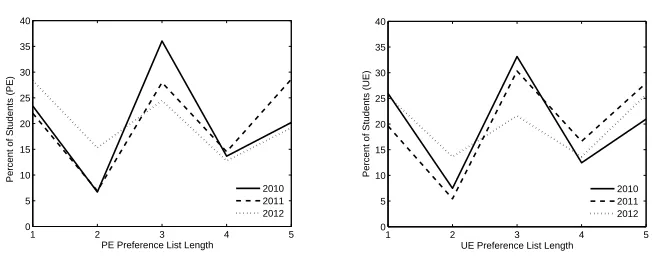
in Figure 2. For both PE and UE, it can be seen that the length of preferences
is almost symmetrically distributed, and the average lengths are 3.00 and 3.07,
respectively. For preference lists no longer than three, a maximum of two ties
can be introduced. Further, in the recent course registration survey (see Figure 1
Question 3), 35 percent of students preferred two levels of preferences and 23
percent preferred three levels, representing a major portion of all surveyed
stu-dents and over 76 percent of whom preferred to have ties.13 Given the average
lengths and survey information, in our simulations we consider two scenarios: two
or three levels in students’ preference lists.
• Two levels means that there is one strict ‘≻’ and the preference list of a student
is divided into two levels at random.
• Three levels means that there are two strict ‘≻’ and the preference list of a
student is divided into three levels at random.
Note that a student is indifferent between the courses in the same level. For
example, if a student has preferenceA ≻B ≻C ≻D≻E, then A=B ≻C =
D=E is a (random) realization with two levels and A ≻B =C ≻D =E is a
(random) realization with three levels.
13We note that the current limit of a maximum of five courses for PE/UE preference lists does not
1 2 3 4 5 0 5 10 15 20 25 30 35 40
PE Preference List Length
Percent of Students (PE)
2010 2011 2012
1 2 3 4 5
0 5 10 15 20 25 30 35 40
UE Preference List Length
Percent of Students (UE)
[image:30.612.137.464.92.220.2]2010 2011 2012
Figure 2. Distribution of the lengths of students’ PE and UE Preference Lists.
Next we describe our simulation environments and results. Due to the
ran-domness involved in introducing ties into students’ preferences, five independent
computations are performed for each of the simulation environments, and the
percentage is the average of the five experiments. For the rest of the paper,
per-centages are measured as the total number of allocations over the total number
of vacancies, unless otherwise specified.
A. Experimental Environment I
We consider three scenarios for simulations.
• Pure PE. We only consider PE courses; thus, we assume that each student has unit capacity and only consider his/her preference for PE courses.
• Pure UE. We only consider UE courses; thus, we assume that each student has unit capacity and only consider his/her preference for UE courses. Note that
the first two scenarios are essentially many-to-one matchings.
• Combined PE+UE. Here all of the courses are pooled together. Note that if
a course falls into both the PE and UE categories, recall that in the NTU’s
current system, two capacities of the course are specified manually for PE and
UE, respectively. In our simulations here, we merge the two separate capacities,
making it a single capacity for each such course. Each student still has two
separate preferences, one for PE and one for UE; the capacity of the student
is in the format of 1 + 1, i.e., the student can get at most one PE course
courses in total. Note that this scenario precisely captures the course allocation
requirements of NTU, and is the one by which we quantitatively evaluate the
performance of our mechanism, which introduces ties into students’ preferences.
In the three scenarios, students essentially have unit capacities (in the third
scenario, a student with two separate preferences can be treated as two students,
among whom one has preferences consisting of PE only and the other has
prefer-ences consisting of UE only). In such cases, one can easily notice that the draft
and dictatorship mechanisms are equivalent. In practice, we run simulations using
both mechanisms and the results do appear to be the same as expected, except for
some small deviations due to the random nature of the mechanisms. Therefore,
we do not distinguish these minor differences caused purely by the randomness
in the algorithms, and instead focus on the effects of allowing ties into students’
preferences. The simulation results for the total number of allocations are shown
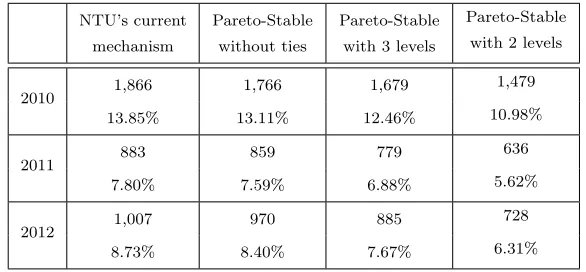
in Table 2 and the corresponding statistics on the number of unassigned students
for combined PE+UE are summarized in Table 3.14 Next, we give a detailed
explanation for the statistics in each column of Table 2 (using the data from
2010).
• Maximum matching. We need a generally reasonable benchmark to measure the
performance of different matchings. (Note that the total number of students
or course vacancies does not qualify, as no feasible matching can match the
bound.) To this end, we consider a maximum cardinality matching (i.e., one has
the maximum number of assigned pairs) from the set of all mutually acceptable
pairs. The size of a maximum cardinality matching provides a theoretical upper
bound on all feasible matchings. For PE, UE and combined PE+UE, the size
of a maximum matching in 2010 is 7,140, 8,958 and 16,536, which takes 87.95
percent, 63.18 percent and 74.17 percent of the total vacancies, respectively.
• NTU’s current mechanism. NTU’s current mechanism is employed with respect
to the given preferences. Note that the statistics here differ slightly from those
in Table 1, as we consider slightly simplified preferences for the courses and
do not include the manual adjustment process. It can be seen that in 2010,
14The percentages in this table are calculated as the total number of unassigned students over the
Table 2—Experimental Results I: Total Number of Allocations
Course Maximum
matching
NTU’s current mechanism
Pareto-Stable without ties
Pareto-Stable with 3 levels
Pareto-Stable with 2 levels
PE 7,140 6,615 6,647 6,720 6,852
87.95% 81.49% 81.88% 82.78% 84.41%
2010 UE 8,958 8,142 8,162 8,295
8,515
63.18% 57.43% 57.57% 58.51% 60.06%
PE+UE 16,536 14,990 15,105 15,312
15,670
74.17% 67.23% 67.75% 68.68% 70.28%
PE 7,725 7,045 7,150 7,342 7,368
76.55% 69.81% 70.85% 72.75% 73.01%
2011 UE 8,041 7,495 7,537 7,626
7,784
52.41% 48.85% 49.13% 49.71% 50.74%
PE+UE 15,803 14,526 14,627 14,833
15,190
62.13% 57.11% 57.51% 58.32% 59.72%
PE 7,308 6,726 6,762 6,838 7,005
78.54% 72.28% 72.67% 73.49% 75.28%
2012 UE 8,075 7,556 7,574 7,672
7,819
49.66% 46.47% 46.58% 47.18% 48.09%
PE+UE 15,412 14,283 14,350 14,530
14,855
60.29% 55.87% 56.13% 56.84% 58.11%
about 81.49 percent of PE vacancies, 57.43 percent of UE vacancies and 67.23
percent of the combined PE+UE vacancies are allocated. We will compare the
performance of our mechanisms to these statistics.
• Pareto-Stable without ties. In this column, the draft/dictatorship mechanism is employed with strict preferences for the students. In comparison with the
allocations using NTU’s current mechanism, for 2010 we see a 0.39 percent
improvement for PE, a 0.14 percent improvement for UE allocations and a
0.52 percent improvement for combined PE+UE. Note that NTU’s current
mechanism also generates a Pareto-stable matching if considering the strict
students’ preferences. The marginal improvement in the number of allocations
comes from the differences in the implementations of the algorithms.
is employed with three random levels on students’ preferences. That is, each
student’s preference has at most three levels. Here we observe improvements of
1.29 percent, 1.08 percent and 1.45 percent for PE, UE and combined PE+UE,
respectively, compared to NTU’s current mechanism.
• Pareto-Stable with 2 levels. In this column, the draft/dictatorship mechanism is employed with two random levels on students’ preferences. That is, each
student’s preference has at most two levels. We observe further improvements
here of 2.92 percent, 2.63 percent and 3.05 percent for PE, UE and combined
PE+UE, respectively. The last two columns show the simulation results after
introducing ties into students’ preferences, indicating that it can improve the
overall efficiency of students.15
We also observe improvements in the total number of allocations after
intro-ducing ties into students’ preferences for 2011 and 2012. In 2011, there are 2.94
percent, 0.86 percent and 1.21 percent improvements for PE, UE and combined
PE+UE, respectively, after we divide preferences into three levels. The
improve-ments for 2012 are 1.21 percent, 0.71 percent and 0.97 percent. Furthermore, we
see more significant improvements of 3.20 percent, 1.89 percent and 2.61 percent
for PE, UE and combined PE+UE, respectively, when we divide the preference
lists into two levels, with improvements of 3.00 percent, 1.62 percent and 2.24
percent, respectively, in 2012.
In summary, for the combined PE+UE scenario, after introducing ties into
stu-dents’ preferences, over the three years we see an average improvement of 1.21
percent and 2.63 percent for three and two levels of preferences, respectively.
This translates to roughly 292 or 639 more student-course assignments every year
which, compared to the allocation results from NTU’s current mechanism,
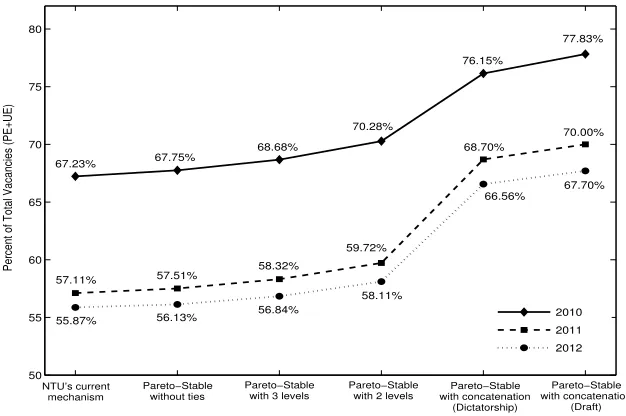
sig-nificantly improves overall students’ social efficiency. The statistics for combined
PE+UE of the simulations are also depicted in Figure 3.
15Note that for the PE and UE scenarios, students have unit capacity, the allocations are therefore