http://wrap.warwick.ac.uk/
Original citation:
Beynon, Meurig (1987) Monotone Boolean functions as combinatorially piecewise linear maps. University of Warwick. Department of Computer Science. (Department of
Computer Science Research Report). (Unpublished) CS-RR-109
Permanent WRAP url:
http://wrap.warwick.ac.uk/60805
Copyright and reuse:
The Warwick Research Archive Portal (WRAP) makes this work by researchers of the University of Warwick available open access under the following conditions. Copyright © and all moral rights to the version of the paper presented here belong to the individual author(s) and/or other copyright owners. To the extent reasonable and practicable the material made available in WRAP has been checked for eligibility before being made available.
Copies of full items can be used for personal research or study, educational, or not-for-profit purposes without prior permission or charge. Provided that the authors, title and full bibliographic details are credited, a hyperlink and/or URL is given for the original metadata page and the content is not changed in any way.
A note on versions:
Rese
archr
Report
109
MONOTONE BOOLEAN
FUNCTIONS AS
COMBINATORIALTY
PIECEWISE TINEARMAPS
Meurig
Beynon
(RR r
09)
The
classof
combinatorially
piecewiselinear (cpl)
maps wasfirst
introduced
to
solve a geometric problem concerning the representability of piecewise linear functions as pointwisemaxima
of
minima
of
linear
functions.
Such maps correspondin
a canonical fashion to monotone booleanfunctions.
This paper describeshow
a monotone boolean functionin
n variables whose prime implicants and prime clauses arenon-rivial
defines a partitionof
the symmetric group on n symbolsinto
a setof
"singular cycles" representing relations between transpositionsof
adjacent symbols. Several possible approaches to the classificationof
such cycles are described, and some characteristic propertiesof
singular cycles areidentified.
Thepotential
computational significanceof
singular cyclesis
indicatedwith
referenceto
new combinatorial models for monotone boolean formulae and circuits that arise directly form the appropriatetheory
of
computational
equivalence andreplaceability.
The
prospectsfor
application to monotone boolean
complexity
arebriefly
examined.
A
catalogueof
known relations is included as an Appendix.-r-Department
of
Computer ScienceUniversity
ofWarwick
Coventry
CV47AL
This paper is concerned
with
an unusual modelfor
monotone boolean functions. The original motivationfor
introducing this model [1] was the proof.of a geometric theorem conceming thei"o."sentability
of piecew"ise linear functions as pointwise maximaof
minima of linear functions.ii;;;;;.ii"ati6n
for
subsequenr research has been a searchfor
combinatorial structureof
monotone boolean functions
thit
has computational significance. The results so far obtained arefor
G
-oiipun
quite elementary, bqtqe
indlcative of a rich combinatorial contextlor
gxaminTg*onoton6
booiean functionsin
which the algebraic structue of the free distributive lattice FDL(n) and the combinatorial geometry of a standard presentationf,,
of the symmetric group S,, are central ingredients.It will
be shown in particular that monotone boolean functions are naturally associatedwith
a special class of relations infr,,
and that there is a canonical partitionof
the symmetric group associatedwith
almost every monorone boolean function.A
full
understanding of the nature andrig"ifii"rre
of tfreselaniii6ns
has s_ofq
proved.elusive, and the principa.l qurpo;e of this paper isio%rganise concepts
ind
minor results that have been derivedin
the searchfor
a formalclassification.
Foi
the piesent, in view of the lack of an adequate theoretical understanding,little
work has been doneoi
potential applications. The research into computational equivalencefor
monorone boolean functionsrepottid in
[2] originatedwith
the study_ of_cpl maps, and some connectionswill
be described(;f
$8eropoiition
9 below). Someof
the longer term objectivesof
thi, ,"rrurrh
are indicated in tfrb frnat secion of the paper; applications to monotone booleand;-tti;; ;;plexity,
computarional geometry and pbssibly concurrent program design may beanticipated.
The paper is divided
into
10 secrions. $1 defines the class of combinatorially piecewise linear (cpl) mapsS'+{
1,2,...,n},and outlines its close connectionwith FDL(n),
the lattice of monotone boolean functionsin
n variables. Throughout the paper, a standard presentation 1', of the symmetric group S,, is interpreted geometrically as a Cayley diagram, and the conceptof
singular edges inf'
associated
with
a cpl map is introduced. g2 outtines a dualityfor
cpl maps that relates "value" and;t;nk".
g3explorei
tttejeo-etry
of
singular edges, establishing the presenceof
singular chains and cycles that have a special geometric form, and thatin
general define a partition of 1,.,. $4 indicates how the dispositionof
singular edge! can be describedwith
reference to the disjunctive unJ"*j*ctive
normal forms of a ironotorie boolean function. $5 considers the structureof
;trg"ht
;tcies
from a group theoretic- perspective, and introduces a useful notation that assistsinfSrmal ilassffication."$O e^xamines thb prbspects
for
generating singular cycles_as gouP relations, una t""r"
deriving monbtone boolean functi6ns with interesgngc^omputational characteristics. Thismotivates the
conjideiutio" in
$7of
a class of monotone boolean functionsof
a particularly simplenna
a"nn"A by
alternating sums and products. $8 describes a new perspective on boolean formulae and circuits that irises directiy from the theory of computatio.na! equ.walence andirpl.r""Uiitty
developedin
[2],.and_in&cates how the- presence of particular singular lYclespdtentially
tris
comp^utationltiignifrcance. In partic-ular, acorresp.ondgq": between s_ilgular cycles;;J.*fib"rutionr 6rpri-"
imp-licants and prime clauses is described. $9 develops this themerurtr,"i,
afrddescrib"sio*
the leometryof iingular
cycles is af-fe-cted by basic circuit building"p"r"iib"r.
Sroia""tinis
so*e"key unresolved'issuei, andincludes some speculation on future developments and aPPlications.
In
the interests of brevity and readability, many proofs areleft
to the reader: most of theproposiioni
-"
ri-prv
intend'ed to summarisL observations thal rggu.rqlittle
proof. To assist theS
I
C ombinatorially piecewise - Iinear ( cp I ) mnp sLet S.
denote the symmetric group of permutationsof
( 1,2,...,n). S,r has a standardpresentation relative to the generating set consisting of the n-1 transpositions at,
xz, ...,
tn-l,
wheret.
interchangesi
and i+1. Theexplicit
set of relations which defines this presentation is: t.2=1(1(<n-1);
(t,t,*r)3=1
(1<i<n-2); (tr tr)2=1(2<i+1<j3-1)'
The Cayley diagram associated
with
this presentation is then an (n-1)-edge-coloured combinatorial graphf
in
which the vertices arein
1-1 correspondencewith
permutationsin
S'
and there is a bidirected edge of colouri
from
p to oif
and onlyif o=t'
P (using the convention whereby"ti
P" denotes "T,followed
byp").
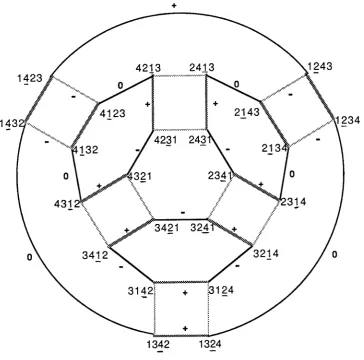
Figure 1 depicts the Cayley diagramlo.
Departing from theconventions defined
in
[1]
(to avoid overloading the term"vertex"),
a subset Sof
{ 1,2,...,n} issaid to be a
prefix
of the pennutation oin
Snif
S-
{ 1.o,2.o,...,lSl.o}
'A
map S,r+{1,2,...,n}
(of degree n) iscombinatoriatly
piecewise-linear
(cpl)if
it
corresponds to an n-vertex-colouring ofl'
in which verticesp
ando
that are adjacent via ani
coloured edge either have the same colour or have colours selected from the set{i.o,
(i+1).o}=
{i.p,
(i+1).p}.
fne
class of maps was introducedin
[1] in
connectionwith
the studyof
i"pr"r..ttution
of piecewise-linear functions as poin^twise maxima of minima of linear functions. There is a 1- 1 correspondence between cpl maps of degree n and elements of FDL(n), thefinite
distributive
lattice freely generated by n generatorsxt,
X2,..., Xrr.In
one direction, thiscorrespondence is defined by associating
with
the cpl map F the functionfrom
the latticeof
subsetsof
{ 1,2,...,n}to {0,1}
which maps Sto
1if
and onlyif
F(o)e
S whenever S is aprefix of o
(cf
tflj.
1.heinverssis
then definedby mapping the monotone boolean functionf
in FDL(n) to the cpl map F such thatF(o)=
r.o,
wheref({1.o,
2.6,..., (r-1).o})=6
andf({
l.o,2.o,...,
r.o})=1.
Figure 2 depicts the vertex colouring of the Cayley diagram
fo
which is associated with the monotone boolean function xrx2+x2x3x4+x1x4 in FDL(4).Given a cpl map F, an edge
(o,o'=t.
o)
issingular for
Fif
F(o)
-
and necessarily alsoF(o')
- isin
the ser{r.o,(r+1).o}.
Three typesof
singular edge can be distinguished:(1)
apositive
(+) singularity, whenF(o)=r.o, F(o')= (r+1)'o,
or equivalentlyF(o')=r.d,
F1o;=1r+ 1)'o'
(2)
anegativeO
singularity, whenF(o)=(r+1).o,
F(o')=r'o,
or equivalently
F(o')= (r+1).o', F(o)- r.o'
(3)
a zero (0) singularity, whenF(o')=F(o).
If
F is a cpl map such thatF(o)= r.o,
then r is therank
of
F at o. The positive and negative singular"^dg"r
ior
F can then be characterisedas those _eqges across which F changes in value but
noirank,
atid the zero singular edges as those across which F changes in-rank but not in valueiFid;"
g).fh"
brief digrissionoi
dual cpl maps thatfollows
gives another perspective on this52
Dunl
cplmapsThere are two Cayley diagrams associated
with
the presentationof
S'
defined above;f,r,
in which adjacency of vertices is defined by multiplication by a transpositiont.
on the left, and a dual graph 1.,r*,in which
adjacency is defined viamultiplication
by a transpositiont.
on the right. (Note thatdifferent
pairs of permutations are adjacent inf.
andf,r*.) A
mapS'+
[ 1,2,...,n] (of degree n)is dual
combinatoriatly
piecewise-linear(dual cpl)
if
it
corresponds to ann-vertex-colouring of
f,r*
in which vertices p ando
that are adjacent via ani
coloured edge either have the same colouroi
hau" colours selected from the set{i,
i+1 }. As is the case for cpl maps, there is a 1-1 correspondence between elements ofFDL(n)
and dual cpl maps. Given feFDL(n)'
thereis
an associated dual cpl map F*: S,r+{I,2,...,n1defined
asfollows:
Let
T
be the total orderingT
of
{1,2,...,n1definedby
l>2>...>n,
and letF*(o)
be the element to whichfe
FDL(n) is mapped by the canonical lattice homomdrphismlIo:FDL(n)+T
(induced by freeness) under which i.o
is the imageof
the generator xt ofFDL(n).
It
follows thatLemma
1: F*is
a dual cpl map. Moreover,if
F is the cpl map associatedwith
fe FDL(n), thenF*(o)
=F(o-l).
o
Proof:Suppose that
oe
Srr. The free generators X1, x2;...t\
can be viewed as inputs to a monotoneboolean
ckcuit
computingf.
Suppose that all the inputs areinitially
assigned 0, and that they aresystematically assigned L ("switched on")
in
such a way that xr.o becomes 1 at timet.
F(o) is then the index s.o, where the outputf
isfirst
1 at time s. To prove Lemma 1,it
will
suffice to prove thatp*(o)
is thetime
atwhich the outputf
is switched onif
the inputs are switched on in the ordero
1.I-etn.be
the mapT+ {0,1}
defined by n10)=1iff
j<i.
Consider the parametrisedfamily of
composite maps of theform
t,llo:
FDL(n)-+{0'1}
where
o€
S,r, andi
rangesfrom
1 to n.It
is evident thatF*(o)
is the leasti
such thatr,llo(0
is
1.On the other hand,
rrllo(0
can also be interpreted asf(a,r, a,r,..., ct,r), where
o,
e
{0,1},
andoj=1
iff
j=r'o
andrsi
ie as the
time
at whichf
is switched on when switching on the inputsxy
x2t"'
x'
in the order prescribedby
o-1.It
remains to show that F* is a dual cplmap.
To this end, consider vertices p and oof
l,r*
that are adjacent
via
ani
coloured edge. Notefirst
thatp.(p)=
{i,i+l}iff
F.(o)e
{i,i+l}.
To
see this, observe thatf-(p)
= F(Ti o-1) .o'ti, so thatF*(p)= {i,i+1}
iff
F(t,
o-1).
{i.o
l, (i+1).o-r}
iff
F(o-l)e
{i'o
1,(i+1)'o-r}
since F is a
cpl
map. Sincen.1o;
=F(o-l).o,
rhe larter condition is equivalent toF*(o)€
(i,i+1).
Similarly,
if
f*(o)e
{i,i+1},
thenF(o-l)e
{i.o
1,(i+1).o-l },
so thatF(t,
o
l;=F(o-l),
andCorollary
1.1: F and F* also satisfy the dual relationshipF(o)
=F*(o
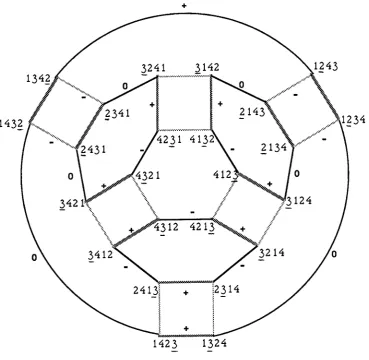
1).oFigure 4 depicts the dual cpl map associated with the monotone boolean function x1x2+x2x3x4+x1x4 in
FDL(4),
which can be comparedwith
Figurer.
Inpictorial
terms,lrmma
1 and Corollary 1.1;6.",,'ili;
fact thatif
Figures'2 and 4. ar9 supeympgsed, then at each vertex the value of theifi;;rrp"iin"a
in the 5ne diagram is therlnk
of the function specified in the other.If
the conceptof
a singular edgefor
the dual cpl map F* in 1',* is defined (by analogywith
that for cpl maps) by adjacent vertices at which either the rank or the value of F* changes, the 1-1 correspondence betweenf'
and frr*
that matcheso
and o=l respects adjacency, and defines a 1-1 correspondence between the singular edges of F and those of F*. In this correspondence:_zero singular edges for F correspond todges
uttitrl.tt
the value F* changesbutthe
rank remains the same: positive andn"gutiu"
singular"edges for F to edges at which the rankof
F* changes but the value remains the ,ufrr". Moro6ver, up?iitiu"
(respeciively negative) singular edge for F corresponds to an edge(o,ro)
in
1.rr* at which the value of F* is the greater (respectively smaller) of the indices in the transpositiont
under the ordering T.53 Chnins and cycles of singular edges
As Figure 2 illustrates, the singular edges
of
a cpl map are generally associated with a cycle, consistingof
a simple circuit in 1,, representing a relationin
the symmetric group Sr,. In fact,if
F is the cpl map corresponding to an element fe FDL(n) which is non-comparablewith
an inputgenerator, the singular edges for F are disposed
in
disjoint cycles which partitionf',.
The"1-dimensional structure" defined by singular edges is the cenffal s_ubject
of
this paPel though this a'pears tooffer
rrop"
ior
interestingandihallenging
analyses, and there arg so_me indicationsof
;";p"i";";Jirgruh"*.e,
it will
dco-e
cleart[at
this sffucture cannot in itself characterise the computational complexity of a monotone boolean function'To describe singular cycles formally,
it
is convenient to consider subgroups of S,r, viz:I!,
=(
tr,
ts>
where lr-sl>
1 and13,s3-1,
and Tr =<
xr-t,xr)
where233'-1'
Given a pennutation Oof
S,r, the cosetsK*
o
and T. O are cycles of edges inln, as
depicted in FigUre 5,in
which Far,(=Xr_rand('=X".
Note that\O
is the set of permutations obtainable from o by permuting(r-1).o, r.o, (r+1).o
whilst
\
o
is the set of permutations obtainable fromo
by permutingr.o,
(r+1).o ands'o,
(s+l).o'
independently. The geometrical relationships bet'ween cosets
of
this type is then as follows:Lemma
2: Either two cycles are edge and ver"tex disjoint, or they correspond to cosets having a cornmon element o. In the latter case, the possible intersections up to symmetry areT.onTro
=
{o}
if
s*
r+
1
;
TronTr*r
o =
{o,
tro}
Tron4io=
{o}
ifi*r
andj
*r ; T,on\o=
{o,t.o}
K,,on\o=
{o} if {ij}n{r,s}=O
; \o,''t\,o=
{o,
t,o}
if
j
+
sProposition
3:Irt
f
be acpl
mapfn
-
{ 1,2,...,n}. Then(i)
f
hastwo
singular edges at those verticeso for which 1<rk(f(o))<n,
and one singular edge at those vertices o for whichrk(f(o))
is
I
or n(ii) f
is either non-singular on a\
o
or has singularities of the same type (positive, negative or zero) on precisely one pair of opposite edges(iii) f
is either non-singular on a\
o
or has singularitiesfollowing
the same pattern as a cpl map of degree 3 (see Figure 6 for details of these patterns)Proof: Exercise to the reader.
Corollary
3.1:Th6 singular edges of a cpl map
f
can be represented as a disjoint unionof
simple circuits exclusivelyvisiting
verticeso
atwhich
1<rk(f(o))<n, and simple paths that originate and terminate ar verticeso
such thatrk(f(o))=1
orrk(f(o))=n.
On such paths and circuits, occurrences of positive and negative singular edges must alternate.The paths and circuits referred to
in
Corollary 3.1will
resp-ecti-vely becalled-thesinsllar
chains
andsingutar
cycles off. With
the exceptionof
thetrivial
cpl maps defined by the free generators ofFDL(n),
there are no cpl mapsfor
which there exist permutationso
andp
such thatrk(f(o))=l
andrk(f(p))=n.
Monotone functions incomparablewith
the free generators have only singular cycles, and these define apafiition of
Sr,. For any monotone function, the minimal rankof
the associated. cpl map is determined by the size of the shortest gri-me implicant, and dually. As a further consequ-ence of Proposition 3,
it
may be seen thatknowl4ge-of
the setof
singular chains and cyclesof
a cpl map is sufficient to characterise the map completely.54
Normalforms
and the disposition of singular edgesThe nature and disposition of the singular edges can be viewed
from
another perspective. For the cpl map defined by the boolean function f=g+h inFDL(n),
there are three regions inlrr:
Rerr, - the set of vertices
o
at whichrk(f(o))=rk(g(o'))>rk(h(o)):
Rn
e - the set of vertices
o
at whichrk(f(o))=rk(h(o))>rk(g(o)):
Rr=n - the set of vertices
o
at whichrk(f(o))=rk(e(o))=rk(h(o)).
The singulat"edges introduced when performing the computational.step f=g+h.then lie on edges conneciing thesE regions, and consisi of positive
or
zero singularities. In the simplest cases,as-when R"rn and
R-*
are connected, and Rr=1is empty, the new singular edges form a cutsetof
positive"iinguhr
b-d-ges (though the geomdtry isin geleral
more complex). As an illustration of this, ^thegeomeu!
of
singular edges can be directly related to the standard normal forms for the monotone boolean function f.If
S is a subsetof
{ 1,2,...,n}, thenl^(S) will
denote the set of permutations which have Sas
prefix.
If
o
is such a permutation, thenf,r(S)
is the connected component that containso
after allLemma
4:Irt
p be the cpl map of degree n determined by the monotone boolean functionxl
.x2.
... .xrand
let
S denote the subset{1,2,...,r}
of
{ 1,2,...,n}. Then p has precisely one negative singularedge at each
of
ther!(n-r)!
vertices offn(S),
and thus defines a matching on f,r(S).If
o
is a permutation withprefix
S, then p behaves as the function x(r-z).o-x(.-r).o.X..o on T.-ro, as x1r-r).o.xr.oofl Ki.-1o,
and as\.o
on T.to and KUo forj*r-1'
Proposition
5:Suppose that p and S are as in Lemma 4, and that
f
is a monotone boolean function with p asa prime implicant. Then
f
behaves as p onf"(S).
The set of permutations at which
f
and p have the same value defines a connected subgraph off'
that contains no positive singularity: every permutationo
such thatf(o)=p(o)
is connected tof"(S)
by a path consistingof
zero or non-singular edges'An
edge(o,o'),
wheref(o)=p(o)
andf(d)*
p(d),
is either a positiveor
zeto singular edge.Proof: Exercise to the reader.
Proposition 5 is illustrated in Figure 7, which
depics
the connected subgraphs of the formf"(S)
for
the functions threshold, andxrxr+x
zx3+xrx4in FDL(4).
(Figure 7 hints at a relationship between formulaefor
f inFDL(n),
and partitions off,,
defined by cutsetsof
singular edges:cf
$8Proposition 9 below.)
It
is known that a monotone boolean function g is zero replaceablefor
the purposesof
computing
f
if
and onlyif
no prime implicantforf
is an implicantfor
g. This.coqdigon may^be.
i"r"tiri"t"[
as asserting:if
pii
aprimelmplicant
forf,
and p and S are related as inIrmma
4, thenthe rank
of
g is greater than the rank off
at all permutations in lrr(S). Note that this condition isin
general weaker than requiring that the rank
of
g exceeds that off
at all permutations inf,r.
For the latter condition to hold,it
is necessary that, for every prime implicantp' of
g, the sets of indices associatedwith
prime implicants off
that are also implicants ofp'
should have empty intersection.55 Cyctes of singular edges and relations in S,
Every cycle
of
singular edges corresponds to a relationin
S,, defined by a productof
transpositions
in
which each consecutive pair has adjacent indices. For instance, the monotone booleanfunction xrxz+\x3x,,+xtx4
inFDL(4)
gives rise to a cpl map in which there are two cycles, oneof
length 6 corresponding to the relation:rfff*fz=
(rrrr)3
=1
and one of length 18 corresponding to the relation: r
Lx ;%x ;c Lx
*
zr*
*
{
f {
rr rr' rr'rr'rr,
=I.
It
can be shown that the relations which correspond to singular cycles have a specialform: they canb"
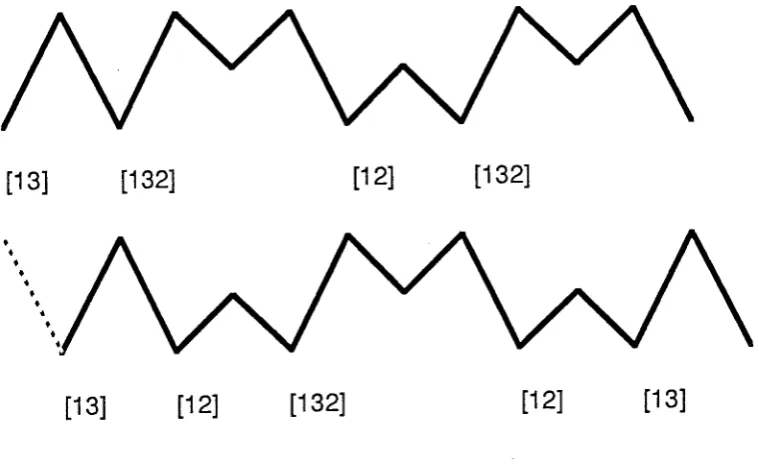
"ip."rr"d
as concatenations ofproduclg oJiryrqp-osiltpnr in whichincreasing and decreasing sequences
of
indices altemate (cf Figure 8).Explicitly,
if
a<b<c<....
<x<y<z
($)is a increasing chain of indices, there is an associated product
of
transpositionswhich can be expressed in the form r"7cr^. The relations associated
with
singular cycles are then concatenations ofalternating
sequences of the formtuTtt-fiR,
where aarxmhas the form(*),
and nR denotes the reversal of the segment rc. The special notation la
zb
y cx
...I
is adoptedfor
the alternating sequence derived from the chain ($)
in
this fashion. Using this notation, the specimenrelitions
defined above can be representedaI
^
J2l3
and
[13]
[1 32]U2)lI32l
respectively. There are then simple ways to calculate the length
of
a cycle and the number of local,,'u'ri-u
(p"crints at which the se{uence-of indices changes direction from increasing to decreasing onG
"Vif")l
rhe rotal length of the cycle is the sum of the lengthsof its constituent alternating secluences, where
length
of
[a,
h...
an) =2.ELr=n-,lar-a,*rl,and each alternating sequence
lat
a2... a,r1 contributesn-l
to the numberof
local maxima. Thesecharacteristics of a cycle - its length and alternation ind.ex - are useful as a means of partial classification;
it
will
be convenient to refer to the qpecimen cycles above as the6,
and 18u cycles respectively,for
example. This distinguishes the singular cycle of length 18 above from the 18t cycle [1 3z]tl
423lwhich
corresponds to a 5 variable function.(It
is of incidgntal interest tooirr"*:"
thaiihe
nu*b".
of variablds required, the length and the alternation index of a cycle can be the samefor
different cycles cf the two 60ro cycles catalogued in the Appendix.)No necessary and sufficient conditions for a relation in
f,,
to correspond to a singular cyclehave yet been derived. By duality, any suclr cyclic relation must-be expressible both as a
.on"ut.nution of
alternating sequences, and as a concatenation of dual alternating sequences, definedin
a manner verys[.'ita'
.
,?1f;ylyi "y;"rTla
decreasing chain of indices (The specimen relations above admit representatiols !2-1li
andt3
1lt3
2lt3
|
2lt3
2ll3
1l of thisio.-
-'&
Figure 8.) This restriction on rblations - theW-M
condition - eliminates ryany possible -pioducts of?anspositions from consideration, but is not sufficient to characterise those associatedwith
singular cycles. For instance, the cyclicrelation
E{r
421t1423\r
al)'-=
1-
which
can also be represented as (141ll4 23114llzl42Dr =
1, and thusnecess.arily_satisfies the.W-M
condition - cooesponds to no'bycleof
singular qdgeg. In fact, there is a unique 5 variable cpl mapfor
which the sequencetI4ZlU.aBl
occursin
a singular cycle,viz:
x1 x2 +
xl
x3 x4 +xl
x3 x5 + x2 x3 x5which has the singular 36n cycle
tl
42)tI
42
3lU
43)tl
32l
at the permutatton 12345.(A
simpler similar example is provided by the relation (t13lt1
3 2l)3= 1)
It
is evident that the sequence of transpositions describedin
abbreviated form bylazbycx...
ltu
is palindromic, so that singular cycles are
built
up from palindromic segments. Many singular"yrl"t
may also be identified as palindromes; for instance, the 18u cycle introduced above ispalindromic, as may be seen from its dual represe_ntation-as
t3 1lt3
2lt3
I
2lt3
2lt3
11.Not
alliingutar
ryri"t
at" patitra.omes however: see the 36n cycle above (cf the discussion ofcircuit
building
and the sffuctureof
singular cyclesin
$9 below).From the abbreviated notation
for
singular cycles described above,it
is easy toidentify
some features of the behaviour of the associatedcfl
mapon the cycle. Every local maximum correspondsio
upoiitiue
singularity and dually; all other edges.arg zero.singularities.If
the abbreviated"*p6tiion
for
isinguiar
cycle contains ndistintt
indices, the behaviourof
the cp-l m3n on thisp.fu;trt
singulariycle
ddpends only uponn+l
variables-If
m and IvI respectively denote the minimumand'-a*itfium
indices wtrii:tr ippear in the relation, the behaviour of the cpl mapof
a"-grt"N
on rheri"guir
cycle is unalterdd by set9ngm-l
variablesto
1, andN-M-l
variables to 0ar no poinr designate the value of the cpl
pap;
these can be detectq! as colresponding to.indices in.tn" rang"
[m,Mi
which do not appear in the abbreviated notation. The.singular cycles which arise in this wa"y are essentially trivial variantsof
smaller cycles, associatedwith
cpl maps of lower degree. For insLnce, the relati,on I1 313=
1, which gives rise to ajingular
cycle of length 12 and altemation index 3 is essentially a trivial variant of the 63 cycle[l2)5
into which6
zeto singular edges have been interpolated. Such variants are oflittle
interest, and do not merit independent consideration.A
simple examplewill
be used to illustrate the above discussion. For the 5 input monotone booleanfunition
f=xrxr+xrxo+xlx4+xtx3 x5, the associated cpl map has a setof
singular cycles which can be classified as follows:a) Singular cycles which incorporate a permutation ending
in
3 or 5All
permutations in such cycles have the samefinal
index. For this reason, the behaviour off
on such cycles is the same as that of the threshold functionxr\+xzx4+xrxo
which is the resultof
setting the variable x3 orx,
to 0. The permutations 12435,31245, 12453 and 51243 in which the indices1,2
and4 appear contiguously lie on distinct singular6,
cycles, and the permutations12345 and
l2543lie
on distinct singular 12, cycles which aretrivial
variants of the 6, cycles. b) Singular cycles which contain a permutation beginningwith
3 or 5All
permutations in such cycles have the sameinitial
index. For this reason, the behaviourof
f
on such Cycles is the same (up to symmetry) as that of the function xrxz+x2x4+\x4+x1x3 which is the resultof
setting the variablex,
to
1. The permutation 5l2341ies on an 18u cycle11
3lt1
zltr32ll1zlu3l
as also (by symmetry) does the
permutation3t2l4.
c)
All
permutations not beginning or endingin
3 or 5 form a singular 36r cycle.(For another perspective on this classification, see the discussion
following
$8 Proposition 9.)A
catalogue of relations which has been discovered sofaris
givenin
an Appendix;.this is not intended to beIn
exhaustive listof
small relations, thoughit
probably contains many of these.It
is clear that each relation has a dual obtained by expressing the relation as a concatenation of dual alternating sequences, and relabelling the sequence of indices 1,2,...,n as n,n-1,...,1. Under this duality the cycle6,
is self dual, whilst the 18u cycletl
3ltl
3zlLr
zltl
32l
=[3
1]t32ll3
|
zl132lt3
1lhas as dual [1
3]t1 2lt1
ZZllt
4t[
3], which is associatedwith
the dual of the monotone boolean function x1x2+x2x3x4+xlx4,viz:
xrxr.+x2x4+x1x4+xrxr. The configuration (see $8 below)associated
with
the dual of a relation is derived by ffansposing rows and columns.56 Elementary group theoretic properties of alternnting sequences and associated relatiors
Methods for recognising and synthesising the relations colresponding to-singular cycles would potentially be of Interest. Thorigh it is relatively easy to discover new relations by serendipity, or by performing simple transformations on monotone boolean functions (see $8 below), more syit6matic prdedurbs
for
generation and analysis are pro-bably needed in order to determine the cbmputatioiral relevanceof
singular cyclgs for monotone boolean functionLemma
6:The permutation represented by the alternating sequence [1
a
b ...y
z] is (1 2)(y+1 z+1). Equivalently:the pbrmutation represented by the alternating sequence t1
kl
(k22) is
the 3-cycle (1 k+1 2), and the permutation represented by the alternating sequenceU
at
a2...a'
ar,+r](r>2)
is the double transposition(l
2) (ar,+1 a,.,*r+1).Proof: Exercise to the reader.
Lemma 6 shows that alternating sequences necessarily represent even permutations. In fact,
it
can be shown that the subgroupof
S'
generated by alternating sequences is the alternating group A,,. Indeed,for
n)3,
A,, is generated by the alternating sequencesof
theform
[1k].
To see this, observe that(l
a})(\b
2)2
= (1 ab)
and
(1 abXl
c a)-
(a b c)and the set
of
3-cycles is known to generate Ar, (see egHall
16l p61).For n=4, the relations satisfied by products of altemating sequences can conveniently be determined from Figure 9: the Cayley diagram for Ao as generated by the basic alternating
sequences [1
2]
and [1 3]. As depicted in Figure 9, the altemating sequencetl3
2) is represented by the permutation of order 2 that corresponds to the two products:tL2l2lr3ltr2l2:
[12][1 3]2tr2l.
The non-trivial relations that arise as singular cycles of monotone boolean functions in 4 variables are:
12q
180
24s 24s
As remarked above, not all the group-theoretic relations between
llz}U
3l
andll3
2l
are associatedwith
singular cycles: the relation (t13lt1 3
2l)2, for instance, traces a circuit off,
which is not simple;it
in fact incorporates the 120 cycle [1 3 2]2.Conjecture; The relations between alternating sequences which correspond to singular cycles are precisely those which satisfy the WM-condition and define simple circuits of
f,r.
It
isof
some interest to determine generic classes of relations that arise as singular cycles. Lemma 6 provides the basis for identifying such classes.A
simple exampleof
such a class is defined by the sequencet2q:it
3
212, 24u :[t
42
312, 40* : [1 5 2 43f,
60ro : 11 6 2 5 3 4f2, ...of
singular cyclesfor
monotone functions in 4,5,6,7,....
variables,of which
the generic instance has length2(n-I)(n-2)
and alternation index 2(n-2). Singular cyclesof
each type arise in connectionwith
functionslying within
specified intervals, but a natural choicefor
a representative functionwith
the singular cycle 2(n-L)(n-2)2(n-2) isaltr(xr,
X3, X4,..., x,r-r).altt(x 2, x3, x4,..., x,r-r), wherealt,
is the alternating sum function to be defined in $7 below.For the present,
it
is hard to establish generic relationsof
the abo-ve typ€; more effective proof techniques are required tojustify
the association of relations and singular cycles rigorously.It
ieems probable that there are many such classes however.
l3
212 - dualof
(tl
3ltr
2D2tl
3lt1
3 2)112)lr
32l
- dualof
tl
2lt1 3l2tr
zlu
3 2l(tl
32lt1
zltl3Dz
- self-dualConjecrure
l:
If
r
denotes the integer partof
n2,
then the relations(t1
rltl
n-1 Z n-2.... r r+11)3 (nodd)
and
([1r]ll
n-l
2 n-2of
type 3n(n-2)r,,r-1) can be realised as singular cyclesof
functions in appropriate functions of a generic form are:xr(x,+xr+x4)+
x,xrxo
xr(xu+x, (x, +xo+xr))+ x
I x4xs
x2(xu+
xr(xr+
x4(x, +xr+x6))+xtxrxu
.... r+1
rl)'
(n even)FDL(n).
For n=4,6,8,...Conjecture
2:
Every relation
of
theform
[1...y z)U ...y
7]or
[1 ...y.z)t!
...zy].caq
be realised as a singular cycle.An
appropriate generic form for functions to realise these cycles is:altp(... ).altr(...
),
ordually:
altr(...)+altil...
)for
suitably chosen alternating sums or products in which selected variables have been assigned to 0or
1. For instance, the relations:18.:
[13z]Ll4231,
28u:lr
43lt1
52431,
38r:[1
431t162534],
52r:fr54][1 726354),
form
a generic class of relationsof
type ((n-1Xn-2)+2(r+1))rr,for
which a suitable representation asa sum
of
alternating products isx2(xr+xrr(xr+\-r(
x++...)
*
xrx.\rl.
The rationale for viewing the latter term above as the result of setting variables is best appreciated by referring to the first example of a generic class given above.
It
does not appear to be easy to determine the maximumlengt!
of the singular cycle that can^
be obtained using i^generators.
It
would be of interest to know whether there are generic classesof
cycles whose length grows faster than qu-adratically withnfor
instance. The elementary _o-bservations that-follow indicate some of the features which constrain the potential length of cycles.
On any singular cycle (without redundancy) on the inputs
{1,2,...,n},
th-ere are permutations atwhich
ttreiant-of
the associated cpl map is 2 and n-1. Such a map necessarily corresponds toa
^
monotone boolean function
f
which has at least one prime implicant and at least one prime clauseof
length 2. :ret P, and Q2 respectively denote the set of the prime implicants and prime clauses of
f of
length 2.It
will
be convenient to represent P, and Q2 as sets of edgesof
a graph on the vertex set{ 1 ,2,...,n } . In
view
of the characteristic properties of prime implicants and clauses, every edgeof
P, is incident
with
every edgeof
Q2. Since these implicants appear on a singular cycle, thesubgraphs P and Q
of
the completegaph
on the vertex set { 1,2,...,n} respectively defined by the edge setsPrandQ2
are connected.From the above observations,
it
can be seen that a Hamiltonian singular cycle occurs onlyif
n(4.
To prove this: consider a singular cycle (without redundancy) on theTp1rll
[1,2,...,n],
let P and Q be as defined above, and suppose (wlog) that q=a1,2> is an edgein
Q. A11 edgesi1
P are_-then incident
with r
or 2, and there must be edgesP1=(1,i> andpr=<z i>
in
P' where1<i<j3'
If
rE4,
i
andj
can clearly be chosen to be distinct indices. Moreover,if
n>4, there must also be an index kdisiinct
froml,Z,iand
j,
and - by connectivityof
P -it
can be assumed that (relabelling verticesI
and2if
necessary)pr=.l,kt
is alsoin
P.Any
edgein
Q is incidentwith
bothpt
and p3,57 Alternating sums and products
The existence of a particular singular cycle indicates that a monotone boolean function specialises to a function of a
particularform
ynqef an appropltate.assignment of boolean variables to selected variables. Ideally,it
would be desirable tofind
a classificationof
singular cycles, and to characterise the interval of monotone boolean functions associatedwith
each singular cycle.If
this proved possible, a further objective might be to interpret the set of singular c.ycles associated with aiarticulir
monotone booleanfunction as representing a canonical decompositionof
some kind.In
view of
the omnipresence of alternating sequencesin
singular cycles,.it seems probable that aparticularly
simpie class of monotone boolean functions - the alternating_sums and products -will
'be
of
direit
releiance in making connections between singular cycles and monotone boolean functions (cf the examples of generic cyclesin
$6).The alternating sum alt2(x1, x2,x3, x4,..., xrr) denotes the monotone boolean function
xl+
x2.
(x:
+ xo . (x5+
... )...) and the alternating productalt{xr,
\,x3,x4,...,
xn) the dual functionx,
. (x2*
x3 . (xo +x,
.(
... )...)).Lemma
7:The alternating sum
altr(xr,
\,
x3, X4,..., Xrr) has the conjunctive normal form:(x,
+xr).(xl*
x3+xa)...(xr+x3+...
+x,r-,
+x,r)
(neven)(x,
+xr).(x1* x3+xa)...(xr +x3+...*xr,-2+xrr-r).(x1+ x3+...
+xrr-t*
xrr)
(nodd)
and the disjunctive normal form:
x1 + x2.x3 + x2.x4.x5 + ...
+
x2.x4.... .Xn-2.Xn-l+
X2.X4.....Xn-2.Xr,
(n even)xl+
x2.x3+
x2.x4.x5+ ...+
x2,x4.....\-t.xr,
(n odd)(A
dual result - derived by interchanging '+'and'.'
- applies to the alternating product.) Proof: Induction on n - exercise to the reader.Altemating
sums and products are naturally associatedwith
altematln_g sequences of productsof
transpositi-ons. To desdribe the correspondence between them,it will
be convenient to 99opt ? notafio.r that distinguishes between an alternating sequence occurring as.a se_gment_within a singular cycle, and an alteniating sequence occurring as a singularg!"in.
The rationale for this is that the (extremal) rank attained'by a cpl map on a singular chain{iffers
from that on a singular cycle;. moreoverthere is a need fbr an apprbpriate notation to reflect the occurrence of sequences such ast13lt12lt13l
as singular chains. The solution is to
inroduce
the symbols 0an{
n_to.designate the P.oints. at which the a Jpl mapof
degree n attains extremal rank on a singrllar chain.With
this convention, the above sequenlce - that otherwise appears anomalous - is denotedby
[0132].Lemma
8:The
singular chain [0 a b c....2f
appears at the permutation 12 ...N
for the cpl map altr(x1, Xa+I, xb+l, X"*1,..., X2r.1)Proof: Exercise to the reader.
Irmmas
6 and 8 together make it possible tofind
boolean functions that exhibit a specific singular cycle (given as pioducts of transpositions defining an appropriate relation in S,r) at a given permutation. For instance: a monotone boolean function that gives rise to the 18u cyclell32l\423l
at the permutation12345 can be identifed asxr.(
x1 + x4.x3; + x1.(x,
+ x5.(x4 + x3 )).(To derive this, observe that the required cycle can be expressed as
r,
with the result that an appropriate function ffaces
a[02])
cycle in the contextxz=l
at thepermutation2l345,
and a t03L2l cyclein
the contextxt=l
at the permutation 12435.)The above observations suggest that the decomposition into singular cycles associated with a cpl map can be interpreted as repiesenting thecorresponding boolean function in terms
of
aite*aii.tg
sumsinvblving
the generators. In this connection,it
is of incidental interest to note that the functionsof
the form altr(x r.o, x2.e X3.6r..., xrr.o) andalta(xt.o,
x2.r
X3.o,...,\.o),
whereo
ranges over S,r, generate all functions in FDL(n) bar the free generators. (To see this, observe that the product
of
all alternating sums of the formaltf,xr.o,
X2.o, X3.o,..., xr,.o)where
1.o=i
is the unique element that covers x, inFDL(n).
This element can play the role of xt in anynon-trivial
disjunction in which the element xi enters a computation, and dually.)58 Singular cycles and configurations of prime implicants and clauses
The theory of computational equivalence for monotone booiean functions shows that the computational usefulness of a monotone boolean function g
for
the Purpo,se of computing^a-given funchonf
depends entirely uponis
relation to the primeimplicans
and clauses of f. Thefollowing
proposition is a consequence:
Proposition
9:Suppose that
fe FDL(n),
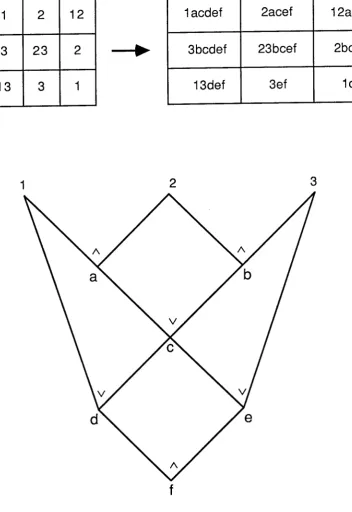
and let R, be the rectangular array whose rows are indexed by the prime implicantsof f,
whose columns are indexed Uy th9 prime clauses, and whose(ii)-+
entry.is^the
set of indices
of
generators appearing in the intersectionof
the i-th prime implicant and thej-th
prime clause.Then
(i)
a formula that representsf
corresponds to a partition of R, into blocks, each of which is a generalised subrectangle in which all entries have an index in common, having the property that\
can bebuilt
up from its constituent blocks by repeatedly gluing together blocks having representativesin
identical rows or columns. The number of blocksin
such a partition is the number of inputs to the formula.(ii)
a circuitfor f
corresponds to a sequenceof
operations on&
each of which selects a pair of indices(x,y)
appearing in the same row (respectively column) of Rr and adjoins a new index to every entry containing x or y in that row (respectively column)until
such time as all entries in\
have an index in common. The number of such operations required is the size of the circuit.Proof:
(i)
A
formula for the boolean functionf
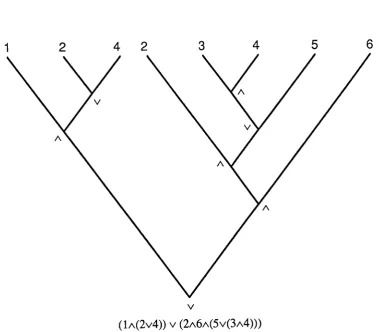
can be interpreted as a circuit in the form of a tree whose leaves are labelled by input variables, and whose internal nodes correspond to and andor
gares.Following
the notationof
l2l,let
P, (respectively Qs) denote ttre set of prime implicants (respectively clauses)of f.
To each node y of this tree, attach a code <cr,F),
where cr (resp. B) is a binary stringof length
lPrl (resp.lQl)
such that cr, (resp. 0,)is
t if
and onlyif
the functioncomputed by y has cti as an implicant (resp. B, as a clause).
<a',
9"),
where theonly
l's in
p"
are representativesfor l's
in y.The blocks of the required partition are then defined by the generalised rectangles in R,
whose rows and columns are respectively indexed by Cr, and B,, where <Crr, Br> is the code
allocated to the leaf node associated with input gate 1.
(ii)
The compurational equivalence classof
ge FDL(n) relative tof
is entirely determined by its relationship to the prime clauses and prime implicantsof
f. The 9ffe9t of the-procedure describedin (ii)
is simpiy to intrbduce a newinderto
represent this computational equivalence class explicitly in the array Rr. For instance,if
g=fi.ft, and p and q respectively represent a prime clause and a primeimplicant of
f,
then p<giff
p<h and p<k,whilst
g<qiff
h<q ork(q.
Introducing g then -orresponds to adjoiningthe new index representing g to each entry in Rt in which at least one of h or
k
is represented, and such that both h andk
are representedwithin
the corresponding row. The functioni
is uniquely represented by an index that appearsin
all entries of the array Rr.a
Proposition 9 indicates a strong connection between configurations
of
prime implicants and clauses an^d the computational characieristics of a monotone boolean function; a theme to bedeveloped elsewhere
I3l. It
can be shown,for
instance, that the array\
consists exclusivelyof
singletons
if
and onlyif f
can be expressed as a formula without duplication of the inputs. (Forsimlle
illustrative
examples of Proposition 9, see Figure 10.)For
non-trivial
functionsf,
analysisof
the array&
appears to bedifficult,
butit
can be shown that the presence of particular singular cycles is connected with features of\.
A
necessary and sufficient condition for fe FDL(n) to possess a particular singular cycle at a given pefinutation is thatit
should belong to a particular interval inFDL(n).
In fact, the form of the singular cycle is-aguarantee that
f
posseises a particular set of implicants and clauses. These sets can be determined 5y examining th^e permutations on the cycle at which the rankof
f
attains its extremal values; oneach such peimutation the set of inputs whose rank is at most the rank of
f
determines a requiredimplicant,
and the set of inputs whose rank is at least the rank off
a required clause. To express this condition in terms of the array&
it is necessary to identify the minimal elements in the required setsof
implicants and clauses; their presence then corresponds to the existence of a particular pattern of incidence within the array RaTo illustrate this, consider the necessary and sufficient conditions
for
a monotone boolean functionf
in
FDL(S) to have the 18, singular cycle[132)11423] at the permutation 12345. Tracing the singular cycle, monitoring the implicants and clauses required to ensure the appropriate exffemal points occur, shows thatf
has the implicants: X1X2 r xzx3x4, x1x3x5 , XlX4x5 , and the clauses:(xr+xa+x5) ,
(xr+xr+xr)
, (xr+x5) , (xr+xr+xo). The pattern of intersection between requiredimplicants and clauses then defines the
4x4
iuray:1122
tt
1r,
',
?to
145
15 5
4that does not
of
course correspond directly to a patternof
intersection between prime.implicants and prime clauses exhibited by any single functionf.in
ttre specified interval.{n
approplate way to hescribe the possible configurations of intersections associatedwith
such functions f is to extractfrom
eachrow
(respectively column) any indices which do not appear as singletons, and to record these separately in ^an additional column (respectively row). These extrarow
(respectively column) entries iorresp6nd to variables that may or may not appear in the implicant^(relqectively glause) . associated wilth therow
(respectivelyiolumn)
- depending on the choice off.
Since the form of the non-singleton entries in the array is dependent on the choice of functionf,
and is uniquelydetermiied
by which of the optibnal variables appear iq primg implicants.and prime clauses ofI
it
intersection that is associated with the represented by the configuration:
1 85 sin gular cy cle
}32ltl
423) at the permutation
12345 isNote that
for
the particular monotone boolean functionxr.(
x,
+ x4.x3; + x1.(x,
+ x5.(x4 + x3 ))that was derived above, a specific form of this configuration arises from the prime implicants
X1X.1: KZ){3X 4, X 1X3X 5, xl X4X5
and the prime clauses (xr+x4), (xr+x3), (xr+x5) and (xr+xr+xo),
viz:
I
I
I
I
I
4 {< {< 5t22
32*
*53
,k54
51122
432*
1*53
*154
The classification of configurations is a variant
of
the problem of classifying intervalsof
monotone boolean functions associated
with
singular cycles referred to above (cf Figure 11, which depicts the lattice interval in FDL(5) associated with the presenceof
a2Ausingular cycle).It
is easyto see that any array that defines such a configuration contains at least two distinct indices in every
row
and column. Specialisation of a function by setting an input xt appearingwithin
a configuration to 0 (respectively 1) can be interpreted as "deleting all rows (respectively columns) containing indexi". If
the effectof
such an operation is to produce a subconfiguration ie an arraywith
at least two distinct indicesin
every row and column, this indicates the presence of additional singular cycles. For instance, the 36, cycle (U32lU4l2)2 has the characteristic configuration:221*
i i;1,
3511
that yields subconfigurations on the assignments x3=0, Xs=O, X3:1, x5=1.
By
referring to the cataloguein
the Appendix, the complete classificationof
singular cyclesfor
the functionx lxz+x2x 4+x
1 x4+x 1 x3 x5
- as specified in detail in a previous section - can be derived.
Reference to the catalogue in the Appendix shows that interdependence
of
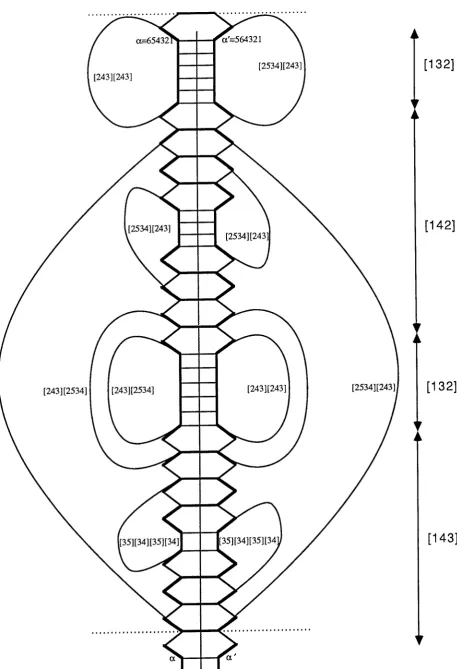
singular cycles is acommon occrrrrence. By the arguments above, the presence of the 2Sucycle
(U42lU3Dz
guarantees the presence
of
a 20ucycle (U43)t1,21)2,for
instance. Figure 12 shows how this relationship between cycles can be interpreted in the Cayley diagramfr.
59 Singular cycles and the complexity of monotone booleanfunctions
Monotone boolean function complexity provided the original motivation for the study
of
singular cycles.
It
might be hoped that functions with largecircuit
size would necessarily possess singular cyclesof
a particularly complicated form. Such a hope is confounded by slice functions,moit
ofwhich
are known to require large circuits by counting arguments [9], but that can have singular cycles associated onlywith
cpl maps of degree at most 4. Nor is the number of.sing-ular cycles an appropriate indication of complexity, since threshold functions and slice functions have v-ery similar characteristics.It
would be interesting to frnd bounds gn thg length and alternation indicesof
singular cycles associated with cpl maps of degree n, and on the complexity of the functions needed to iealise these particular cycles, butit
is not clear at present whether this can offer a methodfor
consffuctively demonstrating non-trivial lower bounds oncircuit
size. Perhapsit
is more reasonable to expect that the complexity of realising an individual singular cycle will_prove to be smallin
general, and that the complexityof
a function is associatedwith
"simultaneouslymap, but how inputs must be assigned in order to realise these cycles.
Attempts to apply the above theory to proving lower bounds on
circuit
complexity have yet to produce inteiesting concrete results. One possible approach is to_consider_q9 implicationsfor
bircuit size of computing a function that can be specialised to yield many different altemating sums and products
(cf t5l). It
is easy to see that an alternating sum or producto!
inpy! variables admits one optimal computation, and that ttre order in which inputs are introducedin
this computation is completely determined. Informally,it
seems plausible that functions that could be.specialised to yield altemating sums and products associatedwith
many different variable orderingg sho_uld be hard to realise. The work on computational equivalence and replaceability describedin
[2] wasoriginally
motivated by the studyof
such issues.A
standard technique,first
introduced by Schnorr[8],
but yet to be successfully applied to provingnon-trivial
lower bounds for monotone boolean functions, aims tofind
invariants that can be shown to attain large values for certain functions, but that cannot increase very$eatly
under the operations that correspond to the construction of a booleancircuit
or formula. For the reasonseiplained above, simple invariants associated
with
single cycles can only have limited significance heie, but consideration of how circuit building operations can affect the geometryof
singular cycles has some intrinsic interest. One attraction of exploring boolean circuit building operations in the context of cpl maps is that theand-or
duality takes a very simple form, and the geometryof
singular cycles respects this duality. (Schnorr's unsuccessful attempts to extend the arguments in
[8]
to monotone boolean functions were based upon combinatorial featuresof
the primeimplicants.)
It
is thus enough to consider two types of operation: the mapping FDL(n) -+ FDL(n+1) defined by replacing the inputx'
by x,r.xrr11, ?nd the mapping FDL(n+1) -+FDL(n)
defined byidentifying
the inputsx'
and xrr*r.Operation 1: replacing the input
\
by\.x,,+r
Suppose that
fe FDL(n),
that Fe FDL(n+1), and thatF(x1, x2, ..., Xn, xrr*l) =
f(xr,
x2, ..., Xn-l, xrr.xr.11).It will
be convenient to assume thatf
- and thus F - is incomparablewith
any generator x1. (Thederivation
of
similar resultsfor
singular chains isleft
as an exercise to the reader.) The singular cyclesof
F can then be inferredfrom
thosefor f.
Suppose that C is a cyclefor
F. There are essentially two possible cases to consider:Case 1: C contains no edge on which the indices n and n+1 are transposed
In this case, the order in which n and n+1 appears in permutations on C is fixed. For each oe C, let
d
be the permutationof
{ 1,2,...,n1obtained by deletingi.o
from
o, wherei
is the smaller of the two indicesfor
whichi.o
= n orn+l.
The result of this operation is to transform C into a cycle c forf;
moreover C is essentially equivalent to the singular cycle c:it
is either identical in form, or differs by the interpolation of zero singular edges. In effect, c is derivedfrom
C by eliminating the variable x,.o, where the behaviour of F on C is independentof
xr.o.Case 2: C contains an edge on which the indices n and
n+l
are transposedIn this case, C contains permutations
o,
o'
=T.o
representable (as sequence of indices) as:o=Gnn+1iB
and
o'=
ctn+l
niB
where cr and B are sequences
of
indices, cr has lengthr-1,
andrk(F(o))=rk(F(o'))
=r*1.
Lrt
p andp'
be the permutationsof
{ 1,2,...,n1defined by the sequences:P=crnjp
and
p'=crjnF.
the singular cycle of
f
that contains(p,p').
Consider a traversalof
the cycle c that begins at p and proceedsin
the direction(p,p'),
and letP6-P'
P1=P""" Pk'"'
be the sequence of permutations encountered. Suppose that t is the smallest positive index such that
f(p,)
=n
andrk(f(p,))
=1.
Such a t necessarily exists, since the permutation that directly precedes Po on the cycle c necessarily
has the index n at rank < r. For the very same reason, po*pt. The
form
of the cycle C is now readily described. In effect, C has a ffaversaloo=0,
or=o',...,
or,that mimics the traversal
po=p,
p1=p',...,
p, exactly on those edges (p1, pi*1) at which a pairof
indices
(
n is transposed, and interpolates a zero singular edge to transpose a pair of indicesof
thform
(n+1,k) whenever this is required. To be moreexplicit, "mimicing
the traversal"Pg
P1,"''
P1at o0=o may lead to a permutation in which the index n+1 separates the two indices
(,k)
that are transposed at the next edge of the cycle c, at which point transposition ofk
and n+1 is required to makej
andk
adjacent. Because of the nature of the functional dependence of F upon the variable x,r*r, this variable is essentially redundant throughout the entire ffaversalso that the rank
of
the index n+1 is"r*"ltilrrlltlr';;tfttes
betweenr
and r-1. tn particular, theindex at rank r-1
in
o,
is necessarily n+1. Because of the symmetry between n and n+1,it
thenfollows
that C is a singular cycle of theform
og,
o1,...,
ot,,q,t,...,
olt'
oot,
oofor
which the corresponding relationin
S, is palindromic. (See Figure 13for
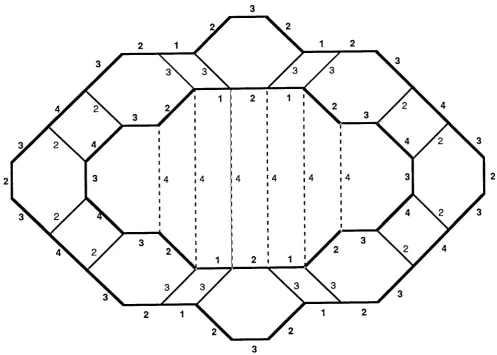
an illustration of how the 18u cycle associated with the function x1x2+x1x3+x rx4+xzx4is transformed into 40ro and 20u cycles via the replacement of xo by xo.x5.)Operation 2; identifying the inputs
\
md
xr,+rSuppose that Fe FDL(n+1), that fe
FDL(n),
and thatf(x1, x2, ...,
xr) = F(xr,
x2, ..., Xn-1, xn, xn).Within
the Cayley diagram\*r,
consider the set H of permutations in which the indices n andn+l
are adjacent. There isa2-l
correspondence X: H -+l,r,
under whichrl
andq'have
the samerepresentative in
f'
when n andn+l
are identified.Note
also that eachpair
(q,n)
such thatX(q)=X(n)
defines an edgeof
l,r*r.
Suppose that(q,q)
and(y,ry)
aretwo
such edges, and that1(q)
andXM
are adjacent inL,.
There are then two possible cases to consider:Case 1: the four permutations
I,I',V
and1/
define a cosetof
the form\
Case 2: the four permutations'[,r1',V and
r/
appear in a cosetof
the form\
In this case - without loss of generality - there are then relationsn=114',
p=tr-rTl=trv,
V{r-1V
andp'=r'r-,4'*M,
where
(tl',p'), (p',V'),
(q,p)
and(p,y)
are edgesof
f,,
+r.If
F is non-singular on all these edges, thenf
is non-singular on the edge (X(q),X(V))h
lr,.
The singularitiesof
F on these edgesotherwise conform to one of the patterns depicted
in
Figure6.
In
ln+l,
assign the code +1 to a positive singular edge, -1 to a negative singular edge, and 0 to other edges.A
trivial
analysis of all possible cases then shows that the sum of the encodingsof
the edges(q,p)
and (p,V) is the same as thatof (n',p')
and(p',y').
Furthermore, the edge(1(q),X(\r))
in
f
is positive singular, negative singular or zero singular according as this sum is +1, -1 or 0.It
may be seen ttrat the effect of identifying inputs on the formof
singular cycles depends on the entire disposition of singular edges for the original function;for
this reason, it is hard to predict. The possible formsof
singular cycles that can arise by replacing an input by an and or anor
of
inputs, on the other hand, can be determined from knowledge
of
the singular cycles originally present. (Contrast Figure 13with
Figure14,in
which the synthesisof
a singular 30r cycle upon identificationof
the inputsx,
and xu in the function x1x2x4+x1x3x5+x2x3x6+x4x5x6 isillustated.)
S 1 0 F uture dev elopments and p ote ntial app lic atio ns
Future development of the ideas set out above has two aspects: further theoretical investigation and the identification of applications.
From a theoretical perspective, the most significant problem is the classification of singular cycles, since this seems
likely
to lead to new insights into the form of monotone boolean functions.A
number of different approaches to this problem of classification have been suggested in this paper: for instance, an appropriate characterisationof
singular cycles might be expressed in terms of relationsin
l,r,
or in terms of intervals in FDL(n). From a group theoretic perspective,connections
with
research into Bruhat orderingsof
Coxetergoups (cf
tal)
seem plausible, since these in particular relate the structure of relations in symmetric groups to abstract simplicialcomplexes, and these can in turn be related to the theory of distributive lattices
t2l.
(No direct links have yet been established.) From a lattice theoretic perspective,it
should be stressed that the structure of free distributive lattices is by no meansfully
understood; as atrivial
indication, the computationof
the size of FDL(n) has only been achieved for n<7.It
may be conjectured that the partitionof
f,,
associatedwith
a monotone boolean functionin FDL(n)
corresponds in some way to a normalform
whose components are determined by the singular cycles. The potential significance of possessing particular singular cycles still requires clarification, however. The geometric content ofiingular
cycles is perhaps best viewedintuitively
as reflecting the 1-dimensional structure of a monoione boolean function; perhapsit
will
be necessary to not only to understand this structure but tofind
techniquesfor
higher dimensional analysis (cf Figure 14).The successful identification of applications might be useful
in
suggesting directionsfor
further theoretical development. The issues raised by complexity analysis have already been discussedin
$9, but there are other potential applications to explore. Computational geometry is one areain
which the geometric model of monotone boolean functions may be relevant (cf [1]).It
is clearfor
instance that cpl maps could be useful as a wayof
abstractly representing continousgeometric structures other than piecewise linear maps: Combinatorial abstraction of this kind can be useful as a basis

![Figure 9: The alternating group as generated by [12] and [13]](https://thumb-us.123doks.com/thumbv2/123dok_us/9878854.489083/29.595.96.416.148.434/figure-alternating-group-generated.webp)