SCALING METHODS FOR THE REPRESENTATION OF COGNITIVE PROCESSES
A dissertation
submitted in partial fulfilment
of the requirements for the D2gree
of
Ibctor of Philosophy in Psychology
in the
University of Canterbury
By
01ristopher 0. Fraser
�
ACKNOWLEDGEMENTS
I would like to thank the following people for their interest, assistance and support in the preparation of this· thesis.
Firstly, I would like to formally acknowledge the valuable assistance of my supervisor, Professor R.A.M. Gregson during my undergraduate and graduate study. His willingness to provide me with constructive advice but with the freedom to pursue my own inclinations were most appreciated.
The following institutions have generously provided me with facilities and material support during preparation of this thesis: the Mathematical Psychology Program, University of Michigan, the Psychometric Laboratory, University of North Carolina, Department of Psychology, University of Newcastle, Centre for Behavioural Studies, University of New England.
I would like to thank James C. Lingoes, Elliot Noma, Clyde H. Coombs, Forrest W. Young, John Hattie, Don Fitzgerald, John Keats and Terry Caeli for valuable discussions on topics relating to this research. I would particularly like to acknowledge the more personal support provided by Clyde Coombs, Forrest Young and John Hattie.
For the typing of various drafts of this thesis, I would like to thank Vicky Eaddy, Sharyn O'Hara, Kim Blacker and Rhonda Kowalczyk.
I also acknowledge the support of my past and present colleagues at the Gippsland Institute of Advanced
Education for encouragement and assistance in providing me with the time to complete this thesis. I particularly thank Warwick Troy and Joseph Kavanagh in this regard.
Chapter
ACKNOWLEDGEMENTS LIST OF TABLES LIST OF FIGURES INTRODUCTION
. . . .
.
. . . . .
.
. . .
.
. . . .
ii Vvi 1 PARI' I
1
II
PART II III
IV
THEORETICAL ISSUES IN QUANTIFICATION IN PSYCHOLOGY THE LOGIC OF MEASUREMENT AND PSYCHOLOGICAL THEORY
Classical physical measurement theory Evaluation of classical physical theory Classical psychological measurement theory
Evaluation of classical psychological measurement theory
Axiomatic measurement theory . . . . Derived measurement . . . . . . . . Evaluation of axiomatic measurement theory Summary . . . . MULTIVARIATE ANALYSIS AND PSYCHOLOGICAL THEORY
Scaling and data theory . . . . Data analyses as models of cognitive processes THEORETICAL ISSUES IN MULTIDIMENSIONAL SCALING MODELS AND METHODS FOR DISTANCE REPRESENTATION Metric multidimensional scaling . . . • . Nonmetric multidimensional scaling . . • • Methods for similarities-distances mapping Alternative distance functions
Combining data across individuals • . . . Alternative data types for distance scaling
Second order comparisons Sorting procedures
Ranking procedures Large data structures
Indirect proximity measures Distance models of profile data
Artificial distances Conjoint scaling
VALIDATION OF MULTIDIMENSIONAL SCALING SOLUTIONS
PART III V
EMPIRICAL EVALUATIONS
THE PERCEPTION OF SPATIAL ORIENTATION The experiment
Results Discussion
Spatial orientation and Results - analysis two
Regression analysis Rank order tests
similarity
Constrained multidimensional scaling Discussion
VI SEMANTIC STRUCTURE OF EMOTION LABELLING Dimensions of emotion
Method . . . . Results
Confirmatory analysis of facet structure Constrained MDS analysis
Results Discussion VIII CONCLUSION REFERENCES
APPENDIX A - Questionnaire for experiment two
APPENDIX B - "Cognitive strategies and multidimensional scaling"
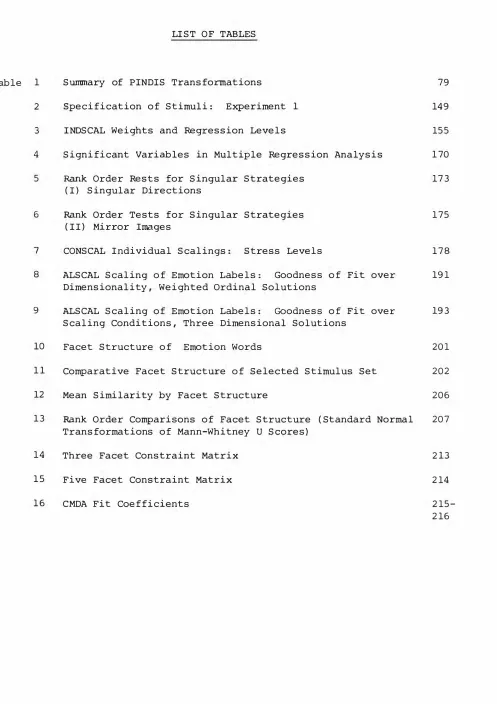
Table 1 2 3 4 5 6 7 8 9 10 11 12 13 14 15 16
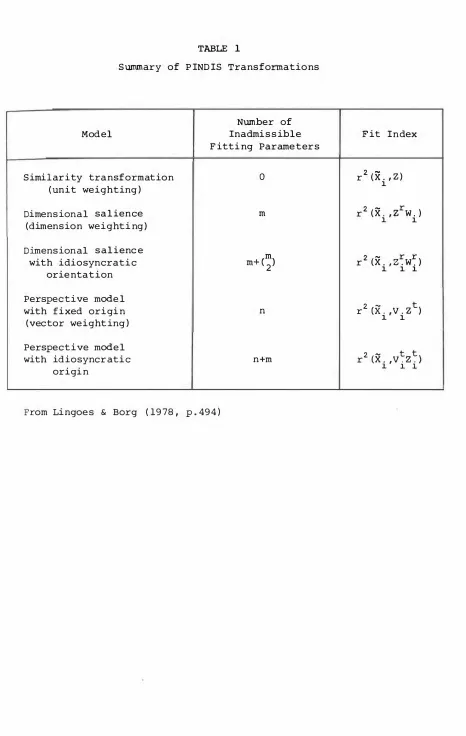
Summary of PINDIS Transformations
Specification of Stimuli: Experiment 1 INDSCAL Weights and Regression Levels
Significant Variables in Multiple Regression Analysis Rank Order Rests for Singular Strategies
(I) Singular Directions
Rank Order Tests for Singular Strategies ( II) Mirror Images
CONSCAL Individual Scalings: Stress Levels
ALSCAL Scaling of Emotion Labels: Goodness of Fit over Dimensionality, Weighted Ordinal Solutions
ALSCAL Scaling of Emotion Labels: Goodness of Fit over Scaling Conditions, Three Dimensional Solutions
Facet Structure of Emotion Words
Comparative Facet Structure of Selected Stimulus Set Mean Similarity by Facet Structure
Rank Order Comparisons of Facet Structure (Standard Normal Transformations of Mann-Whitney U Scores)
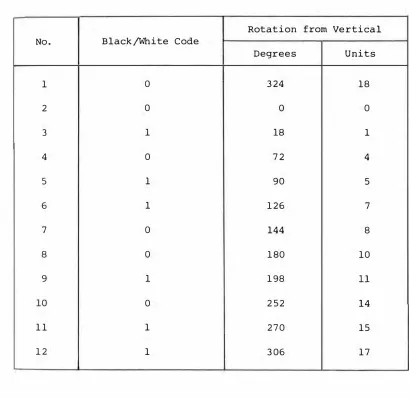
Three Facet Constraint Matrix Five Facet Constraint Matrix CMDA Fit Coefficients
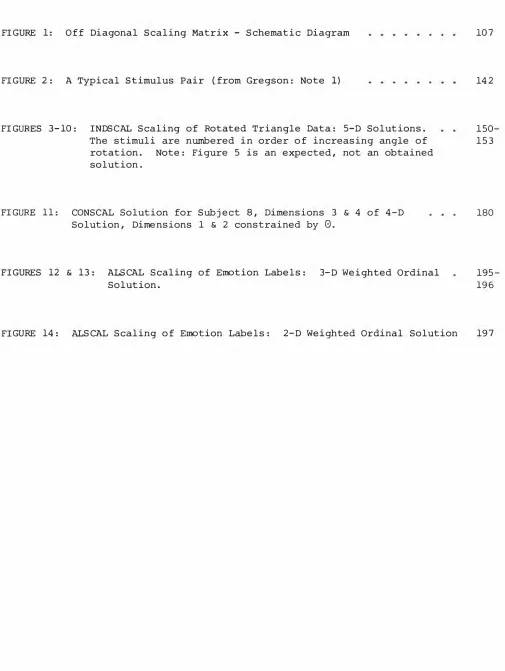
[image:5.595.46.543.79.783.2]LIST OF FIGURES
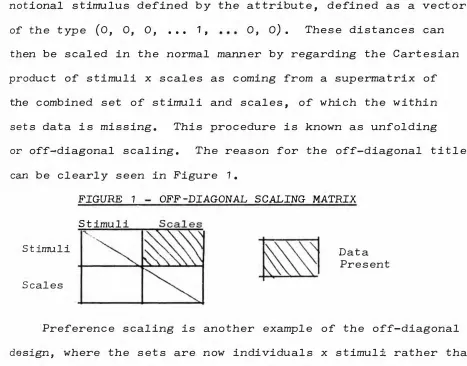
FIGURE 1: Off Diagonal Scaling Matrix - Schematic Diagram
FIGURE 2: A Typical Stimulus Pair (.from Gregson: Note 1)
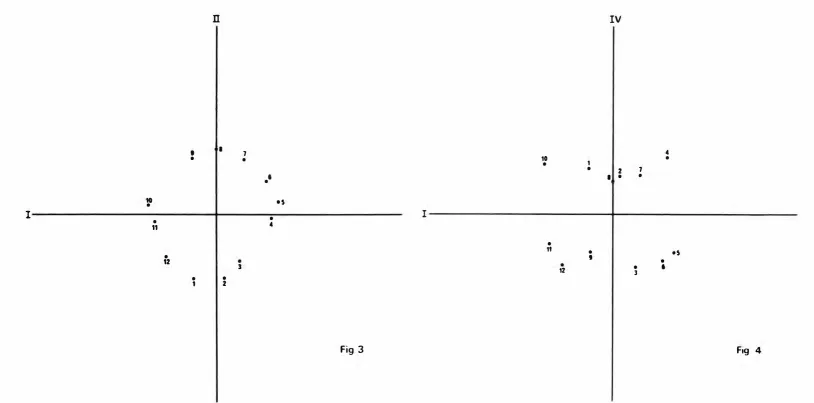
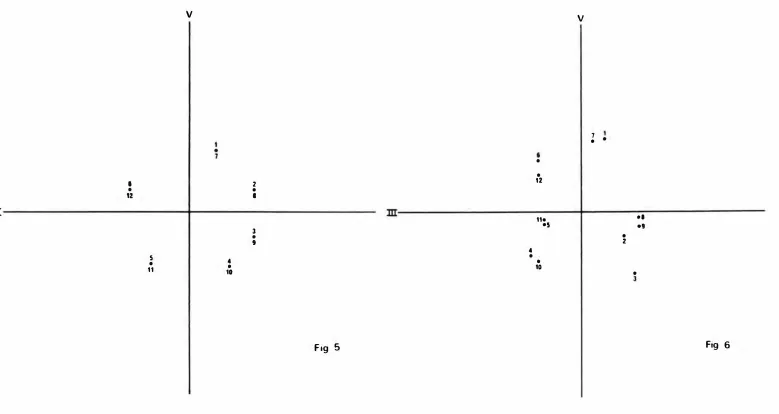
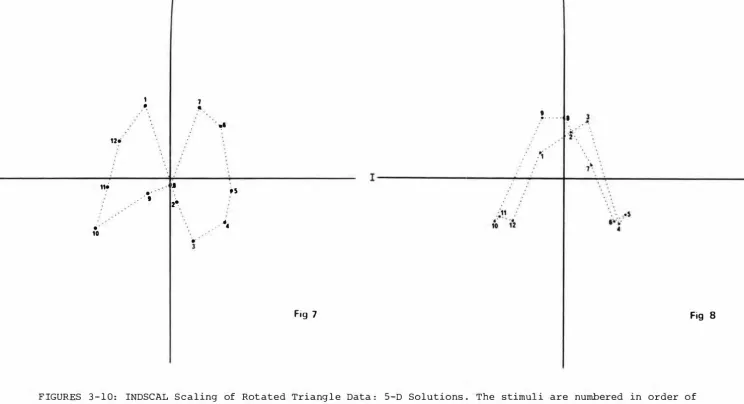
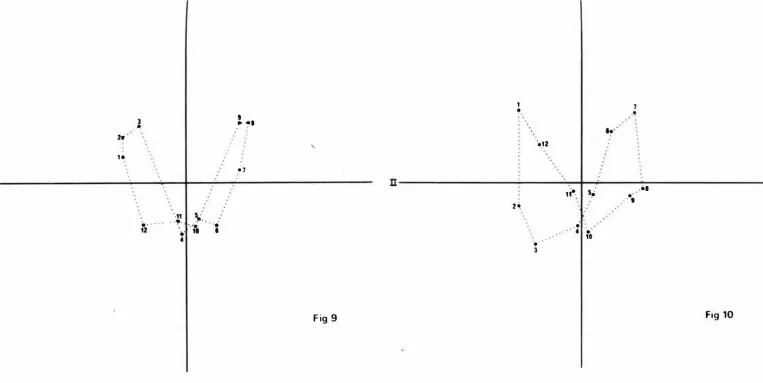
FIGURES 3-10: INDSCAL Scaling of Rotated Triangle Data: 5-D Solutions. The stimuli are numbered in order of increasing angle of rotation. Note: Figure 5 is an expected, not an obtained solution.
FIGURE 11: CONSCAL Solution for Subject 8, Dimensions 3 & 4 of 4-D Solution, Dimensions 1 & 2 constrained by 0.
FIGURES 12 & 13: ALSCAL Scaling of Emotion Labels: 3-D Weighted Ordinal Solution.
107
142
150-153
180
1 95-196
[image:6.595.40.545.124.795.2]Title of Dissertation:
Christopher O. Fraser,
Dissertation Supervisor:
An evaluation of the validity of multidimensional scaling methods for the representation of cognitive processes.
Doctor of Philosophy,
R. A.M. Gregson,
Professor of Psychology, University of New England.
1980.
This study is an evaluation of the issues involved in providing a
meaningful psychological interpretation of multidimensional scaling solutions, for example to regard them as valid representations of the cognitive processes involved in generating the data.
The various metatheoretic approaches that have been developed to define appropriate procedures for the quantification of psychological attributes are discussed and evaluated. It is argued that much current psychological research is based on an inappropriate paradigm. In particular it is argued that the emphasis on magnitude estimation to generate psychological data is misplaced and scales derived from weak-ordered judgements are much to be preferred.
Extending these arguments to the multidimensional case, it is argued that most applications of multivariate methods in psychology have shown
insufficient recognition of the theoretical implications of using a particular technique. The application of any method of data analysis such as multidimensional scaling is only appropriate if it can be shown that the assumptions implicit
in the scaling model are satisfied for that set of empirical data. In addition some variations in the scaling model, such as subjective metrics scaling,
These metatheoretic limitations, as well as evidence on the frequent
occurrence of violations of its basic assumptions suggest that multidimensional scaling configurations can at best be attributed with only a limited degree of psychological significance. It is suggested that such value as it does
possess is limited to the evaluation of non-dimensional structural hypotheses derived from some prior substantive theory.
INTRODUCTION
Since the initial demonstration (Torgerson, 1952) of the feasibility of retrieving the spatial configuration implied by a set of interpoint distances, psychologists have been tempted by the theoretical possibilities presented by multidimensional scaling methods.
The interest in the psychological interpretation of MDS configurations was increased by two apparently significant theoretical advances; the introduction of nonmetric scaling methods (Kruskal, 1964a, b) which appeared to overcome the str�ct linearity assumptions imposed on the data, and
subjective metrics scaling (Carroll & Chang, 1970) which appeared to offer a plausible method of incorporating individual differences within a common perceptual space. Other extensions of the scaling model which appeared to increase its flexibility as a psychological modelling
procedure included variations in the nature of the distance function, and in the ways individual configurations could be related to a common configuration.
Most recent theoretical treatments of the MDS model have however cast doubt on the utility of all of these apparent methodological advances and have criticised the lack of any attempt to justify the theoretical assumptions implicit in the application of MDS techniques. The recent emergence of the area of 'measurement theory' (Krantz, Luce, Suppes & Tversky, 1971) as a more rigourous foundation of psychological measurement procedures has emphasised the
2.
both unidimensional and multidimensional, to be explicitly stated and empirically tested.
One consequence of this greater recognition of the theoretical content of data analysis procedures has been the development of techniques whereby structural hypotheses derived from substantive theory are directly evaluated as a consequence of applying a particular data analytic
technique. Techniques for confirmatory analysis have been derived for both factor analysis (Joreskog, 1969) and multi dimensional scaling (Bentler & Weeks, 1978, Borg & Lingoes
1978, Bloxam, 1978).
The aim of this study is to evaluate the contribution these various methodological developments in multidimensional scaling can make to the goal of providing an interpretation of a spatial structure derived from data that has some
substantive theoretical significance.
Multidimensional scaling will be regarded as a psychological measurement procedure designed to derive
simultaneously scale values on more than one dimension. This study will thus attempt to apply the perspective of the
Part II is a review of all significant methodological variations in multidimensional scaling procedures and an evaluation of the extent to which meaningful psychological interpretations can be attributed to different types of scaling solutions.
Part III describes some empirical research designed to demonstrate what appears to be the most promising approach to the utilisation of MDS methodology in the development of psychological theory. This section also demonstrates how incorrect conclusions can easily be drawn by an uncritical approach to the interpretation of MDS solutions. Chapter V in this section is a more extensive treatment of a previously published study (Fraser, 1976) and a copy of this paper is also attached.
PART ONE
CHAPTER ONE
THE LOGIC OF MEASUREMENT AND PSYCHOLOGICAL THEORY
The increasing use of quantitative methods in psychology should imply an increasing emphasis on both methodological and theoretical aspects of obtaining numerical measures of attributes. While psychology has developed an increasing number of methods to quantify attitudes, abilities, needs, tendencies etc. , very little attention has been devoted to the logical justification of such procedures. Psychology has by and large relied on a set of essentially ad hoc
statistical techniques, subsumed under the titles 'reliability' and 'validity', to justify its measurement procedures. That is, it depends on establishing a system of interrelationships among a variety of measures, rather than an independent
justification of each one singly.
Most texts on psycholog±cal measurement have worked within this paradigm to develop practical procedures for scale constru ction and evaluation (e. g. Nunnally,
1967, 1970;
Cronbach et. al. ,1972;
Lemke and Wiersma1976).
As Nunnally states "theu1timate test is how well the scales that are derived fit in a nexus of lawful relations with other scales"
(1967,
p. J4).A more firm foundation for psychological measurement
6.
fundamental measurement can occur clearly preelude most
psychological attributes. It is hardly surprising then that psychological measurement has long been regarded as
quantitatively and qualitatively of a lower order than physical measurement.
There appears to have been two main consequences of this for the theory and practice of measurement in psychology. The first has been the use of a less deterministic approach to measurement, regarding scales as approximate indices only, subject to an unknown amount of measurement error. The second has been the concept of lower order scales embodied in S.S. Stevens' analysis of measurement theory (Stevens, 1939, 1946, 1951, 1968).
Recent developments in psychological measurement theory have however, demonstrated that the concept of fundamental measurement can be extended in a way that is appropriate for psychological attributes and have identified some substantial logical flaws in previous approaches. By reviewing these developments i t is hoped to show that much of the currently accepted theory and practice of psychological measurement is in need of a substantial revision.
Classical Physical Measurement Theory
In physics, as in psychology, an explicit formulation of the logical conditions for measurement came long after the
development of practical measurement procedures. The first
attemp t to provide a logical justification for measurement was given in the works of Helmholtz (1887). Helmholtz
the presence of an empirical operation to compare directly the quantities of objects (e. g. juxtaposition of length, weights in a pan balance), and attempted to identify the conditions under which such an operation could lead to the development of a measurement scale. This was developed at a more formal level in !folder's
(
1901) classic theorem specifying the ax.iomsof quantity. These specified the relations that must hold between entities for them to be used as elements in additive and multiplicative functions, i.e. as quantities, and also that one be able to add together two quantities to make a new quantity.
The consequences of this for the process of measurement were given their most complete exposition in the works of N.R. Campbell (1920, 192 1, 1928, 1938). Campbell saw
measurement as the demonstration of anisomorphism between the ideas of quantity and the magnitudes of the property to be measured,
(A
magnitude is the amount of a specific property possessed by a specific object). The way to do this was to demonstrate that the magnitudes obeyed the axiom of quantity developed by Holder.Measurement thus depended on being able to observe
relations between physical objects as a consequence of perform ing an empirical operation. This empirical operation was the defining operation of the measurement. There was no meaning
to the concept of two objects being equal with respect to
some quality without first defining the operation used to
test equality.
8.
capacity for addition was regarded as a fundamental
importance to the measur ability of attributes. Campbell and several subsequent theorists (e.g., Cohen and Nagel,
1934,
Ellis, 1960) regarded the existence of an empirically defined concatenation operation as practically essential for fundamental measurement. Campbell referred to this as the additive property, although i t is now usually denoted as the extensive property.Campbell did allow for a potential theoretical distinc
tion between extensive and fundamental measurement, but did not see it of any practical importance since alternative methods were unlikely to be available. Ellis
(1966)
in fact uses the terms synonYmously, using the term direct to indicate fundamental in the sense we have defined it here, i.e.,independence from other measures.
Clearly not all physical scales possess this presumed
fundamental extensive property. Density for example, possesses an operation for ordering objects (which floats on which) but not for adding them. Density and temperature are in fact examples of what are known as intensive properties, since
mmbining objects produces the average, not the sum of their densities. Clearly several important physical properties were intensive but were still capable of being measured successfully by virtue of known mathematical laws relating them to other
Evaluation of Classical Physical Measurement Theory The classical physical view of measurement theory
incorporates two critical features, both of which have been criticised by subsequent theorists as being overly restrictive.
The first is the very restricted view of what can
constitute measurement. Only one type of scale was counten-anced; 'quantity' had one set ofproperties and these were strictly not negotiable. Magnitudes had to meet these in their entirety, or they could not be measured.
The second is the view that the relations implied by the concept of quantity must be directly exhibited by actual
physical objects; that is, no distinction was drawn between the object, and the measure assigned to that object. Since these relations included the concept of addition this implied that it must be meaningful to talk of the addition of objects.
This for example was the basis of the conclusion of a committee of which Campbell was a member, reporting on whether sensations in general, and the sone scale of loudness in
particular, constituted measurement. In its Final Report (Ferguson et.al., 1940) it concluded that:
'any law purporting to express a quantitative
relation between sensation intensity and stimulus intensity is not merely false but is in fact
misleading unless and until a meaning can be given to the concept of addition as applied to sensation'. This insistence that relations can only be exhibited between physical objects clearly poses problems for the concept of
10.
in this direct sense of adding two objects with the particular density, temperature, etc. This fact was criticised by
B. Russell in Principles of Mathematics. As Russell states, one can only add quantities not magnitudes, "addition of two magnitudes yields two magnitudes, while the addition of two quantities does give a new single whole " (1937, p.178)
Classical Psychological Measurement Theory
The measurement theory of S.S. Stevens has gained wide spread acceptance within and outside psychology, and as the first comprehensive attempt to develop a theory applicable to psychology might reasonably be regarded as the classical
psychological approach.
Stevens' main innovation was to remove the restriction that numbers assigned as measures had necessarily to obey the laws of quantity, and introduced the possibility of other types of scales. Instead measurement was defined broadly as
"the assignment of numbers to objects or events according to rules". (1951, p. 1), with the problem being transferred to
identifying the type, rather than the existence of measurement. This classification of the type or level of measurement was to be done by identification of the type of mathematical transformations that left the scale form invariant (i. e. , so it still obeyed the rule).
Evaluation of Classical Psychological Measurement Theory Stevens-tradition (ST) measurement theory clearly provided
some advantages over the classical physical approach. It drew attention to the distinction between the formal system (numbers) and the empirical system it represented and the need for the properties of each to be logically connected. It also
identified the arbitrariness of insisting on using the
prq,erties of the number system in their entirety as the only possible formal system that could constitute measurement.
The critical deficiency in Stevens' system is that while
apparently recognizing the distinction between the formal and empirical systems, it does not in fact characterize them
separately and identify the nature of the connection between them. Ross (1964) argued that because Stevens did not
explicitly state how the assigrunent of scale values related to specific empirical operations, that he in fact implicitly
incorporated non-falsifiable assumptions into this process. Ross drew attention to an inconsistency in Stevens' approach between his theoretical statements and the practical procedures he advocated. For example concerning the formal conditions for measurement he states:
"Measurement is only possible because there is a
kind of isomorphism between (1) the empirical
relations among properties of objects and events and (2) the properties of the formal game in which the numerals are the pawns and operators the
12 .
However, many of the practical applications Stevens has quoted imply that he treats this isomorphism as
axiomatic, something which must be present if measurement has been achieved, rather than a condition that needs to be empirically established. For example, the technique of
magnitude estimation, which assumes subjects can directly generate numbers in proportion to their apparent magnitude, contains no implications of even 1a kind of' isomorphism between basic empirical operations and the number system.
This inconsistency between theory and practice can also be identified in the procedures used for the determination of scale type. Stevens maintains that the classification of scale type can be accomplished by the principle of scale invariance, without reference to any relationship to empirical events or other scales. He states:
"We may seek the final and definitive answer in the mathematical group structure of the scale form; in what ways can we transform its values and still have all the functions previously fulfilled". (Stevens, 1951, p.29)
that "most of the scales used widely by psychologists are ordinal scales"
(1951,
p.20). I.Q. for example, is an ordinal scale according to S tevens, yet by his definition,it could be converted to a ratio scale by counting questions. Clearly something else is being taken into account, although it is not specified what it is. Ellis
(1966,
p.63) concludes that Stevens "simply makes the classification as though the reasons were self-evident", and Nunnally (1967, p.21) that "no one has made it clear what types of evidence would justify the assumption of a part icular scale type".Ellis
(1966)
demonstrated that an inadmissable trans formation of a scale could still serve all of the functions and retain all the information of the old scale. For example, the application of a log transformation to the Kelvin scale for temperature is clearly inadmissible, yet could still be used to formulate physical laws to relate temperature to other scales. The laws would not be of the familiar form, but then these only exist because of the particular type of scale used to express them in.Clearly then the principle of transformational invariance as expressed by Stevens is logically insufficient as a means ofdeterminingscale type. Prytulak (1975) has suggested that
it can be made sufficient by basing it on empirically determined relationships with other scales. To support this he observes that the procedures used by ST theorists do in fact implicitly,
if not explicitly, consider transformations to other scales. They avoid the direct recognition of the second scale by using examples such as subjective length where some familiar scale
14.
can readily appreciate the relation between the scales without any overt recognition that a transformation is involved.
So in fact, as Prytulak observes, the actual choice of scale type results from a consideration of all such implicit combination:;that are relevant to the use of the scale, and involves such intuitive criteria as the relative frequency, importance and range of situation:;in which transformations of the higher and more desirable types occur.
While there is undoubtedly a role for this extended version of ST measurement theory in dealing with the psychol ogical measurement procedures which draw their justification from established relationship with other scales, it is a step back from the objective of deriving fundamental measure-ment procedures in psychology. The transformational
properties of various scales are of some use as a purely descriptive classification, but they cannot be regarded as constituting a philosophy of measurement.
Axiomatic Measurement Theory
An alternative line of development in measurement theory was to return to the concept of fundamental measurement as developed in the classical physical approach, but to extend it to include the situations more commonly found in psychology. This approach recognizes that there is no logical justification for the restricted notion of fundamental measurement proposed by Campbell, which regarded it as equivalent to extensive
measurement.
A more realistic definition of fundamental measurement should incorporate the extension proposed by Stevens of
system, while still retaining the need for an empirically established correspondence between the empirical system and these properties. Coombs, Raiffa and Thrall
(1954)
urged such an extension to include scales based on any type of formal system, including those such as lattices and partial orderings which cannot be represented numerically in any natural way.The earliest approaches attempted to characterise the precise properties in the empirical system required to justify
ordered scales. Hempel
(1952)
for example, derived theaxiomatic conditions for ordinal scales based on what he termed quasi-series.' These required the fairly strict
conditions that both an equivalence and an ordering relation could be empirically observed in order to generate the series. Luce
(1956)
proposed as a natural and more realistic extension the concept of �emiorders� These allowed for the morerealistic situation in psychological ordering where the
indifference relation is not transitive. That is, while one may be indifferent between A and B, and between B and C, one may not necessarily be indifferent between A and C, as the first two differences may be less than one jnd, while the combined differences exceed it.
16.
The first fundamental problem was stated in more formal terms as the need to:
"Characterise the formal properties of the empirical operations and relations used in the procedure and show they are isomorphic to appropriately chosen numerical operations and relations"
(Suppes and Zinnes, 196J, p.4) The precise nature of the isomorphism, that is, what
relations defined in the formal system are assumed to represent relations holding in the empirical system, constitutes the
measurement model. The proof that a numerical (or other) assignment can be made to a given empirical system to produce a representation of the type defined in the measurement model is provided by the representation theorem. This is based on a specification of a number of axioms which represent the minimum conditions that must be satisfied by the empirical system in order for a scale of that particular type to be produced.
The uniqueness theorem specifies the type of representation that is obtained by determining the type of transformations that are permissible for a given numerical assignment, while still obeying the axioms of the representation theorem. It is thus
analagous to Stevens' admissible transformations principle, except the condition of scale invariance has been more
explicitly defined.
relations on differences between pairs of scale values.
Further classes of measurement models have been proposed by subsequent theorists and include for example bisection systems
(Pfanzagl,
1968),
conjoint measurement (Luce and Tu.key, 1964), probability representations (Krantz et. al. ,1971),
Grassman structures (Krantz, 1974). A comprehensive review of mostvarieties of psychological measurement models has been provided in Krantz et. al. ,
(1971).
The details of these will not be considered here. Instead the concept of derived measurement will be reconsidered in the light of the extended definition of fundamental measurement.Derived Measurement
Pfanzagl (1968, p. J1) has maintained that derived
measurement is not really measurement at all, being simply a combination of other scales. He argues that only fundament ally measurable qualities should be used in the search for empirical laws.
This is an overly restricted view, however, as it ignores the importance of the total set of interrelationships that exist among the scales in a given system. In systems where the inter-dependence of scales is high the number of scales which must be independently measured is correspondingly reduced. The
physical system is in the happy situation of having a high
18.
arbitrary choice of unit; we need only specify the units for six basic dimensions to determine the whole system. Several writers have emphasised the theoretical importance of the scales chosen as the basis of a dimensional system. Campbell
(1920) called these basic scales, Palacios (1956) defined them as fundamental and Ellis (1966) called them independent scales. We will follow the terminology of Krantz et. al. , (1971) and denote the scales in the base as primary, those that are not, as secondary. This distinction is somewhat arbitrary as the choice of base is not unique, but does indicate the importance of deriving scales from others within a system, even when an independent fundamental measure may be available. (Campbell used the term quasi-derived for scales in this situation;
1920, p. 379) . Hempel (1952) also referred to the importance of systematic relationships in distinguishing stipulative and vicarious as two categories of direct measurement.
Stipulative is an arbitrarily defined relation with another measure, whereas vicarious measures arise as a consequence of empirical laws. Krantz et. al. , ( 1971) however give a more
operation. The non-extensive attribute, density, arises as a product of the law.
A second type of derived measure results from laws of
exchange. These also relate two extensive attributes to a third attribute, but in this case the two concatenation operations are independent. They are related by a physical law of conservation in a closed system. For example P/VT=
constant, and thus a measure on two defines the third. These
laws thus depend on an empirical compensation of concatenation operations, rather than an equivalence.
Krantz et. al. , (197; , p.488) discuss the relation between derived measurements of this kind and the concept
of conjoint measurement. This is a type of fundamental measure ment based on objects considered cS a conjoint effect of two
or more components. Axioms have been developed specifying the conditions under which this can lead to the construction of a numerical representation that is additive over those components which does not depend on the existence of a concatenation
operation for the objects.
Laws such as m=Vd can thus be regarded as establishing a conjoint scale on one attribute e. g. , density, conditional upon the law relating it to the other two being true. Since this measurement can be defined as fundamental the argument that derived non-extensive scales are not measurement clearly cannot be maintained.
20.
of measurement hold sinrultaneously (1971, ch. 10).
These interrelationship:;between different types of measures and the somewhat arbitrariness of the choice of measure to form the basis to the system, show that the distinction between fundamental and derived measurement is more a matter of convenience than of fundamental theoretical importance.
Evaluation of Axiomatic Measurement Theory
It nrust first. be recognized that axiomatic measurement theory only specifies the conditions under which certain types of scales are theoretically possible. It does not provide a procedure for obtaining such a scale, or even show that such a procedure is feasible.
The evaluation of scaling procedures under this approach will rarely be completely definitive as the conditions required by the measurement model will hardly ever be completely
satisfied. There will thus be some doubt about whether these are systematic departures casting some doubt on the measurement model or simply errors due to noisy data.
Criticism of the impractibility of measurement theory
are given by Luce (1972) and Falmagne (1976). Luce argues that it is unlikely that psychology could develop a system of
psychophysical measures analogous to fundamental measurement in physics due to the lack of any firmly established invariant relationships between them. Falmagne (1976) comments that
model does not provide an appropriate statistical basis for testing for violations. He proposes instead the development of measurement theories based on random variables, rather than constant values and outlines an example of a 'random conjoint measurement theory'.
However, despite these l imitations it must be a distinct advantage to provide for every psychological scaling procedure
an explicit statement of the conditions on which measurability is based. As Pfanzagl has observed "there is a great number
of procedures for computing scales for which no definition is available, except the one implicit in the computational
procedure"
(1968,
p. 9).Probably the major advantage of the axiomatic approach to measurement is that it explicitly recognizes the role of theory in measurement. Measurement is seen as an integral part of the theory, rather than simply a preliminary stage prior to theory construction. As Coombs
(1964)
has remarked:" all knowledge is the result of theory - we buy information with assumptions - " facts" are
inferences, and so also are data and measurements and scales"
(1964,
p.5)
A
consequence of this has been a movement towards theory construction where measurement questions are seen as an integral part. The advantages of this approach have been emphasised by Anderson(1970)
and Krantz(1974).
As Krantz states:" at the present stage of development of quantitative theory in social science it is impossible to separate the search for interesting empirical laws from the discovery and refinement of measurement procedures"
22.
Summary
The arguments presented here should provide conclusive
evidence that many of the traditional attitudes to psychological measurement which have assigned a low priority to its theoretical content are no longer justified. In particular, the dominant theoretical conceptualizations that have been held to structure these ideas are inadequately formulated and inconsistently
applied. As Cliff (1973) observed in a recent review of scaling procedures:
"The recent achievements in measurement theory provide hardly less than the basis for a
CHAPTER TWO
MULTIVARIATE ANALYSIS AND PSYCHOLOGICAL THEORY
Most descriptions of the various methods of multivariate analysis take as their s tarting point an array of numbers , usually regarded as being structured as cases by variables , and describe various procedures for transforming this ' data matrix ' . The s olution thus obtained is seen as a method of summarising or represent ing the original matrix, and the procedure is evaluated in terms of the statistical relations between the two.
This approach thus regards multivariate analy sis as a branch of statistics , t o be applied t o a particular content area, in this case psychology . To then at tempt , as is often
done , t o accord theoretical significance t o the representations arising from these multivariate procedures is clearly
inconsistent with the logic of psychologi cal measurement . That is , the critical question whether mul tivariate analyses represent psychological models or simply methods of data reduction can scarcely admit of the former response as long as statist ical rather than psychological criteria are used t o derive them.
As detailed in the previous chapter, measurement is the process of deriving a representation of certain properties of the data, and the theoretical assumptions made about them. A two stage process of restrict ing measurement questi ons to the stage prior t o the actual analysis , and even then placing little emphasis on it , can thus scarcely encourage an
2 4 .
the inappropriate attitudes regarding nrultivariate procedures implicit in many of their past and current applications to this historical separation.
For example, factor analysis was at one stage a very popular and extensively used technique in psychological research and nruch confidence was placed in the theoretical significance of the factors that resulted. However, the emergence of a number of technical problems relating to the method showed that this confidence was misplaced, and that a more cautious approach to interpretation was required. Current attitudes to its use now range from outright rejection to a continued insistence on its theoretical significance.
In between are attitudes such as those expressed by Royce (197J) who favours its use in what philosophers of science call
1low level theorizing' i.e., conceptuali zations based on
empirical regularities but not regarded as complete and definitive. For example, he states (197J, p. J) that (factor
analysis) "can provide us with some potentially powerful
theoretical constructs, and possibly some clues regarding how these constructs are taxonomicall y arranged, but the building of theoretical structures which elaborate on relationships between variables and otherwise ' explain' observables is an extra-factorial enterprise".
However, all these attitudes miss the essential point
A more logical approach then is to view measurement
as an integral part of the application of psychological
theory to data, and therefore something which relates to the whole analysis, rather than something which must be ' struggled with prior to theory construction • (Krant z, 1971, p.171).
This view is embodied in the conceptualization of mul tivariate
analysis as the application of a measurement model. As with
unidimensional measurement, mul tivariate analysis derives a representation of the data by means of a set of theoretical assumptions relating properties of the dat a to aspects of the
representation. This representation will usually, but not
always, be mul tidimensional, i. e. a set of numerical scales . Spatial models are thus a direct extension of unidimensional measurement, and non-spatial models, such as clustering, can logically be considered as furth9 r generalizations of the measurement process .
26 .
Scaling And Data Theory
It is clear then that much more consideration must be given to the types of observations that should be used as input to multivariate procedures . That is the data analysis consists of a model or formal system, and the observations an
empirical system. The measurement model contains the set of theoretical assumptions specifying a correspondence between
the formal and empirical systems, that is what relations defined
in the formal system are assumed to represent relations holding in the empirical system. The measurement model however only
specifies the conditions under which a scale or scales of a
specific type can be derived . The actual process of scaling, i.e. assigning numbers to objects or properties is a separate enterprise.
The terms scaling and data analysis as we have used them here are essentially equivalent. That is ideally data analysis can be defined as deriving scales under a set of assumptions specified in a measurement model . Certainly in the
unidimensional case no useful distinction can be made. However where more than one scale is to be derived this ideal
require-ment is not always observed. That is, many methods of data
of data analysis that is the prime focus of this thesis, although much of the discussion is also rel evant to other multivariate methods.
In all cases one needs to consider the means by which a correspondence may be established between a set of
observations and a numerical scale. On what basis can we attribute the relational properties required to produce
numerical scal es for different types of behavioural observat ions? Most conceptions of this have been developed within the framework of psychophysical theory. Whil e this term is strictly appropriate only in situations where there is a
known physical scal e, the principl es can logically be extended to cases wherA it is not.
Modern psychophysics make a formal distinction between four qualitatively distinct judgements ; detection, discrim ination, recognition and magnitude estimation. (Luce, Bush and Galanter, 1 96J). These judgements cl early do not have an equival ent psychological status. Detection and discrimin ation ,judgements can be evaluated against a known physical status, and thus false positive statements can be detected. However for magnitude assessment techniques there is no independent physical specification of what the appropriate response should be.
One can identify a number of quite distinct theoretical positions over the measurement properties of these psychoph ysical methods. These have l ed to a number of quite distinct bodies of theo ry and data regarding the procedures for the construction of psychological scal es. One of the most
__
2 8.
magnitudes ' ) are quantitatively related to external observable responses. Two contrasting positions can be
identified here. The first states that the sensation evoked by a stimulus is essentially a phenomenological event which can be directly experienced by the subject and perfectly represented in his judgements.
The alternative position is to regard sensation as a theoretical construct which relates to the internal
representation of stimuli. The observed responses of the subject are assumed to be based on these internal
representations and derived from them by means of some form of cognitive process. That is, this represents the cognitive model ling approach where we do not assume that the empirical system we seek to explain is directly accessible and perfectly represented by our observations. When a subject is exposed to a set of conditions we observe not the direct effect of these conditions but their effect mediated by some internal psychological processes and the processes by which this is transformed into an observed response. The aim of this approach therefore is to develop a plausible model of these processes which then enable the form of the internal
representations to be derived which best account for the data. Of course a number of possible models can be proposed and the meaning of the term sensation will thus vary according to which is being assumed. This leads us to a third compromise position which rests on more pragmatic parsimonious grounds. The term sensation is assigned to a scale only if it is
" If a scale serves no purpose other than as a compact summary of the data from which it was calculated, if it fails to predict different data or to relate apparently unrelated results, that is, if it is not a theoretical device, then it is worth but little attention and surely we should not let it appropriate such a prized word as • sensation • . If however a scale is ever shown to have a rich theoretical and predictive role then the scientific community can afford to risk the loss of a good word".
Consistency across methods must surely be a prime cons ideration for meaningful scales. However before subscribing to this cautious approach we should consider the arguments for the positions taken by the first two approaches regarding the essential nature of the sensory continuum.
The first position is most closely identified with the work of S. S. Stevens and his colleagues. Stevens ' position was that one could treat numerical responses to stimuli as direct numerical measures of attributes. Ross (1964) however drew attention to some ambj g'Uity in Stevens writings over whether this meant acceptance of a phenomenological or behavioural approach to psychology. He compares passages quoted from Stevens ( 1956) which appear to indicate
contradictory assumptions regarding the relationship between the subjective numerical estimates and the concept of
sensation magnitude. On one hand he states :
"The purpose of this study was to try to develop and refine a method for the direct quantitative assessment of subjective magnitude".
30 .
and also that:
"The problem in subjective measurement is to arrange
the conditions and the task in such a way that 0 can assess his impressions and communicate them to
E in a quantitative language with as few biasing
cues, suggestions and constraints as possible". (1 956, p. 2)
These quotes appear to imply that 'sensations ' are the basic elements of the object language of psychology, and the psychologist and the subject have to work in tandem to provide a way to measure these sensations. The subject's statements are thus no longer private statements about sensations, but are on a par with the statements of another psychologist, and
are thus part of the metalanguage. That is, the subject is acting as a scientific observer of his own sensations, even though no one else can observe them.
However, this point of view appears contradicted by the statement in the same paper:
"By a scale of subjective magnitude we mean
quantitative scale by which we can predict what
people will say when they try to give a quantitative description of their impressions".
(1956, p. 2)
This statement retreats to a purely operatio�al definition of subjective magnitude, equating it with the subject's numerical responses.
It is beyond question that subjective responses should be part of the object language. This view has been strongly
urged by Bergmann and Spence (1 944) with explicit reference to this tYPe of psychological scaling procedure. However the second
be applied to the sensory scale underlying one specific class of judgements. As a just ification for this it has often been claimed that magnitude est imat ion and rat io scaling are
' direct ' scaling procedures while those based on discriminat ion are ' indirect' methods. S tevens
(1957)
argued that the reason scales based on category judgements were not linearly related to magnitude est imat ion scales was that subjects in acategory rat ing t ask confused discriminabilit y with
psycholog-ical distance. The arbitrariness of this dist inct ion has been
crit icised by several authors (e. g. Treisman,
1964 ;
Zinnes 1969; Krantz,1972
b ; J. C. Falmagne,1974)
and Stevens ' later writ ings appear to accept the posit ion that there is nothing part icularly unique or direct about the magnitude est imat ion task , and he refers to it simply as a matching t ask, involving the matching of numbers to some other physical variable(Stevens,
1964 , 1966
a , b, c) .On methodological grounds the evidence for using magnitude est imates as stable psychological measures is
somewhat equivocal.
An
enormous number of studies haveat tempted to demonstrate the consistency of these est imates, usually by demonstrat ing that they lead to the well known power law form of the psychophysical funct ion. Zinnes
(1969)
in areview of these studies concluded that t he results were
generally unconvincing. Although a power funct ion was often found to give a reasonable fit the value of the exponent clearly varied with experimental condit ions. Zinnes also pointed out that the level of stat ist ical analysis, usually a least -squares fit of straight lines to log-log dat a, has limited power to
32 .
(e.g. Eisler ,1965 ; Luce, 1972 ; Krantz , 1972 a) have concluded that the regularities of the data are sufficient for i t not
to be rejected on these grounds. Krantz (1972 a) cites four
generalizations of data ari sing out of S tevens methods (in
addition to the power law) which he regards as consistent enough to require explanation. These relate to consistencies between and within the three classes of proceaures which S tevens refers
to as ' ratio scaling '. (Krantz objects to this term and insists on the di stinction between this and the concept of a
ratio scale). The three methods are magnitude estimation ,
where the stimuli are presented one at a time and the subject 'assigns numbers in proportion to the sensations evoked' on the attribute u sed to define the sensory continuum , ratio estimation where two stimuli are presented and the subject is asked to judge the sensation ratio , and cross-modali ty matching where stimuli are presented one at a time and the subject chooses a stimulus in another cortinuum that ma tches the given stimulus.
The four consi stencies Krantz identifies are:
(i) that magnitude estimate data with different moduli
differ by a constant mul tiplier (a modulus is a constant stimulus assigned a predetermined value). (ii) That ratio estimates behave like numerical ratios.
That i s if we denote the estimated ratio of a to b as M (a, b) then we should have M (a, b)/M (b, c) = M (a , c) (iii) The ratio estimate i s equal to the ratio of the
magnitude estimates for members of the pair (iv) Cro·ss-modality estimation is consistent wi th
magnitude estimation on the separate continua.
for the cross-modali ty matching is (xk, yi), then the magnitude estimation of Yi and the magnitude estimation of x . 1 should be the same ratio of the magni tude est imation of their respective moduli,
The last of these has been the mos t extensively researched , mos tly by attempting to demonstrate consis tency of the power function exponent derived from the two me thods (with the aim of thus establishing the generality of the power law).
Stevens ( 1 964) concluded that the exponents generally showed a range sufficiently close to indicate that the evidence
was converging . Mashour and Hosman ( 1 958) however disagreed claiming that a large percentage of results are sufficiently different to regard the power law as unsatifactory even as
a firs t approximation .
However, it is on theoretical rather than empirical
grounds that the most serious objections to direct magnitude estimation arle made. Both Luce ( 1972) and Falmagne ( 1974)
criticise the fact that data based on discrimination and
detection cannot be reconciled with this approach.
A more philosophical objection is that the approach
conceptualises the sensation dimension as being intrinsically numerical. Krantz ( 1972) argues that it is highly implaus ible
to regard sensation as possessing the inherently numerical properties that would be required to accoun t for the ratio like consistency of cross-modality matching. He argues tha t
34 .
Wagenaar
(1975)
supports this criticism and demonstrates that if a transformation to the number system from the subjective magnitude scale is allowed then it becomesimpractical to distinguish the Stevens and Fechner forms of the psychophysical function. While the identification of this is no longer regarded as a critical question it does cast doubt on the use of evidence about the power function to indicate stability of psychological scales.
A central question to the present investigation is the relation of the scales produced by various methods to the concept of measurement. Magnitude estimates could be
justified as fundamental ordinal measurement if the assumption of the Shepard-Krantz theory were accepted. Similarly the parameters of the probabalistic models can be considered as derived measures (from the extensive measure probability) . However, as Luce ( 1972) observes it seems unlikely that either of these will prove sufficiently general to serve as the basis of a system of psychophysical measurement.
One seems to be presented with two options. One is the approach recommended by Luce (1972) of regarding the human
observer as a measurement device (i.e. a system for transforming one attribute into another in an approximately one-to-one
manner) . The task of the psychophysicist is to identify the processes operating in the measuring device.
The alternative is to attempt to derive scales which are fundamentally measurable but to restrict the empirical
avoid the untenable assumption that subjects are measuring instruments capable of being activated at any level of measurement by appropriate instructions.
The progress in measurement theory has demonstrated
that a very firm basis for the foundations of psychophysics can be provided by weak ordered cognitive judgements i. e.
responses to questions like ' Is stimulus a at l east a� � or,ense as stimulus b?' Feasible scaling procedures from judgements
of this type are provided by models such as Coombs unfolding analysis (1950) and Guttman scaling. Direct magnitude estimates do offer some advantages of convenience and one cannot reject such data as entirely lacking in validity. It is clear
however that direct numerical measures should be treated with some caution in situations where some theoretical relevance
is to be attributed to the results. There is certainly no justification for the position that numerical estimates
represent direct measures while categorical data are indirect. One can certainly endorse Zinnes position over the need to abolish this distinction. As Zinnes states (1969, p. 46J)
"There is no important sense in which numerical responses are more direct than non-numerical responses. If
anything numerical responses are more indirect because they are more complex, depending not only on perceptual processes, but on the subject ' s use and familiarity with numbers as well. Ultimately a theory of numerical
�-Data Analyses as Models of Cognitive Process
The extension of the ideas of measurement to the multivariate case implies viewing multi variate procedures as formal models of the behaviour used to generate the data. What this means in terms of the psychological meaning that might be attributed to the results depends on the sense in which we use the term ' modeling ' . The term model can be used in a limited sense to refer to any mathematical system used to predict some quantified aspects of behaviour. The aim in this case is to provide a parsimonious description of the structural relationships in the data, without any claims to identifying psychological reality. Such an approach to modelling can be demonstrated in the mathematical models of learning developed in the 19501s by W. K. Estes, and others
(Bush and Mosteller, 1955 ; Estes, 1959; Luce, 1959).
The emphasi.s in these initial approaches was on deriving accurate predictions of certain aspects of the learning process under various conditions ; they were seen as formal systems
accounting for the data rather than characterizations of 'true' mechanisms. The utility of such a perspective depends on
philosophical orientations to science and psychology which it is not proposed to consider here. Rather it will simp�y be stated that this positivist approach of equating scientific explanation with scientific description will not be regarded as useful here. It will be assumed that the aim of psychology is to describe the cognitive processes that giveS rise to
behaviour itself. So the term m�del will be used in the sense of a quantitative theory, an attempt to, specify precise